Internet Service
 
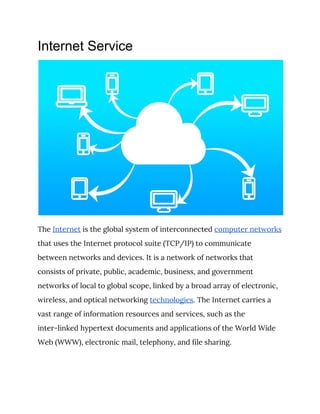
The ​Internet​ is the global system of interconnected ​computer networks 
that uses the Internet protocol suite (TCP/IP) to communicate 
between networks and devices. It is a network of networks that 
consists of private, public, academic, business, and government 
networks of local to global scope, linked by a broad array of electronic, 
wireless, and optical networking ​technologies​. The Internet carries a 
vast range of information resources and services, such as the 
inter-linked hypertext documents and applications of the World Wide 
Web (WWW), electronic mail, telephony, and file sharing. 
The origins of the Internet date back to the development of packet 
switching and research commissioned by the United States Department 
of Defense in the 1960s to enable time-sharing of computers. The 
primary precursor network, the ARPANET, initially served as a 
backbone for interconnection of regional academic and military 
networks ​in the 1970s. The funding of the National Science Foundation 
Network as a new backbone in the 1980s, as well as private funding for 
other commercial extensions, led to worldwide participation in the 
development of new networking technologies, and the merger of many 
networks. The linking of commercial networks and enterprises by the 
early 1990s marked the beginning of the transition to the modern 
Internet, and generated a sustained exponential growth as generations 
of institutional, personal, and mobile computers were connected to the 
network. Although the Internet was widely used by academia in the 
1980s, commercialization incorporated its services and technologies 
into virtually every aspect of modern life. 
AddressBazar.com is an Bangladeshi Online Yellow Page. From here you
will find important and necessary information of various ​Internet service
and E- Commerce related organizations in Bangladesh.
Most ​traditional communication​ media, including telephony, radio, 
television, paper mail and newspapers are reshaped, redefined, or even 
bypassed by the Internet, giving birth to new services such as email, 
Internet telephony, Internet television, online music, digital 
newspapers, and video streaming websites. Newspaper, book, and 
other print publishing are adapting to website technology, or are 
reshaped into blogging, web feeds and online news aggregators. The 
Internet has enabled and accelerated new forms of personal 
interactions through instant messaging, Internet forums, and social 
networking. Online shopping has grown exponentially both for major 
retailers and small ​businesses ​and entrepreneurs, as it enables firms to 
extend their "brick and mortar" presence to serve a larger market or 
even sell goods and services entirely online. Business-to-business and 
financial services on the Internet affect supply chains across entire 
industries. 
The Internet has no single centralized governance in either 
technological implementation or policies for access and usage; each 
constituent network sets its own policies. The overreaching definitions 
of the two principal name spaces in the Internet, the Internet Protocol 
address (IP address) space and the Domain Name System (DNS), are 
directed by a maintainer organization, the Internet Corporation for 
Assigned Names and Numbers (ICANN). The technical underpinning 
and standardization of the core protocols is an activity of the Internet 
Engineering Task Force (IETF), a non-profit organization of loosely 
affiliated international participants that anyone may associate with by 
contributing technical expertise. In November 2006, the Internet was 
included on USA Today's list of New Seven Wonders. 
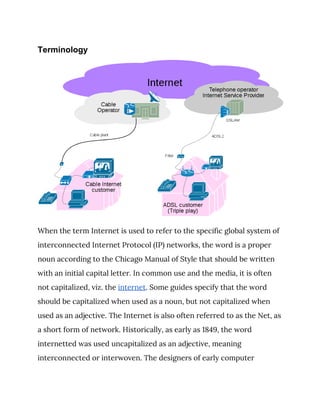
Terminology
 
When the term Internet is used to refer to the specific global system of 
interconnected Internet Protocol (IP) networks, the word is a proper 
noun according to the Chicago Manual of Style that should be written 
with an initial capital letter. In common use and the media, it is often 
not capitalized, viz. the ​internet​. Some guides specify that the word 
should be capitalized when used as a noun, but not capitalized when 
used as an adjective. The Internet is also often referred to as the Net, as 
a short form of network. Historically, as early as 1849, the word 
internetted was used uncapitalized as an adjective, meaning 
interconnected or interwoven. The designers of early computer 
networks used internet both as a noun and as a verb in shorthand form 
of internetwork or internetworking, meaning ​interconnecting 
computer networks. 
The terms Internet and World Wide Web are often used 
interchangeably in everyday speech; it is common to speak of "going on 
the Internet" when using a web browser to view web pages. However, 
the World Wide Web or the Web is only one of a large number of 
Internet services. The Web is a collection of interconnected documents 
(web pages) and other web resources, linked by hyperlinks and URLs. 
The term Interweb is a portmanteau of Internet and World Wide Web 
typically used sarcastically to parody a technically unsavvy user. 
History
The Advanced Research Projects Agency (ARPA) of the United States 
Department ​of Defense funded research into time-sharing of 
computers in the 1960s. Meanwhile, research into packet switching, 
one of the fundamental Internet technologies, started in the work of 
Paul Baran in the early 1960s and, independently, Donald Davies in 1965. 
After the Symposium on Operating Systems Principles in 1967, packet 
switching was incorporated into the proposed design for the ARPANET 
and other networks such as the NPL network, the Merit Network, and 
CYCLADES, which were developed in the late 1960s and early 1970s. 
ARPANET development began with two network nodes which were 
interconnected between the Network Measurement Center at the 
University of California, Los Angeles (UCLA) Henry Samueli School of 
Engineering and Applied Science directed by Leonard Kleinrock, and 
the NLS system at SRI International (SRI) by Douglas Engelbart in Menlo 
Park, California, on 29 October 1969. The third site was the Culler-Fried 
Interactive Mathematics Center at the University of California, Santa 
Barbara, followed by the University of Utah Graphics Department. In a 
sign of future growth, fifteen sites were connected to the young 
ARPANET by the end of 1971. These early years were documented in the 
1972 film Computer Networks: The Heralds of Resource Sharing. 
 
Early international collaborations for the ARPANET were rare. 
Connections were made in 1973 to the Norwegian Seismic Array 
(NORSAR) via a satellite station in Tanum, Sweden, and to Peter 
Kirstein's research group at University College London which provided 
a gateway to British academic networks. The ARPANET project and 
international working​ groups led to the development of various 
protocols and standards by which multiple separate networks could 
become a single network or "a network of networks". In 1974, Vint Cerf 
and Bob Kahn used the term internet as a shorthand for internetwork 
in RFC 675, and later RFCs repeated this use. Cerf and Khan credit Louis 
Pouzin with important influences on TCP/IP design. Commercial PTT 
providers were concerned with developing X.25 public data networks. 
Access to the ARPANET was expanded in 1981 when the National 
Science Foundation (NSF) funded the Computer Science Network 
(CSNET). In 1982, the Internet Protocol Suite (TCP/IP) was 
standardized, which permitted worldwide proliferation of 
interconnected networks. TCP/IP network access expanded again in 
1986 when the National Science Foundation Network (NSFNet) 
provided access to supercomputer sites in the United States for 
researchers, first at speeds of 56 kbit/s and later at 1.5 Mbit/s and 45 
Mbit/s. The NSFNet expanded into academic and research 
organizations in Europe, Australia, New Zealand and Japan in 1988–89. 
Although other network protocols such as UUCP had global reach well 
before this time, this marked the beginning of the Internet as an 
intercontinental network. Commercial Internet service providers (ISPs) 
emerged in 1989 in the United States and Australia. The ARPANET was 
decommissioned in 1990.. 
 
Steady advances in semiconductor technology and optical networking 
created new economic opportunities for commercial involvement in 
the expansion of the network in its core and for delivering services to 
the public. In mid-1989, MCI Mail and Compuserve established 
connections to the Internet, delivering email and public access 
products to the half million users of the Internet. Just months later, on 1 
January 1990, PSInet launched an alternate Internet backbone for 
commercial use; one of the networks that added to the core of the 
commercial Internet of later years. In March 1990, the first high-speed 
T1 (1.5 Mbit/s) link between the NSFNET and Europe was installed 
between Cornell University and CERN, allowing much more robust 
communications than were capable with satellites. Six months later Tim 
Berners-Lee would begin writing WorldWideWeb, the first web 
browser after two years of lobbying CERN management. By Christmas 
1990, Berners-Lee had built all the tools necessary for a working Web: 
the HyperText Transfer Protocol (HTTP) 0.9, the HyperText Markup 
Language (HTML), the first Web browser (which was also a HTML 
editor and could access Usenet newsgroups and FTP files), the first 
HTTP server software (later known as CERN httpd), the first web 
server, and the first Web pages that described the project itself. In 1991 
the Commercial Internet eXchange was founded, allowing PSInet to 
communicate with the other ​commercial networks​ CERFnet and 
Alternet. Stanford Federal Credit Union was the first financial 
institution to offer online Internet banking services to all of its 
members in October 1994. In 1996, OP Financial Group, also a 
cooperative bank, became the second online bank in the world and the 
first in Europe. By 1995, the Internet was fully commercialized in the 
U.S. when the NSFNet was decommissioned, removing the last 
restrictions on use of the Internet to carry commercial traffic. 
 

Internet service

  • 1.
    Internet Service   The ​Internet​is the global system of interconnected ​computer networks  that uses the Internet protocol suite (TCP/IP) to communicate  between networks and devices. It is a network of networks that  consists of private, public, academic, business, and government  networks of local to global scope, linked by a broad array of electronic,  wireless, and optical networking ​technologies​. The Internet carries a  vast range of information resources and services, such as the  inter-linked hypertext documents and applications of the World Wide  Web (WWW), electronic mail, telephony, and file sharing. 
  • 2.
    The origins ofthe Internet date back to the development of packet  switching and research commissioned by the United States Department  of Defense in the 1960s to enable time-sharing of computers. The  primary precursor network, the ARPANET, initially served as a  backbone for interconnection of regional academic and military  networks ​in the 1970s. The funding of the National Science Foundation  Network as a new backbone in the 1980s, as well as private funding for  other commercial extensions, led to worldwide participation in the  development of new networking technologies, and the merger of many  networks. The linking of commercial networks and enterprises by the  early 1990s marked the beginning of the transition to the modern  Internet, and generated a sustained exponential growth as generations  of institutional, personal, and mobile computers were connected to the  network. Although the Internet was widely used by academia in the  1980s, commercialization incorporated its services and technologies  into virtually every aspect of modern life.  AddressBazar.com is an Bangladeshi Online Yellow Page. From here you will find important and necessary information of various ​Internet service and E- Commerce related organizations in Bangladesh. Most ​traditional communication​ media, including telephony, radio,  television, paper mail and newspapers are reshaped, redefined, or even  bypassed by the Internet, giving birth to new services such as email,  Internet telephony, Internet television, online music, digital 
  • 3.
    newspapers, and videostreaming websites. Newspaper, book, and  other print publishing are adapting to website technology, or are  reshaped into blogging, web feeds and online news aggregators. The  Internet has enabled and accelerated new forms of personal  interactions through instant messaging, Internet forums, and social  networking. Online shopping has grown exponentially both for major  retailers and small ​businesses ​and entrepreneurs, as it enables firms to  extend their "brick and mortar" presence to serve a larger market or  even sell goods and services entirely online. Business-to-business and  financial services on the Internet affect supply chains across entire  industries.  The Internet has no single centralized governance in either  technological implementation or policies for access and usage; each  constituent network sets its own policies. The overreaching definitions  of the two principal name spaces in the Internet, the Internet Protocol  address (IP address) space and the Domain Name System (DNS), are  directed by a maintainer organization, the Internet Corporation for  Assigned Names and Numbers (ICANN). The technical underpinning  and standardization of the core protocols is an activity of the Internet  Engineering Task Force (IETF), a non-profit organization of loosely  affiliated international participants that anyone may associate with by  contributing technical expertise. In November 2006, the Internet was  included on USA Today's list of New Seven Wonders. 
  • 4.
    Terminology   When the termInternet is used to refer to the specific global system of  interconnected Internet Protocol (IP) networks, the word is a proper  noun according to the Chicago Manual of Style that should be written  with an initial capital letter. In common use and the media, it is often  not capitalized, viz. the ​internet​. Some guides specify that the word  should be capitalized when used as a noun, but not capitalized when  used as an adjective. The Internet is also often referred to as the Net, as  a short form of network. Historically, as early as 1849, the word  internetted was used uncapitalized as an adjective, meaning  interconnected or interwoven. The designers of early computer 
  • 5.
    networks used internetboth as a noun and as a verb in shorthand form  of internetwork or internetworking, meaning ​interconnecting  computer networks.  The terms Internet and World Wide Web are often used  interchangeably in everyday speech; it is common to speak of "going on  the Internet" when using a web browser to view web pages. However,  the World Wide Web or the Web is only one of a large number of  Internet services. The Web is a collection of interconnected documents  (web pages) and other web resources, linked by hyperlinks and URLs.  The term Interweb is a portmanteau of Internet and World Wide Web  typically used sarcastically to parody a technically unsavvy user.  History The Advanced Research Projects Agency (ARPA) of the United States  Department ​of Defense funded research into time-sharing of  computers in the 1960s. Meanwhile, research into packet switching,  one of the fundamental Internet technologies, started in the work of  Paul Baran in the early 1960s and, independently, Donald Davies in 1965.  After the Symposium on Operating Systems Principles in 1967, packet  switching was incorporated into the proposed design for the ARPANET  and other networks such as the NPL network, the Merit Network, and  CYCLADES, which were developed in the late 1960s and early 1970s. 
  • 6.
    ARPANET development beganwith two network nodes which were  interconnected between the Network Measurement Center at the  University of California, Los Angeles (UCLA) Henry Samueli School of  Engineering and Applied Science directed by Leonard Kleinrock, and  the NLS system at SRI International (SRI) by Douglas Engelbart in Menlo  Park, California, on 29 October 1969. The third site was the Culler-Fried  Interactive Mathematics Center at the University of California, Santa  Barbara, followed by the University of Utah Graphics Department. In a  sign of future growth, fifteen sites were connected to the young  ARPANET by the end of 1971. These early years were documented in the  1972 film Computer Networks: The Heralds of Resource Sharing.    Early international collaborations for the ARPANET were rare.  Connections were made in 1973 to the Norwegian Seismic Array 
  • 7.
    (NORSAR) via asatellite station in Tanum, Sweden, and to Peter  Kirstein's research group at University College London which provided  a gateway to British academic networks. The ARPANET project and  international working​ groups led to the development of various  protocols and standards by which multiple separate networks could  become a single network or "a network of networks". In 1974, Vint Cerf  and Bob Kahn used the term internet as a shorthand for internetwork  in RFC 675, and later RFCs repeated this use. Cerf and Khan credit Louis  Pouzin with important influences on TCP/IP design. Commercial PTT  providers were concerned with developing X.25 public data networks.  Access to the ARPANET was expanded in 1981 when the National  Science Foundation (NSF) funded the Computer Science Network  (CSNET). In 1982, the Internet Protocol Suite (TCP/IP) was  standardized, which permitted worldwide proliferation of  interconnected networks. TCP/IP network access expanded again in  1986 when the National Science Foundation Network (NSFNet)  provided access to supercomputer sites in the United States for  researchers, first at speeds of 56 kbit/s and later at 1.5 Mbit/s and 45  Mbit/s. The NSFNet expanded into academic and research  organizations in Europe, Australia, New Zealand and Japan in 1988–89.  Although other network protocols such as UUCP had global reach well  before this time, this marked the beginning of the Internet as an  intercontinental network. Commercial Internet service providers (ISPs) 
  • 8.
    emerged in 1989in the United States and Australia. The ARPANET was  decommissioned in 1990..    Steady advances in semiconductor technology and optical networking  created new economic opportunities for commercial involvement in  the expansion of the network in its core and for delivering services to  the public. In mid-1989, MCI Mail and Compuserve established  connections to the Internet, delivering email and public access  products to the half million users of the Internet. Just months later, on 1  January 1990, PSInet launched an alternate Internet backbone for  commercial use; one of the networks that added to the core of the  commercial Internet of later years. In March 1990, the first high-speed 
  • 9.
    T1 (1.5 Mbit/s)link between the NSFNET and Europe was installed  between Cornell University and CERN, allowing much more robust  communications than were capable with satellites. Six months later Tim  Berners-Lee would begin writing WorldWideWeb, the first web  browser after two years of lobbying CERN management. By Christmas  1990, Berners-Lee had built all the tools necessary for a working Web:  the HyperText Transfer Protocol (HTTP) 0.9, the HyperText Markup  Language (HTML), the first Web browser (which was also a HTML  editor and could access Usenet newsgroups and FTP files), the first  HTTP server software (later known as CERN httpd), the first web  server, and the first Web pages that described the project itself. In 1991  the Commercial Internet eXchange was founded, allowing PSInet to  communicate with the other ​commercial networks​ CERFnet and  Alternet. Stanford Federal Credit Union was the first financial  institution to offer online Internet banking services to all of its  members in October 1994. In 1996, OP Financial Group, also a  cooperative bank, became the second online bank in the world and the  first in Europe. By 1995, the Internet was fully commercialized in the  U.S. when the NSFNet was decommissioned, removing the last  restrictions on use of the Internet to carry commercial traffic.