DR.S.CHANDRAMOULI
V20UDM104
What is Production management?
• Production management is the process of
effectively planning and regulating the
operations of that part of an enterprise which
is responsible for the actual transformation of
materials into finished products.
5 P`s of Production Management
• 1. PRODUCTS.
• 2. PLANT.
• 3. PROCESS.
• 4. PROGRMS.
• 5. PEOPLE.
• When this five element integrated a successful
production management takes place.
OBJECTIVE OF PRODUCTION MANAGEMENT
• 1. RIGHT QUALITY.
• 2. RIGHT QUANTITY.
• 3. PREDETERMINED TIME.
• 4. PRE-ESTABLISHED COST.
• Other objectives are :
• 1. Machinery and Equipment.
• 2. Materials.
• 3. Manpower.
• 4. Supporting Service.
SCOPE & ACTIVITIES OF PM
• There are two types of scope & activities of PM :
• 1. Strategic level.
• (a) Design & development of new product.
• (b) Process design & Planning
• (c) Facilities location & layout planning
• (d) Design of material handling
• (e) Capacity planning
• 2. Operational level.
• (a) Production Planning
• (b) Production Planning
• (c) Inventory Control
• (d) Product maintenance & replacement
• (e) Cost Control & Cost Reduction
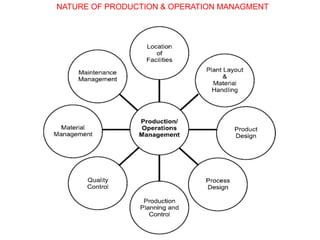
NATURE OF PRODUCTION & OPERATION MANAGMENT
CHARACTERSTICS OF PRODUCTION & OPERATION MANAGMENT
PRODUCTION PLANNING & CONTROL (PPC)
• PPC is the powerful tool available to the mgmt to
achieve the stated objective. Production planning
starts with the analysis of data like demand &
delivery schedule etc & the basis of information
available and resources like machine, material &
men.
• So, PPC is the process of directing & coordinating
of firms resources towards attaining prefixed
goal.
FUNCTIONS OF PPC
• 1. Material Function
• 2. Machine & Equipment
• 3. Methods
• 4. Routing
• 5. Estimating
• 6. Scheduling
• 7. Dispatching
• 8. Expediting
• 9. Inspection
• 10.Evaluation
PRODUCTION AS A SYSTEM
• 1. BATCH PRODUCTION
• 2. MASS & FLOW PRODUCTION
• 3. PROCESS PRODUCTION
• 4. PROJECT PRODUCTION
• 5. JOBBING PRODUCTION
BATCH PRODUCTION
• Batch production is the manufacturing of
limited number of product produced at
regular intervals & stocked in warehouse as
finished goods.
• Eg. Chemical , paint & motor vehicles etc.
CHARACTARISTIC OF BATCH PRODUCTION
• 1. Short Run.
• 2. Skilled labours in specific trades
• 3. Limited span of control
• 4. General purpose machine and process type layout
• 5. Manual material handling
• 6. Manufacturing cycle time affected due to queues
• 7. Large WIP
• 8. Flexible production schedule
• 9. Need to have PPC.
JOBBING PRODUCTION
• Jobbing production is characterized by the
manufacture of one or few number of a single
product designed and manufactured strictly to
customer’s specifications within the given
period and within the price fixed prior to the
contract.
• Eg: general repair shop, tailoring shops.
CHARACTARITIC OF JOBBING PRODUCTION
• 1. Small production runs.
• 2. Discontinuous flow of materials.
• 3. Not proportionate manufacture cycle time.
• 4. Highly skilled labour.
• 5. Highly competent knowledgeable supervision.
• 6. Large WIP.
• 7. Limited function of PPC.
PROJECT PRODUCTION
• Project production is characterized by complex
sets of activities that must be performed in a
particular order within the estimated
expenditure.
• Eg: construction of Roads, Buildings etc.
CHARACTARITIC OF PROJECT PRODUCTION
• 1. Definite beginning & definite end.
• 2. Non uniform requirement of resources.
• 3. Involvement of different agencies.
• 4. Fixed position layout.
• 5. High cost overrun.
• 6. Scheduling & control.
MASS & FLOW PRODUCTION
• Mass as well as flow production are characterized by the
manufacturer of several number of a std product and stocked
in the warehouses as finished goods awaiting sales. The goods
under mass production are manufactured either at a single
operation or a series of operation on one machine.
• Eg: Assembly shop of automobiles, radios, electric fans.
CHARACTARITIC OF MASS & FLOW PRODUCTION
• 1. Continuous flow of material.
• 2. Special purpose m/c and product type layout.
• 3. Mechanized material handling.
• 4. Low skilled labour.
• 5. Short manufacturing cycle time.
• 6. Easy supervision.
• 7. Limited WIP.
PROCESS PRODUCTION
• Process production is characterized by the
manufacture of single product produced and
stocked in the warehouses awaiting sales.
• Eg: Sugar, Steel, Paper, Cement plants.
CHARACTARITIC OF PROCESS PRODUCTION
• 1. Special purpose m/c with built in control.
• 2. Highly mechanized material building.
• 3. Virtually zero manufacturing time.
• 4. Low skilled labor.
• 5. Highly qualified supervisors.
• 6. Negligible WIP.
• 7. Limited PPC.
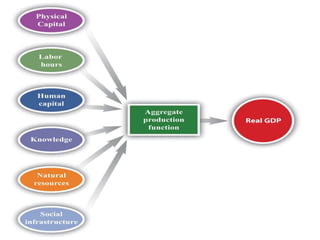
• What is production as a function?
• production function, in economics, equation
that expresses the relationship between the
quantities of productive factors (such as
labour and capital) used and the amount of
product obtained.
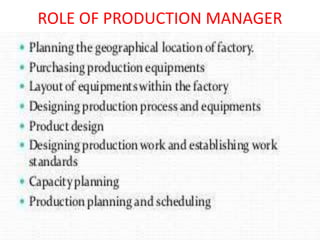
ROLE OF PRODUCTION MANAGER
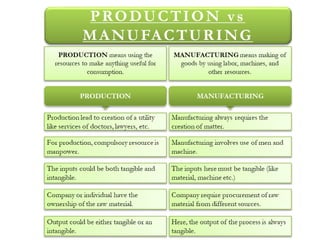
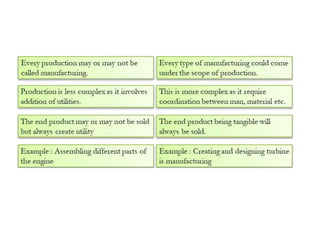
MANUFACTURING SYSTEM
• A manufacturing system is any combination of
actions and processes used throughout the
production of any goods. While businesses
have developed various different systems and
processes over time, they've become an
increasingly important element of any
production environment
METHODS OF MANUFACTURING SYSTEM
• there are four types of manufacturing systems
• Custom manufacturing
• Intermittent manufacturing
• Continuous manufacturing and
• Flexible manufacturing.
• Job shop manufacturing system
• Batch Manufacturing system
• Custom manufacturing system
• Custom manufacturing describes the
production of bespoke products, made to
order, usually by a skilled craftsperson. It is a
relative rarity in modern society, usually
reserved for high-end variants of common
products
INTERMITTENT MANUFACTURING SYSTEM
• Intermittent production is an umbrella term
for manufacturing processes that use
irregular production schedules to create
several different products using one
production line. It's used by manufacturers
who produce low-volume, high-variety
products for either mass customization or
bespoke manufacturing
CONTINUOUS MANUFACTURING SYSTEM
• Continuous manufacturing is a flow production method used
to produce or process products without interruption by
constantly supplying raw materials while the manufacturing
process is underway
• A flexible manufacturing system (FMS) is a production
method that is designed to easily adapt to changes in the
type and quantity of the product being manufactured.
Machines and computerized systems can be configured to
manufacture a variety of parts and handle changing levels of
production.
FLEXIBLE MANUFACTURING SYSTEM
JOB SHOP MANUFACTURING SYSTEM
• A job shop is a type of manufacturing process in
which small batches of a variety of custom products
are made. In the job shop process flow, most of the
products produced require a unique set-up and
sequencing of process steps
• BATCH MANUFACTURING SYSTEM
• Batch production is a method whereby a group of identical
products are produced simultaneously (rather than one at a
time). It is up to the manufacturer to decide how big the batch will
be, and how often these batches will be made. Each batch goes
through the separate stages of the manufacturing process together
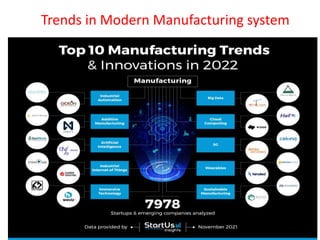
Trends in Modern Manufacturing system
WHAT IS PRODUCTIVITY ?
• Productivity is the quantitative relation
between what we produce and what we use
as a source of produce them. So, Productivity
is the arithmetic ratio of output to the amount
of input.
• PRODUCTIVITY = Output / Input.
• Productivity refers to the efficiency of the
production system.
PRODUCTIVITY MEASURES
• 1. PARTIAL PRODUCTIVITY MEASURE (PPM)
• PARTIAL PRODUCTIVITY= Total output / individual input.
• (a) Labor Productivity=Total o/p / Labor input
• (b) Capital Productivity = Total o/p / Material input
• (c) Material Productivity = Total o/p / Capital input
• (d) Energy Productivity = Total o/p / Energy input.
• 2. TOTAL PRODUCTIVITY MEASURE (TPM)
• = Total tangible o/p / Total tangible i/p
• Tangible o/p= Value of FG & Partial units produced, dividend from
securities, interest, other incomes
• Tangible i/p = Value of ( human , material, capital, other inputs)
FACTORS EFFECTING PRODUCTIVITY
• 1. PRODUCT.
• 2. PLANT &EQUIPMENT.
• 3. TECHNOLOGY.
• 4. MATERIAL & ENERGY.
• 5. HUMAN FACTOR.
• 6. WORK METHOD.
• 7. MANAGEMENT STYLE.
PRODUCTIVITY IMPROVEMENT TECHNIQUES
• 1. TECHNOLOGY BASED
• 2. EMPLOYEE BASED.’
• 3. MATERIAL BASED.
• 4. PROCESS BASED.
• 5. PRODUCT BASED.
• 6. MANAGEMENT BASED.

BBA UNIT -1 INTRODUCTION ABOUT PRODUCTION.ppt

  • 1.
  • 2.
    What is Productionmanagement? • Production management is the process of effectively planning and regulating the operations of that part of an enterprise which is responsible for the actual transformation of materials into finished products.
  • 5.
    5 P`s ofProduction Management • 1. PRODUCTS. • 2. PLANT. • 3. PROCESS. • 4. PROGRMS. • 5. PEOPLE. • When this five element integrated a successful production management takes place.
  • 6.
    OBJECTIVE OF PRODUCTIONMANAGEMENT • 1. RIGHT QUALITY. • 2. RIGHT QUANTITY. • 3. PREDETERMINED TIME. • 4. PRE-ESTABLISHED COST. • Other objectives are : • 1. Machinery and Equipment. • 2. Materials. • 3. Manpower. • 4. Supporting Service.
  • 7.
    SCOPE & ACTIVITIESOF PM • There are two types of scope & activities of PM : • 1. Strategic level. • (a) Design & development of new product. • (b) Process design & Planning • (c) Facilities location & layout planning • (d) Design of material handling • (e) Capacity planning • 2. Operational level. • (a) Production Planning • (b) Production Planning • (c) Inventory Control • (d) Product maintenance & replacement • (e) Cost Control & Cost Reduction
  • 8.
    NATURE OF PRODUCTION& OPERATION MANAGMENT
  • 9.
    CHARACTERSTICS OF PRODUCTION& OPERATION MANAGMENT
  • 10.
    PRODUCTION PLANNING &CONTROL (PPC) • PPC is the powerful tool available to the mgmt to achieve the stated objective. Production planning starts with the analysis of data like demand & delivery schedule etc & the basis of information available and resources like machine, material & men. • So, PPC is the process of directing & coordinating of firms resources towards attaining prefixed goal.
  • 11.
    FUNCTIONS OF PPC •1. Material Function • 2. Machine & Equipment • 3. Methods • 4. Routing • 5. Estimating • 6. Scheduling • 7. Dispatching • 8. Expediting • 9. Inspection • 10.Evaluation
  • 12.
    PRODUCTION AS ASYSTEM • 1. BATCH PRODUCTION • 2. MASS & FLOW PRODUCTION • 3. PROCESS PRODUCTION • 4. PROJECT PRODUCTION • 5. JOBBING PRODUCTION
  • 13.
    BATCH PRODUCTION • Batchproduction is the manufacturing of limited number of product produced at regular intervals & stocked in warehouse as finished goods. • Eg. Chemical , paint & motor vehicles etc.
  • 14.
    CHARACTARISTIC OF BATCHPRODUCTION • 1. Short Run. • 2. Skilled labours in specific trades • 3. Limited span of control • 4. General purpose machine and process type layout • 5. Manual material handling • 6. Manufacturing cycle time affected due to queues • 7. Large WIP • 8. Flexible production schedule • 9. Need to have PPC.
  • 15.
    JOBBING PRODUCTION • Jobbingproduction is characterized by the manufacture of one or few number of a single product designed and manufactured strictly to customer’s specifications within the given period and within the price fixed prior to the contract. • Eg: general repair shop, tailoring shops.
  • 16.
    CHARACTARITIC OF JOBBINGPRODUCTION • 1. Small production runs. • 2. Discontinuous flow of materials. • 3. Not proportionate manufacture cycle time. • 4. Highly skilled labour. • 5. Highly competent knowledgeable supervision. • 6. Large WIP. • 7. Limited function of PPC.
  • 17.
    PROJECT PRODUCTION • Projectproduction is characterized by complex sets of activities that must be performed in a particular order within the estimated expenditure. • Eg: construction of Roads, Buildings etc.
  • 18.
    CHARACTARITIC OF PROJECTPRODUCTION • 1. Definite beginning & definite end. • 2. Non uniform requirement of resources. • 3. Involvement of different agencies. • 4. Fixed position layout. • 5. High cost overrun. • 6. Scheduling & control.
  • 19.
    MASS & FLOWPRODUCTION • Mass as well as flow production are characterized by the manufacturer of several number of a std product and stocked in the warehouses as finished goods awaiting sales. The goods under mass production are manufactured either at a single operation or a series of operation on one machine. • Eg: Assembly shop of automobiles, radios, electric fans.
  • 20.
    CHARACTARITIC OF MASS& FLOW PRODUCTION • 1. Continuous flow of material. • 2. Special purpose m/c and product type layout. • 3. Mechanized material handling. • 4. Low skilled labour. • 5. Short manufacturing cycle time. • 6. Easy supervision. • 7. Limited WIP.
  • 21.
    PROCESS PRODUCTION • Processproduction is characterized by the manufacture of single product produced and stocked in the warehouses awaiting sales. • Eg: Sugar, Steel, Paper, Cement plants.
  • 22.
    CHARACTARITIC OF PROCESSPRODUCTION • 1. Special purpose m/c with built in control. • 2. Highly mechanized material building. • 3. Virtually zero manufacturing time. • 4. Low skilled labor. • 5. Highly qualified supervisors. • 6. Negligible WIP. • 7. Limited PPC.
  • 23.
    • What isproduction as a function? • production function, in economics, equation that expresses the relationship between the quantities of productive factors (such as labour and capital) used and the amount of product obtained.
  • 27.
  • 28.
    MANUFACTURING SYSTEM • Amanufacturing system is any combination of actions and processes used throughout the production of any goods. While businesses have developed various different systems and processes over time, they've become an increasingly important element of any production environment
  • 29.
    METHODS OF MANUFACTURINGSYSTEM • there are four types of manufacturing systems • Custom manufacturing • Intermittent manufacturing • Continuous manufacturing and • Flexible manufacturing. • Job shop manufacturing system • Batch Manufacturing system
  • 30.
    • Custom manufacturingsystem • Custom manufacturing describes the production of bespoke products, made to order, usually by a skilled craftsperson. It is a relative rarity in modern society, usually reserved for high-end variants of common products
  • 31.
    INTERMITTENT MANUFACTURING SYSTEM •Intermittent production is an umbrella term for manufacturing processes that use irregular production schedules to create several different products using one production line. It's used by manufacturers who produce low-volume, high-variety products for either mass customization or bespoke manufacturing
  • 32.
    CONTINUOUS MANUFACTURING SYSTEM •Continuous manufacturing is a flow production method used to produce or process products without interruption by constantly supplying raw materials while the manufacturing process is underway • A flexible manufacturing system (FMS) is a production method that is designed to easily adapt to changes in the type and quantity of the product being manufactured. Machines and computerized systems can be configured to manufacture a variety of parts and handle changing levels of production. FLEXIBLE MANUFACTURING SYSTEM
  • 33.
    JOB SHOP MANUFACTURINGSYSTEM • A job shop is a type of manufacturing process in which small batches of a variety of custom products are made. In the job shop process flow, most of the products produced require a unique set-up and sequencing of process steps • BATCH MANUFACTURING SYSTEM • Batch production is a method whereby a group of identical products are produced simultaneously (rather than one at a time). It is up to the manufacturer to decide how big the batch will be, and how often these batches will be made. Each batch goes through the separate stages of the manufacturing process together
  • 34.
    Trends in ModernManufacturing system
  • 35.
    WHAT IS PRODUCTIVITY? • Productivity is the quantitative relation between what we produce and what we use as a source of produce them. So, Productivity is the arithmetic ratio of output to the amount of input. • PRODUCTIVITY = Output / Input. • Productivity refers to the efficiency of the production system.
  • 36.
    PRODUCTIVITY MEASURES • 1.PARTIAL PRODUCTIVITY MEASURE (PPM) • PARTIAL PRODUCTIVITY= Total output / individual input. • (a) Labor Productivity=Total o/p / Labor input • (b) Capital Productivity = Total o/p / Material input • (c) Material Productivity = Total o/p / Capital input • (d) Energy Productivity = Total o/p / Energy input. • 2. TOTAL PRODUCTIVITY MEASURE (TPM) • = Total tangible o/p / Total tangible i/p • Tangible o/p= Value of FG & Partial units produced, dividend from securities, interest, other incomes • Tangible i/p = Value of ( human , material, capital, other inputs)
  • 37.
    FACTORS EFFECTING PRODUCTIVITY •1. PRODUCT. • 2. PLANT &EQUIPMENT. • 3. TECHNOLOGY. • 4. MATERIAL & ENERGY. • 5. HUMAN FACTOR. • 6. WORK METHOD. • 7. MANAGEMENT STYLE.
  • 38.
    PRODUCTIVITY IMPROVEMENT TECHNIQUES •1. TECHNOLOGY BASED • 2. EMPLOYEE BASED.’ • 3. MATERIAL BASED. • 4. PROCESS BASED. • 5. PRODUCT BASED. • 6. MANAGEMENT BASED.