PRODUCTION
MANAGEMENT
BY: ROHAN DUSANE
INTRODUCTION
 The very essence of any business is to cater needs of
customer by providing services and goods, and in
process create value for customers and solve their
problems. PRODUCTION MANAGEMENT talks
about management concepts in creation of goods and
services.
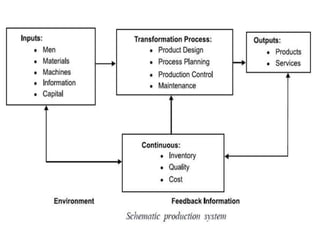
 Production management means planning, organizing, directing
and controlling of production activities.
 Production management deals with converting raw materials
into finished goods or products. It brings together the 6M's i.e. men,
money, machines, materials, methods and markets to satisfy the
wants of the people
 E.S. Buffa defines production management as, “Production
management deals with decision making related to production
processes so that the resulting goods or services are produced
according to specifications, in the amount and by the schedule
demanded and out of minimum cost.”
ACTIVITIES OF PRODUCTION MANAGEMENT
 Specification and procurement of input resources
namely management, material, and land, labour,
equipment and capital.
 Product design and development to determine the
production process for transforming the input factors
into output of goods and services.
 Supervision and control of transformation process for
efficient production of goods.
OBJECTIVES OF PRODUCTION MANAGEMENT
 The objective of the production management is ‘to
produce goods services of right quality and quantity
at the right time and right manufacturing cost’.
1. Right Quality
2. Right Quantity
3. Right Time
4. Right Manufacturing Cost
 RIGHT QUALITY: The quality of product is established based upon the
customers needs. The right quality is not necessarily best quality. It is determined
by the cost of the product and the technical characteristics as suited to the specific
requirements.i.e
 RIGHT QUANTITY: The manufacturing organization should produce the
products in right number. If they are produced in excess of demand the capital
will block up in the form of inventory and if the quantity is produced in short of
demand, leads to shortage of products.
 RIGHT TIME : Timeliness of delivery is one of the important parameter to
judge the effectiveness of production department. So, the production department
has to make the optimal utilization of input resources to achieve its objective
 RIGHT MANUFACTURING COST: Manufacturing costs are
established before the product is actually manufactured.
OBJECTIVES TO THE BUSINESS
FIRM
 Accomplishment of firm's objectives: It produces products,
which satisfy the customers' needs and wants.
 Reputation, Goodwill and Image : This increases the firms
reputation, goodwill and image. A good image helps the firm
to expand and grow.
 Helps to introduce new products : It conducts Research and
development (R&D). This helps the firm to develop newer
and better quality products. These products are successful in
the market because they give full satisfaction to the customers
 Supports other functional areas : such as marketing, finance, and
personnel. The marketing department will find it easier to sell good-quality
products, and the finance department will get more funds due to increase in
sales. The personnel department will be able to manage the human resources
effectively due to the better performance of the production department.
 Helps to face competition : produces products of right quantity, right
quality, right price and at the right time. These products are delivered to the
customers as per their requirements.
 Optimum utilisation of resources : such as manpower, machines,
etc. So, the firm can meet its capacity utilization objective. This will bring
higher returns to the organization
 Minimizes cost of production : It tries to maximize the output and
minimize the inputs. This helps the firm to achieve its cost reduction and
efficiency objective
OBJECTIVES TO CUSTOMER & SOCIETY
 Higher standard of living : They produce new and better
varieties of products. People use these products and enjoy a
higher standard of living.
 Generates employment : Direct employment is generated in
the production area, and indirect employment is generated in t
areas such as marketing, finance, customer support, etc
 Improves quality and reduces cost : Because of large-scale
production, there are economies of large scale. This brings
down the cost of production. So, consumer prices also reduce.
 Spread effect : Because of production, other sectors also
expand. Companies making spare parts will expand. The
service sector such as banking, transport, communication,
insurance, BPO, etc. also expand. This spread effect offers
more job opportunities and boosts economy.
 Creates utility : Production creates Form Utility. Consumers
can get form utility in the shape, size and designs of the
product. Production also creates time utility, because goods are
available whenever consumers need it.
 Boosts economy : This leads to speedy economic growth and
well-being of the nation.
FUTURE SCOPE
 Finance and Production: Finance provide the necessary
funds for the maintenance of Production and Marketing
activities. Funds not only comes from the sale of goods and
services but also acquired through loans – from banks and other
financial institutions, sale of stock investment and income.
 Marketing: The object of production activity is to provide
inputs which include raw materials‟ men, machine, operating
supplies, semi finished products, water, power and place etc.
 Personnel and Production: Concerned with all matters related
to manpower as an input system of business organisation.
From the view point of the production manager following are the
various areas of mutual interest. (i) Recruitment and selection
(ii) Training and development of employees
(iii) Labour relations
(iv) Safety
(v) Wage and salary
(vi) Motivating employees to give their best.
 Production and Industrial Engineering: The main object is
to search for the most efficient way of producing products under
certain constraints such as material, manpower, machines, money
etc
THANK YOU

Production management

  • 1.
  • 2.
    INTRODUCTION  The veryessence of any business is to cater needs of customer by providing services and goods, and in process create value for customers and solve their problems. PRODUCTION MANAGEMENT talks about management concepts in creation of goods and services.
  • 3.
     Production managementmeans planning, organizing, directing and controlling of production activities.  Production management deals with converting raw materials into finished goods or products. It brings together the 6M's i.e. men, money, machines, materials, methods and markets to satisfy the wants of the people  E.S. Buffa defines production management as, “Production management deals with decision making related to production processes so that the resulting goods or services are produced according to specifications, in the amount and by the schedule demanded and out of minimum cost.”
  • 5.
    ACTIVITIES OF PRODUCTIONMANAGEMENT  Specification and procurement of input resources namely management, material, and land, labour, equipment and capital.  Product design and development to determine the production process for transforming the input factors into output of goods and services.  Supervision and control of transformation process for efficient production of goods.
  • 6.
    OBJECTIVES OF PRODUCTIONMANAGEMENT  The objective of the production management is ‘to produce goods services of right quality and quantity at the right time and right manufacturing cost’. 1. Right Quality 2. Right Quantity 3. Right Time 4. Right Manufacturing Cost
  • 7.
     RIGHT QUALITY:The quality of product is established based upon the customers needs. The right quality is not necessarily best quality. It is determined by the cost of the product and the technical characteristics as suited to the specific requirements.i.e  RIGHT QUANTITY: The manufacturing organization should produce the products in right number. If they are produced in excess of demand the capital will block up in the form of inventory and if the quantity is produced in short of demand, leads to shortage of products.  RIGHT TIME : Timeliness of delivery is one of the important parameter to judge the effectiveness of production department. So, the production department has to make the optimal utilization of input resources to achieve its objective  RIGHT MANUFACTURING COST: Manufacturing costs are established before the product is actually manufactured.
  • 8.
    OBJECTIVES TO THEBUSINESS FIRM  Accomplishment of firm's objectives: It produces products, which satisfy the customers' needs and wants.  Reputation, Goodwill and Image : This increases the firms reputation, goodwill and image. A good image helps the firm to expand and grow.  Helps to introduce new products : It conducts Research and development (R&D). This helps the firm to develop newer and better quality products. These products are successful in the market because they give full satisfaction to the customers
  • 9.
     Supports otherfunctional areas : such as marketing, finance, and personnel. The marketing department will find it easier to sell good-quality products, and the finance department will get more funds due to increase in sales. The personnel department will be able to manage the human resources effectively due to the better performance of the production department.  Helps to face competition : produces products of right quantity, right quality, right price and at the right time. These products are delivered to the customers as per their requirements.  Optimum utilisation of resources : such as manpower, machines, etc. So, the firm can meet its capacity utilization objective. This will bring higher returns to the organization  Minimizes cost of production : It tries to maximize the output and minimize the inputs. This helps the firm to achieve its cost reduction and efficiency objective
  • 10.
    OBJECTIVES TO CUSTOMER& SOCIETY  Higher standard of living : They produce new and better varieties of products. People use these products and enjoy a higher standard of living.  Generates employment : Direct employment is generated in the production area, and indirect employment is generated in t areas such as marketing, finance, customer support, etc  Improves quality and reduces cost : Because of large-scale production, there are economies of large scale. This brings down the cost of production. So, consumer prices also reduce.
  • 11.
     Spread effect: Because of production, other sectors also expand. Companies making spare parts will expand. The service sector such as banking, transport, communication, insurance, BPO, etc. also expand. This spread effect offers more job opportunities and boosts economy.  Creates utility : Production creates Form Utility. Consumers can get form utility in the shape, size and designs of the product. Production also creates time utility, because goods are available whenever consumers need it.  Boosts economy : This leads to speedy economic growth and well-being of the nation.
  • 12.
    FUTURE SCOPE  Financeand Production: Finance provide the necessary funds for the maintenance of Production and Marketing activities. Funds not only comes from the sale of goods and services but also acquired through loans – from banks and other financial institutions, sale of stock investment and income.  Marketing: The object of production activity is to provide inputs which include raw materials‟ men, machine, operating supplies, semi finished products, water, power and place etc.
  • 13.
     Personnel andProduction: Concerned with all matters related to manpower as an input system of business organisation. From the view point of the production manager following are the various areas of mutual interest. (i) Recruitment and selection (ii) Training and development of employees (iii) Labour relations (iv) Safety (v) Wage and salary (vi) Motivating employees to give their best.  Production and Industrial Engineering: The main object is to search for the most efficient way of producing products under certain constraints such as material, manpower, machines, money etc
  • 14.