PRODUCTION The conversion of raw materials to end product by using processes, machines, men and tools
Manufacturing Is the production of tangible goods only, whereas production includes creation of both tangible goods and intangible services.
Production Management It deals with decision making related to production process so that the resulting goods or services are produced according to specifications in amounts and by schedules demanded and at minimum cost – E S Buffa
PM Production Management is defined as the design, operation, and improvement of the transformation process, which converts the various inputs into the desired outputs of products and services
A branch of management which deals with the production function. It involves organising, directing and controlling the production process. Management of an organisation’s productive resources or its production system which converts inputs into tangible / intangible outputs needed by the customers of the organisation.
Production management ensures the optimum utilisation of resources in order to attain the production objectives of an organisation.  Multi disciplinary Material management, man management, planning methodologies, scheduling techniques, quality management, cost control, maintenance management and a host of techniques and tools.
5 P Product Plant Processes Programmes People
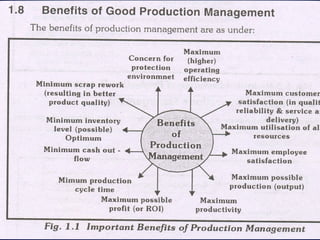
Objectives Maximum posssible production, productivity, employee satisfaction, cutomer satisfaction, profit, utilisation of resources. Minimum scrap / rework, production cycle time. Higher operating efficiency Protection of the environment
Ultimate Objectives Control & reduction in Manufacturing costs To improve the product quality Manufacturing schedule
Intermediate Objectives Machinery & equipments Materials Manpower Manufacturing services Methods
Scope Selection of location – end product Land acquisition, building, construction, selection and installation of machinery, purchasing, receiving, storing, issuing of raw materials and converting the raw materials into products ready for sale.
Scope- Cont’d Long Term Strategic Decisions Product selection & Design Process selection & Planning Location facilities Layout & material handling facilities Capacity planning
Short term Strategic decisions Production planning Production control Inventory control Quality control Method study Maintenance & replacements Cost control & Reduction
Factory Is a place where factors of production- land, labour, money and enterprise are grouped together for the creation of goods or services.
Activities Related to production system designing Production engineering( design of tools, jigs, design, development and installation of equipment) Plant location Work environment, work measurement, plant layout, time and motion study, material handling
Activities related to analysis and control Production planning Production control Quality control Human factor R & D activities
Comparison Manufacturing Tangible Produced to inventory Minimum or no contact with customer Demand varies –week/month/season Market served on regional level Economies of scale Location is in relation to regional market Services Intangible & perishable System is open for services  High contact with the customer Demand – Hourly/daily/weekly Local market Relatively small units- local Location for local customer
Duties & responsibilities of The Production Manager Planning the geographical location of the factory Purchasing the production equipment Layout of the equipment within the factory Designing production processes and equipment Product design Designing production work and establishing work standards Capacity planning Production planning and scheduling Production control Inventory management Supply chain management Quality control
Cont’d Production equipment maintenance and repair Measurement and monitoring of productivity Industrial relations / personnel matters Health and safety Staff selection and training Budgeting & capital planning
 
Problems of Production Management Decisions relating to: Design of the production system Long range decisions – selection and decision of products, selection of equipment and processes, production of design of parts processed, job design, location of the system, facility layout Operation & control of the system Short run decisions -  inventory, production control, maintenance and reliability of the system, quality control, labour control, cost control and improvement.
 
Responsibilities of Production Manager Production planning Production control Plant layout Materials handling Quality control Methods analysis Work measurement (work study, time study) Cost control, standardisation, storage, wages, incentives
In terms of three major managerial functions Planning Capacity, location, products & services, make or buy, layout, projects, scheduling. Organising Degree of centralisation, sub contracting, incentive plans, issue of work orders, job assignments. Controlling Inventory control, quality control, cost control
Three general categories of decision taken by production managers are: strategic decision, operating decision, controlling decision.  Decision areas include:  Quality management, product & service design, process &capacity design, location design, layout design, job design, supply chain management, inventory management, scheduling and maintenance.
 
Systems or types of production Continuous production system Is one in which the equipment and work stations are arranged in the sequence in which the input raw materials are converted into desired components or assembly. Intermittent production system is one in which the production equipments are grouped and organised according to the functions or process they perform.
Job production Goods are produced according to customers orders Also known as market order business Each job is different. Cost of item –high Highly skilled labour required
Batch production When manufacturing is done in batches on the basis of customer’s orders. Eg. If 500 is to be done per year, it is about 40 per month. A batch of 25 or 50 units can be taken at atime.
Mass production Is adopted for off the shelf or stock items for the consumer market. In terms of 1000 units A huge volume of limited variety SPMs , transfer lines are used Robotics Cost of facility is high Raw material inventories come down.
Process production ( Continuous Flow production) Extended form of mass production. Process is automatic and non stop.
 
Productivity Productivity = Output/Input Productivity can be increased by: By increasing of output, keeping input constant. By decreasing inputs for producing the same output. By increasing outputs proportionately higher than increases affected in inputs.
Factors contributing to increase of productivity Better utilisation of resources like men, machine and materials Using efficient ways of working Through good and systematic plant layouts using guidelines and principles of motion economy Reducing material handling through better layouts and using appropriate material handling equipments / facilities Selection of proper maintenance policy, keeping in mind preventive maintenance and breakdown maintenance. Provision of healthy and safe working conditions to workmen
Through modern HRM methods, counselling rather than threatening workmen, through participation of workmen in management including quality circles. This will keep the workforce motivated. Provision of fair wages and proper compensation through incentive schemes. By ensuring  better quality
In a manufacturing unit the standard time allowed for the production of a unit is 5 hours. If in a particular month 126 units are produced by employing 4 persons and the allowable delays are found to be 44 man hours, find the productivity?
Earned Standard Hours  Std time /unit  = 5 hours Production =126 units ESMH =5x 126= 630 hours Available Man-hours Manpower employed= 4 Monthly working hours=4 x 25 x 8 = 800 hours Allowed delays  = 44 hours Actual Man-hours available =800 – 44 =756 hours Productivity = (630/756 ) x 100 = 83.33%
Plant location Location of plant is the function of determining where the plant is to be located, for maximum operating economy and effectiveness. Location once decided, must be permanent. Consideration factors – raw material, supplies, labour and market.
Steps in choosing a location 1.  Deciding   on domestic or international location  Competitive advantage derived from location If international location, choice of country Political stability Export and import quotas Exchange rates Cultural and economic considerations Availability of natural resources, cost of labour Friendliness with the country  Favourable climate at the location
2. Selection of the region Availability of raw materials Nearness to market Availability of power Transport facilities Suitability of climate Govt. policy and competition between states
3. Selection of appropriate place within the region. Skilled labour at cheaper rate Water Civic amenities Finance
4. Selection of various sites within the selected place. Availability of cheap land to build the plant Soil, topography Low cost of construction in levelling, foundation Facilities for transportation of goods Cost of installation of electricity, gas Cheap means of disposing of factory waste Availability of experienced sub contractors Cost of laying water supply, sewage Low pollution
Decide optimum site Work out the cost for different sites and select the optimum site where he would get the maximum benefit
Factors of location ( Location Theory)  Weber’s  Theory Primary factors Material & labour Material oriented Market oriented Secondary factors Banking, credit, insurance, communication, rent, utility rates Agglomerating & degglomerating factors
Factors affecting location of a plant Raw materials Cotton textile Kerala, AP, Karnataka, Tamil Nadu, Mumbai, West Bengal, Kanpur, Gujarat, MP Sugar Industry UP, Bihar, MP, Maharashtra, Tamil Nadu, Mandya
Iron & steel Industry Bihar, Orissa, MP, West Bengal, Karnataka Cement  Bihar, TN, Gujarat, MP, AP, UP, HP & Orissa Jute WB
Paper  Bamboo, grass, wood, sugarcane WB, Orissa , UP, Nagaland, Kerala, Assam Coal  WB, Bihar, Orissa, MP, TN, Assam, Gujarat
IT Industry Educated manpower Power Satellite link Telecommunication Transportation Location with good climate Industry policy of state
Plant Layout Refers to the arrangement of machinery, equipment and other industrial facilities – such as receiving and shipping departments, tool rooms, maintenance rooms, employee amenities, etc. – for the purpose of achieving the quickest and smoothest production at the least cost.
Knowles & Thomson Plant layout involves: Planning and arranging manufacturing machinery, equipment, and services for the first time in completely new plants; The improvements in layouts already in use in order to introduce new methods and improvements in manufacturing procedures.
Objective of a good plant layout Provide enough production capacity Reduce material handling costs Reduce congestion that impedes the movement of people or material Reduce hazards to personnel Utilize labour efficiently Increase employee morale Reduce accidents Utilize available space efficiently Provide for volume and product facility Provide for ease of supervision Facilitate co-ordination & face to face communication where appropriate Provide for employee safety Allow ease of maintenance Allow high machine utilisation Improve productivity
Factors governing layout Factory location Type of manufacturing process Synthetic, Analytical, Intermittant, Repetitive, Non repetitive Type of the product Material input Employee requirements Machinery in the factory Managerial policies
Managerial policy Volume of production, provision for expansion, extent of automation, make or buy of components, desire for rapid delivery of goods to customers, purchasing policy, personnel policies Human factors Exit provisions Rest rooms Drinking water Lavatory Obstruction free work floor
Principles of plant layout Principle of: overall integration Utilisation Flexibility Expansion Minimum distance Max. use of volume Max. visibility Max. accessibility Ordeliness Safety & satisfaction
Types of layout Process layout ( functional layout) Product layout ( straight line layout) Hybrid layout ( Combined layout) Fixed position layout
 
 
Process layout Is the arrangement of a facility so that work centres or departments are grouped together according to their functional type. Also called as Functional layout Job shop layout
 
Product Layout Product layout involves the arrangement of machines in one line, depending upon the sequence of operations. Each of the components skip some of the machines not required. Machines are arranged serially, to machine similar components. Materials are worked out into finished components through a series of integrated operations. Back tracking is avoided.
Advantages of Product layout Uninterrupted output Reduced amount of work in progress Encourages use of automatic devices Best use of floor space Effective supervision Improved production control
Demerits of product layout Higher initial investment Danger of breakdown Expansion is costlier Lack of flexibility Dangers of specilisation
Advantages of process layout Lower capital lockup Greater flexibility Quality supervision Uninterrupted functioning Fuller utilisation of machine capacity Full scope for expansion
Demerits of a process layout Difficulties in production planning and control Excessive handling of materials Larger stock pile in the process Possibility of more floor space Elonged production cycle time
Product or Process layout? Product layouts are preferred where: One or few standard products are involved Production is in large quantities Components are such that material handling facilities are utilised efficiently The same machine is used for less number of products and operations Minimum inspection stages
Process layouts are preferred where: Many types or kinds of products are involved Production is in small quantities Heavy materials or products are used where material handling facilities cannot be used efficiently A number of products can be done on the same machine Inspection stages are many
 
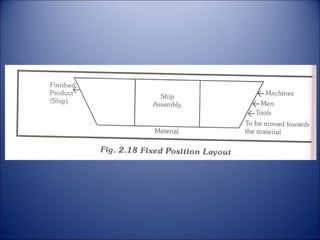
Fixed position layout Job is stationary Men, machines and tools move towards the job Eg: Locomotives, Ship, Satellite, Aircraft, Boilers, Generators Site construction, Hospitals
 
Hybrid layout A combination of product and process layouts, with an emphasis on either, to utilise the advantages of both the types of layouts. Machines are arranged in a sequence. Hence sequence is followed as product layout. There are more number of machines at each stage, and they are grouped as mini departments so that they can take up different components of a similar nature. Process layout principle is followed here.
Advantages of a Good layout Advantages to the workers Reduction in effort Reduction in fatigue Reduction in number of handling Activities at maximum efficiency Encourages specialisation
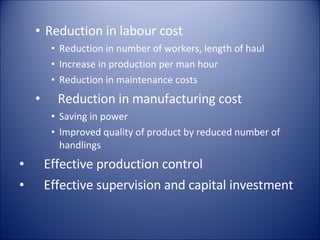
Reduction in labour cost  Reduction in number of workers, length of haul Increase in production per man hour Reduction in maintenance costs Reduction in manufacturing cost Saving in power Improved quality of product by reduced number of handlings Effective production control Effective supervision and capital investment
Characteristic of an Efficient layout Smooth flow  of production Maximum utilisation of space (also cubic space) Sufficient space between the machines, for gangway, for movement of people and trolleys Minimum handling space between machines Provision of ventilation, illumination, water facilities, toilet Flexibility in layout Location of storage Provision to facilitate supervision, co-ordination Workmen safety Effective co ordination and integration Central locations for inspection
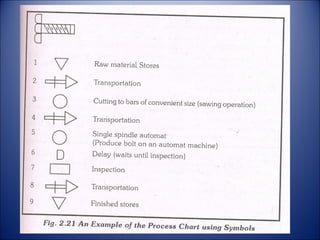
Techniques of a plant layout Charts & Diagrams Operation flowchart Flow process chart Machine card Templates Scale models Wooden models of machines Layout drawings
Procedure for deciding a Layout for a new plant Fix the objectives with regard to capacity, production flexibility and future expansion Collect data about machines and available space Make an overall plan Decide on service activities(location, nature) Determine the building specifications Decide on the industrial machine dimensions Prepare the layout drawings
 
 
Cellular layout A close grouping of equipments for processing a sequence of operations in multiple units of a part or a family of parts is called as ‘manufacturing cells’ Reduces distances moved by parts between machines Reduces transportation cost Frequently parts are processed one by one through processing steps and thereby reducing the work in progress inventory and the manufacturing cycle time or throughput time.
 
 
Organisation of Physical facilities Factory Building Industrial sanitation Noise control Plant lighting Ventilation Air conditioning Employee safety & health
Factory Building The design of the building The types of material for construction The types of building
Factory Building  An ideal factory building is one which is built to house the most efficient layout that can be provided for the process involved, yet which is architecturally attractive and of such a standard shape and design as to be flexible in its use and inexpensive in its construction . –  James Lindey
Significance of a Good factory Building Continuous & effective operation Reduction in material handling costs Provision of protection to all In house items Cutting down production cycle time High employee morale Provision of better control points Reduced costs of repairs & maintenance Core case of company image
Factory Design considerations Building foundation Location of receiving & Despatching departments Location of Aisles Material handling arrangement Location of production & service departments Type of construction Type of building Built in flexibility
Expandability - shape – U,E, H, I, L, T Lighting, Ventilators, doors & windows Floor & roof structures Damp proof construction Waste disposal Special process needs Protection of property & people Aesthetic consideration
Types of building Wood frame Bricks Steel frame RCC Pre-stressed concrete slab - Availability, Strength, Durability, Safety, cost
Single storey buildings High bay and monitor types Multi storey buildings Special Buildings Aircraft, Saw mills
Industrial Sanitation Sanitation – Science of safeguarding health Industrial sanitation – science of safeguarding health of the industrial workers
Elements of sanitation Supply of wholesome water Waste and effluent disposal Avoidance & control of insects, rodents etc. Food sanitation Good industrial housekeeping Providing facilities for personnel service To be free from air pollution
Supply of wholesome water Drinking Toilet purpose Hand washing Canteen Manufacturing – Plating, Heat treatment Lakes, Canals, Springs, Rivers, Borewells, Taps
Industrial wastage Is a residue or piece of raw materials, a byproduct of the manufacturing process. Waste is also produced by industrial establishment and plant personnel Salvageable waste Non salvageable waste Liquid waste Solid waste
Food sanitation Factories Act – canteen – 250 persons Clean handling No galvanized utensils Cover Kitchen – washed clean before & after preparation
Good housekeeping Eliminates accidents & fire hazards Conservation of space, time , materials and efforts Improvement of employee morale
Avoidance & control of insects & rodents Insects- diseases Rodents - plague
Providing facilities for personnel services Air pollution Proper town planning & zoning
Lighting Is one of the physical facilities most required in a factory. Most important single environmental factor contributing to worker satisfaction, comfort & productivity. Lighting is good when it is free from glare and is properly diffused, its colour pleasant & flow direct and steady. Illumination between 14 and 18 lumens will be ideal in any industrial establishment.
Sources of Lighting Day light ( Natural lighting) Artificial  lighting
Natural Lighting Advantages Available in abundance Free of cost Requires no maintenance Free from load shedding Limitations Only during daytime & intensity varies Windows & roofs have to be specially constructed Difficult to provide uniform lighting throughout
Artificial Lighting Advantages Illumination is constant Intensity can be controlled to suit the operations Only method available after daylight hours Well suited to provide supplementary lighting Less no. of windows Disadvantages Quite expensive – investment, recurring – cost & maintenance Power cuts – generator maintenance
Ventilation Supply of air to an enclosed place and removal of air from there. Natural Mechanical Ventilation differs from air conditioning in that, the latter conditions the air by  heating or cooling it by such process, while the former, merely supplies fresh air to or removes vitiated air there from without in any way conditioning it.
General ventilation ( Dilution ventilation) For comfort control To keep contaminants within safe limits Local Exhaust ventilation
Air conditioning Simultaneous control of temperature and humidity, distribution and purity of air by artificial means. Air conditioning is the control of the relationship between certain characteristics of the air, such as temperature, purity, humidity, movement and distribution, to that end, the air will meet the requirement of a particular situation in a room or building
Types Winter A/c Summer A/c Comfort or domestic a/c Industrial a/c Partial a/c Complete a/c
While designing the building Avoid or reduce the number of windows Provide for air ducts in the walls Provide for a seperarte room  for installation of a/c units Provide facilities for admitting fresh air into the building
Noise control Unwanted and unpleasant sound People get headache & get exhausted Control – impossible to eliminate  Control at source Control by absorption  Control through ear protection

Production

  • 1.
    PRODUCTION The conversionof raw materials to end product by using processes, machines, men and tools
  • 2.
    Manufacturing Is theproduction of tangible goods only, whereas production includes creation of both tangible goods and intangible services.
  • 3.
    Production Management Itdeals with decision making related to production process so that the resulting goods or services are produced according to specifications in amounts and by schedules demanded and at minimum cost – E S Buffa
  • 4.
    PM Production Managementis defined as the design, operation, and improvement of the transformation process, which converts the various inputs into the desired outputs of products and services
  • 5.
    A branch ofmanagement which deals with the production function. It involves organising, directing and controlling the production process. Management of an organisation’s productive resources or its production system which converts inputs into tangible / intangible outputs needed by the customers of the organisation.
  • 6.
    Production management ensuresthe optimum utilisation of resources in order to attain the production objectives of an organisation. Multi disciplinary Material management, man management, planning methodologies, scheduling techniques, quality management, cost control, maintenance management and a host of techniques and tools.
  • 7.
    5 P ProductPlant Processes Programmes People
  • 8.
    Objectives Maximum posssibleproduction, productivity, employee satisfaction, cutomer satisfaction, profit, utilisation of resources. Minimum scrap / rework, production cycle time. Higher operating efficiency Protection of the environment
  • 9.
    Ultimate Objectives Control& reduction in Manufacturing costs To improve the product quality Manufacturing schedule
  • 10.
    Intermediate Objectives Machinery& equipments Materials Manpower Manufacturing services Methods
  • 11.
    Scope Selection oflocation – end product Land acquisition, building, construction, selection and installation of machinery, purchasing, receiving, storing, issuing of raw materials and converting the raw materials into products ready for sale.
  • 12.
    Scope- Cont’d LongTerm Strategic Decisions Product selection & Design Process selection & Planning Location facilities Layout & material handling facilities Capacity planning
  • 13.
    Short term Strategicdecisions Production planning Production control Inventory control Quality control Method study Maintenance & replacements Cost control & Reduction
  • 14.
    Factory Is aplace where factors of production- land, labour, money and enterprise are grouped together for the creation of goods or services.
  • 15.
    Activities Related toproduction system designing Production engineering( design of tools, jigs, design, development and installation of equipment) Plant location Work environment, work measurement, plant layout, time and motion study, material handling
  • 16.
    Activities related toanalysis and control Production planning Production control Quality control Human factor R & D activities
  • 17.
    Comparison Manufacturing TangibleProduced to inventory Minimum or no contact with customer Demand varies –week/month/season Market served on regional level Economies of scale Location is in relation to regional market Services Intangible & perishable System is open for services High contact with the customer Demand – Hourly/daily/weekly Local market Relatively small units- local Location for local customer
  • 18.
    Duties & responsibilitiesof The Production Manager Planning the geographical location of the factory Purchasing the production equipment Layout of the equipment within the factory Designing production processes and equipment Product design Designing production work and establishing work standards Capacity planning Production planning and scheduling Production control Inventory management Supply chain management Quality control
  • 19.
    Cont’d Production equipmentmaintenance and repair Measurement and monitoring of productivity Industrial relations / personnel matters Health and safety Staff selection and training Budgeting & capital planning
  • 20.
  • 21.
    Problems of ProductionManagement Decisions relating to: Design of the production system Long range decisions – selection and decision of products, selection of equipment and processes, production of design of parts processed, job design, location of the system, facility layout Operation & control of the system Short run decisions - inventory, production control, maintenance and reliability of the system, quality control, labour control, cost control and improvement.
  • 22.
  • 23.
    Responsibilities of ProductionManager Production planning Production control Plant layout Materials handling Quality control Methods analysis Work measurement (work study, time study) Cost control, standardisation, storage, wages, incentives
  • 24.
    In terms ofthree major managerial functions Planning Capacity, location, products & services, make or buy, layout, projects, scheduling. Organising Degree of centralisation, sub contracting, incentive plans, issue of work orders, job assignments. Controlling Inventory control, quality control, cost control
  • 25.
    Three general categoriesof decision taken by production managers are: strategic decision, operating decision, controlling decision. Decision areas include: Quality management, product & service design, process &capacity design, location design, layout design, job design, supply chain management, inventory management, scheduling and maintenance.
  • 26.
  • 27.
    Systems or typesof production Continuous production system Is one in which the equipment and work stations are arranged in the sequence in which the input raw materials are converted into desired components or assembly. Intermittent production system is one in which the production equipments are grouped and organised according to the functions or process they perform.
  • 28.
    Job production Goodsare produced according to customers orders Also known as market order business Each job is different. Cost of item –high Highly skilled labour required
  • 29.
    Batch production Whenmanufacturing is done in batches on the basis of customer’s orders. Eg. If 500 is to be done per year, it is about 40 per month. A batch of 25 or 50 units can be taken at atime.
  • 30.
    Mass production Isadopted for off the shelf or stock items for the consumer market. In terms of 1000 units A huge volume of limited variety SPMs , transfer lines are used Robotics Cost of facility is high Raw material inventories come down.
  • 31.
    Process production (Continuous Flow production) Extended form of mass production. Process is automatic and non stop.
  • 32.
  • 33.
    Productivity Productivity =Output/Input Productivity can be increased by: By increasing of output, keeping input constant. By decreasing inputs for producing the same output. By increasing outputs proportionately higher than increases affected in inputs.
  • 34.
    Factors contributing toincrease of productivity Better utilisation of resources like men, machine and materials Using efficient ways of working Through good and systematic plant layouts using guidelines and principles of motion economy Reducing material handling through better layouts and using appropriate material handling equipments / facilities Selection of proper maintenance policy, keeping in mind preventive maintenance and breakdown maintenance. Provision of healthy and safe working conditions to workmen
  • 35.
    Through modern HRMmethods, counselling rather than threatening workmen, through participation of workmen in management including quality circles. This will keep the workforce motivated. Provision of fair wages and proper compensation through incentive schemes. By ensuring better quality
  • 36.
    In a manufacturingunit the standard time allowed for the production of a unit is 5 hours. If in a particular month 126 units are produced by employing 4 persons and the allowable delays are found to be 44 man hours, find the productivity?
  • 37.
    Earned Standard Hours Std time /unit = 5 hours Production =126 units ESMH =5x 126= 630 hours Available Man-hours Manpower employed= 4 Monthly working hours=4 x 25 x 8 = 800 hours Allowed delays = 44 hours Actual Man-hours available =800 – 44 =756 hours Productivity = (630/756 ) x 100 = 83.33%
  • 38.
    Plant location Locationof plant is the function of determining where the plant is to be located, for maximum operating economy and effectiveness. Location once decided, must be permanent. Consideration factors – raw material, supplies, labour and market.
  • 39.
    Steps in choosinga location 1. Deciding on domestic or international location Competitive advantage derived from location If international location, choice of country Political stability Export and import quotas Exchange rates Cultural and economic considerations Availability of natural resources, cost of labour Friendliness with the country Favourable climate at the location
  • 40.
    2. Selection ofthe region Availability of raw materials Nearness to market Availability of power Transport facilities Suitability of climate Govt. policy and competition between states
  • 41.
    3. Selection ofappropriate place within the region. Skilled labour at cheaper rate Water Civic amenities Finance
  • 42.
    4. Selection ofvarious sites within the selected place. Availability of cheap land to build the plant Soil, topography Low cost of construction in levelling, foundation Facilities for transportation of goods Cost of installation of electricity, gas Cheap means of disposing of factory waste Availability of experienced sub contractors Cost of laying water supply, sewage Low pollution
  • 43.
    Decide optimum siteWork out the cost for different sites and select the optimum site where he would get the maximum benefit
  • 44.
    Factors of location( Location Theory) Weber’s Theory Primary factors Material & labour Material oriented Market oriented Secondary factors Banking, credit, insurance, communication, rent, utility rates Agglomerating & degglomerating factors
  • 45.
    Factors affecting locationof a plant Raw materials Cotton textile Kerala, AP, Karnataka, Tamil Nadu, Mumbai, West Bengal, Kanpur, Gujarat, MP Sugar Industry UP, Bihar, MP, Maharashtra, Tamil Nadu, Mandya
  • 46.
    Iron & steelIndustry Bihar, Orissa, MP, West Bengal, Karnataka Cement Bihar, TN, Gujarat, MP, AP, UP, HP & Orissa Jute WB
  • 47.
    Paper Bamboo,grass, wood, sugarcane WB, Orissa , UP, Nagaland, Kerala, Assam Coal WB, Bihar, Orissa, MP, TN, Assam, Gujarat
  • 48.
    IT Industry Educatedmanpower Power Satellite link Telecommunication Transportation Location with good climate Industry policy of state
  • 49.
    Plant Layout Refersto the arrangement of machinery, equipment and other industrial facilities – such as receiving and shipping departments, tool rooms, maintenance rooms, employee amenities, etc. – for the purpose of achieving the quickest and smoothest production at the least cost.
  • 50.
    Knowles & ThomsonPlant layout involves: Planning and arranging manufacturing machinery, equipment, and services for the first time in completely new plants; The improvements in layouts already in use in order to introduce new methods and improvements in manufacturing procedures.
  • 51.
    Objective of agood plant layout Provide enough production capacity Reduce material handling costs Reduce congestion that impedes the movement of people or material Reduce hazards to personnel Utilize labour efficiently Increase employee morale Reduce accidents Utilize available space efficiently Provide for volume and product facility Provide for ease of supervision Facilitate co-ordination & face to face communication where appropriate Provide for employee safety Allow ease of maintenance Allow high machine utilisation Improve productivity
  • 52.
    Factors governing layoutFactory location Type of manufacturing process Synthetic, Analytical, Intermittant, Repetitive, Non repetitive Type of the product Material input Employee requirements Machinery in the factory Managerial policies
  • 53.
    Managerial policy Volumeof production, provision for expansion, extent of automation, make or buy of components, desire for rapid delivery of goods to customers, purchasing policy, personnel policies Human factors Exit provisions Rest rooms Drinking water Lavatory Obstruction free work floor
  • 54.
    Principles of plantlayout Principle of: overall integration Utilisation Flexibility Expansion Minimum distance Max. use of volume Max. visibility Max. accessibility Ordeliness Safety & satisfaction
  • 55.
    Types of layoutProcess layout ( functional layout) Product layout ( straight line layout) Hybrid layout ( Combined layout) Fixed position layout
  • 56.
  • 57.
  • 58.
    Process layout Isthe arrangement of a facility so that work centres or departments are grouped together according to their functional type. Also called as Functional layout Job shop layout
  • 59.
  • 60.
    Product Layout Productlayout involves the arrangement of machines in one line, depending upon the sequence of operations. Each of the components skip some of the machines not required. Machines are arranged serially, to machine similar components. Materials are worked out into finished components through a series of integrated operations. Back tracking is avoided.
  • 61.
    Advantages of Productlayout Uninterrupted output Reduced amount of work in progress Encourages use of automatic devices Best use of floor space Effective supervision Improved production control
  • 62.
    Demerits of productlayout Higher initial investment Danger of breakdown Expansion is costlier Lack of flexibility Dangers of specilisation
  • 63.
    Advantages of processlayout Lower capital lockup Greater flexibility Quality supervision Uninterrupted functioning Fuller utilisation of machine capacity Full scope for expansion
  • 64.
    Demerits of aprocess layout Difficulties in production planning and control Excessive handling of materials Larger stock pile in the process Possibility of more floor space Elonged production cycle time
  • 65.
    Product or Processlayout? Product layouts are preferred where: One or few standard products are involved Production is in large quantities Components are such that material handling facilities are utilised efficiently The same machine is used for less number of products and operations Minimum inspection stages
  • 66.
    Process layouts arepreferred where: Many types or kinds of products are involved Production is in small quantities Heavy materials or products are used where material handling facilities cannot be used efficiently A number of products can be done on the same machine Inspection stages are many
  • 67.
  • 68.
    Fixed position layoutJob is stationary Men, machines and tools move towards the job Eg: Locomotives, Ship, Satellite, Aircraft, Boilers, Generators Site construction, Hospitals
  • 69.
  • 70.
    Hybrid layout Acombination of product and process layouts, with an emphasis on either, to utilise the advantages of both the types of layouts. Machines are arranged in a sequence. Hence sequence is followed as product layout. There are more number of machines at each stage, and they are grouped as mini departments so that they can take up different components of a similar nature. Process layout principle is followed here.
  • 71.
    Advantages of aGood layout Advantages to the workers Reduction in effort Reduction in fatigue Reduction in number of handling Activities at maximum efficiency Encourages specialisation
  • 72.
    Reduction in labourcost Reduction in number of workers, length of haul Increase in production per man hour Reduction in maintenance costs Reduction in manufacturing cost Saving in power Improved quality of product by reduced number of handlings Effective production control Effective supervision and capital investment
  • 73.
    Characteristic of anEfficient layout Smooth flow of production Maximum utilisation of space (also cubic space) Sufficient space between the machines, for gangway, for movement of people and trolleys Minimum handling space between machines Provision of ventilation, illumination, water facilities, toilet Flexibility in layout Location of storage Provision to facilitate supervision, co-ordination Workmen safety Effective co ordination and integration Central locations for inspection
  • 74.
    Techniques of aplant layout Charts & Diagrams Operation flowchart Flow process chart Machine card Templates Scale models Wooden models of machines Layout drawings
  • 75.
    Procedure for decidinga Layout for a new plant Fix the objectives with regard to capacity, production flexibility and future expansion Collect data about machines and available space Make an overall plan Decide on service activities(location, nature) Determine the building specifications Decide on the industrial machine dimensions Prepare the layout drawings
  • 76.
  • 77.
  • 78.
    Cellular layout Aclose grouping of equipments for processing a sequence of operations in multiple units of a part or a family of parts is called as ‘manufacturing cells’ Reduces distances moved by parts between machines Reduces transportation cost Frequently parts are processed one by one through processing steps and thereby reducing the work in progress inventory and the manufacturing cycle time or throughput time.
  • 79.
  • 80.
  • 81.
    Organisation of Physicalfacilities Factory Building Industrial sanitation Noise control Plant lighting Ventilation Air conditioning Employee safety & health
  • 82.
    Factory Building Thedesign of the building The types of material for construction The types of building
  • 83.
    Factory Building An ideal factory building is one which is built to house the most efficient layout that can be provided for the process involved, yet which is architecturally attractive and of such a standard shape and design as to be flexible in its use and inexpensive in its construction . – James Lindey
  • 84.
    Significance of aGood factory Building Continuous & effective operation Reduction in material handling costs Provision of protection to all In house items Cutting down production cycle time High employee morale Provision of better control points Reduced costs of repairs & maintenance Core case of company image
  • 85.
    Factory Design considerationsBuilding foundation Location of receiving & Despatching departments Location of Aisles Material handling arrangement Location of production & service departments Type of construction Type of building Built in flexibility
  • 86.
    Expandability - shape– U,E, H, I, L, T Lighting, Ventilators, doors & windows Floor & roof structures Damp proof construction Waste disposal Special process needs Protection of property & people Aesthetic consideration
  • 87.
    Types of buildingWood frame Bricks Steel frame RCC Pre-stressed concrete slab - Availability, Strength, Durability, Safety, cost
  • 88.
    Single storey buildingsHigh bay and monitor types Multi storey buildings Special Buildings Aircraft, Saw mills
  • 89.
    Industrial Sanitation Sanitation– Science of safeguarding health Industrial sanitation – science of safeguarding health of the industrial workers
  • 90.
    Elements of sanitationSupply of wholesome water Waste and effluent disposal Avoidance & control of insects, rodents etc. Food sanitation Good industrial housekeeping Providing facilities for personnel service To be free from air pollution
  • 91.
    Supply of wholesomewater Drinking Toilet purpose Hand washing Canteen Manufacturing – Plating, Heat treatment Lakes, Canals, Springs, Rivers, Borewells, Taps
  • 92.
    Industrial wastage Isa residue or piece of raw materials, a byproduct of the manufacturing process. Waste is also produced by industrial establishment and plant personnel Salvageable waste Non salvageable waste Liquid waste Solid waste
  • 93.
    Food sanitation FactoriesAct – canteen – 250 persons Clean handling No galvanized utensils Cover Kitchen – washed clean before & after preparation
  • 94.
    Good housekeeping Eliminatesaccidents & fire hazards Conservation of space, time , materials and efforts Improvement of employee morale
  • 95.
    Avoidance & controlof insects & rodents Insects- diseases Rodents - plague
  • 96.
    Providing facilities forpersonnel services Air pollution Proper town planning & zoning
  • 97.
    Lighting Is oneof the physical facilities most required in a factory. Most important single environmental factor contributing to worker satisfaction, comfort & productivity. Lighting is good when it is free from glare and is properly diffused, its colour pleasant & flow direct and steady. Illumination between 14 and 18 lumens will be ideal in any industrial establishment.
  • 98.
    Sources of LightingDay light ( Natural lighting) Artificial lighting
  • 99.
    Natural Lighting AdvantagesAvailable in abundance Free of cost Requires no maintenance Free from load shedding Limitations Only during daytime & intensity varies Windows & roofs have to be specially constructed Difficult to provide uniform lighting throughout
  • 100.
    Artificial Lighting AdvantagesIllumination is constant Intensity can be controlled to suit the operations Only method available after daylight hours Well suited to provide supplementary lighting Less no. of windows Disadvantages Quite expensive – investment, recurring – cost & maintenance Power cuts – generator maintenance
  • 101.
    Ventilation Supply ofair to an enclosed place and removal of air from there. Natural Mechanical Ventilation differs from air conditioning in that, the latter conditions the air by heating or cooling it by such process, while the former, merely supplies fresh air to or removes vitiated air there from without in any way conditioning it.
  • 102.
    General ventilation (Dilution ventilation) For comfort control To keep contaminants within safe limits Local Exhaust ventilation
  • 103.
    Air conditioning Simultaneouscontrol of temperature and humidity, distribution and purity of air by artificial means. Air conditioning is the control of the relationship between certain characteristics of the air, such as temperature, purity, humidity, movement and distribution, to that end, the air will meet the requirement of a particular situation in a room or building
  • 104.
    Types Winter A/cSummer A/c Comfort or domestic a/c Industrial a/c Partial a/c Complete a/c
  • 105.
    While designing thebuilding Avoid or reduce the number of windows Provide for air ducts in the walls Provide for a seperarte room for installation of a/c units Provide facilities for admitting fresh air into the building
  • 106.
    Noise control Unwantedand unpleasant sound People get headache & get exhausted Control – impossible to eliminate Control at source Control by absorption Control through ear protection