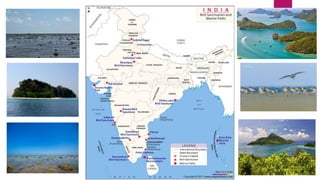
Marine protected Area
Ashish sahu
 A marine protected area (MPA) is an area of sea especially dedicated to the
protection and maintenance of biodiversity, and of natural and associated cultural
resources, and managed through legal or other effective means.
 "Marine protected area (MPA)" is a term for protected areas that include marine
environment and biodiversity.
The International Union for Conservation of Nature (IUCN) defines a protected
area as:
"A clearly defined geographical space, recognised, dedicated and managed,
through legal or other effective means, to achieve the long-term conservation of
nature with associated ecosystem services and cultural values.”
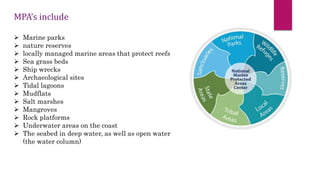
MPA’s include
 Marine parks
 nature reserves
 locally managed marine areas that protect reefs
 Sea grass beds
 Ship wrecks
 Archaeological sites
 Tidal lagoons
 Mudflats
 Salt marshes
 Mangroves
 Rock platforms
 Underwater areas on the coast
 The seabed in deep water, as well as open water
(the water column)
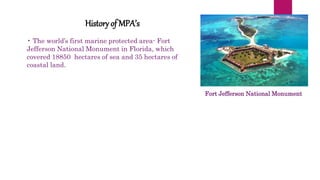
Fort Jefferson National Monument
History of MPA’s
• The world’s first marine protected area- Fort
Jefferson National Monument in Florida, which
covered 18850 hectares of sea and 35 hectares of
coastal land.
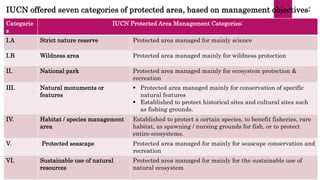
Categarie
s
IUCN Protected Area Management Categories:
I.A Strict nature reserve Protected area managed for mainly science
I.B Wildness area Protected area managed mainly for wildness protection
II. National park Protected area managed mainly for ecosystem protection &
recreation
III. Natural monuments or
features
 Protected area managed mainly for conservation of specific
natural features
 Established to protect historical sites and cultural sites such
as fishing grounds.
IV. Habitat / species management
area
Established to protect a certain species, to benefit fisheries, rare
habitat, as spawning / nursing grounds for fish, or to protect
entire ecosystems.
V. Protected seascape Protected area managed for mainly for seascape conservation and
recreation
VI. Sustainable use of natural
resources
Protected area managed for mainly for the sustainable use of
natural ecosystem
IUCN offered seven categories of protected area, based on management objectives:
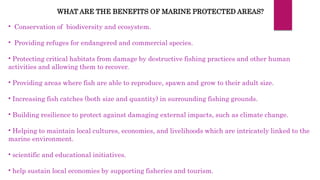
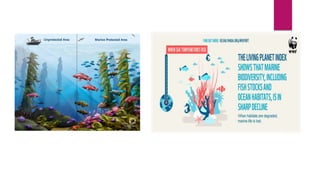
WHAT ARE THE BENEFITS OF MARINE PROTECTED AREAS?
• Conservation of biodiversity and ecosystem.
• Providing refuges for endangered and commercial species.
• Protecting critical habitats from damage by destructive fishing practices and other human
activities and allowing them to recover.
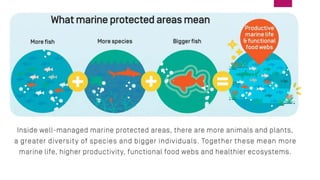
• Providing areas where fish are able to reproduce, spawn and grow to their adult size.
• Increasing fish catches (both size and quantity) in surrounding fishing grounds.
• Building resilience to protect against damaging external impacts, such as climate change.
• Helping to maintain local cultures, economies, and livelihoods which are intricately linked to the
marine environment.
• scientific and educational initiatives.
• help sustain local economies by supporting fisheries and tourism.
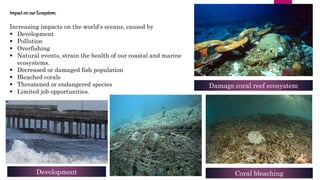
Impact on our Ecosystem:
Increasing impacts on the world's oceans, caused by
 Development
 Pollution
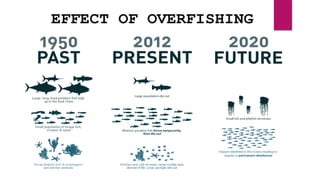
 Overfishing
 Natural events, strain the health of our coastal and marine
ecosystems.
 Decreased or damaged fish population
 Bleached corals
 Threatened or endangered species
 Limited job opportunities.
Damage coral reef ecosystem
Development Coral bleaching
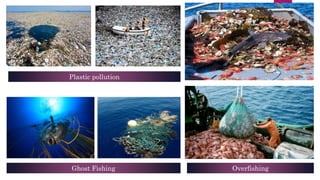
Plastic pollution
Ghost Fishing Overfishing
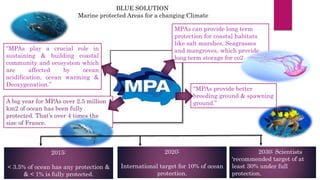
“MPAs play a crucial role in
sustaining & building coastal
community and ecosystem which
are affected by ocean
acidification, ocean warming &
Deoxygenation.”
MPAs can provide long term
protection for coastal habitats
like salt marshes, Seagrasses
and mangroves, which provide
long term storage for co2
A big year for MPAs over 2.5 million
km2 of ocean has been fully
protected. That’s over 4 times the
size of France.
“MPAs provide better
breeding ground & spawning
ground.”
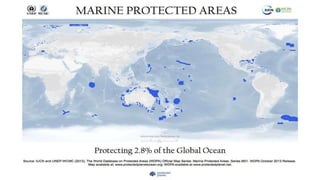
BLUE SOLUTION
Marine protected Areas for a changing Climate
2030: Scientists
'recommended target of at
least 30% under full
protection.
2020:
International target for 10% of ocean
protection.
2015:
< 3.5% of ocean has any protection &
& < 1% is fully protected.
Marine National Park and Water Sanctuaries of India
 A marine park is a park consisting of an area of sea (or lake) sometimes protected for
recreational, Conservation of species.
 National parks are high- secuirity natural area created to conserve & protect animals and
other species.
 The idea of national park was given by the artist George Catlin in 1832s.
 Most marine parks are designated by governments, and organized like 'watery' national
parks.
 The largest marine national parks in the world are Great barrier reef, Australia and Chagos
marine park ,UK.
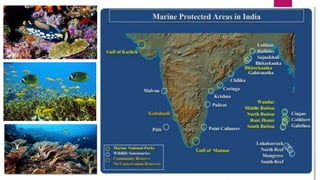
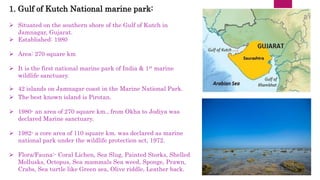
1. Gulf of Kutch National marine park:
 Situated on the southern shore of the Gulf of Kutch in
Jamnagar, Gujarat.
 Established: 1980
 Area: 270 square km
 It is the first national marine park of India & 1st marine
wildlife sanctuary.
 42 islands on Jamnagar coast in the Marine National Park.
 The best known island is Pirotan.
 1980- an area of 270 square km., from Okha to Jodiya was
declared Marine sanctuary.
 1982- a core area of 110 square km. was declared as marine
national park under the wildlife protection act, 1972.
 Flora/Fauna:- Coral Lichen, Sea Slug, Painted Storks, Shelled
Mollusks, Octopus, Sea mammals Sea weed, Sponge, Prawn,
Crabs, Sea turtle like Green sea, Olive riddle, Leather back.
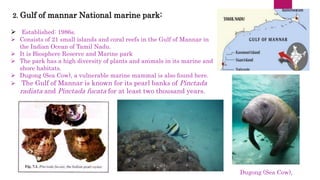
2. Gulf of mannar National marine park:
 Established: 1986s.
 Consists of 21 small islands and coral reefs in the Gulf of Mannar in
the Indian Ocean of Tamil Nadu.
 It is Biosphere Reserve and Marine park
 The park has a high diversity of plants and animals in its marine and
shore habitats.
 Dugong (Sea Cow), a vulnerable marine mammal is also found here.
 The Gulf of Mannar is known for its pearl banks of Pinctada
radiata and Pinctada fucata for at least two thousand years.
Dugong (Sea Cow),
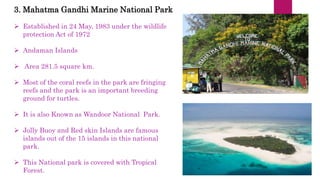
3. Mahatma Gandhi Marine National Park
 Established in 24 May, 1983 under the wildlife
protection Act of 1972
 Andaman Islands
 Area 281.5 square km.
 Most of the coral reefs in the park are fringing
reefs and the park is an important breeding
ground for turtles.
 It is also Known as Wandoor National Park.
 Jolly Buoy and Red skin Islands are famous
islands out of the 15 islands in this national
park.
 This National park is covered with Tropical
Forest.
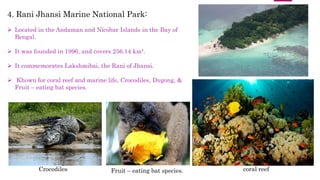
4. Rani Jhansi Marine National Park:
 Located in the Andaman and Nicobar Islands in the Bay of
Bengal.
 It was founded in 1996, and covers 256.14 km².
 It commemorates Lakshmibai, the Rani of Jhansi.
 Khown for coral reef and marine life, Crocodiles, Dugong, &
Fruit – eating bat species.
Fruit – eating bat species.Crocodiles coral reef
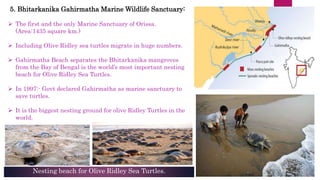
5. Bhitarkanika Gahirmatha Marine Wildlife Sanctuary:
 The first and the only Marine Sanctuary of Orissa.
(Area:1435 square km.)
 Including Olive Ridley sea turtles migrate in huge numbers.
 Gahirmatha Beach separates the Bhitarkanika mangroves
from the Bay of Bengal is the world’s most important nesting
beach for Olive Ridley Sea Turtles.
 In 1997:- Govt declared Gahirmatha as marine sanctuary to
save turtles.
 It is the biggest nesting ground for olive Ridley Turtles in the
world.
Nesting beach for Olive Ridley Sea Turtles.
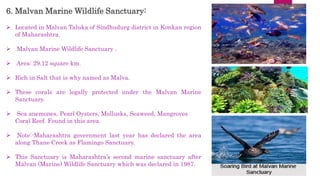
6. Malvan Marine Wildlife Sanctuary:
 Located in Malvan Taluka of Sindhudurg district in Konkan region
of Maharashtra.
 Malvan Marine Wildlife Sanctuary .
 Area: 29.12 square km.
 Rich in Salt that is why named as Malva.
 These corals are legally protected under the Malvan Marine
Sanctuary.
 Sea anemones, Pearl Oysters, Mollusks, Seaweed, Mangroves
Coral Reef. Found in this area.
 Note:-Maharashtra government last year has declared the area
along Thane Creek as Flamingo Sanctuary.
 This Sanctuary is Maharashtra’s second marine sanctuary after
Malvan (Marine) Wildlife Sanctuary which was declared in 1987.
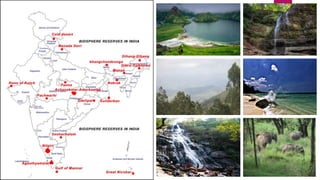
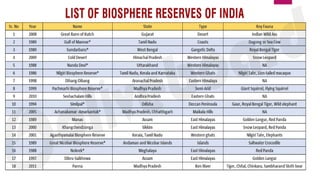
Biosphere reserve of India
 are “special places for people and nature”.
 are areas of terrestrial and coastal ecosystems promoting solutions to reconcile the conservation
of biodiversity with its sustainable use.
 are nominated by national governments.
 A biosphere reserve is an ecosystem with plants and animals of unusual scientific and natural
interest.
 It is a label given by UNESCO to help protect the sites.
 The plan is to promote management, research and education in ecosystem conservation.
 This includes the 'sustainable use of natural resources’.
 If, for example, fish or trees are taken for human use, this is done in ways which least damage
the ecosystem.
 The first biosphere reserve of the world was established in 1979s.
Man and Biosphere ( MAB) programme
 Biosphere Initiated by UNESCO in 1970 under its man and
biosphere ( MAB) programme.
 MAB: Broad based ecological programme to develop within
the natural & social sciences.
 And for improvement of relationship between man and the
environment.
 launched in 1970s.
 is primarily a programme of research and training & seek
scientific information to find the solition.
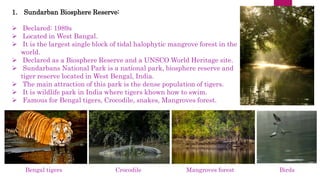
1. Sundarban Biosphere Reserve:
 Declared: 1989s
 Located in West Bangal.
 It is the largest single block of tidal halophytic mangrove forest in the
world.
 Declared as a Biosphere Reserve and a UNSCO World Heritage site.
 Sundarbans National Park is a national park, biosphere reserve and
tiger reserve located in West Bengal, India.
 The main attraction of this park is the dense population of tigers.
 It is wildlife park in India where tigers khown how to swim.
 Famous for Bengal tigers, Crocodile, snakes, Mangroves forest.
Bengal tigers Crocodile Mangroves forest Birds
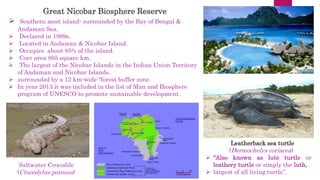
Great Nicobar Biosphere Reserve
 Southern most island- surrounded by the Bay of Bengal &
Andaman Sea.
 Declared in 1989s.
 Located in Andaman & Nicobar Island.
 Occupies about 85% of the island.
 Core area 885 square km.
 The largest of the Nicobar Islands in the Indian Union Territory
of Andaman and Nicobar Islands.
 surrounded by a 12 km-wide "forest buffer zone.
 In year 2013 it was included in the list of Man and Biosphere
program of UNESCO to promote sustainable development.
Leatherback sea turtle
(Dermochelys coriacea)
 “Also known as lute turtle or
leathery turtle or simply the luth,
 largest of all living turtle”.
Saltwater Crocodile
(Crocodylus porosus)
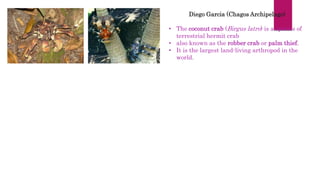
Diego Garcia (Chagos Archipelago)
• The coconut crab (Birgus latro) is a species of
terrestrial hermit crab
• also known as the robber crab or palm thief.
• It is the largest land-living arthropod in the
world.
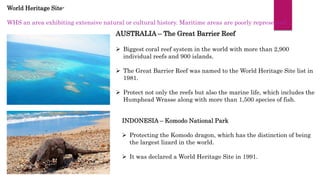
World Heritage Site-
WHS an area exhibiting extensive natural or cultural history. Maritime areas are poorly represented.
AUSTRALIA – The Great Barrier Reef
 Biggest coral reef system in the world with more than 2,900
individual reefs and 900 islands.
 The Great Barrier Reef was named to the World Heritage Site list in
1981.
 Protect not only the reefs but also the marine life, which includes the
Humphead Wrasse along with more than 1,500 species of fish.
INDONESIA – Komodo National Park
 Protecting the Komodo dragon, which has the distinction of being
the largest lizard in the world.
 It was declared a World Heritage Site in 1991.
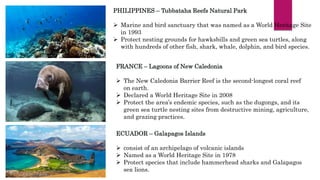
PHILIPPINES – Tubbataha Reefs Natural Park
 Marine and bird sanctuary that was named as a World Heritage Site
in 1993
 Protect nesting grounds for hawksbills and green sea turtles, along
with hundreds of other fish, shark, whale, dolphin, and bird species.
FRANCE – Lagoons of New Caledonia
 The New Caledonia Barrier Reef is the second-longest coral reef
on earth.
 Declared a World Heritage Site in 2008
 Protect the area’s endemic species, such as the dugongs, and its
green sea turtle nesting sites from destructive mining, agriculture,
and grazing practices.
ECUADOR – Galapagos Islands
 consist of an archipelago of volcanic islands
 Named as a World Heritage Site in 1978
 Protect species that include hammerhead sharks and Galapagos
sea lions.
Thank you…..

Marine protected area (MPAs)

  • 1.
  • 2.
     A marineprotected area (MPA) is an area of sea especially dedicated to the protection and maintenance of biodiversity, and of natural and associated cultural resources, and managed through legal or other effective means.  "Marine protected area (MPA)" is a term for protected areas that include marine environment and biodiversity. The International Union for Conservation of Nature (IUCN) defines a protected area as: "A clearly defined geographical space, recognised, dedicated and managed, through legal or other effective means, to achieve the long-term conservation of nature with associated ecosystem services and cultural values.”
  • 3.
    MPA’s include  Marineparks  nature reserves  locally managed marine areas that protect reefs  Sea grass beds  Ship wrecks  Archaeological sites  Tidal lagoons  Mudflats  Salt marshes  Mangroves  Rock platforms  Underwater areas on the coast  The seabed in deep water, as well as open water (the water column)
  • 4.
    Fort Jefferson NationalMonument History of MPA’s • The world’s first marine protected area- Fort Jefferson National Monument in Florida, which covered 18850 hectares of sea and 35 hectares of coastal land.
  • 5.
    Categarie s IUCN Protected AreaManagement Categories: I.A Strict nature reserve Protected area managed for mainly science I.B Wildness area Protected area managed mainly for wildness protection II. National park Protected area managed mainly for ecosystem protection & recreation III. Natural monuments or features  Protected area managed mainly for conservation of specific natural features  Established to protect historical sites and cultural sites such as fishing grounds. IV. Habitat / species management area Established to protect a certain species, to benefit fisheries, rare habitat, as spawning / nursing grounds for fish, or to protect entire ecosystems. V. Protected seascape Protected area managed for mainly for seascape conservation and recreation VI. Sustainable use of natural resources Protected area managed for mainly for the sustainable use of natural ecosystem IUCN offered seven categories of protected area, based on management objectives:
  • 6.
    WHAT ARE THEBENEFITS OF MARINE PROTECTED AREAS? • Conservation of biodiversity and ecosystem. • Providing refuges for endangered and commercial species. • Protecting critical habitats from damage by destructive fishing practices and other human activities and allowing them to recover. • Providing areas where fish are able to reproduce, spawn and grow to their adult size. • Increasing fish catches (both size and quantity) in surrounding fishing grounds. • Building resilience to protect against damaging external impacts, such as climate change. • Helping to maintain local cultures, economies, and livelihoods which are intricately linked to the marine environment. • scientific and educational initiatives. • help sustain local economies by supporting fisheries and tourism.
  • 10.
    Impact on ourEcosystem: Increasing impacts on the world's oceans, caused by  Development  Pollution  Overfishing  Natural events, strain the health of our coastal and marine ecosystems.  Decreased or damaged fish population  Bleached corals  Threatened or endangered species  Limited job opportunities. Damage coral reef ecosystem Development Coral bleaching
  • 11.
  • 14.
    “MPAs play acrucial role in sustaining & building coastal community and ecosystem which are affected by ocean acidification, ocean warming & Deoxygenation.” MPAs can provide long term protection for coastal habitats like salt marshes, Seagrasses and mangroves, which provide long term storage for co2 A big year for MPAs over 2.5 million km2 of ocean has been fully protected. That’s over 4 times the size of France. “MPAs provide better breeding ground & spawning ground.” BLUE SOLUTION Marine protected Areas for a changing Climate 2030: Scientists 'recommended target of at least 30% under full protection. 2020: International target for 10% of ocean protection. 2015: < 3.5% of ocean has any protection & & < 1% is fully protected.
  • 16.
    Marine National Parkand Water Sanctuaries of India  A marine park is a park consisting of an area of sea (or lake) sometimes protected for recreational, Conservation of species.  National parks are high- secuirity natural area created to conserve & protect animals and other species.  The idea of national park was given by the artist George Catlin in 1832s.  Most marine parks are designated by governments, and organized like 'watery' national parks.  The largest marine national parks in the world are Great barrier reef, Australia and Chagos marine park ,UK.
  • 17.
    1. Gulf ofKutch National marine park:  Situated on the southern shore of the Gulf of Kutch in Jamnagar, Gujarat.  Established: 1980  Area: 270 square km  It is the first national marine park of India & 1st marine wildlife sanctuary.  42 islands on Jamnagar coast in the Marine National Park.  The best known island is Pirotan.  1980- an area of 270 square km., from Okha to Jodiya was declared Marine sanctuary.  1982- a core area of 110 square km. was declared as marine national park under the wildlife protection act, 1972.  Flora/Fauna:- Coral Lichen, Sea Slug, Painted Storks, Shelled Mollusks, Octopus, Sea mammals Sea weed, Sponge, Prawn, Crabs, Sea turtle like Green sea, Olive riddle, Leather back.
  • 18.
    2. Gulf ofmannar National marine park:  Established: 1986s.  Consists of 21 small islands and coral reefs in the Gulf of Mannar in the Indian Ocean of Tamil Nadu.  It is Biosphere Reserve and Marine park  The park has a high diversity of plants and animals in its marine and shore habitats.  Dugong (Sea Cow), a vulnerable marine mammal is also found here.  The Gulf of Mannar is known for its pearl banks of Pinctada radiata and Pinctada fucata for at least two thousand years. Dugong (Sea Cow),
  • 19.
    3. Mahatma GandhiMarine National Park  Established in 24 May, 1983 under the wildlife protection Act of 1972  Andaman Islands  Area 281.5 square km.  Most of the coral reefs in the park are fringing reefs and the park is an important breeding ground for turtles.  It is also Known as Wandoor National Park.  Jolly Buoy and Red skin Islands are famous islands out of the 15 islands in this national park.  This National park is covered with Tropical Forest.
  • 20.
    4. Rani JhansiMarine National Park:  Located in the Andaman and Nicobar Islands in the Bay of Bengal.  It was founded in 1996, and covers 256.14 km².  It commemorates Lakshmibai, the Rani of Jhansi.  Khown for coral reef and marine life, Crocodiles, Dugong, & Fruit – eating bat species. Fruit – eating bat species.Crocodiles coral reef
  • 21.
    5. Bhitarkanika GahirmathaMarine Wildlife Sanctuary:  The first and the only Marine Sanctuary of Orissa. (Area:1435 square km.)  Including Olive Ridley sea turtles migrate in huge numbers.  Gahirmatha Beach separates the Bhitarkanika mangroves from the Bay of Bengal is the world’s most important nesting beach for Olive Ridley Sea Turtles.  In 1997:- Govt declared Gahirmatha as marine sanctuary to save turtles.  It is the biggest nesting ground for olive Ridley Turtles in the world. Nesting beach for Olive Ridley Sea Turtles.
  • 22.
    6. Malvan MarineWildlife Sanctuary:  Located in Malvan Taluka of Sindhudurg district in Konkan region of Maharashtra.  Malvan Marine Wildlife Sanctuary .  Area: 29.12 square km.  Rich in Salt that is why named as Malva.  These corals are legally protected under the Malvan Marine Sanctuary.  Sea anemones, Pearl Oysters, Mollusks, Seaweed, Mangroves Coral Reef. Found in this area.  Note:-Maharashtra government last year has declared the area along Thane Creek as Flamingo Sanctuary.  This Sanctuary is Maharashtra’s second marine sanctuary after Malvan (Marine) Wildlife Sanctuary which was declared in 1987.
  • 23.
    Biosphere reserve ofIndia  are “special places for people and nature”.  are areas of terrestrial and coastal ecosystems promoting solutions to reconcile the conservation of biodiversity with its sustainable use.  are nominated by national governments.  A biosphere reserve is an ecosystem with plants and animals of unusual scientific and natural interest.  It is a label given by UNESCO to help protect the sites.  The plan is to promote management, research and education in ecosystem conservation.  This includes the 'sustainable use of natural resources’.  If, for example, fish or trees are taken for human use, this is done in ways which least damage the ecosystem.  The first biosphere reserve of the world was established in 1979s.
  • 25.
    Man and Biosphere( MAB) programme  Biosphere Initiated by UNESCO in 1970 under its man and biosphere ( MAB) programme.  MAB: Broad based ecological programme to develop within the natural & social sciences.  And for improvement of relationship between man and the environment.  launched in 1970s.  is primarily a programme of research and training & seek scientific information to find the solition.
  • 28.
    1. Sundarban BiosphereReserve:  Declared: 1989s  Located in West Bangal.  It is the largest single block of tidal halophytic mangrove forest in the world.  Declared as a Biosphere Reserve and a UNSCO World Heritage site.  Sundarbans National Park is a national park, biosphere reserve and tiger reserve located in West Bengal, India.  The main attraction of this park is the dense population of tigers.  It is wildlife park in India where tigers khown how to swim.  Famous for Bengal tigers, Crocodile, snakes, Mangroves forest. Bengal tigers Crocodile Mangroves forest Birds
  • 29.
    Great Nicobar BiosphereReserve  Southern most island- surrounded by the Bay of Bengal & Andaman Sea.  Declared in 1989s.  Located in Andaman & Nicobar Island.  Occupies about 85% of the island.  Core area 885 square km.  The largest of the Nicobar Islands in the Indian Union Territory of Andaman and Nicobar Islands.  surrounded by a 12 km-wide "forest buffer zone.  In year 2013 it was included in the list of Man and Biosphere program of UNESCO to promote sustainable development. Leatherback sea turtle (Dermochelys coriacea)  “Also known as lute turtle or leathery turtle or simply the luth,  largest of all living turtle”. Saltwater Crocodile (Crocodylus porosus)
  • 30.
    Diego Garcia (ChagosArchipelago) • The coconut crab (Birgus latro) is a species of terrestrial hermit crab • also known as the robber crab or palm thief. • It is the largest land-living arthropod in the world.
  • 31.
    World Heritage Site- WHSan area exhibiting extensive natural or cultural history. Maritime areas are poorly represented. AUSTRALIA – The Great Barrier Reef  Biggest coral reef system in the world with more than 2,900 individual reefs and 900 islands.  The Great Barrier Reef was named to the World Heritage Site list in 1981.  Protect not only the reefs but also the marine life, which includes the Humphead Wrasse along with more than 1,500 species of fish. INDONESIA – Komodo National Park  Protecting the Komodo dragon, which has the distinction of being the largest lizard in the world.  It was declared a World Heritage Site in 1991.
  • 32.
    PHILIPPINES – TubbatahaReefs Natural Park  Marine and bird sanctuary that was named as a World Heritage Site in 1993  Protect nesting grounds for hawksbills and green sea turtles, along with hundreds of other fish, shark, whale, dolphin, and bird species. FRANCE – Lagoons of New Caledonia  The New Caledonia Barrier Reef is the second-longest coral reef on earth.  Declared a World Heritage Site in 2008  Protect the area’s endemic species, such as the dugongs, and its green sea turtle nesting sites from destructive mining, agriculture, and grazing practices. ECUADOR – Galapagos Islands  consist of an archipelago of volcanic islands  Named as a World Heritage Site in 1978  Protect species that include hammerhead sharks and Galapagos sea lions.
  • 33.