Is the Great Barrier Reef facing a significant environmental threat?                                              Peter Ridd School of Engineering and Physical Sciences James Cook University, Townsville, 4811. [email_address]
Some threats to the GBR Sediment from Agriculture Nutrients from Agriculture Pesticides from agriculture Global Warming Fishing Ocean Acidification ……… .
Image from Tim
. Great Barrier Reef Population 0.5 million Most reefs offshore Most reefs rarely visited No fishing of herbivorous fish
Threat 1:  Sediment Input
Newspaper Headline
Threat 1:  Sediment Input Sediment loads to the GBR lagoon have increased perhaps by an order of magnitude due to agriculture River plumes now carry far higher sediment loads River plumes usually have suspended concentrations of the order of 1-10 mg/l and last for a few days a year
 
Inshore corals are well adapted to high sediment loads
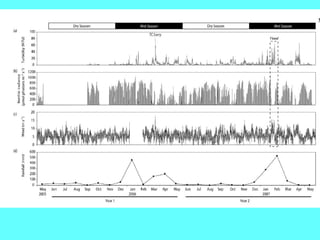
Seabed sediments are regularly resuspended due to wave motion Inshore reefs are surrounded by large quantities of sediment that has been deposited over the last few thousand years. The extra sediment added since European settlement is a tiny fraction of the existing sediment  stored on the shelf These wave events cause suspended sediment concentrations of 10-100 mg/l for periods of a for days per month.
Paluma Shoals Very high turbidity during strong wind events
Image from Tim
 
Conclusion Extra sediment in river discharge may be an environmental problem on the land but is unlikely to be a significant concern for the reef Focus has now shifted to looking at the “quality”of the sediment.
Threat 2: Nutrient Pollution Concern centres on N and P from fertilizer River discharge now has many times the natural levels of nutrient discharge BUT Diffusion models  and exchange calculations of Wang et al. (2007) and Hancock et al. (2006) indicate the lagoon is rapidly flushed.
Sydeny harbour has a flushing time of 250 days. It is highly susceptible to pollution
The GBR lagoon is relatively open to the coral sea and has a short residence time A couple of weeks for the main reef matrix A couple of months for inshore regions
 
Photo: Paul Marshall.   Threat 3: Global Warming The influence of coral bleaching We must provide “resilience” for GW. Links all other supposed stressors to GW.
Are reefs the world’s Canary? Coral reefs are the global canaries, as they are already showing rapid responses to climate change at the global scale. Scientists, managers and policy makers can use reefs to examine the effectiveness of international attempts to understand and respond to the impact of global warming  (Townsville Declaration, 2002)
Corals are a tropical species. Most of the species found on the Great Barrier Reef (GBR), for example, are also found in areas with much warmer water. (2) Corals have been around for over 200 million years. (Hotter and colder) (3) Coral tissue thickness increased with temperature. (4) In 1998 and 2002,most of the reef did not bleach and almost all that did bleach has almost fully recovered.
( 6) Coral growth rates have increased over 100 years******* (there is now some debate about this) (7) The range of corals has expanded poleward
Sea level rise is good for the GBR Reef-flats will be recoloni-sed
Corals: Canary  or
Based on limited research to date, clear impacts of enhanced runoff of sediments, nutrients and contaminants (as a result of landuse) on coral reefs of the GBR ecosystem have proven difficult to detect. (Reef CRC, 2001)
GBR Consensus Statement 2009 Analysis of the latest available evidence leads us to conclude: 1.Water discharged from rivers to the GBR continues to be of poor quality in many locations. 2.  Land derived contaminants, including suspended sediments, nutrients and pesticides are present in the GBR at concentrations likely to cause environmental harm. 3.  There is strengthened evidence of the causal relationship between water quality and coastal and marine ecosystem health. 4.  The health of freshwater ecosystems is impaired by agricultural land use, hydrological change, riparian degradation and weed infestation 5.  Current management interventions are not effectively solving the problem. 6.  Climate change and major land use change will have confounding influences on GBR health. 7.  Effective science coordination to collate, synthesise and integrate disparate knowledge across disciplines is urgently needed.
In other parts of the world, measuring that the coral reefs have been damaged is not “difficult to detect”
Other Environmental Issues in Australia that are not difficult to detect. Rainforest Clearing (Historical): 50% reduction in Rainforest. Almost all Lowland rainforest is gone Salinity: Soil loss in rangelands Eutrophication in water-ways Noxious Weeds:  Introduced Animals: Marine and on Land Urban Sprawl/Population growth
Salinity IS destroying major ecosystems. These systems are collapsing
Noxious weeds ARE choking our water ways and displacing native ecosystems. These systems ARE collapsing
Introduced species are changing marine and terrestrial ecosystems
Urban sprawl and growing population is destroying prime land near cities
Corruption of Science Difficult for opposing views to be heard Peer review Peer funding Dangerous for scientists to raise contrarian views and can be almost impossible to get funding
Conclusions The GBR is in excellent shape Threats to the GBR are not as serious as we first thought Corruption of the Scientific Process is evident A better method of determining environment priorities needs to be developed Whatever priorities are set need to be done based of good, un-emotive, science.

Peter Ridd

  • 1.
    Is the GreatBarrier Reef facing a significant environmental threat?                                              Peter Ridd School of Engineering and Physical Sciences James Cook University, Townsville, 4811. [email_address]
  • 2.
    Some threats tothe GBR Sediment from Agriculture Nutrients from Agriculture Pesticides from agriculture Global Warming Fishing Ocean Acidification ……… .
  • 3.
  • 4.
    . Great BarrierReef Population 0.5 million Most reefs offshore Most reefs rarely visited No fishing of herbivorous fish
  • 5.
    Threat 1: Sediment Input
  • 6.
  • 7.
    Threat 1: Sediment Input Sediment loads to the GBR lagoon have increased perhaps by an order of magnitude due to agriculture River plumes now carry far higher sediment loads River plumes usually have suspended concentrations of the order of 1-10 mg/l and last for a few days a year
  • 8.
  • 9.
    Inshore corals arewell adapted to high sediment loads
  • 10.
    Seabed sediments areregularly resuspended due to wave motion Inshore reefs are surrounded by large quantities of sediment that has been deposited over the last few thousand years. The extra sediment added since European settlement is a tiny fraction of the existing sediment stored on the shelf These wave events cause suspended sediment concentrations of 10-100 mg/l for periods of a for days per month.
  • 11.
    Paluma Shoals Veryhigh turbidity during strong wind events
  • 12.
  • 13.
  • 14.
    Conclusion Extra sedimentin river discharge may be an environmental problem on the land but is unlikely to be a significant concern for the reef Focus has now shifted to looking at the “quality”of the sediment.
  • 15.
    Threat 2: NutrientPollution Concern centres on N and P from fertilizer River discharge now has many times the natural levels of nutrient discharge BUT Diffusion models and exchange calculations of Wang et al. (2007) and Hancock et al. (2006) indicate the lagoon is rapidly flushed.
  • 16.
    Sydeny harbour hasa flushing time of 250 days. It is highly susceptible to pollution
  • 17.
    The GBR lagoonis relatively open to the coral sea and has a short residence time A couple of weeks for the main reef matrix A couple of months for inshore regions
  • 18.
  • 19.
    Photo: Paul Marshall. Threat 3: Global Warming The influence of coral bleaching We must provide “resilience” for GW. Links all other supposed stressors to GW.
  • 20.
    Are reefs theworld’s Canary? Coral reefs are the global canaries, as they are already showing rapid responses to climate change at the global scale. Scientists, managers and policy makers can use reefs to examine the effectiveness of international attempts to understand and respond to the impact of global warming (Townsville Declaration, 2002)
  • 21.
    Corals are atropical species. Most of the species found on the Great Barrier Reef (GBR), for example, are also found in areas with much warmer water. (2) Corals have been around for over 200 million years. (Hotter and colder) (3) Coral tissue thickness increased with temperature. (4) In 1998 and 2002,most of the reef did not bleach and almost all that did bleach has almost fully recovered.
  • 22.
    ( 6) Coralgrowth rates have increased over 100 years******* (there is now some debate about this) (7) The range of corals has expanded poleward
  • 23.
    Sea level riseis good for the GBR Reef-flats will be recoloni-sed
  • 24.
  • 25.
    Based on limitedresearch to date, clear impacts of enhanced runoff of sediments, nutrients and contaminants (as a result of landuse) on coral reefs of the GBR ecosystem have proven difficult to detect. (Reef CRC, 2001)
  • 26.
    GBR Consensus Statement2009 Analysis of the latest available evidence leads us to conclude: 1.Water discharged from rivers to the GBR continues to be of poor quality in many locations. 2. Land derived contaminants, including suspended sediments, nutrients and pesticides are present in the GBR at concentrations likely to cause environmental harm. 3. There is strengthened evidence of the causal relationship between water quality and coastal and marine ecosystem health. 4. The health of freshwater ecosystems is impaired by agricultural land use, hydrological change, riparian degradation and weed infestation 5. Current management interventions are not effectively solving the problem. 6. Climate change and major land use change will have confounding influences on GBR health. 7. Effective science coordination to collate, synthesise and integrate disparate knowledge across disciplines is urgently needed.
  • 27.
    In other partsof the world, measuring that the coral reefs have been damaged is not “difficult to detect”
  • 28.
    Other Environmental Issuesin Australia that are not difficult to detect. Rainforest Clearing (Historical): 50% reduction in Rainforest. Almost all Lowland rainforest is gone Salinity: Soil loss in rangelands Eutrophication in water-ways Noxious Weeds: Introduced Animals: Marine and on Land Urban Sprawl/Population growth
  • 29.
    Salinity IS destroyingmajor ecosystems. These systems are collapsing
  • 30.
    Noxious weeds AREchoking our water ways and displacing native ecosystems. These systems ARE collapsing
  • 31.
    Introduced species arechanging marine and terrestrial ecosystems
  • 32.
    Urban sprawl andgrowing population is destroying prime land near cities
  • 33.
    Corruption of ScienceDifficult for opposing views to be heard Peer review Peer funding Dangerous for scientists to raise contrarian views and can be almost impossible to get funding
  • 34.
    Conclusions The GBRis in excellent shape Threats to the GBR are not as serious as we first thought Corruption of the Scientific Process is evident A better method of determining environment priorities needs to be developed Whatever priorities are set need to be done based of good, un-emotive, science.