Mangroves
Presentation
BY MARWAH(31), ALISHBA RAZZAQ(32), ALISHBA ZAINAB(53E),
MAHEEN(22),HADIA(30)
Contents Slide
Numbers
MANGROVES 3
CHARACTERISTICS OF MANGROVE 4
HABITAT OF MANGROVE 5
ADAPTATIONS OF MANGROVE 6
TYPES OF MANGROVE 7
GEOGRAPHICAL DISTRIBUTION 11
LOCATION OF MANGROVE 14
IMPORTANCE OF MANGROVE 16
USE OF MANGROVE 17
MANGROVE DISAPPEARANCE 18
THREATS TO MANGROVE 24
CONSERVATION OF MANGROVE 33
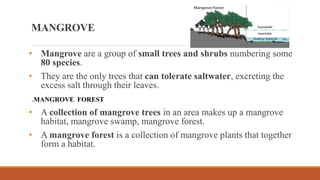
MANGROVE
• Mangrove are a group of small trees and shrubs numbering some
80 species.
• They are the only trees that can tolerate saltwater, excreting the
excess salt through their leaves.
.MANGROVE FOREST
• A collection of mangrove trees in an area makes up a mangrove
habitat, mangrove swamp, mangrove forest.
• A mangrove forest is a collection of mangrove plants that together
form a habitat.
CHARACTERISTICS OF MANGROVE
•They are halophytic (salt loving).
•Mangrove come in a variety of sizes.
•Fishes are liable flock to mangrove.
•Mangroves live on the edge.
•Live in harsh and unpredictable interference between land and sea.
•Dense and evergreen plant.
•It can survive in both fresh and salt water.
HABITAT OF MANGROVE
•Mangrove grow in intertidal or estuarine areas.
•They are found in warmer areas between the latitudes of 32 degrees
north and 38 degrees south, as they need to live in areas where the
• Average annual temp. is 66 F.
•Mangrove were originally found in South Asia but
•have been disbursed around the world and are now found along the
tropical and subtropical coasts of Africa, Asia, and North and South
America.
•In the US mangroves are commonly found in Florida.
ADAPTATIONS OF MANGROVE
•All mangroves have special adaptations that allow
them survive in their salty environment.
•Their unusual root systems give them support and
stability in the loose soil.
•Mangrove plant are unique in that they live young
(viviparous).
•The seed remains attached to the parents plant until it
germinates.
TYPES OF MANGROVE
1. FRINGE:
Fringe mangrove grow on shorelines in relatively thin strips of
forest.
2. BASIN:
Basin mangrove are highly useful for nutrient accumulation.
3.RIVERINE:
Riverine mangroves line the banks of rivers and are flooded by
the river and the sea.
4.Overwash
Over wash mangroves are similar to fringe mangroves, except
they are located on small islands, submerged regularly by the
sea.
5.DWARF:
Dwarf mangrove forests are forests where the trees can grow
five feet or 1.5 meters tall.
TYPES OF MAGROVE IN FLORIDA
Florida mangrove include 4 tree species.
The red mangrove.
The black mangrove.
The white mangrove.
The buttonwood.
GEOGRAPHICAL DISTRIBUTION OF
MANGROVES
There are approximately 54-75 species of mangroves distributed worldwide . Tropical
coastlines 75% between 25%N and 25%S
• East coast of Africa, Australia, and New Zealand where mangroves occur 10-15°
farther south.
• Japan, Florida, Bermuda, and the Red Sea, this range extends 5-7° farther north.
• Mangroves in the Indo-West Pacific are more diverse, consisting of more than 30
tree species, than those in Florida.
• The Ten Thousand Islands in southwest Florida has the highest concentrations of
mangroves in the state.
• Mangroves are adapted to harsh conditions of high salinity, warm air and water
temperatures, extreme tides, muddy, sediment-laden waters, and oxygen-depleted
soils.
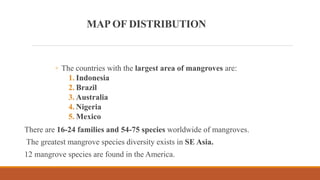
MAP OF DISTRIBUTION
◦ The countries with the largest area of mangroves are:
1. Indonesia
2. Brazil
3. Australia
4. Nigeria
5. Mexico
There are 16-24 families and 54-75 species worldwide of mangroves.
The greatest mangrove species diversity exists in SE Asia.
12 mangrove species are found in the America.
Trees of mangroves
LOCATION OF MANGROVES
• Relative density of mangroves covers an estimated 137,760
square kilometers (53,190 square miles) of Earth’s
surface.
• Coastal forests can be found in 118 countries and
territories
• 75 percent of their area occurs in just 15 countries.
• About 42 percent of the world’s mangroves are found in
Asia, with 21 percent in Africa, 15 percent in North and
Central America, 12 percent in Australia and the islands
of Oceania, and 11 percent in South America.
• 12.3 percent less area covered by mangroves.
LOCATION OF MANGROVES
• Only 6.9 percent of mangrove forests are protected by law.
• Indonesia includes as many as 17,000 islands and nearly a quarter
of the world's mangroves. Yet those forests have been cut in half
in the past three decades, shrinking from 4.2 million hectares in
1982 to 2 million in 2000. Of the remaining forests, nearly 70
percent are “in critical condition and seriously damaged,” reported
Fadel Muhammad, Indonesia’s minister of fisheries and marine
affairs.
• Australia has the third largest area of mangroves in the world
(after Indonesia and Brazil), and approximately 6.4 percent of the
world’s total mangrove area.
IMPORTANCE OF MANGROVES
Soil stabilization & erosion protection.
Keeps coastal zones healthy.
Provides shelter and habitat to wildlife species e.g: Birds, deer, fishes,
honeybees.
Mangroves protect both the saltwater and the freshwater ecosystems they
straddle.
Protect people from waves and storms.
The mangrove trees themselves provide fuel, medicines, tannins, and wood for
building houses and boats.
Flood mitigation and sequestration of carbon dioxide.
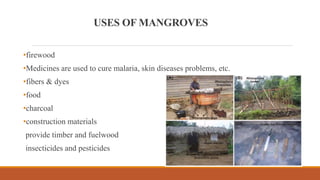
USES OF MANGROVES
•firewood
•Medicines are used to cure malaria, skin diseases problems, etc.
•fibers & dyes
•food
•charcoal
•construction materials
provide timber and fuelwood
insecticides and pesticides
MANGROVE DISAPPEARENCE
• Despite their wide-ranging benefits and importance
• mangroves are being destroyed
• degrading at an alarming rate
• The loss of mangrove species will have devastating economic
and environmental consequences
• effects on coastal communities, especially in those areas with low
mangrove diversity and high mangrove area or species loss.
GLOBALTRENDS OF MANGROVES
DISAPPEARENE
Eleven of the 70 mangrove species (16%) are at elevated threat of
extinction.
IUCN Red list threatened Particular areas of geographical concern include
the Atlantic and Pacific coasts of Central America, where as many as 40%
of mangroves species present are threatened with extinction.
By some estimate less than 50% of the world mangrove forests were
intact at the end of 20th century and half of those that remain are in poor
condition.
Globally 20% and 30% of mangrove area has been lost since
approximately 1980 and mangroves areas are disappearing at the rate of
approximately 2-8% per year.
FOR YOUR INFORMATION : the Pichavaram Mangrove Forest near
Chidambaram is the world second largest forest.
The Sundarbans mangrove ecosystem in India is evaluated as ‘endangered’ by
a global team of researchers using the IUCN’s Red List of Ecosystems
framework.
Thailand has lost 84% of its mangroves , the highest rate of mangrove loss of
any nation. While the Ivory Coast, Guinea- Bissau ,Tanzania, Mexico, Panama
,Malaysia, Pakistan and the Philippines have each lost more than 60% of their
mangrove forests.
Since in 1980 , 25% global reduction in mangrove area has been observed
.Current data suggest an average loss rate of 0.21% annually from 1996 to
2016.
Global mangrove losses and gain, 1996-2016,including annualized
percentage change
Variable 1996 2007 2010 2016 1996-2016
Extent
(km2)
142,795 138,901 137,629 136,714 -
Losses
(km2)
- 5,969 3,498 3,057 8,337
Gains (km2) - 2,074 2,227 2,142 2,356
% Change - -273 -0.92 -0.66 -4.26
Annual %
Change
- -0.25 -0.31 -0.11 -0.21
DISAPPEARENCE TRENDS IN PAKISTAN
There is no doubt that a substantial reduction in the extent of
mangroves, both in area and density (thickness) has taken place. This
has been reported by the various national and international agencies.
 Report of the “National Commission on Agriculture”(1988) states
that the Indus Delta ( Karachi ) has shrunk to ten percent of the
original 26,000 sq.km due to the scarcity of fresh water.
Federal minister for Maritime Affairs, Syed Ali Haider Zaidi ,while
talking about mangrove destruction, claimed the entire area along
Mauripur road might also vanish due to warm climates.
According to ICUN report the Indus Delta, Sandspit, Jiwini ,Kalmat
Khor and Miani Hor are under Red list.
In1999, in the Forestry Sector Master Plan (FSMP), the mangrove
forest extent was visually determined from Land sat images of 1988 -
1991, and was estimated to be 155,369 ha.
National Forest and Range Resources Assessment Study(NFRRAS),
Land sat images of 1997-2001 were automatically processed and the
mangrove areas was estimated to be 158,000ha.
Totally, only 6% of land in Pakistan is covered by forests out of
which less than 3% are mangrove forests which are threatened due to
global warming.
 THREATS TO MANGROVES
Mangrove forests are among the most threatened habitats in the world.
Preserving mangroves is difficult because of development in the form of:
SHRIMP FARMING
By far the greatest threat to the world's mangrove forests is the rapidly
expanding shrimp aquaculture industry.
•Hundreds of thousands of acres of lush wetlands have been cleared.
•Shrimp farmers dig channels to supply the ponds with enormous quantities
of freshwater and seawater.
Alter the natural flow of water that maintains the health of
surrounding mangroves .
Shrimp farmers also use massive amounts of chemicals and
antibiotics to keep the overcrowded shrimp healthy.
In the U.S., the average per
 capita consumption of shrimp
 is four pounds per annum.
 Tourism
Tourism is a booming industry and an important source of income in
many developing nations.
Tourists pollute mangroves with garbage, sewage, noise, fumes,
lights, and other disturbances that can damage mangroves and the
surrounding ecosystems.
 Coastal Development
Coastal development takes many forms.
Streams and wetlands are filled by roads and concrete .
Pollutants that accompany development can damage individual trees or whole
tracts of mangroves.
Rivers that once traveled through the mangroves
 before emptying into the
 sea are blocked.
 Charcoal and Lumber Industries
Chopping down mangroves for charcoal and timber is an important
cottage industry for many coastal communities.
Mangrove wood is used for building material, fencing, and fuel.
In places where fishing has declined below subsistence levels, many
people
 have turned to charcoal
 production for their livelihood.
 CLIMATE CHANGE
For mangroves, sea level rise is the biggest climate-related threat.
Rising sea levels wash away mud, depriving mangroves of the soil they thrive
in and eventually leading to the mangroves dying from oxygen deprivation.
 AGRICULTURE
Many thousands of acres of mangrove forest have been destroyed to
make way for
rice paddies
 rubber trees
 palm oil plantations
 other forms of agriculture.
Farmers often use fertilizers
and chemicals.
 CAUSES OF MANGROVES DESRUCTION
Water pollution
Fertilizer runoff
Industrial waste
Agriculture
Urbanization
Deforestation
Death of coral reefs
Oil spills
 EFFECTS OF MANGROVES DESTRUCTION
Loss of Biodiversity
Environmental Degradation
Coastal Erosion
Reduction of sea grasses and coral reefs
Global Warming
Loss of Livelihoods
Conservation of Mangroves
Initiation of conservation plans
Importance:
Mangroves are crucial in addressing climate change by providing carbon storage
and reducing the emission of CO2 in environment.
They provide habitat to several terrestrial and aquatic wildlife.
They help crossover between ecosystems.
Act as final refuges for species left stranded by habitat loss.
Conservation:
A key issue is not just destruction but degradation of mangrove ecosystems,
through pollution, siltation, changes in salinity or loss of biodiversity due to
urban and agriculture development, aquaculture and deforestation.
Mangrove conservation plans challenge for legal frameworks and assessment
of outcomes.
 Including measures of degradation
 understanding of the seriousness of the problem and increasing coverage of
area with trees
Global action for mangrove recovery
Although mangroves have seen a decline over the past 35 years, these critical
systems can still be protected. A recent scientific model estimated that 6,600
square kilometers of mangrove areas lost since 1996 are “highly restorable.”
the GMA and partners have launched an online platform called the Global
Mangrove Watch that provides near real-time data on where and what changes
are occurring to mangroves across the world.
The tool’s information on topography, soil conditions and hydrology can help
various stakeholders direct mangrove restoration and spatially plan for the most
effective climate and biodiversity strategies.
TNC has been doing mangrove restoration work for decades, in countries from
Mexico to Indonesia
Pakistan restores mangroves
Mangroves are also a central part of the Pakistan government’s ambitious ‘Ten
Billion Tree Tsunami’ drive. Led by Prime Minister Imran Khan and supported by
UNEP, Pakistan has committed to planting 10 billion trees by 2023. Millions, if not
billions, of these trees will be mangroves. By the end of June, this year one billion
trees will have already been planted.
The IUCN has worked on projects including one with the Pakistani Navy to plant
seven million mangrove plants and also public-private enterprises with Engro
Elengy Terminal Private Limited (EETPL) in the Port Qasim area of Karachi.
‘As a result of joint efforts of government departments, non-profit organizations
and corporations, mangrove forest cover in the Indus Delta has increased from
86,000 hectares in 2005 to over 130,000 hectares in 2021. These forests are the
lifeline of the Indus Delta
“Restoring mangroves is five times
more cost effective than building
‘grey infrastructure’ such as flood
walls, which also don’t help with
climate change.”
Makkio Yashiro, regional ecosystems coordinator for UNEP
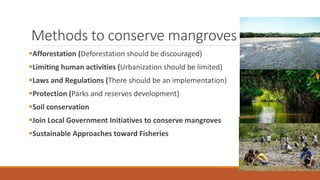
Methods to conserve mangroves
Afforestation (Deforestation should be discouraged)
Limiting human activities (Urbanization should be limited)
Laws and Regulations (There should be an implementation)
Protection (Parks and reserves development)
Soil conservation
Join Local Government Initiatives to conserve mangroves
Sustainable Approaches toward Fisheries
Effects of conservation of mangroves
Mangroves not only support nature but also economy of country. UNEP studies find
that every dollar invested in mangrove restoration there is a benefit of four dollars.
It has been experienced that the damage due to tidal surges and storms is much less
with the presence of mangroves. This was evident during the Indian Ocean Tsunami
where mangroves acted as barriers to reduce the force of the waves in some locations.
With mangrove rehabilitation, fish stocks are reviving, and the livelihood of local
people is improving. It enhances the resilience of local communities on climate
change and promote sustainable management of mangroves in Indus Delta.
Mangroves contribute to building the soil they grow on. Loose sediments are swept
into mangroves with the tides and river currents, where they are trapped and
supplemented with organic matter to form stable soils
Thank You!

Mangroves.ppt

  • 1.
    Mangroves Presentation BY MARWAH(31), ALISHBARAZZAQ(32), ALISHBA ZAINAB(53E), MAHEEN(22),HADIA(30)
  • 2.
    Contents Slide Numbers MANGROVES 3 CHARACTERISTICSOF MANGROVE 4 HABITAT OF MANGROVE 5 ADAPTATIONS OF MANGROVE 6 TYPES OF MANGROVE 7 GEOGRAPHICAL DISTRIBUTION 11 LOCATION OF MANGROVE 14 IMPORTANCE OF MANGROVE 16 USE OF MANGROVE 17 MANGROVE DISAPPEARANCE 18 THREATS TO MANGROVE 24 CONSERVATION OF MANGROVE 33
  • 3.
    MANGROVE • Mangrove area group of small trees and shrubs numbering some 80 species. • They are the only trees that can tolerate saltwater, excreting the excess salt through their leaves. .MANGROVE FOREST • A collection of mangrove trees in an area makes up a mangrove habitat, mangrove swamp, mangrove forest. • A mangrove forest is a collection of mangrove plants that together form a habitat.
  • 4.
    CHARACTERISTICS OF MANGROVE •Theyare halophytic (salt loving). •Mangrove come in a variety of sizes. •Fishes are liable flock to mangrove. •Mangroves live on the edge. •Live in harsh and unpredictable interference between land and sea. •Dense and evergreen plant. •It can survive in both fresh and salt water.
  • 5.
    HABITAT OF MANGROVE •Mangrovegrow in intertidal or estuarine areas. •They are found in warmer areas between the latitudes of 32 degrees north and 38 degrees south, as they need to live in areas where the • Average annual temp. is 66 F. •Mangrove were originally found in South Asia but •have been disbursed around the world and are now found along the tropical and subtropical coasts of Africa, Asia, and North and South America. •In the US mangroves are commonly found in Florida.
  • 6.
    ADAPTATIONS OF MANGROVE •Allmangroves have special adaptations that allow them survive in their salty environment. •Their unusual root systems give them support and stability in the loose soil. •Mangrove plant are unique in that they live young (viviparous). •The seed remains attached to the parents plant until it germinates.
  • 7.
    TYPES OF MANGROVE 1.FRINGE: Fringe mangrove grow on shorelines in relatively thin strips of forest. 2. BASIN: Basin mangrove are highly useful for nutrient accumulation. 3.RIVERINE: Riverine mangroves line the banks of rivers and are flooded by the river and the sea.
  • 8.
    4.Overwash Over wash mangrovesare similar to fringe mangroves, except they are located on small islands, submerged regularly by the sea. 5.DWARF: Dwarf mangrove forests are forests where the trees can grow five feet or 1.5 meters tall.
  • 10.
    TYPES OF MAGROVEIN FLORIDA Florida mangrove include 4 tree species. The red mangrove. The black mangrove. The white mangrove. The buttonwood.
  • 11.
    GEOGRAPHICAL DISTRIBUTION OF MANGROVES Thereare approximately 54-75 species of mangroves distributed worldwide . Tropical coastlines 75% between 25%N and 25%S • East coast of Africa, Australia, and New Zealand where mangroves occur 10-15° farther south. • Japan, Florida, Bermuda, and the Red Sea, this range extends 5-7° farther north. • Mangroves in the Indo-West Pacific are more diverse, consisting of more than 30 tree species, than those in Florida. • The Ten Thousand Islands in southwest Florida has the highest concentrations of mangroves in the state. • Mangroves are adapted to harsh conditions of high salinity, warm air and water temperatures, extreme tides, muddy, sediment-laden waters, and oxygen-depleted soils.
  • 12.
    MAP OF DISTRIBUTION ◦The countries with the largest area of mangroves are: 1. Indonesia 2. Brazil 3. Australia 4. Nigeria 5. Mexico There are 16-24 families and 54-75 species worldwide of mangroves. The greatest mangrove species diversity exists in SE Asia. 12 mangrove species are found in the America.
  • 13.
  • 14.
    LOCATION OF MANGROVES •Relative density of mangroves covers an estimated 137,760 square kilometers (53,190 square miles) of Earth’s surface. • Coastal forests can be found in 118 countries and territories • 75 percent of their area occurs in just 15 countries. • About 42 percent of the world’s mangroves are found in Asia, with 21 percent in Africa, 15 percent in North and Central America, 12 percent in Australia and the islands of Oceania, and 11 percent in South America. • 12.3 percent less area covered by mangroves.
  • 15.
    LOCATION OF MANGROVES •Only 6.9 percent of mangrove forests are protected by law. • Indonesia includes as many as 17,000 islands and nearly a quarter of the world's mangroves. Yet those forests have been cut in half in the past three decades, shrinking from 4.2 million hectares in 1982 to 2 million in 2000. Of the remaining forests, nearly 70 percent are “in critical condition and seriously damaged,” reported Fadel Muhammad, Indonesia’s minister of fisheries and marine affairs. • Australia has the third largest area of mangroves in the world (after Indonesia and Brazil), and approximately 6.4 percent of the world’s total mangrove area.
  • 16.
    IMPORTANCE OF MANGROVES Soilstabilization & erosion protection. Keeps coastal zones healthy. Provides shelter and habitat to wildlife species e.g: Birds, deer, fishes, honeybees. Mangroves protect both the saltwater and the freshwater ecosystems they straddle. Protect people from waves and storms. The mangrove trees themselves provide fuel, medicines, tannins, and wood for building houses and boats. Flood mitigation and sequestration of carbon dioxide.
  • 17.
    USES OF MANGROVES •firewood •Medicinesare used to cure malaria, skin diseases problems, etc. •fibers & dyes •food •charcoal •construction materials provide timber and fuelwood insecticides and pesticides
  • 18.
    MANGROVE DISAPPEARENCE • Despitetheir wide-ranging benefits and importance • mangroves are being destroyed • degrading at an alarming rate • The loss of mangrove species will have devastating economic and environmental consequences • effects on coastal communities, especially in those areas with low mangrove diversity and high mangrove area or species loss.
  • 19.
    GLOBALTRENDS OF MANGROVES DISAPPEARENE Elevenof the 70 mangrove species (16%) are at elevated threat of extinction. IUCN Red list threatened Particular areas of geographical concern include the Atlantic and Pacific coasts of Central America, where as many as 40% of mangroves species present are threatened with extinction. By some estimate less than 50% of the world mangrove forests were intact at the end of 20th century and half of those that remain are in poor condition. Globally 20% and 30% of mangrove area has been lost since approximately 1980 and mangroves areas are disappearing at the rate of approximately 2-8% per year.
  • 20.
    FOR YOUR INFORMATION: the Pichavaram Mangrove Forest near Chidambaram is the world second largest forest. The Sundarbans mangrove ecosystem in India is evaluated as ‘endangered’ by a global team of researchers using the IUCN’s Red List of Ecosystems framework. Thailand has lost 84% of its mangroves , the highest rate of mangrove loss of any nation. While the Ivory Coast, Guinea- Bissau ,Tanzania, Mexico, Panama ,Malaysia, Pakistan and the Philippines have each lost more than 60% of their mangrove forests. Since in 1980 , 25% global reduction in mangrove area has been observed .Current data suggest an average loss rate of 0.21% annually from 1996 to 2016.
  • 21.
    Global mangrove lossesand gain, 1996-2016,including annualized percentage change Variable 1996 2007 2010 2016 1996-2016 Extent (km2) 142,795 138,901 137,629 136,714 - Losses (km2) - 5,969 3,498 3,057 8,337 Gains (km2) - 2,074 2,227 2,142 2,356 % Change - -273 -0.92 -0.66 -4.26 Annual % Change - -0.25 -0.31 -0.11 -0.21
  • 22.
    DISAPPEARENCE TRENDS INPAKISTAN There is no doubt that a substantial reduction in the extent of mangroves, both in area and density (thickness) has taken place. This has been reported by the various national and international agencies.  Report of the “National Commission on Agriculture”(1988) states that the Indus Delta ( Karachi ) has shrunk to ten percent of the original 26,000 sq.km due to the scarcity of fresh water. Federal minister for Maritime Affairs, Syed Ali Haider Zaidi ,while talking about mangrove destruction, claimed the entire area along Mauripur road might also vanish due to warm climates.
  • 23.
    According to ICUNreport the Indus Delta, Sandspit, Jiwini ,Kalmat Khor and Miani Hor are under Red list. In1999, in the Forestry Sector Master Plan (FSMP), the mangrove forest extent was visually determined from Land sat images of 1988 - 1991, and was estimated to be 155,369 ha. National Forest and Range Resources Assessment Study(NFRRAS), Land sat images of 1997-2001 were automatically processed and the mangrove areas was estimated to be 158,000ha. Totally, only 6% of land in Pakistan is covered by forests out of which less than 3% are mangrove forests which are threatened due to global warming.
  • 24.
     THREATS TOMANGROVES Mangrove forests are among the most threatened habitats in the world. Preserving mangroves is difficult because of development in the form of: SHRIMP FARMING By far the greatest threat to the world's mangrove forests is the rapidly expanding shrimp aquaculture industry. •Hundreds of thousands of acres of lush wetlands have been cleared. •Shrimp farmers dig channels to supply the ponds with enormous quantities of freshwater and seawater.
  • 25.
    Alter the naturalflow of water that maintains the health of surrounding mangroves . Shrimp farmers also use massive amounts of chemicals and antibiotics to keep the overcrowded shrimp healthy. In the U.S., the average per  capita consumption of shrimp  is four pounds per annum.
  • 26.
     Tourism Tourism isa booming industry and an important source of income in many developing nations. Tourists pollute mangroves with garbage, sewage, noise, fumes, lights, and other disturbances that can damage mangroves and the surrounding ecosystems.
  • 27.
     Coastal Development Coastaldevelopment takes many forms. Streams and wetlands are filled by roads and concrete . Pollutants that accompany development can damage individual trees or whole tracts of mangroves. Rivers that once traveled through the mangroves  before emptying into the  sea are blocked.
  • 28.
     Charcoal andLumber Industries Chopping down mangroves for charcoal and timber is an important cottage industry for many coastal communities. Mangrove wood is used for building material, fencing, and fuel. In places where fishing has declined below subsistence levels, many people  have turned to charcoal  production for their livelihood.
  • 29.
     CLIMATE CHANGE Formangroves, sea level rise is the biggest climate-related threat. Rising sea levels wash away mud, depriving mangroves of the soil they thrive in and eventually leading to the mangroves dying from oxygen deprivation.
  • 30.
     AGRICULTURE Many thousandsof acres of mangrove forest have been destroyed to make way for rice paddies  rubber trees  palm oil plantations  other forms of agriculture. Farmers often use fertilizers and chemicals.
  • 31.
     CAUSES OFMANGROVES DESRUCTION Water pollution Fertilizer runoff Industrial waste Agriculture Urbanization Deforestation Death of coral reefs Oil spills
  • 32.
     EFFECTS OFMANGROVES DESTRUCTION Loss of Biodiversity Environmental Degradation Coastal Erosion Reduction of sea grasses and coral reefs Global Warming Loss of Livelihoods
  • 33.
    Conservation of Mangroves Initiationof conservation plans Importance: Mangroves are crucial in addressing climate change by providing carbon storage and reducing the emission of CO2 in environment. They provide habitat to several terrestrial and aquatic wildlife. They help crossover between ecosystems. Act as final refuges for species left stranded by habitat loss.
  • 34.
    Conservation: A key issueis not just destruction but degradation of mangrove ecosystems, through pollution, siltation, changes in salinity or loss of biodiversity due to urban and agriculture development, aquaculture and deforestation. Mangrove conservation plans challenge for legal frameworks and assessment of outcomes.  Including measures of degradation  understanding of the seriousness of the problem and increasing coverage of area with trees
  • 35.
    Global action formangrove recovery Although mangroves have seen a decline over the past 35 years, these critical systems can still be protected. A recent scientific model estimated that 6,600 square kilometers of mangrove areas lost since 1996 are “highly restorable.” the GMA and partners have launched an online platform called the Global Mangrove Watch that provides near real-time data on where and what changes are occurring to mangroves across the world. The tool’s information on topography, soil conditions and hydrology can help various stakeholders direct mangrove restoration and spatially plan for the most effective climate and biodiversity strategies. TNC has been doing mangrove restoration work for decades, in countries from Mexico to Indonesia
  • 36.
    Pakistan restores mangroves Mangrovesare also a central part of the Pakistan government’s ambitious ‘Ten Billion Tree Tsunami’ drive. Led by Prime Minister Imran Khan and supported by UNEP, Pakistan has committed to planting 10 billion trees by 2023. Millions, if not billions, of these trees will be mangroves. By the end of June, this year one billion trees will have already been planted. The IUCN has worked on projects including one with the Pakistani Navy to plant seven million mangrove plants and also public-private enterprises with Engro Elengy Terminal Private Limited (EETPL) in the Port Qasim area of Karachi. ‘As a result of joint efforts of government departments, non-profit organizations and corporations, mangrove forest cover in the Indus Delta has increased from 86,000 hectares in 2005 to over 130,000 hectares in 2021. These forests are the lifeline of the Indus Delta
  • 37.
    “Restoring mangroves isfive times more cost effective than building ‘grey infrastructure’ such as flood walls, which also don’t help with climate change.” Makkio Yashiro, regional ecosystems coordinator for UNEP
  • 38.
    Methods to conservemangroves Afforestation (Deforestation should be discouraged) Limiting human activities (Urbanization should be limited) Laws and Regulations (There should be an implementation) Protection (Parks and reserves development) Soil conservation Join Local Government Initiatives to conserve mangroves Sustainable Approaches toward Fisheries
  • 39.
    Effects of conservationof mangroves Mangroves not only support nature but also economy of country. UNEP studies find that every dollar invested in mangrove restoration there is a benefit of four dollars. It has been experienced that the damage due to tidal surges and storms is much less with the presence of mangroves. This was evident during the Indian Ocean Tsunami where mangroves acted as barriers to reduce the force of the waves in some locations. With mangrove rehabilitation, fish stocks are reviving, and the livelihood of local people is improving. It enhances the resilience of local communities on climate change and promote sustainable management of mangroves in Indus Delta. Mangroves contribute to building the soil they grow on. Loose sediments are swept into mangroves with the tides and river currents, where they are trapped and supplemented with organic matter to form stable soils
  • 40.

Editor's Notes

  • #21  International Union for the Conservation of Nature (IUCN)