
By: DR. PAMELA JOSEFINA T. FABIE
 Mastication
 Deglutition
 Speech
 Respiration
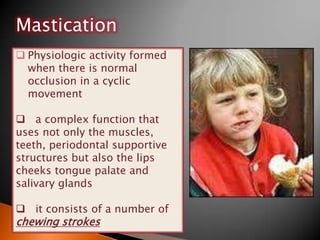
 Physiologic activity formed
when there is normal
occlusion in a cyclic
movement
 a complex function that
uses not only the muscles,
teeth, periodontal supportive
structures but also the lips
cheeks tongue palate and
salivary glands
 it consists of a number of
chewing strokes
Mastication
Mastication
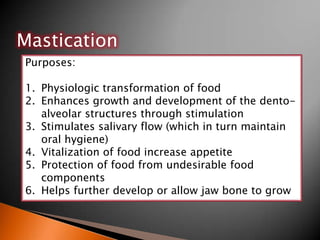
Purposes:
1. Physiologic transformation of food
2. Enhances growth and development of the dento-
alveolar structures through stimulation
3. Stimulates salivary flow (which in turn maintain
oral hygiene)
4. Vitalization of food increase appetite
5. Protection of food from undesirable food
components
6. Helps further develop or allow jaw bone to grow
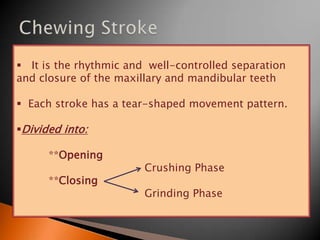
 It is the rhythmic and well-controlled separation
and closure of the maxillary and mandibular teeth
 Each stroke has a tear-shaped movement pattern.
Divided into:
**Opening
Crushing Phase
**Closing
Grinding Phase
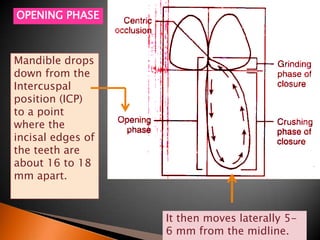
Mandible drops
down from the
Intercuspal
position (ICP)
to a point
where the
incisal edges of
the teeth are
about 16 to 18
mm apart.
It then moves laterally 5-
6 mm from the midline.
OPENING PHASE
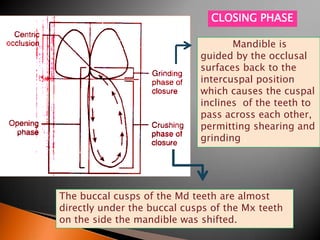
The buccal cusps of the Md teeth are almost
directly under the buccal cusps of the Mx teeth
on the side the mandible was shifted.
Mandible is
guided by the occlusal
surfaces back to the
intercuspal position
which causes the cuspal
inclines of the teeth to
pass across each other,
permitting shearing and
grinding .
CLOSING PHASE
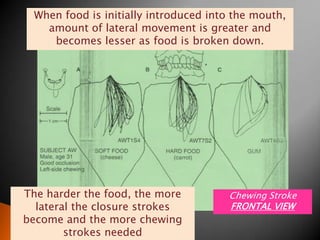
When food is initially introduced into the mouth,
amount of lateral movement is greater and
becomes lesser as food is broken down.
The harder the food, the more
lateral the closure strokes
become and the more chewing
strokes needed
Chewing Stroke
FRONTAL VIEW
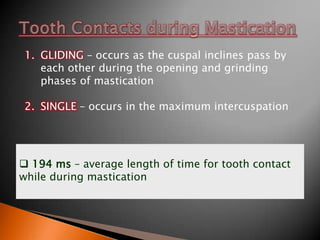
1. GLIDING – occurs as the cuspal inclines pass by
each other during the opening and grinding
phases of mastication
2. SINGLE – occurs in the maximum intercuspation
 194 ms – average length of time for tooth contact
while during mastication
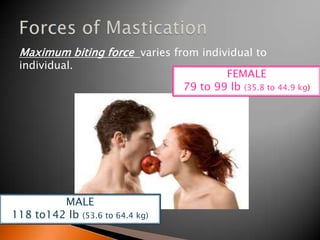
Maximum biting force varies from individual to
individual.
MALE
118 to142 lb (53.6 to 64.4 kg)
FEMALE
79 to 99 lb (35.8 to 44.9 kg)
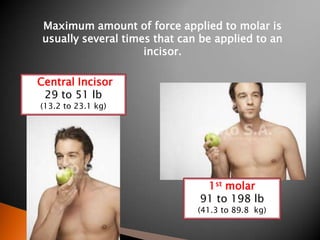
Maximum amount of force applied to molar is
usually several times that can be applied to an
incisor.
Central Incisor
29 to 51 lb
(13.2 to 23.1 kg)
1st molar
91 to 198 lb
(41.3 to 89.8 kg)
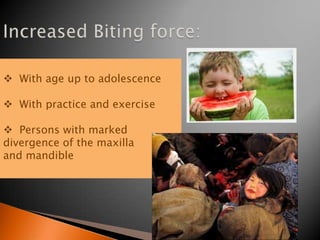
 With age up to adolescence
 With practice and exercise
 Persons with marked
divergence of the maxilla
and mandible
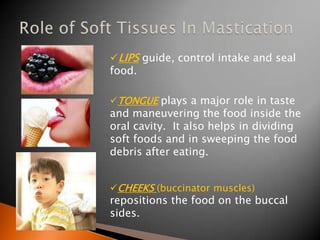
LIPS guide, control intake and seal
food.
TONGUE plays a major role in taste
and maneuvering the food inside the
oral cavity. It also helps in dividing
soft foods and in sweeping the food
debris after eating.
CHEEKS (buccinator muscles)
repositions the food on the buccal
sides.
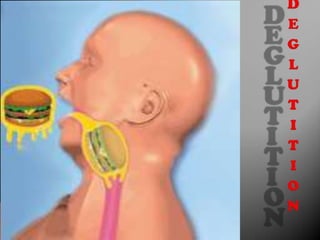
 aka “Deglutition”; an innate function
 the series of coordinated muscle contraction
that moves a bolus of food from the oral cavity
through the esophagus to the stomach.
The decision to swallow depends on several
factors:
•Degree of fineness of the food
•Intensity of the taste extracted
•Degree of lubrication of the bolus
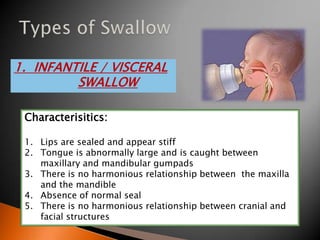
1. INFANTILE / VISCERAL
SWALLOW
Characterisitics:
1. Lips are sealed and appear stiff
2. Tongue is abnormally large and is caught between
maxillary and mandibular gumpads
3. There is no harmonious relationship between the maxilla
and the mandible
4. Absence of normal seal
5. There is no harmonious relationship between cranial and
facial structures
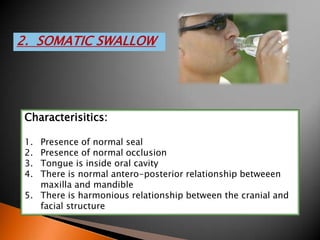
2. SOMATIC SWALLOW
Characterisitics:
1. Presence of normal seal
2. Presence of normal occlusion
3. Tongue is inside oral cavity
4. There is normal antero-posterior relationship betweeen
maxilla and mandible
5. There is harmonious relationship between the cranial and
facial structure
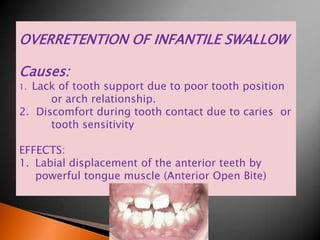
OVERRETENTION OF INFANTILE SWALLOW
Causes:
1. Lack of tooth support due to poor tooth position
or arch relationship.
2. Discomfort during tooth contact due to caries or
tooth sensitivity
EFFECTS:
1. Labial displacement of the anterior teeth by
powerful tongue muscle (Anterior Open Bite)
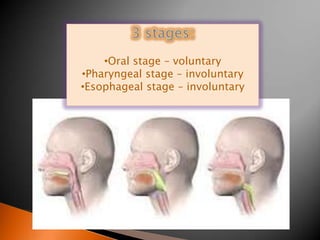
•Oral stage – voluntary
•Pharyngeal stage – involuntary
•Esophageal stage – involuntary
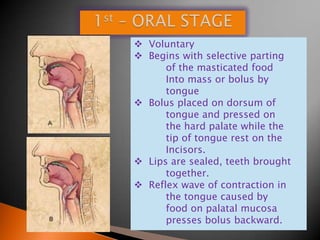
 Voluntary
 Begins with selective parting
of the masticated food
Into mass or bolus by
tongue
 Bolus placed on dorsum of
tongue and pressed on
the hard palate while the
tip of tongue rest on the
Incisors.
 Lips are sealed, teeth brought
together.
 Reflex wave of contraction in
the tongue caused by
food on palatal mucosa
presses bolus backward.
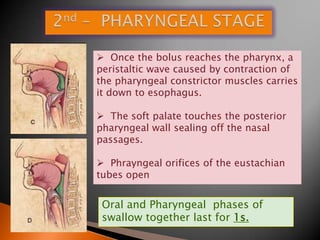
 Once the bolus reaches the pharynx, a
peristaltic wave caused by contraction of
the pharyngeal constrictor muscles carries
it down to esophagus.
 The soft palate touches the posterior
pharyngeal wall sealing off the nasal
passages.
 Phrayngeal orifices of the eustachian
tubes open
Oral and Pharyngeal phases of
swallow together last for 1s.
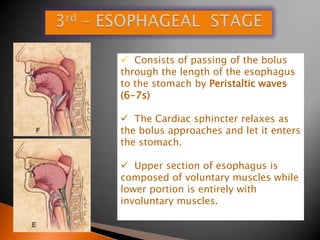
 Consists of passing of the bolus
through the length of the esophagus
to the stomach by Peristaltic waves
(6-7s)
 The Cardiac sphincter relaxes as
the bolus approaches and let it enters
the stomach.
 Upper section of esophagus is
composed of voluntary muscles while
lower portion is entirely with
involuntary muscles.
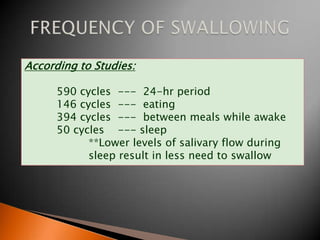
According to Studies:
590 cycles --- 24-hr period
146 cycles --- eating
394 cycles --- between meals while awake
50 cycles --- sleep
**Lower levels of salivary flow during
sleep result in less need to swallow
 DYSPHAGIA – difficulty in swallowing
 ODYNOPHAGIA – painful swallowing
 APHAGIA – absence of swallowing due to paralysis of muscles
of deglutition or mastication
 Abnormal growth of esophagus – cancer, tumor, outgrowth
or overgroath
 3rd major function of the stomatognathic
system
 It occurs when a volume of air is forced
from the lungs by the diaphragm through the
larynx and the oral cavity.
 Controlled contraction and relaxation of the
larynx create a sound with desired PITCH.
 It occurs during the expiration stage of
respiration
 Afferent mechanism – those involved in hearing and
sight
 Association areas – those involved in:
A. seat of learning and memory
B. seat of habits and condition habits
C. cerebral cortex and molar centers
 Efferent mechanism – involves the nerves that
supplies the muscles involved in speech
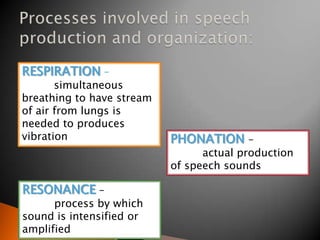
RESPIRATION –
simultaneous
breathing to have stream
of air from lungs is
needed to produces
vibration PHONATION –
actual production
of speech sounds
RESONANCE –
process by which
sound is intensified or
amplified
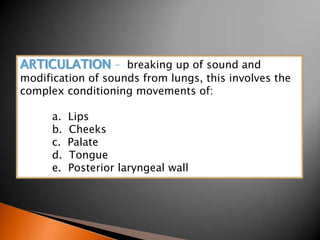
ARTICULATION – breaking up of sound and
modification of sounds from lungs, this involves the
complex conditioning movements of:
a. Lips
b. Cheeks
c. Palate
d. Tongue
e. Posterior laryngeal wall
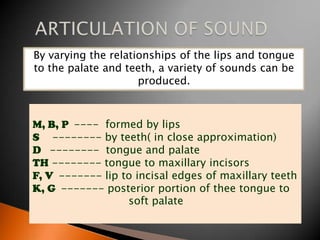
By varying the relationships of the lips and tongue
to the palate and teeth, a variety of sounds can be
produced.
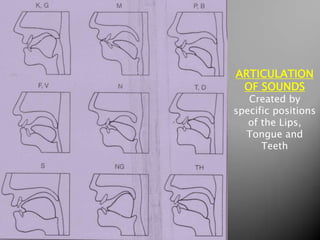
M, B, P ---- formed by lips
S -------- by teeth( in close approximation)
D -------- tongue and palate
TH -------- tongue to maxillary incisors
F, V ------- lip to incisal edges of maxillary teeth
K, G ------- posterior portion of thee tongue to
soft palate
ARTICULATION
OF SOUNDS
Created by
specific positions
of the Lips,
Tongue and
Teeth
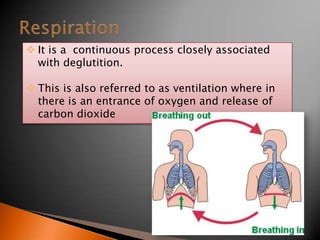
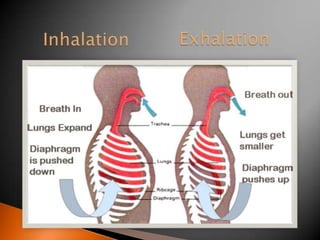
 It is a continuous process closely associated
with deglutition.
 This is also referred to as ventilation where in
there is an entrance of oxygen and release of
carbon dioxide
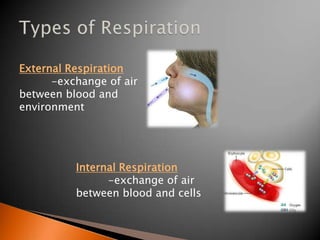
External Respiration
-exchange of air
between blood and
environment
Internal Respiration
-exchange of air
between blood and cells
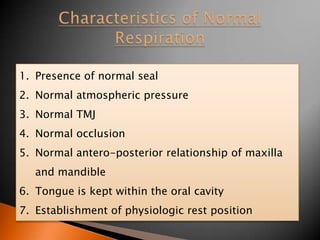
1. Presence of normal seal
2. Normal atmospheric pressure
3. Normal TMJ
4. Normal occlusion
5. Normal antero-posterior relationship of maxilla
and mandible
6. Tongue is kept within the oral cavity
7. Establishment of physiologic rest position
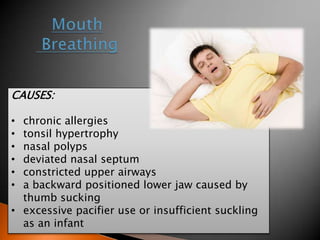
CAUSES:
• chronic allergies
• tonsil hypertrophy
• nasal polyps
• deviated nasal septum
• constricted upper airways
• a backward positioned lower jaw caused by
thumb sucking
• excessive pacifier use or insufficient suckling
as an infant
Functions of Stomatognathic System

Functions of Stomatognathic System

  • 1.
    By: DR. PAMELAJOSEFINA T. FABIE
  • 2.
  • 4.
     Physiologic activityformed when there is normal occlusion in a cyclic movement  a complex function that uses not only the muscles, teeth, periodontal supportive structures but also the lips cheeks tongue palate and salivary glands  it consists of a number of chewing strokes Mastication
  • 5.
    Mastication Purposes: 1. Physiologic transformationof food 2. Enhances growth and development of the dento- alveolar structures through stimulation 3. Stimulates salivary flow (which in turn maintain oral hygiene) 4. Vitalization of food increase appetite 5. Protection of food from undesirable food components 6. Helps further develop or allow jaw bone to grow
  • 6.
     It isthe rhythmic and well-controlled separation and closure of the maxillary and mandibular teeth  Each stroke has a tear-shaped movement pattern. Divided into: **Opening Crushing Phase **Closing Grinding Phase
  • 7.
    Mandible drops down fromthe Intercuspal position (ICP) to a point where the incisal edges of the teeth are about 16 to 18 mm apart. It then moves laterally 5- 6 mm from the midline. OPENING PHASE
  • 8.
    The buccal cuspsof the Md teeth are almost directly under the buccal cusps of the Mx teeth on the side the mandible was shifted. Mandible is guided by the occlusal surfaces back to the intercuspal position which causes the cuspal inclines of the teeth to pass across each other, permitting shearing and grinding . CLOSING PHASE
  • 9.
    When food isinitially introduced into the mouth, amount of lateral movement is greater and becomes lesser as food is broken down. The harder the food, the more lateral the closure strokes become and the more chewing strokes needed Chewing Stroke FRONTAL VIEW
  • 10.
    1. GLIDING –occurs as the cuspal inclines pass by each other during the opening and grinding phases of mastication 2. SINGLE – occurs in the maximum intercuspation  194 ms – average length of time for tooth contact while during mastication
  • 11.
    Maximum biting forcevaries from individual to individual. MALE 118 to142 lb (53.6 to 64.4 kg) FEMALE 79 to 99 lb (35.8 to 44.9 kg)
  • 12.
    Maximum amount offorce applied to molar is usually several times that can be applied to an incisor. Central Incisor 29 to 51 lb (13.2 to 23.1 kg) 1st molar 91 to 198 lb (41.3 to 89.8 kg)
  • 13.
     With ageup to adolescence  With practice and exercise  Persons with marked divergence of the maxilla and mandible
  • 14.
    LIPS guide, controlintake and seal food. TONGUE plays a major role in taste and maneuvering the food inside the oral cavity. It also helps in dividing soft foods and in sweeping the food debris after eating. CHEEKS (buccinator muscles) repositions the food on the buccal sides.
  • 16.
     aka “Deglutition”;an innate function  the series of coordinated muscle contraction that moves a bolus of food from the oral cavity through the esophagus to the stomach. The decision to swallow depends on several factors: •Degree of fineness of the food •Intensity of the taste extracted •Degree of lubrication of the bolus
  • 17.
    1. INFANTILE /VISCERAL SWALLOW Characterisitics: 1. Lips are sealed and appear stiff 2. Tongue is abnormally large and is caught between maxillary and mandibular gumpads 3. There is no harmonious relationship between the maxilla and the mandible 4. Absence of normal seal 5. There is no harmonious relationship between cranial and facial structures
  • 18.
    2. SOMATIC SWALLOW Characterisitics: 1.Presence of normal seal 2. Presence of normal occlusion 3. Tongue is inside oral cavity 4. There is normal antero-posterior relationship betweeen maxilla and mandible 5. There is harmonious relationship between the cranial and facial structure
  • 19.
    OVERRETENTION OF INFANTILESWALLOW Causes: 1. Lack of tooth support due to poor tooth position or arch relationship. 2. Discomfort during tooth contact due to caries or tooth sensitivity EFFECTS: 1. Labial displacement of the anterior teeth by powerful tongue muscle (Anterior Open Bite)
  • 20.
    •Oral stage –voluntary •Pharyngeal stage – involuntary •Esophageal stage – involuntary
  • 21.
     Voluntary  Beginswith selective parting of the masticated food Into mass or bolus by tongue  Bolus placed on dorsum of tongue and pressed on the hard palate while the tip of tongue rest on the Incisors.  Lips are sealed, teeth brought together.  Reflex wave of contraction in the tongue caused by food on palatal mucosa presses bolus backward.
  • 22.
     Once thebolus reaches the pharynx, a peristaltic wave caused by contraction of the pharyngeal constrictor muscles carries it down to esophagus.  The soft palate touches the posterior pharyngeal wall sealing off the nasal passages.  Phrayngeal orifices of the eustachian tubes open Oral and Pharyngeal phases of swallow together last for 1s.
  • 23.
     Consists ofpassing of the bolus through the length of the esophagus to the stomach by Peristaltic waves (6-7s)  The Cardiac sphincter relaxes as the bolus approaches and let it enters the stomach.  Upper section of esophagus is composed of voluntary muscles while lower portion is entirely with involuntary muscles.
  • 24.
    According to Studies: 590cycles --- 24-hr period 146 cycles --- eating 394 cycles --- between meals while awake 50 cycles --- sleep **Lower levels of salivary flow during sleep result in less need to swallow
  • 25.
     DYSPHAGIA –difficulty in swallowing  ODYNOPHAGIA – painful swallowing  APHAGIA – absence of swallowing due to paralysis of muscles of deglutition or mastication  Abnormal growth of esophagus – cancer, tumor, outgrowth or overgroath
  • 27.
     3rd majorfunction of the stomatognathic system  It occurs when a volume of air is forced from the lungs by the diaphragm through the larynx and the oral cavity.  Controlled contraction and relaxation of the larynx create a sound with desired PITCH.  It occurs during the expiration stage of respiration
  • 28.
     Afferent mechanism– those involved in hearing and sight  Association areas – those involved in: A. seat of learning and memory B. seat of habits and condition habits C. cerebral cortex and molar centers  Efferent mechanism – involves the nerves that supplies the muscles involved in speech
  • 29.
    RESPIRATION – simultaneous breathing tohave stream of air from lungs is needed to produces vibration PHONATION – actual production of speech sounds RESONANCE – process by which sound is intensified or amplified
  • 30.
    ARTICULATION – breakingup of sound and modification of sounds from lungs, this involves the complex conditioning movements of: a. Lips b. Cheeks c. Palate d. Tongue e. Posterior laryngeal wall
  • 31.
    By varying therelationships of the lips and tongue to the palate and teeth, a variety of sounds can be produced. M, B, P ---- formed by lips S -------- by teeth( in close approximation) D -------- tongue and palate TH -------- tongue to maxillary incisors F, V ------- lip to incisal edges of maxillary teeth K, G ------- posterior portion of thee tongue to soft palate
  • 32.
    ARTICULATION OF SOUNDS Created by specificpositions of the Lips, Tongue and Teeth
  • 34.
     It isa continuous process closely associated with deglutition.  This is also referred to as ventilation where in there is an entrance of oxygen and release of carbon dioxide
  • 35.
    External Respiration -exchange ofair between blood and environment Internal Respiration -exchange of air between blood and cells
  • 37.
    1. Presence ofnormal seal 2. Normal atmospheric pressure 3. Normal TMJ 4. Normal occlusion 5. Normal antero-posterior relationship of maxilla and mandible 6. Tongue is kept within the oral cavity 7. Establishment of physiologic rest position
  • 38.
    CAUSES: • chronic allergies •tonsil hypertrophy • nasal polyps • deviated nasal septum • constricted upper airways • a backward positioned lower jaw caused by thumb sucking • excessive pacifier use or insufficient suckling as an infant

Editor's Notes

  • #3 SECONDARY FXNS: Respiration and Expression of Emotions
  • #10 In some subjests, the number of chewing strokes does not change with the varying consistency of food.
  • #11 Tooth contacts occur during late stages of mastication.
  • #14 Increased biting force in eskimo populationRather than those with parallel maxilla and mandible
  • #20 However, Presence of tongue thrusting codition does not necessarily lead to altered teeth position