CLASSIFICATION OF
MALOCCLUSION
PRESENTER: SAPEEDEH AFZAL.
ROLL # 10
GROUP : A
ROAD MAP
• WHAT IS MALOCCLUSION?
• NEED OR USES FOR CLASSIFICATION.
• SYSTEMS OF CLASSIFICATION & TERMINOLOGIES.
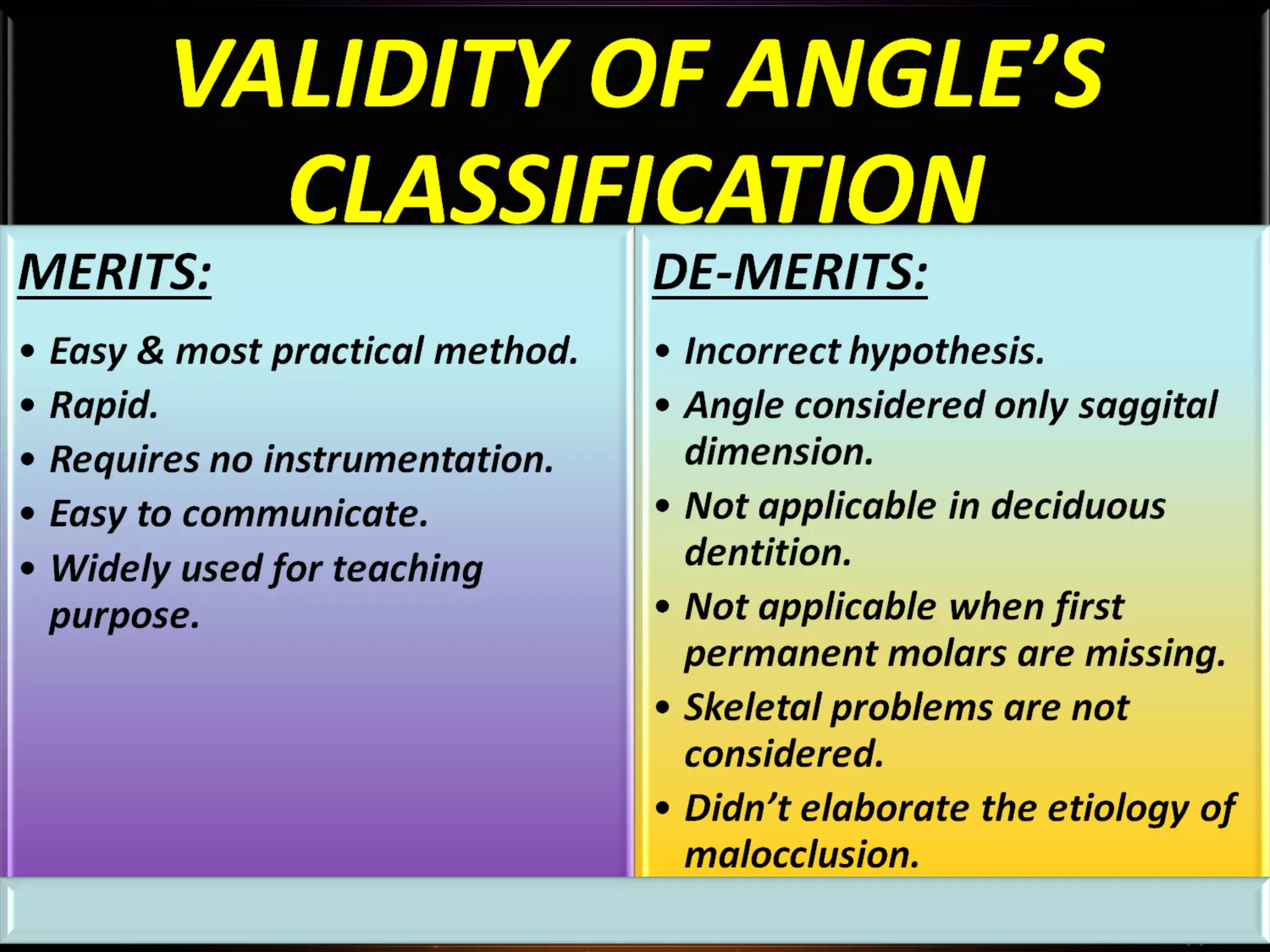
– ANGLE’S CLASSIFICATION.
• MODIFICATIONS OF ANGLE’S CLASSIFICATION.
– ANDREW’S SIX KEYS.
– SKELETAL CLASSIFICATION.
– BRITISH STANDARD CLASSIFICATION OF INCISOR
RELATIONSHIP.
– CANINE CLASSIFICATION.
– SIMON’S CLASSIFICATION.
– ACKERMAN & PROFFIT CLASSIFICATION.
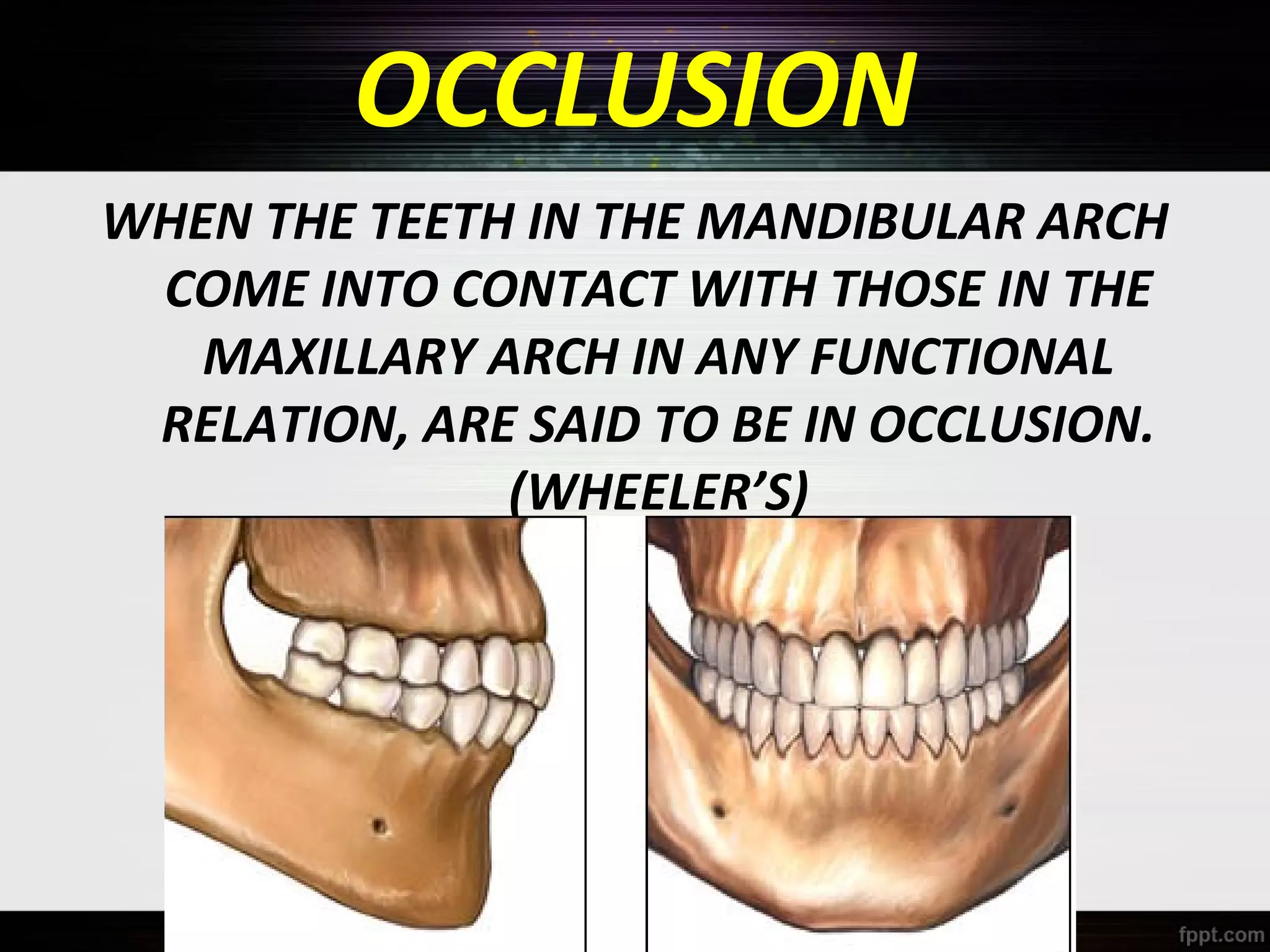
OCCLUSION
WHEN THE TEETH IN THE MANDIBULAR ARCH
COME INTO CONTACT WITH THOSE IN THE
MAXILLARY ARCH IN ANY FUNCTIONAL
RELATION, ARE SAID TO BE IN OCCLUSION.
(WHEELER’S)
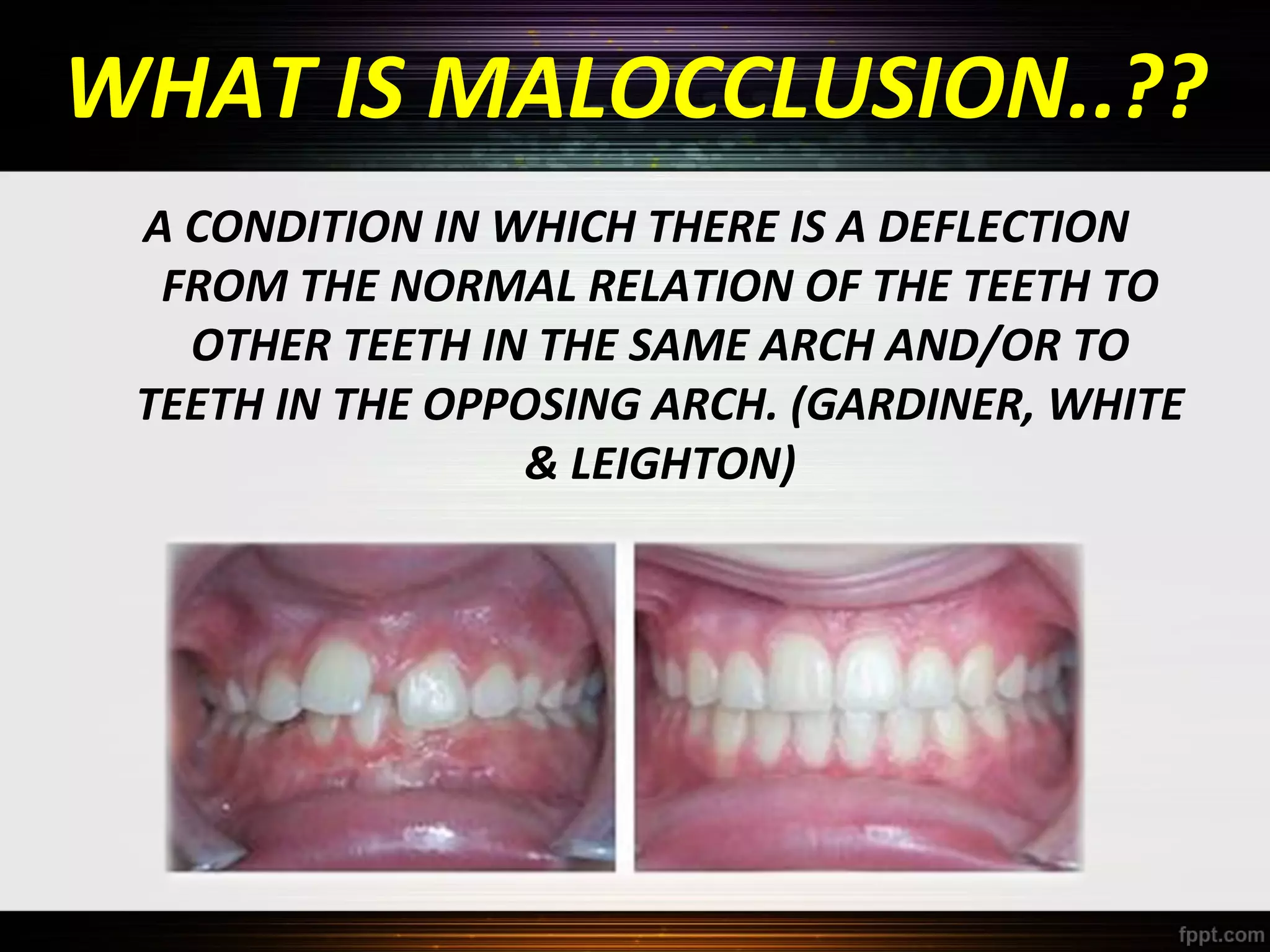
WHAT IS MALOCCLUSION..??
A CONDITION IN WHICH THERE IS A DEFLECTION
FROM THE NORMAL RELATION OF THE TEETH TO
OTHER TEETH IN THE SAME ARCH AND/OR TO
TEETH IN THE OPPOSING ARCH. (GARDINER, WHITE
& LEIGHTON)
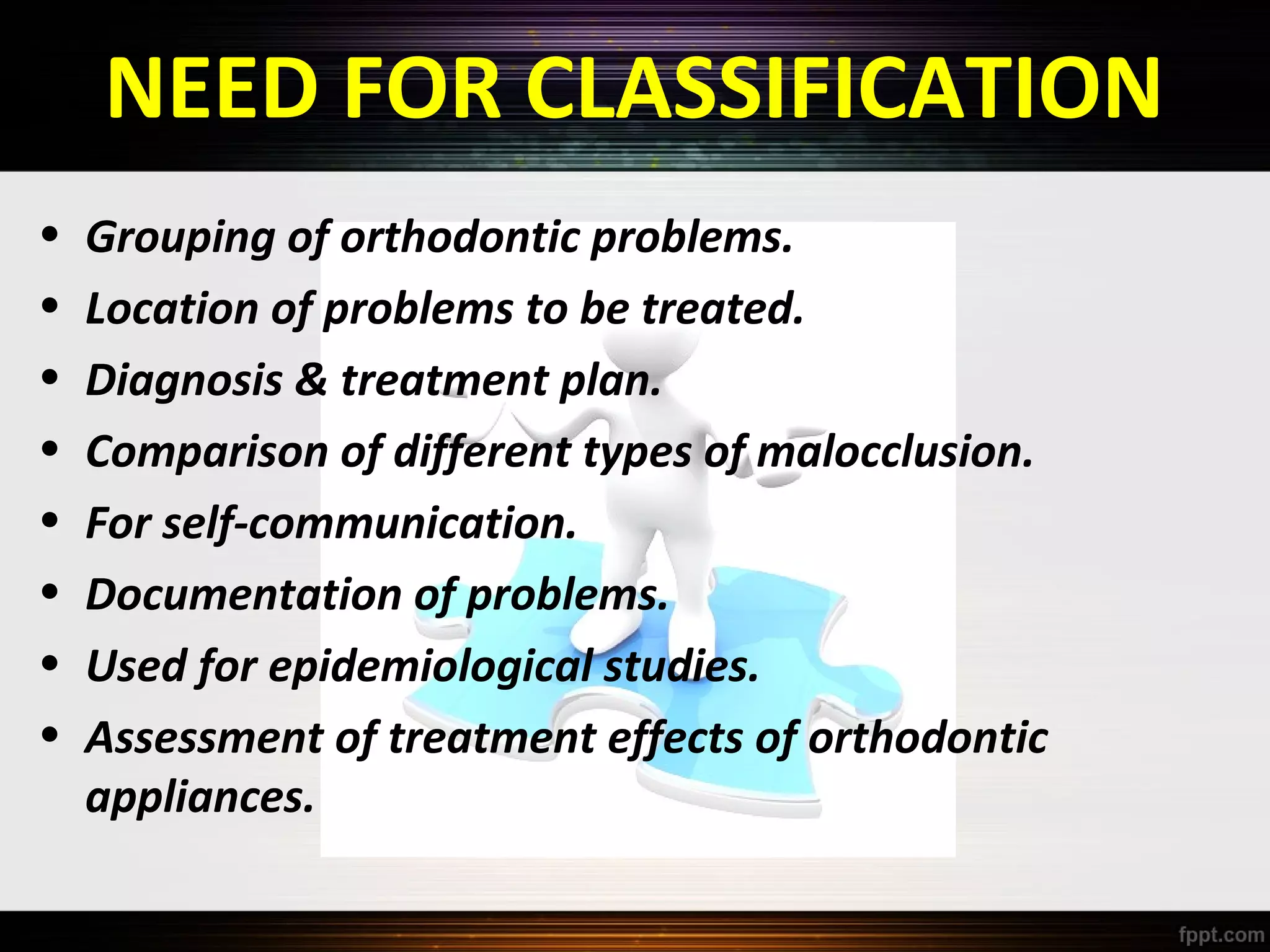
NEED FOR CLASSIFICATION
•
•
•
•
•
•
•
•

Grouping of orthodontic problems.
Location of problems to be treated.
Diagnosis & treatment plan.
Comparison of different types of malocclusion.
For self-communication.
Documentation of problems.
Used for epidemiological studies.
Assessment of treatment effects of orthodontic
appliances.
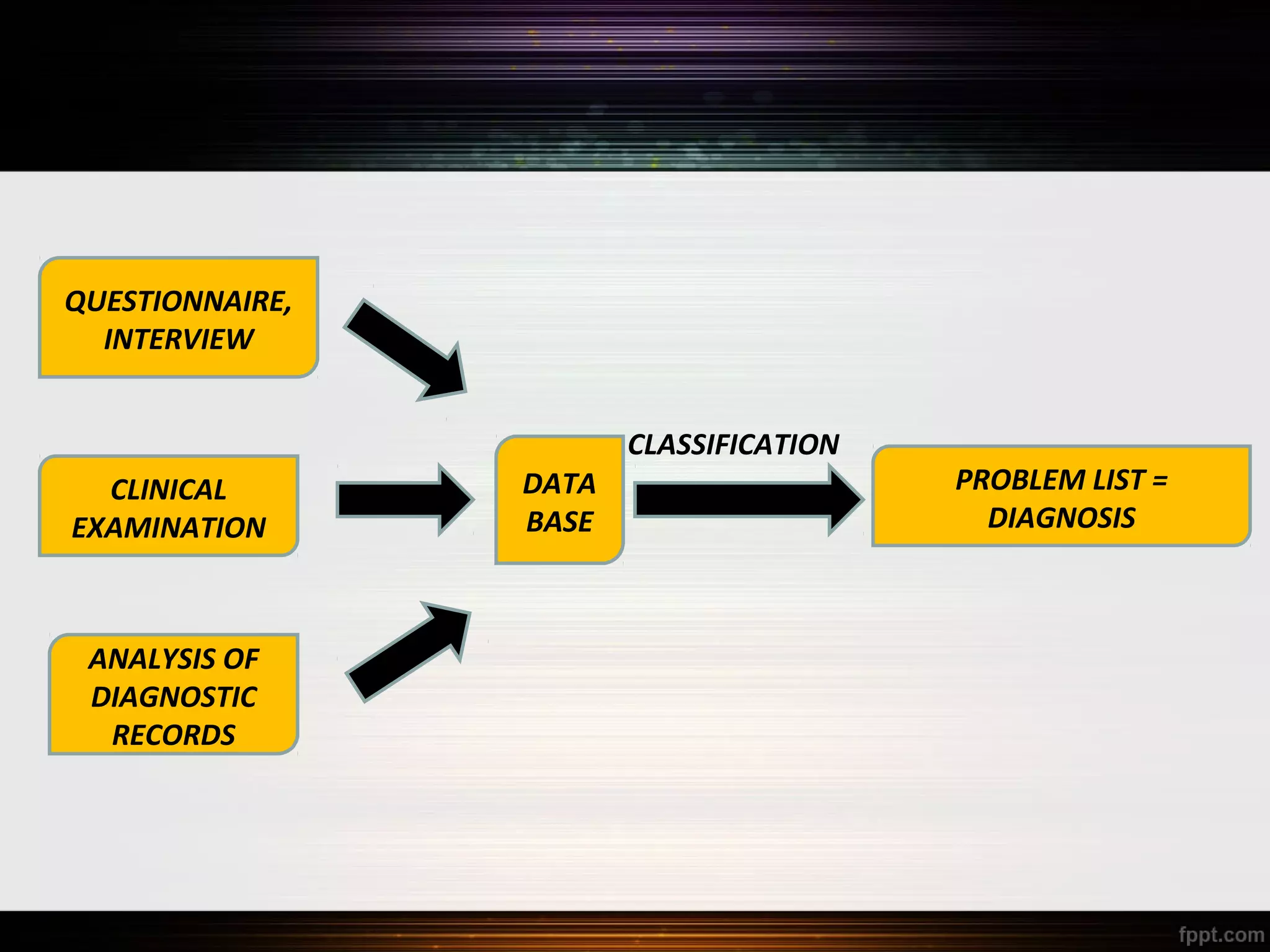
QUESTIONNAIRE,
INTERVIEW
CLASSIFICATION
CLINICAL
EXAMINATION

ANALYSIS OF
DIAGNOSTIC
RECORDS

DATA
BASE

PROBLEM LIST =
DIAGNOSIS
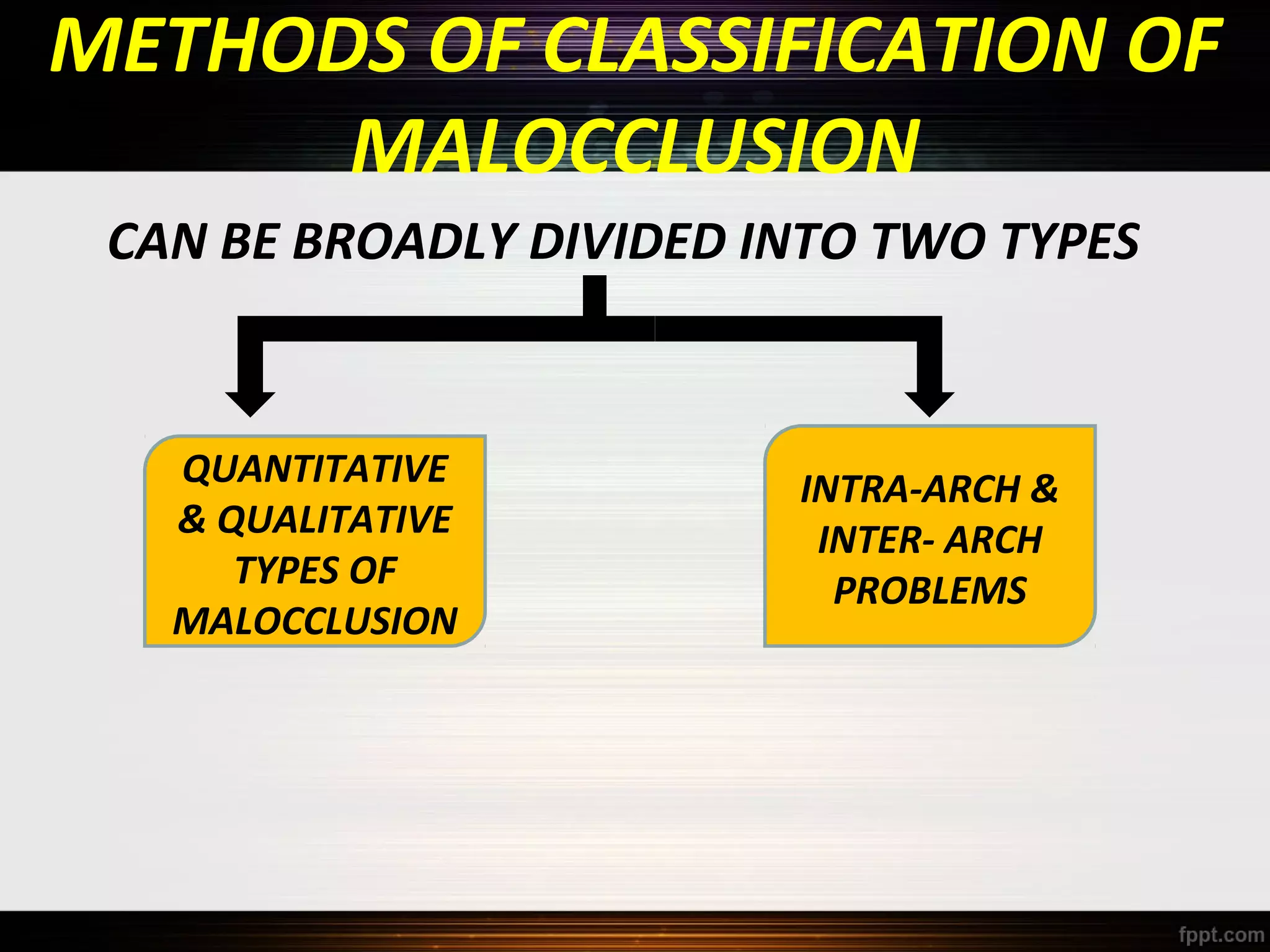
METHODS OF CLASSIFICATION OF
MALOCCLUSION
CAN BE BROADLY DIVIDED INTO TWO TYPES

QUANTITATIVE
& QUALITATIVE
TYPES OF
MALOCCLUSION

INTRA-ARCH &
INTER- ARCH
PROBLEMS
MALOCCLUSION: INTRA-ARCH &
INTER-ARCH PROBLEMS
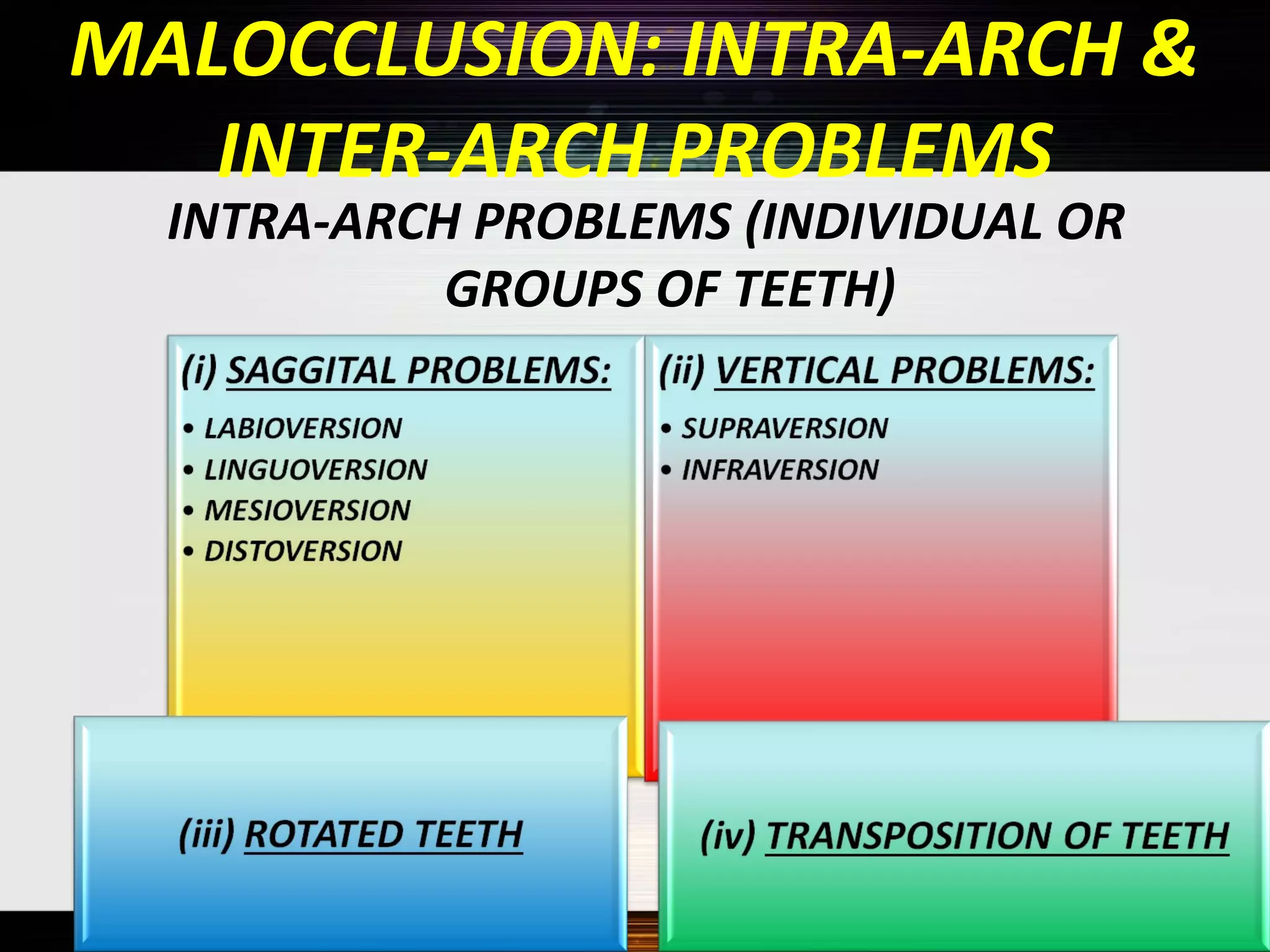
INTRA-ARCH PROBLEMS (INDIVIDUAL OR
GROUPS OF TEETH)
MALOCCLUSION: INTRA-ARCH &
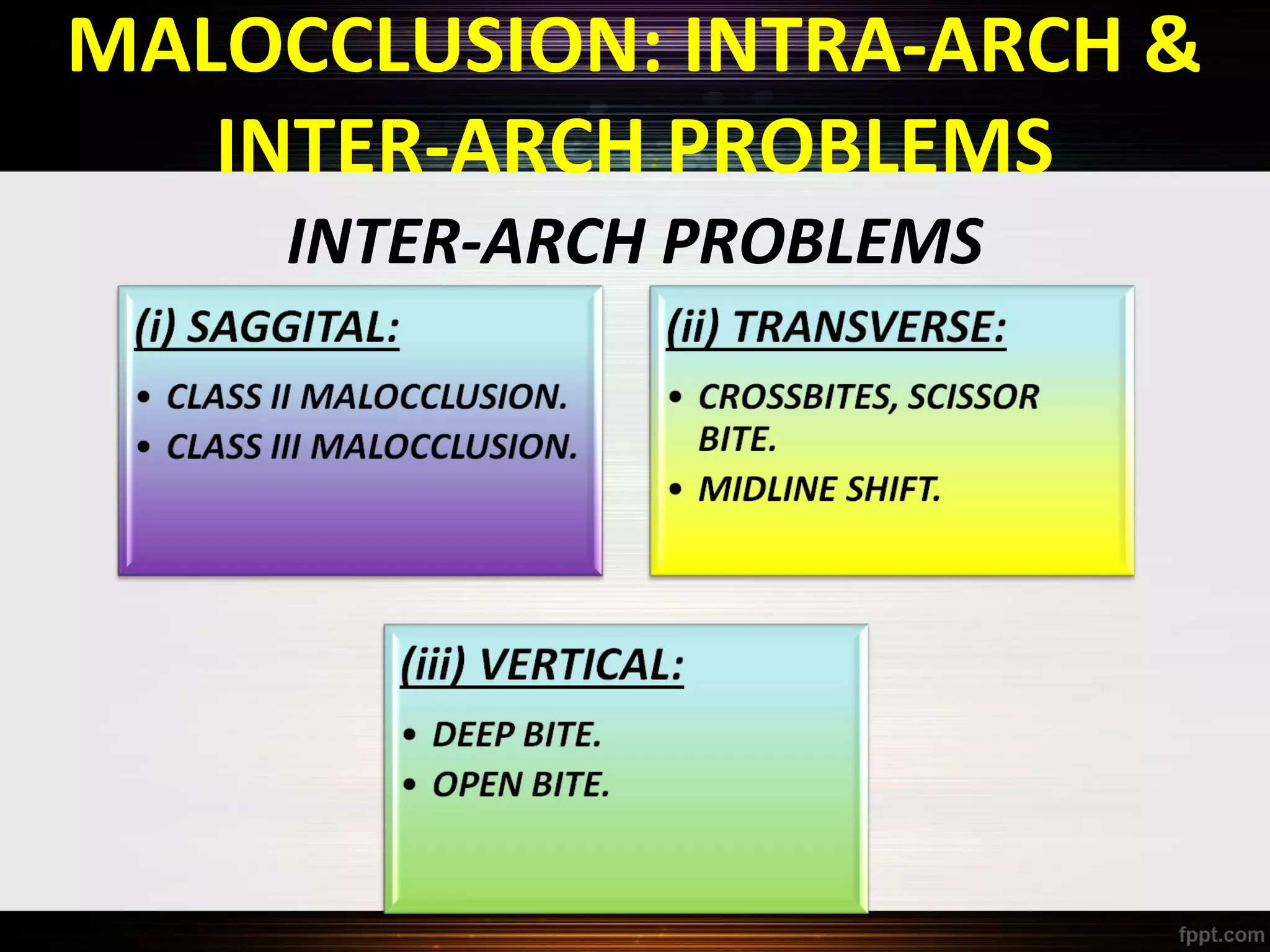
INTER-ARCH PROBLEMS
INTER-ARCH PROBLEMS
ANGLE’S CLASSIFICATION OF
MALOCCLUSION

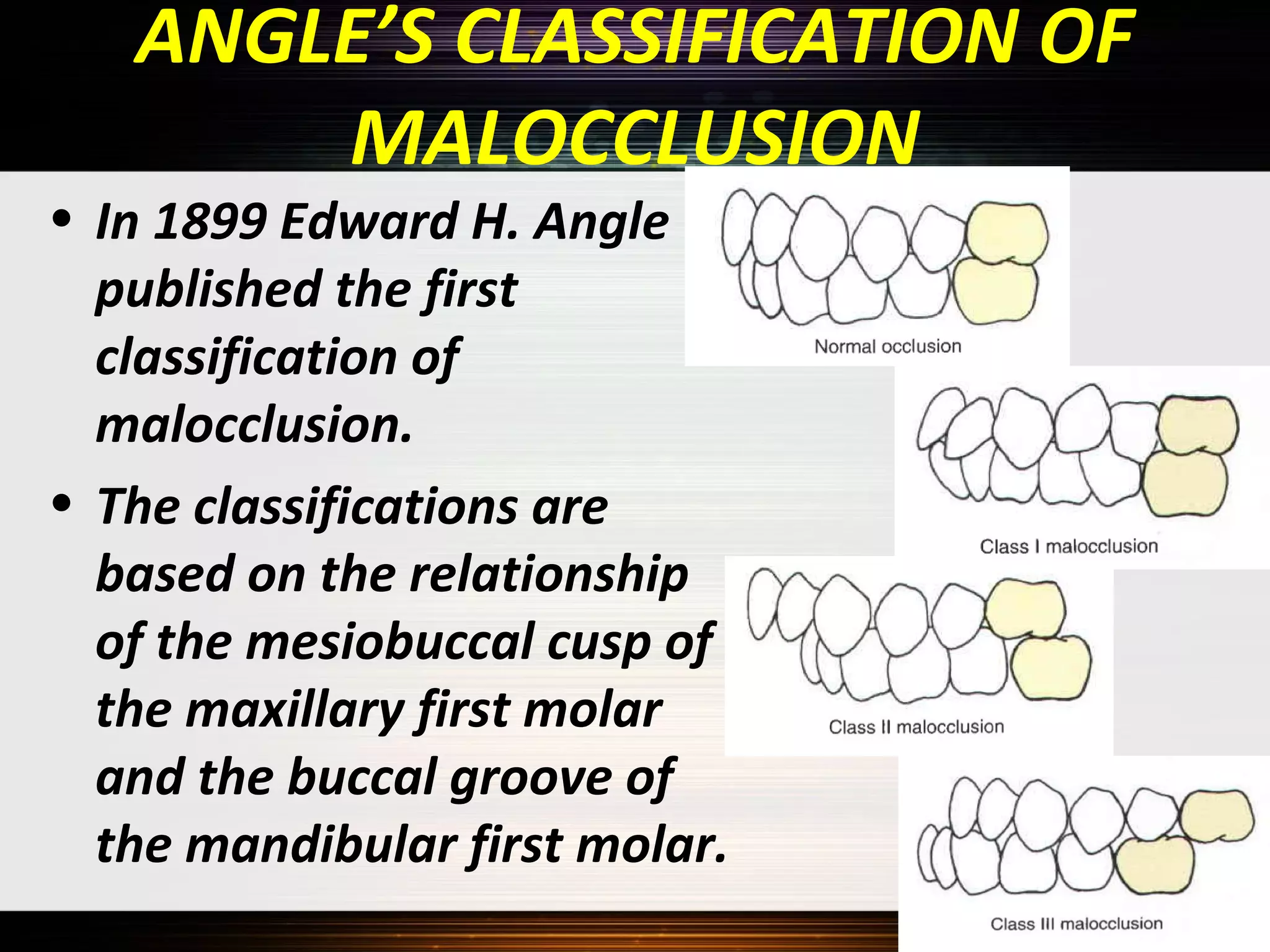
• In 1899 Edward H. Angle
published the first
classification of
malocclusion.
• The classifications are
based on the relationship
of the mesiobuccal cusp of
the maxillary first molar
and the buccal groove of
the mandibular first molar.
ANGLE’S CLASSIFICATION OF
MALOCCLUSION
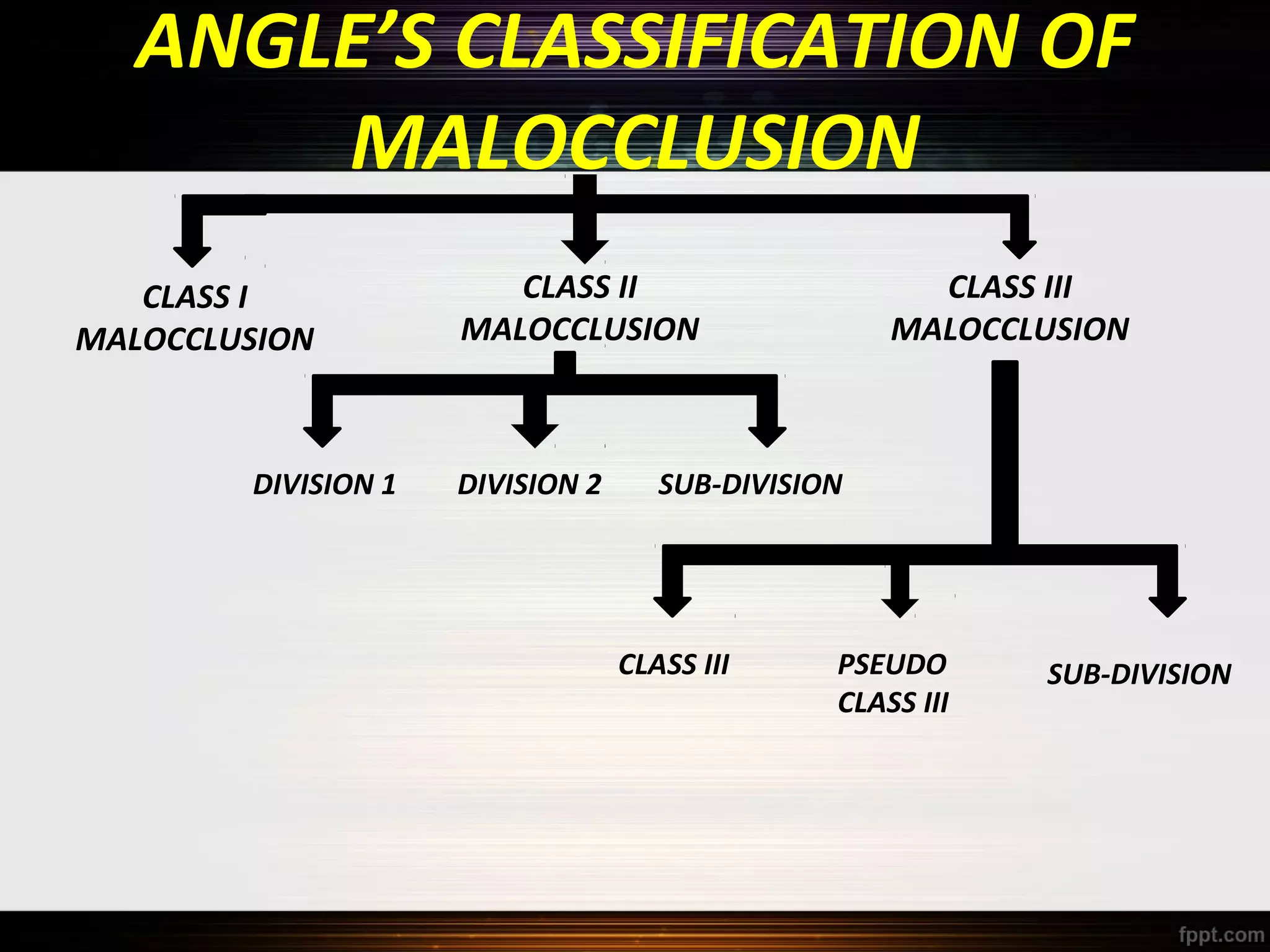
CLASS I
MALOCCLUSION

DIVISION 1

CLASS II
MALOCCLUSION

DIVISION 2

CLASS III
MALOCCLUSION

SUB-DIVISION

CLASS III

PSEUDO
CLASS III

SUB-DIVISION
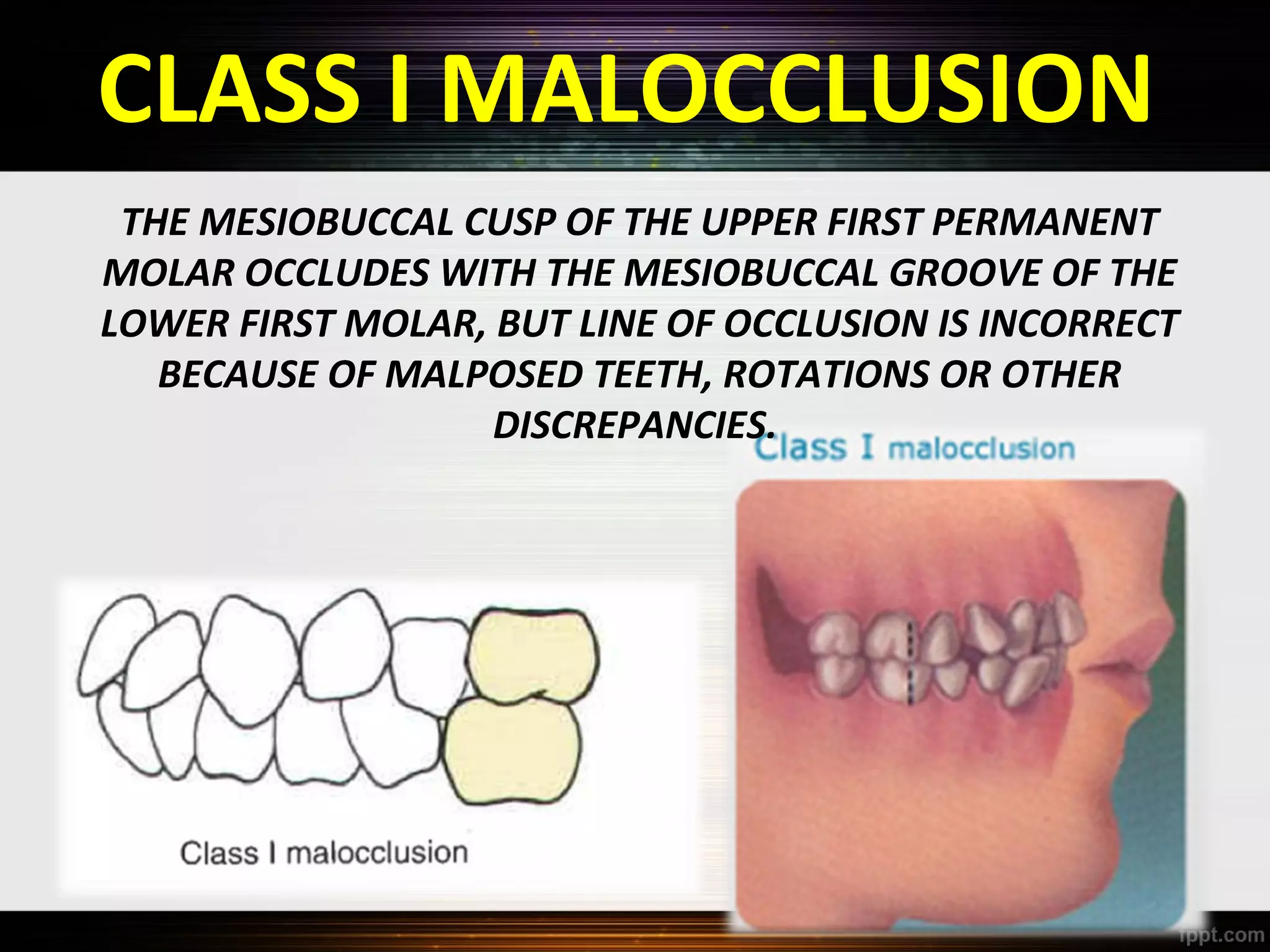
CLASS I MALOCCLUSION
THE MESIOBUCCAL CUSP OF THE UPPER FIRST PERMANENT
MOLAR OCCLUDES WITH THE MESIOBUCCAL GROOVE OF THE
LOWER FIRST MOLAR, BUT LINE OF OCCLUSION IS INCORRECT
BECAUSE OF MALPOSED TEETH, ROTATIONS OR OTHER
DISCREPANCIES.
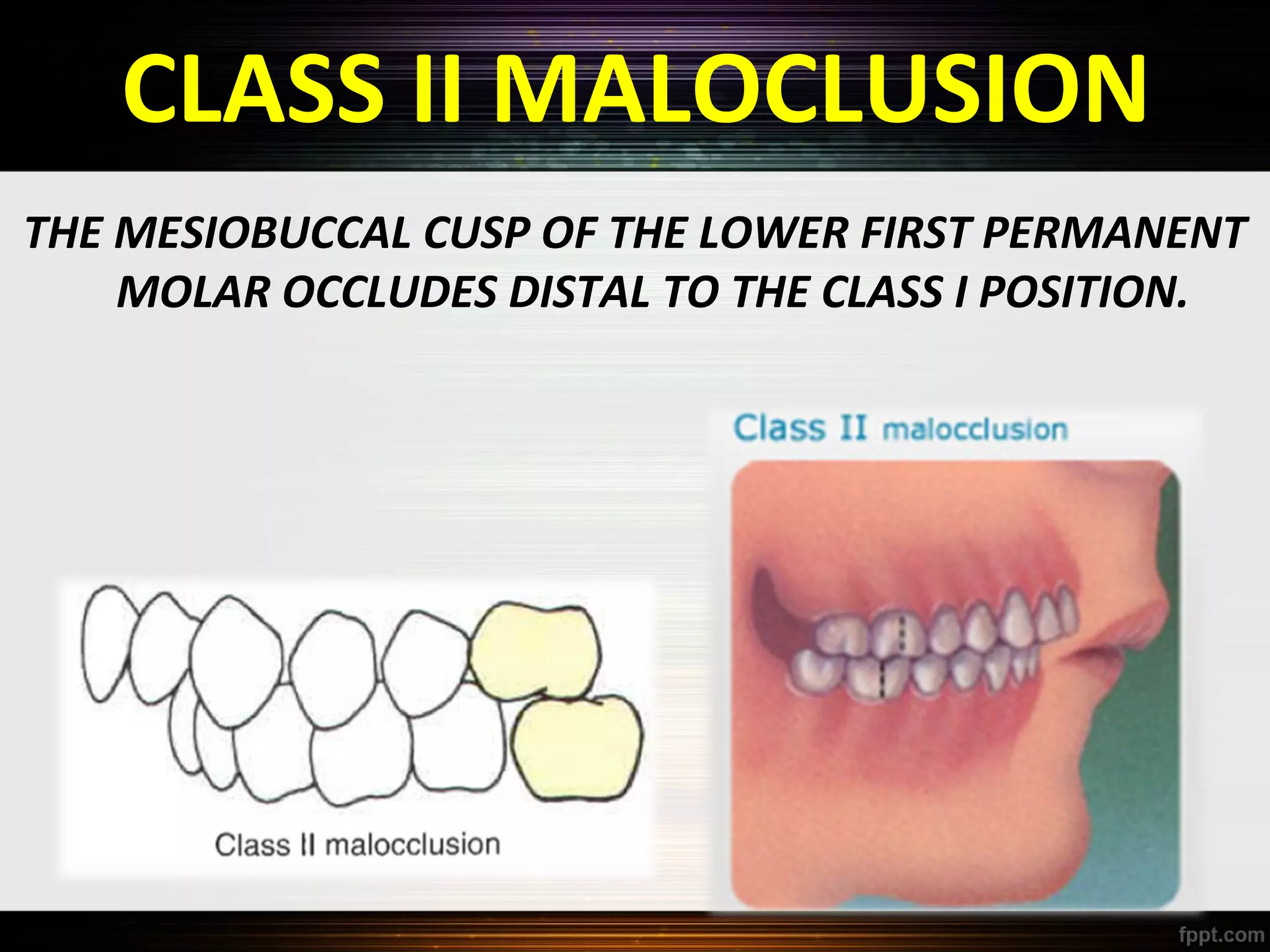
CLASS II MALOCLUSION
THE MESIOBUCCAL CUSP OF THE LOWER FIRST PERMANENT
MOLAR OCCLUDES DISTAL TO THE CLASS I POSITION.
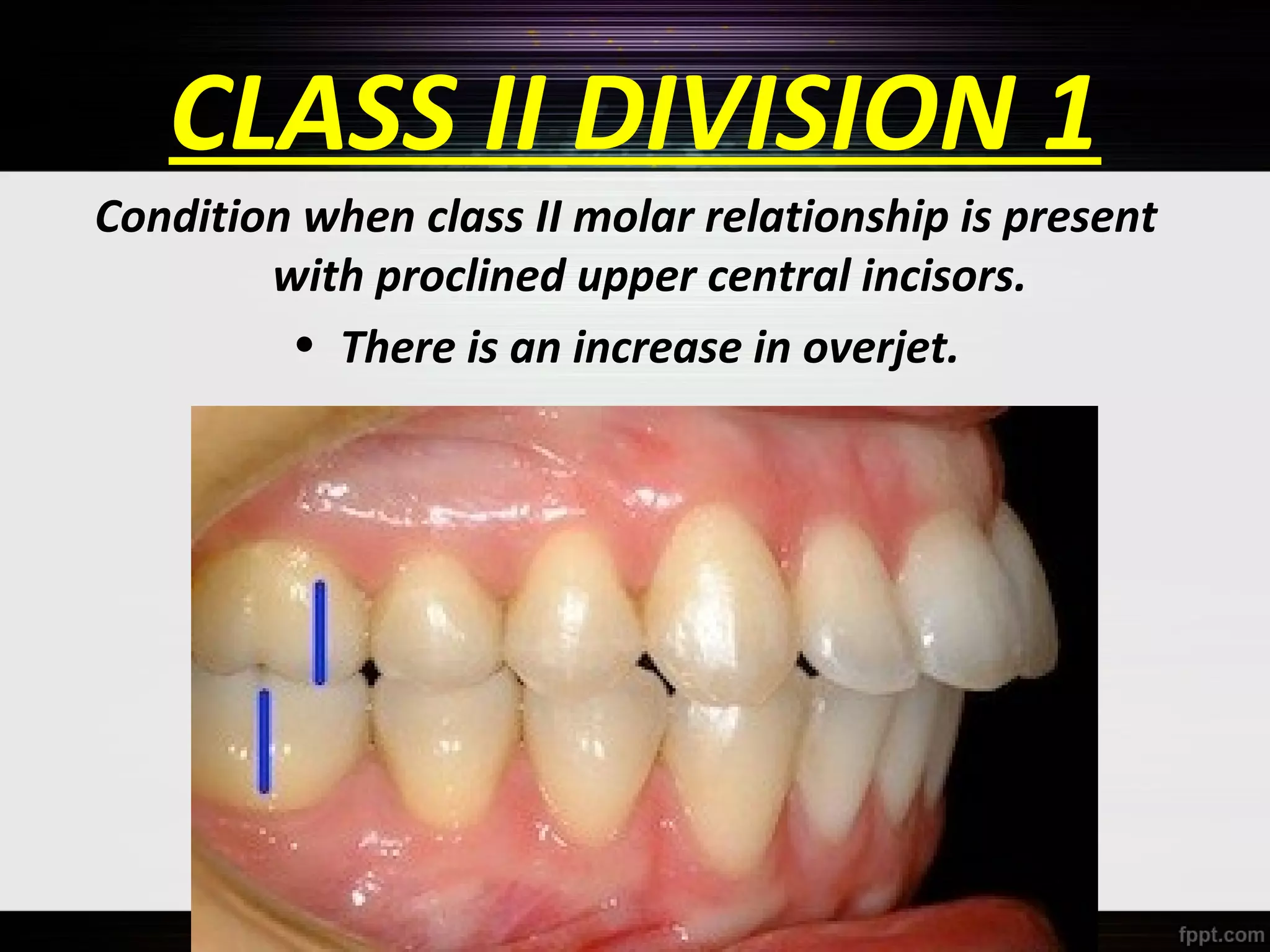
CLASS II DIVISION 1
Condition when class II molar relationship is present
with proclined upper central incisors.
• There is an increase in overjet.
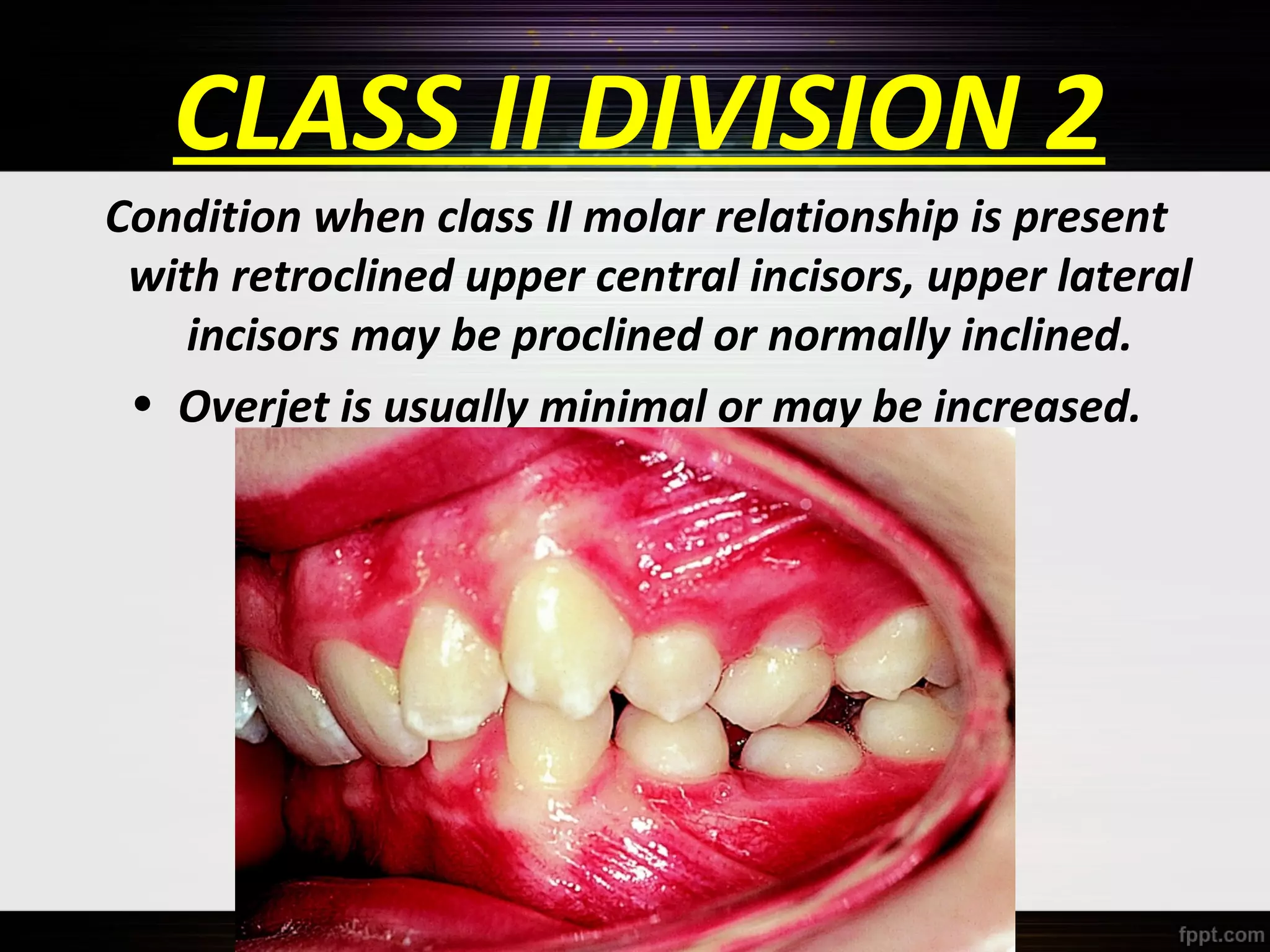
CLASS II DIVISION 2
Condition when class II molar relationship is present
with retroclined upper central incisors, upper lateral
incisors may be proclined or normally inclined.
• Overjet is usually minimal or may be increased.
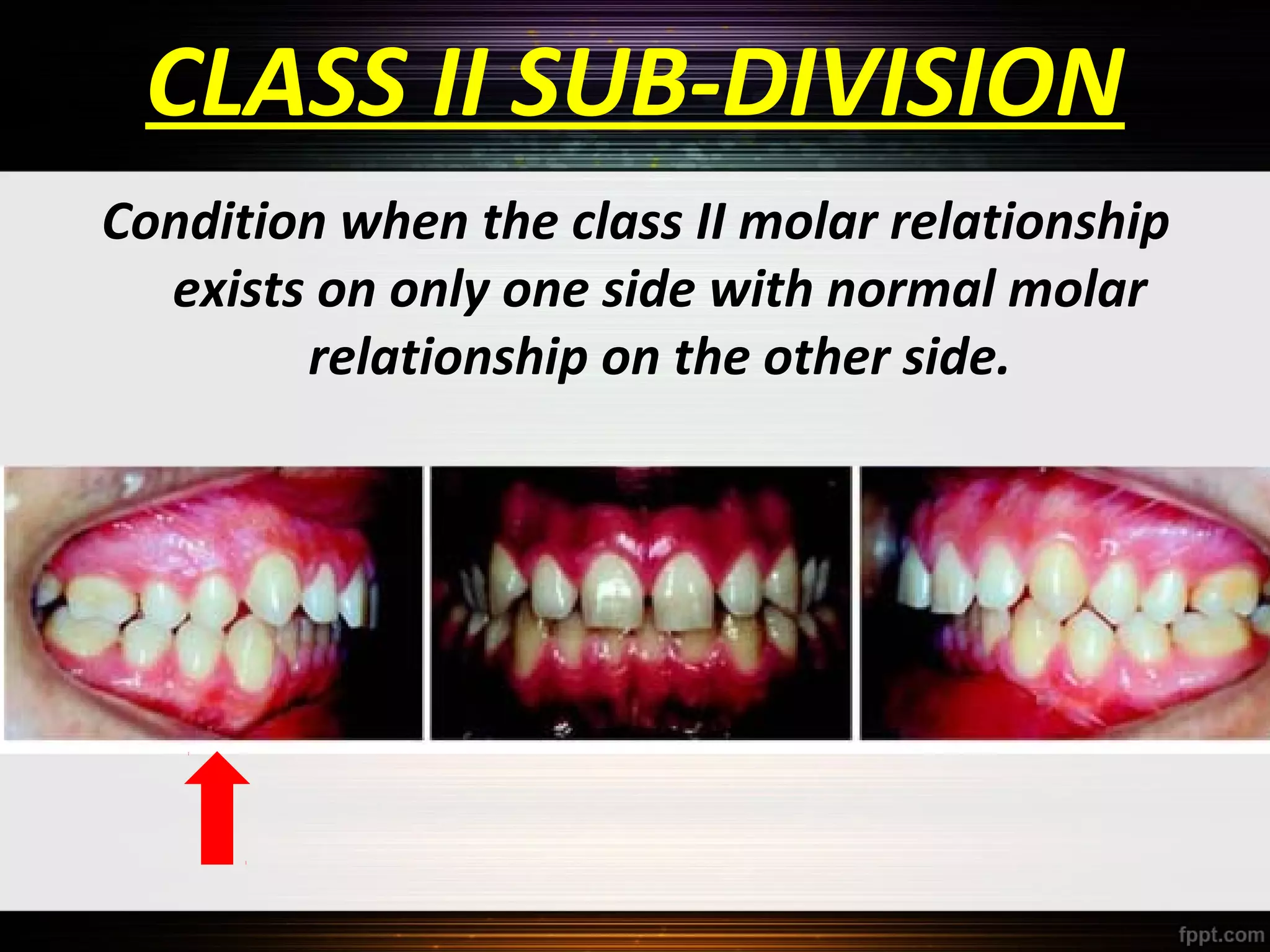
CLASS II SUB-DIVISION
Condition when the class II molar relationship
exists on only one side with normal molar
relationship on the other side.
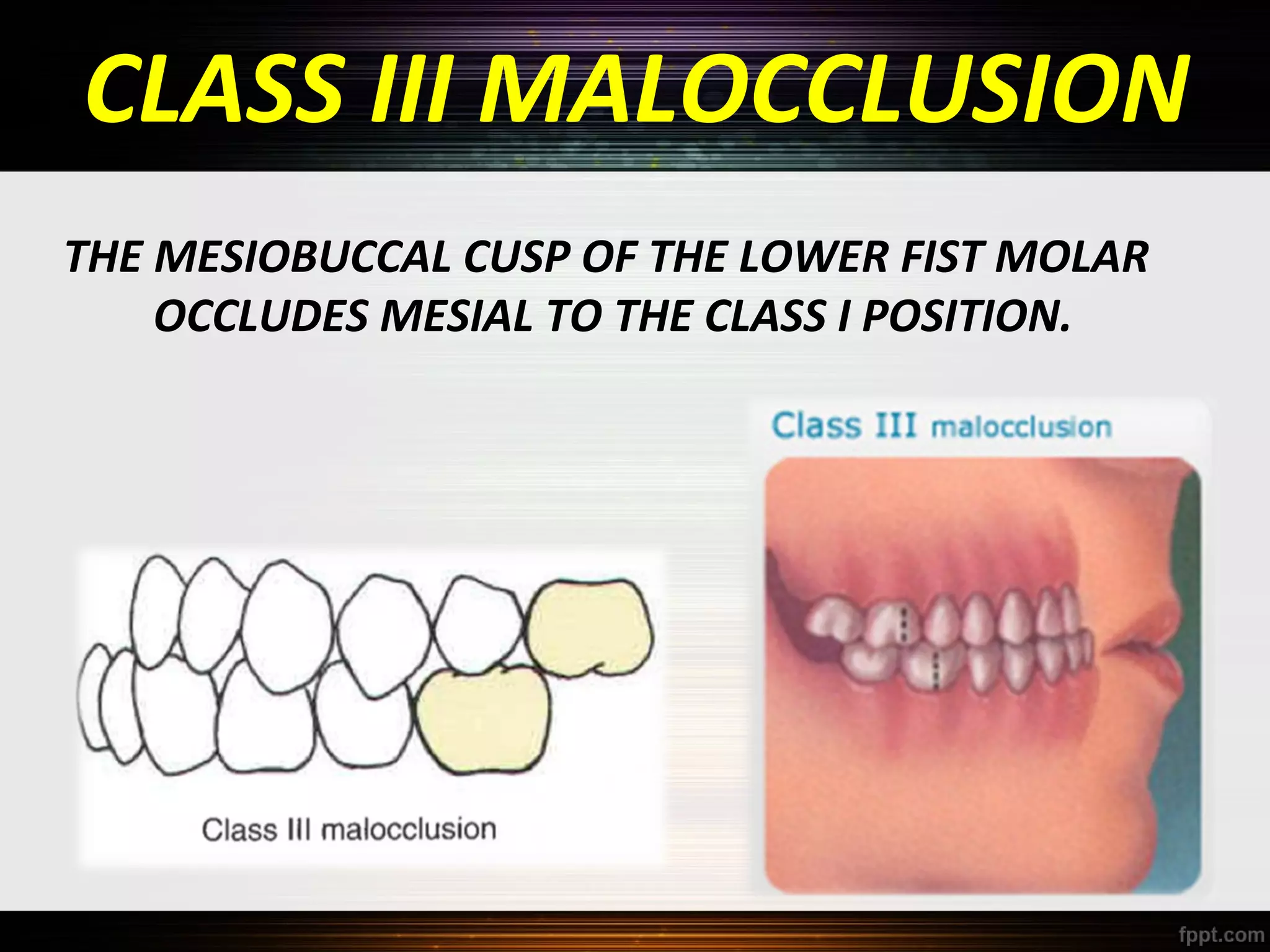
CLASS III MALOCCLUSION
THE MESIOBUCCAL CUSP OF THE LOWER FIST MOLAR
OCCLUDES MESIAL TO THE CLASS I POSITION.
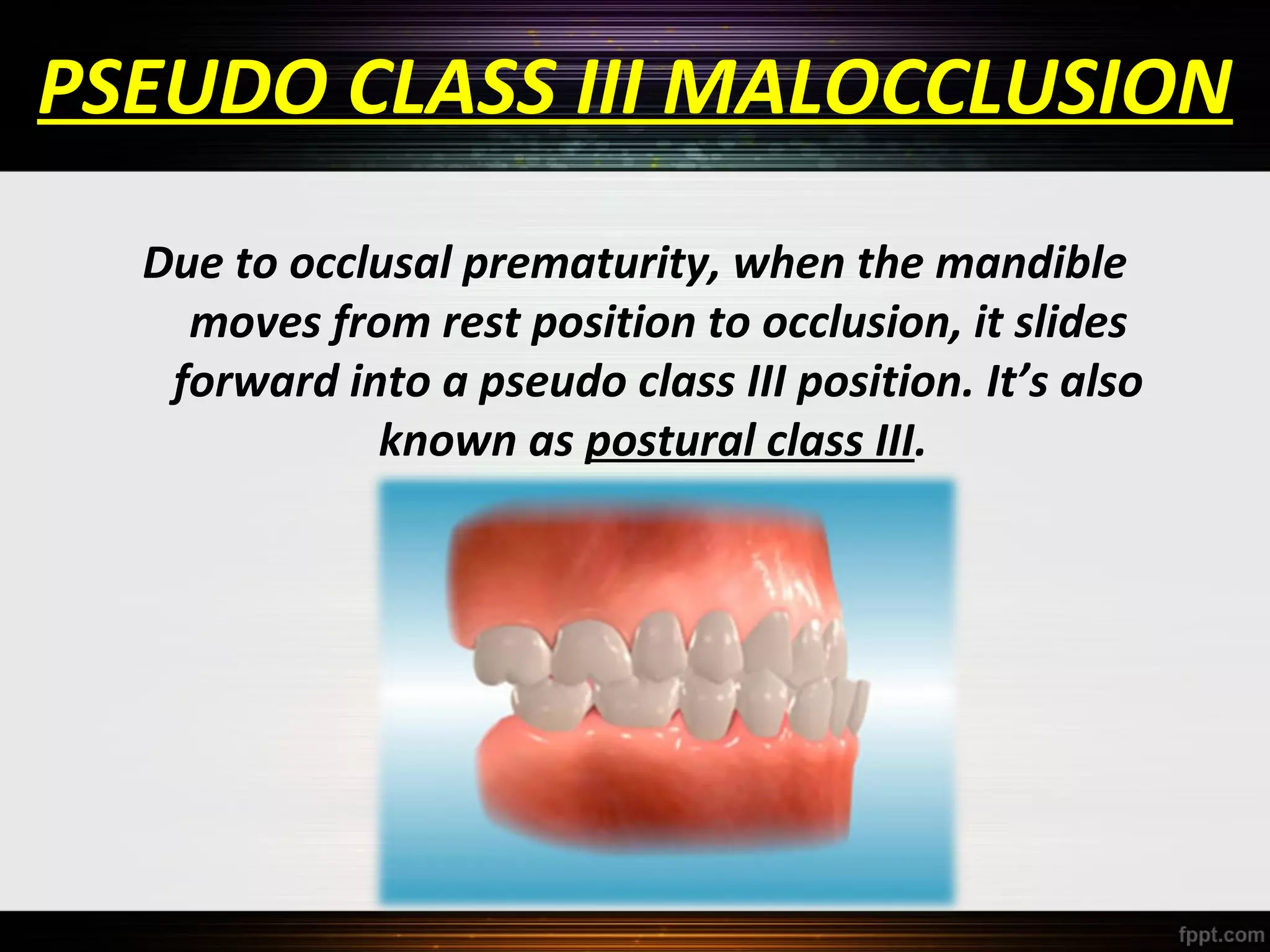
PSEUDO CLASS III MALOCCLUSION
Due to occlusal prematurity, when the mandible
moves from rest position to occlusion, it slides
forward into a pseudo class III position. It’s also
known as postural class III.
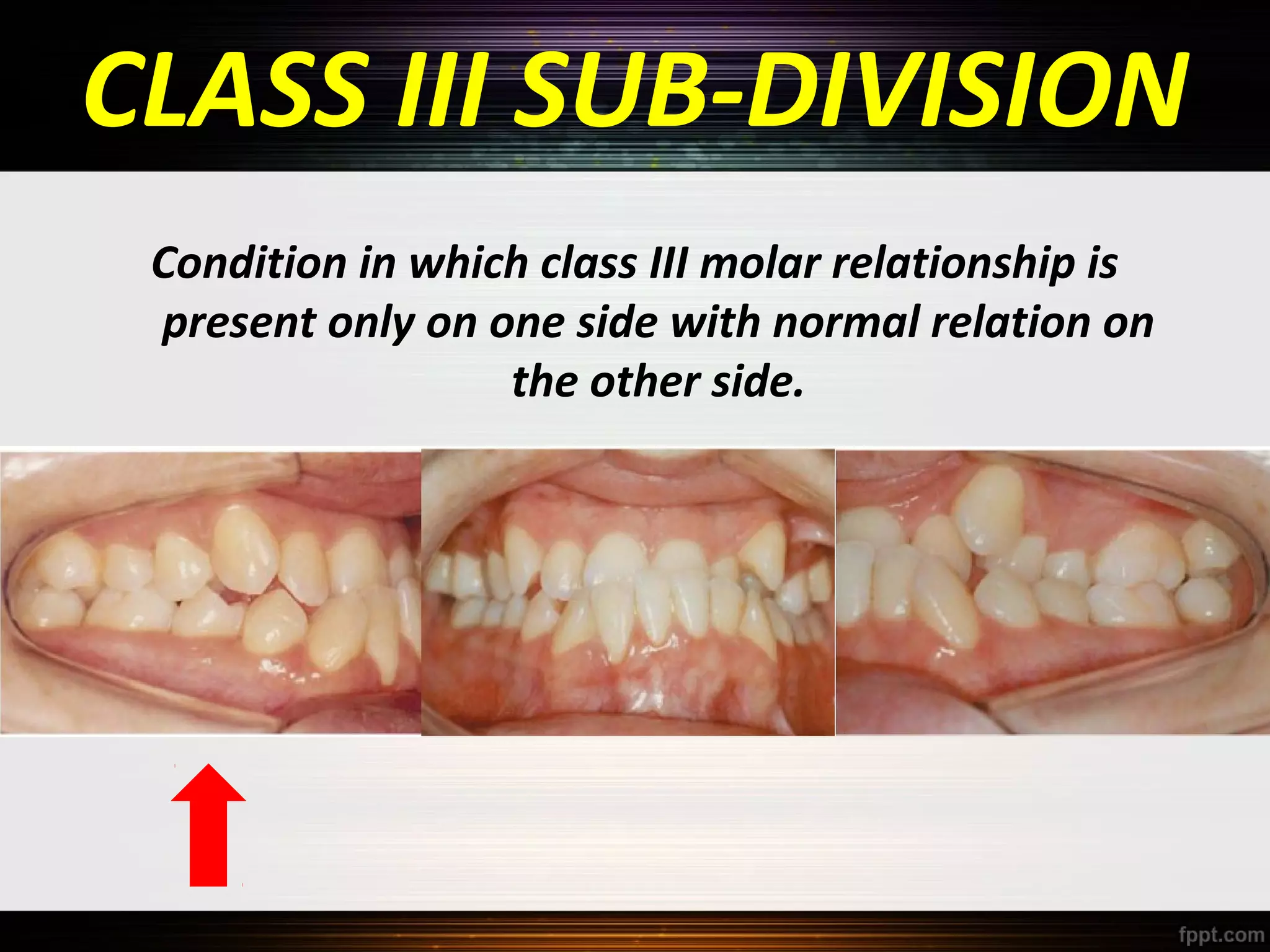
CLASS III SUB-DIVISION
Condition in which class III molar relationship is
present only on one side with normal relation on
the other side.
MODIFICATIONS OF ANGLE’S
CLASSIFICATION
There are two modifications of Angle’s
classification
1.Lischer’s modification.
2.Dewey’s modification.
LISCHER’S MODIFICATION
• He introduced following names to the
Angle’s classification:
– Neutrocclusion- Class I.
– Distocclusion- Class II.
– Mesiocclusion- Class III
DEWEY’S MODIFICATION (1915)
• Martin Dewey divided Angle’s class I & III into
further types:

– CLASS I:
• Type 1: Crowded maxillary anterior teeth. Canines
may be abnormally positioned.
• Type 2: Proclined or labioversion of maxillary incisors.
• Type 3: Anterior cross bite present.
• Type 4: Posterior cross bite present.
• Type 5: Mesioversion of molars.
DEWEY’S MODIFICATION
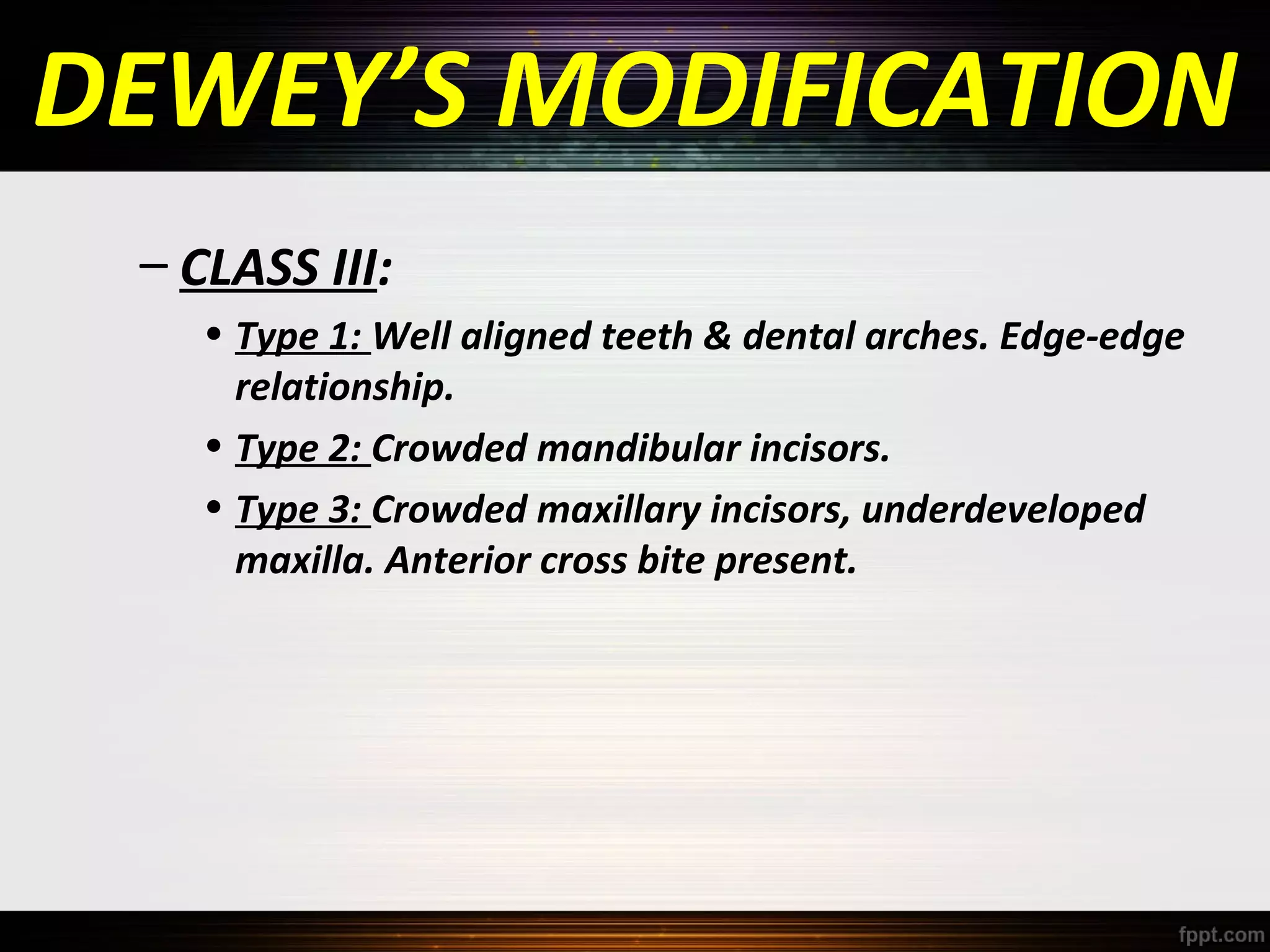
– CLASS III:
• Type 1: Well aligned teeth & dental arches. Edge-edge
relationship.
• Type 2: Crowded mandibular incisors.
• Type 3: Crowded maxillary incisors, underdeveloped
maxilla. Anterior cross bite present.
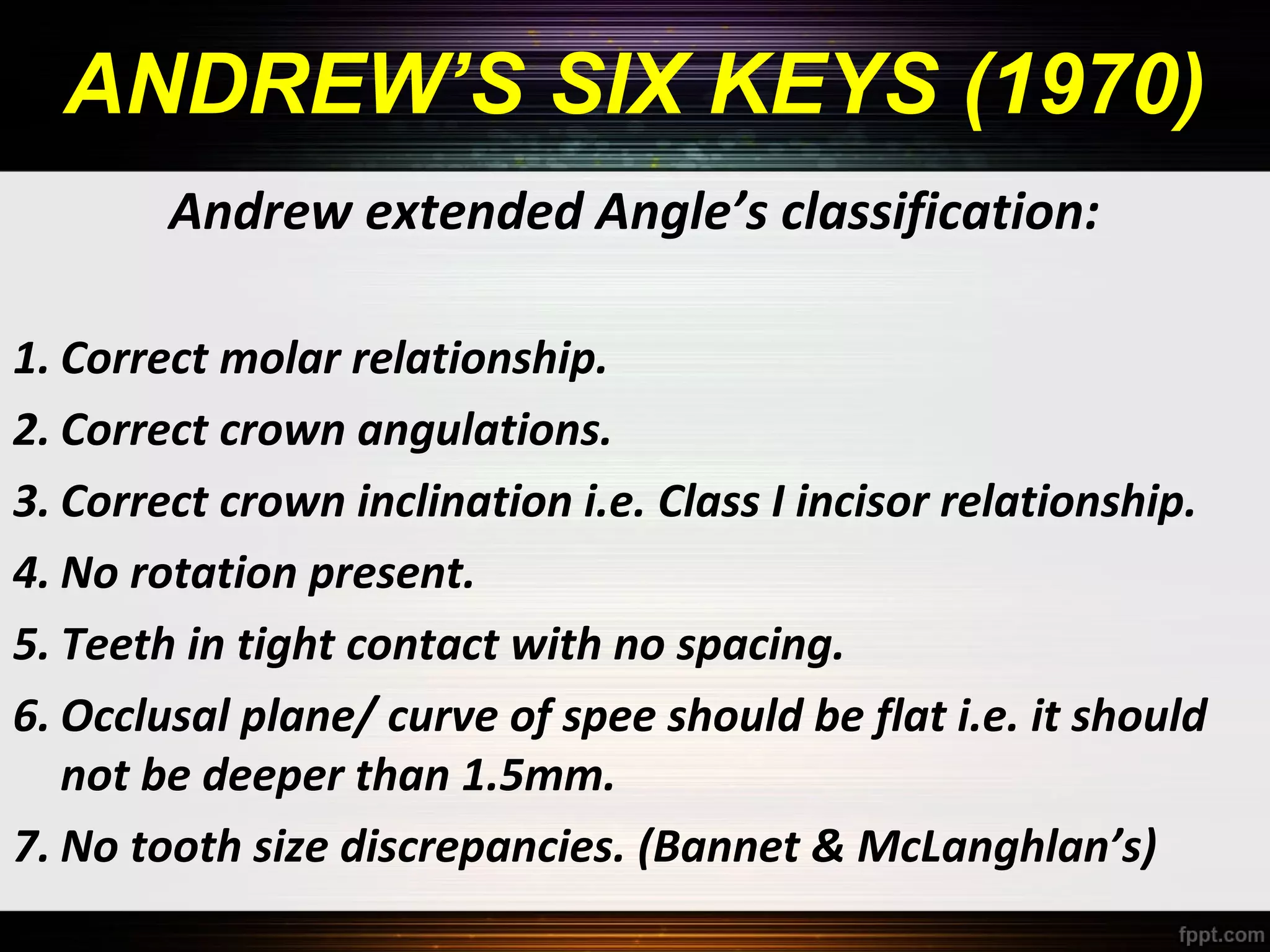
ANDREW’S SIX KEYS (1970)
Andrew extended Angle’s classification:
1. Correct molar relationship.
2. Correct crown angulations.
3. Correct crown inclination i.e. Class I incisor relationship.
4. No rotation present.
5. Teeth in tight contact with no spacing.
6. Occlusal plane/ curve of spee should be flat i.e. it should
not be deeper than 1.5mm.
7. No tooth size discrepancies. (Bannet & McLanghlan’s)
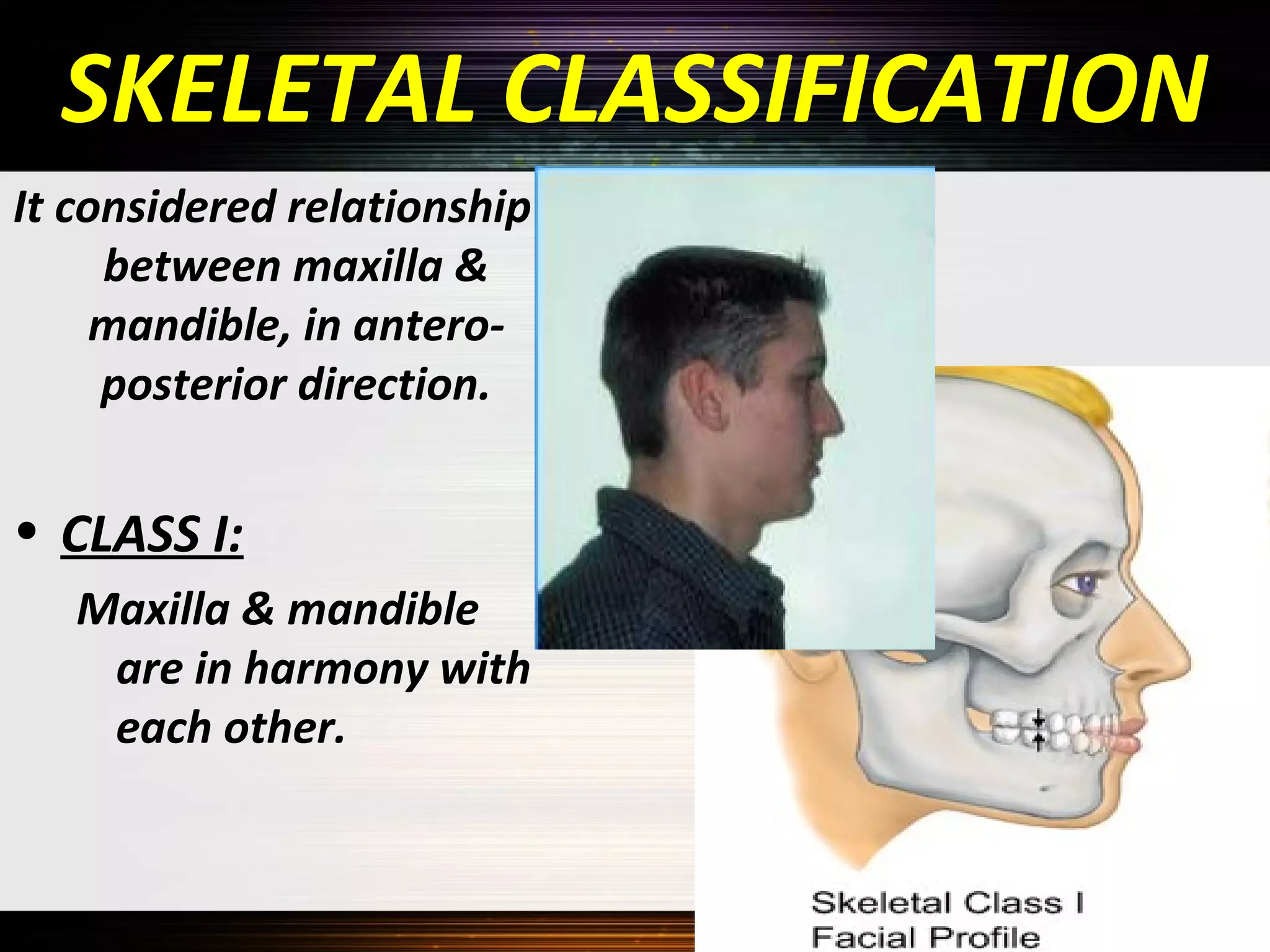
SKELETAL CLASSIFICATION
It considered relationship
between maxilla &
mandible, in anteroposterior direction.

• CLASS I:
Maxilla & mandible
are in harmony with
each other.
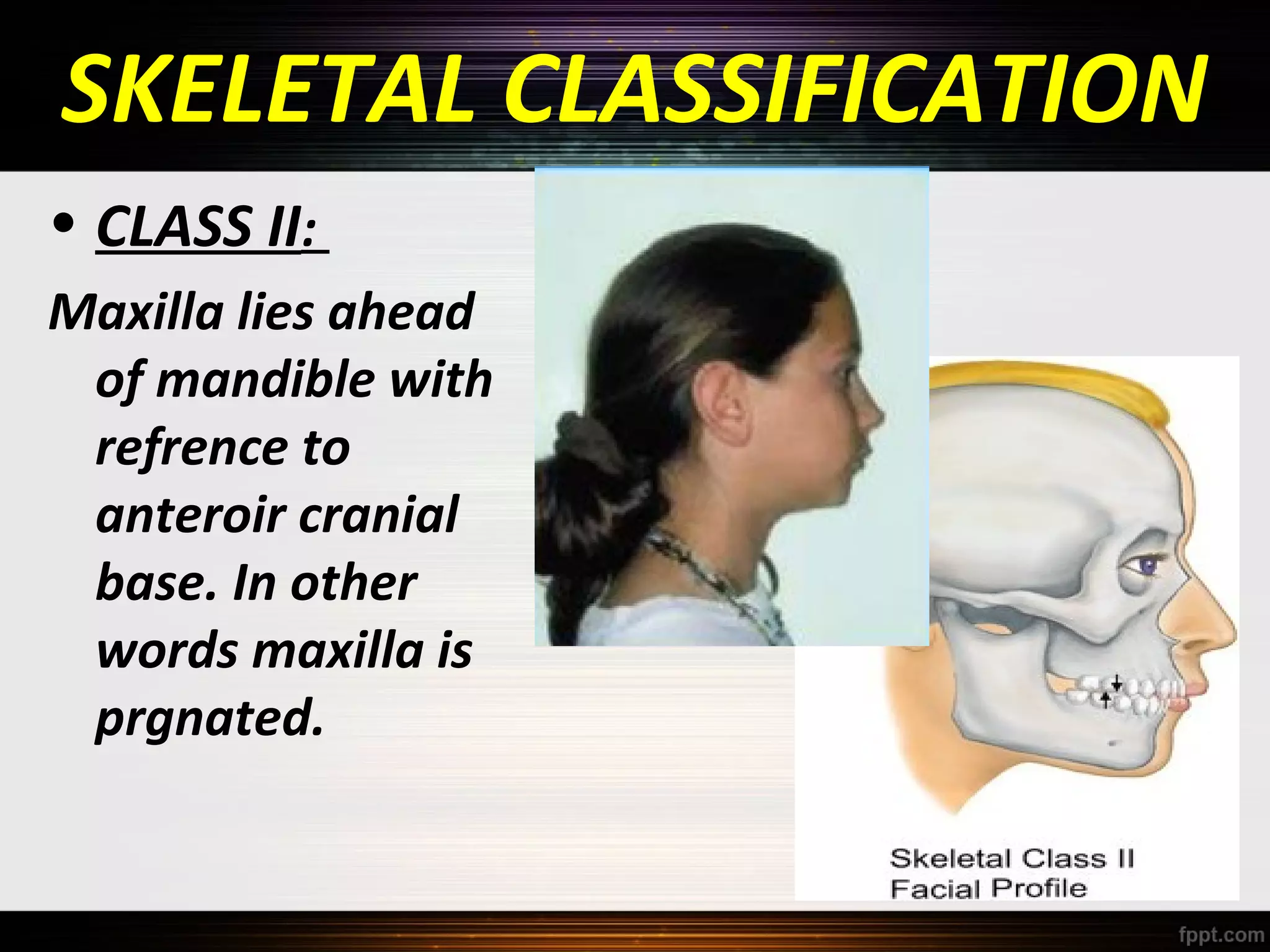
SKELETAL CLASSIFICATION
• CLASS II:
Maxilla lies ahead
of mandible with
refrence to
anteroir cranial
base. In other
words maxilla is
prgnated.
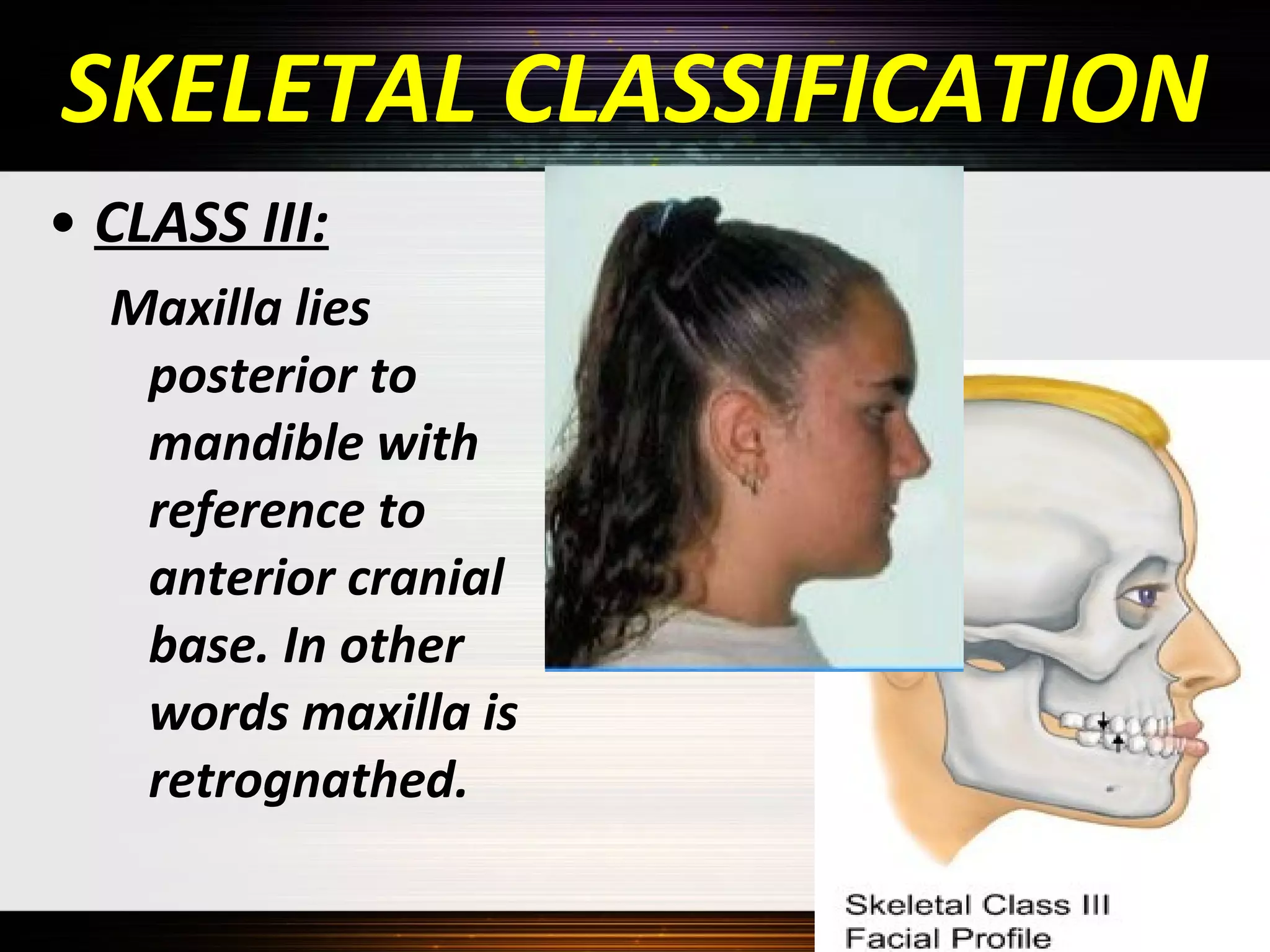
SKELETAL CLASSIFICATION
• CLASS III:
Maxilla lies
posterior to
mandible with
reference to
anterior cranial
base. In other
words maxilla is
retrognathed.
BRITISH STANDARD CLASSIFICATION
OF INCISOR RELATIONSHIP (1983)
Based upon incisor relationship, proposed in 1983.
Do not consider molar relationship in some cases.
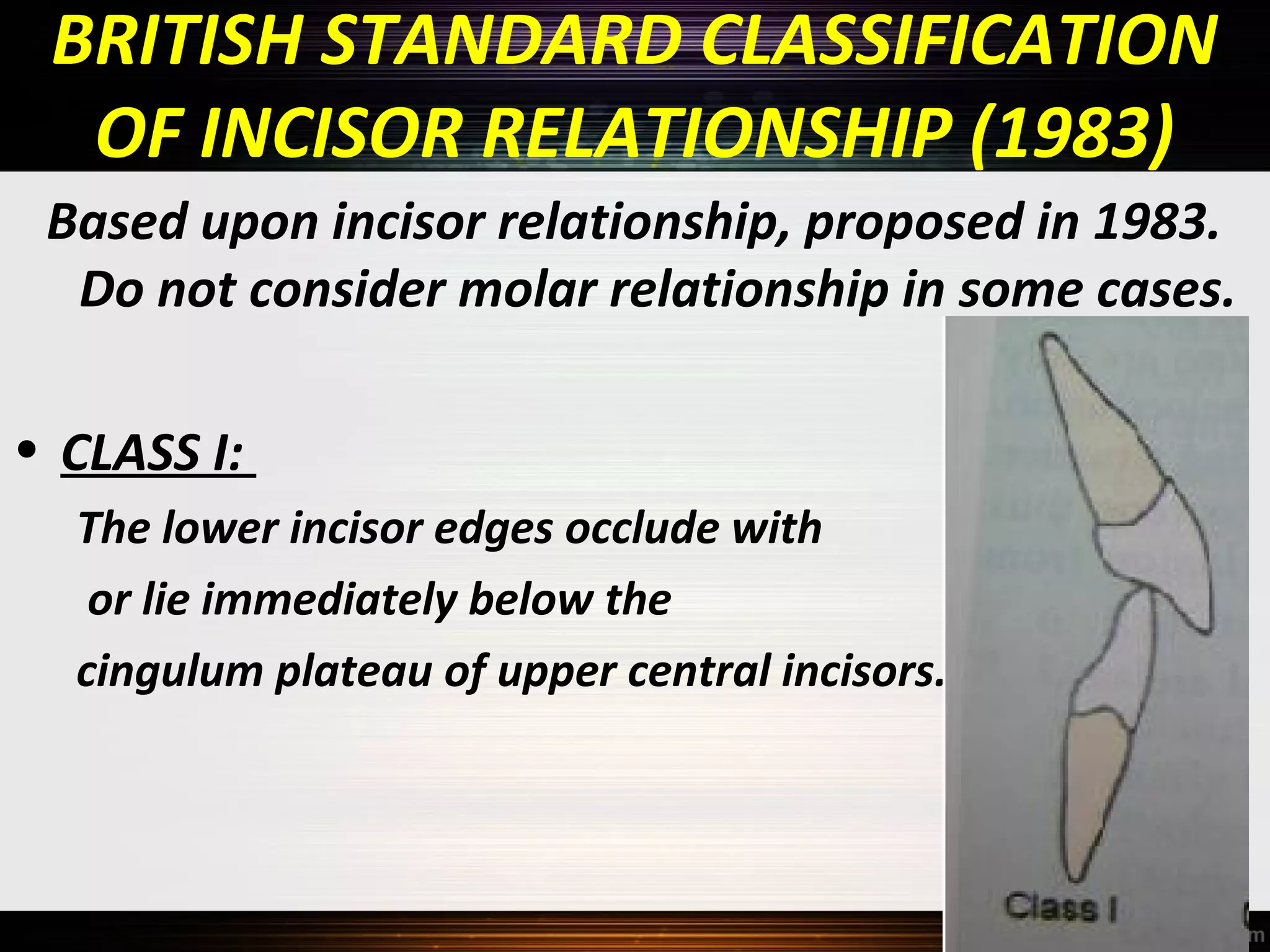
• CLASS I:
The lower incisor edges occlude with
or lie immediately below the
cingulum plateau of upper central incisors.
BRITISH STANDARD CLASSIFICATION
OF INCISOR RELATIONSHIP
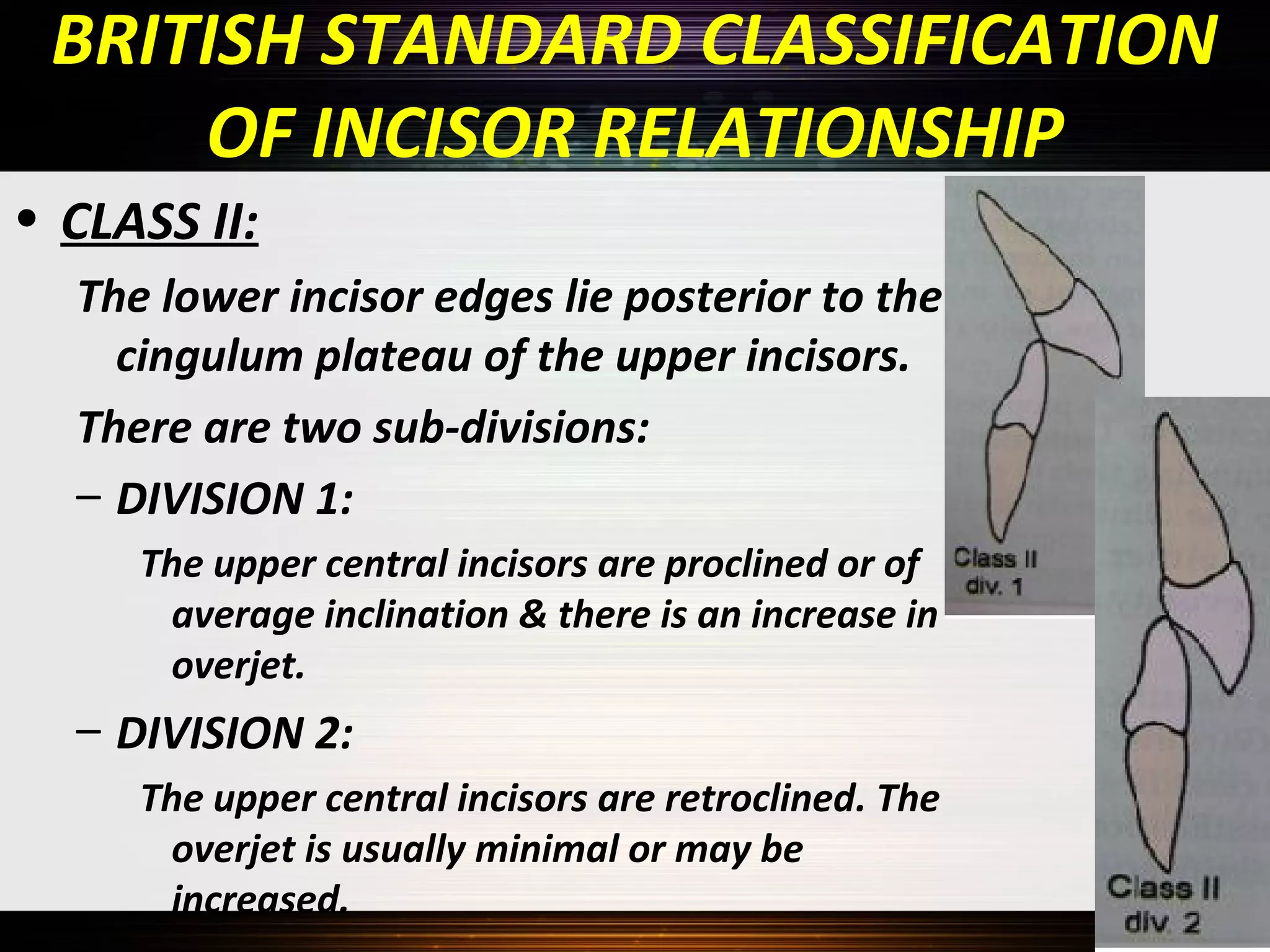
• CLASS II:
The lower incisor edges lie posterior to the
cingulum plateau of the upper incisors.
There are two sub-divisions:
– DIVISION 1:
The upper central incisors are proclined or of
average inclination & there is an increase in
overjet.

– DIVISION 2:
The upper central incisors are retroclined. The
overjet is usually minimal or may be
increased.
BRITISH STANDARD CLASSIFICATION
OF INCISOR RELATIONSHIP
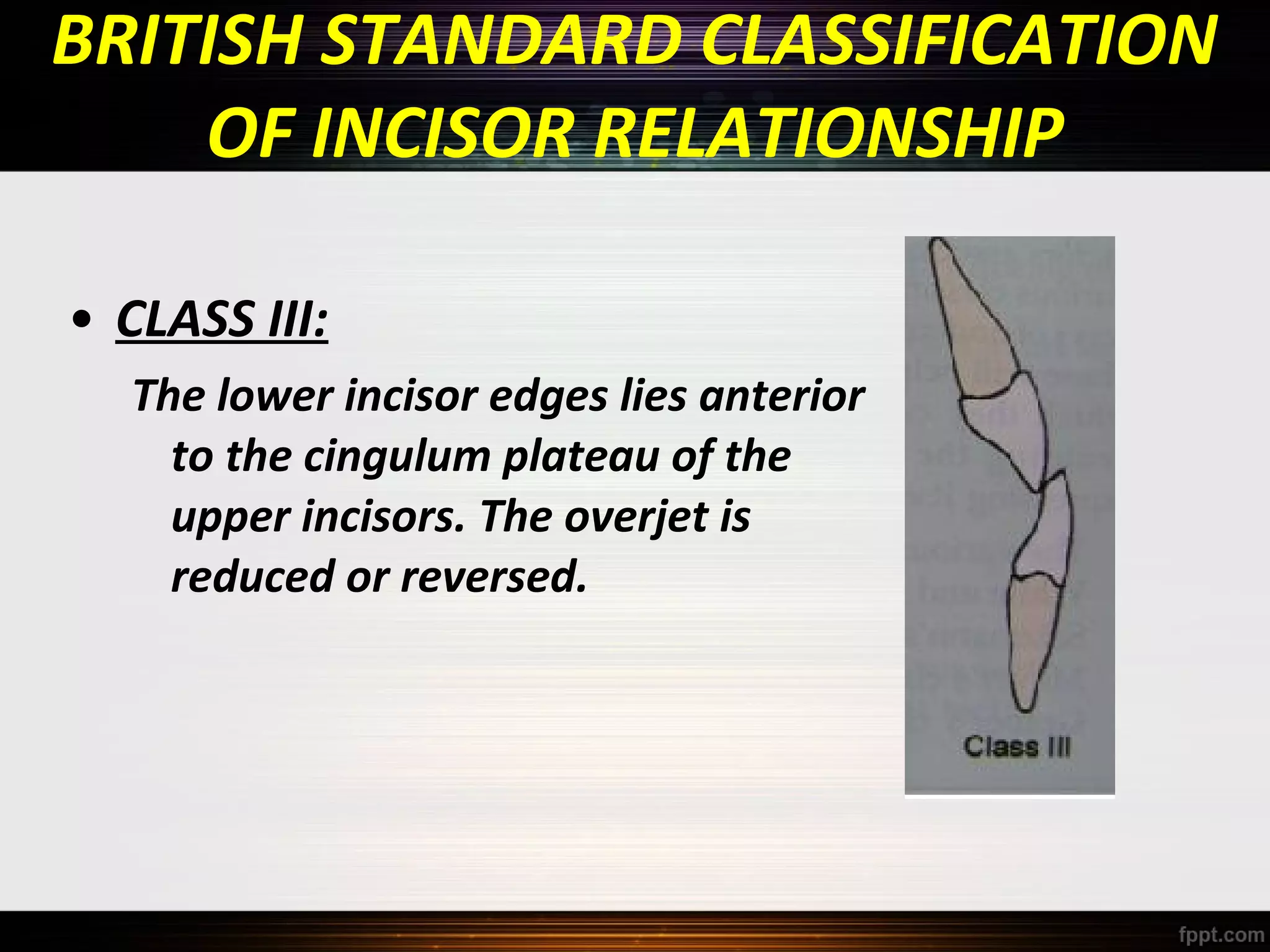
• CLASS III:
The lower incisor edges lies anterior
to the cingulum plateau of the
upper incisors. The overjet is
reduced or reversed.
CANINE CLASSIFICATION
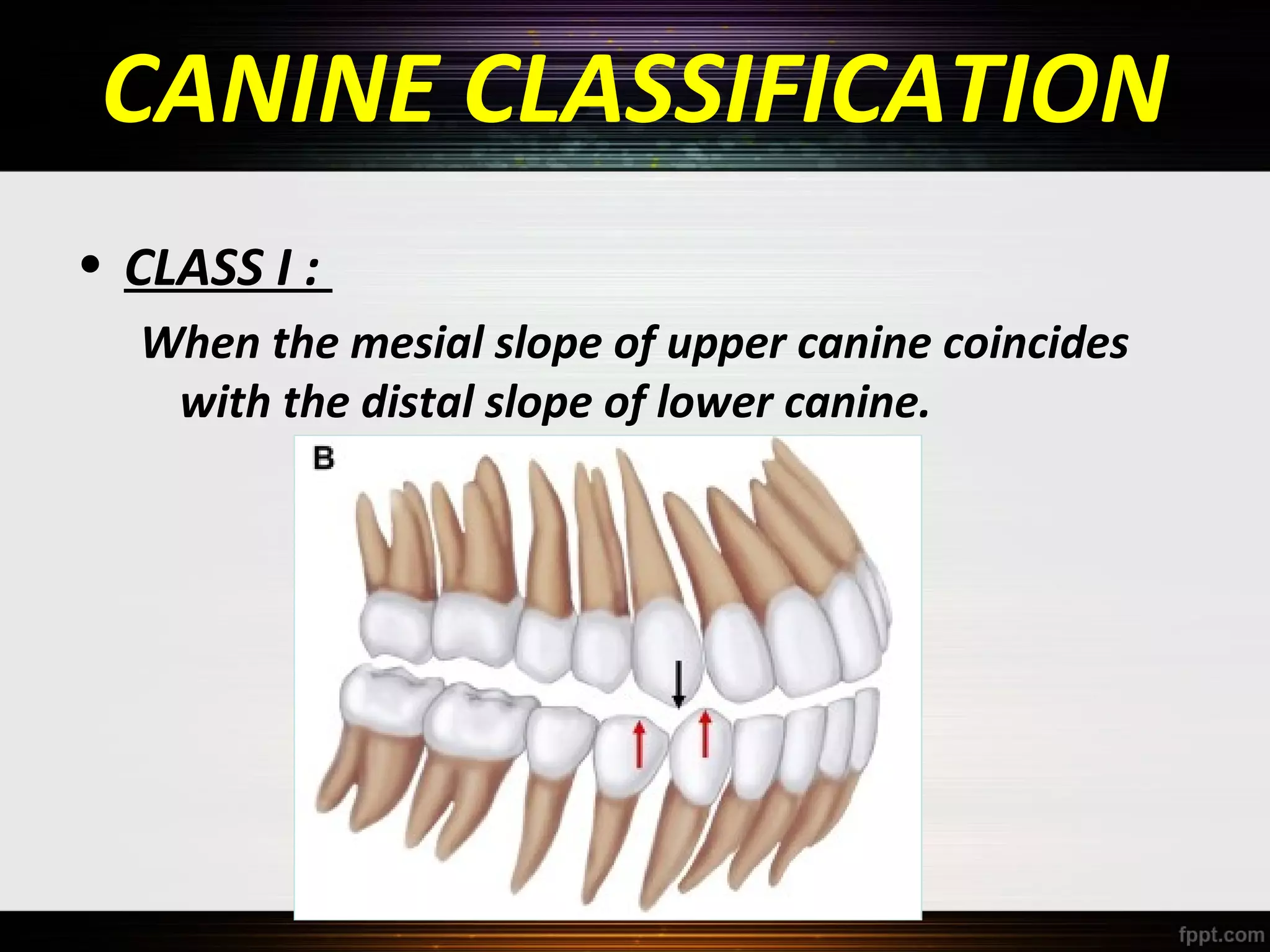
• CLASS I :
When the mesial slope of upper canine coincides
with the distal slope of lower canine.
CANINE CLASSIFICATION
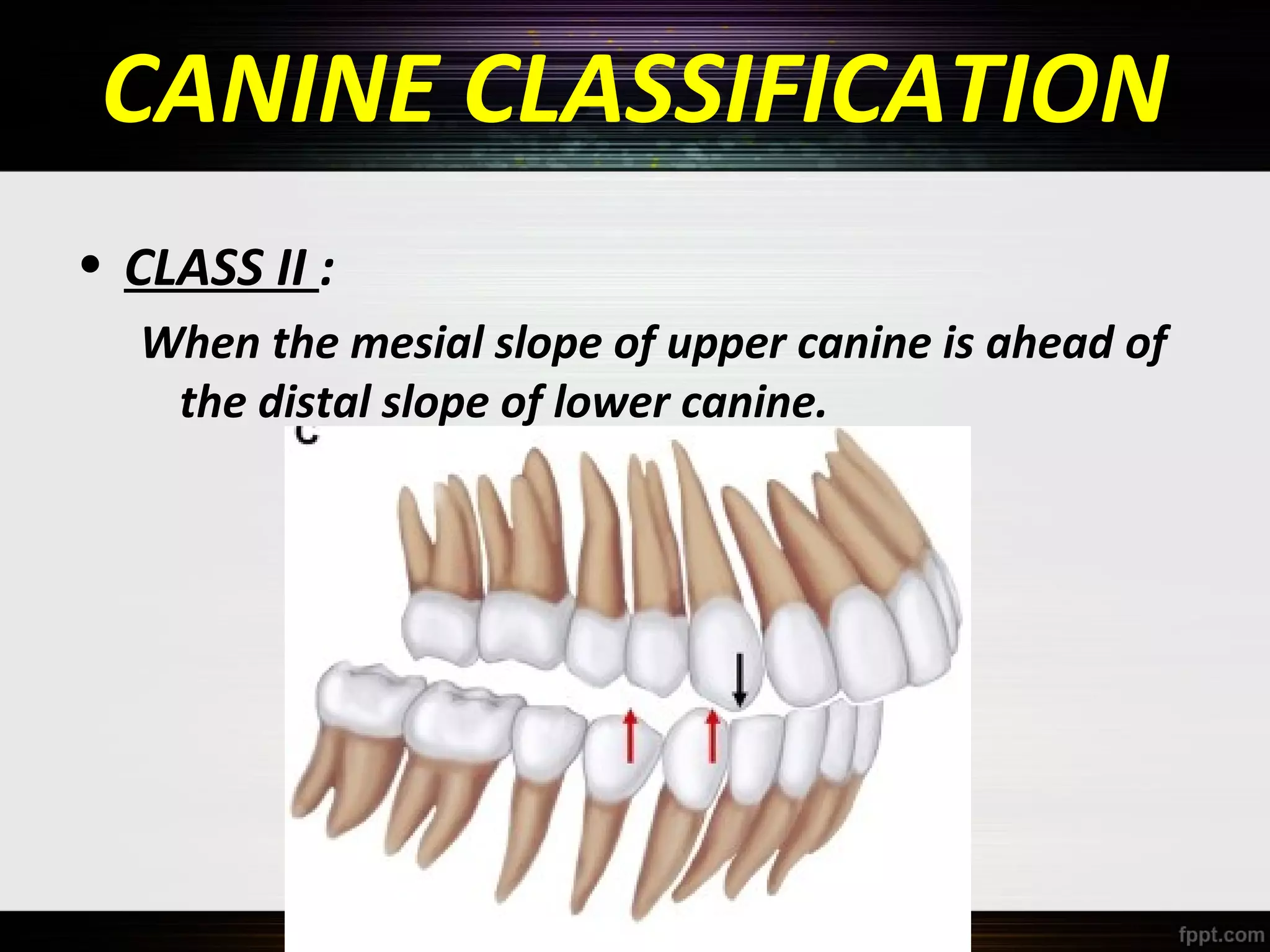
• CLASS II :
When the mesial slope of upper canine is ahead of
the distal slope of lower canine.
CANINE CLASSIFICATION
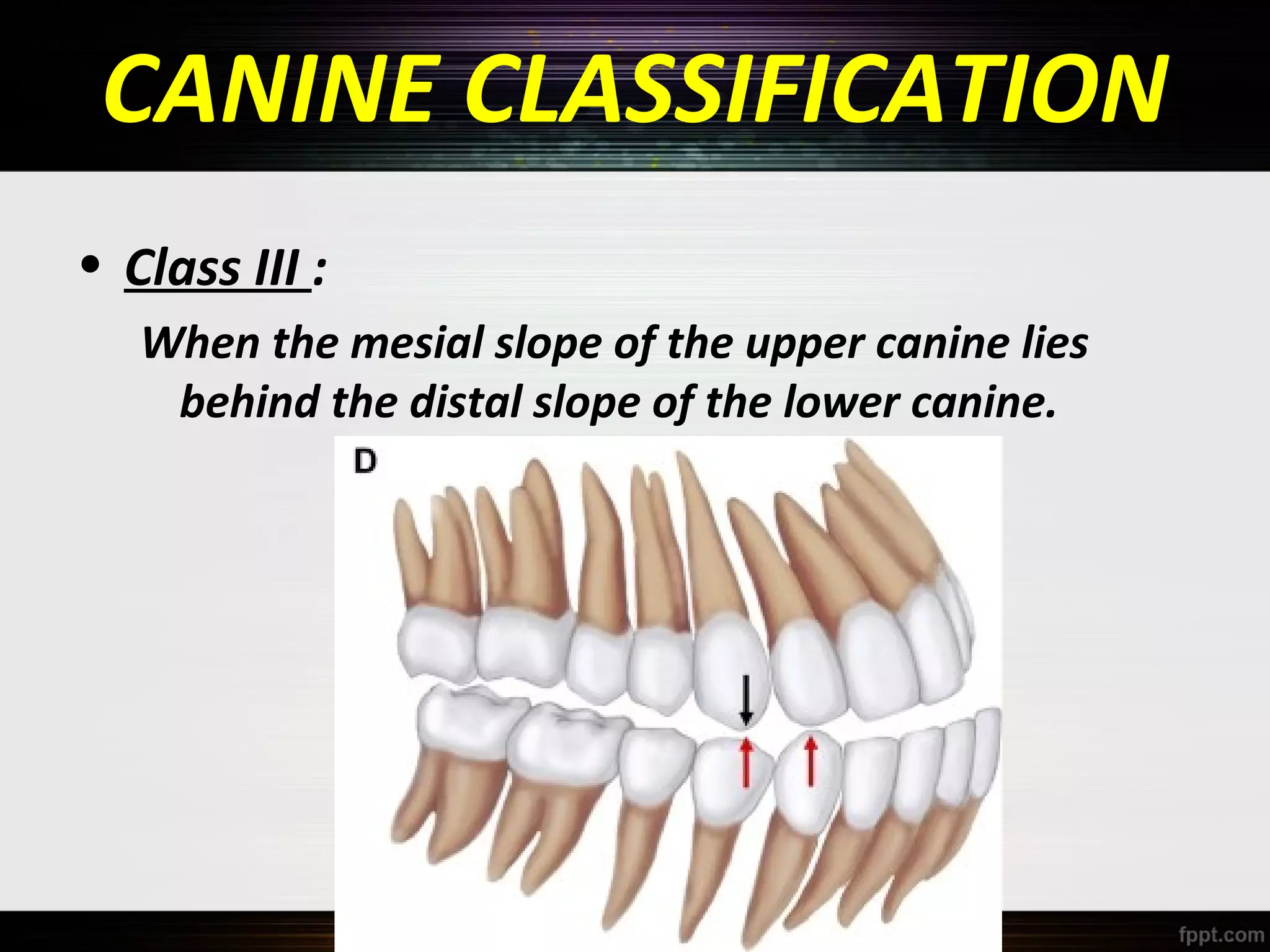
• Class III :
When the mesial slope of the upper canine lies
behind the distal slope of the lower canine.
SIMON’S CLASSIFICATION (1926)
• In Simon’s classification system, the dental
arches are related to three anthropologic
planes.
• PLANES USED:
– Frankfort horizontal plane or eye-ear-plane.
– Orbital plane.
– Raphe median plane or mid-saggital plane.
SIMON’S CLASSIFICATION
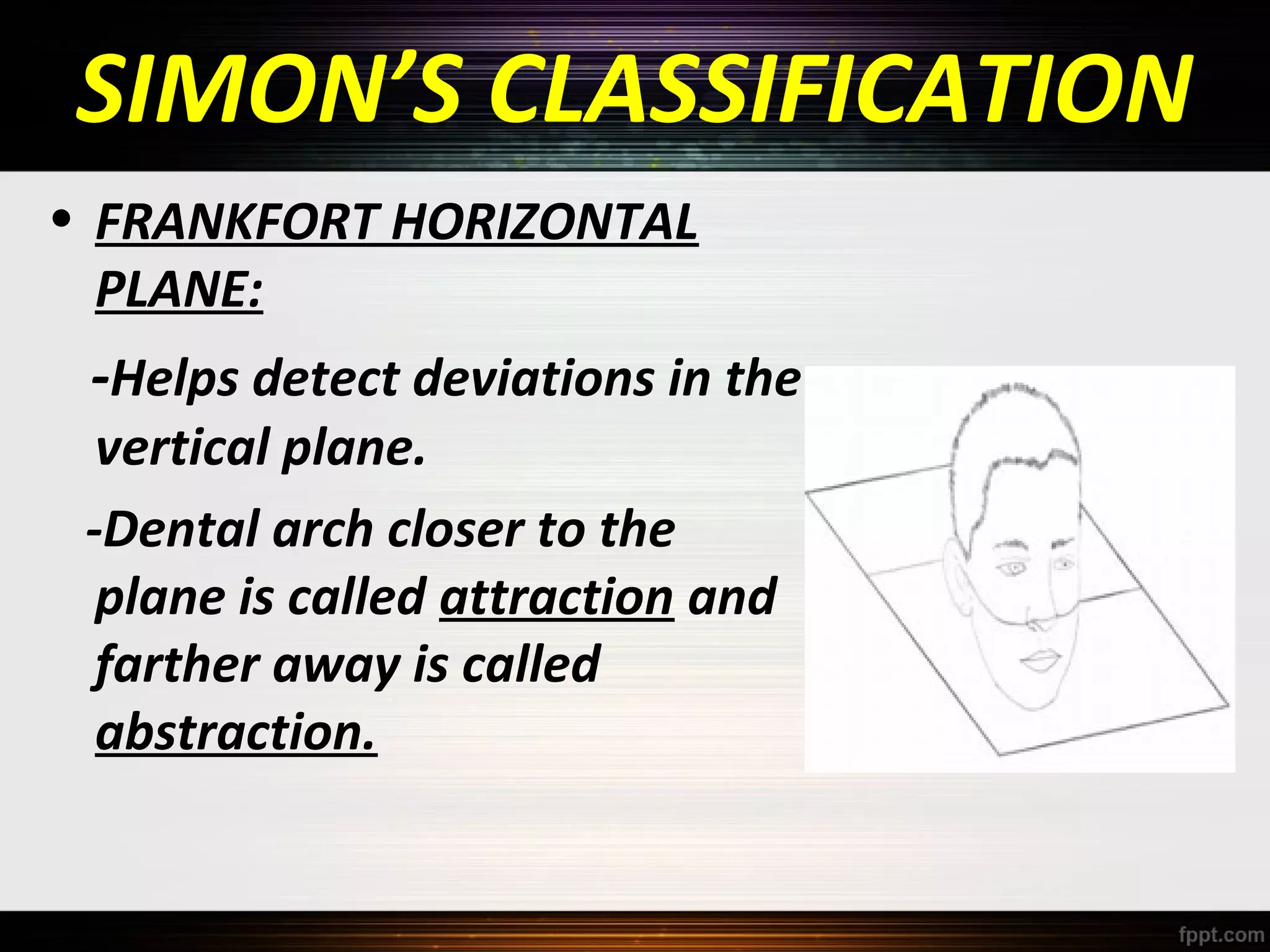
• FRANKFORT HORIZONTAL
PLANE:

-Helps detect deviations in the

vertical plane.
-Dental arch closer to the
plane is called attraction and
farther away is called
abstraction.
SIMON’S CLASSIFICATION
•

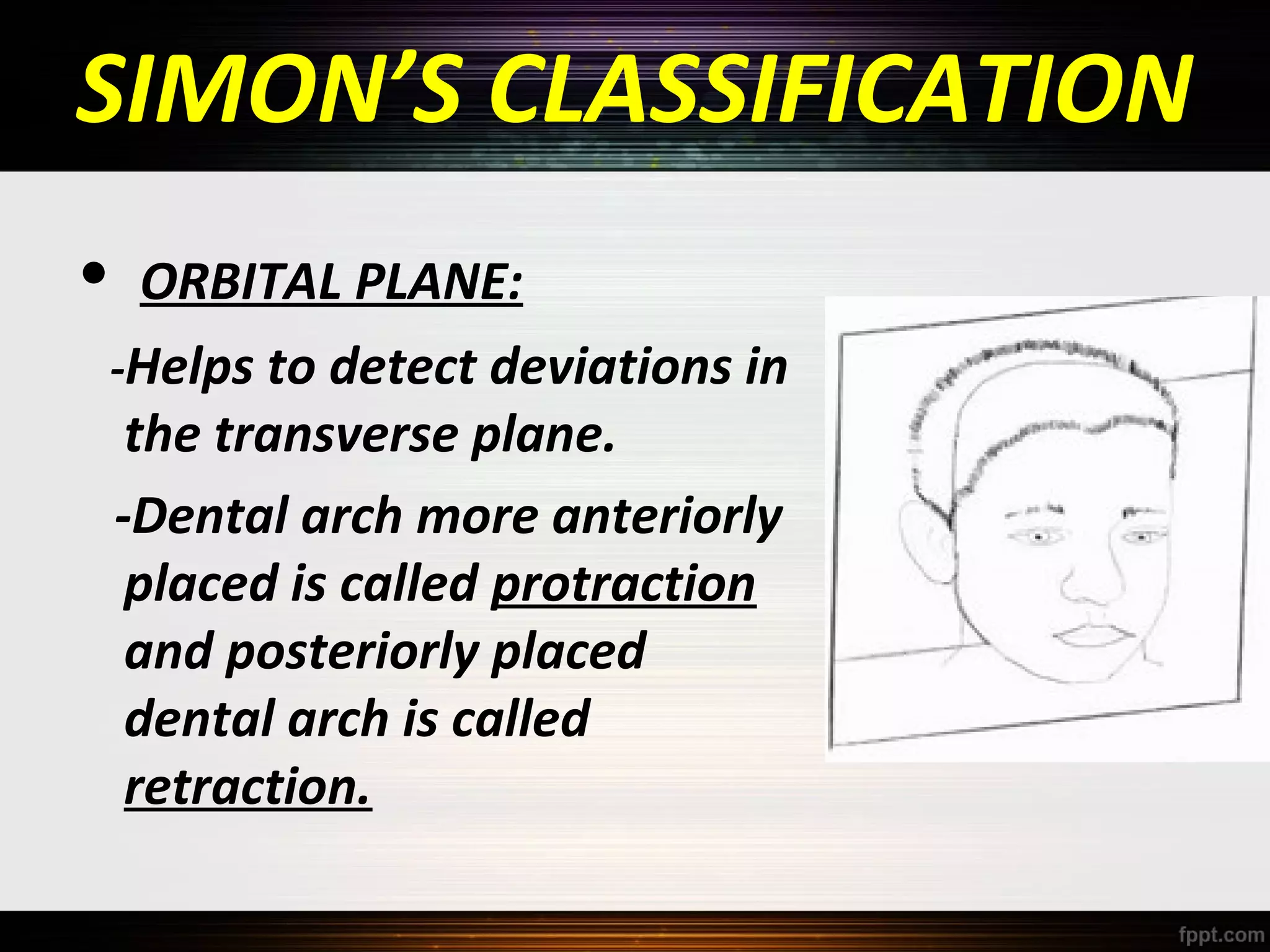
ORBITAL PLANE:
-Helps to detect deviations in
the transverse plane.
-Dental arch more anteriorly
placed is called protraction
and posteriorly placed
dental arch is called
retraction.
SIMON’S CLASSIFICATION
• MID-SAGGITAL PLANE:
- Helps to detect deviations
in the saggital plane.
- Dental arch closer to midsaggital plane is called
contraction and farther
away is called distraction.
ACKERMAN & PROFFIT
CLASSIFICATION (1960)
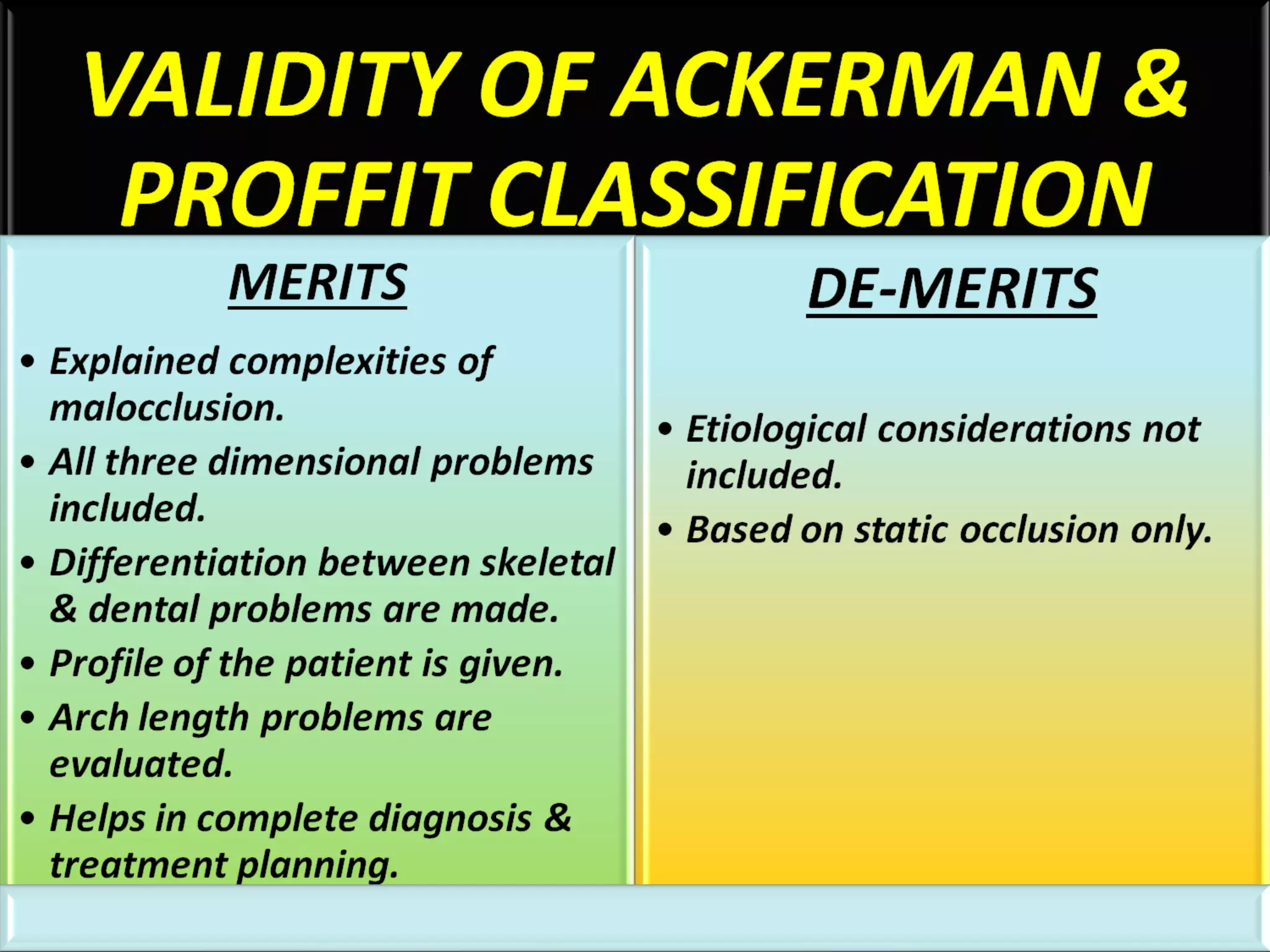
• It was proposed to overcome the drawbacks
of Angle’s classification.
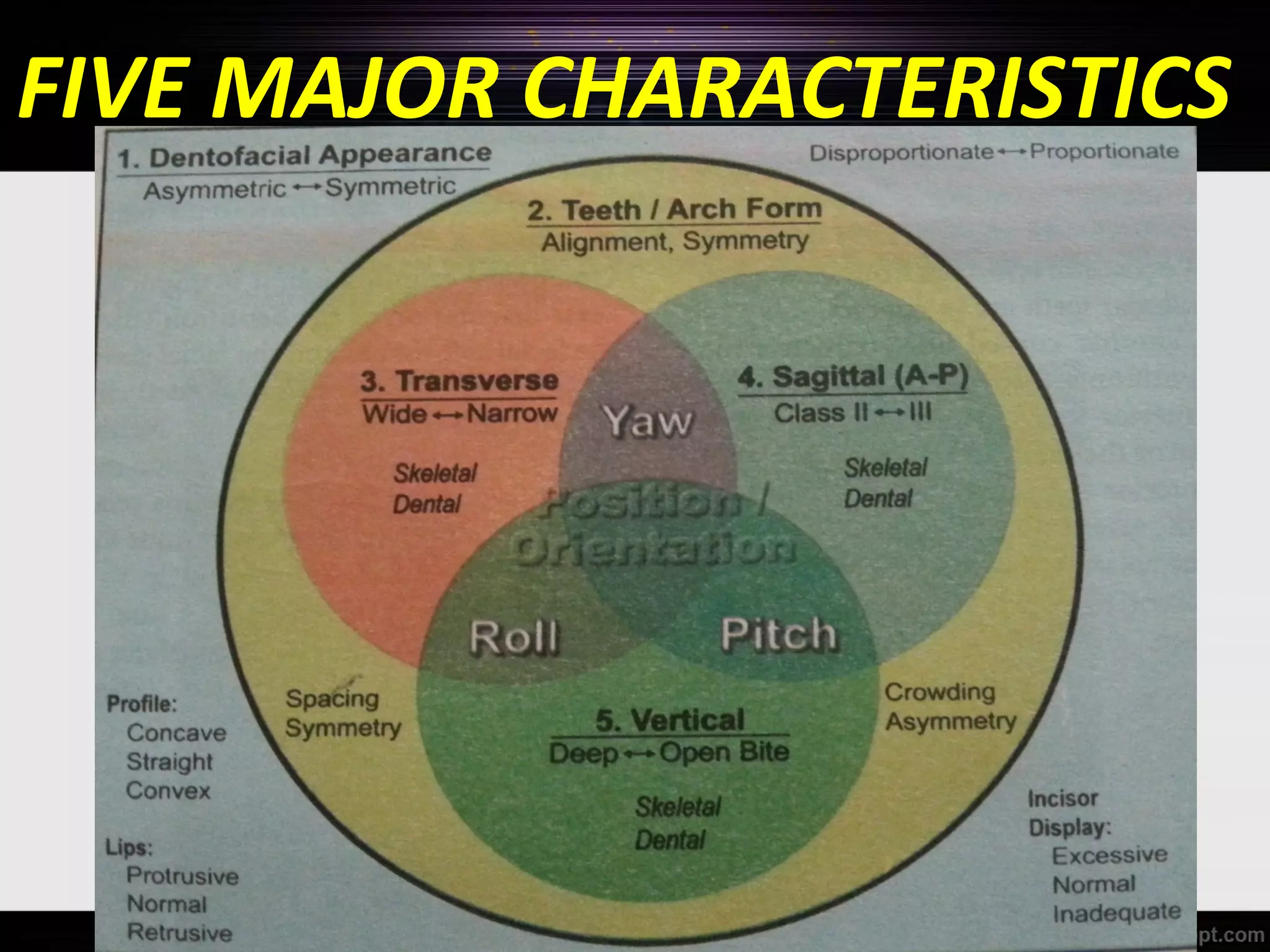
• This system includes Angle’s classification &
five characteristics of malocclusion within a
Venn diagram.
FIVE MAJOR CHARACTERISTICS
ADDITION TO THE FIVE-CHARACTERISTICS
CLASSIFICATION SYSTEM
• Two things particularly help this more
thorough analysis:
1. Esthetic line of occlusion.
2. Rotational axes.
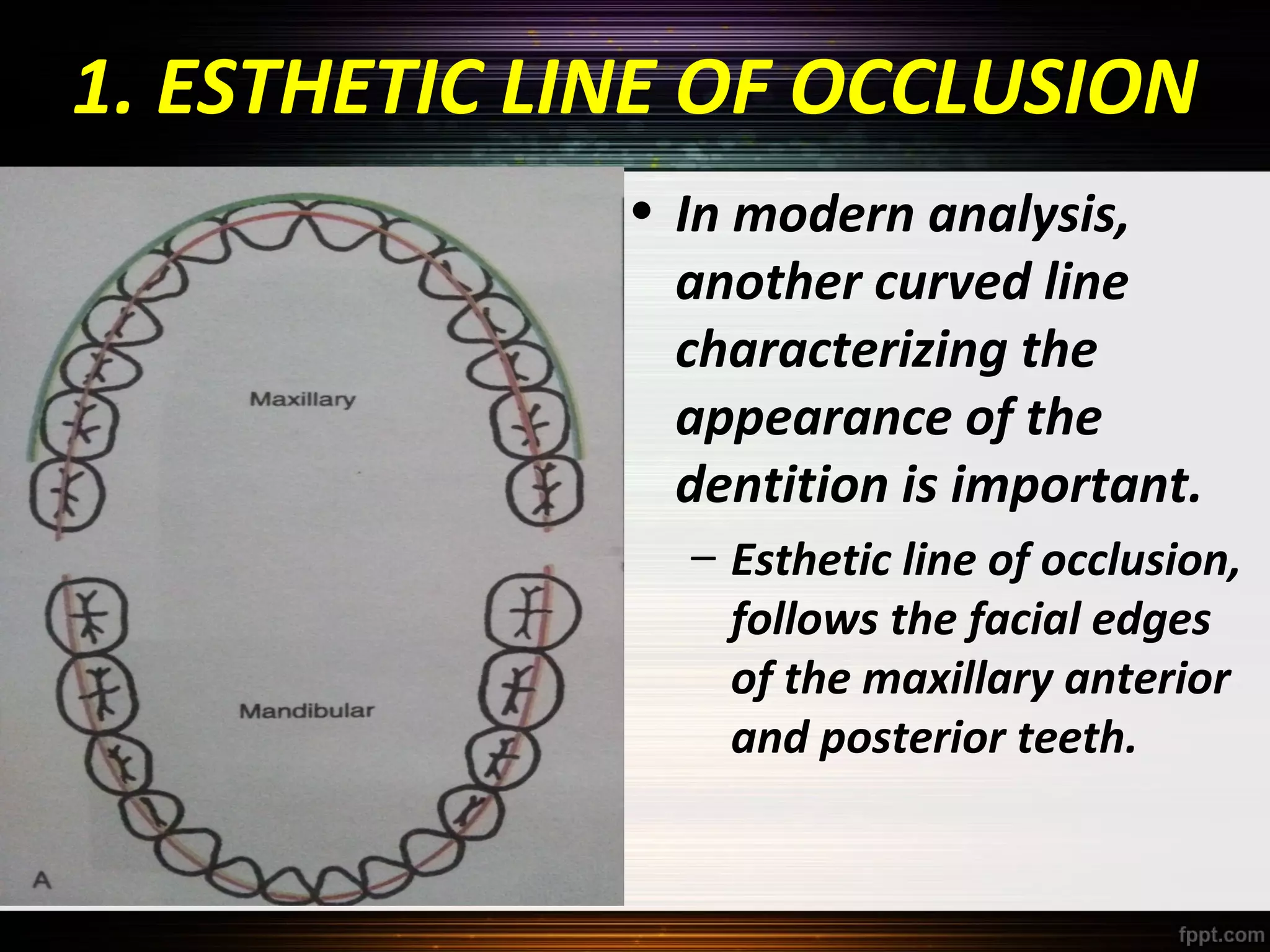
1. ESTHETIC LINE OF OCCLUSION
• In modern analysis,
another curved line
characterizing the
appearance of the
dentition is important.
– Esthetic line of occlusion,
follows the facial edges
of the maxillary anterior
and posterior teeth.
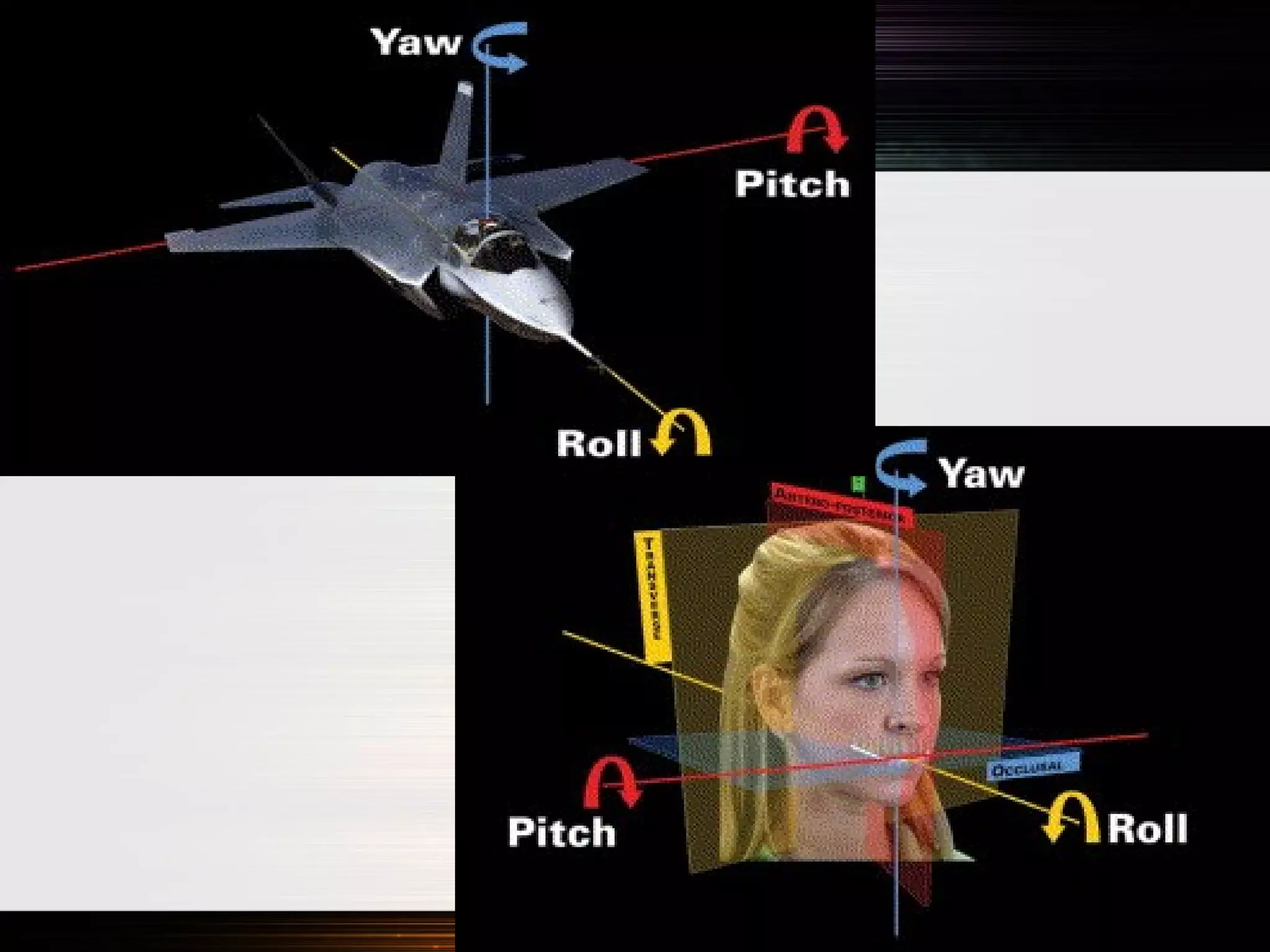
2. ROTATIONAL AXES
• In addition to relationship in the transverse, anteroposterior and vertical planes of space used in
traditional 3-D analysis, rotations around axes
perpendicular to three planes also must be
evaluated.
• It’s a useful way to evaluate the relationship of the
teeth to the soft tissues that frame their display.
– Pitch.
– Roll.
– Yaw.
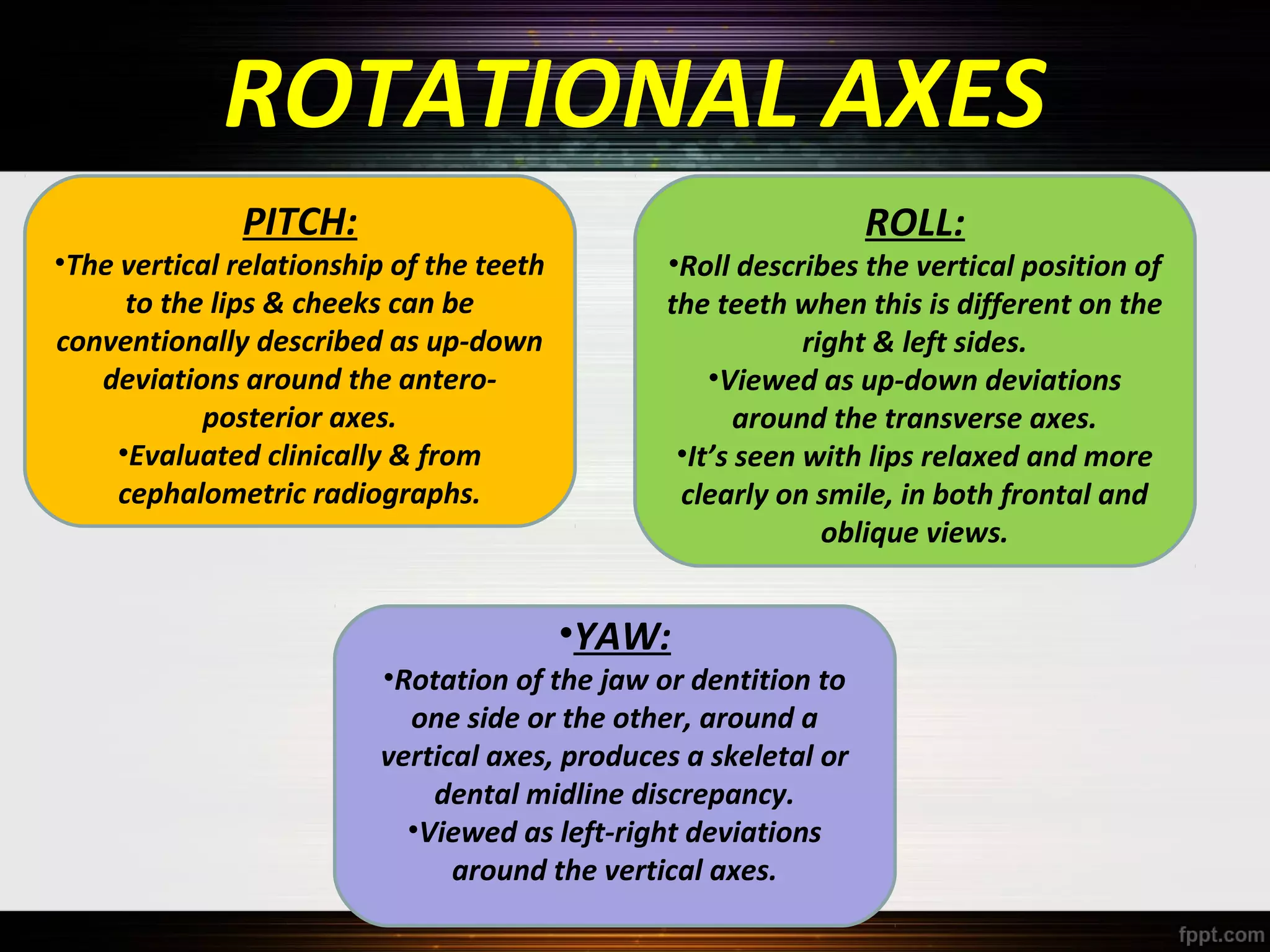
ROTATIONAL AXES
PITCH:

•The vertical relationship of the teeth
to the lips & cheeks can be
conventionally described as up-down
deviations around the anteroposterior axes.
•Evaluated clinically & from
cephalometric radiographs.

ROLL:

•Roll describes the vertical position of
the teeth when this is different on the
right & left sides.
•Viewed as up-down deviations
around the transverse axes.
•It’s seen with lips relaxed and more
clearly on smile, in both frontal and
oblique views.

•YAW:

•Rotation of the jaw or dentition to
one side or the other, around a
vertical axes, produces a skeletal or
dental midline discrepancy.
•Viewed as left-right deviations
around the vertical axes.
REFRENCES
• CONTEMPORARY ORTHODONTICS, WILLIAM R.
PROFFIT (5TH. EDITION)
• INTRODUCTION TO ORTHODONTICS, LAURA
MITCHELL (3RD. EDITION)
• ORTHODONTICS, PREM KUMAR (2ND. EDITION)
Classification of malocclusion

Classification of malocclusion

  • 1.
  • 2.
    ROAD MAP • WHATIS MALOCCLUSION? • NEED OR USES FOR CLASSIFICATION. • SYSTEMS OF CLASSIFICATION & TERMINOLOGIES. – ANGLE’S CLASSIFICATION. • MODIFICATIONS OF ANGLE’S CLASSIFICATION. – ANDREW’S SIX KEYS. – SKELETAL CLASSIFICATION. – BRITISH STANDARD CLASSIFICATION OF INCISOR RELATIONSHIP. – CANINE CLASSIFICATION. – SIMON’S CLASSIFICATION. – ACKERMAN & PROFFIT CLASSIFICATION.
  • 3.
    OCCLUSION WHEN THE TEETHIN THE MANDIBULAR ARCH COME INTO CONTACT WITH THOSE IN THE MAXILLARY ARCH IN ANY FUNCTIONAL RELATION, ARE SAID TO BE IN OCCLUSION. (WHEELER’S)
  • 4.
    WHAT IS MALOCCLUSION..?? ACONDITION IN WHICH THERE IS A DEFLECTION FROM THE NORMAL RELATION OF THE TEETH TO OTHER TEETH IN THE SAME ARCH AND/OR TO TEETH IN THE OPPOSING ARCH. (GARDINER, WHITE & LEIGHTON)
  • 5.
    NEED FOR CLASSIFICATION • • • • • • • • Groupingof orthodontic problems. Location of problems to be treated. Diagnosis & treatment plan. Comparison of different types of malocclusion. For self-communication. Documentation of problems. Used for epidemiological studies. Assessment of treatment effects of orthodontic appliances.
  • 6.
  • 7.
    METHODS OF CLASSIFICATIONOF MALOCCLUSION CAN BE BROADLY DIVIDED INTO TWO TYPES QUANTITATIVE & QUALITATIVE TYPES OF MALOCCLUSION INTRA-ARCH & INTER- ARCH PROBLEMS
  • 9.
    MALOCCLUSION: INTRA-ARCH & INTER-ARCHPROBLEMS INTRA-ARCH PROBLEMS (INDIVIDUAL OR GROUPS OF TEETH)
  • 10.
    MALOCCLUSION: INTRA-ARCH & INTER-ARCHPROBLEMS INTER-ARCH PROBLEMS
  • 11.
    ANGLE’S CLASSIFICATION OF MALOCCLUSION •In 1899 Edward H. Angle published the first classification of malocclusion. • The classifications are based on the relationship of the mesiobuccal cusp of the maxillary first molar and the buccal groove of the mandibular first molar.
  • 12.
    ANGLE’S CLASSIFICATION OF MALOCCLUSION CLASSI MALOCCLUSION DIVISION 1 CLASS II MALOCCLUSION DIVISION 2 CLASS III MALOCCLUSION SUB-DIVISION CLASS III PSEUDO CLASS III SUB-DIVISION
  • 13.
    CLASS I MALOCCLUSION THEMESIOBUCCAL CUSP OF THE UPPER FIRST PERMANENT MOLAR OCCLUDES WITH THE MESIOBUCCAL GROOVE OF THE LOWER FIRST MOLAR, BUT LINE OF OCCLUSION IS INCORRECT BECAUSE OF MALPOSED TEETH, ROTATIONS OR OTHER DISCREPANCIES.
  • 14.
    CLASS II MALOCLUSION THEMESIOBUCCAL CUSP OF THE LOWER FIRST PERMANENT MOLAR OCCLUDES DISTAL TO THE CLASS I POSITION.
  • 15.
    CLASS II DIVISION1 Condition when class II molar relationship is present with proclined upper central incisors. • There is an increase in overjet.
  • 16.
    CLASS II DIVISION2 Condition when class II molar relationship is present with retroclined upper central incisors, upper lateral incisors may be proclined or normally inclined. • Overjet is usually minimal or may be increased.
  • 17.
    CLASS II SUB-DIVISION Conditionwhen the class II molar relationship exists on only one side with normal molar relationship on the other side.
  • 18.
    CLASS III MALOCCLUSION THEMESIOBUCCAL CUSP OF THE LOWER FIST MOLAR OCCLUDES MESIAL TO THE CLASS I POSITION.
  • 19.
    PSEUDO CLASS IIIMALOCCLUSION Due to occlusal prematurity, when the mandible moves from rest position to occlusion, it slides forward into a pseudo class III position. It’s also known as postural class III.
  • 20.
    CLASS III SUB-DIVISION Conditionin which class III molar relationship is present only on one side with normal relation on the other side.
  • 22.
    MODIFICATIONS OF ANGLE’S CLASSIFICATION Thereare two modifications of Angle’s classification 1.Lischer’s modification. 2.Dewey’s modification.
  • 23.
    LISCHER’S MODIFICATION • Heintroduced following names to the Angle’s classification: – Neutrocclusion- Class I. – Distocclusion- Class II. – Mesiocclusion- Class III
  • 24.
    DEWEY’S MODIFICATION (1915) •Martin Dewey divided Angle’s class I & III into further types: – CLASS I: • Type 1: Crowded maxillary anterior teeth. Canines may be abnormally positioned. • Type 2: Proclined or labioversion of maxillary incisors. • Type 3: Anterior cross bite present. • Type 4: Posterior cross bite present. • Type 5: Mesioversion of molars.
  • 25.
    DEWEY’S MODIFICATION – CLASSIII: • Type 1: Well aligned teeth & dental arches. Edge-edge relationship. • Type 2: Crowded mandibular incisors. • Type 3: Crowded maxillary incisors, underdeveloped maxilla. Anterior cross bite present.
  • 26.
    ANDREW’S SIX KEYS(1970) Andrew extended Angle’s classification: 1. Correct molar relationship. 2. Correct crown angulations. 3. Correct crown inclination i.e. Class I incisor relationship. 4. No rotation present. 5. Teeth in tight contact with no spacing. 6. Occlusal plane/ curve of spee should be flat i.e. it should not be deeper than 1.5mm. 7. No tooth size discrepancies. (Bannet & McLanghlan’s)
  • 27.
    SKELETAL CLASSIFICATION It consideredrelationship between maxilla & mandible, in anteroposterior direction. • CLASS I: Maxilla & mandible are in harmony with each other.
  • 28.
    SKELETAL CLASSIFICATION • CLASSII: Maxilla lies ahead of mandible with refrence to anteroir cranial base. In other words maxilla is prgnated.
  • 29.
    SKELETAL CLASSIFICATION • CLASSIII: Maxilla lies posterior to mandible with reference to anterior cranial base. In other words maxilla is retrognathed.
  • 30.
    BRITISH STANDARD CLASSIFICATION OFINCISOR RELATIONSHIP (1983) Based upon incisor relationship, proposed in 1983. Do not consider molar relationship in some cases. • CLASS I: The lower incisor edges occlude with or lie immediately below the cingulum plateau of upper central incisors.
  • 31.
    BRITISH STANDARD CLASSIFICATION OFINCISOR RELATIONSHIP • CLASS II: The lower incisor edges lie posterior to the cingulum plateau of the upper incisors. There are two sub-divisions: – DIVISION 1: The upper central incisors are proclined or of average inclination & there is an increase in overjet. – DIVISION 2: The upper central incisors are retroclined. The overjet is usually minimal or may be increased.
  • 32.
    BRITISH STANDARD CLASSIFICATION OFINCISOR RELATIONSHIP • CLASS III: The lower incisor edges lies anterior to the cingulum plateau of the upper incisors. The overjet is reduced or reversed.
  • 33.
    CANINE CLASSIFICATION • CLASSI : When the mesial slope of upper canine coincides with the distal slope of lower canine.
  • 34.
    CANINE CLASSIFICATION • CLASSII : When the mesial slope of upper canine is ahead of the distal slope of lower canine.
  • 35.
    CANINE CLASSIFICATION • ClassIII : When the mesial slope of the upper canine lies behind the distal slope of the lower canine.
  • 36.
    SIMON’S CLASSIFICATION (1926) •In Simon’s classification system, the dental arches are related to three anthropologic planes. • PLANES USED: – Frankfort horizontal plane or eye-ear-plane. – Orbital plane. – Raphe median plane or mid-saggital plane.
  • 37.
    SIMON’S CLASSIFICATION • FRANKFORTHORIZONTAL PLANE: -Helps detect deviations in the vertical plane. -Dental arch closer to the plane is called attraction and farther away is called abstraction.
  • 38.
    SIMON’S CLASSIFICATION • ORBITAL PLANE: -Helpsto detect deviations in the transverse plane. -Dental arch more anteriorly placed is called protraction and posteriorly placed dental arch is called retraction.
  • 39.
    SIMON’S CLASSIFICATION • MID-SAGGITALPLANE: - Helps to detect deviations in the saggital plane. - Dental arch closer to midsaggital plane is called contraction and farther away is called distraction.
  • 40.
    ACKERMAN & PROFFIT CLASSIFICATION(1960) • It was proposed to overcome the drawbacks of Angle’s classification. • This system includes Angle’s classification & five characteristics of malocclusion within a Venn diagram.
  • 41.
  • 42.
    ADDITION TO THEFIVE-CHARACTERISTICS CLASSIFICATION SYSTEM • Two things particularly help this more thorough analysis: 1. Esthetic line of occlusion. 2. Rotational axes.
  • 43.
    1. ESTHETIC LINEOF OCCLUSION • In modern analysis, another curved line characterizing the appearance of the dentition is important. – Esthetic line of occlusion, follows the facial edges of the maxillary anterior and posterior teeth.
  • 44.
    2. ROTATIONAL AXES •In addition to relationship in the transverse, anteroposterior and vertical planes of space used in traditional 3-D analysis, rotations around axes perpendicular to three planes also must be evaluated. • It’s a useful way to evaluate the relationship of the teeth to the soft tissues that frame their display. – Pitch. – Roll. – Yaw.
  • 46.
    ROTATIONAL AXES PITCH: •The verticalrelationship of the teeth to the lips & cheeks can be conventionally described as up-down deviations around the anteroposterior axes. •Evaluated clinically & from cephalometric radiographs. ROLL: •Roll describes the vertical position of the teeth when this is different on the right & left sides. •Viewed as up-down deviations around the transverse axes. •It’s seen with lips relaxed and more clearly on smile, in both frontal and oblique views. •YAW: •Rotation of the jaw or dentition to one side or the other, around a vertical axes, produces a skeletal or dental midline discrepancy. •Viewed as left-right deviations around the vertical axes.
  • 48.
    REFRENCES • CONTEMPORARY ORTHODONTICS,WILLIAM R. PROFFIT (5TH. EDITION) • INTRODUCTION TO ORTHODONTICS, LAURA MITCHELL (3RD. EDITION) • ORTHODONTICS, PREM KUMAR (2ND. EDITION)