Compensating Curves
Introduction
The arrangement of nonanatomical posterior teeth
with both anteroposterior and mediolateral com-
pensating curves permits the establishment of a
balanced articulation.
The primary function of compensating curve is to provide
balancing contacts for protrusive mandibular movements.
Anteroposterior Compensating Curve
● Begins at the distal marginal ridge of the first posterior
replacement tooth
● continues through the second molar
● involves the cuspid tips and the retromolar pads as the
anatomical guides.
● extent of the curve rarely exceeds 20 degrees.
Mediolateral Compensating Curve
● To achieve balanced articulation during
lateral movements
● Also is initiated with the first replacement
tooth continues through the second
molar.
● The facial cusps elevated in relation to the
lingual cusps to establish this curve
varies with the condylar and incisal
guidances.
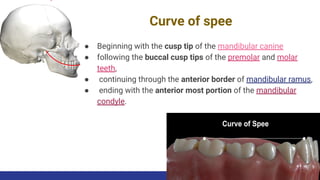
Curve of spee
● Beginning with the cusp tip of the mandibular canine
● following the buccal cusp tips of the premolar and molar
teeth,
● continuing through the anterior border of mandibular ramus,
● ending with the anterior most portion of the mandibular
condyle.
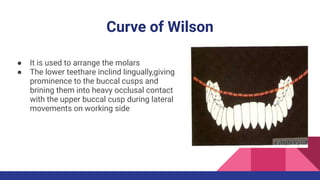
Curve of Wilson
● It is used to arrange the molars
● The lower teethare inclind lingually,giving
prominence to the buccal cusps and
brining them into heavy occlusal contact
with the upper buccal cusp during lateral
movements on working side
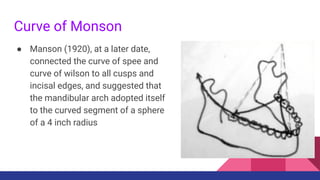
Curve of Monson
● Manson (1920), at a later date,
connected the curve of spee and
curve of wilson to all cusps and
incisal edges, and suggested that
the mandibular arch adopted itself
to the curved segment of a sphere
of a 4 inch radius
Thank you

Compensating Curves.pptx

  • 1.
  • 2.
    Introduction The arrangement ofnonanatomical posterior teeth with both anteroposterior and mediolateral com- pensating curves permits the establishment of a balanced articulation.
  • 3.
    The primary functionof compensating curve is to provide balancing contacts for protrusive mandibular movements.
  • 4.
    Anteroposterior Compensating Curve ●Begins at the distal marginal ridge of the first posterior replacement tooth ● continues through the second molar ● involves the cuspid tips and the retromolar pads as the anatomical guides. ● extent of the curve rarely exceeds 20 degrees.
  • 5.
    Mediolateral Compensating Curve ●To achieve balanced articulation during lateral movements ● Also is initiated with the first replacement tooth continues through the second molar. ● The facial cusps elevated in relation to the lingual cusps to establish this curve varies with the condylar and incisal guidances.
  • 6.
    Curve of spee ●Beginning with the cusp tip of the mandibular canine ● following the buccal cusp tips of the premolar and molar teeth, ● continuing through the anterior border of mandibular ramus, ● ending with the anterior most portion of the mandibular condyle.
  • 7.
    Curve of Wilson ●It is used to arrange the molars ● The lower teethare inclind lingually,giving prominence to the buccal cusps and brining them into heavy occlusal contact with the upper buccal cusp during lateral movements on working side
  • 8.
    Curve of Monson ●Manson (1920), at a later date, connected the curve of spee and curve of wilson to all cusps and incisal edges, and suggested that the mandibular arch adopted itself to the curved segment of a sphere of a 4 inch radius
  • 9.