DR DURGA PRASAD
Professor, Dept Of
Orthodontics.
Navodaya Dental College,
Raichur.
CONCEPT OF OCCLUSION
INTRODUCTION
 The study of occlusion is important aspect of
dentistry. The study & practice of dentistry
should be based on strong foundation of
knowledge of occlusion.
 The orthodontist should know what constitutes
normal occlusion in order to be able to
recognize abnormal occlusion.
OCCLUSION
 OCCLUSION : by dictionary definition refers
to the act of closure or being closed.
 OCCLUSION : The relationship of maxillary
and mandibular teeth when they are in
functional contact during activity of the
mandible
- Dorland’s Medical Dictionary
OCCLUSION
 According to Angle – occlusion is the
normal relation of the occlusal inclined
planes of the teeth when jaws are closed.
 According to Bishara – occlusion is the
way the maxillary and mandibular teeth
articulate.
OCCLUSION
 In modern dentistry – the word occlusion
has a static, morphological, tooth contact
connotation.
 Occlusion also has a functional implication
that involves the teeth and other parts of
masticatory system in various movement
situations.
NORMAL OCCLUSION
 Normal implies a situation commonly found
in absence of disease, and normal values in
a biological system are given within an
adaptive physiological range.
NORMAL OCCLUSION
 Normal occlusion therefore should imply
more than a range of anatomically
acceptable values, it should also indicate
physiological adaptability and the absence of
recognizable pathological manifestation.
IDEAL OCCLUSION
 The concept of ideal or optimal occlusion
refers both to an aesthetic and physiologic
ideal.
 It includes functional harmony, stability of
masticatory system & Neuromuscular
harmony
PHYSOLOGIC OCCLUSION
 The occlusion that shows no signs of
occlusion related pathosis.
 It may not be an ideal occlusion but it is
devoid of any pathological manifestations in
the surrounding tissues.
PATHOLOGIC OCCLUSION
 If the form & function are not in harmony &
the physiologic adaptive mechanism is weak,
one or more of its components can show
break down & exhibit Pathologic occlusion.
PATHOLOGIC OCCLUSION
 Evidences of pathologic occlusion:
- attrition of teeth
- occlusal trauma
- muscular spasm
- TMJ disorders
FUNCTIONAL OCCLUSION
 It is defined as an arrangement of teeth
which will provide the highest efficiency
during all the excursive movements of the
mandible which are necessary during
function.
STATIC & DYNAMIC OCCLUSION
‘Static’ refers to the form, alignment and
articulation of the teeth within and between the
arches, and the relationship of the teeth to their
supporting structure.
‘Dynamic’ refers to the function of the
stomatognathic system as a whole comprising
teeth, supporting structure, temporomandibular
joint & neuromuscular system.
TRAUMATIC OCCLUSION
 An occlusion judged to be causative factors
in the formation of traumatic lesions or
disturbances in the orofacial complex.
THERAPEUTIC OCCLUSION
 It is a treated occlusion employed to
counteract structural interrelationship related
to traumatic occlusion.
SUPPORTING CUSP:
- facial cusp of mandibular & palatal cusp of
maxillary posteriors
- also known as Stamp cusps
- occluded with central fossa & marginal
ridges of opposing teeth.
NON-SUPPORTING CUSP
- maxillary buccal & mandibular lingual cusp
- Shearing or Guiding cusps
- contact & guide the mandible during lateral
excursions & shear food during mastication
DYNAMIC OCCLUSION
 The 13 muscle attachment to the mandible in
addition to articular capsule and tendon
provide a high degree of stability of position
that occlusal equilibration and full mouth
reconstruction can’t change permanently
DYNAMIC OCCLUSION
 The teeth are in occlusal contact only 2 to
6% of the time.
 94% of the time, they are apart.
 The largest segment of time is in postural
rest position determined by musculature.
DYNAMIC OCCLUSION
Three components of occlusion can be summed up
as :
1. Occlusal position (or) tooth contact position
- Masticatory habits, tooth inclination and
malposition, shape of teeth, premature
contact,
faulty restoration, tooth loss, the condition of
periodontium affect the occlusal positions
2. Postural resting position
3. TMJ
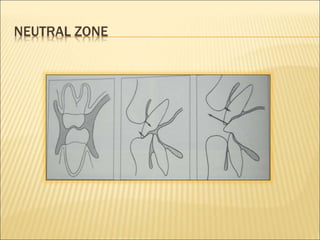
NEUTRAL ZONE
 Dental arches are situated in a space
bounded by the lips & cheeks externally &
tongue internally
 There is equilibrium of muscular forces if the
lip-cheek-tongue system is in balance.
NEUTRAL ZONE
NEUTRAL ZONE
 Equal forces acting on the teeth from lingual
& facial sides helps the teeth to attain a
position of relative stability.
 An imbalance of the system can unfavorably
influence the position of teeth in the dental
arches.
COMPENSATORY CURVES OF DENTAL ARCHES
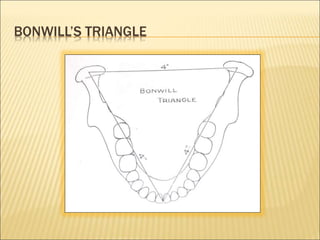
 Bonwill (1899)
- first to describe the mandible & mandibular
arch as adapting itself in part to an
equilateral triangle.
BONWILL’S TRIANGLE
COMPENSATORY CURVES OF DENTAL ARCHES
 Curve of Spee
- F. Graf Von Spee of Germany in 1890
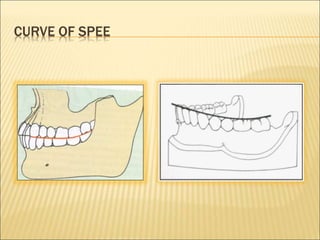
 Its an antero-posterior curve extending from
tip of mandibular cuspid & following the
buccal cusp of bicuspid & molar continuing
as arc through condyle.
 It would form a circle of 4” diameter
CURVE OF SPEE
CURVE OF SPEE
 An excessively concave curve of Spee and
mandibular core line restrict the occlusal
surface available for maxillary teeth.
 A flat to slightly concave curve of Spee and
mandibular core line bare the proper
occlusal surface for optimal occlusion.
 A convex curve of Spee and mandibular
core line bare excessive portions of the
occlusal surface.
CURVE OF WILSON
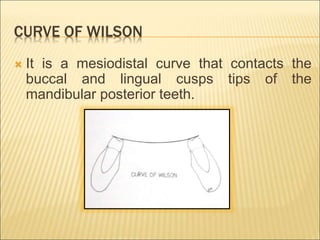
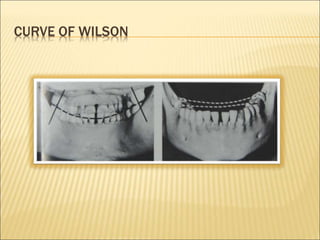
 It is a mesiodistal curve that contacts the
buccal and lingual cusps tips of the
mandibular posterior teeth.
CURVE OF WILSON
CURVE OF WILSON
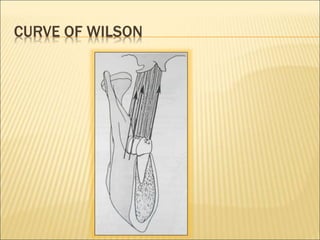
 It helps in two ways:
- Teeth aligned parallel to direction of medial
pterygoid for optimum resistance to
masticatory forces.
- The elevated buccal cusps prevent food
from going past the occlusal table.
CURVE OF WILSON
CURVE OF MONSON
 Monson (1920)
 Connected curve of Spee & curve of Wilson
to all cusp & incisal edges
 Suggested that mandibular arch adopted
itself to the curved segment of a 4” radius.
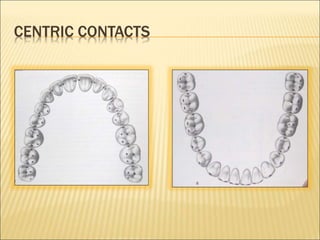
CENTRIC CONTACTS
 Anterior teeth contacts
 Posterior teeth contacts
POSTERIOR CENTRIC CONTACTS
 Facial & lingual range of contacts
- facial range of posterior centric contacts
involve the mandibular facial cusp tips
contacting the central fossa & marginal
ridges of opposing maxillary teeth
POSTERIOR CENTRIC CONTACTS
 Lingual range of posterior centric contact
involve the maxillary lingual cusp tips
contacting the central fossa & distal marginal
ridges of the opposing mandibular teeth.
ANTERIOR CENTRIC CONTACTS
 Anterior teeth have only one range of centric
contacts & are in line with the facial range
posterior centric contacts.
CENTRIC CONTACTS
PLANE OF OCCLUSION
 An imaginary surface that is related
anatomically to the cranium & that
theoretically touches the incisal edges of the
incisors & the tips of the occluding surfaces
of posterior teeth.
PLANE OF OCCLUSION
 A flat occlusal plane increases the chances
for the other occlusal factors as condylar &
incisal guidance, to disarticulate the posterior
teeth in protrusion & on the non working side.
CENTRIC RELATION
 CR may be defined as the relationship of the
mandible to the maxilla when the properly
aligned condyle disk assemblies are in the
most superior position against the eminentia,
irrespective of tooth position or vertical
dimension.
CENTRIC OCCLUSION
 CO refers to the relationship of the mandible
to the maxilla when the teeth are in
maximum occlusal contact, irrespective of
the position or alignment of the condyle disk
assemblies.
 Maximum interocclusal position
 CR is bilaterally symmetrical, is
physiologically accepted, & serves as a
therapeutic position for occlusal adjustment.
 CR is approximately 1mm distal to CO in 70-
90% of individuals.
IMPORTANCE OF CENTRIC RELATION
 In Orthodontics, diagnosis and treatment
planning should be performed by an
evaluation of an malocclusion with the
mandible in centric relation, i.e. the natural
musculoskeletal position of the condyle in
the fossa, in order to obtain the true maxillary
- mandibular skeletal and dental relations in
the three planes of space.
IMPORTANCE OF CENTRIC RELATION
 If this is overlooked an incorrect diagnosis
and treatment plan of the actual
malocclusion, along with its unfavorable
consequences, may result.

Class-Concept of occlusion O.ppt

  • 1.
    DR DURGA PRASAD Professor,Dept Of Orthodontics. Navodaya Dental College, Raichur. CONCEPT OF OCCLUSION
  • 2.
    INTRODUCTION  The studyof occlusion is important aspect of dentistry. The study & practice of dentistry should be based on strong foundation of knowledge of occlusion.  The orthodontist should know what constitutes normal occlusion in order to be able to recognize abnormal occlusion.
  • 3.
    OCCLUSION  OCCLUSION :by dictionary definition refers to the act of closure or being closed.  OCCLUSION : The relationship of maxillary and mandibular teeth when they are in functional contact during activity of the mandible - Dorland’s Medical Dictionary
  • 4.
    OCCLUSION  According toAngle – occlusion is the normal relation of the occlusal inclined planes of the teeth when jaws are closed.  According to Bishara – occlusion is the way the maxillary and mandibular teeth articulate.
  • 5.
    OCCLUSION  In moderndentistry – the word occlusion has a static, morphological, tooth contact connotation.  Occlusion also has a functional implication that involves the teeth and other parts of masticatory system in various movement situations.
  • 6.
    NORMAL OCCLUSION  Normalimplies a situation commonly found in absence of disease, and normal values in a biological system are given within an adaptive physiological range.
  • 7.
    NORMAL OCCLUSION  Normalocclusion therefore should imply more than a range of anatomically acceptable values, it should also indicate physiological adaptability and the absence of recognizable pathological manifestation.
  • 8.
    IDEAL OCCLUSION  Theconcept of ideal or optimal occlusion refers both to an aesthetic and physiologic ideal.  It includes functional harmony, stability of masticatory system & Neuromuscular harmony
  • 9.
    PHYSOLOGIC OCCLUSION  Theocclusion that shows no signs of occlusion related pathosis.  It may not be an ideal occlusion but it is devoid of any pathological manifestations in the surrounding tissues.
  • 10.
    PATHOLOGIC OCCLUSION  Ifthe form & function are not in harmony & the physiologic adaptive mechanism is weak, one or more of its components can show break down & exhibit Pathologic occlusion.
  • 11.
    PATHOLOGIC OCCLUSION  Evidencesof pathologic occlusion: - attrition of teeth - occlusal trauma - muscular spasm - TMJ disorders
  • 12.
    FUNCTIONAL OCCLUSION  Itis defined as an arrangement of teeth which will provide the highest efficiency during all the excursive movements of the mandible which are necessary during function.
  • 13.
    STATIC & DYNAMICOCCLUSION ‘Static’ refers to the form, alignment and articulation of the teeth within and between the arches, and the relationship of the teeth to their supporting structure. ‘Dynamic’ refers to the function of the stomatognathic system as a whole comprising teeth, supporting structure, temporomandibular joint & neuromuscular system.
  • 14.
    TRAUMATIC OCCLUSION  Anocclusion judged to be causative factors in the formation of traumatic lesions or disturbances in the orofacial complex.
  • 15.
    THERAPEUTIC OCCLUSION  Itis a treated occlusion employed to counteract structural interrelationship related to traumatic occlusion.
  • 16.
    SUPPORTING CUSP: - facialcusp of mandibular & palatal cusp of maxillary posteriors - also known as Stamp cusps - occluded with central fossa & marginal ridges of opposing teeth.
  • 17.
    NON-SUPPORTING CUSP - maxillarybuccal & mandibular lingual cusp - Shearing or Guiding cusps - contact & guide the mandible during lateral excursions & shear food during mastication
  • 18.
    DYNAMIC OCCLUSION  The13 muscle attachment to the mandible in addition to articular capsule and tendon provide a high degree of stability of position that occlusal equilibration and full mouth reconstruction can’t change permanently
  • 19.
    DYNAMIC OCCLUSION  Theteeth are in occlusal contact only 2 to 6% of the time.  94% of the time, they are apart.  The largest segment of time is in postural rest position determined by musculature.
  • 20.
    DYNAMIC OCCLUSION Three componentsof occlusion can be summed up as : 1. Occlusal position (or) tooth contact position - Masticatory habits, tooth inclination and malposition, shape of teeth, premature contact, faulty restoration, tooth loss, the condition of periodontium affect the occlusal positions 2. Postural resting position 3. TMJ
  • 21.
    NEUTRAL ZONE  Dentalarches are situated in a space bounded by the lips & cheeks externally & tongue internally  There is equilibrium of muscular forces if the lip-cheek-tongue system is in balance.
  • 22.
  • 23.
    NEUTRAL ZONE  Equalforces acting on the teeth from lingual & facial sides helps the teeth to attain a position of relative stability.  An imbalance of the system can unfavorably influence the position of teeth in the dental arches.
  • 24.
    COMPENSATORY CURVES OFDENTAL ARCHES  Bonwill (1899) - first to describe the mandible & mandibular arch as adapting itself in part to an equilateral triangle.
  • 25.
  • 26.
    COMPENSATORY CURVES OFDENTAL ARCHES  Curve of Spee - F. Graf Von Spee of Germany in 1890  Its an antero-posterior curve extending from tip of mandibular cuspid & following the buccal cusp of bicuspid & molar continuing as arc through condyle.  It would form a circle of 4” diameter
  • 27.
  • 28.
    CURVE OF SPEE An excessively concave curve of Spee and mandibular core line restrict the occlusal surface available for maxillary teeth.  A flat to slightly concave curve of Spee and mandibular core line bare the proper occlusal surface for optimal occlusion.  A convex curve of Spee and mandibular core line bare excessive portions of the occlusal surface.
  • 29.
    CURVE OF WILSON It is a mesiodistal curve that contacts the buccal and lingual cusps tips of the mandibular posterior teeth.
  • 30.
  • 31.
    CURVE OF WILSON It helps in two ways: - Teeth aligned parallel to direction of medial pterygoid for optimum resistance to masticatory forces. - The elevated buccal cusps prevent food from going past the occlusal table.
  • 32.
  • 33.
    CURVE OF MONSON Monson (1920)  Connected curve of Spee & curve of Wilson to all cusp & incisal edges  Suggested that mandibular arch adopted itself to the curved segment of a 4” radius.
  • 34.
    CENTRIC CONTACTS  Anteriorteeth contacts  Posterior teeth contacts
  • 35.
    POSTERIOR CENTRIC CONTACTS Facial & lingual range of contacts - facial range of posterior centric contacts involve the mandibular facial cusp tips contacting the central fossa & marginal ridges of opposing maxillary teeth
  • 36.
    POSTERIOR CENTRIC CONTACTS Lingual range of posterior centric contact involve the maxillary lingual cusp tips contacting the central fossa & distal marginal ridges of the opposing mandibular teeth.
  • 37.
    ANTERIOR CENTRIC CONTACTS Anterior teeth have only one range of centric contacts & are in line with the facial range posterior centric contacts.
  • 38.
  • 39.
    PLANE OF OCCLUSION An imaginary surface that is related anatomically to the cranium & that theoretically touches the incisal edges of the incisors & the tips of the occluding surfaces of posterior teeth.
  • 40.
    PLANE OF OCCLUSION A flat occlusal plane increases the chances for the other occlusal factors as condylar & incisal guidance, to disarticulate the posterior teeth in protrusion & on the non working side.
  • 41.
    CENTRIC RELATION  CRmay be defined as the relationship of the mandible to the maxilla when the properly aligned condyle disk assemblies are in the most superior position against the eminentia, irrespective of tooth position or vertical dimension.
  • 42.
    CENTRIC OCCLUSION  COrefers to the relationship of the mandible to the maxilla when the teeth are in maximum occlusal contact, irrespective of the position or alignment of the condyle disk assemblies.  Maximum interocclusal position
  • 43.
     CR isbilaterally symmetrical, is physiologically accepted, & serves as a therapeutic position for occlusal adjustment.  CR is approximately 1mm distal to CO in 70- 90% of individuals.
  • 44.
    IMPORTANCE OF CENTRICRELATION  In Orthodontics, diagnosis and treatment planning should be performed by an evaluation of an malocclusion with the mandible in centric relation, i.e. the natural musculoskeletal position of the condyle in the fossa, in order to obtain the true maxillary - mandibular skeletal and dental relations in the three planes of space.
  • 45.
    IMPORTANCE OF CENTRICRELATION  If this is overlooked an incorrect diagnosis and treatment plan of the actual malocclusion, along with its unfavorable consequences, may result.