Managing
internal parasitism
SUSAN SCHOENIAN
SHEEP & GOAT SPECIALIST
UNIVERSITY OF MARYLAND EXTENSION
SSCHOEN@UMD.EDU – SHEEPANDGOAT.COM – WORMX.INFO
Managing internal parasitism
• Do you have to deworm your animals a lot?
• Do you know which dewormers work on your farm?
• Do you rely too much on drugs to control internal
parasites?
American Consortium for Small Ruminant Parasite Control
www.acsrpc.org or www.wormx.info
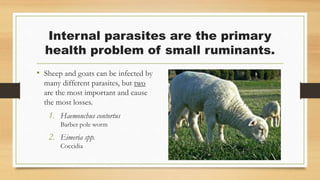
Internal parasites are the primary
health problem of small ruminants.
• Sheep and goats can be infected by
many different parasites, but two
are the most important and cause
the most losses.
1. Haemonchus contortus
Barber pole worm
2. Eimeria spp.
Coccidia
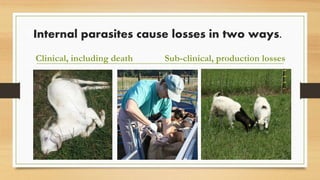
Internal parasites cause losses in two ways.
Clinical, including death Sub-clinical, production losses
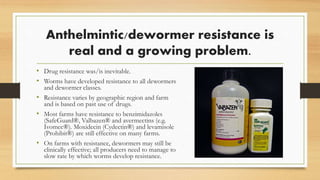
Anthelmintic/dewormer resistance is
real and a growing problem.
• Drug resistance was/is inevitable.
• Worms have developed resistance to all dewormers
and dewormer classes.
• Resistance varies by geographic region and farm
and is based on past use of drugs.
• Most farms have resistance to benzimidazoles
(SafeGuard®, Valbazen® and avermectins (e.g.
Ivomec®). Moxidecin (Cydectin®) and levamisole
(Prohibit®) are still effective on many farms.
• On farms with resistance, dewormers may still be
clinically effective; all producers need to manage to
slow rate by which worms develop resistance.
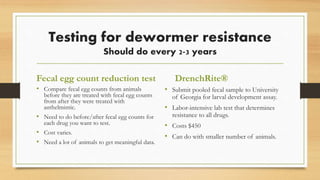
Testing for dewormer resistance
Should do every 2-3 years
Fecal egg count reduction test
• Compare fecal egg counts from animals
before they are treated with fecal egg counts
from after they were treated with
anthelmintic.
• Need to do before/after fecal egg counts for
each drug you want to test.
• Cost varies.
• Need a lot of animals to get meaningful data.
DrenchRite®
• Submit pooled fecal sample to University
of Georgia for larval development assay.
• Labor-intensive lab test that determines
resistance to all drugs.
• Costs $450
• Can do with smaller number of animals.
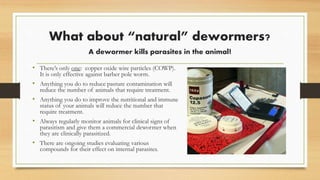
What about “natural” dewormers?
A dewormer kills parasites in the animal!
• There’s only one: copper oxide wire particles (COWP).
It is only effective against barber pole worm.
• Anything you do to reduce pasture contamination will
reduce the number of animals that require treatment.
• Anything you do to improve the nutritional and immune
status of your animals will reduce the number that
require treatment.
• Always regularly monitor animals for clinical signs of
parasitism and give them a commercial dewormer when
they are clinically parasitized.
• There are ongoing studies evaluating various
compounds for their effect on internal parasites.
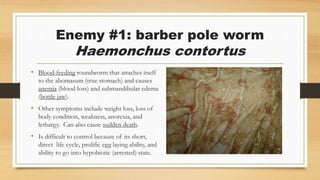
Enemy #1: barber pole worm
Haemonchus contortus
• Blood-feeding roundworm that attaches itself
to the abomasum (true stomach) and causes
anemia (blood loss) and submandibular edema
(bottle jaw).
• Other symptoms include weight loss, loss of
body condition, weakness, anorexia, and
lethargy. Can also cause sudden death.
• Is difficult to control because of its short,
direct life cycle, prolific egg laying ability, and
ability to go into hypobiotic (arrested) state.
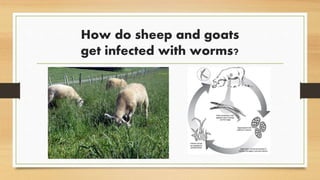
How do sheep and goats
get infected with worms?
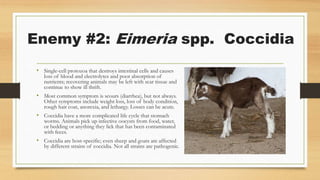
Enemy #2: Eimeria spp. Coccidia
• Single-cell protozoa that destroys intestinal cells and causes
loss of blood and electrolytes and poor absorption of
nutrients; recovering animals may be left with scar tissue and
continue to show ill thrift.
• Most common symptom is scours (diarrhea), but not always.
Other symptoms include weight loss, loss of body condition,
rough hair coat, anorexia, and lethargy. Losses can be acute.
• Coccidia have a more complicated life cycle that stomach
worms. Animals pick up infective oocysts from food, water,
or bedding or anything they lick that has been contaminated
with feces.
• Coccidia are host-specific; even sheep and goats are affected
by different strains of coccidia. Not all strains are pathogenic.
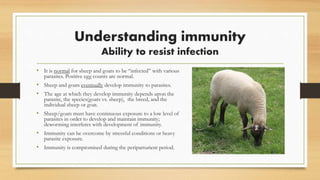
Understanding immunity
Ability to resist infection
• It is normal for sheep and goats to be “infected” with various
parasites. Positive egg counts are normal.
• Sheep and goats eventually develop immunity to parasites.
• The age at which they develop immunity depends upon the
parasite, the species(goats vs. sheep), the breed, and the
individual sheep or goat.
• Sheep/goats must have continuous exposure to a low level of
parasites in order to develop and maintain immunity;
deworming interferes with development of immunity.
• Immunity can be overcome by stressful conditions or heavy
parasite exposure.
• Immunity is compromised during the periparturient period.
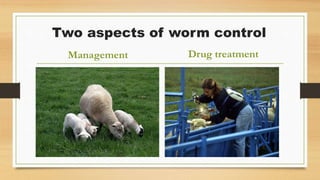
Two aspects of worm control
Management Drug treatment
Two aspects of worm control
Management
• Pasture management
• Grazing management
• Zero grazing
• Nutritional management
• Genetic selection
• Biosecurity
Drug treatment
• Targeted selective treatment
• FAMACHA© system
• Five Point Check©
• Happy Factor©.
• Proper use of anthelmintics, including
testing for resistance.
• DrenchRite® test
• Fecal egg count reduction test
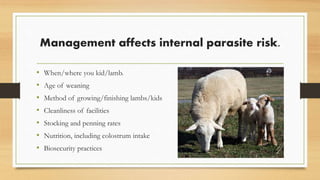
Management affects internal parasite risk.
• When/where you kid/lamb.
• Age of weaning
• Method of growing/finishing lambs/kids
• Cleanliness of facilities
• Stocking and penning rates
• Nutrition, including colostrum intake
• Biosecurity practices
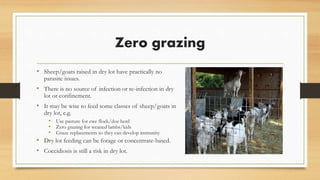
Zero grazing
• Sheep/goats raised in dry lot have practically no
parasite issues.
• There is no source of infection or re-infection in dry
lot or confinement.
• It may be wise to feed some classes of sheep/goats in
dry lot, e.g.
• Use pasture for ewe flock/doe herd
• Zero grazing for weaned lambs/kids
• Graze replacements so they can develop immunity
• Dry lot feeding can be forage or concentrate-based.
• Coccidiosis is still a risk in dry lot.
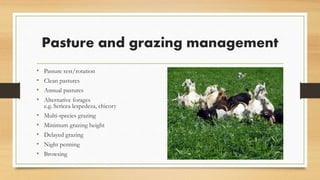
Pasture and grazing management
• Pasture rest/rotation
• Clean pastures
• Annual pastures
• Alternative forages
e.g. Sericea lespedeza, chicory
• Multi-species grazing
• Minimum grazing height
• Delayed grazing
• Night penning
• Browsing
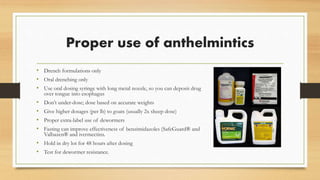
Proper use of anthelmintics
• Drench formulations only
• Oral drenching only
• Use oral dosing syringe with long metal nozzle, so you can deposit drug
over tongue into esophagus
• Don’t under-dose; dose based on accurate weights
• Give higher dosages (per lb) to goats (usually 2x sheep dose)
• Proper extra-label use of dewormers
• Fasting can improve effectiveness of benzimidazoles (SafeGuard® and
Valbazen® and ivermectins.
• Hold in dry lot for 48 hours after dosing
• Test for dewormer resistance.
Periparturient egg rise (PPER)
What is it?
• Females suffer a temporary loss of
immunity to parasites from late gestation
through early lactation.
• If eggs are deposited on pasture, they can
become the primary source of infection to
grazing lambs/kids.
• PPER often coincides with hypobiotic
larvae resuming their life cycle; resulting in
the “spring rise.”
Manage it
• Deworm females during late pregnancy;
leave a few “fat” ones untreated.
• Increase protein level of ration during late
gestation. (by-pass protein)
• Maintain pregnant and lactating females in
dry lot during periparturient period.
• Never let kids/lambs graze.
• Lamb/kid in fall or winter to reduce risk.
Using genetics to control internal parasitism
• Between species
Goats are more susceptible than sheep
• Between breeds
Some breeds are more resistant
• Within breeds
• Parasite resistance (fecal egg counts) is a
moderately heritable trait.
• Fecal egg counts are not evenly dispersed in a
flock/herd; 20-30% of animals are responsible
for 70-80% of fecal egg production.
• There is a correlation between FAMACHA©
scores and fecal egg counts.
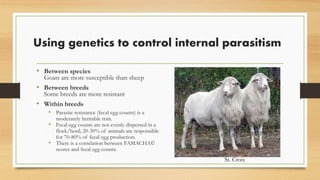
St. Croix
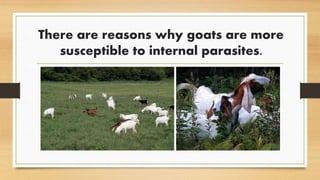
There are reasons why goats are more
susceptible to internal parasites.
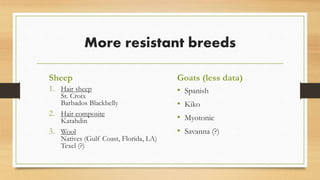
More resistant breeds
Sheep
1. Hair sheep
St. Croix
Barbados Blackbelly
2. Hair composite
Katahdin
3. Wool
Natives (Gulf Coast, Florida, LA)
Texel (?)
Goats (less data)
• Spanish
• Kiko
• Myotonic
• Savanna (?)
Selecting for parasite resistance
• Principles of selection: select best males for breeding [top] and cull the
worst females [bottom].
• Don’t keep or buy males (especially) or replacement females that require
deworming (or frequent deworming).
• Do fecal egg counts and keep animals with lowest egg counts; make sure
there is enough of a parasite challenge!
• Consign and/or purchase rams to/from SW Virginia Performance Test.
Rams are kept on pasture and challenged with worm larvae.
• Purchase Katahdin ram(s) with above-average EBVs for parasite resistance
• Consign and/or purchase (Kiko) bucks to/from Western Maryland
Pasture-Based Meat Goat Performance Test. Bucks are raised on pasture and
evaluated for parasite resistance.
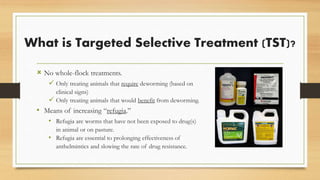
What is Targeted Selective Treatment (TST)?
 No whole-flock treatments.
 Only treating animals that require deworming (based on
clinical signs)
 Only treating animals that would benefit from deworming.
• Means of increasing “refugia.”
• Refugia are worms that have not been exposed to drug(s)
in animal or on pasture.
• Refugia are essential to prolonging effectiveness of
anthelmintics and slowing the rate of drug resistance.
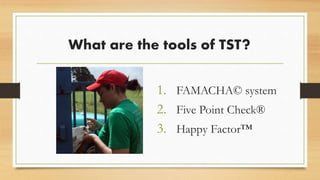
What are the tools of TST?
1. FAMACHA© system
2. Five Point Check®
3. Happy Factor™
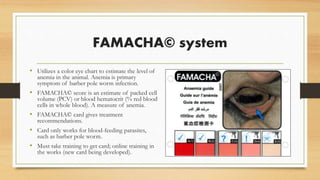
FAMACHA© system
• Utilizes a color eye chart to estimate the level of
anemia in the animal. Anemia is primary
symptom of barber pole worm infection.
• FAMACHA© score is an estimate of packed cell
volume (PCV) or blood hematocrit (% red blood
cells in whole blood). A measure of anemia.
• FAMACHA© card gives treatment
recommendations.
• Card only works for blood-feeding parasites,
such as barber pole worm.
• Must take training to get card; online training in
the works (new card being developed).
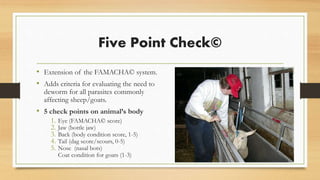
Five Point Check©
• Extension of the FAMACHA© system.
• Adds criteria for evaluating the need to
deworm for all parasites commonly
affecting sheep/goats.
• 5 check points on animal’s body
1. Eye (FAMACHA© score)
2. Jaw (bottle jaw)
3. Back (body condition score, 1-5)
4. Tail (dag score/scours, 0-5)
5. Nose (nasal bots)
Coat condition for goats (1-3)
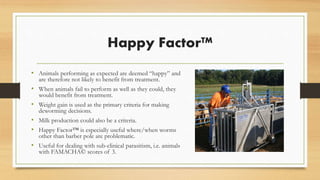
Happy Factor™
• Animals performing as expected are deemed “happy” and
are therefore not likely to benefit from treatment.
• When animals fail to perform as well as they could, they
would benefit from treatment.
• Weight gain is used as the primary criteria for making
deworming decisions.
• Milk production could also be a criteria.
• Happy Factor™ is especially useful where/when worms
other than barber pole are problematic.
• Useful for dealing with sub-clinical parasitism, i.e. animals
with FAMACHA© scores of 3.
Control of coccidia
• Prevent with good sanitation, nutrition, and management.
• Prevent with coccidiostats in feed, mineral, water, and/or milk
replacer.
• Bovatec® - sheep
• Rumensin ® - goats  (toxic to equines)
• Deccox® - sheep, goats
• Corid® - OTC, Rx
• Treat with amprolium (Corid) or sulfa drugs [OTC, ELDU]
• New Veterinary Feed Directive may affect how we
control/treat coccidiosis in sheep/lambs
Sulfa drugs are affected by new regulations.
• Sericea lespedeza may provide natural control of coccidiosis
Thank you for your attention.
Do you have any
questions or comments?
SUSAN SCHOENIAN
Sheep & Goat Specialist
University of Maryland Extension
sschoen@umd.edu
sheepandgoat.com

ManagingInternalParasitism

  • 1.
    Managing internal parasitism SUSAN SCHOENIAN SHEEP& GOAT SPECIALIST UNIVERSITY OF MARYLAND EXTENSION SSCHOEN@UMD.EDU – SHEEPANDGOAT.COM – WORMX.INFO
  • 2.
    Managing internal parasitism •Do you have to deworm your animals a lot? • Do you know which dewormers work on your farm? • Do you rely too much on drugs to control internal parasites? American Consortium for Small Ruminant Parasite Control www.acsrpc.org or www.wormx.info
  • 3.
    Internal parasites arethe primary health problem of small ruminants. • Sheep and goats can be infected by many different parasites, but two are the most important and cause the most losses. 1. Haemonchus contortus Barber pole worm 2. Eimeria spp. Coccidia
  • 4.
    Internal parasites causelosses in two ways. Clinical, including death Sub-clinical, production losses
  • 5.
    Anthelmintic/dewormer resistance is realand a growing problem. • Drug resistance was/is inevitable. • Worms have developed resistance to all dewormers and dewormer classes. • Resistance varies by geographic region and farm and is based on past use of drugs. • Most farms have resistance to benzimidazoles (SafeGuard®, Valbazen® and avermectins (e.g. Ivomec®). Moxidecin (Cydectin®) and levamisole (Prohibit®) are still effective on many farms. • On farms with resistance, dewormers may still be clinically effective; all producers need to manage to slow rate by which worms develop resistance.
  • 6.
    Testing for dewormerresistance Should do every 2-3 years Fecal egg count reduction test • Compare fecal egg counts from animals before they are treated with fecal egg counts from after they were treated with anthelmintic. • Need to do before/after fecal egg counts for each drug you want to test. • Cost varies. • Need a lot of animals to get meaningful data. DrenchRite® • Submit pooled fecal sample to University of Georgia for larval development assay. • Labor-intensive lab test that determines resistance to all drugs. • Costs $450 • Can do with smaller number of animals.
  • 7.
    What about “natural”dewormers? A dewormer kills parasites in the animal! • There’s only one: copper oxide wire particles (COWP). It is only effective against barber pole worm. • Anything you do to reduce pasture contamination will reduce the number of animals that require treatment. • Anything you do to improve the nutritional and immune status of your animals will reduce the number that require treatment. • Always regularly monitor animals for clinical signs of parasitism and give them a commercial dewormer when they are clinically parasitized. • There are ongoing studies evaluating various compounds for their effect on internal parasites.
  • 8.
    Enemy #1: barberpole worm Haemonchus contortus • Blood-feeding roundworm that attaches itself to the abomasum (true stomach) and causes anemia (blood loss) and submandibular edema (bottle jaw). • Other symptoms include weight loss, loss of body condition, weakness, anorexia, and lethargy. Can also cause sudden death. • Is difficult to control because of its short, direct life cycle, prolific egg laying ability, and ability to go into hypobiotic (arrested) state.
  • 9.
    How do sheepand goats get infected with worms?
  • 10.
    Enemy #2: Eimeriaspp. Coccidia • Single-cell protozoa that destroys intestinal cells and causes loss of blood and electrolytes and poor absorption of nutrients; recovering animals may be left with scar tissue and continue to show ill thrift. • Most common symptom is scours (diarrhea), but not always. Other symptoms include weight loss, loss of body condition, rough hair coat, anorexia, and lethargy. Losses can be acute. • Coccidia have a more complicated life cycle that stomach worms. Animals pick up infective oocysts from food, water, or bedding or anything they lick that has been contaminated with feces. • Coccidia are host-specific; even sheep and goats are affected by different strains of coccidia. Not all strains are pathogenic.
  • 11.
    Understanding immunity Ability toresist infection • It is normal for sheep and goats to be “infected” with various parasites. Positive egg counts are normal. • Sheep and goats eventually develop immunity to parasites. • The age at which they develop immunity depends upon the parasite, the species(goats vs. sheep), the breed, and the individual sheep or goat. • Sheep/goats must have continuous exposure to a low level of parasites in order to develop and maintain immunity; deworming interferes with development of immunity. • Immunity can be overcome by stressful conditions or heavy parasite exposure. • Immunity is compromised during the periparturient period.
  • 12.
    Two aspects ofworm control Management Drug treatment
  • 13.
    Two aspects ofworm control Management • Pasture management • Grazing management • Zero grazing • Nutritional management • Genetic selection • Biosecurity Drug treatment • Targeted selective treatment • FAMACHA© system • Five Point Check© • Happy Factor©. • Proper use of anthelmintics, including testing for resistance. • DrenchRite® test • Fecal egg count reduction test
  • 14.
    Management affects internalparasite risk. • When/where you kid/lamb. • Age of weaning • Method of growing/finishing lambs/kids • Cleanliness of facilities • Stocking and penning rates • Nutrition, including colostrum intake • Biosecurity practices
  • 15.
    Zero grazing • Sheep/goatsraised in dry lot have practically no parasite issues. • There is no source of infection or re-infection in dry lot or confinement. • It may be wise to feed some classes of sheep/goats in dry lot, e.g. • Use pasture for ewe flock/doe herd • Zero grazing for weaned lambs/kids • Graze replacements so they can develop immunity • Dry lot feeding can be forage or concentrate-based. • Coccidiosis is still a risk in dry lot.
  • 16.
    Pasture and grazingmanagement • Pasture rest/rotation • Clean pastures • Annual pastures • Alternative forages e.g. Sericea lespedeza, chicory • Multi-species grazing • Minimum grazing height • Delayed grazing • Night penning • Browsing
  • 17.
    Proper use ofanthelmintics • Drench formulations only • Oral drenching only • Use oral dosing syringe with long metal nozzle, so you can deposit drug over tongue into esophagus • Don’t under-dose; dose based on accurate weights • Give higher dosages (per lb) to goats (usually 2x sheep dose) • Proper extra-label use of dewormers • Fasting can improve effectiveness of benzimidazoles (SafeGuard® and Valbazen® and ivermectins. • Hold in dry lot for 48 hours after dosing • Test for dewormer resistance.
  • 18.
    Periparturient egg rise(PPER) What is it? • Females suffer a temporary loss of immunity to parasites from late gestation through early lactation. • If eggs are deposited on pasture, they can become the primary source of infection to grazing lambs/kids. • PPER often coincides with hypobiotic larvae resuming their life cycle; resulting in the “spring rise.” Manage it • Deworm females during late pregnancy; leave a few “fat” ones untreated. • Increase protein level of ration during late gestation. (by-pass protein) • Maintain pregnant and lactating females in dry lot during periparturient period. • Never let kids/lambs graze. • Lamb/kid in fall or winter to reduce risk.
  • 19.
    Using genetics tocontrol internal parasitism • Between species Goats are more susceptible than sheep • Between breeds Some breeds are more resistant • Within breeds • Parasite resistance (fecal egg counts) is a moderately heritable trait. • Fecal egg counts are not evenly dispersed in a flock/herd; 20-30% of animals are responsible for 70-80% of fecal egg production. • There is a correlation between FAMACHA© scores and fecal egg counts. St. Croix
  • 20.
    There are reasonswhy goats are more susceptible to internal parasites.
  • 21.
    More resistant breeds Sheep 1.Hair sheep St. Croix Barbados Blackbelly 2. Hair composite Katahdin 3. Wool Natives (Gulf Coast, Florida, LA) Texel (?) Goats (less data) • Spanish • Kiko • Myotonic • Savanna (?)
  • 22.
    Selecting for parasiteresistance • Principles of selection: select best males for breeding [top] and cull the worst females [bottom]. • Don’t keep or buy males (especially) or replacement females that require deworming (or frequent deworming). • Do fecal egg counts and keep animals with lowest egg counts; make sure there is enough of a parasite challenge! • Consign and/or purchase rams to/from SW Virginia Performance Test. Rams are kept on pasture and challenged with worm larvae. • Purchase Katahdin ram(s) with above-average EBVs for parasite resistance • Consign and/or purchase (Kiko) bucks to/from Western Maryland Pasture-Based Meat Goat Performance Test. Bucks are raised on pasture and evaluated for parasite resistance.
  • 23.
    What is TargetedSelective Treatment (TST)?  No whole-flock treatments.  Only treating animals that require deworming (based on clinical signs)  Only treating animals that would benefit from deworming. • Means of increasing “refugia.” • Refugia are worms that have not been exposed to drug(s) in animal or on pasture. • Refugia are essential to prolonging effectiveness of anthelmintics and slowing the rate of drug resistance.
  • 24.
    What are thetools of TST? 1. FAMACHA© system 2. Five Point Check® 3. Happy Factor™
  • 25.
    FAMACHA© system • Utilizesa color eye chart to estimate the level of anemia in the animal. Anemia is primary symptom of barber pole worm infection. • FAMACHA© score is an estimate of packed cell volume (PCV) or blood hematocrit (% red blood cells in whole blood). A measure of anemia. • FAMACHA© card gives treatment recommendations. • Card only works for blood-feeding parasites, such as barber pole worm. • Must take training to get card; online training in the works (new card being developed).
  • 26.
    Five Point Check© •Extension of the FAMACHA© system. • Adds criteria for evaluating the need to deworm for all parasites commonly affecting sheep/goats. • 5 check points on animal’s body 1. Eye (FAMACHA© score) 2. Jaw (bottle jaw) 3. Back (body condition score, 1-5) 4. Tail (dag score/scours, 0-5) 5. Nose (nasal bots) Coat condition for goats (1-3)
  • 27.
    Happy Factor™ • Animalsperforming as expected are deemed “happy” and are therefore not likely to benefit from treatment. • When animals fail to perform as well as they could, they would benefit from treatment. • Weight gain is used as the primary criteria for making deworming decisions. • Milk production could also be a criteria. • Happy Factor™ is especially useful where/when worms other than barber pole are problematic. • Useful for dealing with sub-clinical parasitism, i.e. animals with FAMACHA© scores of 3.
  • 28.
    Control of coccidia •Prevent with good sanitation, nutrition, and management. • Prevent with coccidiostats in feed, mineral, water, and/or milk replacer. • Bovatec® - sheep • Rumensin ® - goats  (toxic to equines) • Deccox® - sheep, goats • Corid® - OTC, Rx • Treat with amprolium (Corid) or sulfa drugs [OTC, ELDU] • New Veterinary Feed Directive may affect how we control/treat coccidiosis in sheep/lambs Sulfa drugs are affected by new regulations. • Sericea lespedeza may provide natural control of coccidiosis
  • 29.
    Thank you foryour attention. Do you have any questions or comments? SUSAN SCHOENIAN Sheep & Goat Specialist University of Maryland Extension sschoen@umd.edu sheepandgoat.com