Treatments (Tx)
SUSAN SCHOENIAN
Sheep & Goat Specialist
University of Maryland Extension
sschoen@umd.edu
wormx.info | sheepandgoat.com
Presentation topics
Drugs
 Anthelmintics 101
 Anthelmintic resistance
 Testing for resistance
 Natural treatments
Using drugs
 Targeted selective
treatment (TST)
 Combination treatments
 Treatment and prevention of coccidiosis
 Tapeworm removal
 Treatment of meningeal worm
 Veterinary-Patient-Client Relationship
Dewormers
(Anthelmintics)
101
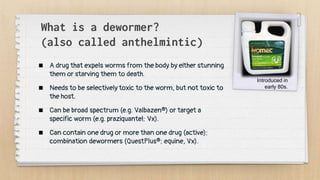
What is a dewormer?
(also called anthelmintic)
 A drug that expels worms from the body by either stunning
them or starving them to death.
 Needs to be selectively toxic to the worm, but not toxic to
the host.
 Can be broad spectrum (e.g. Valbazen®) or target a
specific worm (e.g. praziquantel; Vx).
 Can contain one drug or more than one drug (active):
combination dewormers (QuestPlus®; equine, Vx).
Introduced in
early 80s.
Three dewormer classes
for sheep and goats
1) Benzimidazoles (BZD)
white dewormers
2) Macrocylic lactones (ML)
a) Avermectins
b) Milbimycins
3) Membrane depolarizing class
Nicotinic agonists
• Dewormers are separated into classes
based on similar chemical structure and
mode of action.
• Cross-resistance usually develops among
drugs in the same class.
[1] Benzimidazoles (BZD)
Fenbendazole
SafeGuard® *
 Labeled dose
ineffective.
 Effective against
tapeworms at
higher dosage (Vx).
 Drug of choice for
meningeal worm.
Albendazole
Valbazen® **
 More potent than fenbendazole
 Effective against tapeworms
(heads + segments)
 Effective against adult liver flukes
 Pregnancy restriction
First 30 days 
*FDA-approved for goats
**FDA-approved for sheep
and liver fluke control in goats
[2] Macrocylic Lactones
[A] Avermectins *
1) Ivermectin
Ivomec®*
2) Doramectin
Dectomax®
3) Eprinomectin
Eprinex®
[B] Milbimycin
1) Moxidectin
Cydectin®*, Quest®
*FDA-approved for sheep
 Persistent activity
 Effective against external parasites (Ivomec®: nasal bots)
 Avermectins more effective against external parasites
 Milbimycins more effective against internal parasites.
 Avermectins are harmful to dung beetles.
[3] Membrane cell depolarizers
Levamisole*
Prohibit®
Leva-Med®
 Usually most effective Tx
 Less effective against larvae [?]
 Shortest withdrawal period
 Lowest margin of safety (~3x)
 Comes in powder that you have
to dissolve in water.
Morantel tartrate**
Rumatel®
Mor-Max®
Positive Pellet®
 Only kills adult worms
 Top-dress or mix in feed
 30 day meat withdrawal
0 day milk withdrawal
*FDA-approved for sheep
**FDA-approved for goats
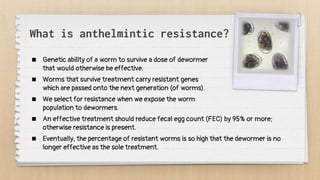
What is anthelmintic resistance?
 Genetic ability of a worm to survive a dose of dewormer
that would otherwise be effective.
 Worms that survive treatment carry resistant genes
which are passed onto the next generation (of worms).
 We select for resistance when we expose the worm
population to dewormers.
 An effective treatment should reduce fecal egg count (FEC) by 95% or more;
otherwise resistance is present.
 Eventually, the percentage of resistant worms is so high that the dewormer is no
longer effective as the sole treatment.
What practices have helped to
accelerate anthelmintic resistance?
 Frequent treatments
 Whole flock or herd treatments
 Underdosing
 Treating and moving animals to a clean pasture
 Rotating dewormers
 Depositing drug in mouth instead of over back of tongue
 Persistent activity dewormers
 Injecting dewormers
 Pouring on dewormers
 Feeding dewormer to a group of animals instead of individually
 Feeding dewormer in free choice salt or mineral
 Improper storage of dewormers
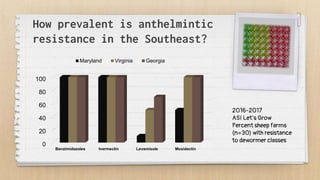
How prevalent is anthelmintic
resistance in the Southeast?
0
20
40
60
80
100
Benzimidazoles Ivermectin Levamisole Moxidectin
Maryland Virginia Georgia
2016-2017
ASI Let’s Grow
Percent sheep farms
(n=30) with resistance
to dewormer classes
How do you determine dewormer
resistance?
Fecal egg count
reduction test (FECRT)
 Compare before and
after deworming fecal
egg counts from
individual or pooled
fecal samples from
same ~15 animals.
DrenchRite® larval
development assay
 Lab test that
determines
resistance to all
anthelmintic classes
from a single pooled
fecal sample.
 University of Georgia
Natural
Treatments
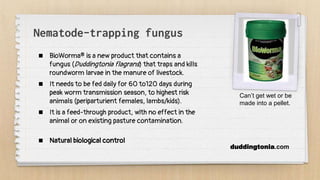
Nematode-trapping fungus
 BioWorma® is a new product that contains a
fungus (Duddingtonia flagrans) that traps and kills
roundworm larvae in the manure of livestock.
 It needs to be fed daily for 60 to120 days during
peak worm transmission season, to highest risk
animals (periparturient females, lambs/kids).
 It is a feed-through product, with no effect in the
animal or on existing pasture contamination.
 Natural biological control
duddingtonia.com
Can’t get wet or be
made into a pellet.
Two products are available.
[1 ] BioWorma®
 Contains 34.6%
fungus
 Due to EPA
restrictions,
distribution is limited
to veterinarians, feed
mills, and premixers.
[2] Livamol® with
BioWorma®
 Nutritional
supplement
containing 2.2%
fungus
 Available over-
the-counter (OTC)
Livamol® + BioWorma®
40 to 60 ¢ per day
For 100-lb. animal
(Premier 1 Supplies, Iowa)
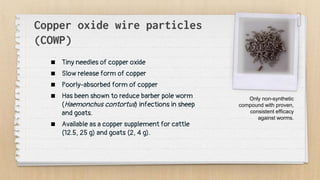
Copper oxide wire particles
(COWP)
 Tiny needles of copper oxide
 Slow release form of copper
 Poorly-absorbed form of copper
 Has been shown to reduce barber pole worm
(Haemonchus contortus) infections in sheep
and goats.
 Available as a copper supplement for cattle
(12.5, 25 g) and goats (2, 4 g).
Only non-synthetic
compound with proven,
consistent efficacy
against worms.
How to use COWP as a dewormer
 Always use lowest dose possible to achieve deworming
effect.
 Dosage is based on age, not weight
0.5 to 1 g for lambs and kids
1 to 2 g for mature animals
 Repackage cattle and goat boluses into smaller doses
 Can be challenging to administer; use plastic balling
gun, pet piller, or small PVC pipe with wooden dowel.
Be safe using COWP,
especially with sheep
 Before using, check copper status of flock/herd by
submitting livers (or kidneys) to diagnostic lab for
mineral profile.
 Selectively treat according to TST criteria.
 Minimize number of treatments given to same animal.
 Periodically, re-check copper status of flock/herd.
Targeted Selective
Treatment
(TST)
What is targeted selective
treatment (TST)?
 Deworming only those animals that require
treatment or would benefit most from
treatment.
 TST is the recommended strategy for controlling
internal parasites in small ruminants.
 TST slows anthelmintic resistance by reducing
the number of treatments, which increases
refugia.
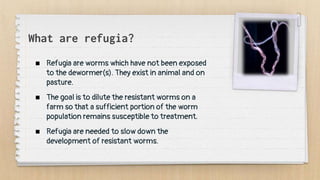
What are refugia?
 Refugia are worms which have not been exposed
to the dewormer(s). They exist in animal and on
pasture.
 The goal is to dilute the resistant worms on a
farm so that a sufficient portion of the worm
population remains susceptible to treatment.
 Refugia are needed to slow down the
development of resistant worms.
How to maintain refugia
 Reduce number of treatments
 Do not treat everyone
 Leave at least 10% (ideally 15-20%
or more) of animals untreated.
 Adults animals in good body condition are the
best animals to leave untreated to achieve
refugia.
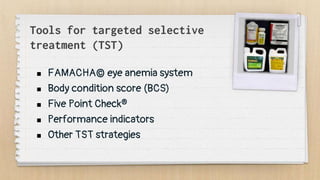
Tools for targeted selective
treatment (TST)
 FAMACHA© eye anemia system
 Body condition score (BCS)
 Five Point Check®
 Performance indicators
 Other TST strategies
FAMACHA©
eye anemia
system
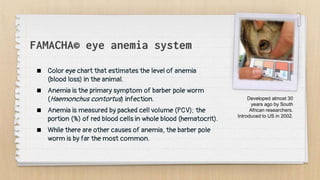
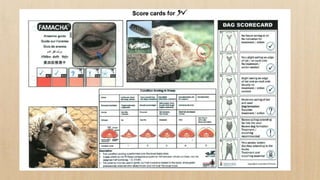
FAMACHA© eye anemia system
 Color eye chart that estimates the level of anemia
(blood loss) in the animal.
 Anemia is the primary symptom of barber pole worm
(Haemonchus contortus) infection.
 Anemia is measured by packed cell volume (PCV); the
portion (%) of red blood cells in whole blood (hematocrit).
 While there are other causes of anemia, the barber pole
worm is by far the most common.
Developed almost 30
years ago by South
African researchers.
Introduced to US in 2002.
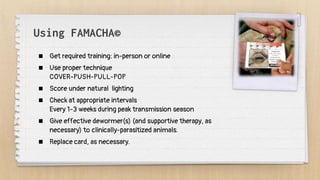
Using FAMACHA©
 Get required training: in-person or online
 Use proper technique
COVER-PUSH-PULL-POP
 Score under natural lighting
 Check at appropriate intervals
Every 1-3 weeks during peak transmission season
 Give effective dewormer(s) (and supportive therapy, as
necessary) to clinically-parasitized animals.
 Replace card, as necessary.
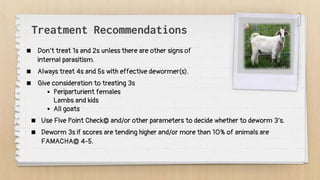
Treatment Recommendations
 Don’t treat 1s and 2s unless there are other signs of
internal parasitism.
 Always treat 4s and 5s with effective dewormer(s).
 Give consideration to treating 3s
 Periparturient females
Lambs and kids
 All goats
 Use Five Point Check© and/or other parameters to decide whether to deworm 3’s.
 Deworm 3s if scores are tending higher and/or more than 10% of animals are
FAMACHA© 4-5.
Body condition
score (BCS)
Body condition score (BCS)
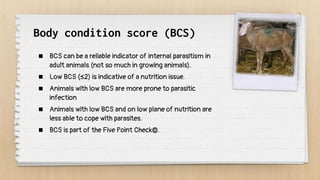
 BCS can be a reliable indicator of internal parasitism in
adult animals (not so much in growing animals).
 Low BCS (≤2) is indicative of a nutrition issue.
 Animals with low BCS are more prone to parasitic
infection
 Animals with low BCS and on low plane of nutrition are
less able to cope with parasites.
 BCS is part of the Five Point Check©.
Body condition score (BCS)
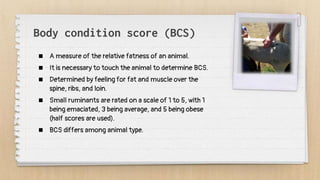
 A measure of the relative fatness of an animal.
 It is necessary to touch the animal to determine BCS.
 Determined by feeling for fat and muscle over the
spine, ribs, and loin.
 Small ruminants are rated on a scale of 1 to 5, with 1
being emaciated, 3 being average, and 5 being obese
(half scores are used).
 BCS differs among animal type.
Five Point
Check®
5 . 
Five Point Check© (5.)
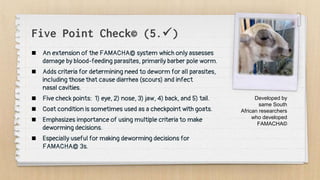
 An extension of the FAMACHA© system which only assesses
damage by blood-feeding parasites, primarily barber pole worm.
 Adds criteria for determining need to deworm for all parasites,
including those that cause diarrhea (scours) and infect
nasal cavities.
 Five check points: 1) eye, 2) nose, 3) jaw, 4) back, and 5) tail.
 Coat condition is sometimes used as a checkpoint with goats.
 Emphasizes importance of using multiple criteria to make
deworming decisions.
 Especially useful for making deworming decisions for
FAMACHA© 3s.
Developed by
same South
African researchers
who developed
FAMACHA©
Other tools or
strategies for
targeted selective
treatment
Performance-based criteria
 Performance can be used to make deworming decisions.
 The Happy Factor™ model predicts a target weight for
lambs. Those not achieving the predicted level of
performance are dewormed.
 High producing dairy goats or those in their first lactation
can be targeted for treatment.
 Litter size can be used as a criteria for deworming (or
not). Example: don’t treat females with singles, but
treat females with 3 or more offspring.
Fecal egg count (FEC)
 FEC is a deworming criteria for other livestock and in
large flocks/herds where individual assessment is not
practical.
 Thresholds for treatment vary; some animals should
be left untreated to maintain refugia.
 By itself, FEC is not a good diagnostic tool for
determining the need to treat an individual animal.
 FEC is best when combined with other criteria, such
as FAMACHA© and body condition score.
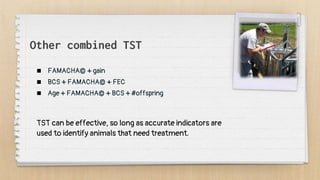
Other combined TST
 FAMACHA© + gain
 BCS + FAMACHA© + FEC
 Age + FAMACHA© + BCS + #offspring
TST can be effective, so long as accurate indicators are
used to identify animals that need treatment.
Combination
treatments
What is a combination treatment?
 A combination treatment is when you give more than one
dewormer to kill the same worm species.
 The purpose is to kill as many resistant worms as possible.
 Combination treatments have an additive effect on the
worm population; worms that survive the first drug can be
kill by the second (or third).
 Combination treatments only work when the drugs in the
combination still have some efficacy.
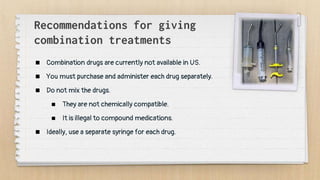
Recommendations for giving
combination treatments
 Combination drugs are currently not available in US.
 You must purchase and administer each drug separately.
 Do not mix the drugs.
 They are not chemically compatible.
 It is illegal to compound medications.
 Ideally, use a separate syringe for each drug.
Recommendations for giving
combination treatments
 Give the most potent drug from each class
albendazole (Valbazen®) +
moxidectin (Cydectin®) +
levamisole (Prohibit®, LevaMed®)
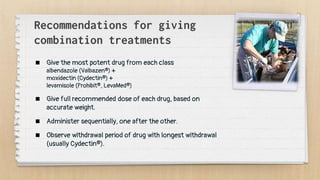
 Give full recommended dose of each drug, based on
accurate weight.
 Administer sequentially, one after the other.
 Observe withdrawal period of drug with longest withdrawal
(usually Cydectin®).
Recommendations for giving
combination treatments
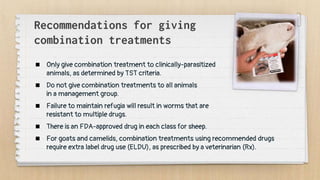
 Only give combination treatment to clinically-parasitized
animals, as determined by TST criteria.
 Do not give combination treatments to all animals
in a management group.
 Failure to maintain refugia will result in worms that are
resistant to multiple drugs.
 There is an FDA-approved drug in each class for sheep.
 For goats and camelids, combination treatments using recommended drugs
require extra label drug use (ELDU), as prescribed by a veterinarian (Rx).
Dewormer + COWP
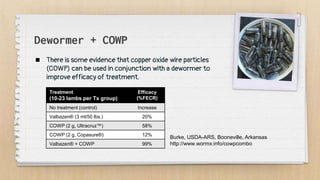
 There is some evidence that copper oxide wire particles
(COWP) can be used in conjunction with a dewormer to
improve efficacy of treatment.
Treatment
(10-23 lambs per Tx group)
Efficacy
(%FECR)
No treatment (control) Increase
Valbazen® (3 ml/50 lbs.) 20%
COWP (2 g, Ultracruz™) 58%
COWP (2 g, Copasure®) 12%
Valbazen® + COWP 99%
Burke, USDA-ARS, Booneville, Arkansas
http://www.wormx.info/cowpcombo
Prevention and
treatment of
coccidiosis
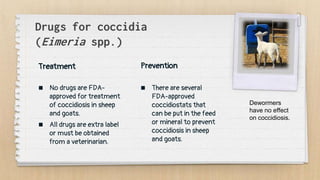
Drugs for coccidia
(Eimeria spp.)
Treatment
 No drugs are FDA-
approved for treatment
of coccidiosis in sheep
and goats.
 All drugs are extra label
or must be obtained
from a veterinarian.
Prevention
 There are several
FDA-approved
coccidiostats that
can be put in the feed
or mineral to prevent
coccidiosis in sheep
and goats.
Dewormers
have no effect
on coccidiosis.
Drugs for coccidia
(Eimeria spp.)
Treatment
 Amprolium
(OTC, Rx)
Corid®
 Sulfa antibiotics
(Rx)
Di-Methox®
Sulmet®
Albon®
Prevention
 Amprolium (Corid®) [Rx]
(better for treatment)
 Ionophores
 Lasalocid (Bovatec®)*
 Monensin (Rumensin®)**
 Non-antibiotic
 Decoquinate
Deccox®* **
* FDA-approved for sheep
** FDA-approved for goats
 Toxic to equines
Prevention and treatment of
coccidiosis
Treatment (ELDU, Vx)
 Corid® or Di-Methox® is
usually put in the drinking
water for 5 days.
 Individual drenching of
animals is preferable.
 Corid® inhibits thiamine
production; some risk of
polio with excessive intake.
 Resistance to Corid® is
suspected.
Prevention
 Put coccidiostat in feed
or mineral.
 Timing is everything;
need to feed before risk.
 Dosage is important; animal must
consume enough drug to be effective.
 Feed milk replacer with coccidiostat in it.
 Feed to females in late pregnancy to reduce
shedding of oocysts (Rx)
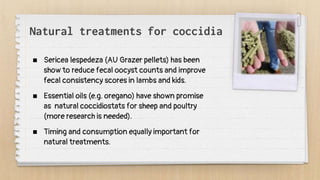
Natural treatments for coccidia
 Sericea lespedeza (AU Grazer pellets) has been
show to reduce fecal oocyst counts and improve
fecal consistency scores in lambs and kids.
 Essential oils (e.g. oregano) have shown promise
as natural coccidiostats for sheep and poultry
(more research is needed).
 Timing and consumption equally important for
natural treatments.
Removal of
tapeworms
(Moniezia spp.)
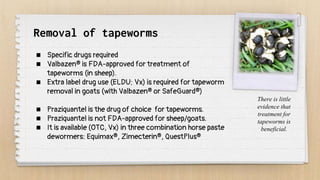
Removal of tapeworms
 Specific drugs required
 Valbazen® is FDA-approved for treatment of
tapeworms (in sheep).
 Extra label drug use (ELDU; Vx) is required for tapeworm
removal in goats (with Valbazen® or SafeGuard®)
 Praziquantel is the drug of choice for tapeworms.
 Praziquantel is not FDA-approved for sheep/goats.
 It is available (OTC, Vx) in three combination horse paste
dewormers: Equimax®, Zimecterin®, QuestPlus®
There is little
evidence that
treatment for
tapeworms is
beneficial.
Treating
meningeal worm
(P. tenius)
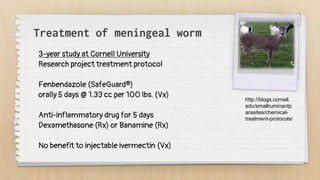
Treatment of meningeal worm
3-year study at Cornell University
Research project treatment protocol
Fenbendazole (SafeGuard®)
orally 5 days @ 1.33 cc per 100 lbs. (Vx)
Anti-inflammatory drug for 5 days
Dexamethasone (Rx) or Banamine (Rx)
No benefit to injectable ivermectin (Vx)
http://blogs.cornell.
edu/smallruminantp
arasites/chemical-
treatment-protocols/
Veterinary-
Client-Patient
Relationship
(VCPR)
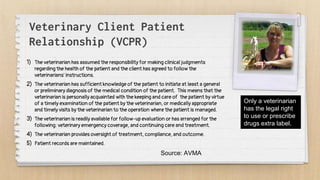
Veterinary Client Patient
Relationship (VCPR)
1) The veterinarian has assumed the responsibility for making clinical judgments
regarding the health of the patient and the client has agreed to follow the
veterinarians' instructions.
2) The veterinarian has sufficient knowledge of the patient to initiate at least a general
or preliminary diagnosis of the medical condition of the patient. This means that the
veterinarian is personally acquainted with the keeping and care of the patient by virtue
of a timely examination of the patient by the veterinarian, or medically appropriate
and timely visits by the veterinarian to the operation where the patient is managed.
3) The veterinarian is readily available for follow-up evaluation or has arranged for the
following: veterinary emergency coverage, and continuing care and treatment.
4) The veterinarian provides oversight of treatment, compliance, and outcome.
5) Patient records are maintained.
Source: AVMA
Only a veterinarian
has the legal right
to use or prescribe
drugs extra label.
sheepandgoat.com

Treatments

  • 1.
    Treatments (Tx) SUSAN SCHOENIAN Sheep& Goat Specialist University of Maryland Extension sschoen@umd.edu wormx.info | sheepandgoat.com
  • 2.
    Presentation topics Drugs  Anthelmintics101  Anthelmintic resistance  Testing for resistance  Natural treatments Using drugs  Targeted selective treatment (TST)  Combination treatments  Treatment and prevention of coccidiosis  Tapeworm removal  Treatment of meningeal worm  Veterinary-Patient-Client Relationship
  • 3.
  • 4.
    What is adewormer? (also called anthelmintic)  A drug that expels worms from the body by either stunning them or starving them to death.  Needs to be selectively toxic to the worm, but not toxic to the host.  Can be broad spectrum (e.g. Valbazen®) or target a specific worm (e.g. praziquantel; Vx).  Can contain one drug or more than one drug (active): combination dewormers (QuestPlus®; equine, Vx). Introduced in early 80s.
  • 5.
    Three dewormer classes forsheep and goats 1) Benzimidazoles (BZD) white dewormers 2) Macrocylic lactones (ML) a) Avermectins b) Milbimycins 3) Membrane depolarizing class Nicotinic agonists • Dewormers are separated into classes based on similar chemical structure and mode of action. • Cross-resistance usually develops among drugs in the same class.
  • 6.
    [1] Benzimidazoles (BZD) Fenbendazole SafeGuard®*  Labeled dose ineffective.  Effective against tapeworms at higher dosage (Vx).  Drug of choice for meningeal worm. Albendazole Valbazen® **  More potent than fenbendazole  Effective against tapeworms (heads + segments)  Effective against adult liver flukes  Pregnancy restriction First 30 days  *FDA-approved for goats **FDA-approved for sheep and liver fluke control in goats
  • 7.
    [2] Macrocylic Lactones [A]Avermectins * 1) Ivermectin Ivomec®* 2) Doramectin Dectomax® 3) Eprinomectin Eprinex® [B] Milbimycin 1) Moxidectin Cydectin®*, Quest® *FDA-approved for sheep  Persistent activity  Effective against external parasites (Ivomec®: nasal bots)  Avermectins more effective against external parasites  Milbimycins more effective against internal parasites.  Avermectins are harmful to dung beetles.
  • 8.
    [3] Membrane celldepolarizers Levamisole* Prohibit® Leva-Med®  Usually most effective Tx  Less effective against larvae [?]  Shortest withdrawal period  Lowest margin of safety (~3x)  Comes in powder that you have to dissolve in water. Morantel tartrate** Rumatel® Mor-Max® Positive Pellet®  Only kills adult worms  Top-dress or mix in feed  30 day meat withdrawal 0 day milk withdrawal *FDA-approved for sheep **FDA-approved for goats
  • 9.
    What is anthelminticresistance?  Genetic ability of a worm to survive a dose of dewormer that would otherwise be effective.  Worms that survive treatment carry resistant genes which are passed onto the next generation (of worms).  We select for resistance when we expose the worm population to dewormers.  An effective treatment should reduce fecal egg count (FEC) by 95% or more; otherwise resistance is present.  Eventually, the percentage of resistant worms is so high that the dewormer is no longer effective as the sole treatment.
  • 10.
    What practices havehelped to accelerate anthelmintic resistance?  Frequent treatments  Whole flock or herd treatments  Underdosing  Treating and moving animals to a clean pasture  Rotating dewormers  Depositing drug in mouth instead of over back of tongue  Persistent activity dewormers  Injecting dewormers  Pouring on dewormers  Feeding dewormer to a group of animals instead of individually  Feeding dewormer in free choice salt or mineral  Improper storage of dewormers
  • 12.
    How prevalent isanthelmintic resistance in the Southeast? 0 20 40 60 80 100 Benzimidazoles Ivermectin Levamisole Moxidectin Maryland Virginia Georgia 2016-2017 ASI Let’s Grow Percent sheep farms (n=30) with resistance to dewormer classes
  • 13.
    How do youdetermine dewormer resistance? Fecal egg count reduction test (FECRT)  Compare before and after deworming fecal egg counts from individual or pooled fecal samples from same ~15 animals. DrenchRite® larval development assay  Lab test that determines resistance to all anthelmintic classes from a single pooled fecal sample.  University of Georgia
  • 14.
  • 15.
    Nematode-trapping fungus  BioWorma®is a new product that contains a fungus (Duddingtonia flagrans) that traps and kills roundworm larvae in the manure of livestock.  It needs to be fed daily for 60 to120 days during peak worm transmission season, to highest risk animals (periparturient females, lambs/kids).  It is a feed-through product, with no effect in the animal or on existing pasture contamination.  Natural biological control duddingtonia.com Can’t get wet or be made into a pellet.
  • 16.
    Two products areavailable. [1 ] BioWorma®  Contains 34.6% fungus  Due to EPA restrictions, distribution is limited to veterinarians, feed mills, and premixers. [2] Livamol® with BioWorma®  Nutritional supplement containing 2.2% fungus  Available over- the-counter (OTC) Livamol® + BioWorma® 40 to 60 ¢ per day For 100-lb. animal (Premier 1 Supplies, Iowa)
  • 17.
    Copper oxide wireparticles (COWP)  Tiny needles of copper oxide  Slow release form of copper  Poorly-absorbed form of copper  Has been shown to reduce barber pole worm (Haemonchus contortus) infections in sheep and goats.  Available as a copper supplement for cattle (12.5, 25 g) and goats (2, 4 g). Only non-synthetic compound with proven, consistent efficacy against worms.
  • 18.
    How to useCOWP as a dewormer  Always use lowest dose possible to achieve deworming effect.  Dosage is based on age, not weight 0.5 to 1 g for lambs and kids 1 to 2 g for mature animals  Repackage cattle and goat boluses into smaller doses  Can be challenging to administer; use plastic balling gun, pet piller, or small PVC pipe with wooden dowel.
  • 19.
    Be safe usingCOWP, especially with sheep  Before using, check copper status of flock/herd by submitting livers (or kidneys) to diagnostic lab for mineral profile.  Selectively treat according to TST criteria.  Minimize number of treatments given to same animal.  Periodically, re-check copper status of flock/herd.
  • 20.
  • 21.
    What is targetedselective treatment (TST)?  Deworming only those animals that require treatment or would benefit most from treatment.  TST is the recommended strategy for controlling internal parasites in small ruminants.  TST slows anthelmintic resistance by reducing the number of treatments, which increases refugia.
  • 22.
    What are refugia? Refugia are worms which have not been exposed to the dewormer(s). They exist in animal and on pasture.  The goal is to dilute the resistant worms on a farm so that a sufficient portion of the worm population remains susceptible to treatment.  Refugia are needed to slow down the development of resistant worms.
  • 23.
    How to maintainrefugia  Reduce number of treatments  Do not treat everyone  Leave at least 10% (ideally 15-20% or more) of animals untreated.  Adults animals in good body condition are the best animals to leave untreated to achieve refugia.
  • 24.
    Tools for targetedselective treatment (TST)  FAMACHA© eye anemia system  Body condition score (BCS)  Five Point Check®  Performance indicators  Other TST strategies
  • 25.
  • 26.
    FAMACHA© eye anemiasystem  Color eye chart that estimates the level of anemia (blood loss) in the animal.  Anemia is the primary symptom of barber pole worm (Haemonchus contortus) infection.  Anemia is measured by packed cell volume (PCV); the portion (%) of red blood cells in whole blood (hematocrit).  While there are other causes of anemia, the barber pole worm is by far the most common. Developed almost 30 years ago by South African researchers. Introduced to US in 2002.
  • 27.
    Using FAMACHA©  Getrequired training: in-person or online  Use proper technique COVER-PUSH-PULL-POP  Score under natural lighting  Check at appropriate intervals Every 1-3 weeks during peak transmission season  Give effective dewormer(s) (and supportive therapy, as necessary) to clinically-parasitized animals.  Replace card, as necessary.
  • 28.
    Treatment Recommendations  Don’ttreat 1s and 2s unless there are other signs of internal parasitism.  Always treat 4s and 5s with effective dewormer(s).  Give consideration to treating 3s  Periparturient females Lambs and kids  All goats  Use Five Point Check© and/or other parameters to decide whether to deworm 3’s.  Deworm 3s if scores are tending higher and/or more than 10% of animals are FAMACHA© 4-5.
  • 29.
  • 30.
    Body condition score(BCS)  BCS can be a reliable indicator of internal parasitism in adult animals (not so much in growing animals).  Low BCS (≤2) is indicative of a nutrition issue.  Animals with low BCS are more prone to parasitic infection  Animals with low BCS and on low plane of nutrition are less able to cope with parasites.  BCS is part of the Five Point Check©.
  • 31.
    Body condition score(BCS)  A measure of the relative fatness of an animal.  It is necessary to touch the animal to determine BCS.  Determined by feeling for fat and muscle over the spine, ribs, and loin.  Small ruminants are rated on a scale of 1 to 5, with 1 being emaciated, 3 being average, and 5 being obese (half scores are used).  BCS differs among animal type.
  • 32.
  • 33.
    Five Point Check©(5.)  An extension of the FAMACHA© system which only assesses damage by blood-feeding parasites, primarily barber pole worm.  Adds criteria for determining need to deworm for all parasites, including those that cause diarrhea (scours) and infect nasal cavities.  Five check points: 1) eye, 2) nose, 3) jaw, 4) back, and 5) tail.  Coat condition is sometimes used as a checkpoint with goats.  Emphasizes importance of using multiple criteria to make deworming decisions.  Especially useful for making deworming decisions for FAMACHA© 3s. Developed by same South African researchers who developed FAMACHA©
  • 35.
    Other tools or strategiesfor targeted selective treatment
  • 36.
    Performance-based criteria  Performancecan be used to make deworming decisions.  The Happy Factor™ model predicts a target weight for lambs. Those not achieving the predicted level of performance are dewormed.  High producing dairy goats or those in their first lactation can be targeted for treatment.  Litter size can be used as a criteria for deworming (or not). Example: don’t treat females with singles, but treat females with 3 or more offspring.
  • 37.
    Fecal egg count(FEC)  FEC is a deworming criteria for other livestock and in large flocks/herds where individual assessment is not practical.  Thresholds for treatment vary; some animals should be left untreated to maintain refugia.  By itself, FEC is not a good diagnostic tool for determining the need to treat an individual animal.  FEC is best when combined with other criteria, such as FAMACHA© and body condition score.
  • 38.
    Other combined TST FAMACHA© + gain  BCS + FAMACHA© + FEC  Age + FAMACHA© + BCS + #offspring TST can be effective, so long as accurate indicators are used to identify animals that need treatment.
  • 39.
  • 40.
    What is acombination treatment?  A combination treatment is when you give more than one dewormer to kill the same worm species.  The purpose is to kill as many resistant worms as possible.  Combination treatments have an additive effect on the worm population; worms that survive the first drug can be kill by the second (or third).  Combination treatments only work when the drugs in the combination still have some efficacy.
  • 41.
    Recommendations for giving combinationtreatments  Combination drugs are currently not available in US.  You must purchase and administer each drug separately.  Do not mix the drugs.  They are not chemically compatible.  It is illegal to compound medications.  Ideally, use a separate syringe for each drug.
  • 42.
    Recommendations for giving combinationtreatments  Give the most potent drug from each class albendazole (Valbazen®) + moxidectin (Cydectin®) + levamisole (Prohibit®, LevaMed®)  Give full recommended dose of each drug, based on accurate weight.  Administer sequentially, one after the other.  Observe withdrawal period of drug with longest withdrawal (usually Cydectin®).
  • 43.
    Recommendations for giving combinationtreatments  Only give combination treatment to clinically-parasitized animals, as determined by TST criteria.  Do not give combination treatments to all animals in a management group.  Failure to maintain refugia will result in worms that are resistant to multiple drugs.  There is an FDA-approved drug in each class for sheep.  For goats and camelids, combination treatments using recommended drugs require extra label drug use (ELDU), as prescribed by a veterinarian (Rx).
  • 44.
    Dewormer + COWP There is some evidence that copper oxide wire particles (COWP) can be used in conjunction with a dewormer to improve efficacy of treatment. Treatment (10-23 lambs per Tx group) Efficacy (%FECR) No treatment (control) Increase Valbazen® (3 ml/50 lbs.) 20% COWP (2 g, Ultracruz™) 58% COWP (2 g, Copasure®) 12% Valbazen® + COWP 99% Burke, USDA-ARS, Booneville, Arkansas http://www.wormx.info/cowpcombo
  • 45.
  • 46.
    Drugs for coccidia (Eimeriaspp.) Treatment  No drugs are FDA- approved for treatment of coccidiosis in sheep and goats.  All drugs are extra label or must be obtained from a veterinarian. Prevention  There are several FDA-approved coccidiostats that can be put in the feed or mineral to prevent coccidiosis in sheep and goats. Dewormers have no effect on coccidiosis.
  • 47.
    Drugs for coccidia (Eimeriaspp.) Treatment  Amprolium (OTC, Rx) Corid®  Sulfa antibiotics (Rx) Di-Methox® Sulmet® Albon® Prevention  Amprolium (Corid®) [Rx] (better for treatment)  Ionophores  Lasalocid (Bovatec®)*  Monensin (Rumensin®)**  Non-antibiotic  Decoquinate Deccox®* ** * FDA-approved for sheep ** FDA-approved for goats  Toxic to equines
  • 48.
    Prevention and treatmentof coccidiosis Treatment (ELDU, Vx)  Corid® or Di-Methox® is usually put in the drinking water for 5 days.  Individual drenching of animals is preferable.  Corid® inhibits thiamine production; some risk of polio with excessive intake.  Resistance to Corid® is suspected. Prevention  Put coccidiostat in feed or mineral.  Timing is everything; need to feed before risk.  Dosage is important; animal must consume enough drug to be effective.  Feed milk replacer with coccidiostat in it.  Feed to females in late pregnancy to reduce shedding of oocysts (Rx)
  • 49.
    Natural treatments forcoccidia  Sericea lespedeza (AU Grazer pellets) has been show to reduce fecal oocyst counts and improve fecal consistency scores in lambs and kids.  Essential oils (e.g. oregano) have shown promise as natural coccidiostats for sheep and poultry (more research is needed).  Timing and consumption equally important for natural treatments.
  • 50.
  • 51.
    Removal of tapeworms Specific drugs required  Valbazen® is FDA-approved for treatment of tapeworms (in sheep).  Extra label drug use (ELDU; Vx) is required for tapeworm removal in goats (with Valbazen® or SafeGuard®)  Praziquantel is the drug of choice for tapeworms.  Praziquantel is not FDA-approved for sheep/goats.  It is available (OTC, Vx) in three combination horse paste dewormers: Equimax®, Zimecterin®, QuestPlus® There is little evidence that treatment for tapeworms is beneficial.
  • 52.
  • 53.
    Treatment of meningealworm 3-year study at Cornell University Research project treatment protocol Fenbendazole (SafeGuard®) orally 5 days @ 1.33 cc per 100 lbs. (Vx) Anti-inflammatory drug for 5 days Dexamethasone (Rx) or Banamine (Rx) No benefit to injectable ivermectin (Vx) http://blogs.cornell. edu/smallruminantp arasites/chemical- treatment-protocols/
  • 54.
  • 55.
    Veterinary Client Patient Relationship(VCPR) 1) The veterinarian has assumed the responsibility for making clinical judgments regarding the health of the patient and the client has agreed to follow the veterinarians' instructions. 2) The veterinarian has sufficient knowledge of the patient to initiate at least a general or preliminary diagnosis of the medical condition of the patient. This means that the veterinarian is personally acquainted with the keeping and care of the patient by virtue of a timely examination of the patient by the veterinarian, or medically appropriate and timely visits by the veterinarian to the operation where the patient is managed. 3) The veterinarian is readily available for follow-up evaluation or has arranged for the following: veterinary emergency coverage, and continuing care and treatment. 4) The veterinarian provides oversight of treatment, compliance, and outcome. 5) Patient records are maintained. Source: AVMA Only a veterinarian has the legal right to use or prescribe drugs extra label.
  • 56.