

PUTTING IT ALL
TOGETHER
Dr. Niki Whitley
FortValley State University
Cooperative Extension
whitleyn@fvsu.edu; 478-825-6577
Thanks to Susan
Schoenian for slides and
pictures
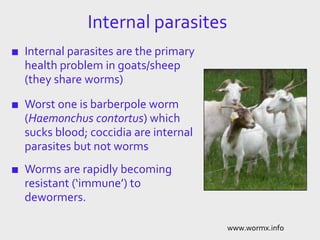
Internal parasites
■ Internal parasites are the primary
health problem in goats/sheep
(they share worms)
■ Worst one is barberpole worm
(Haemonchus contortus) which
sucks blood; coccidia are internal
parasites but not worms
■ Worms are rapidly becoming
resistant (‘immune’) to
dewormers.
www.wormx.info
Internal parasites
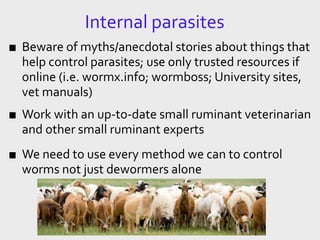
■ Beware of myths/anecdotal stories about things that
help control parasites; use only trusted resources if
online (i.e. wormx.info; wormboss; University sites,
vet manuals)
■ Work with an up-to-date small ruminant veterinarian
and other small ruminant experts
■ We need to use every method we can to control
worms not just dewormers alone
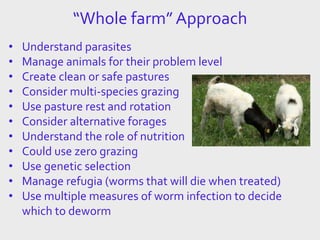
“Whole farm” Approach
• Understand parasites
• Manage animals for their problem level
• Create clean or safe pastures
• Consider multi-species grazing
• Use pasture rest and rotation
• Consider alternative forages
• Understand the role of nutrition
• Could use zero grazing
• Use genetic selection
• Manage refugia (worms that will die when treated)
• Use multiple measures of worm infection to decide
which to deworm
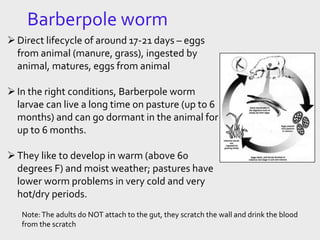
Barberpole worm
Direct lifecycle of around 17-21 days – eggs
from animal (manure, grass), ingested by
animal, matures, eggs from animal
In the right conditions, Barberpole worm
larvae can live a long time on pasture (up to 6
months) and can go dormant in the animal for
up to 6 months.
They like to develop in warm (above 60
degrees F) and moist weather; pastures have
lower worm problems in very cold and very
hot/dry periods.
Note:The adults do NOT attach to the gut, they scratch the wall and drink the blood
from the scratch
Barberpole worm
When resistance (immunity) to
dewormers is discussed, this is
the parasite focused on;
controlling it mostly controls other
strongyle types
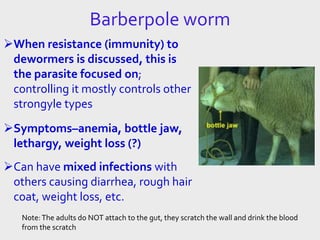
Symptoms–anemia, bottle jaw,
lethargy, weight loss (?)
Can have mixed infections with
others causing diarrhea, rough hair
coat, weight loss, etc.
Note:The adults do NOT attach to the gut, they scratch the wall and drink the blood
from the scratch
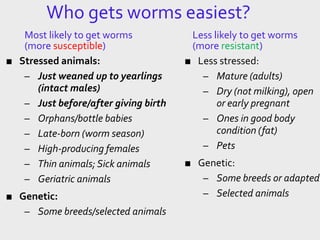
Who gets worms easiest?
Most likely to get worms
(more susceptible)
■ Stressed animals:
– Just weaned up to yearlings
(intact males)
– Just before/after giving birth
– Orphans/bottle babies
– Late-born (worm season)
– High-producing females
– Thin animals; Sick animals
– Geriatric animals
■ Genetic:
– Some breeds/selected animals
Less likely to get worms
(more resistant)
■ Less stressed:
– Mature (adults)
– Dry (not milking), open
or early pregnant
– Ones in good body
condition (fat)
– Pets
■ Genetic:
– Some breeds or adapted
– Selected animals
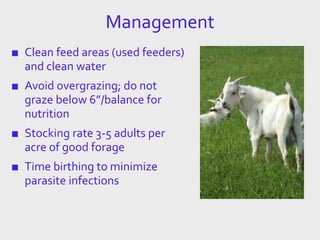
Management
■ Clean feed areas (used feeders)
and clean water
■ Avoid overgrazing; do not
graze below 6”/balance for
nutrition
■ Stocking rate 3-5 adults per
acre of good forage
■ Time birthing to minimize
parasite infections
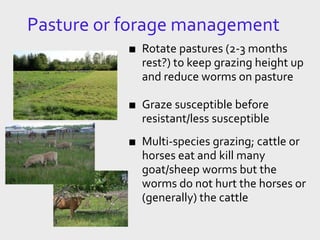
Pasture or forage management
■ Rotate pastures (2-3 months
rest?) to keep grazing height up
and reduce worms on pasture
■ Graze susceptible before
resistant/less susceptible
■ Multi-species grazing; cattle or
horses eat and kill many
goat/sheep worms but the
worms do not hurt the horses or
(generally) the cattle
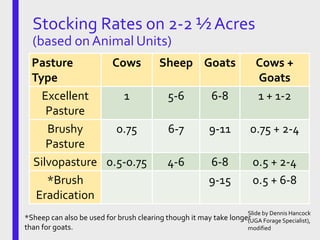
Pasture
Type
Cows Sheep Goats Cows +
Goats
Excellent
Pasture
1 5-6 6-8 1 + 1-2
Brushy
Pasture
0.75 6-7 9-11 0.75 + 2-4
Silvopasture 0.5-0.75 4-6 6-8 0.5 + 2-4
*Brush
Eradication
9-15 0.5 + 6-8
Stocking Rates on 2-2 ½ Acres
(based on Animal Units)
*Sheep can also be used for brush clearing though it may take longer
than for goats.
Slide by Dennis Hancock
(UGA Forage Specialist),
modified
Pasture or forage management
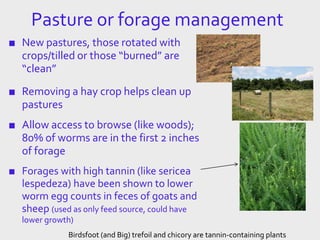
■ New pastures, those rotated with
crops/tilled or those “burned” are
“clean”
■ Removing a hay crop helps clean up
pastures
■ Allow access to browse (like woods);
80% of worms are in the first 2 inches
of forage
■ Forages with high tannin (like sericea
lespedeza) have been shown to lower
worm egg counts in feces of goats and
sheep (used as only feed source, could have
lower growth)
Birdsfoot (and Big) trefoil and chicory are tannin-containing plants
Nutritional management
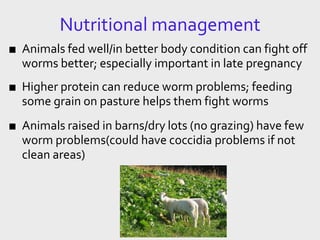
■ Animals fed well/in better body condition can fight off
worms better; especially important in late pregnancy
■ Higher protein can reduce worm problems; feeding
some grain on pasture helps them fight worms
■ Animals raised in barns/dry lots (no grazing) have few
worm problems(could have coccidia problems if not
clean areas)
Genetic selection
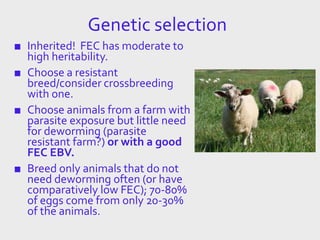
■ Inherited! FEC has moderate to
high heritability.
■ Choose a resistant
breed/consider crossbreeding
with one.
■ Choose animals from a farm with
parasite exposure but little need
for deworming (parasite
resistant farm?) or with a good
FEC EBV.
■ Breed only animals that do not
need deworming often (or have
comparatively low FEC); 70-80%
of eggs come from only 20-30%
of the animals.
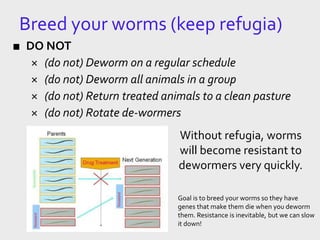
Breed your worms (keep refugia)
■ DO NOT
× (do not) Deworm on a regular schedule
× (do not) Deworm all animals in a group
× (do not) Return treated animals to a clean pasture
× (do not) Rotate de-wormers
Without refugia, worms
will become resistant to
dewormers very quickly.
Goal is to breed your worms so they have
genes that make them die when you deworm
them. Resistance is inevitable, but we can slow
it down!
Breed your worms (keep refugia)
■ DO
√ Deworm correctly (see deworming slides)
√ Deworm all new animals in quarantine with one
anthelmintic (dewormer) from all three classes of
dewormer (one after the other); make sure FEC goes
to 0
√ NEW INFORMATION presented at
wormx.info - using more than one
dewormer class every time you
deworm can slow down worm
resistance (immunity) to
dewormers
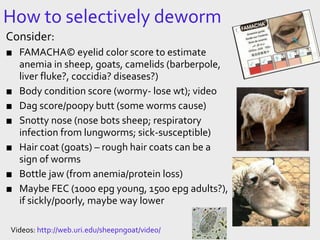
How to selectively deworm
Videos: http://web.uri.edu/sheepngoat/video/
Consider:
■ FAMACHA© eyelid color score to estimate
anemia in sheep, goats, camelids (barberpole,
liver fluke?, coccidia? diseases?)
■ Body condition score (wormy- lose wt); video
■ Dag score/poopy butt (some worms cause)
■ Snotty nose (nose bots sheep; respiratory
infection from lungworms; sick-susceptible)
■ Hair coat (goats) – rough hair coats can be a
sign of worms
■ Bottle jaw (from anemia/protein loss)
■ Maybe FEC (1000 epg young, 1500 epg adults?),
if sickly/poorly, maybe way lower
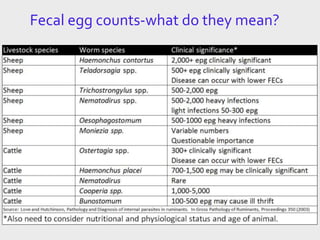
Fecal egg counts-what do they mean?
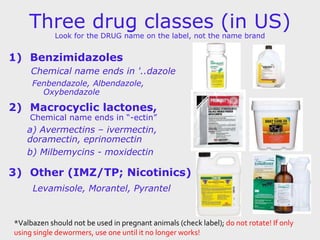
Three drug classes (in US)
Look for the DRUG name on the label, not the name brand
1) Benzimidazoles
Chemical name ends in '..dazole
Fenbendazole, Albendazole,
Oxybendazole
2) Macrocyclic lactones,
Chemical name ends in “-ectin”
a) Avermectins – ivermectin,
doramectin, eprinomectin
b) Milbemycins - moxidectin
3) Other (IMZ/TP; Nicotinics)
Levamisole, Morantel, Pyrantel
*Valbazen should not be used in pregnant animals (check label); do not rotate! If only
using single dewormers, use one until it no longer works!
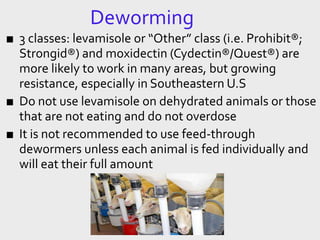
Deworming
■ 3 classes: levamisole or “Other” class (i.e. Prohibit®;
Strongid®) and moxidectin (Cydectin®/Quest®) are
more likely to work in many areas, but growing
resistance, especially in Southeastern U.S
■ Do not use levamisole on dehydrated animals or those
that are not eating and do not overdose
■ It is not recommended to use feed-through
dewormers unless each animal is fed individually and
will eat their full amount
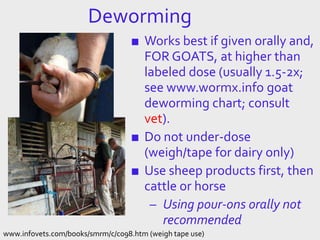
Deworming
■ Works best if given orally and,
FOR GOATS, at higher than
labeled dose (usually 1.5-2x;
see www.wormx.info goat
deworming chart; consult
vet).
■ Do not under-dose
(weigh/tape for dairy only)
■ Use sheep products first, then
cattle or horse
– Using pour-ons orally not
recommended
www.infovets.com/books/smrm/c/c098.htm (weigh tape use)
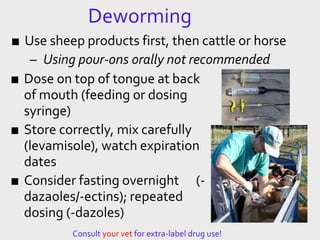
Deworming
■ Use sheep products first, then cattle or horse
– Using pour-ons orally not recommended
■ Dose on top of tongue at back
of mouth (feeding or dosing
syringe)
■ Store correctly, mix carefully
(levamisole), watch expiration
dates
■ Consider fasting overnight (-
dazaoles/-ectins); repeated
dosing (-dazoles)
Consult your vet for extra-label drug use!
Deworming
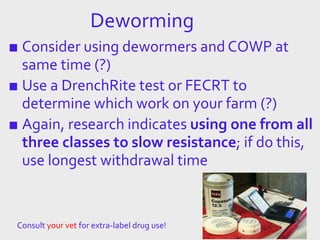
■ Consider using dewormers and COWP at
same time (?)
■ Use a DrenchRite test or FECRT to
determine which work on your farm (?)
■ Again, research indicates using one from all
three classes to slow resistance; if do this,
use longest withdrawal time
Consult your vet for extra-label drug use!
Deworming – Other Support
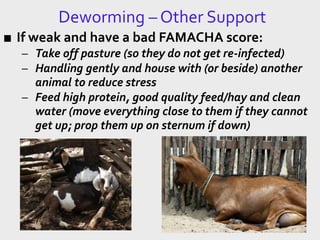
■ If weak and have a bad FAMACHA score:
– Take off pasture (so they do not get re-infected)
– Handling gently and house with (or beside) another
animal to reduce stress
– Feed high protein, good quality feed/hay and clean
water (move everything close to them if they cannot
get up; prop them up on sternum if down)
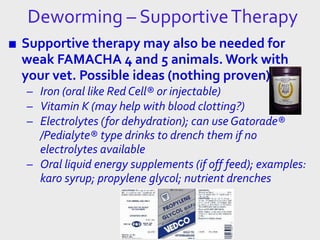
■ Supportive therapy may also be needed for
weak FAMACHA 4 and 5 animals. Work with
your vet. Possible ideas (nothing proven):
– Iron (oral like Red Cell® or injectable)
– Vitamin K (may help with blood clotting?)
– Electrolytes (for dehydration); can use Gatorade®
/Pedialyte® type drinks to drench them if no
electrolytes available
– Oral liquid energy supplements (if off feed); examples:
karo syrup; propylene glycol; nutrient drenches
Deworming – SupportiveTherapy
Supplemental treatments?
■ Copper oxide wire particles- YES
■ Sericea lespedeza (lowers
FEC/cocci)
■ Pine bark (?)
■ Fungus (reduces
reinfection/pasture
contamination)
■ Copper sulfate (? – toxic)
 Garlic
 Pumpkin seed (variable)
 Diatomaceous earth
 Commercial herbal dewormers
■ New anthelmintics?
(Zolvix®?) will be a long
time to come to US, if
ever
■ Vaccine – will not be in
U.S.
■ Replace worms?
■ EBVs/DNA tests
Sheep are sensitive to copper, so care should be taken if using copper-based treatments. More information:
www.wormx.info and https://attra.ncat.org/attra-pub/summaries/summary.php?pub=216
Natural/alternative dewormers for support, but NOT to replace chemical dewormers
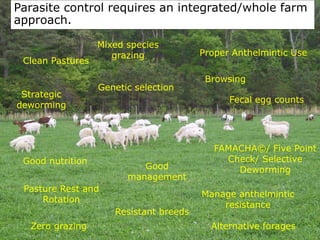
Parasite control requires an integrated/whole farm
approach.
Pasture Rest and
Rotation
Strategic
deworming
Fecal egg counts
Mixed species
grazing
Alternative forages
Good nutrition
Zero grazing
Genetic selection
Manage anthelmintic
resistance
Browsing
Resistant breeds
Good
management
FAMACHA©/ Five Point
Check/ Selective
Deworming
Proper Anthelmintic Use
Clean Pastures
Questions?

Putting It All Together

  • 1.
    PUTTING IT ALL TOGETHER Dr.Niki Whitley FortValley State University Cooperative Extension whitleyn@fvsu.edu; 478-825-6577 Thanks to Susan Schoenian for slides and pictures
  • 2.
    Internal parasites ■ Internalparasites are the primary health problem in goats/sheep (they share worms) ■ Worst one is barberpole worm (Haemonchus contortus) which sucks blood; coccidia are internal parasites but not worms ■ Worms are rapidly becoming resistant (‘immune’) to dewormers. www.wormx.info
  • 3.
    Internal parasites ■ Bewareof myths/anecdotal stories about things that help control parasites; use only trusted resources if online (i.e. wormx.info; wormboss; University sites, vet manuals) ■ Work with an up-to-date small ruminant veterinarian and other small ruminant experts ■ We need to use every method we can to control worms not just dewormers alone
  • 4.
    “Whole farm” Approach •Understand parasites • Manage animals for their problem level • Create clean or safe pastures • Consider multi-species grazing • Use pasture rest and rotation • Consider alternative forages • Understand the role of nutrition • Could use zero grazing • Use genetic selection • Manage refugia (worms that will die when treated) • Use multiple measures of worm infection to decide which to deworm
  • 5.
    Barberpole worm Direct lifecycleof around 17-21 days – eggs from animal (manure, grass), ingested by animal, matures, eggs from animal In the right conditions, Barberpole worm larvae can live a long time on pasture (up to 6 months) and can go dormant in the animal for up to 6 months. They like to develop in warm (above 60 degrees F) and moist weather; pastures have lower worm problems in very cold and very hot/dry periods. Note:The adults do NOT attach to the gut, they scratch the wall and drink the blood from the scratch
  • 6.
    Barberpole worm When resistance(immunity) to dewormers is discussed, this is the parasite focused on; controlling it mostly controls other strongyle types Symptoms–anemia, bottle jaw, lethargy, weight loss (?) Can have mixed infections with others causing diarrhea, rough hair coat, weight loss, etc. Note:The adults do NOT attach to the gut, they scratch the wall and drink the blood from the scratch
  • 7.
    Who gets wormseasiest? Most likely to get worms (more susceptible) ■ Stressed animals: – Just weaned up to yearlings (intact males) – Just before/after giving birth – Orphans/bottle babies – Late-born (worm season) – High-producing females – Thin animals; Sick animals – Geriatric animals ■ Genetic: – Some breeds/selected animals Less likely to get worms (more resistant) ■ Less stressed: – Mature (adults) – Dry (not milking), open or early pregnant – Ones in good body condition (fat) – Pets ■ Genetic: – Some breeds or adapted – Selected animals
  • 8.
    Management ■ Clean feedareas (used feeders) and clean water ■ Avoid overgrazing; do not graze below 6”/balance for nutrition ■ Stocking rate 3-5 adults per acre of good forage ■ Time birthing to minimize parasite infections
  • 9.
    Pasture or foragemanagement ■ Rotate pastures (2-3 months rest?) to keep grazing height up and reduce worms on pasture ■ Graze susceptible before resistant/less susceptible ■ Multi-species grazing; cattle or horses eat and kill many goat/sheep worms but the worms do not hurt the horses or (generally) the cattle
  • 10.
    Pasture Type Cows Sheep GoatsCows + Goats Excellent Pasture 1 5-6 6-8 1 + 1-2 Brushy Pasture 0.75 6-7 9-11 0.75 + 2-4 Silvopasture 0.5-0.75 4-6 6-8 0.5 + 2-4 *Brush Eradication 9-15 0.5 + 6-8 Stocking Rates on 2-2 ½ Acres (based on Animal Units) *Sheep can also be used for brush clearing though it may take longer than for goats. Slide by Dennis Hancock (UGA Forage Specialist), modified
  • 11.
    Pasture or foragemanagement ■ New pastures, those rotated with crops/tilled or those “burned” are “clean” ■ Removing a hay crop helps clean up pastures ■ Allow access to browse (like woods); 80% of worms are in the first 2 inches of forage ■ Forages with high tannin (like sericea lespedeza) have been shown to lower worm egg counts in feces of goats and sheep (used as only feed source, could have lower growth) Birdsfoot (and Big) trefoil and chicory are tannin-containing plants
  • 12.
    Nutritional management ■ Animalsfed well/in better body condition can fight off worms better; especially important in late pregnancy ■ Higher protein can reduce worm problems; feeding some grain on pasture helps them fight worms ■ Animals raised in barns/dry lots (no grazing) have few worm problems(could have coccidia problems if not clean areas)
  • 13.
    Genetic selection ■ Inherited!FEC has moderate to high heritability. ■ Choose a resistant breed/consider crossbreeding with one. ■ Choose animals from a farm with parasite exposure but little need for deworming (parasite resistant farm?) or with a good FEC EBV. ■ Breed only animals that do not need deworming often (or have comparatively low FEC); 70-80% of eggs come from only 20-30% of the animals.
  • 14.
    Breed your worms(keep refugia) ■ DO NOT × (do not) Deworm on a regular schedule × (do not) Deworm all animals in a group × (do not) Return treated animals to a clean pasture × (do not) Rotate de-wormers Without refugia, worms will become resistant to dewormers very quickly. Goal is to breed your worms so they have genes that make them die when you deworm them. Resistance is inevitable, but we can slow it down!
  • 15.
    Breed your worms(keep refugia) ■ DO √ Deworm correctly (see deworming slides) √ Deworm all new animals in quarantine with one anthelmintic (dewormer) from all three classes of dewormer (one after the other); make sure FEC goes to 0 √ NEW INFORMATION presented at wormx.info - using more than one dewormer class every time you deworm can slow down worm resistance (immunity) to dewormers
  • 16.
    How to selectivelydeworm Videos: http://web.uri.edu/sheepngoat/video/ Consider: ■ FAMACHA© eyelid color score to estimate anemia in sheep, goats, camelids (barberpole, liver fluke?, coccidia? diseases?) ■ Body condition score (wormy- lose wt); video ■ Dag score/poopy butt (some worms cause) ■ Snotty nose (nose bots sheep; respiratory infection from lungworms; sick-susceptible) ■ Hair coat (goats) – rough hair coats can be a sign of worms ■ Bottle jaw (from anemia/protein loss) ■ Maybe FEC (1000 epg young, 1500 epg adults?), if sickly/poorly, maybe way lower
  • 17.
    Fecal egg counts-whatdo they mean?
  • 18.
    Three drug classes(in US) Look for the DRUG name on the label, not the name brand 1) Benzimidazoles Chemical name ends in '..dazole Fenbendazole, Albendazole, Oxybendazole 2) Macrocyclic lactones, Chemical name ends in “-ectin” a) Avermectins – ivermectin, doramectin, eprinomectin b) Milbemycins - moxidectin 3) Other (IMZ/TP; Nicotinics) Levamisole, Morantel, Pyrantel *Valbazen should not be used in pregnant animals (check label); do not rotate! If only using single dewormers, use one until it no longer works!
  • 19.
    Deworming ■ 3 classes:levamisole or “Other” class (i.e. Prohibit®; Strongid®) and moxidectin (Cydectin®/Quest®) are more likely to work in many areas, but growing resistance, especially in Southeastern U.S ■ Do not use levamisole on dehydrated animals or those that are not eating and do not overdose ■ It is not recommended to use feed-through dewormers unless each animal is fed individually and will eat their full amount
  • 20.
    Deworming ■ Works bestif given orally and, FOR GOATS, at higher than labeled dose (usually 1.5-2x; see www.wormx.info goat deworming chart; consult vet). ■ Do not under-dose (weigh/tape for dairy only) ■ Use sheep products first, then cattle or horse – Using pour-ons orally not recommended www.infovets.com/books/smrm/c/c098.htm (weigh tape use)
  • 21.
    Deworming ■ Use sheepproducts first, then cattle or horse – Using pour-ons orally not recommended ■ Dose on top of tongue at back of mouth (feeding or dosing syringe) ■ Store correctly, mix carefully (levamisole), watch expiration dates ■ Consider fasting overnight (- dazaoles/-ectins); repeated dosing (-dazoles) Consult your vet for extra-label drug use!
  • 22.
    Deworming ■ Consider usingdewormers and COWP at same time (?) ■ Use a DrenchRite test or FECRT to determine which work on your farm (?) ■ Again, research indicates using one from all three classes to slow resistance; if do this, use longest withdrawal time Consult your vet for extra-label drug use!
  • 23.
    Deworming – OtherSupport ■ If weak and have a bad FAMACHA score: – Take off pasture (so they do not get re-infected) – Handling gently and house with (or beside) another animal to reduce stress – Feed high protein, good quality feed/hay and clean water (move everything close to them if they cannot get up; prop them up on sternum if down)
  • 24.
    ■ Supportive therapymay also be needed for weak FAMACHA 4 and 5 animals. Work with your vet. Possible ideas (nothing proven): – Iron (oral like Red Cell® or injectable) – Vitamin K (may help with blood clotting?) – Electrolytes (for dehydration); can use Gatorade® /Pedialyte® type drinks to drench them if no electrolytes available – Oral liquid energy supplements (if off feed); examples: karo syrup; propylene glycol; nutrient drenches Deworming – SupportiveTherapy
  • 25.
    Supplemental treatments? ■ Copperoxide wire particles- YES ■ Sericea lespedeza (lowers FEC/cocci) ■ Pine bark (?) ■ Fungus (reduces reinfection/pasture contamination) ■ Copper sulfate (? – toxic)  Garlic  Pumpkin seed (variable)  Diatomaceous earth  Commercial herbal dewormers ■ New anthelmintics? (Zolvix®?) will be a long time to come to US, if ever ■ Vaccine – will not be in U.S. ■ Replace worms? ■ EBVs/DNA tests Sheep are sensitive to copper, so care should be taken if using copper-based treatments. More information: www.wormx.info and https://attra.ncat.org/attra-pub/summaries/summary.php?pub=216 Natural/alternative dewormers for support, but NOT to replace chemical dewormers
  • 26.
    Parasite control requiresan integrated/whole farm approach. Pasture Rest and Rotation Strategic deworming Fecal egg counts Mixed species grazing Alternative forages Good nutrition Zero grazing Genetic selection Manage anthelmintic resistance Browsing Resistant breeds Good management FAMACHA©/ Five Point Check/ Selective Deworming Proper Anthelmintic Use Clean Pastures
  • 27.