Winning against worms
SUSAN SCHOENIAN
Sheep & Goat Specialist
University of Maryland Extension
sschoen@umd.edu – wormx.info
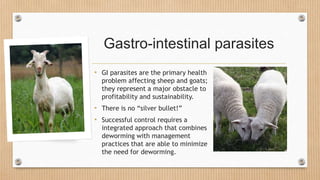
Gastro-intestinal parasites
• GI parasites are the primary health
problem affecting sheep and goats;
they represent a major obstacle to
profitability and sustainability.
• There is no “silver bullet!”
• Successful control requires a
integrated approach that combines
deworming with management
practices that are able to minimize
the need for deworming.
Four potential components of an integrated
parasite management program
1. Administering combination
treatments to clinically-
parasitized animals.
2. Using copper oxide wire
particles to combat barber
pole worm infections.
3. Using genetics to control
internal parasitism.
4. Feeding nematode-trapping
fungus to reduce pasture
contamination.
Combination treatments
“There now is very
strong evidence that
using combination
treatment is the best
method for using
dewormers and should
be instituted on all
farms immediately.”
January 2017
Dr. Ray Kaplan
University of Georgia
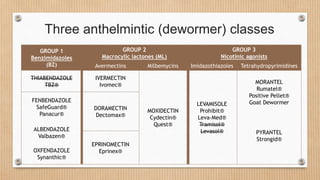
Three anthelmintic (dewormer) classes
GROUP 1
Benzimidazoles
(BZ)
GROUP 2
Macrocylic lactones (ML)
GROUP 3
Nicotinic agonists
Avermectins Milbemycins Imidazothiazoles Tetrahydropyrimidines
THIABENDAZOLE
TBZ®
IVERMECTIN
Ivomec®
MOXIDECTIN
Cydectin®
Quest®
LEVAMISOLE
Prohibit®
Leva-Med®
Tramisol®
Levasol®
MORANTEL
Rumatel®
Positive Pellet®
Goat DewormerFENBENDAZOLE
SafeGuard®
Panacur®
DORAMECTIN
Dectomax®
PYRANTEL
Strongid®
ALBENDAZOLE
Valbazen®
EPRINOMECTIN
Eprinex®OXFENDAZOLE
Synanthic®
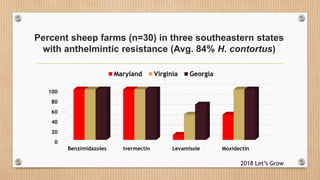
Percent sheep farms (n=30) in three southeastern states
with anthelmintic resistance (Avg. 84% H. contortus)
0
20
40
60
80
100
Benzimidazoles Ivermectin Levamisole Moxidectin
Maryland Virginia Georgia
2018 Let’s Grow
Combination
Treatments
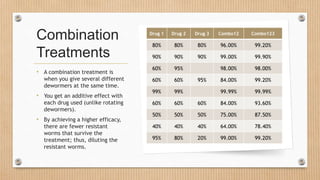
• A combination treatment is
when you give several different
dewormers at the same time.
• You get an additive effect with
each drug used (unlike rotating
dewormers).
• By achieving a higher efficacy,
there are fewer resistant
worms that survive the
treatment; thus, diluting the
resistant worms.
Drug 1 Drug 2 Drug 3 Combo12 Combo123
80% 80% 80% 96.00% 99.20%
90% 90% 90% 99.00% 99.90%
60% 95% 98.00% 98.00%
60% 60% 95% 84.00% 99.20%
99% 99% 99.99% 99.99%
60% 60% 60% 84.00% 93.60%
50% 50% 50% 75.00% 87.50%
40% 40% 40% 64.00% 78.40%
95% 80% 20% 99.00% 99.20%
Combination
treatments
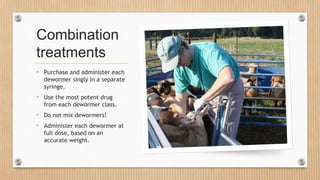
• Purchase and administer each
dewormer singly in a separate
syringe.
• Use the most potent drug
from each dewormer class.
• Do not mix dewormers!
• Administer each dewormer at
full dose, based on an
accurate weight.
Combination treatments
Valbazen®* Cydectin® Prohibit®
Sheep 1.5 ml/50 lbs.
[7 days]
4.5 ml/50 lbs.
[7 days]
Depends on dilution
[3 days]
Goats 4 ml/50 lbs.
[9 days meat]
[7 days milk]
9 ml/50 lbs.
[17 days meat]
[8 days milk]
Depends on dilution
[4 days meat]
[3 days milk]
Camelids 4 ml/50 lbs. 9 ml/50 lbs. Depends on dilution
*Do not use first 30 days of pregnancy www.wormx.info
Combination
treatments
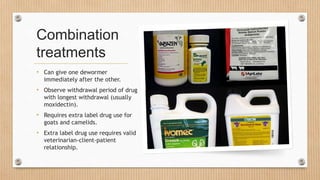
• Can give one dewormer
immediately after the other.
• Observe withdrawal period of drug
with longest withdrawal (usually
moxidectin).
• Requires extra label drug use for
goats and camelids.
• Extra label drug use requires valid
veterinarian-client-patient
relationship.
Targeted selective treatment (TST)
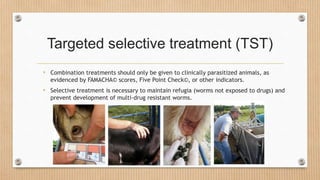
• Combination treatments should only be given to clinically parasitized animals, as
evidenced by FAMACHA© scores, Five Point Check©, or other indicators.
• Selective treatment is necessary to maintain refugia (worms not exposed to drugs) and
prevent development of multi-drug resistant worms.
Copper oxide wire particles
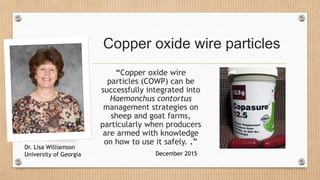
“Copper oxide wire
particles (COWP) can be
successfully integrated into
Haemonchus contortus
management strategies on
sheep and goat farms,
particularly when producers
are armed with knowledge
on how to use it safely. .”
December 2015
Dr. Lisa Williamson
University of Georgia
Copper oxide wire particles
(COWP)
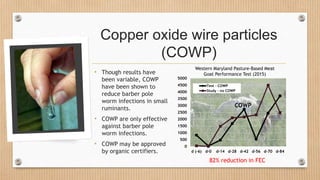
• Though results have
been variable, COWP
have been shown to
reduce barber pole
worm infections in small
ruminants.
• COWP are only effective
against barber pole
worm infections.
• COWP may be approved
by organic certifiers.
0
500
1000
1500
2000
2500
3000
3500
4000
4500
5000
d (-6) d-0 d-14 d-28 d-42 d-56 d-70 d-84
Test - COWP
Study - no COWP
COWP
Western Maryland Pasture-Based Meat
Goat Performance Test (2015)
82% reduction in FEC
Copper oxide
wire particles
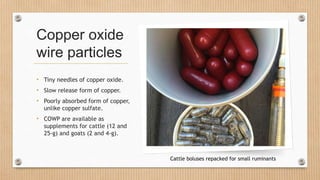
• Tiny needles of copper oxide.
• Slow release form of copper.
• Poorly absorbed form of copper,
unlike copper sulfate.
• COWP are available as
supplements for cattle (12 and
25-g) and goats (2 and 4-g).
Cattle boluses repacked for small ruminants
Using COWP
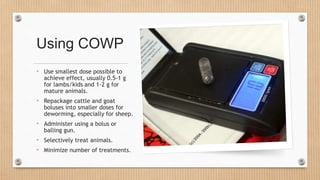
• Use smallest dose possible to
achieve effect, usually 0.5-1 g
for lambs/kids and 1-2 g for
mature animals.
• Repackage cattle and goat
boluses into smaller doses for
deworming, especially for sheep.
• Administer using a bolus or
balling gun.
• Selectively treat animals.
• Minimize number of treatments.
Using COWP
Safely
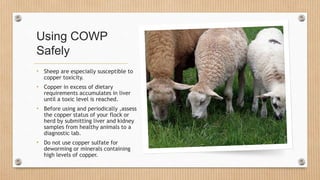
• Sheep are especially susceptible to
copper toxicity.
• Copper in excess of dietary
requirements accumulates in liver
until a toxic level is reached.
• Before using and periodically ,assess
the copper status of your flock or
herd by submitting liver and kidney
samples from healthy animals to a
diagnostic lab.
• Do not use copper sulfate for
deworming or minerals containing
high levels of copper.
Combination treatment with
copper oxide wire particles
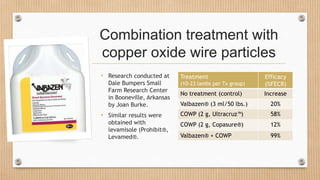
Treatment
(10-23 lambs per Tx group)
Efficacy
(%FECR)
No treatment (control) Increase
Valbazen® (3 ml/50 lbs.) 20%
COWP (2 g, Ultracruz™) 58%
COWP (2 g, Copasure®) 12%
Valbazen® + COWP 99%
• Research conducted at
Dale Bumpers Small
Farm Research Center
in Booneville, Arkansas
by Joan Burke.
• Similar results were
obtained with
levamisole (Prohibit®,
Levamed®.
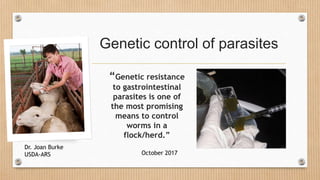
Genetic control of parasites
“Genetic resistance
to gastrointestinal
parasites is one of
the most promising
means to control
worms in a
flock/herd.”
October 2017
Dr. Joan Burke
USDA-ARS
There are two traits to consider.
RESILIENCE
• Ability of animal with withstand or
tolerate parasite infection or challenge
and still perform (grow, produce milk).
• Measured by FAMACHA© (estimate of
packed cell volume), body condition
score and other performance indicators.
• Resilient animals require less
deworming, but may still shed a lot of
eggs onto the pasture.
RESISTANCE
• Ability of animal to limit infection by
suppressing worm growth, suppressing
larvae establishment, and expelling
worms.
• Measured by fecal egg counts (FEC).
• Resistance animals reduce the need for
deworming by reducing the level of
pasture contamination.
• The better trait for selection programs.
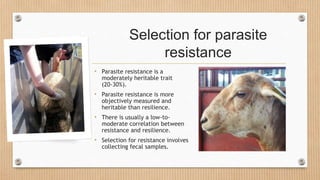
Selection for parasite
resistance
• Parasite resistance is a
moderately heritable trait
(20-30%).
• Parasite resistance is more
objectively measured and
heritable than resilience.
• There is usually a low-to-
moderate correlation between
resistance and resilience.
• Selection for resistance involves
collecting fecal samples.
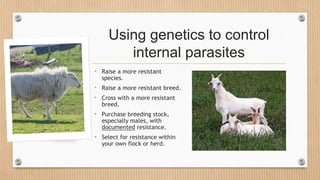
Using genetics to control
internal parasites
• Raise a more resistant
species.
• Raise a more resistant breed.
• Cross with a more resistant
breed.
• Purchase breeding stock,
especially males, with
documented resistance.
• Select for resistance within
your own flock or herd.
More resistant breeds
SHEEP
• Hair sheep
Barbados Blackbelly, St. Croix
• Native sheep of the Southeast
Florida, Louisiana, Gulf Coast Natives
• Hair sheep composites
Katahdin, Royal White(?)
• Terminal sire
Texel
GOATS
• Myotonic
• Kiko
• Spanish
• There is less data documenting breed
differences in goats.
More resistant animals
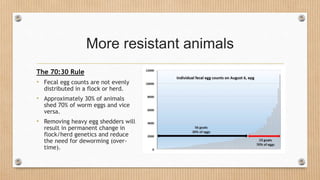
The 70:30 Rule
• Fecal egg counts are not evenly
distributed in a flock or herd.
• Approximately 30% of animals
shed 70% of worm eggs and vice
versa.
• Removing heavy egg shedders will
result in permanent change in
flock/herd genetics and reduce
the need for deworming (over-
time).
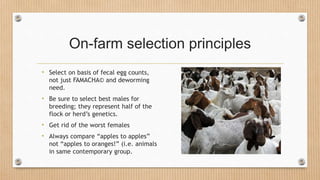
On-farm selection principles
• Select on basis of fecal egg counts,
not just FAMACHA© and deworming
need.
• Be sure to select best males for
breeding; they represent half of the
flock or herd’s genetics.
• Get rid of the worst females
• Always compare “apples to apples”
not “apples to oranges!” (i.e. animals
in same contemporary group.
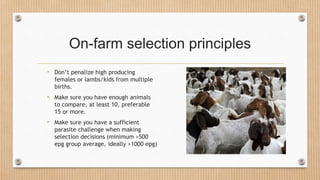
On-farm selection principles
• Don’t penalize high producing
females or lambs/kids from multiple
births.
• Make sure you have enough animals
to compare, at least 10, preferable
15 or more.
• Make sure you have a sufficient
parasite challenge when making
selection decisions (minimum >500
epg group average, ideally >1000 epg)
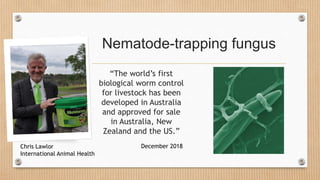
Nematode-trapping fungus
“The world’s first
biological worm control
for livestock has been
developed in Australia
and approved for sale
in Australia, New
Zealand and the US.”
December 2018Chris Lawlor
International Animal Health
Nematode-trapping fungus
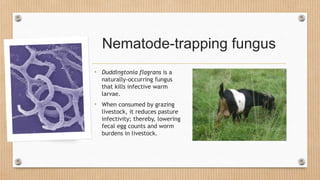
• Duddingtonia flagrans is a
naturally-occurring fungus
that kills infective warm
larvae.
• When consumed by grazing
livestock, it reduces pasture
infectivity; thereby, lowering
fecal egg counts and worm
burdens in livestock.
BioWorma®
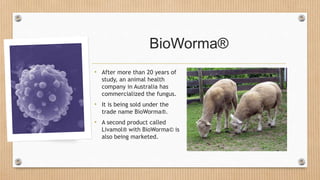
• After more than 20 years of
study, an animal health
company in Australia has
commercialized the fungus.
• It is being sold under the
trade name BioWorma®.
• A second product called
Livamol® with BioWorma© is
also being marketed.
Two products
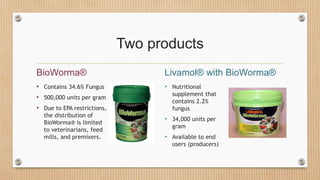
BioWorma®
• Contains 34.6% Fungus
• 500,000 units per gram
• Due to EPA restrictions,
the distribution of
BioWorma® is limited
to veterinarians, feed
mills, and premixers.
Livamol® with BioWorma®
• Nutritional
supplement that
contains 2.2%
fungus
• 34,000 units per
gram
• Available to end
users (producers)
Using
BioWorma®
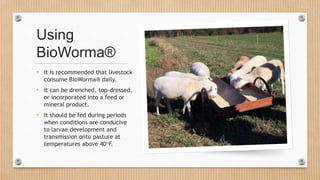
• It is recommended that livestock
consume BioWorma® daily.
• It can be drenched, top-dressed,
or incorporated into a feed or
mineral product.
• It should be fed during periods
when conditions are conducive
to larvae development and
transmission onto pasture at
temperatures above 40F.
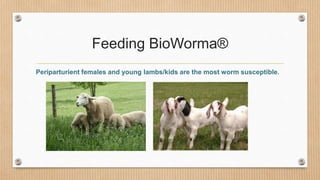
Feeding BioWorma®
Periparturient females and young lambs/kids are the most worm susceptible.
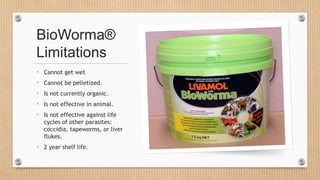
BioWorma®
Limitations
• Cannot get wet
• Cannot be pelletized.
• Is not currently organic.
• Is not effective in animal.
• Is not effective against life
cycles of other parasites:
coccidia, tapeworms, or liver
flukes.
• 2 year shelf life.
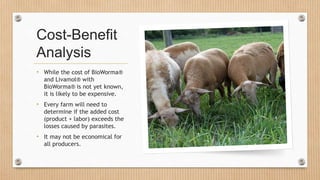
Cost-Benefit
Analysis
• While the cost of BioWorma®
and Livamol® with
BioWorma® is not yet known,
it is likely to be expensive.
• Every farm will need to
determine if the added cost
(product + labor) exceeds the
losses caused by parasites.
• It may not be economical for
all producers.
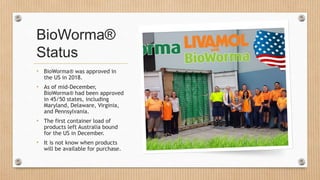
BioWorma®
Status
• BioWorma® was approved in
the US in 2018.
• As of mid-December,
BioWorma® had been approved
in 45/50 states, including
Maryland, Delaware, Virginia,
and Pennsylvania.
• The first container load of
products left Australia bound
for the US in December.
• It is not know when products
will be available for purchase.
Thank you.

Winning against worms

  • 1.
    Winning against worms SUSANSCHOENIAN Sheep & Goat Specialist University of Maryland Extension sschoen@umd.edu – wormx.info
  • 2.
    Gastro-intestinal parasites • GIparasites are the primary health problem affecting sheep and goats; they represent a major obstacle to profitability and sustainability. • There is no “silver bullet!” • Successful control requires a integrated approach that combines deworming with management practices that are able to minimize the need for deworming.
  • 3.
    Four potential componentsof an integrated parasite management program 1. Administering combination treatments to clinically- parasitized animals. 2. Using copper oxide wire particles to combat barber pole worm infections. 3. Using genetics to control internal parasitism. 4. Feeding nematode-trapping fungus to reduce pasture contamination.
  • 4.
    Combination treatments “There nowis very strong evidence that using combination treatment is the best method for using dewormers and should be instituted on all farms immediately.” January 2017 Dr. Ray Kaplan University of Georgia
  • 5.
    Three anthelmintic (dewormer)classes GROUP 1 Benzimidazoles (BZ) GROUP 2 Macrocylic lactones (ML) GROUP 3 Nicotinic agonists Avermectins Milbemycins Imidazothiazoles Tetrahydropyrimidines THIABENDAZOLE TBZ® IVERMECTIN Ivomec® MOXIDECTIN Cydectin® Quest® LEVAMISOLE Prohibit® Leva-Med® Tramisol® Levasol® MORANTEL Rumatel® Positive Pellet® Goat DewormerFENBENDAZOLE SafeGuard® Panacur® DORAMECTIN Dectomax® PYRANTEL Strongid® ALBENDAZOLE Valbazen® EPRINOMECTIN Eprinex®OXFENDAZOLE Synanthic®
  • 6.
    Percent sheep farms(n=30) in three southeastern states with anthelmintic resistance (Avg. 84% H. contortus) 0 20 40 60 80 100 Benzimidazoles Ivermectin Levamisole Moxidectin Maryland Virginia Georgia 2018 Let’s Grow
  • 7.
    Combination Treatments • A combinationtreatment is when you give several different dewormers at the same time. • You get an additive effect with each drug used (unlike rotating dewormers). • By achieving a higher efficacy, there are fewer resistant worms that survive the treatment; thus, diluting the resistant worms. Drug 1 Drug 2 Drug 3 Combo12 Combo123 80% 80% 80% 96.00% 99.20% 90% 90% 90% 99.00% 99.90% 60% 95% 98.00% 98.00% 60% 60% 95% 84.00% 99.20% 99% 99% 99.99% 99.99% 60% 60% 60% 84.00% 93.60% 50% 50% 50% 75.00% 87.50% 40% 40% 40% 64.00% 78.40% 95% 80% 20% 99.00% 99.20%
  • 8.
    Combination treatments • Purchase andadminister each dewormer singly in a separate syringe. • Use the most potent drug from each dewormer class. • Do not mix dewormers! • Administer each dewormer at full dose, based on an accurate weight.
  • 9.
    Combination treatments Valbazen®* Cydectin®Prohibit® Sheep 1.5 ml/50 lbs. [7 days] 4.5 ml/50 lbs. [7 days] Depends on dilution [3 days] Goats 4 ml/50 lbs. [9 days meat] [7 days milk] 9 ml/50 lbs. [17 days meat] [8 days milk] Depends on dilution [4 days meat] [3 days milk] Camelids 4 ml/50 lbs. 9 ml/50 lbs. Depends on dilution *Do not use first 30 days of pregnancy www.wormx.info
  • 10.
    Combination treatments • Can giveone dewormer immediately after the other. • Observe withdrawal period of drug with longest withdrawal (usually moxidectin). • Requires extra label drug use for goats and camelids. • Extra label drug use requires valid veterinarian-client-patient relationship.
  • 11.
    Targeted selective treatment(TST) • Combination treatments should only be given to clinically parasitized animals, as evidenced by FAMACHA© scores, Five Point Check©, or other indicators. • Selective treatment is necessary to maintain refugia (worms not exposed to drugs) and prevent development of multi-drug resistant worms.
  • 12.
    Copper oxide wireparticles “Copper oxide wire particles (COWP) can be successfully integrated into Haemonchus contortus management strategies on sheep and goat farms, particularly when producers are armed with knowledge on how to use it safely. .” December 2015 Dr. Lisa Williamson University of Georgia
  • 13.
    Copper oxide wireparticles (COWP) • Though results have been variable, COWP have been shown to reduce barber pole worm infections in small ruminants. • COWP are only effective against barber pole worm infections. • COWP may be approved by organic certifiers. 0 500 1000 1500 2000 2500 3000 3500 4000 4500 5000 d (-6) d-0 d-14 d-28 d-42 d-56 d-70 d-84 Test - COWP Study - no COWP COWP Western Maryland Pasture-Based Meat Goat Performance Test (2015) 82% reduction in FEC
  • 14.
    Copper oxide wire particles •Tiny needles of copper oxide. • Slow release form of copper. • Poorly absorbed form of copper, unlike copper sulfate. • COWP are available as supplements for cattle (12 and 25-g) and goats (2 and 4-g). Cattle boluses repacked for small ruminants
  • 15.
    Using COWP • Usesmallest dose possible to achieve effect, usually 0.5-1 g for lambs/kids and 1-2 g for mature animals. • Repackage cattle and goat boluses into smaller doses for deworming, especially for sheep. • Administer using a bolus or balling gun. • Selectively treat animals. • Minimize number of treatments.
  • 16.
    Using COWP Safely • Sheepare especially susceptible to copper toxicity. • Copper in excess of dietary requirements accumulates in liver until a toxic level is reached. • Before using and periodically ,assess the copper status of your flock or herd by submitting liver and kidney samples from healthy animals to a diagnostic lab. • Do not use copper sulfate for deworming or minerals containing high levels of copper.
  • 17.
    Combination treatment with copperoxide wire particles Treatment (10-23 lambs per Tx group) Efficacy (%FECR) No treatment (control) Increase Valbazen® (3 ml/50 lbs.) 20% COWP (2 g, Ultracruz™) 58% COWP (2 g, Copasure®) 12% Valbazen® + COWP 99% • Research conducted at Dale Bumpers Small Farm Research Center in Booneville, Arkansas by Joan Burke. • Similar results were obtained with levamisole (Prohibit®, Levamed®.
  • 18.
    Genetic control ofparasites “Genetic resistance to gastrointestinal parasites is one of the most promising means to control worms in a flock/herd.” October 2017 Dr. Joan Burke USDA-ARS
  • 19.
    There are twotraits to consider. RESILIENCE • Ability of animal with withstand or tolerate parasite infection or challenge and still perform (grow, produce milk). • Measured by FAMACHA© (estimate of packed cell volume), body condition score and other performance indicators. • Resilient animals require less deworming, but may still shed a lot of eggs onto the pasture. RESISTANCE • Ability of animal to limit infection by suppressing worm growth, suppressing larvae establishment, and expelling worms. • Measured by fecal egg counts (FEC). • Resistance animals reduce the need for deworming by reducing the level of pasture contamination. • The better trait for selection programs.
  • 20.
    Selection for parasite resistance •Parasite resistance is a moderately heritable trait (20-30%). • Parasite resistance is more objectively measured and heritable than resilience. • There is usually a low-to- moderate correlation between resistance and resilience. • Selection for resistance involves collecting fecal samples.
  • 21.
    Using genetics tocontrol internal parasites • Raise a more resistant species. • Raise a more resistant breed. • Cross with a more resistant breed. • Purchase breeding stock, especially males, with documented resistance. • Select for resistance within your own flock or herd.
  • 22.
    More resistant breeds SHEEP •Hair sheep Barbados Blackbelly, St. Croix • Native sheep of the Southeast Florida, Louisiana, Gulf Coast Natives • Hair sheep composites Katahdin, Royal White(?) • Terminal sire Texel GOATS • Myotonic • Kiko • Spanish • There is less data documenting breed differences in goats.
  • 23.
    More resistant animals The70:30 Rule • Fecal egg counts are not evenly distributed in a flock or herd. • Approximately 30% of animals shed 70% of worm eggs and vice versa. • Removing heavy egg shedders will result in permanent change in flock/herd genetics and reduce the need for deworming (over- time).
  • 24.
    On-farm selection principles •Select on basis of fecal egg counts, not just FAMACHA© and deworming need. • Be sure to select best males for breeding; they represent half of the flock or herd’s genetics. • Get rid of the worst females • Always compare “apples to apples” not “apples to oranges!” (i.e. animals in same contemporary group.
  • 25.
    On-farm selection principles •Don’t penalize high producing females or lambs/kids from multiple births. • Make sure you have enough animals to compare, at least 10, preferable 15 or more. • Make sure you have a sufficient parasite challenge when making selection decisions (minimum >500 epg group average, ideally >1000 epg)
  • 26.
    Nematode-trapping fungus “The world’sfirst biological worm control for livestock has been developed in Australia and approved for sale in Australia, New Zealand and the US.” December 2018Chris Lawlor International Animal Health
  • 27.
    Nematode-trapping fungus • Duddingtoniaflagrans is a naturally-occurring fungus that kills infective warm larvae. • When consumed by grazing livestock, it reduces pasture infectivity; thereby, lowering fecal egg counts and worm burdens in livestock.
  • 28.
    BioWorma® • After morethan 20 years of study, an animal health company in Australia has commercialized the fungus. • It is being sold under the trade name BioWorma®. • A second product called Livamol® with BioWorma© is also being marketed.
  • 29.
    Two products BioWorma® • Contains34.6% Fungus • 500,000 units per gram • Due to EPA restrictions, the distribution of BioWorma® is limited to veterinarians, feed mills, and premixers. Livamol® with BioWorma® • Nutritional supplement that contains 2.2% fungus • 34,000 units per gram • Available to end users (producers)
  • 30.
    Using BioWorma® • It isrecommended that livestock consume BioWorma® daily. • It can be drenched, top-dressed, or incorporated into a feed or mineral product. • It should be fed during periods when conditions are conducive to larvae development and transmission onto pasture at temperatures above 40F.
  • 31.
    Feeding BioWorma® Periparturient femalesand young lambs/kids are the most worm susceptible.
  • 32.
    BioWorma® Limitations • Cannot getwet • Cannot be pelletized. • Is not currently organic. • Is not effective in animal. • Is not effective against life cycles of other parasites: coccidia, tapeworms, or liver flukes. • 2 year shelf life.
  • 33.
    Cost-Benefit Analysis • While thecost of BioWorma® and Livamol® with BioWorma® is not yet known, it is likely to be expensive. • Every farm will need to determine if the added cost (product + labor) exceeds the losses caused by parasites. • It may not be economical for all producers.
  • 34.
    BioWorma® Status • BioWorma® wasapproved in the US in 2018. • As of mid-December, BioWorma® had been approved in 45/50 states, including Maryland, Delaware, Virginia, and Pennsylvania. • The first container load of products left Australia bound for the US in December. • It is not know when products will be available for purchase.
  • 35.