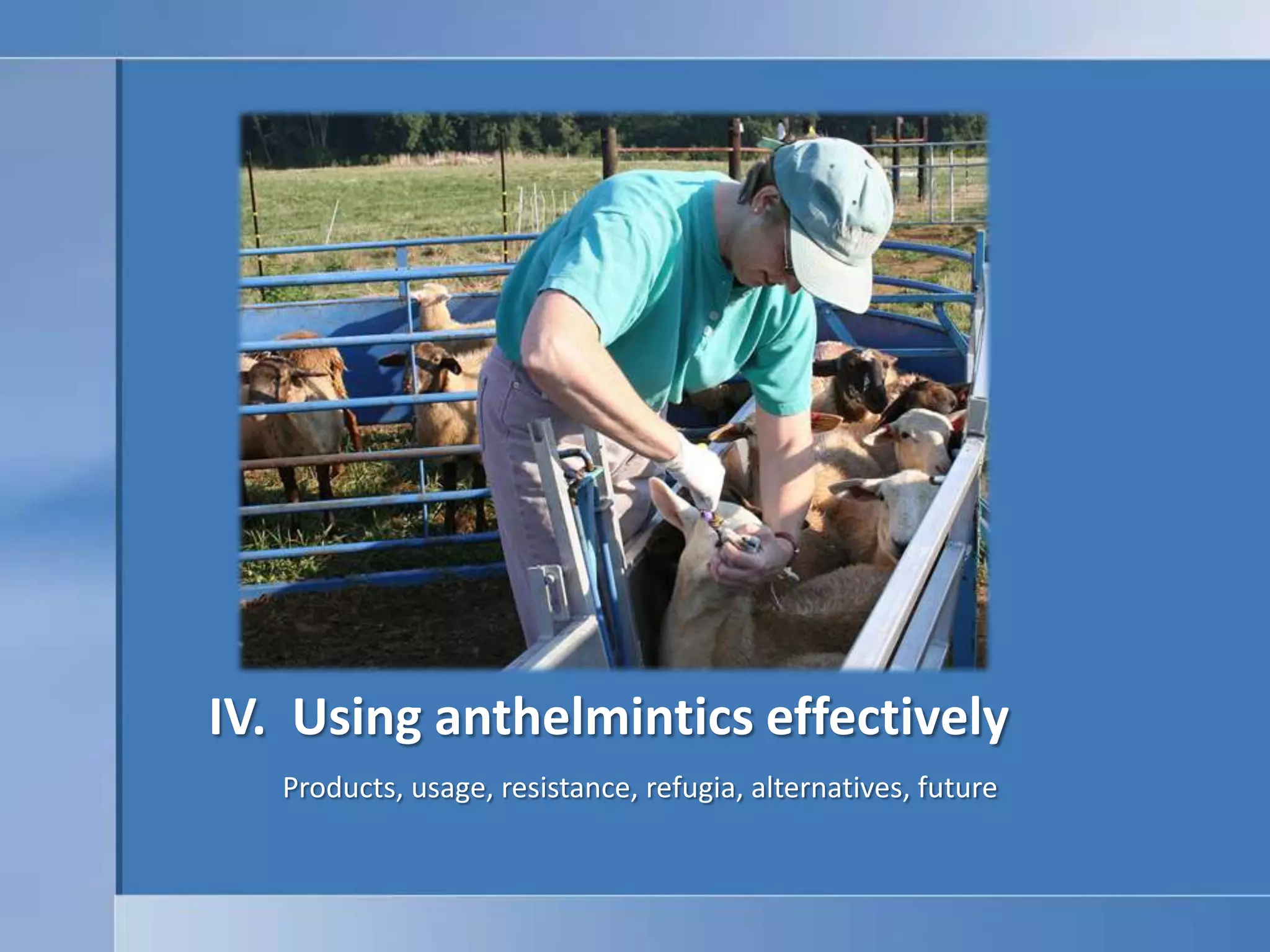
IV.  Using anthelmintics effectivelyProducts, usage, resistance, refugia, alternatives, future
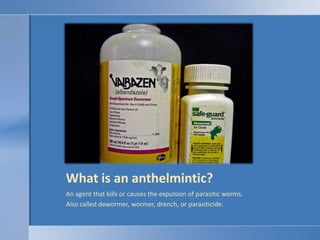
What is an anthelmintic?An agent that kills or causes the expulsion of parasitic worms.Also called dewormer, wormer, drench, or parasiticide.
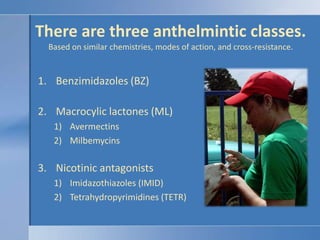
There are three anthelmintic classes.Based on similar chemistries, modes of action, and cross-resistance.Benzimidazoles (BZ)Macrocylic lactones (ML)AvermectinsMilbemycinsNicotinic antagonistsImidazothiazoles (IMID)Tetrahydropyrimidines (TETR)
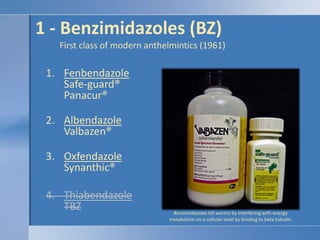
1 - Benzimidazoles (BZ)           First class of modern anthelmintics (1961)FenbendazoleSafe-guard®Panacur®AlbendazoleValbazen®OxfendazoleSynanthic®ThiabendazoleTBZBenzimidazoles kill worms by interfering with energy metabolism on a cellular level by binding to beta tubulin.
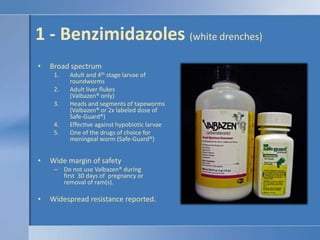
1 - Benzimidazoles (white drenches)Broad spectrumAdult and 4th stage larvae of roundwormsAdult liver flukes (Valbazen® only)Heads and segments of tapeworms  (Valbazen® or 2x labeled dose of Safe-Guard®)Effective against hypobiotic larvaeOne of the drugs of choice for meningeal worm (Safe-Guard®)Wide margin of safetyDo not use Valbazen® during first  30 days of  pregnancy or removal of ram(s).Widespread resistance reported.
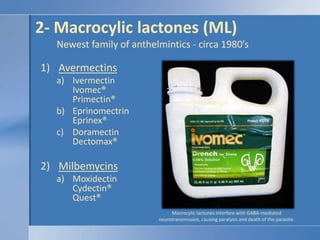
2- Macrocylic lactones (ML)         Newest family of anthelmintics - circa 1980’sAvermectinsIvermectin Ivomec®Primectin®EprinomectrinEprinex®DoramectinDectomax®MilbemycinsMoxidectin Cydectin®Quest®Macrocylic lactones interfere with GABA-mediated neurotransmission, causing paralysis and death of the parasite.
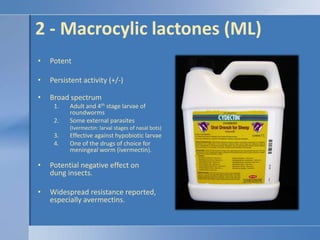
2 - Macrocylic lactones (ML)PotentPersistent activity (+/-)Broad spectrumAdult and 4th stage larvae of roundwormsSome external parasites(Ivermectin: larval stages of nasal bots)Effective against hypobiotic larvaeOne of the drugs of choice for meningeal worm (ivermectin).Potential negative effect on dung insects.Widespread resistance reported, especially avermectins.
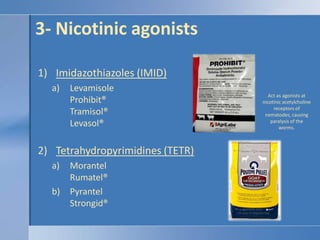
3- Nicotinic agonistsImidazothiazoles (IMID)LevamisoleProhibit®Tramisol®Levasol®Tetrahydropyrimidines (TETR)MorantelRumatel®PyrantelStrongid® Act as agonists at nicotinic acetylcholine receptors of nematodes, causing paralysis of the worms.
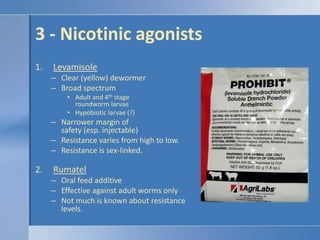
3 - Nicotinic agonistsLevamisoleClear (yellow) dewormerBroad spectrumAdult and 4th stage roundworm larvaeHypobiotic larvae (?)Narrower margin of safety (esp. injectable)Resistance varies from high to low.Resistance is sex-linked.RumatelOral feed additiveEffective against adult worms onlyNot much is known about resistance levels.
FDA-approved anthelminticsSHEEPGOATSIvomec® sheep drenchIvermectinCydectin® sheep drenchMoxidectinProhibit® drenchLevamisoleValbazen® liquidAlbendazoleSafe-Guard® suspensionFenbendazoleValbazen® liquidAlbendazole[liver flukes only]Rumatel® premixMorantelDifferent anthelmintics may be approved and available in different countries.
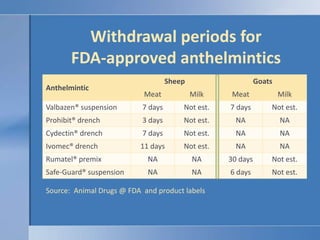
Withdrawal periods for FDA-approved anthelminticsSource:  Animal Drugs @ FDA  and product labels
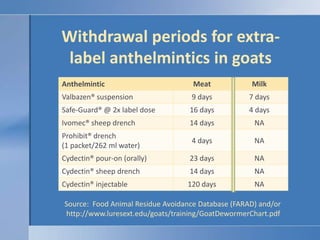
Withdrawal periods for extra-label anthelmintics in goatsSource:  Food Animal Residue Avoidance Database (FARAD) and/or http://www.luresext.edu/goats/training/GoatDewormerChart.pdf
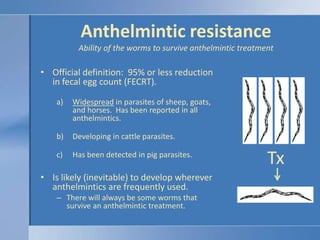
Anthelmintic resistanceAbility of the worms to survive anthelmintic treatmentOfficial definition:  95% or less reduction in fecal egg count (FECRT).Widespread in parasites of sheep, goats, and horses.  Has been reported in all anthelmintics.Developing in cattle parasites.Has been detected in pig parasites.Is likely (inevitable) to develop wherever anthelmintics are frequently used.There will always be some worms that survive an anthelmintic treatment.Tx
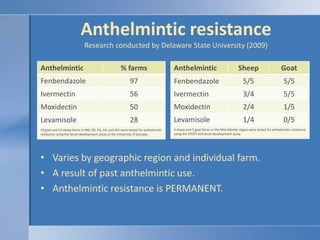
Anthelmintic resistanceResearch conducted by Delaware State University (2009)Varies by geographic region and individual farm.A result of past anthelmintic use.Anthelmintic resistance is PERMANENT.
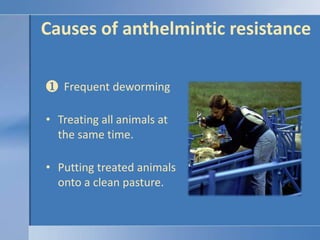
Causes of anthelmintic resistance  Frequent dewormingTreating all animals at the same time.Putting treated animals onto a clean pasture.
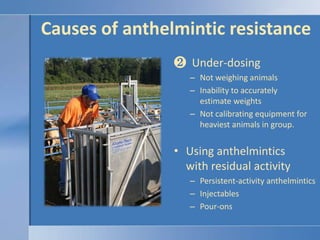
Causes of anthelmintic resistance  Under-dosingNot weighing animalsInability to accurately estimate weightsNot calibrating equipment for heaviest animals in group.Using anthelmintics with residual activityPersistent-activity anthelminticsInjectablesPour-ons
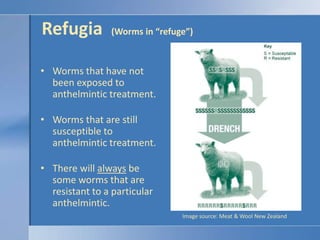
Refugia  (Worms in “refuge”)Worms that have not been exposed to anthelmintic treatment.Worms that are still susceptible to anthelmintic treatment.There will always be some worms that are resistant to a particular anthelmintic.Image source: Meat & Wool New Zealand
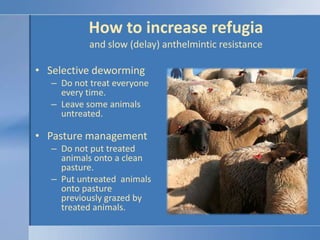
How to increase refugiaand slow (delay) anthelmintic resistanceSelective dewormingDo not treat everyone every time.Leave some animals untreated.Pasture managementDo not put treated animals onto a clean pasture.Put untreated  animals onto pasture previously grazed by treated animals.
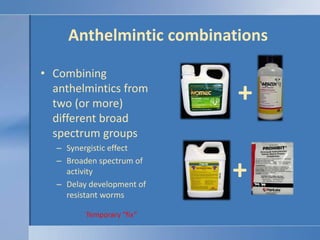
Anthelmintic combinationsCombining anthelmintics from two (or more) different broad spectrum groupsSynergistic effectBroaden spectrum of activityDelay development of resistant worms++Temporary “fix”
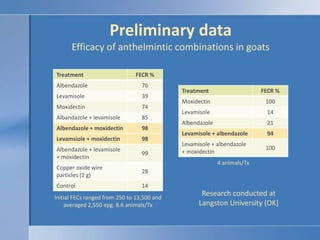
Preliminary dataEfficacy of anthelmintic combinations in goats4 animals/TxResearch conducted at Langston University (OK)Initial FECs ranged from 250 to 13,500 and averaged 2,550 epg. 8.6 animals/Tx
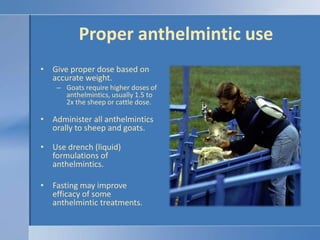
Proper anthelmintic useGive proper dose based on accurate weight.Goats require higher doses of anthelmintics, usually 1.5 to 2x the sheep or cattle dose.Administer all anthelmintics orally to sheep and goats.Use drench (liquid) formulations of anthelmintics.Fasting may improve efficacy of some anthelmintic treatments.
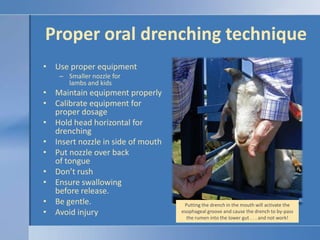
Proper oral drenching techniqueUse proper equipmentSmaller nozzle for lambs and kidsMaintain equipment properlyCalibrate equipment for proper dosageHold head horizontal for drenchingInsert nozzle in side of mouthPut nozzle over back of tongueDon’t rushEnsure swallowing before release.Be gentle.Avoid injuryPutting the drench in the mouth will activate the esophageal groove and cause the drench to by-pass the rumen into the lower gut . . . and not work!
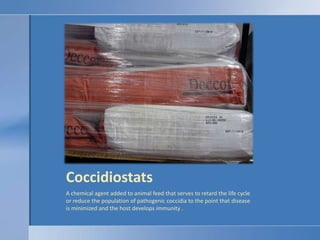
CoccidiostatsA chemical agent added to animal feed that serves to retard the life cycle or reduce the population of pathogenic coccidia to the point that disease is minimized and the host develops immunity .
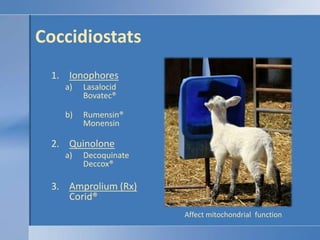
CoccidiostatsIonophoresLasalocidBovatec®Rumensin®MonensinQuinoloneDecoquinateDeccox®Amprolium (Rx)Corid®Affect mitochondrial  function
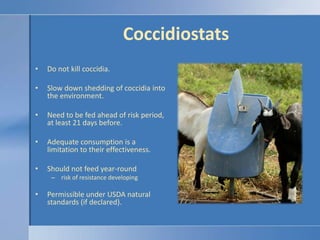
CoccidiostatsDo not kill coccidia.Slow down shedding of coccidia into the environment.Need to be fed ahead of risk period, at least 21 days before.Adequate consumption is a limitation to their effectiveness.Should not feed year-round risk of resistance developingPermissible under USDA natural standards (if declared).
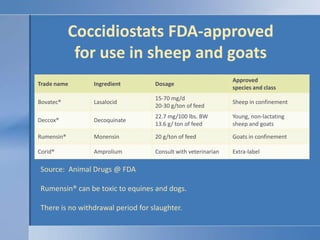
Coccidiostats FDA-approved for use in sheep and goatsSource:  Animal Drugs @ FDARumensin® can be toxic to equines and dogs.There is no withdrawal period for slaughter.
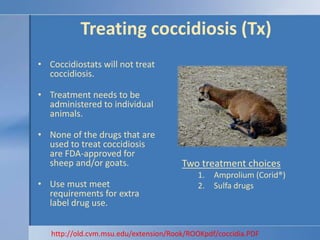
Treating coccidiosis (Tx)Coccidiostats will not treat coccidiosis.Treatment needs to be administered to individual animals.None of the drugs that are used to treat coccidiosis are FDA-approved for sheep and/or goats.Use must meet requirements for extra label drug use.Two treatment choicesAmprolium (Corid®)Sulfa drugshttp://old.cvm.msu.edu/extension/Rook/ROOKpdf/coccidia.PDF
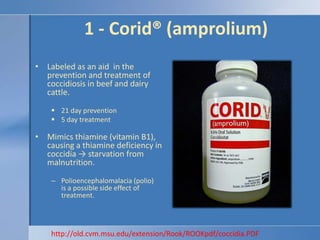
1 - Corid® (amprolium)Labeled as an aid  in the prevention and treatment of coccidiosis in beef and dairy cattle.21 day prevention
5 day treatmentMimics thiamine (vitamin B1), causing a thiamine deficiency in coccidia -> starvation from malnutrition.Polioencephalomalacia (polio) is a possible side effect of treatment.http://old.cvm.msu.edu/extension/Rook/ROOKpdf/coccidia.PDF
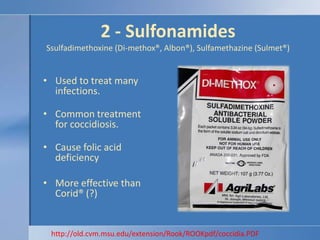
2 - SulfonamidesSsulfadimethoxine (Di-methox®, Albon®), Sulfamethazine (Sulmet®)Used to treat many infections.Common treatment for coccidiosis.Cause folic acid deficiency More effective than Corid® (?)http://old.cvm.msu.edu/extension/Rook/ROOKpdf/coccidia.PDF
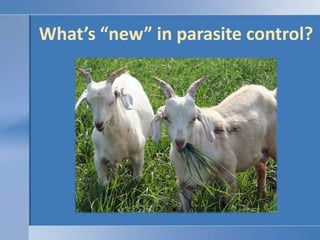
What’s “new” in parasite control?
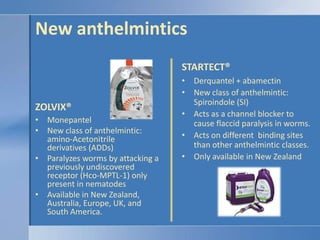
New anthelminticsSTARTECT®Derquantel + abamectinNew class of anthelmintic: Spiroindole (SI)Acts as a channel blocker to cause flaccid paralysis in worms.Acts on different  binding sites than other anthelmintic classes.Only available in New ZealandZOLVIX® MonepantelNew class of anthelmintic: amino-Acetonitrilederivatives (ADDs)Paralyzes worms by attacking a previously undiscovered receptor (Hco-MPTL-1) only present in nematodesAvailable in New Zealand, Australia, Europe, UK, and South America.
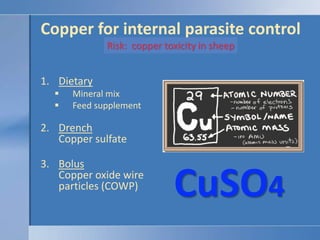
Copper for internal parasite controlRisk:  copper toxicity in sheepDietaryMineral mix
Feed supplementDrenchCopper sulfateBolusCopper oxide wire particles (COWP) CuSO4
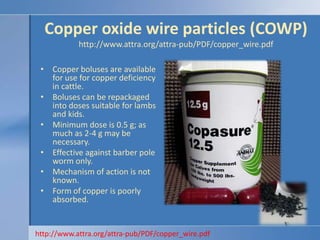
Copper oxide wire particles (COWP) http://www.attra.org/attra-pub/PDF/copper_wire.pdfCopper boluses are available for use for copper deficiency in cattle.Boluses can be repackaged into doses suitable for lambs and kids.Minimum dose is 0.5 g; as much as 2-4 g may be necessary.Effective against barber pole worm only.Mechanism of action is not known.Form of copper is poorly absorbed.http://www.attra.org/attra-pub/PDF/copper_wire.pdf
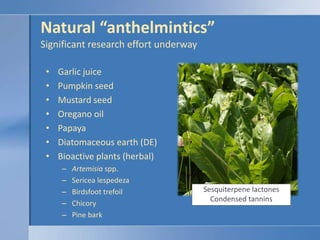
Natural “anthelmintics”Significant research effort underwayGarlic juicePumpkin seedMustard seedOregano oilPapaya Diatomaceous earth (DE)Bioactive plants (herbal)Artemisia spp. SericealespedezaBirdsfoot trefoilChicoryPine barkSesquiterpene lactonesCondensed tannins
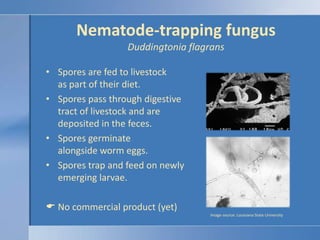
Nematode-trapping fungusDuddingtoniaflagransSpores are fed to livestock as part of their diet.Spores pass through digestive tract of livestock and are deposited in the feces.Spores germinate alongside worm eggs.Spores trap and feed on newly emerging larvae.No commercial product (yet)Image source: Louisiana State University
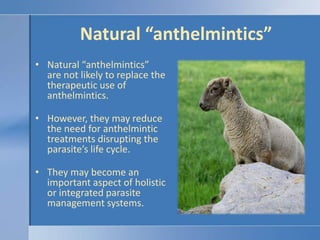
Natural “anthelmintics”Natural “anthelmintics” are not likely to replace the therapeutic use of anthelmintics.However, they may reduce the need for anthelmintic treatments disrupting the parasite’s life cycle.They may become an important aspect of holistic or integrated parasite management systems.
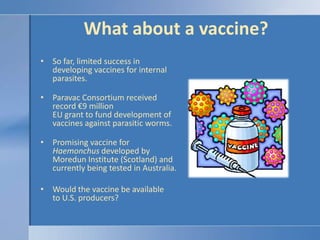
What about a vaccine?So far, limited success in developing vaccines for internal parasites.Paravac Consortium received record €9 million EU grant to fund development of vaccines against parasitic worms.Promising vaccine for Haemonchus developed by Moredun Institute (Scotland) and currently being tested in Australia.Would the vaccine be available to U.S. producers?

Anthelmintics

  • 1.
    IV. Usinganthelmintics effectivelyProducts, usage, resistance, refugia, alternatives, future
  • 2.
    What is ananthelmintic?An agent that kills or causes the expulsion of parasitic worms.Also called dewormer, wormer, drench, or parasiticide.
  • 3.
    There are threeanthelmintic classes.Based on similar chemistries, modes of action, and cross-resistance.Benzimidazoles (BZ)Macrocylic lactones (ML)AvermectinsMilbemycinsNicotinic antagonistsImidazothiazoles (IMID)Tetrahydropyrimidines (TETR)
  • 4.
    1 - Benzimidazoles(BZ) First class of modern anthelmintics (1961)FenbendazoleSafe-guard®Panacur®AlbendazoleValbazen®OxfendazoleSynanthic®ThiabendazoleTBZBenzimidazoles kill worms by interfering with energy metabolism on a cellular level by binding to beta tubulin.
  • 5.
    1 - Benzimidazoles(white drenches)Broad spectrumAdult and 4th stage larvae of roundwormsAdult liver flukes (Valbazen® only)Heads and segments of tapeworms (Valbazen® or 2x labeled dose of Safe-Guard®)Effective against hypobiotic larvaeOne of the drugs of choice for meningeal worm (Safe-Guard®)Wide margin of safetyDo not use Valbazen® during first 30 days of pregnancy or removal of ram(s).Widespread resistance reported.
  • 6.
    2- Macrocylic lactones(ML) Newest family of anthelmintics - circa 1980’sAvermectinsIvermectin Ivomec®Primectin®EprinomectrinEprinex®DoramectinDectomax®MilbemycinsMoxidectin Cydectin®Quest®Macrocylic lactones interfere with GABA-mediated neurotransmission, causing paralysis and death of the parasite.
  • 7.
    2 - Macrocyliclactones (ML)PotentPersistent activity (+/-)Broad spectrumAdult and 4th stage larvae of roundwormsSome external parasites(Ivermectin: larval stages of nasal bots)Effective against hypobiotic larvaeOne of the drugs of choice for meningeal worm (ivermectin).Potential negative effect on dung insects.Widespread resistance reported, especially avermectins.
  • 8.
    3- Nicotinic agonistsImidazothiazoles(IMID)LevamisoleProhibit®Tramisol®Levasol®Tetrahydropyrimidines (TETR)MorantelRumatel®PyrantelStrongid® Act as agonists at nicotinic acetylcholine receptors of nematodes, causing paralysis of the worms.
  • 9.
    3 - NicotinicagonistsLevamisoleClear (yellow) dewormerBroad spectrumAdult and 4th stage roundworm larvaeHypobiotic larvae (?)Narrower margin of safety (esp. injectable)Resistance varies from high to low.Resistance is sex-linked.RumatelOral feed additiveEffective against adult worms onlyNot much is known about resistance levels.
  • 10.
    FDA-approved anthelminticsSHEEPGOATSIvomec® sheepdrenchIvermectinCydectin® sheep drenchMoxidectinProhibit® drenchLevamisoleValbazen® liquidAlbendazoleSafe-Guard® suspensionFenbendazoleValbazen® liquidAlbendazole[liver flukes only]Rumatel® premixMorantelDifferent anthelmintics may be approved and available in different countries.
  • 11.
    Withdrawal periods forFDA-approved anthelminticsSource: Animal Drugs @ FDA and product labels
  • 12.
    Withdrawal periods forextra-label anthelmintics in goatsSource: Food Animal Residue Avoidance Database (FARAD) and/or http://www.luresext.edu/goats/training/GoatDewormerChart.pdf
  • 13.
    Anthelmintic resistanceAbility ofthe worms to survive anthelmintic treatmentOfficial definition: 95% or less reduction in fecal egg count (FECRT).Widespread in parasites of sheep, goats, and horses. Has been reported in all anthelmintics.Developing in cattle parasites.Has been detected in pig parasites.Is likely (inevitable) to develop wherever anthelmintics are frequently used.There will always be some worms that survive an anthelmintic treatment.Tx
  • 14.
    Anthelmintic resistanceResearch conductedby Delaware State University (2009)Varies by geographic region and individual farm.A result of past anthelmintic use.Anthelmintic resistance is PERMANENT.
  • 15.
    Causes of anthelminticresistance Frequent dewormingTreating all animals at the same time.Putting treated animals onto a clean pasture.
  • 16.
    Causes of anthelminticresistance Under-dosingNot weighing animalsInability to accurately estimate weightsNot calibrating equipment for heaviest animals in group.Using anthelmintics with residual activityPersistent-activity anthelminticsInjectablesPour-ons
  • 17.
    Refugia (Wormsin “refuge”)Worms that have not been exposed to anthelmintic treatment.Worms that are still susceptible to anthelmintic treatment.There will always be some worms that are resistant to a particular anthelmintic.Image source: Meat & Wool New Zealand
  • 18.
    How to increaserefugiaand slow (delay) anthelmintic resistanceSelective dewormingDo not treat everyone every time.Leave some animals untreated.Pasture managementDo not put treated animals onto a clean pasture.Put untreated animals onto pasture previously grazed by treated animals.
  • 19.
    Anthelmintic combinationsCombining anthelminticsfrom two (or more) different broad spectrum groupsSynergistic effectBroaden spectrum of activityDelay development of resistant worms++Temporary “fix”
  • 20.
    Preliminary dataEfficacy ofanthelmintic combinations in goats4 animals/TxResearch conducted at Langston University (OK)Initial FECs ranged from 250 to 13,500 and averaged 2,550 epg. 8.6 animals/Tx
  • 21.
    Proper anthelmintic useGiveproper dose based on accurate weight.Goats require higher doses of anthelmintics, usually 1.5 to 2x the sheep or cattle dose.Administer all anthelmintics orally to sheep and goats.Use drench (liquid) formulations of anthelmintics.Fasting may improve efficacy of some anthelmintic treatments.
  • 22.
    Proper oral drenchingtechniqueUse proper equipmentSmaller nozzle for lambs and kidsMaintain equipment properlyCalibrate equipment for proper dosageHold head horizontal for drenchingInsert nozzle in side of mouthPut nozzle over back of tongueDon’t rushEnsure swallowing before release.Be gentle.Avoid injuryPutting the drench in the mouth will activate the esophageal groove and cause the drench to by-pass the rumen into the lower gut . . . and not work!
  • 23.
    CoccidiostatsA chemical agentadded to animal feed that serves to retard the life cycle or reduce the population of pathogenic coccidia to the point that disease is minimized and the host develops immunity .
  • 24.
  • 25.
    CoccidiostatsDo not killcoccidia.Slow down shedding of coccidia into the environment.Need to be fed ahead of risk period, at least 21 days before.Adequate consumption is a limitation to their effectiveness.Should not feed year-round risk of resistance developingPermissible under USDA natural standards (if declared).
  • 26.
    Coccidiostats FDA-approved foruse in sheep and goatsSource: Animal Drugs @ FDARumensin® can be toxic to equines and dogs.There is no withdrawal period for slaughter.
  • 27.
    Treating coccidiosis (Tx)Coccidiostatswill not treat coccidiosis.Treatment needs to be administered to individual animals.None of the drugs that are used to treat coccidiosis are FDA-approved for sheep and/or goats.Use must meet requirements for extra label drug use.Two treatment choicesAmprolium (Corid®)Sulfa drugshttp://old.cvm.msu.edu/extension/Rook/ROOKpdf/coccidia.PDF
  • 28.
    1 - Corid®(amprolium)Labeled as an aid in the prevention and treatment of coccidiosis in beef and dairy cattle.21 day prevention
  • 29.
    5 day treatmentMimicsthiamine (vitamin B1), causing a thiamine deficiency in coccidia -> starvation from malnutrition.Polioencephalomalacia (polio) is a possible side effect of treatment.http://old.cvm.msu.edu/extension/Rook/ROOKpdf/coccidia.PDF
  • 30.
    2 - SulfonamidesSsulfadimethoxine(Di-methox®, Albon®), Sulfamethazine (Sulmet®)Used to treat many infections.Common treatment for coccidiosis.Cause folic acid deficiency More effective than Corid® (?)http://old.cvm.msu.edu/extension/Rook/ROOKpdf/coccidia.PDF
  • 31.
    What’s “new” inparasite control?
  • 32.
    New anthelminticsSTARTECT®Derquantel +abamectinNew class of anthelmintic: Spiroindole (SI)Acts as a channel blocker to cause flaccid paralysis in worms.Acts on different binding sites than other anthelmintic classes.Only available in New ZealandZOLVIX® MonepantelNew class of anthelmintic: amino-Acetonitrilederivatives (ADDs)Paralyzes worms by attacking a previously undiscovered receptor (Hco-MPTL-1) only present in nematodesAvailable in New Zealand, Australia, Europe, UK, and South America.
  • 33.
    Copper for internalparasite controlRisk: copper toxicity in sheepDietaryMineral mix
  • 34.
    Feed supplementDrenchCopper sulfateBolusCopperoxide wire particles (COWP) CuSO4
  • 35.
    Copper oxide wireparticles (COWP) http://www.attra.org/attra-pub/PDF/copper_wire.pdfCopper boluses are available for use for copper deficiency in cattle.Boluses can be repackaged into doses suitable for lambs and kids.Minimum dose is 0.5 g; as much as 2-4 g may be necessary.Effective against barber pole worm only.Mechanism of action is not known.Form of copper is poorly absorbed.http://www.attra.org/attra-pub/PDF/copper_wire.pdf
  • 36.
    Natural “anthelmintics”Significant researcheffort underwayGarlic juicePumpkin seedMustard seedOregano oilPapaya Diatomaceous earth (DE)Bioactive plants (herbal)Artemisia spp. SericealespedezaBirdsfoot trefoilChicoryPine barkSesquiterpene lactonesCondensed tannins
  • 37.
    Nematode-trapping fungusDuddingtoniaflagransSpores arefed to livestock as part of their diet.Spores pass through digestive tract of livestock and are deposited in the feces.Spores germinate alongside worm eggs.Spores trap and feed on newly emerging larvae.No commercial product (yet)Image source: Louisiana State University
  • 38.
    Natural “anthelmintics”Natural “anthelmintics”are not likely to replace the therapeutic use of anthelmintics.However, they may reduce the need for anthelmintic treatments disrupting the parasite’s life cycle.They may become an important aspect of holistic or integrated parasite management systems.
  • 39.
    What about avaccine?So far, limited success in developing vaccines for internal parasites.Paravac Consortium received record €9 million EU grant to fund development of vaccines against parasitic worms.Promising vaccine for Haemonchus developed by Moredun Institute (Scotland) and currently being tested in Australia.Would the vaccine be available to U.S. producers?