Minimizing
Feed Costs
SUSAN SCHOENIAN
SHEEP & GOAT SPECIALIST
UNIVERSITY OF MARYLAND EXTENSION
SSCHOEN@UMD.EDU – SHEEPANDGOAT.COM – WORMX.INFO
Minimizing feed costs
• Do you know how much your hay costs?
• Do you know how much it costs to feed one of your ewes or
does for a year?
• Are you feeding balanced rations or just feeding?
Coping with high feed costs: http://www.sheepandgoat.com/#!copinghighfeed/caxv
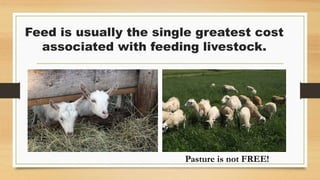
Feed is usually the single greatest cost
associated with feeding livestock.
Pasture is not FREE!
Two kinds of feed costs
Purchased/harvested feedstuffs
• Hay
• Grain
• By-product feeds
• Minerals
• Milk replacer
Pasture and browse
• Seed
• Fertilizer
• Lime
• Weed control
• Fencing
• Watering system
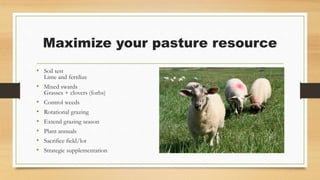
Maximize your pasture resource
• Soil test
Lime and fertilize
• Mixed swards
Grasses + clovers (forbs)
• Control weeds
• Rotational grazing
• Extend grazing season
• Plant annuals
• Sacrifice field/lot
• Strategic supplementation
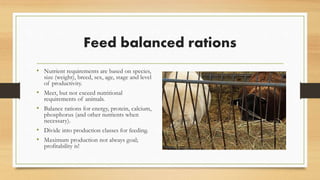
Feed balanced rations
• Nutrient requirements are based on species,
size (weight), breed, sex, age, stage and level
of productivity.
• Should meet, but not exceed nutritional
requirements of animals.
• Should balance rations for energy, protein,
calcium, phosphorus (and other nutrients
when necessary).
• Divide into production classes for feeding.
• Maximum production not always goal;
profitability is!
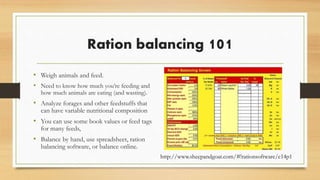
Ration balancing 101
• Weigh animals and feed.
• Need to know how much you’re feeding and
how much animals are eating (and wasting).
• Analyze forages and other feedstuffs that
can have variable nutritional composition
• You can use book values or feed tags for
many feeds.
• Balance by hand, use spreadsheet, ration
balancing software, or balance online.
http://www.sheepandgoat.com/#!rationsoftware/c14p1
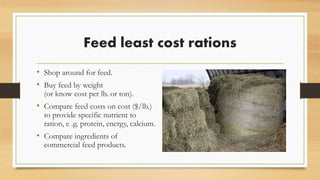
Feed least cost rations
• Shop around for feed.
• Buy feed by weight
(or know cost per lb. or ton).
• Compare feed costs on cost (e.g.
$/lb.) to provide specific nutrient to
ration, e .g. protein, energy, calcium.
• Compare ingredients of
commercial feed products.
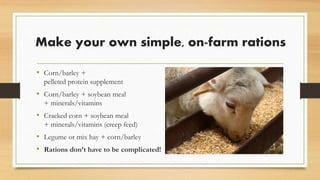
Make your own simple, on-farm rations
• Corn/barley +
pelleted protein supplement
• Corn/barley + soybean meal
+ minerals/vitamins
• Cracked corn + soybean meal
+ minerals/vitamins (creep feed)
• Legume or mix hay + corn/barley
• Rations don’t have to be complicated!
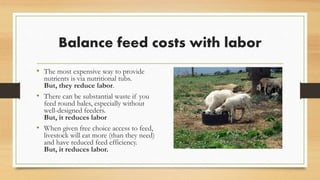
Balance feed costs with labor
• The most expensive way to provide
nutrients is via nutritional tubs.
But, they reduce labor.
• There can be substantial waste if you
feed round bales, especially without
well-designed feeders.
But, it reduces labor
• When given free choice access to feed,
livestock will eat more (than they need)
and have reduced feed efficiency.
But, it reduces labor.
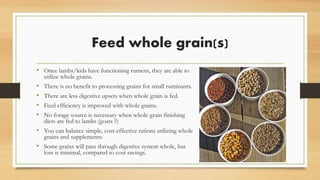
Feed whole grain(s)
• Once lambs/kids have functioning rumens, they are able to
utilize whole grains.
• There is no benefit to processing grains for small ruminants.
• Some grains will pass through digestive system whole, but
loss is minimal, compared to cost savings.
• There are less digestive upsets when whole grain is fed.
• Feed efficiency is improved with whole grains.
• No forage source is necessary when whole grain finishing
diets are fed to lambs (and goats ?)
• You can balance simple, cost-effective rations utilizing whole
grains and supplements.
Consider alternative feeds
Soyhulls are the “almost” perfect feed
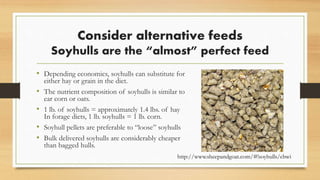
• Depending economics, soyhulls can substitute for
either hay or grain in the diet.
• The nutrient composition of soyhulls is similar to
ear corn or oats.
• 1 lb. of soyhulls = approximately 1.4 lbs. of hay
In forage diets, 1 lb. soyhulls = 1 lb. corn.
• Soyhull pellets are preferable to “loose” soyhulls
• Bulk delivered soyhulls are considerably cheaper
than bagged hulls.
http://www.sheepandgoat.com/#!soyhulls/cbwi
Invest in feed storage
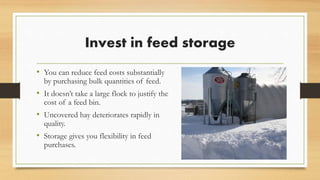
• You can reduce feed costs substantially
by purchasing bulk quantities of feed.
• It doesn’t take a large flock to justify the
cost of a feed bin.
• Uncovered hay deteriorates rapidly in
quality.
• Storage gives you flexibility in feed
purchases.
Fine tune your mineral
supplementation program
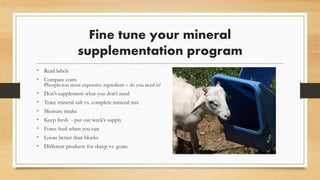
• Read labels
• Compare costs
Phosphorus most expensive ingredient – do you need it?
• Don’t supplement what you don’t need
• Trace mineral salt vs. complete mineral mix
• Measure intake
• Keep fresh - put out week’s supply
• Force feed when you can
• Loose better than blocks
• Different products for sheep vs. goats
Well-designed feeders
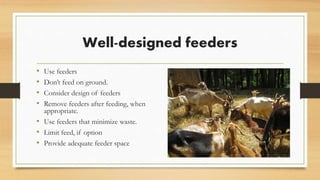
• Use feeders
• Don’t feed on ground.
• Consider design of feeders
• Remove feeders after feeding, when
appropriate.
• Use feeders that minimize waste.
• Limit feed, if option
• Provide adequate feeder space, especially if
limit feeding.
Thank you for your attention.
Do you have any
questions or comments?
SUSAN SCHOENIAN
Sheep & Goat Specialist
University of Maryland Extension
sschoen@umd.edu
sheepandgoat.com

Minimizingfeedcosts

  • 1.
    Minimizing Feed Costs SUSAN SCHOENIAN SHEEP& GOAT SPECIALIST UNIVERSITY OF MARYLAND EXTENSION SSCHOEN@UMD.EDU – SHEEPANDGOAT.COM – WORMX.INFO
  • 2.
    Minimizing feed costs •Do you know how much your hay costs? • Do you know how much it costs to feed one of your ewes or does for a year? • Are you feeding balanced rations or just feeding? Coping with high feed costs: http://www.sheepandgoat.com/#!copinghighfeed/caxv
  • 3.
    Feed is usuallythe single greatest cost associated with feeding livestock. Pasture is not FREE!
  • 4.
    Two kinds offeed costs Purchased/harvested feedstuffs • Hay • Grain • By-product feeds • Minerals • Milk replacer Pasture and browse • Seed • Fertilizer • Lime • Weed control • Fencing • Watering system
  • 5.
    Maximize your pastureresource • Soil test Lime and fertilize • Mixed swards Grasses + clovers (forbs) • Control weeds • Rotational grazing • Extend grazing season • Plant annuals • Sacrifice field/lot • Strategic supplementation
  • 6.
    Feed balanced rations •Nutrient requirements are based on species, size (weight), breed, sex, age, stage and level of productivity. • Should meet, but not exceed nutritional requirements of animals. • Should balance rations for energy, protein, calcium, phosphorus (and other nutrients when necessary). • Divide into production classes for feeding. • Maximum production not always goal; profitability is!
  • 7.
    Ration balancing 101 •Weigh animals and feed. • Need to know how much you’re feeding and how much animals are eating (and wasting). • Analyze forages and other feedstuffs that can have variable nutritional composition • You can use book values or feed tags for many feeds. • Balance by hand, use spreadsheet, ration balancing software, or balance online. http://www.sheepandgoat.com/#!rationsoftware/c14p1
  • 8.
    Feed least costrations • Shop around for feed. • Buy feed by weight (or know cost per lb. or ton). • Compare feed costs on cost (e.g. $/lb.) to provide specific nutrient to ration, e .g. protein, energy, calcium. • Compare ingredients of commercial feed products.
  • 9.
    Make your ownsimple, on-farm rations • Corn/barley + pelleted protein supplement • Corn/barley + soybean meal + minerals/vitamins • Cracked corn + soybean meal + minerals/vitamins (creep feed) • Legume or mix hay + corn/barley • Rations don’t have to be complicated!
  • 10.
    Balance feed costswith labor • The most expensive way to provide nutrients is via nutritional tubs. But, they reduce labor. • There can be substantial waste if you feed round bales, especially without well-designed feeders. But, it reduces labor • When given free choice access to feed, livestock will eat more (than they need) and have reduced feed efficiency. But, it reduces labor.
  • 11.
    Feed whole grain(s) •Once lambs/kids have functioning rumens, they are able to utilize whole grains. • There is no benefit to processing grains for small ruminants. • Some grains will pass through digestive system whole, but loss is minimal, compared to cost savings. • There are less digestive upsets when whole grain is fed. • Feed efficiency is improved with whole grains. • No forage source is necessary when whole grain finishing diets are fed to lambs (and goats ?) • You can balance simple, cost-effective rations utilizing whole grains and supplements.
  • 12.
    Consider alternative feeds Soyhullsare the “almost” perfect feed • Depending economics, soyhulls can substitute for either hay or grain in the diet. • The nutrient composition of soyhulls is similar to ear corn or oats. • 1 lb. of soyhulls = approximately 1.4 lbs. of hay In forage diets, 1 lb. soyhulls = 1 lb. corn. • Soyhull pellets are preferable to “loose” soyhulls • Bulk delivered soyhulls are considerably cheaper than bagged hulls. http://www.sheepandgoat.com/#!soyhulls/cbwi
  • 13.
    Invest in feedstorage • You can reduce feed costs substantially by purchasing bulk quantities of feed. • It doesn’t take a large flock to justify the cost of a feed bin. • Uncovered hay deteriorates rapidly in quality. • Storage gives you flexibility in feed purchases.
  • 14.
    Fine tune yourmineral supplementation program • Read labels • Compare costs Phosphorus most expensive ingredient – do you need it? • Don’t supplement what you don’t need • Trace mineral salt vs. complete mineral mix • Measure intake • Keep fresh - put out week’s supply • Force feed when you can • Loose better than blocks • Different products for sheep vs. goats
  • 15.
    Well-designed feeders • Usefeeders • Don’t feed on ground. • Consider design of feeders • Remove feeders after feeding, when appropriate. • Use feeders that minimize waste. • Limit feed, if option • Provide adequate feeder space, especially if limit feeding.
  • 16.
    Thank you foryour attention. Do you have any questions or comments? SUSAN SCHOENIAN Sheep & Goat Specialist University of Maryland Extension sschoen@umd.edu sheepandgoat.com