SUSAN SCHOENIAN (Shāy-ne-ŭn)
Sheep & Goat Specialist
Western Maryland Research & Education Center (WMREC)
sschoen@umd.edu - sheepandgoat.com - wormx.info
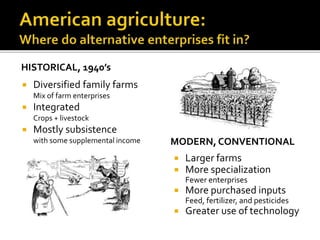
HISTORICAL, 1940’s
 Diversified family farms
Mix of farm enterprises
 Integrated
Crops + livestock
 Mostly subsistence
with some supplemental income MODERN, CONVENTIONAL
 Larger farms
 More specialization
Fewer enterprises
 More purchased inputs
Feed, fertilizer, and pesticides
 Greater use of technology
 Goals and objectives
 Personal preference
 Location and climate
 Resource inventory
 Land – feed
 Buildings, equipment
 Labor - management
 Capital - own vs. borrowed
 Markets - demand
 Relationships among
enterprises
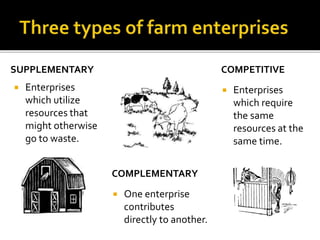
COMPLEMENTARY
COMPETITIVE
 Enterprises
which require
the same
resources at the
same time.
 One enterprise
contributes
directly to another.
SUPPLEMENTARY
 Enterprises
which utilize
resources that
might otherwise
go to waste.
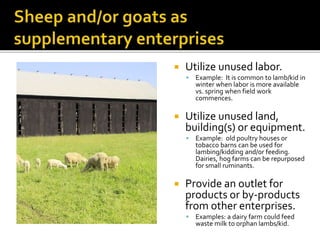
 Utilize unused labor.
 Example: It is common to lamb/kid in
winter when labor is more available
vs. spring when field work
commences.
 Utilize unused land,
building(s) or equipment.
 Example: old poultry houses or
tobacco barns can be used for
lambing/kidding and/or feeding.
Dairies, hog farms can be repurposed
for small ruminants.
 Provide an outlet for
products or by-products
from other enterprises.
 Examples: a dairy farm could feed
waste milk to orphan lambs/kid.
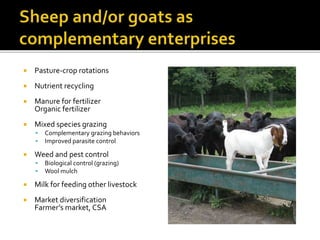
 Pasture-crop rotations
 Nutrient recycling
 Manure for fertilizer
Organic fertilizer
 Mixed species grazing
 Complementary grazing behaviors
 Improved parasite control
 Weed and pest control
 Biological control (grazing)
 Wool mulch
 Milk for feeding other livestock
 Market diversification
Farmer’s market, CSA
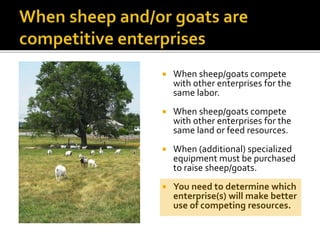
 When sheep/goats compete
with other enterprises for the
same labor.
 When sheep/goats compete
with other enterprises for the
same land or feed resources.
 When (additional) specialized
equipment must be purchased
to raise sheep/goats.
 You need to determine which
enterprise(s) will make better
use of competing resources.
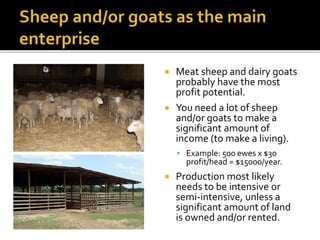
 Meat sheep and dairy goats
probably have the most
profit potential.
 You need a lot of sheep
and/or goats to make a
significant amount of
income (to make a living).
 Example: 500 ewes x $30
profit/head = $15000/year.
 Production most likely
needs to be intensive or
semi-intensive, unless a
significant amount of land
is owned and/or rented.
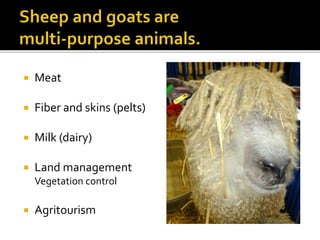
 Meat
 Fiber and skins (pelts)
 Milk (dairy)
 Land management
Vegetation control
 Agritourism
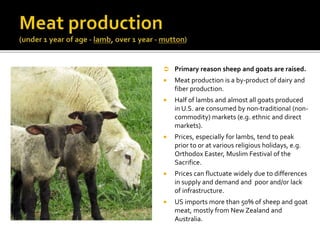
 Primary reason sheep and goats are raised.
 Meat production is a by-product of dairy and
fiber production.
 Half of lambs and almost all goats produced
in U.S. are consumed by non-traditional (non-
commodity) markets (e.g. ethnic and direct
markets).
 Prices, especially for lambs, tend to peak
prior to or at various religious holidays, e.g.
Orthodox Easter, Muslim Festival of the
Sacrifice.
 Prices can fluctuate widely due to differences
in supply and demand and poor and/or lack
of infrastructure.
 US imports more than 50% of sheep and goat
meat, mostly from New Zealand and
Australia.
COMMODITY (LIVE ANIMAL)
 Public auction
Primary method sheep/goats are sold.
1. Local (e.g. Westminster)
2. Terminal (regional, e.g. New Holland)
3. Special sale(s) (e.g. Easter)
 Feeder, grazer
 Middleman
1. Broker, dealer, order buyer
2. Co-op or pool
3. Direct marketer
4. Abattoir (meat processor)
5. Live market
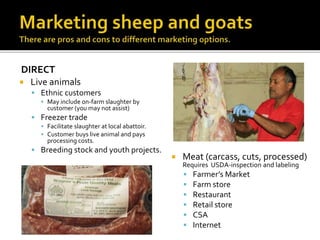
DIRECT
 Meat (carcass, cuts, processed)
Requires USDA-inspection and labeling
 Farmer’s Market
 Farm store
 Restaurant
 Retail store
 CSA
 Internet
 Live animals
 Ethnic customers
 May include on-farm slaughter by
customer (you may not assist)
 Freezer trade
 Facilitate slaughter at local abattoir.
 Customer buys live animal and pays
processing costs.
 Breeding stock and youth projects.
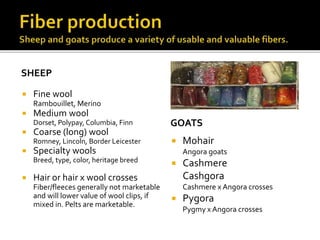
SHEEP
 Fine wool
Rambouillet, Merino
 Medium wool
Dorset, Polypay, Columbia, Finn
 Coarse (long) wool
Romney, Lincoln, Border Leicester
 Specialty wools
Breed, type, color, heritage breed
 Hair or hair x wool crosses
Fiber/fleeces generally not marketable
and will lower value of wool clips, if
mixed in. Pelts are marketable.
GOATS
 Mohair
Angora goats
 Cashmere
Cashgora
Cashmere x Angora crosses
 Pygora
Pygmy x Angora crosses
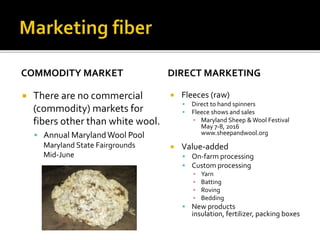
COMMODITY MARKET
 There are no commercial
(commodity) markets for
fibers other than white wool.
 Annual MarylandWool Pool
Maryland State Fairgrounds
Mid-June
DIRECT MARKETING
 Fleeces (raw)
 Direct to hand spinners
 Fleece shows and sales
▪ Maryland Sheep &Wool Festival
May 7-8, 2016
www.sheepandwool.org
 Value-added
 On-farm processing
 Custom processing
▪ Yarn
▪ Batting
▪ Roving
▪ Bedding
 New products
insulation, fertilizer, packing boxes
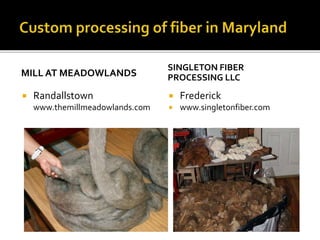
MILL AT MEADOWLANDS
 Randallstown
www.themillmeadowlands.com
SINGLETON FIBER
PROCESSING LLC
 Frederick
 www.singletonfiber.com
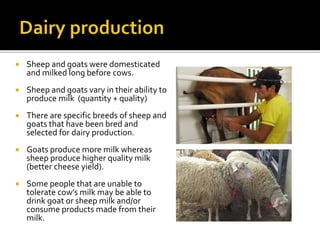
 Sheep and goats were domesticated
and milked long before cows.
 Sheep and goats vary in their ability to
produce milk (quantity + quality)
 There are specific breeds of sheep and
goats that have been bred and
selected for dairy production.
 Goats produce more milk whereas
sheep produce higher quality milk
(better cheese yield).
 Some people that are unable to
tolerate cow’s milk may be able to
drink goat or sheep milk and/or
consume products made from their
milk.
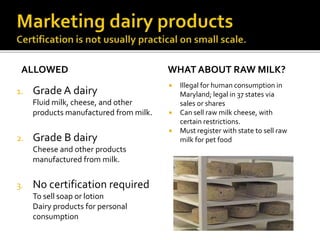
ALLOWED
1. Grade A dairy
Fluid milk, cheese, and other
products manufactured from milk.
2. Grade B dairy
Cheese and other products
manufactured from milk.
3. No certification required
To sell soap or lotion
Dairy products for personal
consumption
WHAT ABOUT RAW MILK?
 Illegal for human consumption in
Maryland; legal in 37 states via
sales or shares
 Can sell raw milk cheese, with
certain restrictions.
 Must register with state to sell raw
milk for pet food
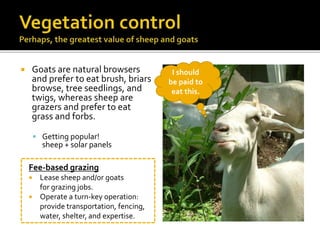
 Goats are natural browsers
and prefer to eat brush, briars
browse, tree seedlings, and
twigs, whereas sheep are
grazers and prefer to eat
grass and forbs.
 Getting popular!
sheep + solar panels
Fee-based grazing
 Lease sheep and/or goats
for grazing jobs.
 Operate a turn-key operation:
provide transportation, fencing,
water, shelter, and expertise.
I should
be paid to
eat this.
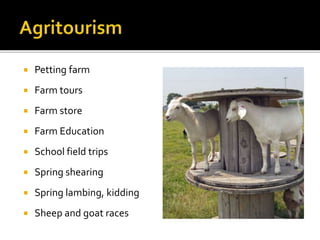
 Petting farm
 Farm tours
 Farm store
 Farm Education
 School field trips
 Spring shearing
 Spring lambing, kidding
 Sheep and goat races
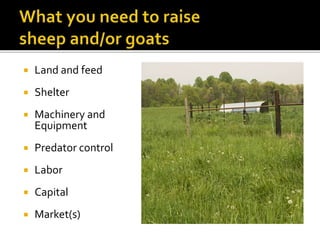
 Land and feed
 Shelter
 Machinery and
Equipment
 Predator control
 Labor
 Capital
 Market(s)
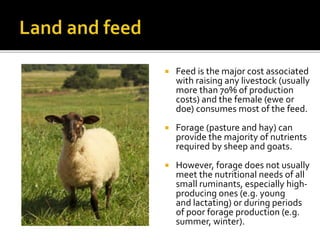
 Feed is the major cost associated
with raising any livestock (usually
more than 70% of production
costs) and the female (ewe or
doe) consumes most of the feed.
 Forage (pasture and hay) can
provide the majority of nutrients
required by sheep and goats.
 However, forage does not usually
meet the nutritional needs of all
small ruminants, especially high-
producing ones (e.g. young
and lactating) or during periods
of poor forage production (e.g.
summer, winter).
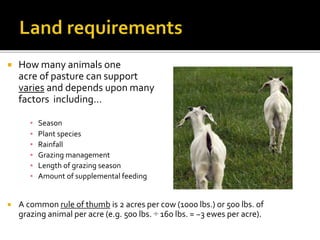
 How many animals one
acre of pasture can support
varies and depends upon many
factors including…
▪ Season
▪ Plant species
▪ Rainfall
▪ Grazing management
▪ Length of grazing season
▪ Amount of supplemental feeding
 A common rule of thumb is 2 acres per cow (1000 lbs.) or 500 lbs. of
grazing animal per acre (e.g. 500 lbs. ÷ 160 lbs. = ~3 ewes per acre).
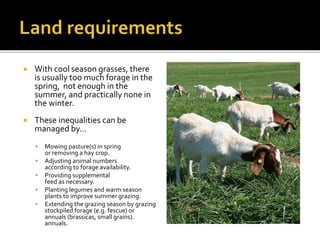
 With cool season grasses, there
is usually too much forage in the
spring, not enough in the
summer, and practically none in
the winter.
 These inequalities can be
managed by…
 Mowing pasture(s) in spring
or removing a hay crop.
 Adjusting animal numbers
according to forage availability.
 Providing supplemental
feed as necessary.
 Planting legumes and warm season
plants to improve summer grazing.
 Extending the grazing season by grazing
stockpiled forage (e.g. fescue) or
annuals (brassicas, small grains).
annuals.
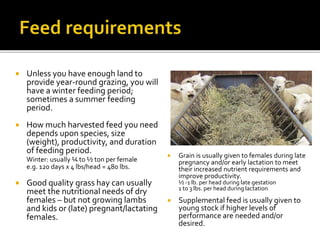
 Unless you have enough land to
provide year-round grazing, you will
have a winter feeding period;
sometimes a summer feeding
period.
 How much harvested feed you need
depends upon species, size
(weight), productivity, and duration
of feeding period.
Winter: usually ¼ to ½ ton per female
e.g. 120 days x 4 lbs/head = 480 lbs.
 Good quality grass hay can usually
meet the nutritional needs of dry
females – but not growing lambs
and kids or (late) pregnant/lactating
females.
 Grain is usually given to females during late
pregnancy and/or early lactation to meet
their increased nutrient requirements and
improve productivity.
½ -1 lb. per head during late gestation
1 to 3 lbs. per head during lactation
 Supplemental feed is usually given to
young stock if higher levels of
performance are needed and/or
desired.
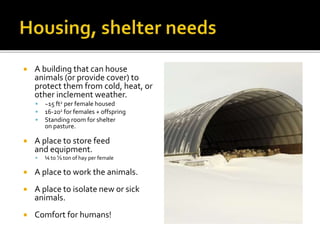
 A building that can house
animals (or provide cover) to
protect them from cold, heat, or
other inclement weather.
 ~15 ft2 per female housed
 16-202 for females + offspring
 Standing room for shelter
on pasture.
 A place to store feed
and equipment.
 ¼ to ⅓ ton of hay per female
 A place to work the animals.
 A place to isolate new or sick
animals.
 Comfort for humans!
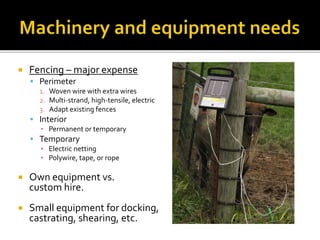
 Fencing – major expense
 Perimeter
1. Woven wire with extra wires
2. Multi-strand, high-tensile, electric
3. Adapt existing fences
 Interior
▪ Permanent or temporary
 Temporary
▪ Electric netting
▪ Polywire, tape, or rope
 Own equipment vs.
custom hire.
 Small equipment for docking,
castrating, shearing, etc.
 Sheep and goats, especially lambs
and kids, are very vulnerable to an
array of predators including
domestic and wild dogs, coyotes,
bears, foxes, bobcats, cougars,
wolves, and various birds of prey.
 Predator control starts with a good
fence. Also helps with neighbor
relations.
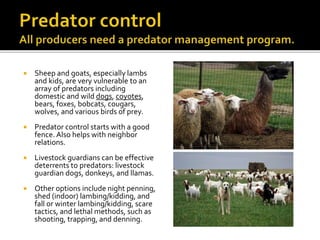
 Livestock guardians can be effective
deterrents to predators: livestock
guardian dogs, donkeys, and llamas.
 Other options include night penning,
shed (indoor) lambing/kidding, and
fall or winter lambing/kidding, scare
tactics, and lethal methods, such as
shooting, trapping, and denning.
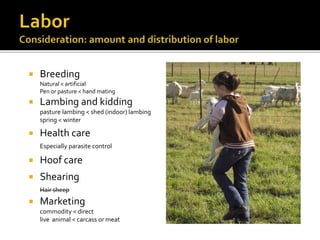
 Breeding
Natural < artificial
Pen or pasture < hand mating
 Lambing and kidding
pasture lambing < shed (indoor) lambing
spring < winter
 Health care
Especially parasite control
 Hoof care
 Shearing
Hair sheep
 Marketing
commodity < direct
live animal < carcass or meat
 Who?
 What?
 Where?
 When?
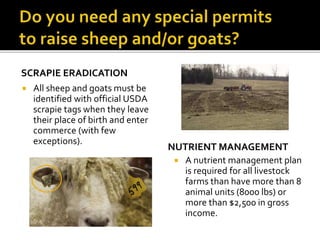
SCRAPIE ERADICATION
 All sheep and goats must be
identified with official USDA
scrapie tags when they leave
their place of birth and enter
commerce (with few
exceptions).
NUTRIENT MANAGEMENT
 A nutrient management plan
is required for all livestock
farms than have more than 8
animal units (8000 lbs) or
more than $2,500 in gross
income.
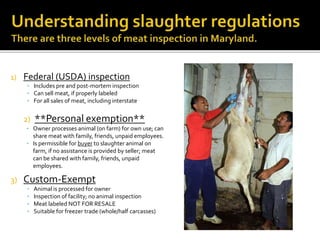
1) Federal (USDA) inspection
• Includes pre and post-mortem inspection
• Can sell meat, if properly labeled
• For all sales of meat, including interstate
2) **Personal exemption**
• Owner processes animal (on farm) for own use; can
share meat with family, friends, unpaid employees.
• Is permissible for buyer to slaughter animal on
farm, if no assistance is provided by seller; meat
can be shared with family, friends, unpaid
employees.
3) Custom-Exempt
• Animal is processed for owner
• Inspection of facility; no animal inspection
• Meat labeled NOT FOR RESALE
• Suitable for freezer trade (whole/half carcasses)
 All sheep and lambs are
subject to check-off
assessment, regardless of
what kind of sheep they
are or how they are sold.
 Established in 2002.
 Established 13-member
American Lamb Board
whose purpose is to increase
demand forAmerican lamb
and increase the value of
American Lamb for all
segments contributing to the
check-off.
 Approved by majority of
producers who represent a
majority of the volume of
lambs sold.
$ 0.007 per lb. of live animal
+ $0.42 per carcass
= $1.12 for a 100-lb. lamb
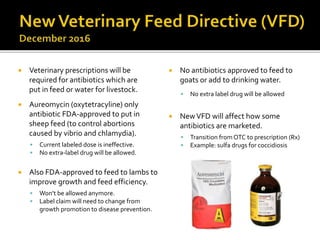
 Veterinary prescriptions will be
required for antibiotics which are
put in feed or water for livestock.
 Aureomycin (oxytetracyline) only
antibiotic FDA-approved to put in
sheep feed (to control abortions
caused by vibrio and chlamydia).
 Current labeled dose is ineffective.
 No extra-label drug will be allowed.
 Also FDA-approved to feed to lambs to
improve growth and feed efficiency.
 Won’t be allowed anymore.
 Label claim will need to change from
growth promotion to disease prevention.
 No antibiotics approved to feed to
goats or add to drinking water.
 No extra label drug will be allowed
 NewVFD will affect how some
antibiotics are marketed.
 Transition fromOTC to prescription (Rx)
 Example: sulfa drugs for coccidiosis
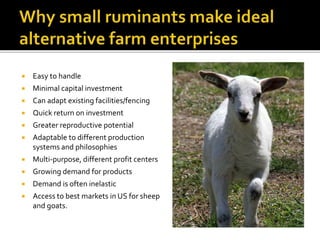
 Easy to handle
 Minimal capital investment
 Can adapt existing facilities/fencing
 Quick return on investment
 Greater reproductive potential
 Adaptable to different production
systems and philosophies
 Multi-purpose, different profit centers
 Growing demand for products
 Demand is often inelastic
 Access to best markets in US for sheep
and goats.
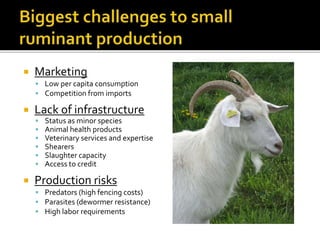
 Marketing
 Low per capita consumption
 Competition from imports
 Lack of infrastructure
 Status as minor species
 Animal health products
 Veterinary services and expertise
 Shearers
 Slaughter capacity
 Access to credit
 Production risks
 Predators (high fencing costs)
 Parasites (dewormer resistance)
 High labor requirements
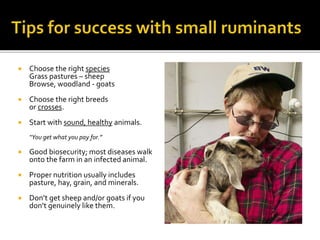
 Choose the right species
Grass pastures – sheep
Browse, woodland - goats
 Choose the right breeds
or crosses.
 Start with sound, healthy animals.
“You get what you pay for.”
 Good biosecurity; most diseases walk
onto the farm in an infected animal.
 Proper nutrition usually includes
pasture, hay, grain, and minerals.
 Don’t get sheep and/or goats if you
don’t genuinely like them.
 Web portal: www.sheepandgoat.com
 Social media
 Wild &Woolly Quarterly Newsletter
 Webinar short courses
 All-day conferences
 Integrated Parasite Management Workshops
 Western Maryland Pasture-based Meat Goat
PerformanceTest and carcass contest
 4-H animal science program
 E-mail: sschoen@umd.edu
Thank you for your attention.
Do you have any questions?

Sheep and goats as alternative enterprises

  • 1.
    SUSAN SCHOENIAN (Shāy-ne-ŭn) Sheep& Goat Specialist Western Maryland Research & Education Center (WMREC) sschoen@umd.edu - sheepandgoat.com - wormx.info
  • 2.
    HISTORICAL, 1940’s  Diversifiedfamily farms Mix of farm enterprises  Integrated Crops + livestock  Mostly subsistence with some supplemental income MODERN, CONVENTIONAL  Larger farms  More specialization Fewer enterprises  More purchased inputs Feed, fertilizer, and pesticides  Greater use of technology
  • 3.
     Goals andobjectives  Personal preference  Location and climate  Resource inventory  Land – feed  Buildings, equipment  Labor - management  Capital - own vs. borrowed  Markets - demand  Relationships among enterprises
  • 4.
    COMPLEMENTARY COMPETITIVE  Enterprises which require thesame resources at the same time.  One enterprise contributes directly to another. SUPPLEMENTARY  Enterprises which utilize resources that might otherwise go to waste.
  • 5.
     Utilize unusedlabor.  Example: It is common to lamb/kid in winter when labor is more available vs. spring when field work commences.  Utilize unused land, building(s) or equipment.  Example: old poultry houses or tobacco barns can be used for lambing/kidding and/or feeding. Dairies, hog farms can be repurposed for small ruminants.  Provide an outlet for products or by-products from other enterprises.  Examples: a dairy farm could feed waste milk to orphan lambs/kid.
  • 6.
     Pasture-crop rotations Nutrient recycling  Manure for fertilizer Organic fertilizer  Mixed species grazing  Complementary grazing behaviors  Improved parasite control  Weed and pest control  Biological control (grazing)  Wool mulch  Milk for feeding other livestock  Market diversification Farmer’s market, CSA
  • 7.
     When sheep/goatscompete with other enterprises for the same labor.  When sheep/goats compete with other enterprises for the same land or feed resources.  When (additional) specialized equipment must be purchased to raise sheep/goats.  You need to determine which enterprise(s) will make better use of competing resources.
  • 8.
     Meat sheepand dairy goats probably have the most profit potential.  You need a lot of sheep and/or goats to make a significant amount of income (to make a living).  Example: 500 ewes x $30 profit/head = $15000/year.  Production most likely needs to be intensive or semi-intensive, unless a significant amount of land is owned and/or rented.
  • 9.
     Meat  Fiberand skins (pelts)  Milk (dairy)  Land management Vegetation control  Agritourism
  • 10.
     Primary reasonsheep and goats are raised.  Meat production is a by-product of dairy and fiber production.  Half of lambs and almost all goats produced in U.S. are consumed by non-traditional (non- commodity) markets (e.g. ethnic and direct markets).  Prices, especially for lambs, tend to peak prior to or at various religious holidays, e.g. Orthodox Easter, Muslim Festival of the Sacrifice.  Prices can fluctuate widely due to differences in supply and demand and poor and/or lack of infrastructure.  US imports more than 50% of sheep and goat meat, mostly from New Zealand and Australia.
  • 11.
    COMMODITY (LIVE ANIMAL) Public auction Primary method sheep/goats are sold. 1. Local (e.g. Westminster) 2. Terminal (regional, e.g. New Holland) 3. Special sale(s) (e.g. Easter)  Feeder, grazer  Middleman 1. Broker, dealer, order buyer 2. Co-op or pool 3. Direct marketer 4. Abattoir (meat processor) 5. Live market
  • 12.
    DIRECT  Meat (carcass,cuts, processed) Requires USDA-inspection and labeling  Farmer’s Market  Farm store  Restaurant  Retail store  CSA  Internet  Live animals  Ethnic customers  May include on-farm slaughter by customer (you may not assist)  Freezer trade  Facilitate slaughter at local abattoir.  Customer buys live animal and pays processing costs.  Breeding stock and youth projects.
  • 13.
    SHEEP  Fine wool Rambouillet,Merino  Medium wool Dorset, Polypay, Columbia, Finn  Coarse (long) wool Romney, Lincoln, Border Leicester  Specialty wools Breed, type, color, heritage breed  Hair or hair x wool crosses Fiber/fleeces generally not marketable and will lower value of wool clips, if mixed in. Pelts are marketable. GOATS  Mohair Angora goats  Cashmere Cashgora Cashmere x Angora crosses  Pygora Pygmy x Angora crosses
  • 14.
    COMMODITY MARKET  Thereare no commercial (commodity) markets for fibers other than white wool.  Annual MarylandWool Pool Maryland State Fairgrounds Mid-June DIRECT MARKETING  Fleeces (raw)  Direct to hand spinners  Fleece shows and sales ▪ Maryland Sheep &Wool Festival May 7-8, 2016 www.sheepandwool.org  Value-added  On-farm processing  Custom processing ▪ Yarn ▪ Batting ▪ Roving ▪ Bedding  New products insulation, fertilizer, packing boxes
  • 15.
    MILL AT MEADOWLANDS Randallstown www.themillmeadowlands.com SINGLETON FIBER PROCESSING LLC  Frederick  www.singletonfiber.com
  • 16.
     Sheep andgoats were domesticated and milked long before cows.  Sheep and goats vary in their ability to produce milk (quantity + quality)  There are specific breeds of sheep and goats that have been bred and selected for dairy production.  Goats produce more milk whereas sheep produce higher quality milk (better cheese yield).  Some people that are unable to tolerate cow’s milk may be able to drink goat or sheep milk and/or consume products made from their milk.
  • 17.
    ALLOWED 1. Grade Adairy Fluid milk, cheese, and other products manufactured from milk. 2. Grade B dairy Cheese and other products manufactured from milk. 3. No certification required To sell soap or lotion Dairy products for personal consumption WHAT ABOUT RAW MILK?  Illegal for human consumption in Maryland; legal in 37 states via sales or shares  Can sell raw milk cheese, with certain restrictions.  Must register with state to sell raw milk for pet food
  • 18.
     Goats arenatural browsers and prefer to eat brush, briars browse, tree seedlings, and twigs, whereas sheep are grazers and prefer to eat grass and forbs.  Getting popular! sheep + solar panels Fee-based grazing  Lease sheep and/or goats for grazing jobs.  Operate a turn-key operation: provide transportation, fencing, water, shelter, and expertise. I should be paid to eat this.
  • 19.
     Petting farm Farm tours  Farm store  Farm Education  School field trips  Spring shearing  Spring lambing, kidding  Sheep and goat races
  • 20.
     Land andfeed  Shelter  Machinery and Equipment  Predator control  Labor  Capital  Market(s)
  • 21.
     Feed isthe major cost associated with raising any livestock (usually more than 70% of production costs) and the female (ewe or doe) consumes most of the feed.  Forage (pasture and hay) can provide the majority of nutrients required by sheep and goats.  However, forage does not usually meet the nutritional needs of all small ruminants, especially high- producing ones (e.g. young and lactating) or during periods of poor forage production (e.g. summer, winter).
  • 22.
     How manyanimals one acre of pasture can support varies and depends upon many factors including… ▪ Season ▪ Plant species ▪ Rainfall ▪ Grazing management ▪ Length of grazing season ▪ Amount of supplemental feeding  A common rule of thumb is 2 acres per cow (1000 lbs.) or 500 lbs. of grazing animal per acre (e.g. 500 lbs. ÷ 160 lbs. = ~3 ewes per acre).
  • 23.
     With coolseason grasses, there is usually too much forage in the spring, not enough in the summer, and practically none in the winter.  These inequalities can be managed by…  Mowing pasture(s) in spring or removing a hay crop.  Adjusting animal numbers according to forage availability.  Providing supplemental feed as necessary.  Planting legumes and warm season plants to improve summer grazing.  Extending the grazing season by grazing stockpiled forage (e.g. fescue) or annuals (brassicas, small grains). annuals.
  • 24.
     Unless youhave enough land to provide year-round grazing, you will have a winter feeding period; sometimes a summer feeding period.  How much harvested feed you need depends upon species, size (weight), productivity, and duration of feeding period. Winter: usually ¼ to ½ ton per female e.g. 120 days x 4 lbs/head = 480 lbs.  Good quality grass hay can usually meet the nutritional needs of dry females – but not growing lambs and kids or (late) pregnant/lactating females.  Grain is usually given to females during late pregnancy and/or early lactation to meet their increased nutrient requirements and improve productivity. ½ -1 lb. per head during late gestation 1 to 3 lbs. per head during lactation  Supplemental feed is usually given to young stock if higher levels of performance are needed and/or desired.
  • 25.
     A buildingthat can house animals (or provide cover) to protect them from cold, heat, or other inclement weather.  ~15 ft2 per female housed  16-202 for females + offspring  Standing room for shelter on pasture.  A place to store feed and equipment.  ¼ to ⅓ ton of hay per female  A place to work the animals.  A place to isolate new or sick animals.  Comfort for humans!
  • 26.
     Fencing –major expense  Perimeter 1. Woven wire with extra wires 2. Multi-strand, high-tensile, electric 3. Adapt existing fences  Interior ▪ Permanent or temporary  Temporary ▪ Electric netting ▪ Polywire, tape, or rope  Own equipment vs. custom hire.  Small equipment for docking, castrating, shearing, etc.
  • 27.
     Sheep andgoats, especially lambs and kids, are very vulnerable to an array of predators including domestic and wild dogs, coyotes, bears, foxes, bobcats, cougars, wolves, and various birds of prey.  Predator control starts with a good fence. Also helps with neighbor relations.  Livestock guardians can be effective deterrents to predators: livestock guardian dogs, donkeys, and llamas.  Other options include night penning, shed (indoor) lambing/kidding, and fall or winter lambing/kidding, scare tactics, and lethal methods, such as shooting, trapping, and denning.
  • 28.
     Breeding Natural <artificial Pen or pasture < hand mating  Lambing and kidding pasture lambing < shed (indoor) lambing spring < winter  Health care Especially parasite control  Hoof care  Shearing Hair sheep  Marketing commodity < direct live animal < carcass or meat
  • 29.
     Who?  What? Where?  When?
  • 30.
    SCRAPIE ERADICATION  Allsheep and goats must be identified with official USDA scrapie tags when they leave their place of birth and enter commerce (with few exceptions). NUTRIENT MANAGEMENT  A nutrient management plan is required for all livestock farms than have more than 8 animal units (8000 lbs) or more than $2,500 in gross income.
  • 31.
    1) Federal (USDA)inspection • Includes pre and post-mortem inspection • Can sell meat, if properly labeled • For all sales of meat, including interstate 2) **Personal exemption** • Owner processes animal (on farm) for own use; can share meat with family, friends, unpaid employees. • Is permissible for buyer to slaughter animal on farm, if no assistance is provided by seller; meat can be shared with family, friends, unpaid employees. 3) Custom-Exempt • Animal is processed for owner • Inspection of facility; no animal inspection • Meat labeled NOT FOR RESALE • Suitable for freezer trade (whole/half carcasses)
  • 32.
     All sheepand lambs are subject to check-off assessment, regardless of what kind of sheep they are or how they are sold.  Established in 2002.  Established 13-member American Lamb Board whose purpose is to increase demand forAmerican lamb and increase the value of American Lamb for all segments contributing to the check-off.  Approved by majority of producers who represent a majority of the volume of lambs sold. $ 0.007 per lb. of live animal + $0.42 per carcass = $1.12 for a 100-lb. lamb
  • 33.
     Veterinary prescriptionswill be required for antibiotics which are put in feed or water for livestock.  Aureomycin (oxytetracyline) only antibiotic FDA-approved to put in sheep feed (to control abortions caused by vibrio and chlamydia).  Current labeled dose is ineffective.  No extra-label drug will be allowed.  Also FDA-approved to feed to lambs to improve growth and feed efficiency.  Won’t be allowed anymore.  Label claim will need to change from growth promotion to disease prevention.  No antibiotics approved to feed to goats or add to drinking water.  No extra label drug will be allowed  NewVFD will affect how some antibiotics are marketed.  Transition fromOTC to prescription (Rx)  Example: sulfa drugs for coccidiosis
  • 34.
     Easy tohandle  Minimal capital investment  Can adapt existing facilities/fencing  Quick return on investment  Greater reproductive potential  Adaptable to different production systems and philosophies  Multi-purpose, different profit centers  Growing demand for products  Demand is often inelastic  Access to best markets in US for sheep and goats.
  • 35.
     Marketing  Lowper capita consumption  Competition from imports  Lack of infrastructure  Status as minor species  Animal health products  Veterinary services and expertise  Shearers  Slaughter capacity  Access to credit  Production risks  Predators (high fencing costs)  Parasites (dewormer resistance)  High labor requirements
  • 36.
     Choose theright species Grass pastures – sheep Browse, woodland - goats  Choose the right breeds or crosses.  Start with sound, healthy animals. “You get what you pay for.”  Good biosecurity; most diseases walk onto the farm in an infected animal.  Proper nutrition usually includes pasture, hay, grain, and minerals.  Don’t get sheep and/or goats if you don’t genuinely like them.
  • 37.
     Web portal:www.sheepandgoat.com  Social media  Wild &Woolly Quarterly Newsletter  Webinar short courses  All-day conferences  Integrated Parasite Management Workshops  Western Maryland Pasture-based Meat Goat PerformanceTest and carcass contest  4-H animal science program  E-mail: sschoen@umd.edu
  • 38.
    Thank you foryour attention. Do you have any questions?