Management Skills for New
Managers
Overview
• Personality traits of successful managers.
• Basic skills in management.
• Managing performance.
• Becoming a great manager.
If there is nothing very special about your work
… You won’t get noticed, and that means you
won’t get paid much either.”
Michael Goldhaber, Wired Magazine
Personality Traits of Successful Managers
• Attitude
“If you think you can, you can. And if you think you
can’t, you cant!”
“Winners never quit, quitters never win.”
Personality Traits of Successful Managers
• Loyalty
Be loyal to yourself, your people, and your
company.
Personality Traits of Successful Managers
• Perfection
- Don’t settle for less than 100% from
yourself, people you care about, and
your employees.
- When you do it, just do it right.
Personality Traits of Successful
Managers
• Eye for details
- The eye behind your eye
- Your subconscious’s secret
scanner
- See the trees in the forest
Personality Traits of Successful Managers
• Honesty
Honesty leads to trust, trust leads to belief,
belief leads to dedication.
Personality Traits of Successful
Managers
• Organized
- Organize your mind
- Organize your
workspace
“Experience is not what happens to you but what you
make of what happens to you.”
Aldus Huxley
Basic Skills in Management
Delegation
“The primary skill of a manager consists of
knowing how to make assignments and
picking the right people to carry out those
assignments.”
Lee Iacocca
Basic Skills in Management
Delegation
• Micro vs. Macro
management.
• What to delegate.
• Whom to delegate to.
• Trust, but verify.
Basic Skills in Management
• Problem solving & Decision making
Define
Analyze
Propose
Select
Implement
Evaluate
Basic Skills in Management
• Root Cause Analysis
Root Cause Analysis
Visual Management
• Workplace layout and
design.
• Management by
walking around.
Basic Skills in Management
• Coordinating/controlling
Man
Material
Machine
Time
Information
Basic Skills in Management
• Communication skills
–Verbal
–Listening
–Body Language
–Written
Basic Skills in Management
• Motivating for results
Exercise:
Write down 5 things that:
- Motivate you.
- Discourage you.
Basic Skills in Management
• Motivating for results
Yourself
Others
What
How
Managing Performance
“You can take my factories, burn up my buildings, but give
me my people and I’ll build the business right back
again.”
Henry Ford
Managing Performance
• Job description and duties
Functions
Responsibilities
Authority
Span of influence
Reporting to
Managing Performance
Efficiency is doing things right.
Effectiveness is doing the right things.
Managing Performance
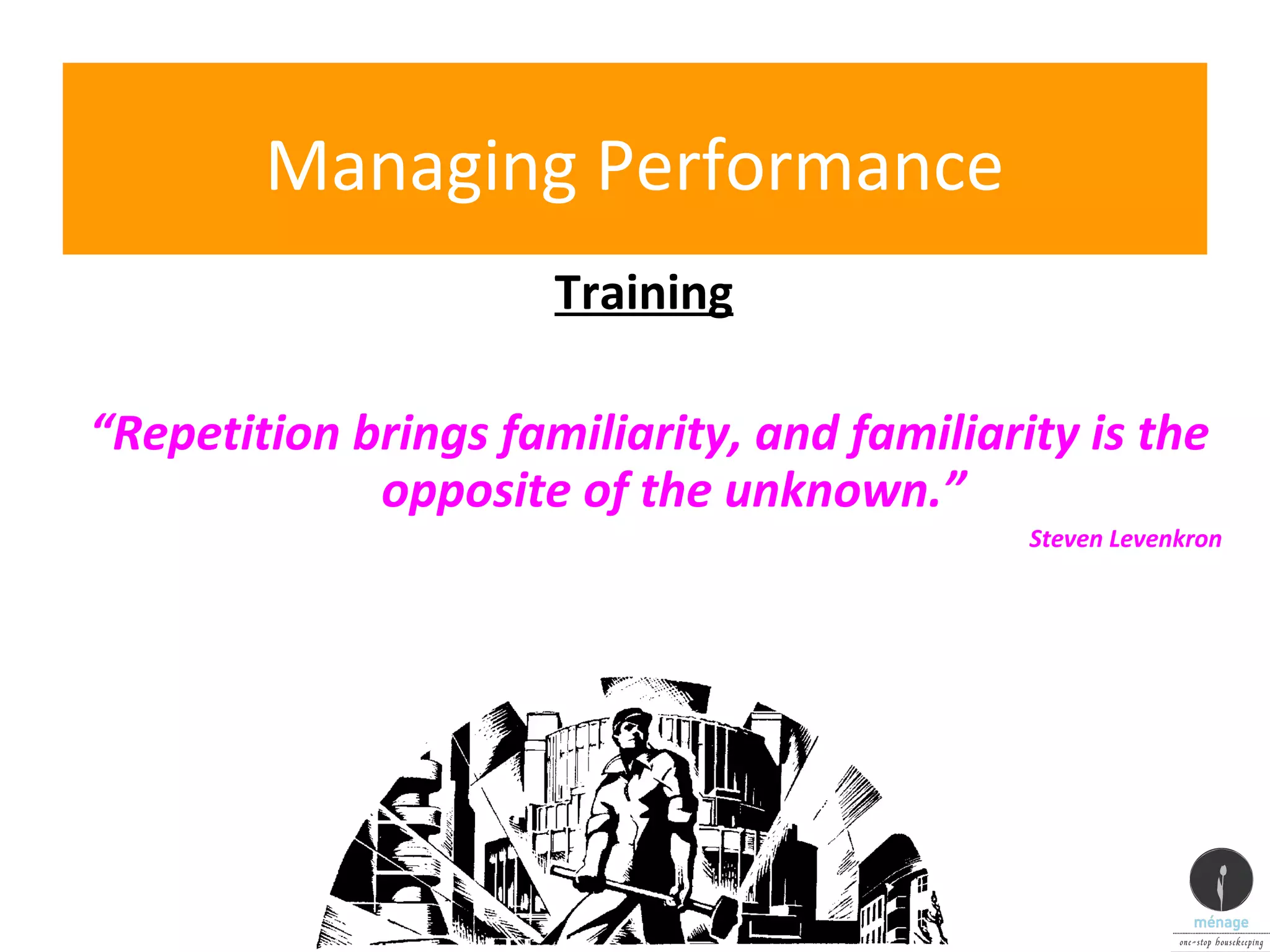
Training
“Repetition brings familiarity, and familiarity is the
opposite of the unknown.”
Steven Levenkron
Copyright Fahmi Abdein
2006
Managing Performance
• Training
Importance
Fairness
Career Killer
Planned
Practical
Monitor
Update
Managing Performance
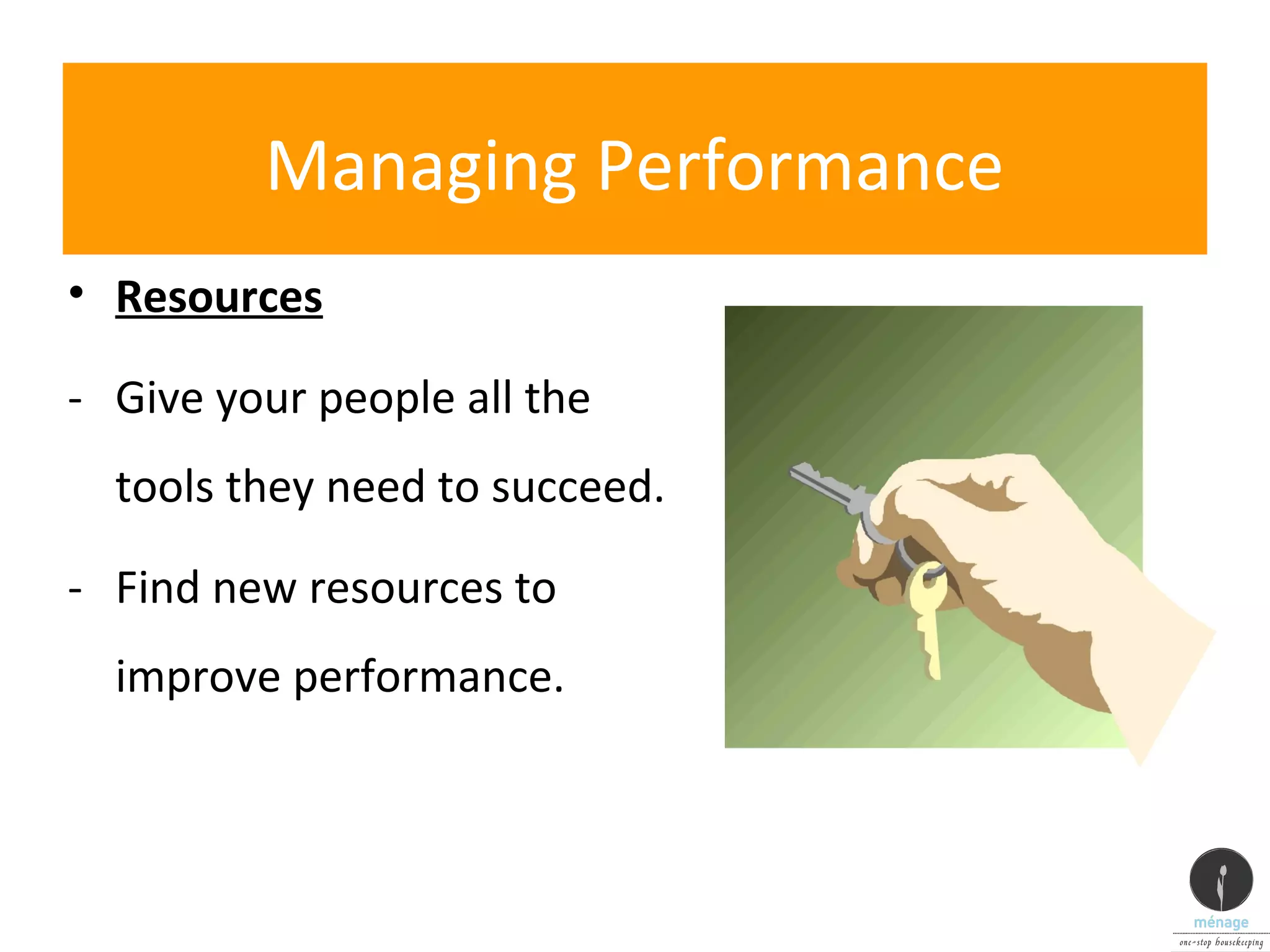
• Resources
- Give your people all the
tools they need to succeed.
- Find new resources to
improve performance.
Managing Performance
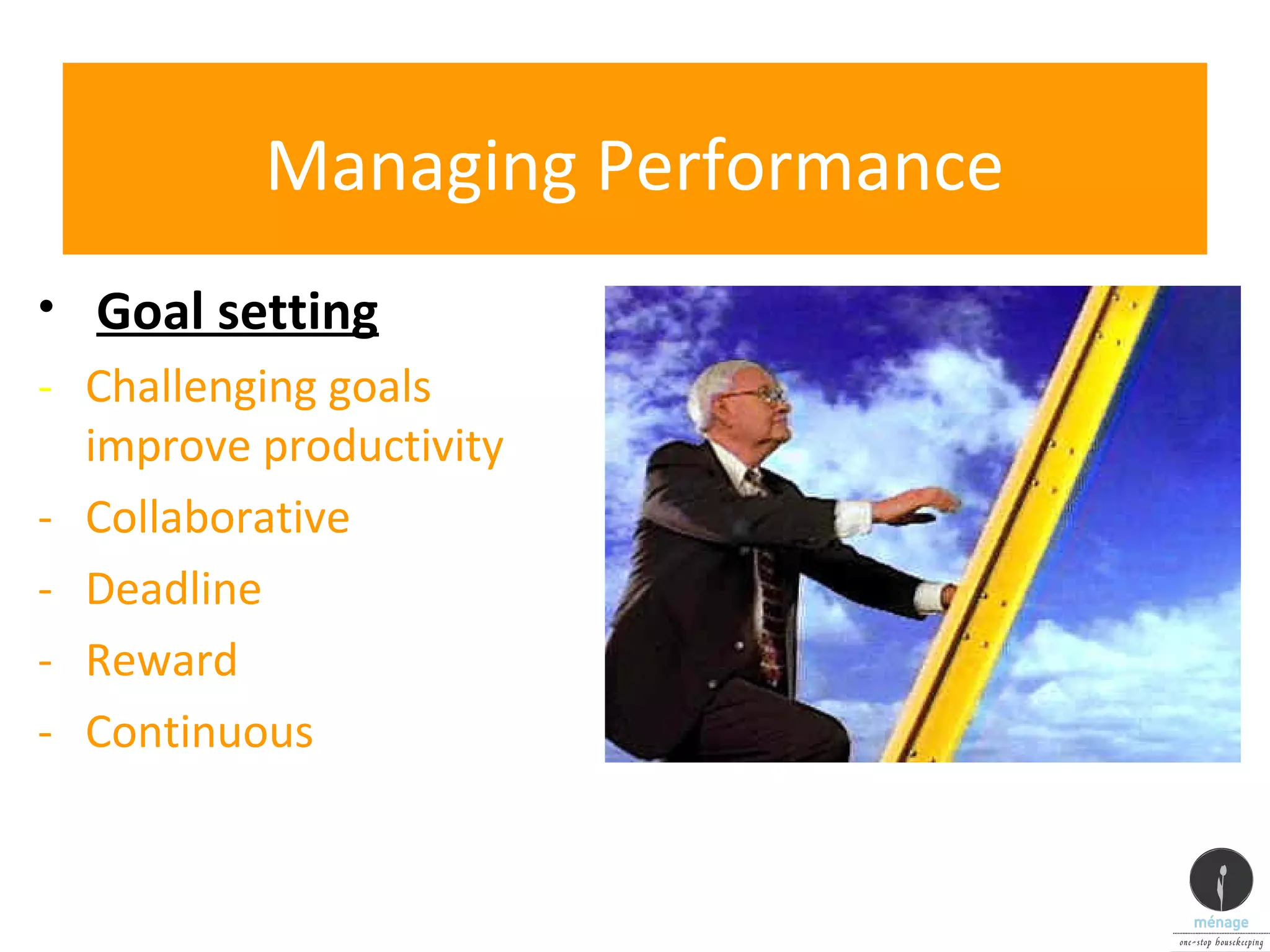
• Goal setting
- Challenging goals
improve productivity
- Collaborative
- Deadline
- Reward
- Continuous
Managing Performance
“Regard your soldiers as your children, and they
will follow you into the deepest valleys; look
upon them as your own beloved sons, and they
will stand by you even unto death.”
Sun Tzu’s Art of War
Managing Performance
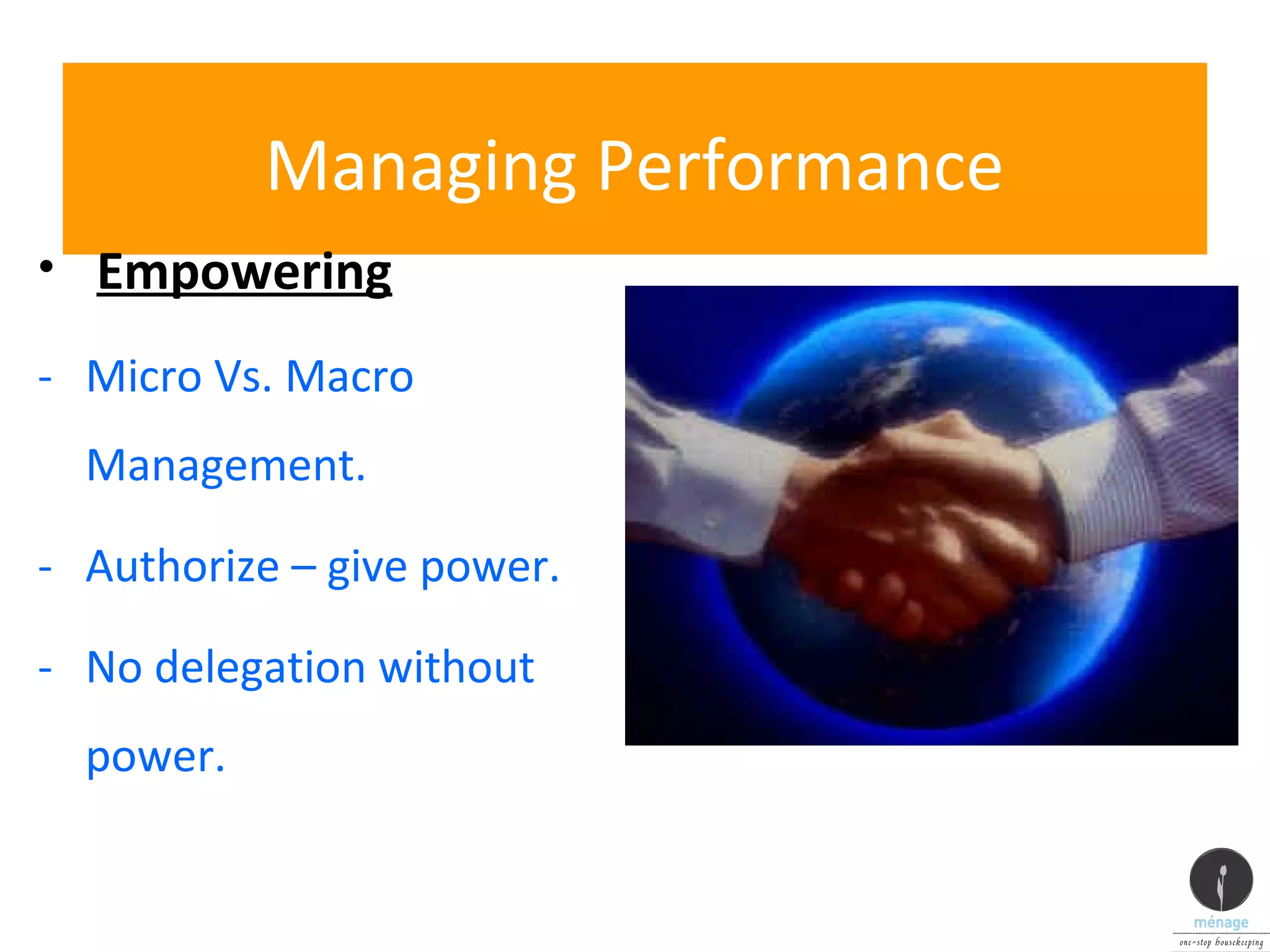
• Empowering
- Micro Vs. Macro
Management.
- Authorize – give power.
- No delegation without
power.
Managing Performance
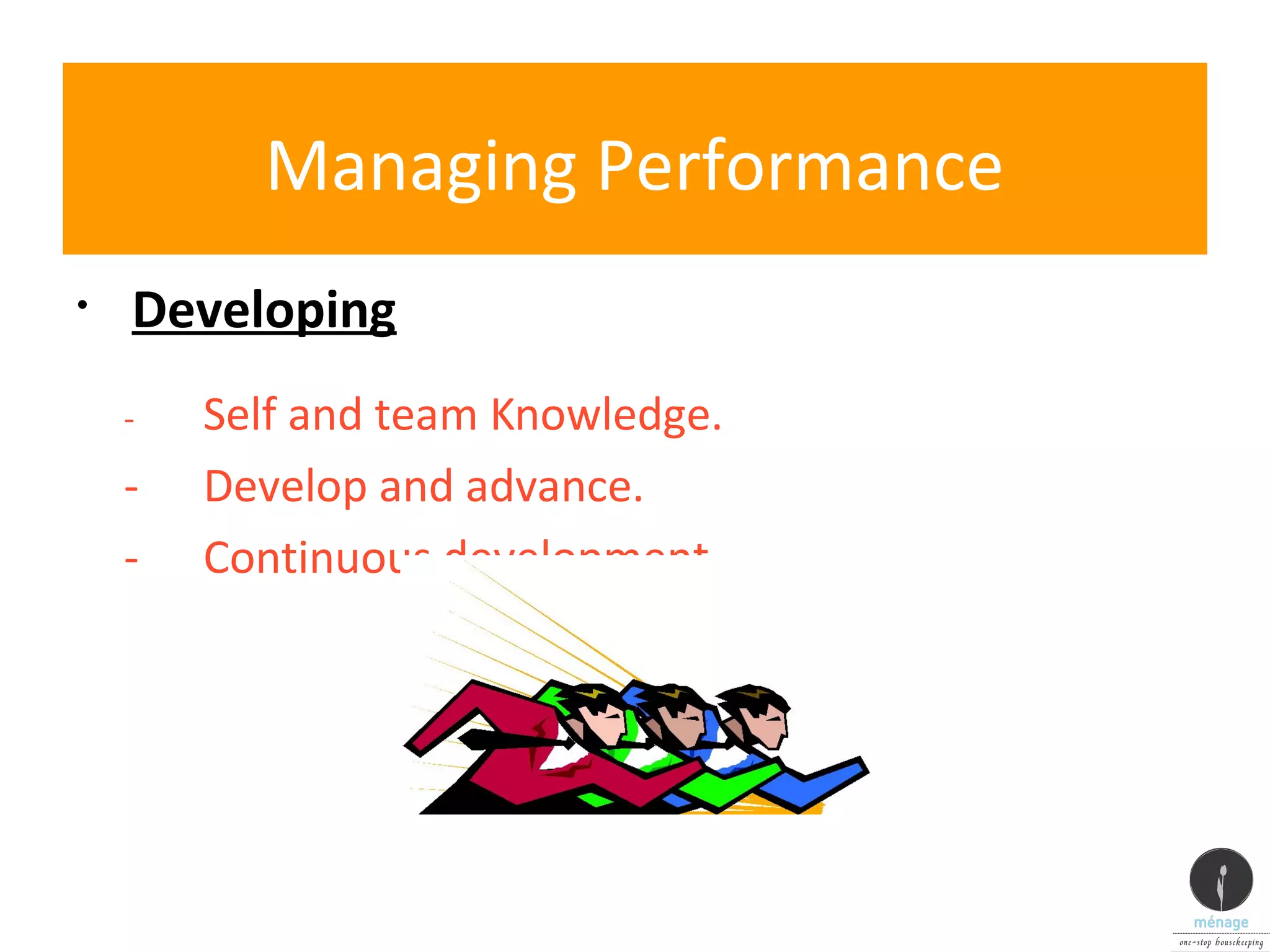
• Developing
- Self and team Knowledge.
- Develop and advance.
- Continuous development.
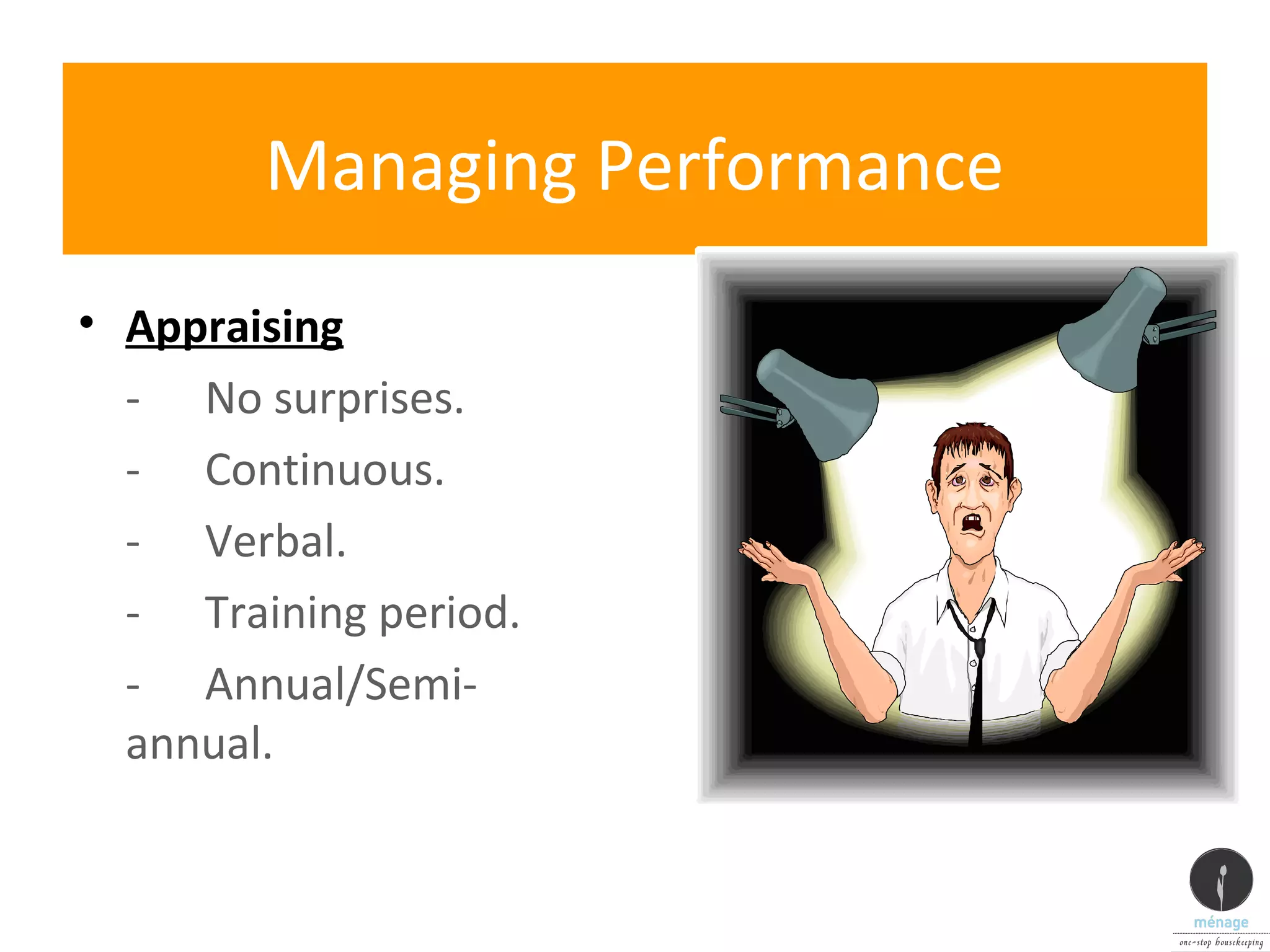
Managing Performance
• Appraising
- No surprises.
- Continuous.
- Verbal.
- Training period.
- Annual/Semi-
annual.
Leaders are born to be made
Fahmi Abdein
Leaders: Born or Made?Leaders: Born or Made?
Becoming a Great Manager
“In the province of the mind, what one believes
to be true either is true or becomes true.”
John Lilly
Becoming a Great Manager
• Know yourself.
• Love what you do.
• Learn by doing.
• Roll-up your sleeves.
• Knowledge is power.
• Practice, practice, practice.
• Persistence pays.
• Be clear.
• Be consistent.
• Be accessible.
• It’s NOT what you say, it’s HOW
you say it.
• Be fair.
• Keep your promises.
• Motivate & Reward.
• Reprimand.
• If you don’t know it, ask about it.
• Accept criticism.
• Find, and train your replacement.
Know Yourself
Exercise
On a piece of paper, write down 5 strengths and 5
weaknesses you have.
Know Yourself
• Believe it or not, you do
have weaknesses.
• First step to recovery is
acknowledgement!
• Do not put yourself in
unbearable situations.
• Continuously do an
inventory.
Love What You Do
“You must love it in order to succeed
in it”
Learn By Doing
• Turn knowledge to practice.
• Keep doing it until you perfect it.
Roll-up Your Sleeves
• Hands on management.
• If you are not willing to do it yourself
don’t ask it from someone else.
Copyright Fahmi Abdein
Roll-up Your Sleeves
The power of the presence of a leader
among followers ….
Just being there
Knowledge Is Power
Practice, Practice, Practice
“Perfect” Practice
makes “perfect”.
Persistence Pays
Copyright Fahmi Abdein
““When theWhen the
going getsgoing gets
tough;tough;
the toughthe tough
get going”get going”
““Power-Power-
lessnesslessness
is a stateis a state
of mind”of mind”
“The enlightened ruler lays his plans well
ahead; the good general cultivates his
resources.”
Sun Tzu’s Art of War
Be Clear
• Be straight forward.
• Don’t leave any chance for
misinterpretation.
• Make sure that you were
clearly understood.
Be Consistent
• Consistent behavior.
• Equal treatment.
• No surprises.
It’s NOT What You Say, It’s HOW You
Say It
Copyright Fahmi Abdein
Be Fair
Treat others the way you would like to be
treated
Keep Your Promises
• Respect is earned, not given.
• Your actions speak louder than you
words.
Motivate & Reward
• Clear reward system.
• In public.
• Always celebrate success.
Reprimand
• Poor performance.
• In private.
• What would they do?
If You Don’t Know It, Ask About It
• No one knows it all.
• Ignorance isn’t “not knowing”, rather it’s “not
asking” for knowledge
• Make them feel good.
Be Accessible
• Always be available to help your team.
• Open door policy.
Accept Criticism
• Even the best managers make mistakes.
• Don’t take it personally.
Find, And Train Your Replacement
Excellence is a State of Mind
Make the decision to: Never again … do
anything that is not EXCELLENT
Always Remember,
“Quality People Produce
Quality Products”

Management skills for new managers

  • 1.
  • 2.
    Overview • Personality traitsof successful managers. • Basic skills in management. • Managing performance. • Becoming a great manager.
  • 3.
    If there isnothing very special about your work … You won’t get noticed, and that means you won’t get paid much either.” Michael Goldhaber, Wired Magazine
  • 4.
    Personality Traits ofSuccessful Managers • Attitude “If you think you can, you can. And if you think you can’t, you cant!” “Winners never quit, quitters never win.”
  • 5.
    Personality Traits ofSuccessful Managers • Loyalty Be loyal to yourself, your people, and your company.
  • 6.
    Personality Traits ofSuccessful Managers • Perfection - Don’t settle for less than 100% from yourself, people you care about, and your employees. - When you do it, just do it right.
  • 7.
    Personality Traits ofSuccessful Managers • Eye for details - The eye behind your eye - Your subconscious’s secret scanner - See the trees in the forest
  • 8.
    Personality Traits ofSuccessful Managers • Honesty Honesty leads to trust, trust leads to belief, belief leads to dedication.
  • 9.
    Personality Traits ofSuccessful Managers • Organized - Organize your mind - Organize your workspace
  • 10.
    “Experience is notwhat happens to you but what you make of what happens to you.” Aldus Huxley
  • 11.
    Basic Skills inManagement Delegation “The primary skill of a manager consists of knowing how to make assignments and picking the right people to carry out those assignments.” Lee Iacocca
  • 12.
    Basic Skills inManagement Delegation • Micro vs. Macro management. • What to delegate. • Whom to delegate to. • Trust, but verify.
  • 13.
    Basic Skills inManagement • Problem solving & Decision making Define Analyze Propose Select Implement Evaluate
  • 14.
    Basic Skills inManagement • Root Cause Analysis
  • 15.
  • 16.
    Visual Management • Workplacelayout and design. • Management by walking around.
  • 17.
    Basic Skills inManagement • Coordinating/controlling Man Material Machine Time Information
  • 18.
    Basic Skills inManagement • Communication skills –Verbal –Listening –Body Language –Written
  • 19.
    Basic Skills inManagement • Motivating for results Exercise: Write down 5 things that: - Motivate you. - Discourage you.
  • 20.
    Basic Skills inManagement • Motivating for results Yourself Others What How
  • 21.
    Managing Performance “You cantake my factories, burn up my buildings, but give me my people and I’ll build the business right back again.” Henry Ford
  • 22.
    Managing Performance • Jobdescription and duties Functions Responsibilities Authority Span of influence Reporting to
  • 23.
    Managing Performance Efficiency isdoing things right. Effectiveness is doing the right things.
  • 24.
    Managing Performance Training “Repetition bringsfamiliarity, and familiarity is the opposite of the unknown.” Steven Levenkron Copyright Fahmi Abdein 2006
  • 25.
    Managing Performance • Training Importance Fairness CareerKiller Planned Practical Monitor Update
  • 26.
    Managing Performance • Resources -Give your people all the tools they need to succeed. - Find new resources to improve performance.
  • 27.
    Managing Performance • Goalsetting - Challenging goals improve productivity - Collaborative - Deadline - Reward - Continuous
  • 28.
    Managing Performance “Regard yoursoldiers as your children, and they will follow you into the deepest valleys; look upon them as your own beloved sons, and they will stand by you even unto death.” Sun Tzu’s Art of War
  • 29.
    Managing Performance • Empowering -Micro Vs. Macro Management. - Authorize – give power. - No delegation without power.
  • 30.
    Managing Performance • Developing -Self and team Knowledge. - Develop and advance. - Continuous development.
  • 31.
    Managing Performance • Appraising -No surprises. - Continuous. - Verbal. - Training period. - Annual/Semi- annual.
  • 32.
    Leaders are bornto be made Fahmi Abdein Leaders: Born or Made?Leaders: Born or Made?
  • 33.
    Becoming a GreatManager “In the province of the mind, what one believes to be true either is true or becomes true.” John Lilly
  • 34.
    Becoming a GreatManager • Know yourself. • Love what you do. • Learn by doing. • Roll-up your sleeves. • Knowledge is power. • Practice, practice, practice. • Persistence pays. • Be clear. • Be consistent. • Be accessible. • It’s NOT what you say, it’s HOW you say it. • Be fair. • Keep your promises. • Motivate & Reward. • Reprimand. • If you don’t know it, ask about it. • Accept criticism. • Find, and train your replacement.
  • 35.
    Know Yourself Exercise On apiece of paper, write down 5 strengths and 5 weaknesses you have.
  • 36.
    Know Yourself • Believeit or not, you do have weaknesses. • First step to recovery is acknowledgement! • Do not put yourself in unbearable situations. • Continuously do an inventory.
  • 37.
    Love What YouDo “You must love it in order to succeed in it”
  • 38.
    Learn By Doing •Turn knowledge to practice. • Keep doing it until you perfect it.
  • 39.
    Roll-up Your Sleeves •Hands on management. • If you are not willing to do it yourself don’t ask it from someone else. Copyright Fahmi Abdein
  • 40.
    Roll-up Your Sleeves Thepower of the presence of a leader among followers …. Just being there
  • 41.
  • 42.
    Practice, Practice, Practice “Perfect”Practice makes “perfect”.
  • 43.
    Persistence Pays Copyright FahmiAbdein ““When theWhen the going getsgoing gets tough;tough; the toughthe tough get going”get going” ““Power-Power- lessnesslessness is a stateis a state of mind”of mind”
  • 44.
    “The enlightened rulerlays his plans well ahead; the good general cultivates his resources.” Sun Tzu’s Art of War
  • 45.
    Be Clear • Bestraight forward. • Don’t leave any chance for misinterpretation. • Make sure that you were clearly understood.
  • 46.
    Be Consistent • Consistentbehavior. • Equal treatment. • No surprises.
  • 47.
    It’s NOT WhatYou Say, It’s HOW You Say It Copyright Fahmi Abdein
  • 48.
    Be Fair Treat othersthe way you would like to be treated
  • 49.
    Keep Your Promises •Respect is earned, not given. • Your actions speak louder than you words.
  • 50.
    Motivate & Reward •Clear reward system. • In public. • Always celebrate success.
  • 51.
    Reprimand • Poor performance. •In private. • What would they do?
  • 52.
    If You Don’tKnow It, Ask About It • No one knows it all. • Ignorance isn’t “not knowing”, rather it’s “not asking” for knowledge • Make them feel good.
  • 53.
    Be Accessible • Alwaysbe available to help your team. • Open door policy.
  • 54.
    Accept Criticism • Eventhe best managers make mistakes. • Don’t take it personally.
  • 55.
    Find, And TrainYour Replacement
  • 56.
    Excellence is aState of Mind Make the decision to: Never again … do anything that is not EXCELLENT
  • 57.
    Always Remember, “Quality PeopleProduce Quality Products”