Welcome toPsychology 41G:
Write About YouYou are going to write a letter to me.
Address to Mr. Boughen
Content
Brief introduction about yourself
Goal of this class
What kind of student are you…
Reader, writer, presenter, group worker. When do you work well, work do you not work well.
What do you need from me?
Interests
What you did over the summerKWL		What do you know about PsychologyWhat do you want to know about Psychology	What have you learned about Psychology
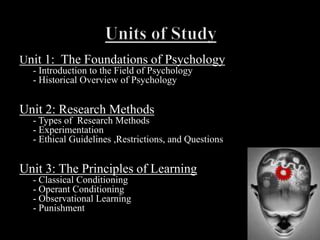
What is Psychology?“This course is designed to be an introduction to the field of Psychology. Psychology is a diverse and ever-changing discipline that is constantly seeking revolutionary ways to apply knowledge gained from new research. This class will explore what the study of psychology has to offer individuals, groups, and society as a whole.”Units of StudyUnit 1:  The Foundations of Psychology- Introduction to the Field of Psychology
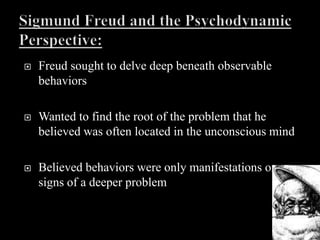
- Historical Overview of Psychology  Unit 2: Research Methods- Types of  Research Methods
- Experimentation
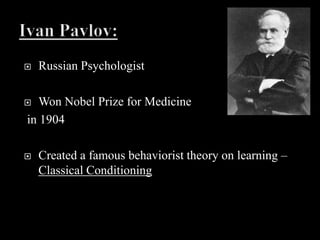
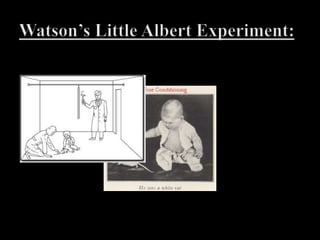
- Ethical Guidelines ,Restrictions, and Questions  Unit 3: The Principles of Learning- Classical Conditioning
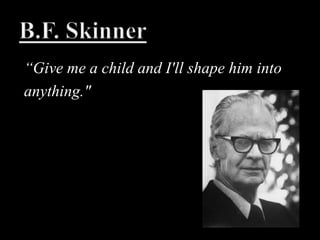
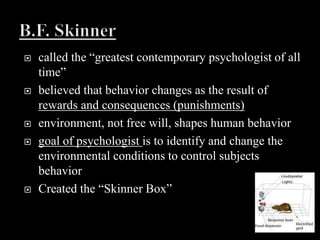
- Operant Conditioning
- Observational Learning
- PunishmentUnits of Study Continued…Unit 4: MemoryStructure of Memory
Models of Memory
Types of Memory
Memory Improvement Techniques
Eye Witness Testimonies   Unit 5: Cognitive PsychologyProblem Solving and Decision Making
Thinking
Creativity
Language
The Brain Structures and Functions
Intelligence – Testing, Types Etc.  
Units of Study Continued…Unit 6: Experiencing the WorldSensation
Perception
 Sleep and other Altered States of ConsciousnessUnit 7: Aspects of Identify Formation 
Assessment  I will be assessing you every day. Observations, discussions, and daily work etc. You will know well in advance the work I will be collecting and using to determine your grade.Course work				70%  Exam					30%Course work will include, test, assignments, presentations, and projects.
Unit 1:Foundations of Psychology
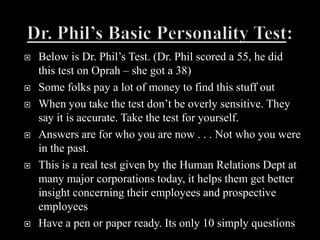
Dr. Phil’s Basic Personality Test:Below is Dr. Phil’s Test. (Dr. Phil scored a 55, he did this test on Oprah – she got a 38)Some folks pay a lot of money to find this stuff outWhen you take the test don’t be overly sensitive. They say it is accurate. Take the test for yourself.Answers are for who you are now . . . Not who you were in the past.This is a real test given by the Human Relations Dept at many major corporations today, it helps them get better insight concerning their employees and prospective employeesHave a pen or paper ready. Its only 10 simply questions
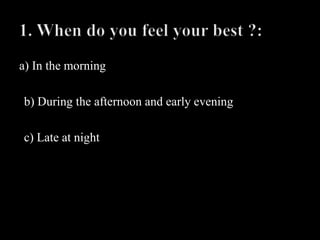
1. When do you feel your best ?:a) In the morningb) During the afternoon and early eveningc) Late at night
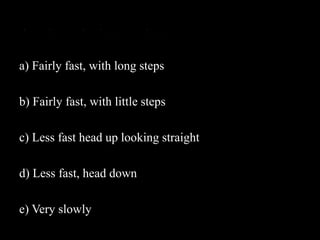
2. You usually walk:a) Fairly fast, with long stepsb) Fairly fast, with little stepsc) Less fast head up looking straightd) Less fast, head downe) Very slowly
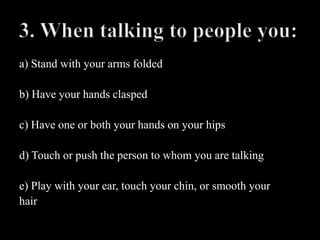
3. When talking to people you:a) Stand with your arms foldedb) Have your hands claspedc) Have one or both your hands on your hipsd) Touch or push the person to whom you are talkinge) Play with your ear, touch your chin, or smooth yourhair
4. When relaxing, you sit with:a) Your knees bent with your legs neatly side by sideb) Your legs crossedc) Your legs stretched out or straightd) One leg curled under you
5. When something really amuses you , you react with:a) Big appreciated laughb) A laugh, but not a loud onec) A quiet chuckled) A smile
6. When you go to a party or social gathering you:a) Make a loud entrance so everyone notices youb) Make a quiet entrance, looking around for someone you knowc) Make the quietest entrance possible, trying to stayunnoticed
7.You’re working very hard, concentrating hard, and you’re interrupted, you:a) Welcome the breakb) Feel extremely irritatedc) Vary between these two extremes
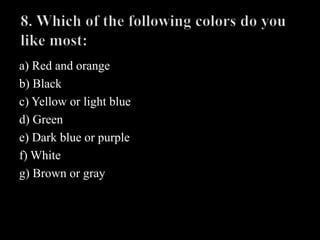
8. Which of the following colors do you like most:a) Red and orangeb) Blackc) Yellow or light blued) Greene) Dark blue or purplef) Whiteg) Brown or gray
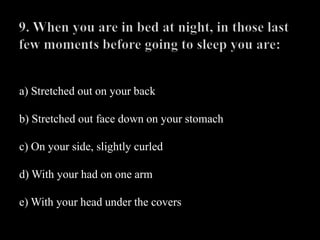
9. When you are in bed at night, in those last few moments before going to sleep you are:a) Stretched out on your backb) Stretched out face down on your stomachc) On your side, slightly curledd) With your had on one arme) With your head under the covers
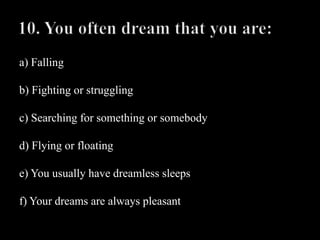
10. You often dream that you are:a) Fallingb) Fighting or strugglingc) Searching for something or somebodyd) Flying or floatinge) You usually have dreamless sleepsf) Your dreams are always pleasant
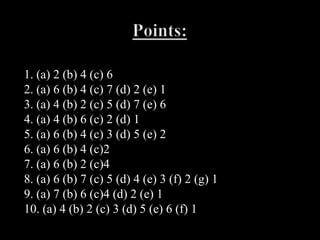
Points:1. (a) 2 (b) 4 (c) 62. (a) 6 (b) 4 (c) 7 (d) 2 (e) 13. (a) 4 (b) 2 (c) 5 (d) 7 (e) 64. (a) 4 (b) 6 (c) 2 (d) 15. (a) 6 (b) 4 (c) 3 (d) 5 (e) 26. (a) 6 (b) 4 (c)27. (a) 6 (b) 2 (c)48. (a) 6 (b) 7 (c) 5 (d) 4 (e) 3 (f) 2 (g) 19. (a) 7 (b) 6 (c)4 (d) 2 (e) 110. (a) 4 (b) 2 (c) 3 (d) 5 (e) 6 (f) 1
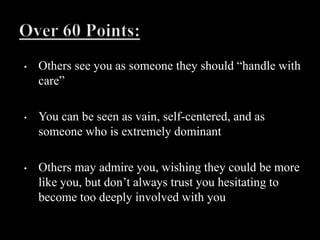
Over 60 Points:Others see you as someone they should “handle with care”
You can be seen as vain, self-centered, and as someone who is extremely dominant
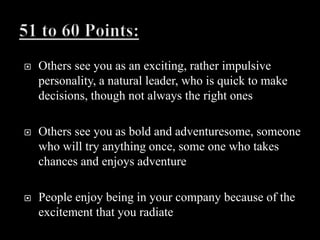
Others may admire you, wishing they could be more like you, but don’t always trust you hesitating to become too deeply involved with you51 to 60 Points:Others see you as an exciting, rather impulsive personality, a natural leader, who is quick to make decisions, though not always the right ones
Others see you as bold and adventuresome, someone who will try anything once, some one who takes chances and enjoys adventure
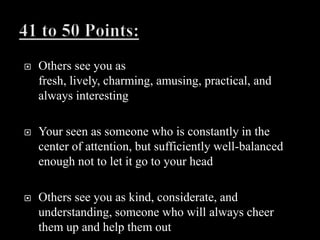
People enjoy being in your company because of the excitement that you radiate41 to 50 Points:Others see you as fresh, lively, charming, amusing, practical, and always interesting
Your seen as someone who is constantly in the center of attention, but sufficiently well-balanced enough not to let it go to your head
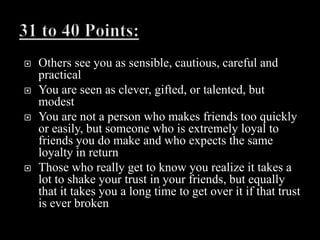
Others see you as kind, considerate, and understanding, someone who will always cheer them up and help them out31 to 40 Points:Others see you as sensible, cautious, careful and practical
You are seen as clever, gifted, or talented, but modest
You are not a person who makes friends too quickly or easily, but someone who is extremely loyal to friends you do make and who expects the same loyalty in return
Those who really get to know you realize it takes a lot to shake your trust in your friends, but equally that it takes you a long time to get over it if that trust is ever broken21 to 30 Points:Your friends see you as painstaking and fussyThey view you as very cautious, extremely careful, and slow and steadyIt would really surprise them if you ever did something impulsively or on the spur of the moment, expecting you to examine everything carefully from every angel and then, usually decide against itThey think this reaction is caused partly by your careful nature
What is Psychology?Psychology: The science of behavior and mental processes
Although this definition emphasizes behavior, it alsoincludes the inner self, such as dreams, daydreams, andother inner emotions / drives
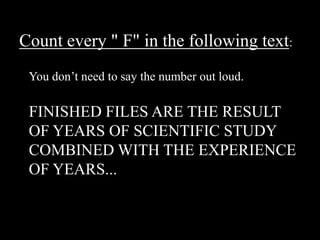
Count every " F" in the following text: You don’t need to say the number out loud.FINISHED FILES ARE THE RESULT OF YEARS OF SCIENTIFIC STUDY COMBINED WITH THE EXPERIENCE OF YEARS...
The Cambridge University Language Study O lnysrmatpoelpe can raedtihs. I cdnuoltblveieetaht I cluodaulacltyuesdnatnrdwaht I was rdanieg. The  phaonmnealpweor of the hmuanmnid, aoccdrnig to a rscheearch at CmabrigdeUinervtisy, it deosn'tmttaer in wahtoredr the ltteers in a wrod are, the olnyiprmoatnttihng is taht the frist and lsatltteer be in the rghitpclae. The rset can be a taotlmses and you can sitllraed it wouthit a porbelm. Tihs is bcuseae the huamnmniddeos not raederveylteter by istlef, but the wrod as a wlohe. Amzanig huh? yaeh and I awlyastghuhotslpeling was ipmorantt!
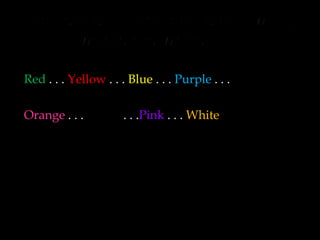
Name the Color that the following words are written in:Red . . . Yellow . . . Blue . . . Purple . . . Orange . . . Green . . .Pink . . . White
Old or Young Lady?
Good or Evil?
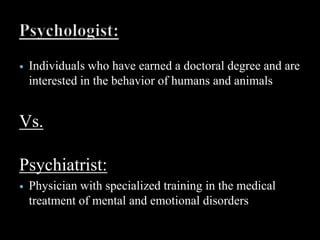
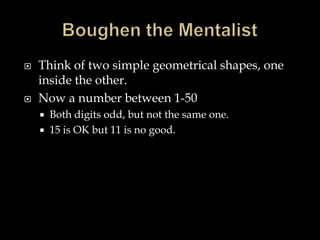
Psychologist:Individuals who have earned a doctoral degree and are interested in the behavior of humans and animalsVs.Psychiatrist:Physician with specialized training in the medical treatment of mental and emotional disordersBoughen the MentalistThink of two simple geometrical shapes, one inside the other.Now a number between 1-50Both digits odd, but not the same one.15 is OK but 11 is no good.
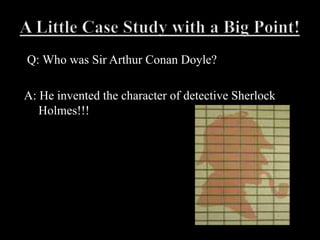
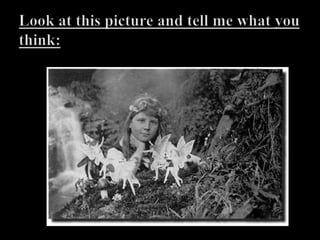
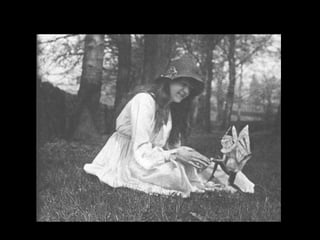
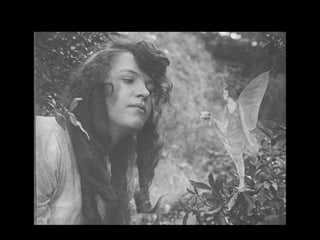
A Little Case Study with a Big Point! Q: Who was Sir Arthur Conan Doyle?A: He invented the character of detective Sherlock Holmes!!!
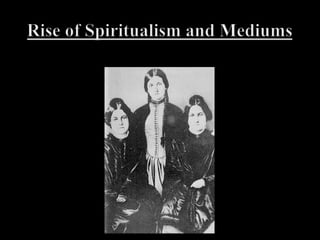
Rise of Spiritualism and Mediums
Look at this picture and tell me what you think:
My question to you is . .Why did Sir Arthur ConanDoyle believe these girls andthese photographs?
Bias:Preconceptions (already held beliefs) that cloud ourobservations and influence the questions we ask.Law of Parsimony:Theory that tells us to adopt the explanation thatrequires the fewest assumptions
When studying Psychology you should always ask yourself:1.What is the claim and who is making it?2.Is the claim based on scientific observation?3. What do statistics reveal?-When evaluating a claim we need to know whether the 	findings occurred by chance		- Findings are only significant if they are statistically		significant (occur over and over enough times)4.Are there plausible alternative explanations for the claim?
The Placebo Effect
Placebo Effect:Found in research and experiments, refers to the effects(either positive or negative) associated with a subject’sbeliefs and attitudesThis phenomena has been found in:		1. Headache Experiments		2. Alcohol Experiments
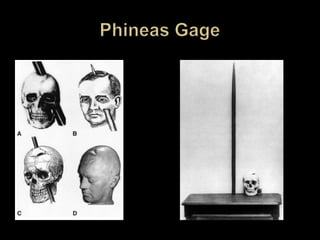
Specialties in Psychology:ResearchForensic (Jury Selection, Discredit Eye Witness)PsychiatristSchool				ConsumerCognitive			Health (changing Harmful Behaviours)	Industrial and OrganizationalNeuropsychologyEclecticsportsClinical (Diagnosis and treatment of Psychological disorders)Phineas Gage
The Three Debates:Nature Vs. NurturePerson Vs. SituationStability Vs. Change
The Three Big Debates:Read the handout “Enduring Issues in Psychology” and think about the three debates discussed in the article: The Nature vs. Nurture debate, The Person vs. Situation Debate, and the Stability vs. Change Debate.Pair up with a partner and discuss the debates. Write a definition of each debate in your notes. Then take a stance on your own beliefs.Journal Assignment: In three well written paragraphs explain what each debate is and then take a stance about which side of each debate you think is correct. Explain why you think a particular side is more correct by providing examples that you have seen in your own life, and/or by making reference to different things you have heard about or read.
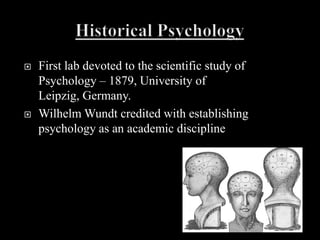
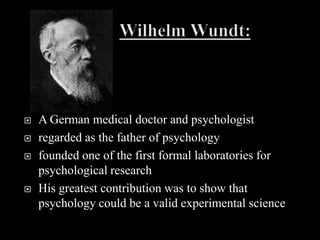
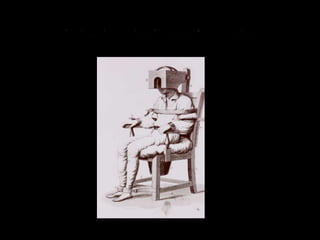
Historical PsychologyFirst lab devoted to the scientific study of Psychology – 1879, University of Leipzig, Germany. Wilhelm Wundt credited with establishing psychology as an academic discipline

Unit1 Principle Processes

  • 1.
  • 2.
    Write About YouYouare going to write a letter to me.
  • 3.
  • 4.
  • 5.
  • 6.
  • 7.
    What kind ofstudent are you…
  • 8.
    Reader, writer, presenter,group worker. When do you work well, work do you not work well.
  • 9.
    What do youneed from me?
  • 10.
  • 11.
    What you didover the summerKWL What do you know about PsychologyWhat do you want to know about Psychology What have you learned about Psychology
  • 12.
    What is Psychology?“Thiscourse is designed to be an introduction to the field of Psychology. Psychology is a diverse and ever-changing discipline that is constantly seeking revolutionary ways to apply knowledge gained from new research. This class will explore what the study of psychology has to offer individuals, groups, and society as a whole.”Units of StudyUnit 1: The Foundations of Psychology- Introduction to the Field of Psychology
  • 13.
    - Historical Overviewof Psychology  Unit 2: Research Methods- Types of Research Methods
  • 14.
  • 15.
    - Ethical Guidelines,Restrictions, and Questions  Unit 3: The Principles of Learning- Classical Conditioning
  • 16.
  • 17.
  • 18.
    - PunishmentUnits ofStudy Continued…Unit 4: MemoryStructure of Memory
  • 19.
  • 20.
  • 21.
  • 22.
    Eye Witness Testimonies   Unit5: Cognitive PsychologyProblem Solving and Decision Making
  • 23.
  • 24.
  • 25.
  • 26.
  • 27.
  • 28.
    Units of StudyContinued…Unit 6: Experiencing the WorldSensation
  • 29.
  • 30.
    Sleep andother Altered States of ConsciousnessUnit 7: Aspects of Identify Formation 
  • 31.
    Assessment  I will beassessing you every day. Observations, discussions, and daily work etc. You will know well in advance the work I will be collecting and using to determine your grade.Course work 70%  Exam 30%Course work will include, test, assignments, presentations, and projects.
  • 33.
  • 36.
    Dr. Phil’s BasicPersonality Test:Below is Dr. Phil’s Test. (Dr. Phil scored a 55, he did this test on Oprah – she got a 38)Some folks pay a lot of money to find this stuff outWhen you take the test don’t be overly sensitive. They say it is accurate. Take the test for yourself.Answers are for who you are now . . . Not who you were in the past.This is a real test given by the Human Relations Dept at many major corporations today, it helps them get better insight concerning their employees and prospective employeesHave a pen or paper ready. Its only 10 simply questions
  • 37.
    1. When doyou feel your best ?:a) In the morningb) During the afternoon and early eveningc) Late at night
  • 38.
    2. You usuallywalk:a) Fairly fast, with long stepsb) Fairly fast, with little stepsc) Less fast head up looking straightd) Less fast, head downe) Very slowly
  • 39.
    3. When talkingto people you:a) Stand with your arms foldedb) Have your hands claspedc) Have one or both your hands on your hipsd) Touch or push the person to whom you are talkinge) Play with your ear, touch your chin, or smooth yourhair
  • 40.
    4. When relaxing,you sit with:a) Your knees bent with your legs neatly side by sideb) Your legs crossedc) Your legs stretched out or straightd) One leg curled under you
  • 41.
    5. When somethingreally amuses you , you react with:a) Big appreciated laughb) A laugh, but not a loud onec) A quiet chuckled) A smile
  • 42.
    6. When yougo to a party or social gathering you:a) Make a loud entrance so everyone notices youb) Make a quiet entrance, looking around for someone you knowc) Make the quietest entrance possible, trying to stayunnoticed
  • 43.
    7.You’re working veryhard, concentrating hard, and you’re interrupted, you:a) Welcome the breakb) Feel extremely irritatedc) Vary between these two extremes
  • 44.
    8. Which ofthe following colors do you like most:a) Red and orangeb) Blackc) Yellow or light blued) Greene) Dark blue or purplef) Whiteg) Brown or gray
  • 45.
    9. When youare in bed at night, in those last few moments before going to sleep you are:a) Stretched out on your backb) Stretched out face down on your stomachc) On your side, slightly curledd) With your had on one arme) With your head under the covers
  • 46.
    10. You oftendream that you are:a) Fallingb) Fighting or strugglingc) Searching for something or somebodyd) Flying or floatinge) You usually have dreamless sleepsf) Your dreams are always pleasant
  • 47.
    Points:1. (a) 2(b) 4 (c) 62. (a) 6 (b) 4 (c) 7 (d) 2 (e) 13. (a) 4 (b) 2 (c) 5 (d) 7 (e) 64. (a) 4 (b) 6 (c) 2 (d) 15. (a) 6 (b) 4 (c) 3 (d) 5 (e) 26. (a) 6 (b) 4 (c)27. (a) 6 (b) 2 (c)48. (a) 6 (b) 7 (c) 5 (d) 4 (e) 3 (f) 2 (g) 19. (a) 7 (b) 6 (c)4 (d) 2 (e) 110. (a) 4 (b) 2 (c) 3 (d) 5 (e) 6 (f) 1
  • 48.
    Over 60 Points:Otherssee you as someone they should “handle with care”
  • 49.
    You can beseen as vain, self-centered, and as someone who is extremely dominant
  • 50.
    Others may admireyou, wishing they could be more like you, but don’t always trust you hesitating to become too deeply involved with you51 to 60 Points:Others see you as an exciting, rather impulsive personality, a natural leader, who is quick to make decisions, though not always the right ones
  • 51.
    Others see youas bold and adventuresome, someone who will try anything once, some one who takes chances and enjoys adventure
  • 52.
    People enjoy beingin your company because of the excitement that you radiate41 to 50 Points:Others see you as fresh, lively, charming, amusing, practical, and always interesting
  • 53.
    Your seen assomeone who is constantly in the center of attention, but sufficiently well-balanced enough not to let it go to your head
  • 54.
    Others see youas kind, considerate, and understanding, someone who will always cheer them up and help them out31 to 40 Points:Others see you as sensible, cautious, careful and practical
  • 55.
    You are seenas clever, gifted, or talented, but modest
  • 56.
    You are nota person who makes friends too quickly or easily, but someone who is extremely loyal to friends you do make and who expects the same loyalty in return
  • 57.
    Those who reallyget to know you realize it takes a lot to shake your trust in your friends, but equally that it takes you a long time to get over it if that trust is ever broken21 to 30 Points:Your friends see you as painstaking and fussyThey view you as very cautious, extremely careful, and slow and steadyIt would really surprise them if you ever did something impulsively or on the spur of the moment, expecting you to examine everything carefully from every angel and then, usually decide against itThey think this reaction is caused partly by your careful nature
  • 59.
    What is Psychology?Psychology:The science of behavior and mental processes
  • 60.
    Although this definitionemphasizes behavior, it alsoincludes the inner self, such as dreams, daydreams, andother inner emotions / drives
  • 61.
    Count every "F" in the following text: You don’t need to say the number out loud.FINISHED FILES ARE THE RESULT OF YEARS OF SCIENTIFIC STUDY COMBINED WITH THE EXPERIENCE OF YEARS...
  • 62.
    The Cambridge UniversityLanguage Study O lnysrmatpoelpe can raedtihs. I cdnuoltblveieetaht I cluodaulacltyuesdnatnrdwaht I was rdanieg. The phaonmnealpweor of the hmuanmnid, aoccdrnig to a rscheearch at CmabrigdeUinervtisy, it deosn'tmttaer in wahtoredr the ltteers in a wrod are, the olnyiprmoatnttihng is taht the frist and lsatltteer be in the rghitpclae. The rset can be a taotlmses and you can sitllraed it wouthit a porbelm. Tihs is bcuseae the huamnmniddeos not raederveylteter by istlef, but the wrod as a wlohe. Amzanig huh? yaeh and I awlyastghuhotslpeling was ipmorantt!
  • 63.
    Name the Colorthat the following words are written in:Red . . . Yellow . . . Blue . . . Purple . . . Orange . . . Green . . .Pink . . . White
  • 64.
  • 65.
  • 66.
    Psychologist:Individuals who haveearned a doctoral degree and are interested in the behavior of humans and animalsVs.Psychiatrist:Physician with specialized training in the medical treatment of mental and emotional disordersBoughen the MentalistThink of two simple geometrical shapes, one inside the other.Now a number between 1-50Both digits odd, but not the same one.15 is OK but 11 is no good.
  • 67.
    A Little CaseStudy with a Big Point! Q: Who was Sir Arthur Conan Doyle?A: He invented the character of detective Sherlock Holmes!!!

  • 68.
  • 69.
    Look at thispicture and tell me what you think:
  • 72.
    My question toyou is . .Why did Sir Arthur ConanDoyle believe these girls andthese photographs?
  • 73.
    Bias:Preconceptions (already heldbeliefs) that cloud ourobservations and influence the questions we ask.Law of Parsimony:Theory that tells us to adopt the explanation thatrequires the fewest assumptions
  • 74.
    When studying Psychologyyou should always ask yourself:1.What is the claim and who is making it?2.Is the claim based on scientific observation?3. What do statistics reveal?-When evaluating a claim we need to know whether the findings occurred by chance - Findings are only significant if they are statistically significant (occur over and over enough times)4.Are there plausible alternative explanations for the claim?

  • 75.
  • 76.
    Placebo Effect:Found inresearch and experiments, refers to the effects(either positive or negative) associated with a subject’sbeliefs and attitudesThis phenomena has been found in: 1. Headache Experiments 2. Alcohol Experiments

  • 77.
    Specialties in Psychology:ResearchForensic(Jury Selection, Discredit Eye Witness)PsychiatristSchool ConsumerCognitive Health (changing Harmful Behaviours) Industrial and OrganizationalNeuropsychologyEclecticsportsClinical (Diagnosis and treatment of Psychological disorders)Phineas Gage
  • 78.
    The Three Debates:NatureVs. NurturePerson Vs. SituationStability Vs. Change
  • 79.
    The Three BigDebates:Read the handout “Enduring Issues in Psychology” and think about the three debates discussed in the article: The Nature vs. Nurture debate, The Person vs. Situation Debate, and the Stability vs. Change Debate.Pair up with a partner and discuss the debates. Write a definition of each debate in your notes. Then take a stance on your own beliefs.Journal Assignment: In three well written paragraphs explain what each debate is and then take a stance about which side of each debate you think is correct. Explain why you think a particular side is more correct by providing examples that you have seen in your own life, and/or by making reference to different things you have heard about or read.
  • 80.
    Historical PsychologyFirst labdevoted to the scientific study of Psychology – 1879, University of Leipzig, Germany. Wilhelm Wundt credited with establishing psychology as an academic discipline