Managerial Decision Making
Cost Behavior Analysis
Refers to the way different types of production costs change
when there is a change in level of production.
The reaction of expenses to alterations in the amount of
some business activity. For example, the cost behavior for
aspects of automobile
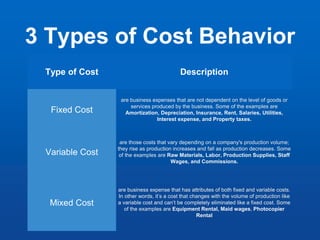
3 Types of Cost Behavior
Type of Cost Description
Fixed Cost
are business expenses that are not dependent on the level of goods or
services produced by the business. Some of the examples are
Amortization, Depreciation, Insurance, Rent, Salaries, Utilities,
Interest expense, and Property taxes.
Variable Cost
are those costs that vary depending on a company's production volume;
they rise as production increases and fall as production decreases. Some
of the examples are Raw Materials, Labor, Production Supplies, Staff
Wages, and Commissions.
Mixed Cost
are business expense that has attributes of both fixed and variable costs.
In other words, it’s a cost that changes with the volume of production like
a variable cost and can’t be completely eliminated like a fixed cost. Some
of the examples are Equipment Rental, Maid wages, Photocopier
Rental
Activity Based Costing
Video Presentation
Tactical Decision Making
consists of choosing among alternatives with an immediate or
limited end in view. Accepting a special order for less than the
normal selling price to utilize idle capacity and increase the year’s
profits is an example.
The overall objective of strategic decision making is to select
among alternatives the strategies so that a long-term competitive
advantage is established
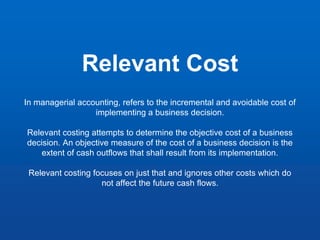
Relevant Cost
In managerial accounting, refers to the incremental and avoidable cost of
implementing a business decision.
Relevant costing attempts to determine the objective cost of a business
decision. An objective measure of the cost of a business decision is the
extent of cash outflows that shall result from its implementation.
Relevant costing focuses on just that and ignores other costs which do
not affect the future cash flows.
Relevant Cost Application
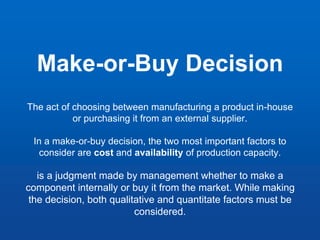
Make-or-Buy Decision
The act of choosing between manufacturing a product in-house
or purchasing it from an external supplier.
In a make-or-buy decision, the two most important factors to
consider are cost and availability of production capacity.
is a judgment made by management whether to make a
component internally or buy it from the market. While making
the decision, both qualitative and quantitate factors must be
considered.
Keep-or-Drop Decision
A decision whether or not to continue an old product line or
department, or to start a new one is called an add-or-drop
decision. An add-or-drop decision must be based only on
relevant information.
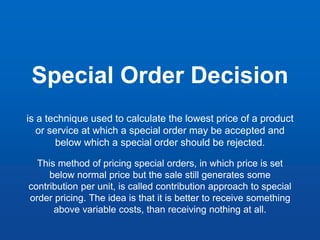
Special Order Decision
is a technique used to calculate the lowest price of a product
or service at which a special order may be accepted and
below which a special order should be rejected.
This method of pricing special orders, in which price is set
below normal price but the sale still generates some
contribution per unit, is called contribution approach to special
order pricing. The idea is that it is better to receive something
above variable costs, than receiving nothing at all.
Sell-or-Process Decision
A decision whether to sell a joint product at split-off point or to
process it further and sell it in a more refined form is called a
sell-or-process-further decision.
Product Mix Decision
refers to the decisions regarding adding a new or eliminating
any existing product from the product mix, adding a new product
line, lengthening any existing line, or bringing new variants of a
brand to expand the business and to increase the profitability.
Different Product Mix Decision
Product Line Decision
Product line managers takes product line decisions considering the sales
and profit of each items in the line and comparing their product line with the
competitors' product lines in the same markets. Marketing managers have
to decide the optimal length of the product line by adding new items or
dropping existing items from the line.
Line Stretching
Decision
Line stretching means lengthening a product
line beyond its current range. An organization
can stretch its product line downward, upward,
or both way.
Line Filing Decision
It means adding more items within the present range
of the product line. Line filling can be done to reach
for incremental profits, or to utilize excess capacity.
Pricing Strategy
can be used to pursue different types of objectives, such as
increasing market share, expanding profit margin, or driving a
competitor from the marketplace. It may be necessary for a
business to alter its pricing strategy over time as its market
changes.
Cost-Based Pricing Strategy
Absorption Pricing
Includes all variable costs, as well as an
allocation of fixed costs.
Breakeven Pricing
The setting of a price at the exact point at which
a company earns no profit, based on an
examination of variable costs and the estimated
number of units to be sold.
Cost-Plus Pricing
Includes all variable costs, an allocation of fixed
costs, and a predetermined markup percentage.
Time and Materials
Pricing
Customers are billed for the labor and materials
incurred by the company, with a profit markup.
Value Pricing StrategyThese pricing strategies do not rely upon cost, but rather the perception of customers of the value of the product or service.
Dynamic Pricing
Technology is used to alter prices continuously,
based on the willingness of customers to pay.
Premium Pricing
The practice of setting prices higher than the
market rate in order to create the aura of
exclusivity.
Price Skimming
The practice of initially setting a high price to reap
unusually high profits when a product is initially
introduced.
Teaser Pricing StrategyThese strategies are based on the concept of luring in customers with a few low-priced or free products or services,
and then cross-selling them higher-priced items.
Freemium Pricing
The practice of offering a basic service for free,
and charging a price for a higher service level.
High-low Pricing
The setting of a price at the exact point at which
a company earns no profit, based on an
examination of variable costs and the estimated
number of units to be sold.
Loss Leader Pricing
The practice of pricing a few products below the
market rate to bring in customers, and pricing all other
items above the market rate
Strategic Pricing StrategyThese strategies involve the use of product pricing to position a company within a market or to exclude competitors from it.
Limit Pricing
The practice of offering a basic service for free,
and charging a price for a higher service level.
Penetration Pricing
The setting of a price at the exact point at which
a company earns no profit, based on an
examination of variable costs and the estimated
number of units to be sold.
Predatory Pricing
The practice of pricing a few products below the
market rate to bring in customers, and pricing all other
items above the market rate
Price Leadership
When one company sets a price point that is adopted
by competitors.
Miscellaneous Pricing StrategyThe following pricing strategies are separate pricing concepts not related to the preceding categories
Psychological
Pricing
The practice of setting prices slightly lower than
a rounded price, in the expectation that
customers will consider the prices to be
substantially lower than they really are.
Shadow Pricing
The assignment of a price to an intangible item
for which there is no market price.
Transfer Pricing
The price at which a product is sold from one
subsidiary of a parent company to another.
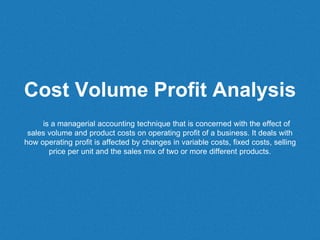
Cost Volume Profit Analysis
is a managerial accounting technique that is concerned with the effect of
sales volume and product costs on operating profit of a business. It deals with
how operating profit is affected by changes in variable costs, fixed costs, selling
price per unit and the sales mix of two or more different products.
Cost Volume Profit Analysis
Video Presentation
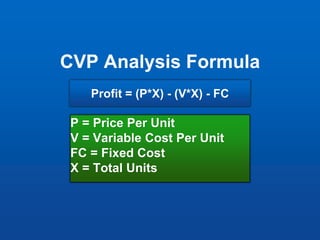
CVP Analysis Formula
Profit = (P*X) - (V*X) - FC
P = Price Per Unit
V = Variable Cost Per Unit
FC = Fixed Cost
X = Total Units
Contribution Margin
is equal to the difference between total sales (S) and
total variable cost or, in other words, it is the amount
by which sales exceed total variable costs (VC). In
order to make profit the contribution margin of a
business must exceed its total fixed costs.
CM = Total Sales - Variable Cost
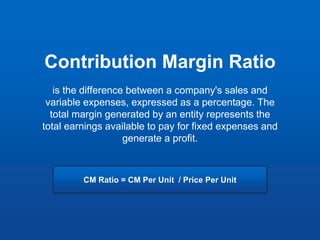
Contribution Margin Ratio
is the difference between a company's sales and
variable expenses, expressed as a percentage. The
total margin generated by an entity represents the
total earnings available to pay for fixed expenses and
generate a profit.
CM Ratio = CM Per Unit / Price Per Unit
Breakeven Analysis
is the point at which its sales exactly cover its
expenses. The company sells enough units of its
product to cover its expenses without making a profit
or taking a loss.
Breakeven Point = Fixed Cost / CM Unit
Example # 1
Let's say we own a company that manufactures bowling balls. Consider the following
given information on the unit pricing and variable cost for each unit (bowling ball)
that we produce and sell
Sale price per unit PHP10.00
Variable cost per unit
Direct Materials
Direct Labor
Variable portion of manufacturing overhead
Total Variable Cost Per Unit PHP6.00
CM Per Unit = PHP10.00 – PHP6.00
CM Per Unit = PHP4.00
This means that for each unit we produce and sell, we are left with $4 toward our
profit. In other words, for this example, PHP4.00 is how much each bowling ball
contributes to our margin (profit).
CM Ratio = PHP4.00 / PHP10.00
CM Ratio = .40 ; 40%
Example # 2
What if this year we produce and sell 1,000 units ?
Sales Revenue (1,000 units * PHP10.00 per unit) = PHP10,000.00
- Variable Cost (1,000 units * PHP6.00 per unit) = (PHP6,000.00)
Contribution Margin Per Unit = PHP10,000.00 – PHP6,000.00
Contribution Margin Per Unit = PHP4,000.00
CM Ratio
= CM per unit / sale price per unit
= PHP4,000.00 / PHP10,000.00
= .40 ; 40%
Notice how the cm ratio remains constant regardless of the number of units we
produce and sell. This is the percentage of sales pesos that "stays in our pocket",
although we still have not deducted our fixed cost.
Example # 3
What if this year we produce and sell 1,000,000 units and our total
fixed costs for the year are PHP2,500,000.00
Sales Revenue (1,000,000 units * PHP10.00 per unit) = PHP10,000,000.00
Variable Cost (1,000,000 units * PHP6.00 per unit) = (PHP6,000,000.00)
Contribution Margin Per Unit = PHP10,000.00 – PHP6,000,000.00
Contribution Margin Per Unit = PHP4,000,000.00
Total Fixed Costs = (PHP2,500,000.00)
NET INCOME = PHP1,500,000.00
Example #4 (Breakeven)
What if this year we produce and sell 625,000 units and our total
fixed costs for the year are PHP2,500,000.00
Sales Revenue (625,000 units * PHP10.00 per unit) = PHP6,250,000.00
Variable Cost (625,000 units * PHP6.00 per unit) = (PHP3,750,000.00)
Contribution Margin Per Unit = PHP2,500,00.00
Total Fixed Costs = (PHP2,500,000.00)
NET INCOME = PHP0.00
The analysis above shows that if our company sells each unit for PHP10.00,
the variable cost per unit is PHP6.00, and total annual fixed costs are
PHP2,500,000.00, If we sell 625,000 units this year(or PHP6,250,000 in pesos)
our net income will be PHP0.00. This is known as the breakeven point and it tells
us how much we need to sell to just cover our costs
Thank You

Managerial decision making

  • 1.
  • 2.
    Cost Behavior Analysis Refersto the way different types of production costs change when there is a change in level of production. The reaction of expenses to alterations in the amount of some business activity. For example, the cost behavior for aspects of automobile
  • 3.
    3 Types ofCost Behavior Type of Cost Description Fixed Cost are business expenses that are not dependent on the level of goods or services produced by the business. Some of the examples are Amortization, Depreciation, Insurance, Rent, Salaries, Utilities, Interest expense, and Property taxes. Variable Cost are those costs that vary depending on a company's production volume; they rise as production increases and fall as production decreases. Some of the examples are Raw Materials, Labor, Production Supplies, Staff Wages, and Commissions. Mixed Cost are business expense that has attributes of both fixed and variable costs. In other words, it’s a cost that changes with the volume of production like a variable cost and can’t be completely eliminated like a fixed cost. Some of the examples are Equipment Rental, Maid wages, Photocopier Rental
  • 4.
  • 5.
  • 6.
    Tactical Decision Making consistsof choosing among alternatives with an immediate or limited end in view. Accepting a special order for less than the normal selling price to utilize idle capacity and increase the year’s profits is an example. The overall objective of strategic decision making is to select among alternatives the strategies so that a long-term competitive advantage is established
  • 7.
    Relevant Cost In managerialaccounting, refers to the incremental and avoidable cost of implementing a business decision. Relevant costing attempts to determine the objective cost of a business decision. An objective measure of the cost of a business decision is the extent of cash outflows that shall result from its implementation. Relevant costing focuses on just that and ignores other costs which do not affect the future cash flows.
  • 8.
  • 9.
    Make-or-Buy Decision The actof choosing between manufacturing a product in-house or purchasing it from an external supplier. In a make-or-buy decision, the two most important factors to consider are cost and availability of production capacity. is a judgment made by management whether to make a component internally or buy it from the market. While making the decision, both qualitative and quantitate factors must be considered.
  • 10.
    Keep-or-Drop Decision A decisionwhether or not to continue an old product line or department, or to start a new one is called an add-or-drop decision. An add-or-drop decision must be based only on relevant information.
  • 11.
    Special Order Decision isa technique used to calculate the lowest price of a product or service at which a special order may be accepted and below which a special order should be rejected. This method of pricing special orders, in which price is set below normal price but the sale still generates some contribution per unit, is called contribution approach to special order pricing. The idea is that it is better to receive something above variable costs, than receiving nothing at all.
  • 12.
    Sell-or-Process Decision A decisionwhether to sell a joint product at split-off point or to process it further and sell it in a more refined form is called a sell-or-process-further decision.
  • 13.
    Product Mix Decision refersto the decisions regarding adding a new or eliminating any existing product from the product mix, adding a new product line, lengthening any existing line, or bringing new variants of a brand to expand the business and to increase the profitability.
  • 14.
    Different Product MixDecision Product Line Decision Product line managers takes product line decisions considering the sales and profit of each items in the line and comparing their product line with the competitors' product lines in the same markets. Marketing managers have to decide the optimal length of the product line by adding new items or dropping existing items from the line. Line Stretching Decision Line stretching means lengthening a product line beyond its current range. An organization can stretch its product line downward, upward, or both way. Line Filing Decision It means adding more items within the present range of the product line. Line filling can be done to reach for incremental profits, or to utilize excess capacity.
  • 15.
    Pricing Strategy can beused to pursue different types of objectives, such as increasing market share, expanding profit margin, or driving a competitor from the marketplace. It may be necessary for a business to alter its pricing strategy over time as its market changes.
  • 16.
    Cost-Based Pricing Strategy AbsorptionPricing Includes all variable costs, as well as an allocation of fixed costs. Breakeven Pricing The setting of a price at the exact point at which a company earns no profit, based on an examination of variable costs and the estimated number of units to be sold. Cost-Plus Pricing Includes all variable costs, an allocation of fixed costs, and a predetermined markup percentage. Time and Materials Pricing Customers are billed for the labor and materials incurred by the company, with a profit markup.
  • 17.
    Value Pricing StrategyThesepricing strategies do not rely upon cost, but rather the perception of customers of the value of the product or service. Dynamic Pricing Technology is used to alter prices continuously, based on the willingness of customers to pay. Premium Pricing The practice of setting prices higher than the market rate in order to create the aura of exclusivity. Price Skimming The practice of initially setting a high price to reap unusually high profits when a product is initially introduced.
  • 18.
    Teaser Pricing StrategyThesestrategies are based on the concept of luring in customers with a few low-priced or free products or services, and then cross-selling them higher-priced items. Freemium Pricing The practice of offering a basic service for free, and charging a price for a higher service level. High-low Pricing The setting of a price at the exact point at which a company earns no profit, based on an examination of variable costs and the estimated number of units to be sold. Loss Leader Pricing The practice of pricing a few products below the market rate to bring in customers, and pricing all other items above the market rate
  • 19.
    Strategic Pricing StrategyThesestrategies involve the use of product pricing to position a company within a market or to exclude competitors from it. Limit Pricing The practice of offering a basic service for free, and charging a price for a higher service level. Penetration Pricing The setting of a price at the exact point at which a company earns no profit, based on an examination of variable costs and the estimated number of units to be sold. Predatory Pricing The practice of pricing a few products below the market rate to bring in customers, and pricing all other items above the market rate Price Leadership When one company sets a price point that is adopted by competitors.
  • 20.
    Miscellaneous Pricing StrategyThefollowing pricing strategies are separate pricing concepts not related to the preceding categories Psychological Pricing The practice of setting prices slightly lower than a rounded price, in the expectation that customers will consider the prices to be substantially lower than they really are. Shadow Pricing The assignment of a price to an intangible item for which there is no market price. Transfer Pricing The price at which a product is sold from one subsidiary of a parent company to another.
  • 21.
    Cost Volume ProfitAnalysis is a managerial accounting technique that is concerned with the effect of sales volume and product costs on operating profit of a business. It deals with how operating profit is affected by changes in variable costs, fixed costs, selling price per unit and the sales mix of two or more different products.
  • 22.
    Cost Volume ProfitAnalysis Video Presentation
  • 23.
    CVP Analysis Formula Profit= (P*X) - (V*X) - FC P = Price Per Unit V = Variable Cost Per Unit FC = Fixed Cost X = Total Units
  • 24.
    Contribution Margin is equalto the difference between total sales (S) and total variable cost or, in other words, it is the amount by which sales exceed total variable costs (VC). In order to make profit the contribution margin of a business must exceed its total fixed costs. CM = Total Sales - Variable Cost
  • 25.
    Contribution Margin Ratio isthe difference between a company's sales and variable expenses, expressed as a percentage. The total margin generated by an entity represents the total earnings available to pay for fixed expenses and generate a profit. CM Ratio = CM Per Unit / Price Per Unit
  • 26.
    Breakeven Analysis is thepoint at which its sales exactly cover its expenses. The company sells enough units of its product to cover its expenses without making a profit or taking a loss. Breakeven Point = Fixed Cost / CM Unit
  • 27.
    Example # 1 Let'ssay we own a company that manufactures bowling balls. Consider the following given information on the unit pricing and variable cost for each unit (bowling ball) that we produce and sell Sale price per unit PHP10.00 Variable cost per unit Direct Materials Direct Labor Variable portion of manufacturing overhead Total Variable Cost Per Unit PHP6.00 CM Per Unit = PHP10.00 – PHP6.00 CM Per Unit = PHP4.00 This means that for each unit we produce and sell, we are left with $4 toward our profit. In other words, for this example, PHP4.00 is how much each bowling ball contributes to our margin (profit). CM Ratio = PHP4.00 / PHP10.00 CM Ratio = .40 ; 40%
  • 28.
    Example # 2 Whatif this year we produce and sell 1,000 units ? Sales Revenue (1,000 units * PHP10.00 per unit) = PHP10,000.00 - Variable Cost (1,000 units * PHP6.00 per unit) = (PHP6,000.00) Contribution Margin Per Unit = PHP10,000.00 – PHP6,000.00 Contribution Margin Per Unit = PHP4,000.00 CM Ratio = CM per unit / sale price per unit = PHP4,000.00 / PHP10,000.00 = .40 ; 40% Notice how the cm ratio remains constant regardless of the number of units we produce and sell. This is the percentage of sales pesos that "stays in our pocket", although we still have not deducted our fixed cost.
  • 29.
    Example # 3 Whatif this year we produce and sell 1,000,000 units and our total fixed costs for the year are PHP2,500,000.00 Sales Revenue (1,000,000 units * PHP10.00 per unit) = PHP10,000,000.00 Variable Cost (1,000,000 units * PHP6.00 per unit) = (PHP6,000,000.00) Contribution Margin Per Unit = PHP10,000.00 – PHP6,000,000.00 Contribution Margin Per Unit = PHP4,000,000.00 Total Fixed Costs = (PHP2,500,000.00) NET INCOME = PHP1,500,000.00
  • 30.
    Example #4 (Breakeven) Whatif this year we produce and sell 625,000 units and our total fixed costs for the year are PHP2,500,000.00 Sales Revenue (625,000 units * PHP10.00 per unit) = PHP6,250,000.00 Variable Cost (625,000 units * PHP6.00 per unit) = (PHP3,750,000.00) Contribution Margin Per Unit = PHP2,500,00.00 Total Fixed Costs = (PHP2,500,000.00) NET INCOME = PHP0.00 The analysis above shows that if our company sells each unit for PHP10.00, the variable cost per unit is PHP6.00, and total annual fixed costs are PHP2,500,000.00, If we sell 625,000 units this year(or PHP6,250,000 in pesos) our net income will be PHP0.00. This is known as the breakeven point and it tells us how much we need to sell to just cover our costs
  • 31.