
CONTENTS
Price
Pricing Objective
Pricing Decision
Factors Affecting Pricing
 Decisions
Determining Demand
Methods Of Pricing
Pricing Strategies
Price
Price is the sum of all the values
 that consumers exchange for the
 benefits of having or using the
 product or service.
“Rent, tuition, fees, fares, tools,
 rates, premiums, honoraria, bribes,
 dues, bids, assessments, retainers,
 salaries, wages, commissions,
 taxes…”
Why is it dangerous?
PRICING OBJECTIVES
~PROFIT OBJECTIVE
     PROFIT MAXIMIZATION
     TARGET RETURN
~SALES OBJECTIVE
     GROWTH IN SALES
     GROWTH IN MKT SHARE
     SURVIVAL-MINIMUM SALES
~COMPETITION OBJECTIVE
    TO MEET OR PREVENT COMPETITION
    TO DESTROY COMPETITION
~DEVELOPMENT OBJECTIVE
  -EXPANDING EXISTING MARKETS (NON-
  USERS TO USERS)
  -PRODUCT DEVELOPMENT
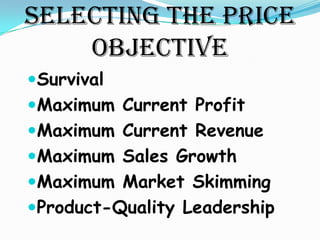
SELECTING THE PRICE
    OBJECTIVE
Survival
Maximum Current Profit
Maximum Current Revenue
Maximum Sales Growth
Maximum Market Skimming
Product-Quality Leadership
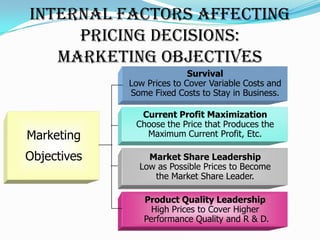
Internal Factors Affecting
     Pricing Decisions:
   Marketing Objectives
                            Survival
             Low Prices to Cover Variable Costs and
             Some Fixed Costs to Stay in Business.

               Current Profit Maximization
              Choose the Price that Produces the
Marketing       Maximum Current Profit, Etc.

Objectives       Market Share Leadership
               Low as Possible Prices to Become
                  the Market Share Leader.

                Product Quality Leadership
                  High Prices to Cover Higher
                Performance Quality and R & D.
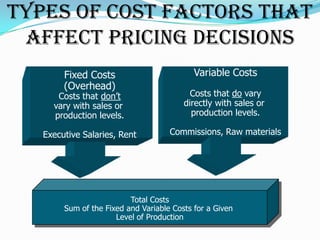
Types of Cost Factors that
 Affect Pricing Decisions
        Fixed Costs                         Variable Costs
        (Overhead)
      Costs that don’t                     Costs that do vary
     vary with sales or                  directly with sales or
     production levels.                    production levels.

   Executive Salaries, Rent          Commissions, Raw materials


                          Total Costs
        Sum of the Fixed and Variable Costs for a Given
                      Level of Production
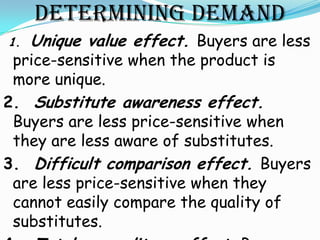
DETERMINING DEMAND
1.   Unique value effect. Buyers are less
 price-sensitive when the product is
 more unique.
2. Substitute awareness effect.
 Buyers are less price-sensitive when
 they are less aware of substitutes.
3. Difficult comparison effect. Buyers
 are less price-sensitive when they
 cannot easily compare the quality of
 substitutes.
6. Shared cost effect. Buyers are
 less price-sensitive when part of
 the cost is borne by another party.
7. Sunk investment effect. Buyers
 are less price-sensitive when the
 product is used in conjunction with
 assets previously bought.
8. Price-quality effect. Buyers
 are less price-sensitive when the
 product is assumed to have more
METHODS OF PRICING
Cost Plus Pricing:
 This method is prevalent in urban
markets, but it suits the rural market
more, because a company has to incur the
cost of the product, distribution
expenses, and also add a small profit
margin.
Value Pricing:
It means assigning a low price tag for a
product and providing the benefits of
low-cost mass production to the
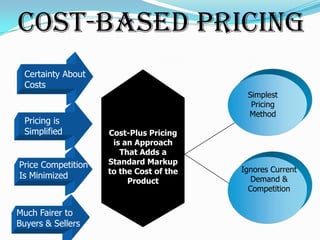
Cost-Based Pricing
  Certainty About
  Costs
                                           Simplest
                                            Pricing
                    Ethical
                                           Method
                         Factors
  Pricing is           Situational
  Simplified         Cost-Plus Pricing
                       Unexpected
                      is an Approach
                        That Adds a
Price Competition    Standard Markup
                     to the Cost of the
                         Attitudes        Ignores Current
Is Minimized                                 Demand &
                          Product
                             of             Competition
                              Others
Much Fairer to
Buyers & Sellers
1)Variable cost pricing:
 Marginal or incremental cost of producing goods charged
 Sell products abroad at lower net prices than the domestic
  market
 Used when a Co. has high fixed cost and unused production


2) Full cost Pricing:
 Total fixed cost + variable cost
 High variable cost relative to fixed cost
 Price= Total cost +profit
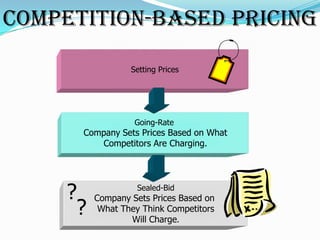
Competition-Based Pricing

                  Setting Prices


                   Going-Rate
      Company Sets Prices Based on What
         Competitors Are Charging.


     ?             Sealed-Bid
          Company Sets Prices Based on
      ?    What They Think Competitors
                  Will Charge.
Pricing Strategies
Companies face many problems
 in setting their prices.
  Standard pricing methods such as
  uniform pricing, standard markup
  of costs everywhere, or charging
  what the market will bear ignores
  cost differentials and local
  market conditions.
    11/3/2012    International MKTG   14
                   Pricing Strategy
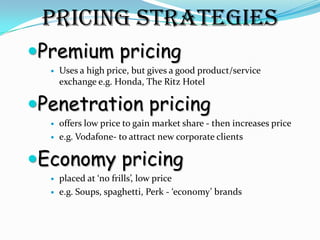
Pricing Strategies
Premium pricing
     Uses a high price, but gives a good product/service
      exchange e.g. Honda, The Ritz Hotel

Penetration pricing
     offers low price to gain market share - then increases price
     e.g. Vodafone- to attract new corporate clients

Economy pricing
     placed at ‘no frills’, low price
     e.g. Soups, spaghetti, Perk - ‘economy’ brands
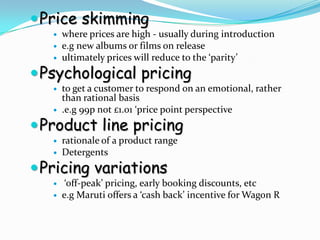
 Price skimming
      where prices are high - usually during introduction
      e.g new albums or films on release
      ultimately prices will reduce to the ‘parity’
 Psychological pricing
      to get a customer to respond on an emotional, rather
       than rational basis
      .e.g 99p not £1.01 ‘price point perspective
 Product line pricing
      rationale of a product range
      Detergents
 Pricing variations
       ‘off-peak’ pricing, early booking discounts, etc
      e.g Maruti offers a ‘cash back’ incentive for Wagon R
 Optional product-pricing
      e.g. optional extras - BMW famously under-
       equipped
 Captive product pricing
      products that complement others
      e.g Gillette razors (low price) and blades (high
       price)
 Product-bundle pricing
      sellers combine several products at the same
       price
      e.g software, books, CDs.
 Promotional pricing
      e.g. toothpaste, soups, etc
THANK YOU!!!

Pricing policies

  • 2.
    CONTENTS Price Pricing Objective Pricing Decision FactorsAffecting Pricing Decisions Determining Demand Methods Of Pricing Pricing Strategies
  • 3.
    Price Price is thesum of all the values that consumers exchange for the benefits of having or using the product or service. “Rent, tuition, fees, fares, tools, rates, premiums, honoraria, bribes, dues, bids, assessments, retainers, salaries, wages, commissions, taxes…” Why is it dangerous?
  • 4.
    PRICING OBJECTIVES ~PROFIT OBJECTIVE PROFIT MAXIMIZATION TARGET RETURN ~SALES OBJECTIVE GROWTH IN SALES GROWTH IN MKT SHARE SURVIVAL-MINIMUM SALES ~COMPETITION OBJECTIVE TO MEET OR PREVENT COMPETITION TO DESTROY COMPETITION ~DEVELOPMENT OBJECTIVE -EXPANDING EXISTING MARKETS (NON- USERS TO USERS) -PRODUCT DEVELOPMENT
  • 5.
    SELECTING THE PRICE OBJECTIVE Survival Maximum Current Profit Maximum Current Revenue Maximum Sales Growth Maximum Market Skimming Product-Quality Leadership
  • 6.
    Internal Factors Affecting Pricing Decisions: Marketing Objectives Survival Low Prices to Cover Variable Costs and Some Fixed Costs to Stay in Business. Current Profit Maximization Choose the Price that Produces the Marketing Maximum Current Profit, Etc. Objectives Market Share Leadership Low as Possible Prices to Become the Market Share Leader. Product Quality Leadership High Prices to Cover Higher Performance Quality and R & D.
  • 7.
    Types of CostFactors that Affect Pricing Decisions Fixed Costs Variable Costs (Overhead) Costs that don’t Costs that do vary vary with sales or directly with sales or production levels. production levels. Executive Salaries, Rent Commissions, Raw materials Total Costs Sum of the Fixed and Variable Costs for a Given Level of Production
  • 8.
    DETERMINING DEMAND 1. Unique value effect. Buyers are less price-sensitive when the product is more unique. 2. Substitute awareness effect. Buyers are less price-sensitive when they are less aware of substitutes. 3. Difficult comparison effect. Buyers are less price-sensitive when they cannot easily compare the quality of substitutes.
  • 9.
    6. Shared costeffect. Buyers are less price-sensitive when part of the cost is borne by another party. 7. Sunk investment effect. Buyers are less price-sensitive when the product is used in conjunction with assets previously bought. 8. Price-quality effect. Buyers are less price-sensitive when the product is assumed to have more
  • 10.
    METHODS OF PRICING CostPlus Pricing: This method is prevalent in urban markets, but it suits the rural market more, because a company has to incur the cost of the product, distribution expenses, and also add a small profit margin. Value Pricing: It means assigning a low price tag for a product and providing the benefits of low-cost mass production to the
  • 11.
    Cost-Based Pricing Certainty About Costs Simplest Pricing Ethical Method Factors Pricing is Situational Simplified Cost-Plus Pricing Unexpected is an Approach That Adds a Price Competition Standard Markup to the Cost of the Attitudes Ignores Current Is Minimized Demand & Product of Competition Others Much Fairer to Buyers & Sellers
  • 12.
    1)Variable cost pricing: Marginal or incremental cost of producing goods charged  Sell products abroad at lower net prices than the domestic market  Used when a Co. has high fixed cost and unused production 2) Full cost Pricing:  Total fixed cost + variable cost  High variable cost relative to fixed cost  Price= Total cost +profit
  • 13.
    Competition-Based Pricing Setting Prices Going-Rate Company Sets Prices Based on What Competitors Are Charging. ? Sealed-Bid Company Sets Prices Based on ? What They Think Competitors Will Charge.
  • 14.
    Pricing Strategies Companies facemany problems in setting their prices.  Standard pricing methods such as uniform pricing, standard markup of costs everywhere, or charging what the market will bear ignores cost differentials and local market conditions. 11/3/2012 International MKTG 14 Pricing Strategy
  • 15.
    Pricing Strategies Premium pricing  Uses a high price, but gives a good product/service exchange e.g. Honda, The Ritz Hotel Penetration pricing  offers low price to gain market share - then increases price  e.g. Vodafone- to attract new corporate clients Economy pricing  placed at ‘no frills’, low price  e.g. Soups, spaghetti, Perk - ‘economy’ brands
  • 16.
     Price skimming  where prices are high - usually during introduction  e.g new albums or films on release  ultimately prices will reduce to the ‘parity’  Psychological pricing  to get a customer to respond on an emotional, rather than rational basis  .e.g 99p not £1.01 ‘price point perspective  Product line pricing  rationale of a product range  Detergents  Pricing variations  ‘off-peak’ pricing, early booking discounts, etc  e.g Maruti offers a ‘cash back’ incentive for Wagon R
  • 17.
     Optional product-pricing  e.g. optional extras - BMW famously under- equipped  Captive product pricing  products that complement others  e.g Gillette razors (low price) and blades (high price)  Product-bundle pricing  sellers combine several products at the same price  e.g software, books, CDs.  Promotional pricing  e.g. toothpaste, soups, etc
  • 18.