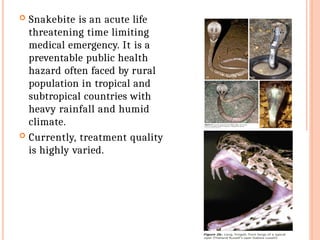
Snakebite isan acute life
threatening time limiting
medical emergency. It is a
preventable public health
hazard often faced by rural
population in tropical and
subtropical countries with
heavy rainfall and humid
climate.
Currently, treatment quality
is highly varied.
5.
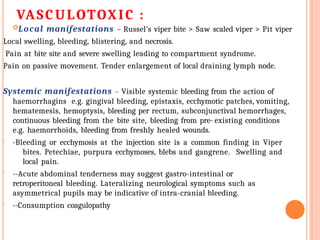
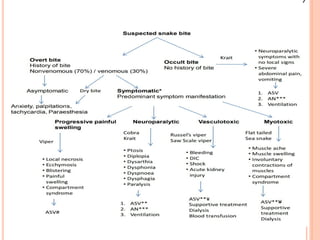
VASCULOTOXIC :
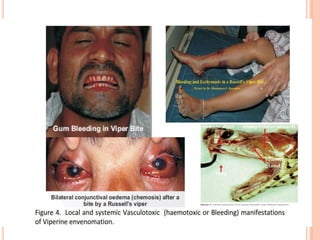
Local manifestations– Russel’s viper bite > Saw scaled viper > Pit viper
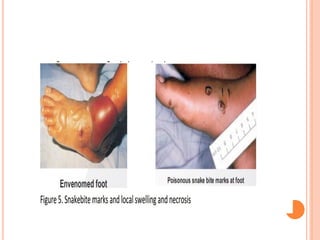
Local swelling, bleeding, blistering, and necrosis.
Pain at bite site and severe swelling leading to compartment syndrome.
Pain on passive movement. Tender enlargement of local draining lymph node.
Systemic manifestations – Visible systemic bleeding from the action of
haemorrhagins e.g. gingival bleeding, epistaxis, ecchymotic patches, vomiting,
hematemesis, hemoptysis, bleeding per rectum, subconjunctival hemorrhages,
continuous bleeding from the bite site, bleeding from pre- existing conditions
e.g. haemorrhoids, bleeding from freshly healed wounds.
- -Bleeding or ecchymosis at the injection site is a common finding in Viper
bites. Petechiae, purpura ecchymoses, blebs and gangrene. Swelling and
local pain.
- --Acute abdominal tenderness may suggest gastro-intestinal or
retroperitoneal bleeding. Lateralizing neurological symptoms such as
asymmetrical pupils may be indicative of intra-cranial bleeding.
- --Consumption coagulopathy
7.
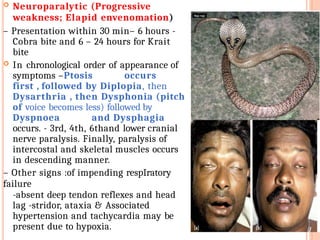
Neuroparalytic (Progressive
weakness;Elapid envenomation)
– Presentation within 30 min– 6 hours -
Cobra bite and 6 – 24 hours for Krait
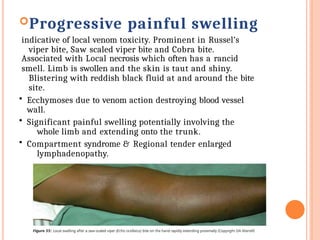
bite
In chronological order of appearance of
symptoms –Ptosis occurs
first , followed by Diplopia, then
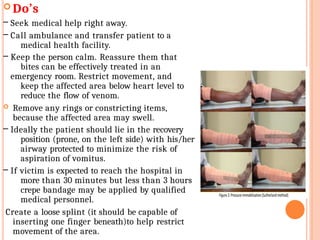
Dysarthria , then Dysphonia (pitch
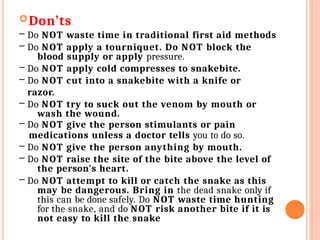
of voice becomes less) followed by
Dyspnoea and Dysphagia
occurs. - 3rd, 4th, 6thand lower cranial
nerve paralysis. Finally, paralysis of
intercostal and skeletal muscles occurs
in descending manner.
– Other signs :of impending respIratory
failure
-absent deep tendon reflexes and head
lag -stridor, ataxia & Associated
hypertension and tachycardia may be
present due to hypoxia.
9.
Occult snakebite
• Kraitbite victims often present in the early morning
with paralysis with no local signs. Krait has
nocturnal habitat and has fine slender teeth. Hence
no bite marks .
Typical presenting history is that the patient was healthy
at night, in the morning gets up with severe
epigastric/umbilical pain with vomiting persisting for 3
– 4hours and followed by typical neuroparalytic
symptoms within next 4- 6 hours.
There is no history of snakebite.
Unexplained respiratory distress in children in the
presence of ptosis or sudden onset of acute flaccid
paralysis in a child (locked-in syndrome) are highly
suspicious symptoms in endemic areas particularly of
Krait bite envenomation. throat pain or chest pain
occasionaly
10.
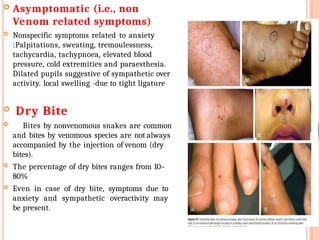
Asymptomatic (i.e.,non
Venom related symptoms)
Nonspecific symptoms related to anxiety
:Palpitations, sweating, tremoulessness,
tachycardia, tachypnoea, elevated blood
pressure, cold extremities and paraesthesia.
Dilated pupils suggestive of sympathetic over
activity. local swelling -due to tight ligature
Dry Bite
Bites by nonvenomous snakes are common
and bites by venomous species are not always
accompanied by the injection of venom (dry
bites).
The percentage of dry bites ranges from 10–
80%
Even in case of dry bite, symptoms due to
anxiety and sympathetic overactivity may
be present.
11.
Myotoxic
Sea snakebite.
• Muscleaches, muscle swelling, involuntary
contractions of muscles.
• Passage of dark brown urine.
• Compartment syndrome, cardiac arrhythmias due to
hyperkalaemia, acute kidney injury due to
myoglobinuria, and subtle neuroparalytic signs.
13.
Physical examination
Carefulassessment of the site of the bite and signs of
local envenomation
Monitor the patient closely,progrssion of swelling and
repeat all above, every 1-2 hourly.
Monitor the following: Pulse rate, respiratory rate, blood
pressure .
Inspection of local site of bite can also help to identify
snake’s species.
Local swelling, bleeding, blistering, necrosis suggests
Cobra bite.
Minimum local changes indicate Krait bite. Local bleeding
suggests Nilgiri Russel’s viper.
Pain in abdomen and hyper peristalsis indicates Krait
bite.
Kraits are active during night hours, often biting a person
sleeping on floor bed. Maximum Viper and Cobra bites occur
during the day or early darkness, while watering the
plantation or walking bare foot in grown grass or soybean
crops.
14.
To identifyimpending respiratory failure bedside
tests :
• Single breath count – number of digits counted in
one exhalation - >30 normal
• Breath holding time – breath held in inspiration
– normal > 45 sec
• Ability to complete one sentence in one breath.
– Cry in a child whether loud or husky can help
in identifying impending respiratory failure
15.
20 minutewhole blood clotting test (20 WBCT):
– It is a bedside test.
– Place 2 ml of freshly sampled venous blood in a small glass test
tube and leave undisturbed for 20 minutes at ambient
temperature.
– Gently tilt the test tube to see if the blood is still liquid; the
patient has hypofibrinogenaemia (“incoagulable” blood or “not
clotted”) as a result of coagulopathy.
if blood clot is formed and signs and symptoms of neurotoxic
envenomation present, classify as neurotoxic envenomation.
– Caution: If the test tube used for the test is not made of
ordinary glass, its wall may not stimulate clotting of the blood
sample in the usual way and test will be invalid.
If clotted, the test should be carried out every 1 h from admission
for three hours and then 6 hourly for 24 hours. In case test is
non-clotting, repeat 6 hour after administration of loading dose of
ASV. In case of neurotoxic envenomation repeat clotting
test after 6 hours.
16.
OTHER LABORATORY TESTS
--Inneuroparalytic envenomation
• Arterial blood gases. Caution: Arterial puncture is
contraindicated in patients with haemostatic abnormalities.
• Pulmonary function tests
– In Vasculotoxic venomation
• For coagulopathy- BT, CT, PT, APTT, Platelet, Serum
Fibrinogen, FDP D-Dimer assay, LDH, peripheral blood smear
• Hemolysis -Urine for myoglobin, Urine haemoglobin
• For renal failure- Urine microscopy for RBC, casts, RFT,
urinary proteins,creatinine ratio
• Hepatic injury – LFTs including SGOT, SGPT, Alkaline
phosphatase, serum proteins
• Cardiotoxicity- CPK-MB, 2D Echo, BNP
• Myotoxic – CPK, SGOT, Urine myoglobin, compartment
pressure
• Infection- Serum procalcitonin, culture (blood, urine, wound)
and sensitivity
– Arterial blood gases and urine examination should be repeated at
frequent intervals during the acute phase to assess progressive
systemic toxicity.
17.
FIRST AID MEASURES
At The Community or Village Level
Check history of snakebite and look for obvious evidence
of a bite (fang puncture marks, bleeding, swelling of the
bitten part etc.). However, in krait bite no local marks
may be seen.
– Reassure the patient as around 70% of all snakebites
are from non-venomous species.
– Immobilize the limb in the same way as a fractured
limb. Use bandages or cloth to hold the splints (wooden
stick), but do NOT block the blood supply or apply
pressure. Ideally the patient should lie in the
recovery position (prone, on the left side) with
his/her airway protected to minimize the risk of
aspiration of vomitus
18.
Nil bymouth till victim reaches a medical health facility.
– Traditional remedies have NO PROVEN benefit in
treating snakebite.
– Shift the victim to the nearest health facility (PHC or
hospital) immediately Inform the doctor of any
symptoms such as progress of swelling, ptosis
or new symptoms that manifest on the way to hospital.
– Remove shoes, rings, watches, jewellery and tight clothing
from the bitten area as they can act as a tourniquet when
swelling occurs.
– Leave the blisters undisturbed.
At A Health Care Facility
– Admit all victims of snakebite confirmed or
suspected and keep under observation for 24 hours.
– Provide first-aid measures, supportive measures
immediately. Observe for signs of envenomation.
Administer ASV therapy as soon as there is evidence of
envenomation
19.
ANTI SNAKE VENOM(ASV) THERAPY
– If ASV is indicated i.e. signs and symptoms of
envenomation with or without evidence of
laboratory tests, administer full dose.
– There are no absolute contraindications to
ASV.
– Purely local swelling, even if accompanied by a bite
mark from an apparently venomous snake, is not a
ground for administering ASV. Swelling, a number of
hours old is also not a ground for giving ASV.
However, rapid development of swelling
indicates bite with envenoming requiring AVS
ASV supplied in dry powder form has to be
reconstituted by diluting in 10 ml of distilled
water/normal saline . Mixing is done by swirling and
not by vigorous shaking.
20.
PRECAUTIONS DURING
ASV
ADMINISTRATION
ASV should be given by IV route only slowly(under
aseptic conditions) with physician at the bed side. The
rate of infusion can be increased gradually in the
absence of a reaction until the full starting dose has
been administered (over a period of ~1 hour).
– Epinephrine (adrenaline) should always be drawn up in
readiness before ASV is administered.
– DONOT inject the ASV locally at the bite site or IM since
it is not effective & is extremely painful and may increase
intra-compartmental pressure.
Dose of ASV for neuroparalytic
snakebite – ASV 10 vials stat as infusion over
30 minutes followed by 2nd dose of 10 vials after 1
hour if no improvement within 1st hour
21.
Dose of ASVfor vasculotoxic
snakebite –
Two regimens low dose infusion :
– Low Dose infusion therapy – 10 vials for Russel’s viper or 6
vials for Saw scaled viper as stat as infusion over 30 minutes
followed by 2 vials every 6 hours as infusion in 100 ml of normal
saline till clotting time normalizes or for 3 days whichever is
earlier.
OR
– High dose intermittent bolus therapy - 10 vials of polyvalent
ASV stat over 30minutes as infusion, followed by 6 vials 6 hourly
as bolus therapy till clotting time normalizes and/or local swelling
subsides.
– No ASV for Sea snakebite or pit viper bite as available ASV
does not contain antibodies against them.
– The range of venom injected is 5 mg-147 mg. The total required
dose range between 10 and 30 vials as each vial neutralizes 6 mg of
Russell’s Viper venom.
Depending on the patient condition, additional vials can be
considered.
22.
Repeat dose ofASV
– Repeat dose: in Vasculotoxic or haemotoxic
envenomation
Repeat clotting test every 6 hours until coagulation is
restored. Administer ASV every 6 h until coagulation is
restored. If 30 vials of ASV have been administered
reconsider whether continued administration of ASV is
serving any purpose, particularly in the absence of proven
systemic bleeding.
– Repeat dose: Neurotoxic envenomation
Give 10 vials of ASV on arrival and if no improvement within
one hour repeat10 vials of ASV (No more than 20 vials of
ASV).
• No further ASV and Atropine Neostigmine (AN) infusion is
required ONLY to reverse the Ptosis. Ptosis in Common
Krait bite is due to presynaptic blockage, further ASV and
Neostigmine dose beyond 3 doses cannot reverse it, since
regeneration is a natural process and may take 4-5 days.
23.
ASV REACTION
NOASV TEST DOSE MUST BE ADMINISTERED.NO
ROLE OF SKIN/CONJUNCTIVAL
HYPERSENSITIVITY .
– Early anaphylactic reactions : within 10–180 min
&
characterized by itching, urticaria, dry cough, nausea and
vomiting, abdominal colic, diarrhoea, tachycardia, and
fever.
– Pyrogenic reactions usually develop 1–2 h after
treatment. Symptoms include chills and rigors, fever,
and hypotension. These reactions are caused by
contamination of the ASV with pyrogens during the
manufacturing process.
– Any new sign or symptom after starting the ASV in
drip should be suspected as a reaction to ASV.
– Late (serum sickness–type) reactions develop 1–12
(mean 7) days after treatment : fever, nausea, vomiting,
diarrhoea, itching, recurrent urticaria, arthralgia, myalgia,
lymphadenopathy, immune complex nephritis and, rarely,
encephalopathy.
24.
TREATMENT FO REARLY ASV
REACTION
STOP ASV temporarily
Oxygen
Start fresh IV normal saline infusion with a new IV
set
Administer Epinephrine (adrenaline) (1 in 1,000
solution intramuscular over deltoid or over
thigh; In children 0.01 mg/kg body weight) for
early anaphylactic and pyrogenic ASV reactions.
Administer Chlorpheniramine maleate in
children
0.2 mg/kg intravenously.
Role of Hydrocortisone in managing ASV
reaction is not proved.
Once the patient has recovered, re-start ASV slowly for 10-
15 minutes keeping the patient under close observation.
Then resume normal drip rate.
25.
Treatment ofLate (serum sickness–type)
reactions
– Inj. Chlorpheniramine 2 mg in adults (In children
0.25 mg/kg/day) 6 hourly for 5days.
– In patients who fail to respond within 24–48 h
give a 5-day course of Prednisolone (5 mg 6
hourly in adults and 0.7 mg/kg/day in divided
doses in children.
26.
MANAGEMENT NEUROTOXIC
(NEUROPARALYTIC)ENVENOMATION
Antisnake venom treatment alone cannot be relied
upon to save the life of a patient . Administer
following in addition:
– Oxygen
– Assisted ventilation
Atropine neostigmine (AN) dosage schedule
– Atropine 0.6 mg followed by neostigmine (1.5mg) to be given
IV stat and repeat dose of neostigmine 0.5 mg with atropine
every 30 minutes for 5 doses (In children, Inj. Atropine 0.05
mg/kg followed by Inj. Neostigmine 0.04 mg/kg
Intravenous and repeat dose 0.01 mg/kg every 30
minutes for 5 doses). A fixed dose combination of
Neostigmine and glycopyrolate IV can also be used.
– Thereafter to be given as tapering dose at 1 hour, 2 hour, 6
hours and 12 hour
27.
Majority ofpatients improve within first 5 doses. Observe the
patient closely observed for 1 hour to determine if the
neostigmine is effective. After 30 minutes, any improvement
should be visible by an improvement in ptosis.
Positive response to “AN” trial is measured as 50% or more
recovery of theptosis in one hour.
– Stop Atropine neostigmine (AN)
dosage schedule if:
Patient has complete recovery from neuroparalysis. Rarely
patient can have recurrence, carefully watch patients for
recurrence.
• Patient shows side effects in the form of fasciculations or
bradycardia.
• If there is no improvement after 3 doses.
– Improvement by atropine neostigmine indicates Cobra bite .
28.
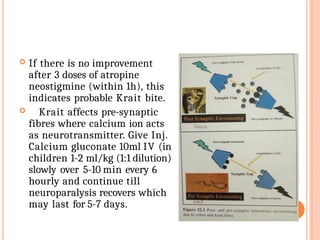
If thereis no improvement
after 3 doses of atropine
neostigmine (within 1h), this
indicates probable Krait bite.
Krait affects pre-synaptic
fibres where calcium ion acts
as neurotransmitter. Give Inj.
Calcium gluconate 10ml IV (in
children 1-2 ml/kg (1:1 dilution)
slowly over 5-10 min every 6
hourly and continue till
neuroparalysis recovers which
may last for 5-7 days.
29.
MANAGEMENT OFVASCULOTOXIC
SNAKEBITE:
– Strict bed rest to avoid even minor trauma.
– Screen for hematuria, hemoglobinuria,
myoglobinuria by Dipstick method.
– Closely monitor urine output and maintain 1
ml/kg/h urine output.
Volume Replacement in snake bite:
– If the patient has intravascular volume
depletion:
– Establish intravenous access.
– Give fluid challenge: with isotonic
saline
– Observe the patient closely while this is being
done. The fluid challenge must be stopped
immediately if pulmonary oedema develops.
30.
For coagulopathy– in case of prolonged CT,
PT, aPTT administer fresh frozen plasma (FFP)
infusion. Low fibrinogen and high FDP will require
fibrinogen/FFP supplementation.
Bleeding leads to anaemia, PCV of 30% must be
maintained, therefore, measure serial PCV every 4 – 6
h depending upon bleeding severity of patients. If PCV
is lower than 30 needs blood transfusion/PCV
transfusion.
– FFP administration after ASV administration results
in more rapid restoration of clotting function .
Administer 10-15 ml/kg of FFP within over 30–60 min
within 4 hours of ASV administration. The aim should
be a return of coagulation function, as defined by an INR
of < 2.0, at 6 h after ASV administration was
commenced.
Antifibrinolytic agents are not effective and
should not be used in victims
31.
MANAGEMENT OF SE V E R E
L O C A L ENVENOMING
– Give prophylactic broad-spectrum antimicrobial
treatment for cellulitis after completion of first 10
vials of ASV is as following.
• Inj. Amoxiciilin+ clavulanic acid In children,
the dose is 100
mg/Kg/day in three divided doses
intravenously; for oral therapy, the dose is
50mg/kg/day in divided doses.or inj
metronidazole.
32.
Recovery phase orobservation of
the response to adequate dose of
antisnake venom
Response to infusion of ASV is marked by
-- normalization of blood pressure.
--Within 15–30 min bleeding stops, though coagulation
disturbances may take up to 6 h to normalize.
– Neurotoxic envenoming of the postsynaptic type (Cobra
bites) begins to improve within the first 30 min, but
patients may require 24–48 h for full recovery.
Envenoming with pre synaptic toxins (Kraits and sea
snakes) do not respond
– Nausea, headache and generalised aches and pains may
disappear very quickly.
– In shock patients, blood pressure may increase within the
first 30-60 minutes and arrhythmias such as sinus
bradycardia may resolve.
– Active haemolysis and rhabdomyolysis may cease within a
few hours . However, red colour urine may persist for
several days due to damage of renal papillae, no further
ASV can help.
33.
COMPLICATIONS O FSNAKE BITE
Renal involvement : hematuria, hemoglobinuria,
myoglobinuria followed by oliguria and anuria with acute
kidney injury (AKI).
Bilateral renal angle tenderness.
Passage of discolored (reddish or dark brown urine or
declining urine output.
Acute Kidney Injury e.g. declining or no urine output,
rising serum creatinine, urea or K+
Hypotension due to hypovolaemia or direct vasodilatation
or direct cardiotoxicity aggravates AKI.
Parotid swelling, conjunctiva oedema, sub-conjunctival
haemorrhage, renal failure, acute respiratory distress
syndrome [leaking syndrome] and refractory shock.
Long term sequelae e.g. pituitary insufficiency with
Russell’s viper (Daboia sp),Sheehan’s syndrome or
amenorrhea in females.
34.
Progressive painful swelling
indicativeof local venom toxicity. Prominent in Russel’s
viper bite, Saw scaled viper bite and Cobra bite.
Associated with Local necrosis which often has a rancid
smell. Limb is swollen and the skin is taut and shiny.
Blistering with reddish black fluid at and around the bite
site.
• Ecchymoses due to venom action destroying blood vessel
wall.
• Significant painful swelling potentially involving the
whole limb and extending onto the trunk.
• Compartment syndrome & Regional tender enlarged
lymphadenopathy.
35.
Compartment syndrome
Clinical featuresof a compartmental syndrome
Compartment syndrome is diagnosed with 5 ‘P’ –
• Pain (severe)
• Pallor
• Paraesthesia
• Pulselessness
• Paralysis or weakness of compartment muscle.
36.
Criteria for fasciotomyin snakebite
limb
• Haemostatic abnormalities have been corrected
Clinical evidence of an intracompartmental
syndrome
• Intra-compartmental pressure >40 mmHg of
normal saline (inadults).
.Compartment pressure can be measured bed side
using 3 way cannula – 16 Gneedle attached to one
end, BP apparatus attached to 2nd end and saline
infusion on 3rd side .
This can be confirmed by vascular Doppler and
rising CPK in thousands. Timely fasciotomy
decreases the need for repeated dialysis
37.
Discharge
Ifno symptoms and signs develop after 24 hours the patient can be
discharged.
Keep the patient under observation for 48 hours if ASV was
infused.
Follow-up
A snakebite victim discharged from the hospital should continue to
be followed up.
At the time of discharge patient should be advised to return to the
emergency, if there is worsening of symptoms or signs such as
evidence of bleeding, worsening of pain and swelling at the site of
bite, difficulty in breathing, altered sensorium, reduced or increased
urine output etc & explained about the signs and symptoms of serum
sickness (fever, joint pain, joint swelling) which may manifest after 5-
10 days.
Rehabilitation
In patients with severe local envenoming, the limb should be
maintained in a functional position.
Conventional physiotherapy may accelerate recovery of bitten
limb
38.
Do’s
– Seekmedical help right away.
– Call ambulance and transfer patient to a
medical health facility.
– Keep the person calm. Reassure them that
bites can be effectively treated in an
emergency room. Restrict movement, and
keep the affected area below heart level to
reduce the flow of venom.
Remove any rings or constricting items,
because the affected area may swell.
– Ideally the patient should lie in the recovery
position (prone, on the left side) with his/her
airway protected to minimize the risk of
aspiration of vomitus.
– If victim is expected to reach the hospital in
more than 30 minutes but less than 3 hours
crepe bandage may be applied by qualified
medical personnel.
Create a loose splint (it should be capable of
inserting one finger beneath)to help restrict
movement of the area.
39.
Don’ts
– Do NOTwaste time in traditional first aid methods
– Do NOT apply a tourniquet. Do NOT block the
blood supply or apply pressure.
– Do NOT apply cold compresses to snakebite.
– Do NOT cut into a snakebite with a knife or
razor.
– Do NOT try to suck out the venom by mouth or
wash the wound.
– Do NOT give the person stimulants or pain
medications unless a doctor tells you to do so.
– Do NOT give the person anything by mouth.
– Do NOT raise the site of the bite above the level of
the person's heart.
– Do NOT attempt to kill or catch the snake as this
may be dangerous. Bring in the dead snake only if
this can be done safely. Do NOT waste time hunting
for the snake, and do NOT risk another bite if it is
not easy to kill the snake

![COMPLICATIONS O F SNAKE BITE
Renal involvement : hematuria, hemoglobinuria,
myoglobinuria followed by oliguria and anuria with acute
kidney injury (AKI).
Bilateral renal angle tenderness.
Passage of discolored (reddish or dark brown urine or
declining urine output.
Acute Kidney Injury e.g. declining or no urine output,
rising serum creatinine, urea or K+
Hypotension due to hypovolaemia or direct vasodilatation
or direct cardiotoxicity aggravates AKI.
Parotid swelling, conjunctiva oedema, sub-conjunctival
haemorrhage, renal failure, acute respiratory distress
syndrome [leaking syndrome] and refractory shock.
Long term sequelae e.g. pituitary insufficiency with
Russell’s viper (Daboia sp),Sheehan’s syndrome or
amenorrhea in females.](https://image.slidesharecdn.com/snakebite-250910172023-7b28afae/85/snake-bite-ppt-pptx-snake-bite-presentation-33-320.jpg)



![PERI-PROSTHETIC FRACTURE NAIL-PLATE CONSTRUCT [NPC].pptx](https://cdn.slidesharecdn.com/ss_thumbnails/drarunkumardrmohamedashrafperiprostheticfrasturenail-plateconstructnpc-260209164459-7e9d15a1-thumbnail.jpg?width=640&height=640&fit=bounds)


