SNAKE BITE
Dr. Soujanya
Assistant Professor
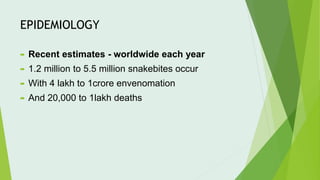
EPIDEMIOLOGY
 Recent estimates - worldwide each year
 1.2 million to 5.5 million snakebites occur
 With 4 lakh to 1crore envenomation
 And 20,000 to 1lakh deaths
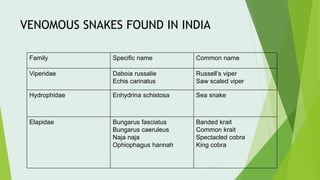
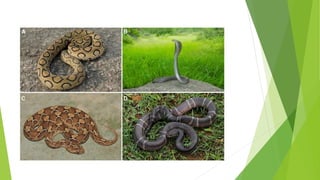
VENOMOUS SNAKES FOUND IN INDIA
Family Specific name Common name
Viperidae Daboia russalie
Echis carinatus
Russell’s viper
Saw scaled viper
Hydrophidae Enhydrina schistosa Sea snake
Elapidae Bungarus fasciatus
Bungarus caeruleus
Naja naja
Ophiophagus hannah
Banded krait
Common krait
Spectacled cobra
King cobra
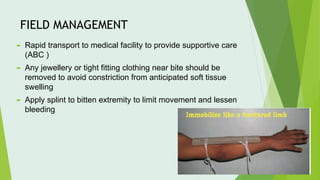
FIELD MANAGEMENT
 Rapid transport to medical facility to provide supportive care
(ABC )
 Any jewellery or tight fitting clothing near bite should be
removed to avoid constriction from anticipated soft tissue
swelling
 Apply splint to bitten extremity to limit movement and lessen
bleeding
CLINICAL
PRESENTATION
CLINICAL PICTURE DEPENDS ON-
 Species involved
 Anatomic location of bite
 Amount of venom injected
 Season of the bite
 Whether snake is fed or unfed
 Area covered or uncovered
 Dry or incomplete bite
 Multiple bites
 Venom injection in the vessel
 Weight of victim
 Time elapsed between bite and administration of ASV
Non venom related symptoms
 NON SPECIFIC SYMPTOMS RELATED TO ANXIETY
 Palpitations, sweating, tremulousness, tachycardia,
tachypnoea, elevated BP, cold extremities and paresthesia
 May have dilated pupils – s/o sympathetic overactivity
 SIGNS AND SYMPTOMS OF ENVENOMATION
 Redness, increased temperature, persistant bleeding and
tenderness locally
DRY BITE
 Bites by non venomous snakes/ bites by venomous
species not accompanied by injection of venom
 10-80% range of dry bites for various poisonous
snakes
 Symptoms due to anxiety and sympathetic
overactivity may be present
 Symptoms associated with panic or stress
sometimes mimic early envenoming symptoms
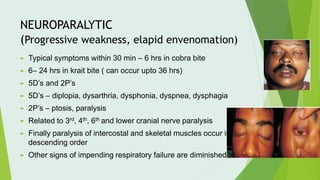
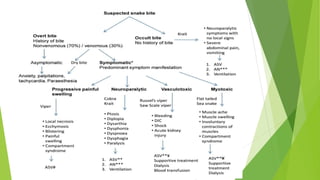
NEUROPARALYTIC
(Progressive weakness, elapid envenomation)
 Typical symptoms within 30 min – 6 hrs in cobra bite
 6– 24 hrs in krait bite ( can occur upto 36 hrs)
 5D’s and 2P’s
 5D’s – diplopia, dysarthria, dysphonia, dyspnea, dysphagia
 2P’s – ptosis, paralysis
 Related to 3rd, 4th, 6th and lower cranial nerve paralysis
 Finally paralysis of intercostal and skeletal muscles occur in
descending order
 Other signs of impending respiratory failure are diminished
To identify impending respiratory failure
in adults-
 SINGLE BREATH COUNT –
 number of digits counted in one exhalation - >30 is normal
 BREATH HOLDING TIME –
 Breath held in inspiration - >45 sec is normal
 Ability to complete one sentence in one breatth
 Refer to higher centre immediately after giving Atropine
Neostigmine ( AN ) injection for intensive monitoring
VASCULOTOXIC
( hemotoxic or Bleeding; viperine envenomation)
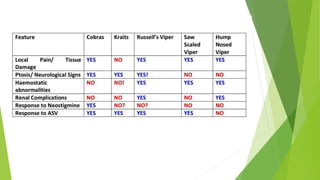
LOCAL MANIFESTATIONS
 Prominence – Russel’s viper > saw scaled viper > pit viper
 MANIFESTATIONS
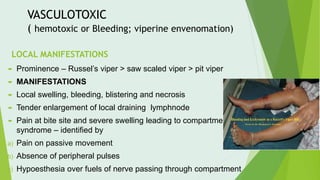
 Local swelling, bleeding, blistering and necrosis
 Tender enlargement of local draining lymphnode
 Pain at bite site and severe swelling leading to compartment
syndrome – identified by
a) Pain on passive movement
b) Absence of peripheral pulses
c) Hypoesthesia over fuels of nerve passing through compartment
SYSTEMIC MANIFESTATIONS
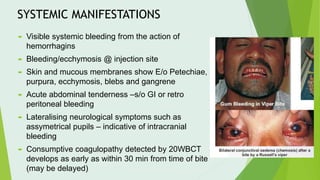
 Visible systemic bleeding from the action of
hemorrhagins
 Bleeding/ecchymosis @ injection site
 Skin and mucous membranes show E/o Petechiae,
purpura, ecchymosis, blebs and gangrene
 Acute abdominal tenderness –s/o GI or retro
peritoneal bleeding
 Lateralising neurological symptoms such as
assymetrical pupils – indicative of intracranial
bleeding
 Consumptive coagulopathy detected by 20WBCT
develops as early as within 30 min from time of bite
(may be delayed)
LIFE THREATENING COMPLICATIONS
(due to renal involvement)
 Presents with hematuria,hemoglobinuria, followed by
oliguria, anuria with Acute kidney injury (AKI)
• Bilateral renal angle tenderness
• Passage of discoloured urine( reddish or dark brown) or
declining urine output
• Deteorating renal signs – rising serum creatinine, urea , or
potassium
• some species e.g. Russell’s viper and saw scaled vipers
frequently cause acute kidney ininjury
• LONG TERM SEQUELAE – E.g. pituatary insufficiency with
Russell’s viper, sheehan’s syndrome or amenorrhea in females
PAINFUL PROGRESSIVE SWELLING
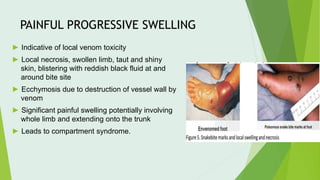
► Indicative of local venom toxicity
► Local necrosis, swollen limb, taut and shiny
skin, blistering with reddish black fluid at and
around bite site
► Ecchymosis due to destruction of vessel wall by
venom
► Significant painful swelling potentially involving
whole limb and extending onto the trunk
► Leads to compartment syndrome.
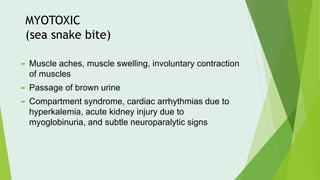
MYOTOXIC
(sea snake bite)
 Muscle aches, muscle swelling, involuntary contraction
of muscles
 Passage of brown urine
 Compartment syndrome, cardiac arrhythmias due to
hyperkalemia, acute kidney injury due to
myoglobinuria, and subtle neuroparalytic signs
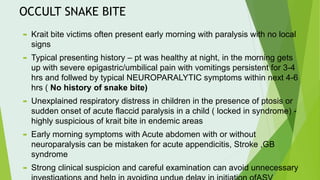
OCCULT SNAKE BITE
 Krait bite victims often present early morning with paralysis with no local
signs
 Typical presenting history – pt was healthy at night, in the morning gets
up with severe epigastric/umbilical pain with vomitings persistent for 3-4
hrs and follwed by typical NEUROPARALYTIC symptoms within next 4-6
hrs ( No history of snake bite)
 Unexplained respiratory distress in children in the presence of ptosis or
sudden onset of acute flaccid paralysis in a child ( locked in syndrome) -
highly suspicious of krait bite in endemic areas
 Early morning symptoms with Acute abdomen with or without
neuroparalysis can be mistaken for acute appendicitis, Stroke ,GB
syndrome
 Strong clinical suspicion and careful examination can avoid unnecessary
PATIENT ASSESSMENT ON ARRIVAL TO
HOSPITAL
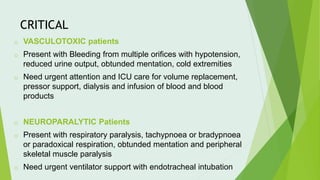
CRITICAL
o VASCULOTOXIC patients
o Present with Bleeding from multiple orifices with hypotension,
reduced urine output, obtunded mentation, cold extremities
o Need urgent attention and ICU care for volume replacement,
pressor support, dialysis and infusion of blood and blood
products
o NEUROPARALYTIC Patients
o Present with respiratory paralysis, tachypnoea or bradypnoea
or paradoxical respiration, obtunded mentation and peripheral
skeletal muscle paralysis
o Need urgent ventilator support with endotracheal intubation
NON-CRITICAL
 TAKE HISTORY REGARDING
• Time elapsed since the snake bite
• What the victim was doing at the time of bite
• H/o sleeping on floor previous night
• If any traditional practices have been used
• Brief medical history ( date of last tetanus immunization,
use of any medication, presence of any systemic disease
and history of allergy)
• If the victim has brought the snake, identification of
species should be carried out carefully, since crotalids
can envenomate even when dead.
PHYSICAL EXAMINATION And 20- min WBCT
 Careful assessment of bite site and signs of
local envenomation and examination of
patient
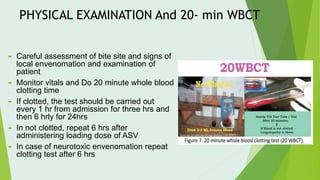
 Monitor vitals and Do 20 minute whole blood
clotting time
 If clotted, the test should be carried out
every 1 hr from admission for three hrs and
then 6 hrly for 24hrs
 In not clotted, repeat 6 hrs after
administering loading dose of ASV
 In case of neurotoxic envenomation repeat
clotting test after 6 hrs
INVESTIGATIONS
 20 minute whole blood clotting time – to diagnose
coagulopathy
 Complete blood picture – to determine degree of
hemorrhage or hemolysis and to detect
thrombocytopenia
 RFT and LFT’s
 Coagulation studies- to diagnose consumptive
coagulopathy
 Measurement of creatine kinase and testing of urine
for blood or myoglobin- for suspected rhadomyolysis
 ABG, ECG, Chest X Ray – in severe envenomations or
in pts with significant comorbididties
HOSPITAL MANAGEMENT
⮚ ABC
⮚ Monitoring of vitals , cardiac rhythm , oxygen saturation and
urine output
⮚ Secure two large bore iv lines in unaffected extremities
⮚ Fluid resuscitation with isotonic saline 20-40 ml/kg iv ; if
hemodynamic instability is present (5% Albumin can be tried if
response to saline is inadequate)
⮚ Vasopressors ( norepinephrine , dopamine) – only if venom
induced shock persists after aggressive volume resuscitation and
antivenom administration
⮚ Invasive hemodynamic monitoring ( central venous / continous
arterial pressures ) is helpful but risky if coagulopathy has
devoloped
DO’S 💯 ☑️
 Thorough history and complete physical examination
 Removal of bandages and wraps applied in the field
 Objective evaluation
i. Leading edge of the swelling
ii. Ecchymosis
iii. Tenderness
iv. Measurement of limb circumference every 15 min until
local tissue effects have stabilised
⮚ Victims of neurotoxic envenomation need close monitoring for
evidence of cranial nerve dysfunction (ptosis) – may precede
overt signs of impending airway compromise necessitating ET
intubation and Mechanical ventilation
AVOID❌
 Incising and suction to bite site ( exacerbates local
tissue damage ; increases risk of infection)
 Application of poultices,ice and electric shock
 Venom sequestration devices Eg: lympho occlusive
bandages ,torniquets ( intensify local tissue
damage by restricting the spread of potentially
necrotising venom)
 Tourniquet use can result in loss of
function,ischemia and limb amputation even in the
absence of envenomation
ANTIVENOM – MAINSTAY OF RX
 Produced by injecting animals ( horses/sheep) with venoms
from medically important snakes
 GOAL – to allow antibodies to bind and deactivate circulating
venom components before they attach to target tissues and
cause deleterious effects
 Limited efficacy in preventing local tissue damage caused by
necrotising venoms
 Should be administered as soon as need for it is identified (
Eg cranial nerve dysfunction as evidence of neurotoxicity)
 Effective only in reversing active venom toxicity ( no benefit in
reversing effects that have been already established Eg :
renal failure , paralysis
INDICATIONS FOR ANTIVENOM
ADMINISTRATION
 Significant progressive local findings ( Eg : soft
tissue swelling that crosses a joint)
 Involvement of more than half of bitten limb
 Rapidly spreading
 Extensive blistering or bruising
 Severe pain
 Evidence of systemic envenomation
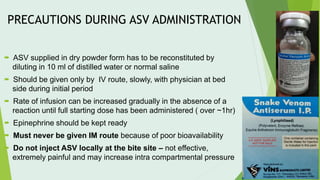
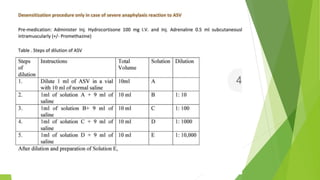
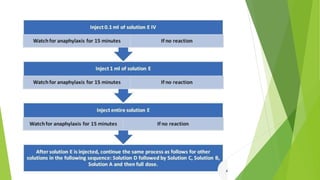
PRECAUTIONS DURING ASV ADMINISTRATION
 ASV supplied in dry powder form has to be reconstituted by
diluting in 10 ml of distilled water or normal saline
 Should be given only by IV route, slowly, with physician at bed
side during initial period
 Rate of infusion can be increased gradually in the absence of a
reaction until full starting dose has been administered ( over ~1hr)
 Epinephrine should be kept ready
 Must never be given IM route because of poor bioavailability
 Do not inject ASV locally at the bite site – not effective,
extremely painful and may increase intra compartmental pressure
DOSE OF ASV
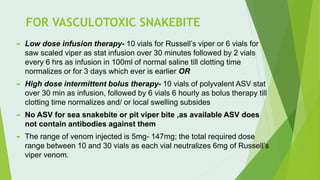
 FOR NEUROPARALYTIC SNAKEBITE
 ASV 10 vials stat as infusion over 30 minutes followed by 2nd dose of 10 vials
after 1 hour if no improvement within 1st hr
FOR VASCULOTOXIC SNAKEBITE
 Low dose infusion therapy- 10 vials for Russell’s viper or 6 vials for
saw scaled viper as stat infusion over 30 minutes followed by 2 vials
every 6 hrs as infusion in 100ml of normal saline till clotting time
normalizes or for 3 days which ever is earlier OR
 High dose intermittent bolus therapy- 10 vials of polyvalent ASV stat
over 30 min as infusion, followed by 6 vials 6 hourly as bolus therapy till
clotting time normalizes and/ or local swelling subsides
 No ASV for sea snakebite or pit viper bite ,as available ASV does
not contain antibodies against them
 The range of venom injected is 5mg- 147mg; the total required dose
range between 10 and 30 vials as each vial neutralizes 6mg of Russell’s
viper venom.
REPEAT DOSE OF ASV
 IN VASCULOTOXIC OR HEMOTOXIC ENVENOMATION
 Administer ASV every 6 h until coagulation is restored
 If 30 vials of ASV have been administered reconsider whether
continued administration ofASV is serving any purpose, particularly
in the absence of proven systemic bleeding
 IN NEUROTOXIC ENVENOMATION
 Repeat ASV when there is worsening neurotoxic or cardiovascular
signs even after 1-2 hr
 Maximum dose – 20 vials
 If coagulation abnormality persists, give FFP or cryoprecipitate (
fibrinogen, factor VIII ), fresh whole blood, if FFP not available or
platelet concentrate
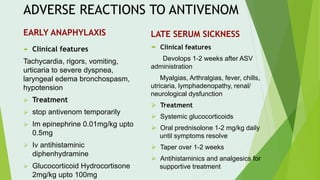
ADVERSE REACTIONS TO ANTIVENOM
EARLY ANAPHYLAXIS LATE SERUM SICKNESS
 Clinical features
Tachycardia, rigors, vomiting,
urticaria to severe dyspnea,
laryngeal edema bronchospasm,
hypotension
⮚ Treatment
⮚ stop antivenom temporarily
⮚ Im epinephrine 0.01mg/kg upto
0.5mg
⮚ Iv antihistaminic
diphenhydramine
⮚ Glucocorticoid Hydrocortisone
2mg/kg upto 100mg
 Clinical features
Devolops 1-2 weeks after ASV
administration
Myalgias, Arthralgias, fever, chills,
utricaria, lymphadenopathy, renal/
neurological dysfunction
⮚ Treatment
⮚ Systemic glucocorticoids
⮚ Oral prednisolone 1-2 mg/kg daily
until symptoms resolve
⮚ Taper over 1-2 weeks
⮚ Antihistaminics and analgesics for
supportive treatment
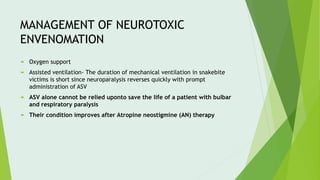
MANAGEMENT OF NEUROTOXIC
ENVENOMATION
 Oxygen support
 Assisted ventilation- The duration of mechanical ventilation in snakebite
victims is short since neuroparalysis reverses quickly with prompt
administration of ASV
 ASV alone cannot be relied uponto save the life of a patient with bulbar
and respiratory paralysis
 Their condition improves after Atropine neostigmine (AN) therapy
ATROPINE NEOSTIGME (AN) DOSE-
 Atropine 0.6 mg followed by neostigmine (1.5mg) to be given IV stat
 Repeat dose of neostigmine 0.5mg with Atropine every 30 min for 5
doses
 Thereafter to be given as tapering dose at 1 hr, 2hr, 6 hrs and 12 hrs
 Majority improve within first 5 doses
 If neostigmine is effective, ptosis improvement is visible after 30 min of
dosage
 Stop AN dosage if-
• Complete recovery from neuroparalysis ( cobra bite)
• Side effects – fasciculations or bradycardia
• No improvement after 3 doses ( krait bite)
⮚ Krait affects pre- synaptic fibres where calicium ion acts as NT
• Give Inj. Calicium gluconate 10ml IV slowly over 5-10 min every 6th hrly
and continue till nueroparalysis recovers ( may last 5-7 days)
MANAGEMENT OF VASCULOTOXIC SNAKEBITE
 Strict bed rest to avoid even minor trauma
 Screen for hematuria, hemoglobinuria, myoglobinuria by Dipstick
method
 Volume replacement-
 If patient has signs of intravascular volume depletion, Give fluid
challenge with 2 litres isotonic saline over one hr
 Fluid challenge must be stopped immediately if pulmonary edema
devolops
 Forced alkaline diuresis (FAD)-
 If the patient has oliguria or dipstick positive for blood give a trial of
FAD within first 24 hrs of the bite to avoid pigment nephropathy
leading to ACUTE TUBULAR NECROSIS
 Delayed FAD has no role
SEQUENCE OF FAD
 Inj. Furosemide 40mg IV stat
 Inj. Normal saline 500 ml + 20 ml of NaHCO3 over 20 min
 Inj. Ringer’s lactate 500ml + 20 ml of NaHCO3 over 20 min
 Inj. 5% dextrose 500ml + 10 ml of KCL over 90 min
 Inj. Mannitol 150 ml over 20 min
 Whole cycle completes in 2h 30 min and urine output of 3
ml/min is expected
 If patient responds to First cycle continue for 3 cycles
 If there is no response to furosemide discontinue FAD
and refer patient for dialysis
 Dialysis is indicated if blood urea > 130mg/dl ; sr.creatinine >
4 mg/dl
FOR COAGULOPATHY
 In case of prolonged CT, PT ,APTT patient needs FFP
administration
 FFP should be given after ASV administration for rapid resoration
of clotting function
 Administer 10-15 ml/kg of FFP within over 30-60 min within 4 hrs
of ASV administration
 Aim is to restore coagulation function (i.e, INR < 2, at 6 hr after
ASV administration was commenced)
 Heparin is ineffective against venom induced thrombosis and
may cause bleeding- should never be used
MANAGEMENT OF SEVERE LOCAL
ENVENOMING
 If ASV is NOT administered - local
necrosis,intracompartmental syndrome and even thrombosis
of major vessels are more likely
 Surgical intervention may be needed but risks of surgery must
be outweighed against life threatening complications of local
envenoming
 For cellulitis Give prophylactic broad spectrum
antibiotics-
 Inj. Amoxyclav 1.2 g IV TID for first 7 days ; then switch to
oral Tab. Amoxyclav 625 mg TID for further 3-7 days
 Inj. Metronidazole 400mg IV TID for 7 days
RECOVERY PHASE / ADEQUATE RESPONSE
TO ASV
 Response to ASV infusion is marked by normalisation of
BP , Within 15-30 min Bleeding stops , though
coagulation profile takes upto 6 hrs to normalise
 Neurotoxic envenoming of cobra bite ( post synaptic)
begins to improve within first 30 min , but patients may
require 24-48 hrs for full recovery
 Active hemolysis and rhabdomyolysis may cease within
few hrs and the urine returns to its normal colour ( red
colour may persist for some days if damage to renal
papillae occurred)
OTHER MEASURES
 Clean the bite site with povidine iodine solution
 For progressive swelling – limb elevation and glycerine +
MgSO4 dressings can help
 Leave blisters alone; Allow them to heal spontaneously
 If there is local necrosis, excise and apply saline dressings
 Administer booster dose of Tetanus toxoid injection, if not
vaccinated earlier or vaccination history is unreliable
 For mild pain – Tab paracetamol and for severe pain-
Tramadol oral or iv can be given
 Morbidity and mortality depends on the age and size of
victim, comorbid conditions as well as nature of first aid
given
DISCHARGE AND FOLLOW UP
 If no symptoms and signs develop after 24 hrs ,the patient can
be discharged
 Keep the patient under observation for 48 hrs if ASV was infused
 At the time of discharge patient should be advised to return to
emergency if-
• Worsening of Pain and swelling at the bite site
• Evidence of Bleeding
• Difficulty in breathing
• Altered sensorium
• Reduced urine output
⮚ Patients should as be explained about signs and symptoms of
serum sickness which may manifest after 5-10 days
REFERENCES
HARRISONS 21ST EDITION
THANK YOU

SNAKE BITE presentation... Ppt..........

  • 1.
  • 2.
    EPIDEMIOLOGY  Recent estimates- worldwide each year  1.2 million to 5.5 million snakebites occur  With 4 lakh to 1crore envenomation  And 20,000 to 1lakh deaths
  • 3.
    VENOMOUS SNAKES FOUNDIN INDIA Family Specific name Common name Viperidae Daboia russalie Echis carinatus Russell’s viper Saw scaled viper Hydrophidae Enhydrina schistosa Sea snake Elapidae Bungarus fasciatus Bungarus caeruleus Naja naja Ophiophagus hannah Banded krait Common krait Spectacled cobra King cobra
  • 5.
    FIELD MANAGEMENT  Rapidtransport to medical facility to provide supportive care (ABC )  Any jewellery or tight fitting clothing near bite should be removed to avoid constriction from anticipated soft tissue swelling  Apply splint to bitten extremity to limit movement and lessen bleeding
  • 6.
  • 7.
    CLINICAL PICTURE DEPENDSON-  Species involved  Anatomic location of bite  Amount of venom injected  Season of the bite  Whether snake is fed or unfed  Area covered or uncovered  Dry or incomplete bite  Multiple bites  Venom injection in the vessel  Weight of victim  Time elapsed between bite and administration of ASV
  • 8.
    Non venom relatedsymptoms  NON SPECIFIC SYMPTOMS RELATED TO ANXIETY  Palpitations, sweating, tremulousness, tachycardia, tachypnoea, elevated BP, cold extremities and paresthesia  May have dilated pupils – s/o sympathetic overactivity  SIGNS AND SYMPTOMS OF ENVENOMATION  Redness, increased temperature, persistant bleeding and tenderness locally
  • 9.
    DRY BITE  Bitesby non venomous snakes/ bites by venomous species not accompanied by injection of venom  10-80% range of dry bites for various poisonous snakes  Symptoms due to anxiety and sympathetic overactivity may be present  Symptoms associated with panic or stress sometimes mimic early envenoming symptoms
  • 10.
    NEUROPARALYTIC (Progressive weakness, elapidenvenomation)  Typical symptoms within 30 min – 6 hrs in cobra bite  6– 24 hrs in krait bite ( can occur upto 36 hrs)  5D’s and 2P’s  5D’s – diplopia, dysarthria, dysphonia, dyspnea, dysphagia  2P’s – ptosis, paralysis  Related to 3rd, 4th, 6th and lower cranial nerve paralysis  Finally paralysis of intercostal and skeletal muscles occur in descending order  Other signs of impending respiratory failure are diminished
  • 11.
    To identify impendingrespiratory failure in adults-  SINGLE BREATH COUNT –  number of digits counted in one exhalation - >30 is normal  BREATH HOLDING TIME –  Breath held in inspiration - >45 sec is normal  Ability to complete one sentence in one breatth  Refer to higher centre immediately after giving Atropine Neostigmine ( AN ) injection for intensive monitoring
  • 12.
    VASCULOTOXIC ( hemotoxic orBleeding; viperine envenomation) LOCAL MANIFESTATIONS  Prominence – Russel’s viper > saw scaled viper > pit viper  MANIFESTATIONS  Local swelling, bleeding, blistering and necrosis  Tender enlargement of local draining lymphnode  Pain at bite site and severe swelling leading to compartment syndrome – identified by a) Pain on passive movement b) Absence of peripheral pulses c) Hypoesthesia over fuels of nerve passing through compartment
  • 13.
    SYSTEMIC MANIFESTATIONS  Visiblesystemic bleeding from the action of hemorrhagins  Bleeding/ecchymosis @ injection site  Skin and mucous membranes show E/o Petechiae, purpura, ecchymosis, blebs and gangrene  Acute abdominal tenderness –s/o GI or retro peritoneal bleeding  Lateralising neurological symptoms such as assymetrical pupils – indicative of intracranial bleeding  Consumptive coagulopathy detected by 20WBCT develops as early as within 30 min from time of bite (may be delayed)
  • 14.
    LIFE THREATENING COMPLICATIONS (dueto renal involvement)  Presents with hematuria,hemoglobinuria, followed by oliguria, anuria with Acute kidney injury (AKI) • Bilateral renal angle tenderness • Passage of discoloured urine( reddish or dark brown) or declining urine output • Deteorating renal signs – rising serum creatinine, urea , or potassium • some species e.g. Russell’s viper and saw scaled vipers frequently cause acute kidney ininjury • LONG TERM SEQUELAE – E.g. pituatary insufficiency with Russell’s viper, sheehan’s syndrome or amenorrhea in females
  • 15.
    PAINFUL PROGRESSIVE SWELLING ►Indicative of local venom toxicity ► Local necrosis, swollen limb, taut and shiny skin, blistering with reddish black fluid at and around bite site ► Ecchymosis due to destruction of vessel wall by venom ► Significant painful swelling potentially involving whole limb and extending onto the trunk ► Leads to compartment syndrome.
  • 16.
    MYOTOXIC (sea snake bite) Muscle aches, muscle swelling, involuntary contraction of muscles  Passage of brown urine  Compartment syndrome, cardiac arrhythmias due to hyperkalemia, acute kidney injury due to myoglobinuria, and subtle neuroparalytic signs
  • 17.
    OCCULT SNAKE BITE Krait bite victims often present early morning with paralysis with no local signs  Typical presenting history – pt was healthy at night, in the morning gets up with severe epigastric/umbilical pain with vomitings persistent for 3-4 hrs and follwed by typical NEUROPARALYTIC symptoms within next 4-6 hrs ( No history of snake bite)  Unexplained respiratory distress in children in the presence of ptosis or sudden onset of acute flaccid paralysis in a child ( locked in syndrome) - highly suspicious of krait bite in endemic areas  Early morning symptoms with Acute abdomen with or without neuroparalysis can be mistaken for acute appendicitis, Stroke ,GB syndrome  Strong clinical suspicion and careful examination can avoid unnecessary
  • 19.
    PATIENT ASSESSMENT ONARRIVAL TO HOSPITAL
  • 20.
    CRITICAL o VASCULOTOXIC patients oPresent with Bleeding from multiple orifices with hypotension, reduced urine output, obtunded mentation, cold extremities o Need urgent attention and ICU care for volume replacement, pressor support, dialysis and infusion of blood and blood products o NEUROPARALYTIC Patients o Present with respiratory paralysis, tachypnoea or bradypnoea or paradoxical respiration, obtunded mentation and peripheral skeletal muscle paralysis o Need urgent ventilator support with endotracheal intubation
  • 21.
    NON-CRITICAL  TAKE HISTORYREGARDING • Time elapsed since the snake bite • What the victim was doing at the time of bite • H/o sleeping on floor previous night • If any traditional practices have been used • Brief medical history ( date of last tetanus immunization, use of any medication, presence of any systemic disease and history of allergy) • If the victim has brought the snake, identification of species should be carried out carefully, since crotalids can envenomate even when dead.
  • 22.
    PHYSICAL EXAMINATION And20- min WBCT  Careful assessment of bite site and signs of local envenomation and examination of patient  Monitor vitals and Do 20 minute whole blood clotting time  If clotted, the test should be carried out every 1 hr from admission for three hrs and then 6 hrly for 24hrs  In not clotted, repeat 6 hrs after administering loading dose of ASV  In case of neurotoxic envenomation repeat clotting test after 6 hrs
  • 23.
    INVESTIGATIONS  20 minutewhole blood clotting time – to diagnose coagulopathy  Complete blood picture – to determine degree of hemorrhage or hemolysis and to detect thrombocytopenia  RFT and LFT’s  Coagulation studies- to diagnose consumptive coagulopathy  Measurement of creatine kinase and testing of urine for blood or myoglobin- for suspected rhadomyolysis  ABG, ECG, Chest X Ray – in severe envenomations or in pts with significant comorbididties
  • 24.
    HOSPITAL MANAGEMENT ⮚ ABC ⮚Monitoring of vitals , cardiac rhythm , oxygen saturation and urine output ⮚ Secure two large bore iv lines in unaffected extremities ⮚ Fluid resuscitation with isotonic saline 20-40 ml/kg iv ; if hemodynamic instability is present (5% Albumin can be tried if response to saline is inadequate) ⮚ Vasopressors ( norepinephrine , dopamine) – only if venom induced shock persists after aggressive volume resuscitation and antivenom administration ⮚ Invasive hemodynamic monitoring ( central venous / continous arterial pressures ) is helpful but risky if coagulopathy has devoloped
  • 25.
    DO’S 💯 ☑️ Thorough history and complete physical examination  Removal of bandages and wraps applied in the field  Objective evaluation i. Leading edge of the swelling ii. Ecchymosis iii. Tenderness iv. Measurement of limb circumference every 15 min until local tissue effects have stabilised ⮚ Victims of neurotoxic envenomation need close monitoring for evidence of cranial nerve dysfunction (ptosis) – may precede overt signs of impending airway compromise necessitating ET intubation and Mechanical ventilation
  • 26.
    AVOID❌  Incising andsuction to bite site ( exacerbates local tissue damage ; increases risk of infection)  Application of poultices,ice and electric shock  Venom sequestration devices Eg: lympho occlusive bandages ,torniquets ( intensify local tissue damage by restricting the spread of potentially necrotising venom)  Tourniquet use can result in loss of function,ischemia and limb amputation even in the absence of envenomation
  • 27.
    ANTIVENOM – MAINSTAYOF RX  Produced by injecting animals ( horses/sheep) with venoms from medically important snakes  GOAL – to allow antibodies to bind and deactivate circulating venom components before they attach to target tissues and cause deleterious effects  Limited efficacy in preventing local tissue damage caused by necrotising venoms  Should be administered as soon as need for it is identified ( Eg cranial nerve dysfunction as evidence of neurotoxicity)  Effective only in reversing active venom toxicity ( no benefit in reversing effects that have been already established Eg : renal failure , paralysis
  • 28.
    INDICATIONS FOR ANTIVENOM ADMINISTRATION Significant progressive local findings ( Eg : soft tissue swelling that crosses a joint)  Involvement of more than half of bitten limb  Rapidly spreading  Extensive blistering or bruising  Severe pain  Evidence of systemic envenomation
  • 29.
    PRECAUTIONS DURING ASVADMINISTRATION  ASV supplied in dry powder form has to be reconstituted by diluting in 10 ml of distilled water or normal saline  Should be given only by IV route, slowly, with physician at bed side during initial period  Rate of infusion can be increased gradually in the absence of a reaction until full starting dose has been administered ( over ~1hr)  Epinephrine should be kept ready  Must never be given IM route because of poor bioavailability  Do not inject ASV locally at the bite site – not effective, extremely painful and may increase intra compartmental pressure
  • 30.
    DOSE OF ASV FOR NEUROPARALYTIC SNAKEBITE  ASV 10 vials stat as infusion over 30 minutes followed by 2nd dose of 10 vials after 1 hour if no improvement within 1st hr
  • 31.
    FOR VASCULOTOXIC SNAKEBITE Low dose infusion therapy- 10 vials for Russell’s viper or 6 vials for saw scaled viper as stat infusion over 30 minutes followed by 2 vials every 6 hrs as infusion in 100ml of normal saline till clotting time normalizes or for 3 days which ever is earlier OR  High dose intermittent bolus therapy- 10 vials of polyvalent ASV stat over 30 min as infusion, followed by 6 vials 6 hourly as bolus therapy till clotting time normalizes and/ or local swelling subsides  No ASV for sea snakebite or pit viper bite ,as available ASV does not contain antibodies against them  The range of venom injected is 5mg- 147mg; the total required dose range between 10 and 30 vials as each vial neutralizes 6mg of Russell’s viper venom.
  • 32.
    REPEAT DOSE OFASV  IN VASCULOTOXIC OR HEMOTOXIC ENVENOMATION  Administer ASV every 6 h until coagulation is restored  If 30 vials of ASV have been administered reconsider whether continued administration ofASV is serving any purpose, particularly in the absence of proven systemic bleeding  IN NEUROTOXIC ENVENOMATION  Repeat ASV when there is worsening neurotoxic or cardiovascular signs even after 1-2 hr  Maximum dose – 20 vials  If coagulation abnormality persists, give FFP or cryoprecipitate ( fibrinogen, factor VIII ), fresh whole blood, if FFP not available or platelet concentrate
  • 33.
    ADVERSE REACTIONS TOANTIVENOM EARLY ANAPHYLAXIS LATE SERUM SICKNESS  Clinical features Tachycardia, rigors, vomiting, urticaria to severe dyspnea, laryngeal edema bronchospasm, hypotension ⮚ Treatment ⮚ stop antivenom temporarily ⮚ Im epinephrine 0.01mg/kg upto 0.5mg ⮚ Iv antihistaminic diphenhydramine ⮚ Glucocorticoid Hydrocortisone 2mg/kg upto 100mg  Clinical features Devolops 1-2 weeks after ASV administration Myalgias, Arthralgias, fever, chills, utricaria, lymphadenopathy, renal/ neurological dysfunction ⮚ Treatment ⮚ Systemic glucocorticoids ⮚ Oral prednisolone 1-2 mg/kg daily until symptoms resolve ⮚ Taper over 1-2 weeks ⮚ Antihistaminics and analgesics for supportive treatment
  • 36.
    MANAGEMENT OF NEUROTOXIC ENVENOMATION Oxygen support  Assisted ventilation- The duration of mechanical ventilation in snakebite victims is short since neuroparalysis reverses quickly with prompt administration of ASV  ASV alone cannot be relied uponto save the life of a patient with bulbar and respiratory paralysis  Their condition improves after Atropine neostigmine (AN) therapy
  • 37.
    ATROPINE NEOSTIGME (AN)DOSE-  Atropine 0.6 mg followed by neostigmine (1.5mg) to be given IV stat  Repeat dose of neostigmine 0.5mg with Atropine every 30 min for 5 doses  Thereafter to be given as tapering dose at 1 hr, 2hr, 6 hrs and 12 hrs  Majority improve within first 5 doses  If neostigmine is effective, ptosis improvement is visible after 30 min of dosage  Stop AN dosage if- • Complete recovery from neuroparalysis ( cobra bite) • Side effects – fasciculations or bradycardia • No improvement after 3 doses ( krait bite) ⮚ Krait affects pre- synaptic fibres where calicium ion acts as NT • Give Inj. Calicium gluconate 10ml IV slowly over 5-10 min every 6th hrly and continue till nueroparalysis recovers ( may last 5-7 days)
  • 38.
    MANAGEMENT OF VASCULOTOXICSNAKEBITE  Strict bed rest to avoid even minor trauma  Screen for hematuria, hemoglobinuria, myoglobinuria by Dipstick method  Volume replacement-  If patient has signs of intravascular volume depletion, Give fluid challenge with 2 litres isotonic saline over one hr  Fluid challenge must be stopped immediately if pulmonary edema devolops  Forced alkaline diuresis (FAD)-  If the patient has oliguria or dipstick positive for blood give a trial of FAD within first 24 hrs of the bite to avoid pigment nephropathy leading to ACUTE TUBULAR NECROSIS  Delayed FAD has no role
  • 39.
    SEQUENCE OF FAD Inj. Furosemide 40mg IV stat  Inj. Normal saline 500 ml + 20 ml of NaHCO3 over 20 min  Inj. Ringer’s lactate 500ml + 20 ml of NaHCO3 over 20 min  Inj. 5% dextrose 500ml + 10 ml of KCL over 90 min  Inj. Mannitol 150 ml over 20 min  Whole cycle completes in 2h 30 min and urine output of 3 ml/min is expected  If patient responds to First cycle continue for 3 cycles  If there is no response to furosemide discontinue FAD and refer patient for dialysis  Dialysis is indicated if blood urea > 130mg/dl ; sr.creatinine > 4 mg/dl
  • 41.
    FOR COAGULOPATHY  Incase of prolonged CT, PT ,APTT patient needs FFP administration  FFP should be given after ASV administration for rapid resoration of clotting function  Administer 10-15 ml/kg of FFP within over 30-60 min within 4 hrs of ASV administration  Aim is to restore coagulation function (i.e, INR < 2, at 6 hr after ASV administration was commenced)  Heparin is ineffective against venom induced thrombosis and may cause bleeding- should never be used
  • 42.
    MANAGEMENT OF SEVERELOCAL ENVENOMING  If ASV is NOT administered - local necrosis,intracompartmental syndrome and even thrombosis of major vessels are more likely  Surgical intervention may be needed but risks of surgery must be outweighed against life threatening complications of local envenoming  For cellulitis Give prophylactic broad spectrum antibiotics-  Inj. Amoxyclav 1.2 g IV TID for first 7 days ; then switch to oral Tab. Amoxyclav 625 mg TID for further 3-7 days  Inj. Metronidazole 400mg IV TID for 7 days
  • 43.
    RECOVERY PHASE /ADEQUATE RESPONSE TO ASV  Response to ASV infusion is marked by normalisation of BP , Within 15-30 min Bleeding stops , though coagulation profile takes upto 6 hrs to normalise  Neurotoxic envenoming of cobra bite ( post synaptic) begins to improve within first 30 min , but patients may require 24-48 hrs for full recovery  Active hemolysis and rhabdomyolysis may cease within few hrs and the urine returns to its normal colour ( red colour may persist for some days if damage to renal papillae occurred)
  • 44.
    OTHER MEASURES  Cleanthe bite site with povidine iodine solution  For progressive swelling – limb elevation and glycerine + MgSO4 dressings can help  Leave blisters alone; Allow them to heal spontaneously  If there is local necrosis, excise and apply saline dressings  Administer booster dose of Tetanus toxoid injection, if not vaccinated earlier or vaccination history is unreliable  For mild pain – Tab paracetamol and for severe pain- Tramadol oral or iv can be given  Morbidity and mortality depends on the age and size of victim, comorbid conditions as well as nature of first aid given
  • 45.
    DISCHARGE AND FOLLOWUP  If no symptoms and signs develop after 24 hrs ,the patient can be discharged  Keep the patient under observation for 48 hrs if ASV was infused  At the time of discharge patient should be advised to return to emergency if- • Worsening of Pain and swelling at the bite site • Evidence of Bleeding • Difficulty in breathing • Altered sensorium • Reduced urine output ⮚ Patients should as be explained about signs and symptoms of serum sickness which may manifest after 5-10 days
  • 46.
  • 47.