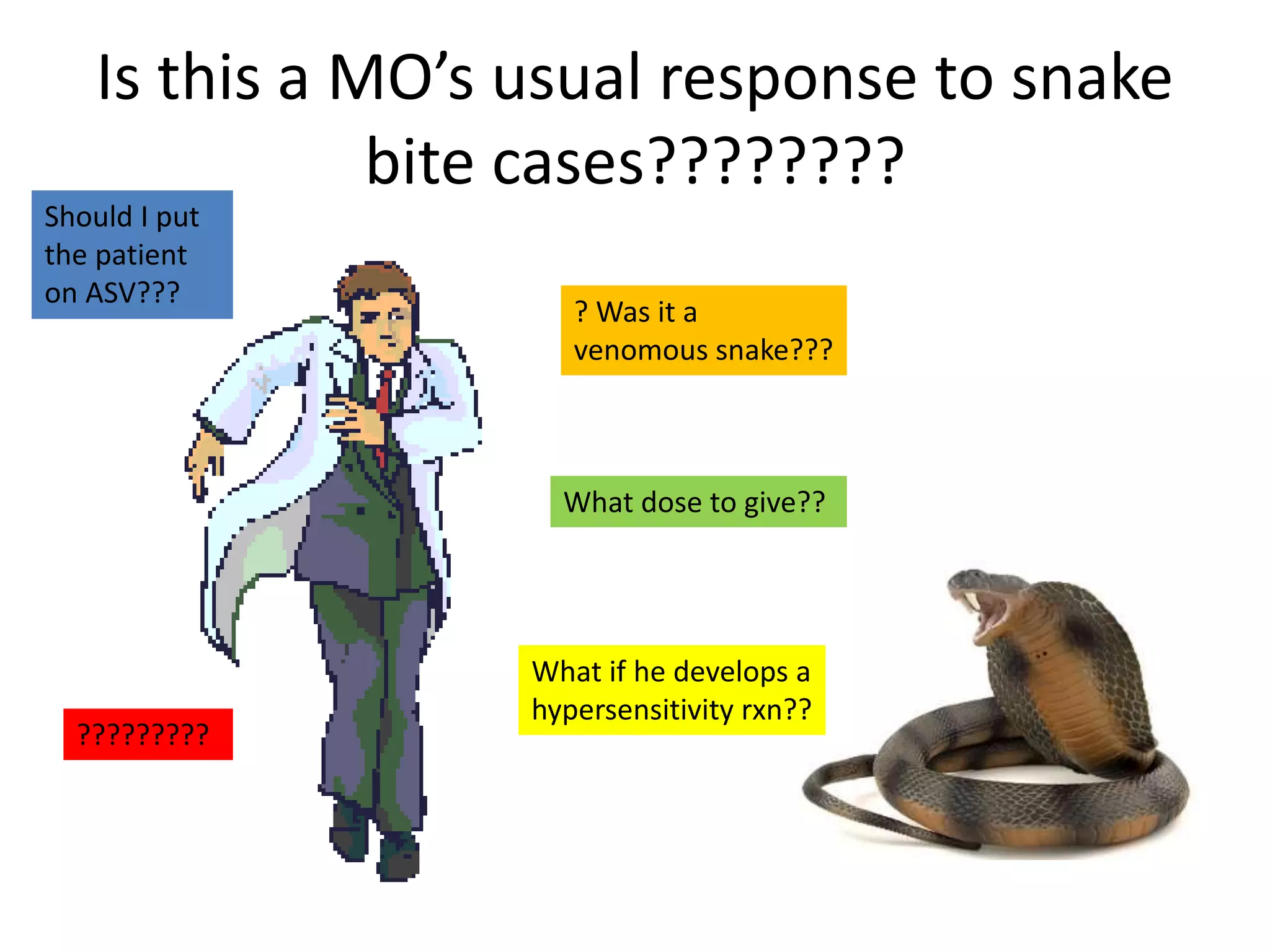
Is this a MO’s usual response to snake
bite cases????????
? Was it a
venomous snake???
Should I put
the patient
on ASV???
What dose to give??
What if he develops a
hypersensitivity rxn??
?????????
This presentation will attempt to
change the response to……..
All is well!!!!
All is well!!!!
All is well!!!!
All is well!!!!
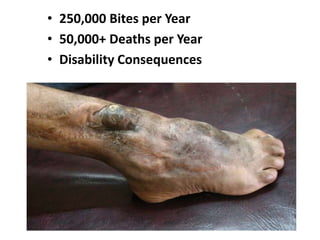
• 250,000 Bites per Year
• 50,000+ Deaths per Year
• Disability Consequences
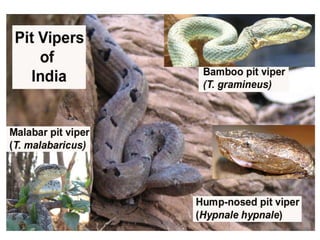
Snakes of Medical Importance (India)
• Class I Commonly Cause Death or Serious Disability
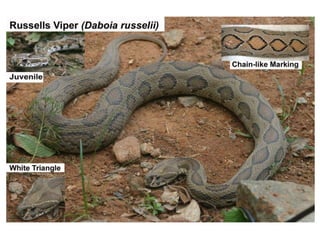
Spectacled Cobra/Russells Viper / Northern &
Southern Saw Scaled Viper
• Class II Uncommonly cause bites but are recorded
to cause serious effects (Death or Local necrosis)
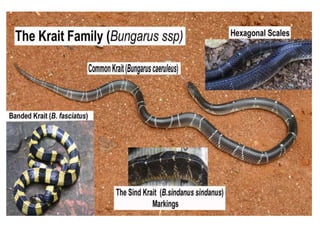
Common Krait / Sind Krait / Banded Krait / Hump-
nosed Pitviper / Levantine Viper / King Cobra
• Class III Commonly cause bites but serious effects
are very uncommon : Bamboo Pit Viper
World Health Organisation 1981
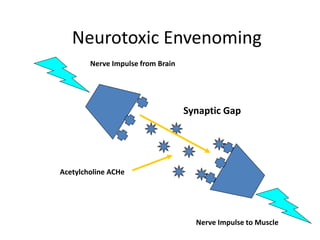
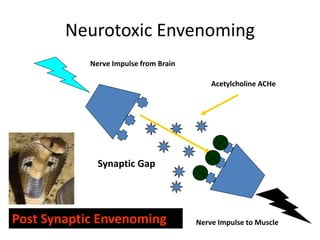
Neurotoxic Envenoming
Acetylcholine ACHe
Nerve Impulse from Brain
Nerve Impulse to Muscle
Synaptic Gap
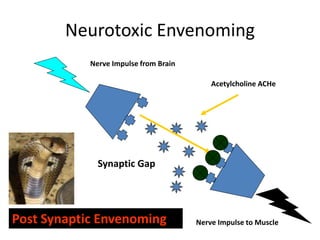
Neurotoxic Envenoming
Acetylcholine ACHe
Nerve Impulse from Brain
Nerve Impulse to Muscle
Synaptic Gap
Post Synaptic Envenoming
Neurotoxic Envenoming
Acetylcholine ACHe
Nerve Impulse from Brain
Nerve Impulse to Muscle
Synaptic Gap
Post Synaptic Envenoming
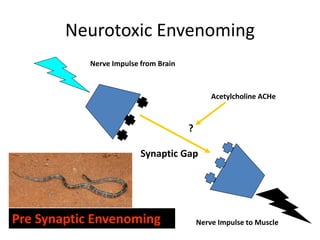
Neurotoxic Envenoming
Acetylcholine ACHe
Nerve Impulse from Brain
Nerve Impulse to Muscle
Synaptic Gap
Pre Synaptic Envenoming
?
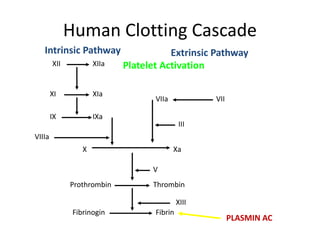
Human Clotting Cascade
XII XIIa
X
XI
Xa
XIa
IX IXa
VIIIa
Prothrombin Thrombin
Fibrinogin Fibrin
XIII
V
Intrinsic Pathway
VII
VIIa
III
Extrinsic Pathway
PLASMIN AC
Platelet Activation
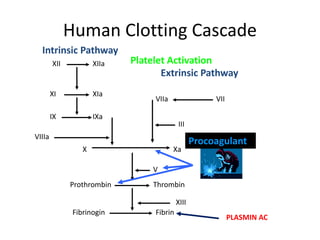
Human Clotting Cascade
XII XIIa
X
XI
Xa
XIa
IX IXa
VIIIa
Prothrombin Thrombin
Fibrinogin Fibrin
XIII
V
Intrinsic Pathway
VII
VIIa
III
Extrinsic Pathway
PLASMIN AC
Procoagulant
Platelet Activation
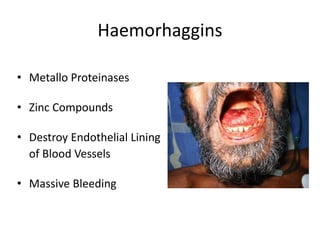
Haemorhaggins
• Metallo Proteinases
• Zinc Compounds
• Destroy Endothelial Lining
of Blood Vessels
• Massive Bleeding
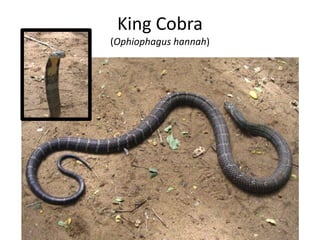
King Cobra
(Ophiophagus hannah)
Ineffective Activities
• Repellent Chemicals
• Repellent Plants
• Ditches or Physical Defences
• Keeping Animals or Dogs
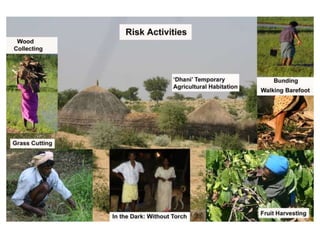
Preventive Measures
 Walk at night with a torch, sturdy footwear & a stick
Walk with heavy footsteps – snakes detect vibration
 Harvesting – keep an eye on ground ahead
 Close attention to ground when collecting leaves /
wood
 Avoid rubbish / food waste near dwellings – attracts
rats – snakes follow!
 Avoid sleeping on ground
 Avoid creepers etc near dwellings
 While trekking, follow foot-tracks; adequate clothing
First Aid – Please Do NOT attempt.....
NEVER do the following….
(As procedures to minimize
envenomation : ‘so called’ 1st Aid)
• Tourniquet application
• Cutting & suction
• Electricity & Ice
• Pressure Immobilization method
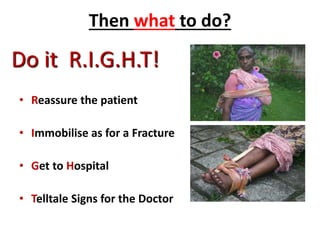
Then what to do?
• Reassure the patient
• Immobilise as for a Fracture
• Get to Hospital
• Telltale Signs for the Doctor
Do it R.I.G.H.T!
Diagnosis Phase
• Epidemiology
~ When Were You Bitten?
Non-venomous snake
- Delayed onset Delayed envenomation
(?Efficacy of ASV)
- Time of bite – Cobra / Krait
What Were You Doing? – Risk factors
What First Aid? (Confusing symp like swelling
(tourniquets), abd pain (chillies), Vomiting (ghee)
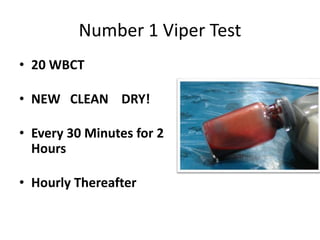
Number 1 Viper Test
• 20 WBCT
• NEW CLEAN DRY!
• Every 30 Minutes for 2
Hours
• Hourly Thereafter
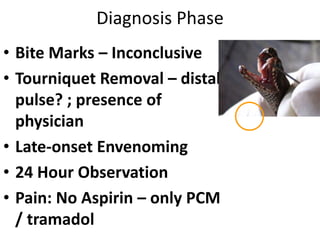
Diagnosis Phase
• Bite Marks – Inconclusive
• Tourniquet Removal – distal
pulse? ; presence of
physician
• Late-onset Envenoming
• 24 Hour Observation
• Pain: No Aspirin – only PCM
/ tramadol
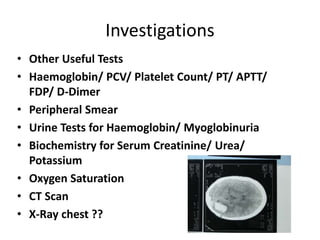
Investigations
• Other Useful Tests
• Haemoglobin/ PCV/ Platelet Count/ PT/ APTT/
FDP/ D-Dimer
• Peripheral Smear
• Urine Tests for Haemoglobin/ Myoglobinuria
• Biochemistry for Serum Creatinine/ Urea/
Potassium
• Oxygen Saturation
• CT Scan
• X-Ray chest ??
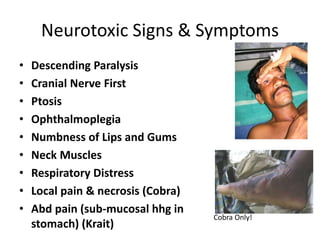
Neurotoxic Signs & Symptoms
• Descending Paralysis
• Cranial Nerve First
• Ptosis
• Ophthalmoplegia
• Numbness of Lips and Gums
• Neck Muscles
• Respiratory Distress
• Local pain & necrosis (Cobra)
• Abd pain (sub-mucosal hhg in
stomach) (Krait)
Cobra Only!
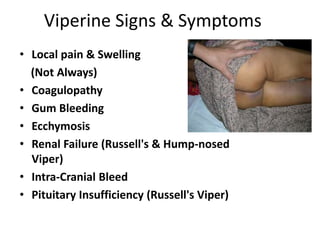
Viperine Signs & Symptoms
• Local pain & Swelling
(Not Always)
• Coagulopathy
• Gum Bleeding
• Ecchymosis
• Renal Failure (Russell's & Hump-nosed
Viper)
• Intra-Cranial Bleed
• Pituitary Insufficiency (Russell's Viper)
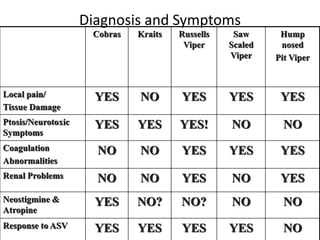
Diagnosis and Symptoms
Cobras Kraits Russells
Viper
Saw
Scaled
Viper
Hump
nosed
Pit Viper
Local pain/
Tissue Damage
YES NO YES YES YES
Ptosis/Neurotoxic
Symptoms
YES YES YES! NO NO
Coagulation
Abnormalities
NO NO YES YES YES
Renal Problems NO NO YES NO YES
Neostigmine &
Atropine
YES NO? NO? NO NO
Response to ASV YES YES YES YES NO
Anti Snake Venom (ASV)
• 7 Producers of Polyvalent ASV
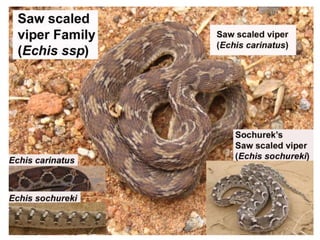
• Cobra (Naja naja) Russell’s Viper, Saw Scaled Viper (Echis
carinatus), Common Krait (Bungarus caeruleus)
• Lyophilized (SL 5yrs; no refrigeration) Vs
Liquid (SL 2yrs; refrigeration / cold chain needed)
• IV Injection (bolus) Vs Continuous Infusion (in 250ml
NS/5D)
• Neutralise Free Flowing Venom – venom once bound to
target tissues cannot be neutralized.
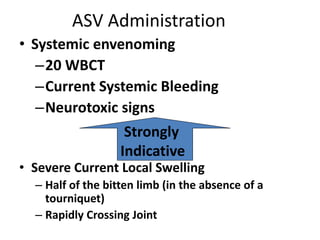
ASV Administration
• Systemic envenoming
–20 WBCT
–Current Systemic Bleeding
–Neurotoxic signs
• Severe Current Local Swelling
– Half of the bitten limb (in the absence of a
tourniquet)
– Rapidly Crossing Joint
Strongly
Indicative
ASV Dosage & Admin
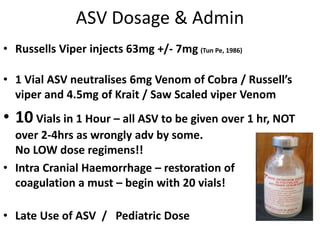
• Russells Viper injects 63mg +/- 7mg (Tun Pe, 1986)
• 1 Vial ASV neutralises 6mg Venom of Cobra / Russell’s
viper and 4.5mg of Krait / Saw Scaled viper Venom
• 10 Vials in 1 Hour – all ASV to be given over 1 hr, NOT
over 2-4hrs as wrongly adv by some.
No LOW dose regimens!!
• Intra Cranial Haemorrhage – restoration of
coagulation a must – begin with 20 vials!
• Late Use of ASV / Pediatric Dose
ASV Reactions
• No ASV Test Doses
• If ASV rxn – stop ASV and treat rxn urgently
• Prophylactic Regimes Optional
– Adrenaline (Premawardenha, 1999)
– Hydrocortisone and Antihistamine (Gawarammana, 2003)
Reaction Treatment
• First Sign of Symptoms
(Sampson, 1992).
• ASV Stopped
• IM Adrenaline 0.5mg 1:1000
(American Association, 2003)
(Average Blood Plasma Time)
IM 8 Mins
Subcut 34 Mins
• Steroidal Support + 25 mg
Promethazine
(Hydrocortisone – 4 Hours lag
period!
Anti Cholinesterase
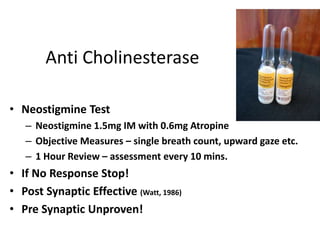
• Neostigmine Test
– Neostigmine 1.5mg IM with 0.6mg Atropine
– Objective Measures – single breath count, upward gaze etc.
– 1 Hour Review – assessment every 10 mins.
• If No Response Stop!
• Post Synaptic Effective (Watt, 1986)
• Pre Synaptic Unproven!
Other Methods
• Heparin
– Venom Induced Thrombin unresponsive to heparin
(Warrell 2005)
– AT III already eliminated by the time heparin adm.
– No Beneficial Effect (Tin Na Swe, 1992)
• Botropase (From two South American Pit vipers!!)
– Re-envenomation of Victim!
Recovery Signs
• Spontaneous systemic bleeding stops: 15-30
mins.
• Coagulability restored: 6 hours.
• Post-synaptic type (cobra bites): 30 minutes
after antivenom, but can take several hours.
• Presynaptic toxins (kraits): usually takes a
considerable time to improve.
• Shocked patients, BP may increase within the
first 30-60 minutes.
Haemotoxic Bites
• 6 Hour Rule
• Coagulation Test
• Repeat Full Dose (over 1 hr)
• Blood Coagulability Restored
• 30 vials Maximum (Can neutralize 180mg of Russell’s &
135 mg of Saw scaled viper venom). Never exceed.
• If coagulability unrestored?
- Associated med disorders (hemophilia etc)
- Other snake – hump nosed pit viper etc
Neurotoxic Bites
–1-2 Hour Rule (Watt, 1986)
–2nd Full Dose
–Halt ASV 20 Vials Maximum
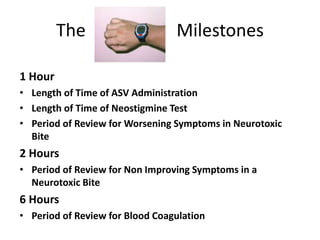
The Watch Milestones
• 8 Minutes
• Average Blood Plasma Time of Adrenaline
• 12-14 Minutes
• Period of Adrenaline Effectiveness in Anaphylaxis
Patient
• 20 Minutes
• 20WBCT
• Average Blood Plasma Time of neostigmine
• Average time of onset of ASV Reaction
The Watch Milestones
1 Hour
• Length of Time of ASV Administration
• Length of Time of Neostigmine Test
• Period of Review for Worsening Symptoms in Neurotoxic
Bite
2 Hours
• Period of Review for Non Improving Symptoms in a
Neurotoxic Bite
6 Hours
• Period of Review for Blood Coagulation
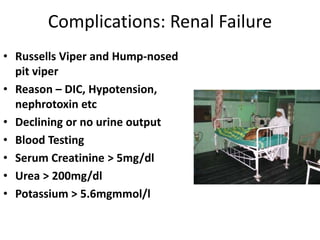
Complications: Renal Failure
• Russells Viper and Hump-nosed
pit viper
• Reason – DIC, Hypotension,
nephrotoxin etc
• Declining or no urine output
• Blood Testing
• Serum Creatinine > 5mg/dl
• Urea > 200mg/dl
• Potassium > 5.6mgmmol/l
Hypotension & Bleeding
• Reason for Hypotension – Hypovolaemia or
Vasodilation
• Postural blood pressure test – identifies
hypovolemia
• Plasma expanders. No conclusive trial evidence to
support a preference for colloids or crystalloids
• If whole blood given – restore coagulation first
• Dopamine. Dosing 2.5- 5μ /kg/minute
• KEYWORD! – Neutralize Venom First
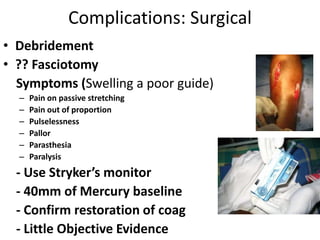
Complications: Surgical
• Debridement
• ?? Fasciotomy
Symptoms (Swelling a poor guide)
– Pain on passive stretching
– Pain out of proportion
– Pulselessness
– Pallor
– Parasthesia
– Paralysis
- Use Stryker’s monitor
- 40mm of Mercury baseline
- Confirm restoration of coag
- Little Objective Evidence
Conclusion
• Latest Evidenced Based
Methods
• Treatment Closer to Victim
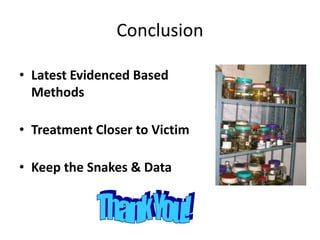
• Keep the Snakes & Data

Snake Bite -Management Stratgies.pptx

  • 1.
    Is this aMO’s usual response to snake bite cases???????? ? Was it a venomous snake??? Should I put the patient on ASV??? What dose to give?? What if he develops a hypersensitivity rxn?? ?????????
  • 2.
    This presentation willattempt to change the response to…….. All is well!!!! All is well!!!! All is well!!!! All is well!!!!
  • 3.
    • 250,000 Bitesper Year • 50,000+ Deaths per Year • Disability Consequences
  • 5.
    Snakes of MedicalImportance (India) • Class I Commonly Cause Death or Serious Disability Spectacled Cobra/Russells Viper / Northern & Southern Saw Scaled Viper • Class II Uncommonly cause bites but are recorded to cause serious effects (Death or Local necrosis) Common Krait / Sind Krait / Banded Krait / Hump- nosed Pitviper / Levantine Viper / King Cobra • Class III Commonly cause bites but serious effects are very uncommon : Bamboo Pit Viper World Health Organisation 1981
  • 7.
    Neurotoxic Envenoming Acetylcholine ACHe NerveImpulse from Brain Nerve Impulse to Muscle Synaptic Gap
  • 8.
    Neurotoxic Envenoming Acetylcholine ACHe NerveImpulse from Brain Nerve Impulse to Muscle Synaptic Gap Post Synaptic Envenoming
  • 10.
    Neurotoxic Envenoming Acetylcholine ACHe NerveImpulse from Brain Nerve Impulse to Muscle Synaptic Gap Post Synaptic Envenoming
  • 11.
    Neurotoxic Envenoming Acetylcholine ACHe NerveImpulse from Brain Nerve Impulse to Muscle Synaptic Gap Pre Synaptic Envenoming ?
  • 14.
    Human Clotting Cascade XIIXIIa X XI Xa XIa IX IXa VIIIa Prothrombin Thrombin Fibrinogin Fibrin XIII V Intrinsic Pathway VII VIIa III Extrinsic Pathway PLASMIN AC Platelet Activation
  • 15.
    Human Clotting Cascade XIIXIIa X XI Xa XIa IX IXa VIIIa Prothrombin Thrombin Fibrinogin Fibrin XIII V Intrinsic Pathway VII VIIa III Extrinsic Pathway PLASMIN AC Procoagulant Platelet Activation
  • 16.
    Haemorhaggins • Metallo Proteinases •Zinc Compounds • Destroy Endothelial Lining of Blood Vessels • Massive Bleeding
  • 18.
  • 20.
    Ineffective Activities • RepellentChemicals • Repellent Plants • Ditches or Physical Defences • Keeping Animals or Dogs
  • 21.
    Preventive Measures  Walkat night with a torch, sturdy footwear & a stick Walk with heavy footsteps – snakes detect vibration  Harvesting – keep an eye on ground ahead  Close attention to ground when collecting leaves / wood  Avoid rubbish / food waste near dwellings – attracts rats – snakes follow!  Avoid sleeping on ground  Avoid creepers etc near dwellings  While trekking, follow foot-tracks; adequate clothing
  • 22.
    First Aid –Please Do NOT attempt.....
  • 23.
    NEVER do thefollowing…. (As procedures to minimize envenomation : ‘so called’ 1st Aid) • Tourniquet application • Cutting & suction • Electricity & Ice • Pressure Immobilization method
  • 24.
    Then what todo? • Reassure the patient • Immobilise as for a Fracture • Get to Hospital • Telltale Signs for the Doctor Do it R.I.G.H.T!
  • 25.
    Diagnosis Phase • Epidemiology ~When Were You Bitten? Non-venomous snake - Delayed onset Delayed envenomation (?Efficacy of ASV) - Time of bite – Cobra / Krait What Were You Doing? – Risk factors What First Aid? (Confusing symp like swelling (tourniquets), abd pain (chillies), Vomiting (ghee)
  • 26.
    Number 1 ViperTest • 20 WBCT • NEW CLEAN DRY! • Every 30 Minutes for 2 Hours • Hourly Thereafter
  • 27.
    Diagnosis Phase • BiteMarks – Inconclusive • Tourniquet Removal – distal pulse? ; presence of physician • Late-onset Envenoming • 24 Hour Observation • Pain: No Aspirin – only PCM / tramadol
  • 28.
    Investigations • Other UsefulTests • Haemoglobin/ PCV/ Platelet Count/ PT/ APTT/ FDP/ D-Dimer • Peripheral Smear • Urine Tests for Haemoglobin/ Myoglobinuria • Biochemistry for Serum Creatinine/ Urea/ Potassium • Oxygen Saturation • CT Scan • X-Ray chest ??
  • 29.
    Neurotoxic Signs &Symptoms • Descending Paralysis • Cranial Nerve First • Ptosis • Ophthalmoplegia • Numbness of Lips and Gums • Neck Muscles • Respiratory Distress • Local pain & necrosis (Cobra) • Abd pain (sub-mucosal hhg in stomach) (Krait) Cobra Only!
  • 30.
    Viperine Signs &Symptoms • Local pain & Swelling (Not Always) • Coagulopathy • Gum Bleeding • Ecchymosis • Renal Failure (Russell's & Hump-nosed Viper) • Intra-Cranial Bleed • Pituitary Insufficiency (Russell's Viper)
  • 31.
    Diagnosis and Symptoms CobrasKraits Russells Viper Saw Scaled Viper Hump nosed Pit Viper Local pain/ Tissue Damage YES NO YES YES YES Ptosis/Neurotoxic Symptoms YES YES YES! NO NO Coagulation Abnormalities NO NO YES YES YES Renal Problems NO NO YES NO YES Neostigmine & Atropine YES NO? NO? NO NO Response to ASV YES YES YES YES NO
  • 32.
    Anti Snake Venom(ASV) • 7 Producers of Polyvalent ASV • Cobra (Naja naja) Russell’s Viper, Saw Scaled Viper (Echis carinatus), Common Krait (Bungarus caeruleus) • Lyophilized (SL 5yrs; no refrigeration) Vs Liquid (SL 2yrs; refrigeration / cold chain needed) • IV Injection (bolus) Vs Continuous Infusion (in 250ml NS/5D) • Neutralise Free Flowing Venom – venom once bound to target tissues cannot be neutralized.
  • 33.
    ASV Administration • Systemicenvenoming –20 WBCT –Current Systemic Bleeding –Neurotoxic signs • Severe Current Local Swelling – Half of the bitten limb (in the absence of a tourniquet) – Rapidly Crossing Joint Strongly Indicative
  • 34.
    ASV Dosage &Admin • Russells Viper injects 63mg +/- 7mg (Tun Pe, 1986) • 1 Vial ASV neutralises 6mg Venom of Cobra / Russell’s viper and 4.5mg of Krait / Saw Scaled viper Venom • 10 Vials in 1 Hour – all ASV to be given over 1 hr, NOT over 2-4hrs as wrongly adv by some. No LOW dose regimens!! • Intra Cranial Haemorrhage – restoration of coagulation a must – begin with 20 vials! • Late Use of ASV / Pediatric Dose
  • 35.
    ASV Reactions • NoASV Test Doses • If ASV rxn – stop ASV and treat rxn urgently • Prophylactic Regimes Optional – Adrenaline (Premawardenha, 1999) – Hydrocortisone and Antihistamine (Gawarammana, 2003)
  • 36.
    Reaction Treatment • FirstSign of Symptoms (Sampson, 1992). • ASV Stopped • IM Adrenaline 0.5mg 1:1000 (American Association, 2003) (Average Blood Plasma Time) IM 8 Mins Subcut 34 Mins • Steroidal Support + 25 mg Promethazine (Hydrocortisone – 4 Hours lag period!
  • 37.
    Anti Cholinesterase • NeostigmineTest – Neostigmine 1.5mg IM with 0.6mg Atropine – Objective Measures – single breath count, upward gaze etc. – 1 Hour Review – assessment every 10 mins. • If No Response Stop! • Post Synaptic Effective (Watt, 1986) • Pre Synaptic Unproven!
  • 38.
    Other Methods • Heparin –Venom Induced Thrombin unresponsive to heparin (Warrell 2005) – AT III already eliminated by the time heparin adm. – No Beneficial Effect (Tin Na Swe, 1992) • Botropase (From two South American Pit vipers!!) – Re-envenomation of Victim!
  • 39.
    Recovery Signs • Spontaneoussystemic bleeding stops: 15-30 mins. • Coagulability restored: 6 hours. • Post-synaptic type (cobra bites): 30 minutes after antivenom, but can take several hours. • Presynaptic toxins (kraits): usually takes a considerable time to improve. • Shocked patients, BP may increase within the first 30-60 minutes.
  • 40.
    Haemotoxic Bites • 6Hour Rule • Coagulation Test • Repeat Full Dose (over 1 hr) • Blood Coagulability Restored • 30 vials Maximum (Can neutralize 180mg of Russell’s & 135 mg of Saw scaled viper venom). Never exceed. • If coagulability unrestored? - Associated med disorders (hemophilia etc) - Other snake – hump nosed pit viper etc
  • 41.
    Neurotoxic Bites –1-2 HourRule (Watt, 1986) –2nd Full Dose –Halt ASV 20 Vials Maximum
  • 42.
    The Watch Milestones •8 Minutes • Average Blood Plasma Time of Adrenaline • 12-14 Minutes • Period of Adrenaline Effectiveness in Anaphylaxis Patient • 20 Minutes • 20WBCT • Average Blood Plasma Time of neostigmine • Average time of onset of ASV Reaction
  • 43.
    The Watch Milestones 1Hour • Length of Time of ASV Administration • Length of Time of Neostigmine Test • Period of Review for Worsening Symptoms in Neurotoxic Bite 2 Hours • Period of Review for Non Improving Symptoms in a Neurotoxic Bite 6 Hours • Period of Review for Blood Coagulation
  • 44.
    Complications: Renal Failure •Russells Viper and Hump-nosed pit viper • Reason – DIC, Hypotension, nephrotoxin etc • Declining or no urine output • Blood Testing • Serum Creatinine > 5mg/dl • Urea > 200mg/dl • Potassium > 5.6mgmmol/l
  • 45.
    Hypotension & Bleeding •Reason for Hypotension – Hypovolaemia or Vasodilation • Postural blood pressure test – identifies hypovolemia • Plasma expanders. No conclusive trial evidence to support a preference for colloids or crystalloids • If whole blood given – restore coagulation first • Dopamine. Dosing 2.5- 5μ /kg/minute • KEYWORD! – Neutralize Venom First
  • 46.
    Complications: Surgical • Debridement •?? Fasciotomy Symptoms (Swelling a poor guide) – Pain on passive stretching – Pain out of proportion – Pulselessness – Pallor – Parasthesia – Paralysis - Use Stryker’s monitor - 40mm of Mercury baseline - Confirm restoration of coag - Little Objective Evidence
  • 47.
    Conclusion • Latest EvidencedBased Methods • Treatment Closer to Victim • Keep the Snakes & Data