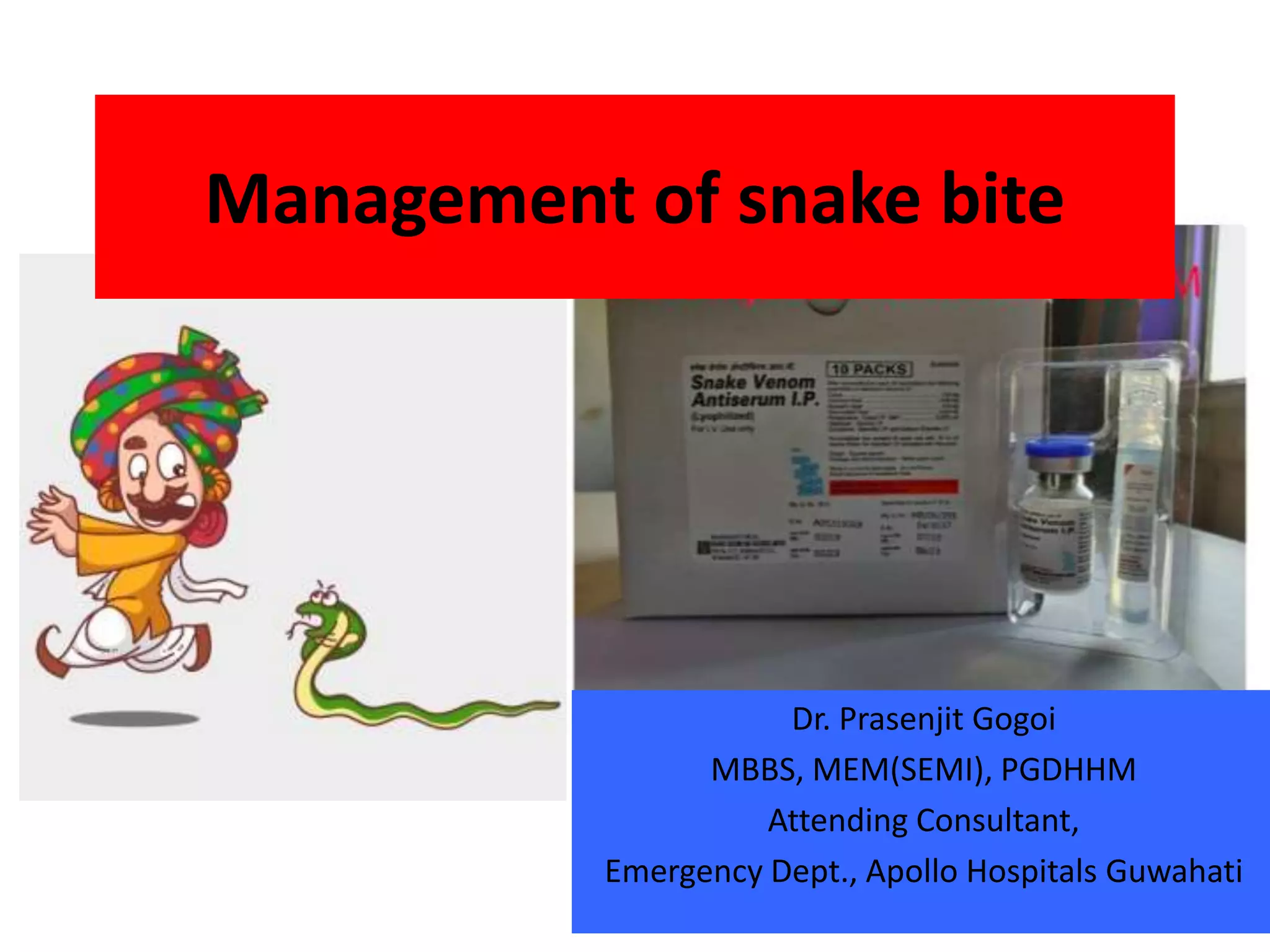
Management of snake bite
Dr. Prasenjit Gogoi
MBBS, MEM(SEMI), PGDHHM
Attending Consultant,
Emergency Dept., Apollo Hospitals Guwahati
Introduction
• India is estimated to have the highest snakebite
mortality in the world.
• 2.8 million cases of snakebite annually with 46,900
deaths annually in India (WHO)
• Snake bite is an occupational hazard in an agricultural
country like India.
• Snake bites are more common in rural areas especially
during monsoon season.
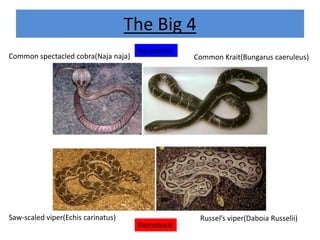
The Big 4
Common spectacled cobra(Naja naja) Common Krait(Bungarus caeruleus)
Saw-scaled viper(Echis carinatus) Russel’s viper(Daboia Russelii)
Hemotoxic
Neurotoxic
Composition of snake venom
• Procoagulant enzymes
(Viperidae)
• Haemorrhagins (zinc
metalloproteinases)
• Cytolytic or necrotic
toxins
• Haemolytic and myolytic
phospholipases A2
• Pre-synaptic neurotoxins
(Elapidae and some
viperidae)
• Post-synaptic
neurotoxins (Elapidae)
Clinical features
• General – fear and anxiety
• Local envenoming
– Local pain at bite site
– Local swelling
– Tenderness
– Painful swelling of regional lymph nodes
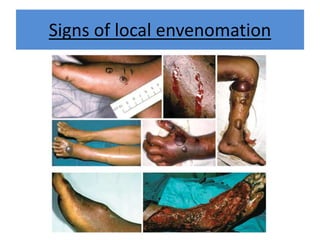
– Other signs : fang marks, persistent local bleeding,
bruising, lymphangitis, inflammation, blistering,
infection, abscess formation, necrosis
Signs of local envenomation
Clinical features (cont)
• Systemic envenoming : nausea, vomiting,
malaise, abdominal pain, weakness,
drowsiness, prostration.
1. Cardiovascular (Viperidae)
– Hypotension, syncope, collapse, shock
– Cardiac arrhythmias
– Myocardial damage
Clinical features (cont)
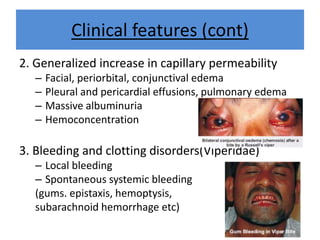
2. Generalized increase in capillary permeability
– Facial, periorbital, conjunctival edema
– Pleural and pericardial effusions, pulmonary edema
– Massive albuminuria
– Hemoconcentration
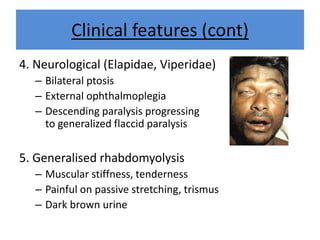
3. Bleeding and clotting disorders(Viperidae)
– Local bleeding
– Spontaneous systemic bleeding
(gums. epistaxis, hemoptysis,
subarachnoid hemorrhage etc)
Clinical features (cont)
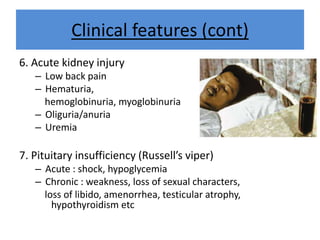
4. Neurological (Elapidae, Viperidae)
– Bilateral ptosis
– External ophthalmoplegia
– Descending paralysis progressing
to generalized flaccid paralysis
5. Generalised rhabdomyolysis
– Muscular stiffness, tenderness
– Painful on passive stretching, trismus
– Dark brown urine
Clinical features (cont)
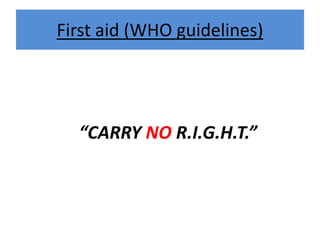
6. Acute kidney injury
– Low back pain
– Hematuria,
hemoglobinuria, myoglobinuria
– Oliguria/anuria
– Uremia
7. Pituitary insufficiency (Russell’s viper)
– Acute : shock, hypoglycemia
– Chronic : weakness, loss of sexual characters,
loss of libido, amenorrhea, testicular atrophy,
hypothyroidism etc
First aid (WHO guidelines)
“CARRY NO R.I.G.H.T.”
First aid (cont.)
• CARRY = Do not allow victim to walk.
• No = Tourniquet, No-electrotherapy, No-cutting, No-pressure
immobilization, No-sucking of venom
• R = Reassure the patient.
• I = Immobilize the limb.
• GH = Get to hospital immediately.
Traditional remedies - NO PROVEN benefit
• T = Tell the doctor of any systemic symptoms that manifest on the
way to hospital.
Pre - hospital management
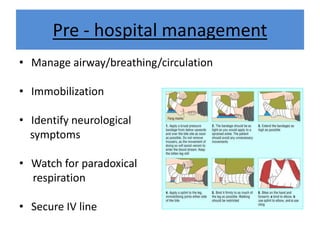
• Manage airway/breathing/circulation
• Immobilization
• Identify neurological
symptoms
• Watch for paradoxical
respiration
• Secure IV line
Emergency hospital management
Initial management
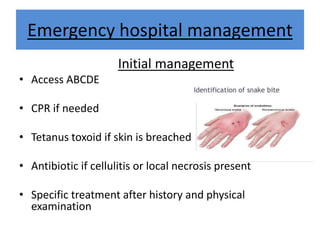
• Access ABCDE
• CPR if needed
• Tetanus toxoid if skin is breached
• Antibiotic if cellulitis or local necrosis present
• Specific treatment after history and physical
examination
Diagnosing Envenomation
Pure clinical skill
No diagnostic kit available yet !!
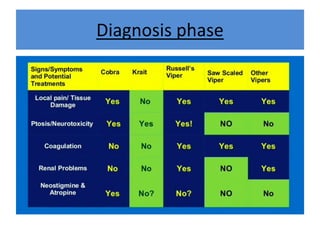
Diagnosis phase
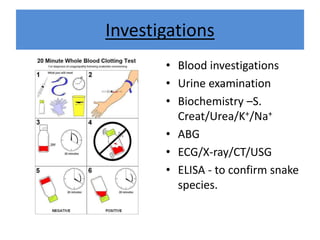
Investigations
• Blood investigations
• Urine examination
• Biochemistry –S.
Creat/Urea/K+/Na+
• ABG
• ECG/X-ray/CT/USG
• ELISA - to confirm snake
species.
Treatment phase
• Pain management – oral paracetamol/tramadol
~NO APRIRIN/NSAIDS~
• Handling tourniquets
– Sudden removal -> neurological paralysis and hypotension.
– Remove after ASV administration + doctor present
– Test for the presence of a pulse distal to the tourniquet. If
no distal pulse, apply blood pressure cuff & reduce the
pressure slowly.
Anti Snake Venom
• ASV is Ig (usually the enzyme refined F(ab)2
fragment of IgG) purified from the serum/plasma
of a horse/sheep immunised with the venoms of
one or more species of snake.
• It neutralises the free, unbound venom and to
some extent also dissociates bound toxin.
• WHO has included ASV in the list for Essential
Medicines and should be part of any primary
healthcare package where snakebites occur.
Anti Snake Venom
• In India, polyvalent ASV, effective against all the
four common species; Russell’s viper, common
cobra, common Krait and saw-scaled viper is
available.
• ASV is produced both in liquid and lyophilized
forms.
– Liquid ASV requires a reliable cold chain and has 2-
year shelf life.
– Lyophilized ASV, in powder form, has 5-year shelf life
and requires only to be kept cool.
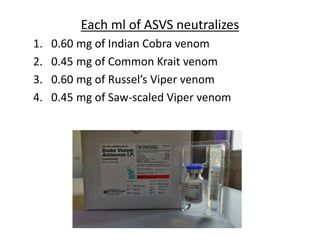
Each ml of ASVS neutralizes
1. 0.60 mg of Indian Cobra venom
2. 0.45 mg of Common Krait venom
3. 0.60 mg of Russel’s Viper venom
4. 0.45 mg of Saw-scaled Viper venom
Prophylaxis of ASV reactions
• hydrocortisone (100 mg) + antihistamine
or
0.25–0.3 mg adrenaline subcutaneously
• In asthmatics inhaled adrenergic beta2 agonist
may prevent bronchospasm
Test dose of ASV is not recommended.
National Snakebite Treatment Protocol
• For neurotoxicity: 10 vials stat as infusion over 30 mins
followed by 2nd dose of 10 vials after 1 hour (if no
improvement within 1st hour)
• For hemotoxicity :
Low dose infusion therapy – 10 vials for russels viper or 6
vials for saw scaled viper as stat infusion over 30 mins
followed by 2 vials every 6 hours as infusion in 100 ml ns
till clotting time normalizes or 3 days whichever is earlier
High dose intermittent bolus therapy – 10 vials of asv over
30 mins as infusion followed by 6 vials 6 hourly as bolus
therapy till clotting time normalizes or local swelling
subsides
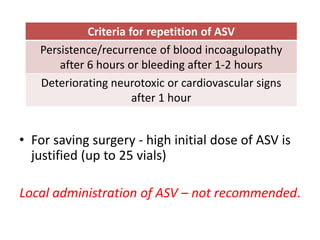
• For saving surgery - high initial dose of ASV is
justified (up to 25 vials)
Local administration of ASV – not recommended.
Criteria for repetition of ASV
Persistence/recurrence of blood incoagulopathy
after 6 hours or bleeding after 1-2 hours
Deteriorating neurotoxic or cardiovascular signs
after 1 hour
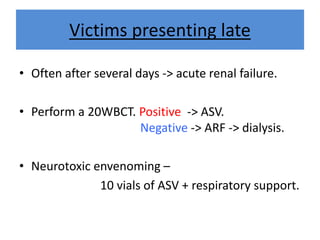
Victims presenting late
• Often after several days -> acute renal failure.
• Perform a 20WBCT. Positive -> ASV.
Negative -> ARF -> dialysis.
• Neurotoxic envenoming –
10 vials of ASV + respiratory support.
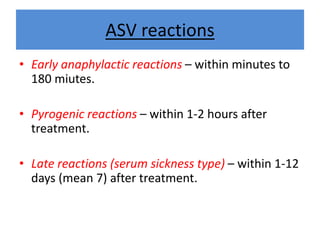
ASV reactions
• Early anaphylactic reactions – within minutes to
180 miutes.
• Pyrogenic reactions – within 1-2 hours after
treatment.
• Late reactions (serum sickness type) – within 1-12
days (mean 7) after treatment.
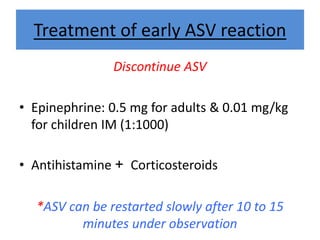
Treatment of early ASV reaction
Discontinue ASV
• Epinephrine: 0.5 mg for adults & 0.01 mg/kg
for children IM (1:1000)
• Antihistamine + Corticosteroids
*ASV can be restarted slowly after 10 to 15
minutes under observation
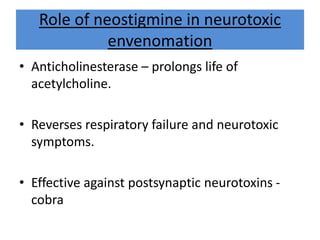
Role of neostigmine in neurotoxic
envenomation
• Anticholinesterase – prolongs life of
acetylcholine.
• Reverses respiratory failure and neurotoxic
symptoms.
• Effective against postsynaptic neurotoxins -
cobra
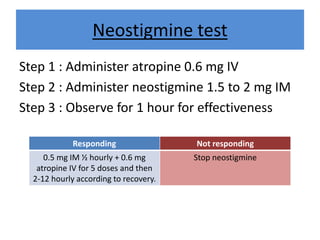
Neostigmine test
Step 1 : Administer atropine 0.6 mg IV
Step 2 : Administer neostigmine 1.5 to 2 mg IM
Step 3 : Observe for 1 hour for effectiveness
Responding Not responding
0.5 mg IM ½ hourly + 0.6 mg
atropine IV for 5 doses and then
2-12 hourly according to recovery.
Stop neostigmine
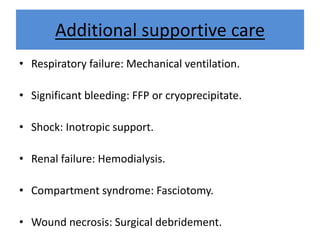
Additional supportive care
• Respiratory failure: Mechanical ventilation.
• Significant bleeding: FFP or cryoprecipitate.
• Shock: Inotropic support.
• Renal failure: Hemodialysis.
• Compartment syndrome: Fasciotomy.
• Wound necrosis: Surgical debridement.
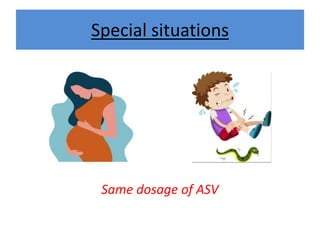
Special situations
Same dosage of ASV
Follow up
Essential
Discharged within 24 hours -> return if any
worsening of symptoms
Serum Sickness
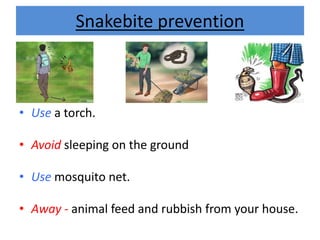
Snakebite prevention
• Use a torch.
• Avoid sleeping on the ground
• Use mosquito net.
• Away - animal feed and rubbish from your house.
References
• Jesudasan JE, Abhilash KP. Venomous snakebites: Management and anti-snake
venom. Curr Med Issues 2019;17:66-8
• Himmatrao Saluba Bawaskar, Pramodini Himmatrao Bawaskar. Snake bite:
prevention and management in rural Indian settings. The Lancet Glocal Health,
Vol.7, Issue9, sept2019; Page e1178
• Mohan G, Singh A, Singh T. Guidelines for the Management of Snakebites. Curr
Trends Diagn Treat 2018;2(2):102-108.
• Guidelines for the management of snakebite, 2nd edition; South east asia WHO
publication 2016. https://www.who.int/docs/default-source/searo/india/health-
topic-pdf/who-guidance-on-management-of-snakebites.pdf?sfvrsn=5528d0cf_2
• Shibendu Ghosh, Prabuddha Mukhopadhyay, Tanmoy Chatterjee: Management of
Snake Bite in India. https://www.japi.org/r2a48494/management-of-snake-bite-in-
india#.YPbjVzpSUO8.link
• Surjit Singh, Gagandip Singh. Snake Bite: Indian Guidelines and Protocol. Available
at http://www.apiindia.org/medicine_update_2013/chap94.pdf
• Ahmed SM, Ahmed M, Nadeem A, Mahajan J, Choudhary A, Pal J. Emergency
treatment of a snake bite: Pearls from literature. J Emerg Trauma Shock.
2008;1(2):97-105. doi:10.4103/0974-2700.43190
Thank You ..!!

Snake bite management in India

  • 1.
    Management of snakebite Dr. Prasenjit Gogoi MBBS, MEM(SEMI), PGDHHM Attending Consultant, Emergency Dept., Apollo Hospitals Guwahati
  • 2.
    Introduction • India isestimated to have the highest snakebite mortality in the world. • 2.8 million cases of snakebite annually with 46,900 deaths annually in India (WHO) • Snake bite is an occupational hazard in an agricultural country like India. • Snake bites are more common in rural areas especially during monsoon season.
  • 3.
    The Big 4 Commonspectacled cobra(Naja naja) Common Krait(Bungarus caeruleus) Saw-scaled viper(Echis carinatus) Russel’s viper(Daboia Russelii) Hemotoxic Neurotoxic
  • 4.
    Composition of snakevenom • Procoagulant enzymes (Viperidae) • Haemorrhagins (zinc metalloproteinases) • Cytolytic or necrotic toxins • Haemolytic and myolytic phospholipases A2 • Pre-synaptic neurotoxins (Elapidae and some viperidae) • Post-synaptic neurotoxins (Elapidae)
  • 5.
    Clinical features • General– fear and anxiety • Local envenoming – Local pain at bite site – Local swelling – Tenderness – Painful swelling of regional lymph nodes – Other signs : fang marks, persistent local bleeding, bruising, lymphangitis, inflammation, blistering, infection, abscess formation, necrosis
  • 6.
    Signs of localenvenomation
  • 7.
    Clinical features (cont) •Systemic envenoming : nausea, vomiting, malaise, abdominal pain, weakness, drowsiness, prostration. 1. Cardiovascular (Viperidae) – Hypotension, syncope, collapse, shock – Cardiac arrhythmias – Myocardial damage
  • 8.
    Clinical features (cont) 2.Generalized increase in capillary permeability – Facial, periorbital, conjunctival edema – Pleural and pericardial effusions, pulmonary edema – Massive albuminuria – Hemoconcentration 3. Bleeding and clotting disorders(Viperidae) – Local bleeding – Spontaneous systemic bleeding (gums. epistaxis, hemoptysis, subarachnoid hemorrhage etc)
  • 9.
    Clinical features (cont) 4.Neurological (Elapidae, Viperidae) – Bilateral ptosis – External ophthalmoplegia – Descending paralysis progressing to generalized flaccid paralysis 5. Generalised rhabdomyolysis – Muscular stiffness, tenderness – Painful on passive stretching, trismus – Dark brown urine
  • 10.
    Clinical features (cont) 6.Acute kidney injury – Low back pain – Hematuria, hemoglobinuria, myoglobinuria – Oliguria/anuria – Uremia 7. Pituitary insufficiency (Russell’s viper) – Acute : shock, hypoglycemia – Chronic : weakness, loss of sexual characters, loss of libido, amenorrhea, testicular atrophy, hypothyroidism etc
  • 11.
    First aid (WHOguidelines) “CARRY NO R.I.G.H.T.”
  • 12.
    First aid (cont.) •CARRY = Do not allow victim to walk. • No = Tourniquet, No-electrotherapy, No-cutting, No-pressure immobilization, No-sucking of venom • R = Reassure the patient. • I = Immobilize the limb. • GH = Get to hospital immediately. Traditional remedies - NO PROVEN benefit • T = Tell the doctor of any systemic symptoms that manifest on the way to hospital.
  • 13.
    Pre - hospitalmanagement • Manage airway/breathing/circulation • Immobilization • Identify neurological symptoms • Watch for paradoxical respiration • Secure IV line
  • 14.
    Emergency hospital management Initialmanagement • Access ABCDE • CPR if needed • Tetanus toxoid if skin is breached • Antibiotic if cellulitis or local necrosis present • Specific treatment after history and physical examination
  • 15.
    Diagnosing Envenomation Pure clinicalskill No diagnostic kit available yet !!
  • 16.
  • 17.
    Investigations • Blood investigations •Urine examination • Biochemistry –S. Creat/Urea/K+/Na+ • ABG • ECG/X-ray/CT/USG • ELISA - to confirm snake species.
  • 18.
    Treatment phase • Painmanagement – oral paracetamol/tramadol ~NO APRIRIN/NSAIDS~ • Handling tourniquets – Sudden removal -> neurological paralysis and hypotension. – Remove after ASV administration + doctor present – Test for the presence of a pulse distal to the tourniquet. If no distal pulse, apply blood pressure cuff & reduce the pressure slowly.
  • 19.
    Anti Snake Venom •ASV is Ig (usually the enzyme refined F(ab)2 fragment of IgG) purified from the serum/plasma of a horse/sheep immunised with the venoms of one or more species of snake. • It neutralises the free, unbound venom and to some extent also dissociates bound toxin. • WHO has included ASV in the list for Essential Medicines and should be part of any primary healthcare package where snakebites occur.
  • 20.
    Anti Snake Venom •In India, polyvalent ASV, effective against all the four common species; Russell’s viper, common cobra, common Krait and saw-scaled viper is available. • ASV is produced both in liquid and lyophilized forms. – Liquid ASV requires a reliable cold chain and has 2- year shelf life. – Lyophilized ASV, in powder form, has 5-year shelf life and requires only to be kept cool.
  • 21.
    Each ml ofASVS neutralizes 1. 0.60 mg of Indian Cobra venom 2. 0.45 mg of Common Krait venom 3. 0.60 mg of Russel’s Viper venom 4. 0.45 mg of Saw-scaled Viper venom
  • 22.
    Prophylaxis of ASVreactions • hydrocortisone (100 mg) + antihistamine or 0.25–0.3 mg adrenaline subcutaneously • In asthmatics inhaled adrenergic beta2 agonist may prevent bronchospasm Test dose of ASV is not recommended.
  • 23.
    National Snakebite TreatmentProtocol • For neurotoxicity: 10 vials stat as infusion over 30 mins followed by 2nd dose of 10 vials after 1 hour (if no improvement within 1st hour) • For hemotoxicity : Low dose infusion therapy – 10 vials for russels viper or 6 vials for saw scaled viper as stat infusion over 30 mins followed by 2 vials every 6 hours as infusion in 100 ml ns till clotting time normalizes or 3 days whichever is earlier High dose intermittent bolus therapy – 10 vials of asv over 30 mins as infusion followed by 6 vials 6 hourly as bolus therapy till clotting time normalizes or local swelling subsides
  • 24.
    • For savingsurgery - high initial dose of ASV is justified (up to 25 vials) Local administration of ASV – not recommended. Criteria for repetition of ASV Persistence/recurrence of blood incoagulopathy after 6 hours or bleeding after 1-2 hours Deteriorating neurotoxic or cardiovascular signs after 1 hour
  • 25.
    Victims presenting late •Often after several days -> acute renal failure. • Perform a 20WBCT. Positive -> ASV. Negative -> ARF -> dialysis. • Neurotoxic envenoming – 10 vials of ASV + respiratory support.
  • 26.
    ASV reactions • Earlyanaphylactic reactions – within minutes to 180 miutes. • Pyrogenic reactions – within 1-2 hours after treatment. • Late reactions (serum sickness type) – within 1-12 days (mean 7) after treatment.
  • 27.
    Treatment of earlyASV reaction Discontinue ASV • Epinephrine: 0.5 mg for adults & 0.01 mg/kg for children IM (1:1000) • Antihistamine + Corticosteroids *ASV can be restarted slowly after 10 to 15 minutes under observation
  • 28.
    Role of neostigminein neurotoxic envenomation • Anticholinesterase – prolongs life of acetylcholine. • Reverses respiratory failure and neurotoxic symptoms. • Effective against postsynaptic neurotoxins - cobra
  • 29.
    Neostigmine test Step 1: Administer atropine 0.6 mg IV Step 2 : Administer neostigmine 1.5 to 2 mg IM Step 3 : Observe for 1 hour for effectiveness Responding Not responding 0.5 mg IM ½ hourly + 0.6 mg atropine IV for 5 doses and then 2-12 hourly according to recovery. Stop neostigmine
  • 30.
    Additional supportive care •Respiratory failure: Mechanical ventilation. • Significant bleeding: FFP or cryoprecipitate. • Shock: Inotropic support. • Renal failure: Hemodialysis. • Compartment syndrome: Fasciotomy. • Wound necrosis: Surgical debridement.
  • 31.
  • 32.
    Follow up Essential Discharged within24 hours -> return if any worsening of symptoms Serum Sickness
  • 33.
    Snakebite prevention • Usea torch. • Avoid sleeping on the ground • Use mosquito net. • Away - animal feed and rubbish from your house.
  • 34.
    References • Jesudasan JE,Abhilash KP. Venomous snakebites: Management and anti-snake venom. Curr Med Issues 2019;17:66-8 • Himmatrao Saluba Bawaskar, Pramodini Himmatrao Bawaskar. Snake bite: prevention and management in rural Indian settings. The Lancet Glocal Health, Vol.7, Issue9, sept2019; Page e1178 • Mohan G, Singh A, Singh T. Guidelines for the Management of Snakebites. Curr Trends Diagn Treat 2018;2(2):102-108. • Guidelines for the management of snakebite, 2nd edition; South east asia WHO publication 2016. https://www.who.int/docs/default-source/searo/india/health- topic-pdf/who-guidance-on-management-of-snakebites.pdf?sfvrsn=5528d0cf_2 • Shibendu Ghosh, Prabuddha Mukhopadhyay, Tanmoy Chatterjee: Management of Snake Bite in India. https://www.japi.org/r2a48494/management-of-snake-bite-in- india#.YPbjVzpSUO8.link • Surjit Singh, Gagandip Singh. Snake Bite: Indian Guidelines and Protocol. Available at http://www.apiindia.org/medicine_update_2013/chap94.pdf • Ahmed SM, Ahmed M, Nadeem A, Mahajan J, Choudhary A, Pal J. Emergency treatment of a snake bite: Pearls from literature. J Emerg Trauma Shock. 2008;1(2):97-105. doi:10.4103/0974-2700.43190
  • 35.