Presentation on man made
disaster
Submitted To : Submitted To :
MS: Jyoti gupta Gopal singh
dushyant sharma
hemraj jat
M
DEFINITION
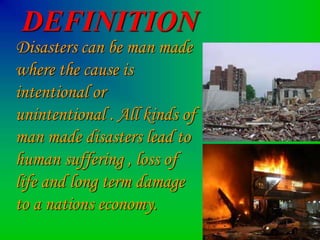
Disasters can be man made
where the cause is
intentional or
unintentional . All kinds of
man made disasters lead to
human suffering , loss of
life and long term damage
to a nations economy.
TYPES OF MAN MADE
DISASTERS
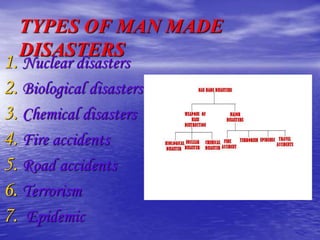
1. Nuclear disasters
2. Biological disasters
3. Chemical disasters
4. Fire accidents
5. Road accidents
6. Terrorism
7. Epidemic
NUCLEAR
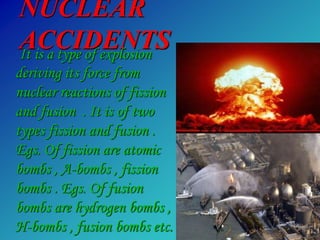
ACCIDENTSIt is a type of explosion
deriving its force from
nuclear reactions of fission
and fusion . It is of two
types fission and fusion .
Egs. Of fission are atomic
bombs , A-bombs , fission
bombs . Egs. Of fusion
bombs are hydrogen bombs ,
H-bombs , fusion bombs etc.
PRECAUTIONS
1. Common indicators of these
disasters are vomiting ,
nausea , dizziness etc.
2. Don’t look at fire as it
causes instant blindness
3. Close all doors and windows
as radioactivity doesn’t
penetrate into solid
structures
4. Cover all food and water
and listen govt. orders
BIOLOGICAL DISASTERS
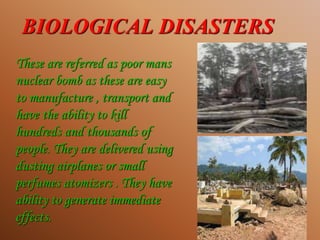
These are referred as poor mans
nuclear bomb as these are easy
to manufacture , transport and
have the ability to kill
hundreds and thousands of
people. They are delivered using
dusting airplanes or small
perfumes atomizers . They have
ability to generate immediate
effects.
PRECAUTIONS
1. The WHO should lay emphasis on
prohibition against biological
warfare
2. We should immediately get away
from an suspicious thing
3. Cover your mouth with a wet cloth
4. Listen to T.V. and Radio for
further GOVT. instructions.
CHEMICAL DISASTERS
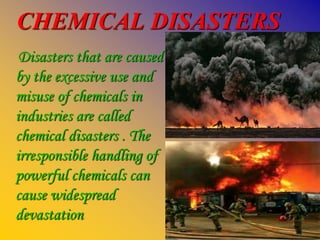
Disasters that are caused
by the excessive use and
misuse of chemicals in
industries are called
chemical disasters . The
irresponsible handling of
powerful chemicals can
cause widespread
devastation
BHOPAL DISASTER
The Bhopal disaster, also referred to as the Bhopal gas
tragedy, was a gas leak incident in India, considered the
world’s worst industrial disaster. It occurred on the night of
2–3 December 1984 at the Union carbide India limited (UCIL)
pesticide plant in Bhopal, Madhya Pradesh. Over 500,000
people were exposed to methyl isocyanate gas and other
chemicals.
PRECAUTIONS
1. Industries using harmful and
powerful chemicals should be
located far away from residential
areas
2. There should be surveys to keep a
check on their activity
3. The govt. should formulate an
emergency plan to in case of an
accident
4. Pollution levels should be checked
and maintained
FIRE ACCIDENTS
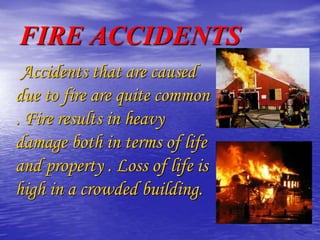
Accidents that are caused
due to fire are quite common
. Fire results in heavy
damage both in terms of life
and property . Loss of life is
high in a crowded building.
PRECAUTIONS
1. The main reason is poor wiring and
faulty electrical equipment , leaking gas
or carelessly thrown cigarettes and
matches
2. The main power supply source is good
condition.
3. Wire should be properly covered
4. Inflammable things should be kept out
of reach of children
5. Power points shouldn’t be overloaded
TRAVEL ACCIDENTS
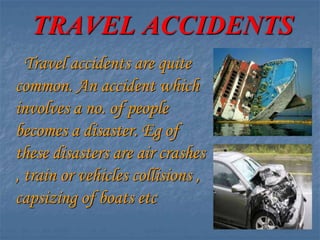
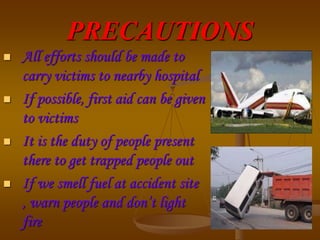
Travel accidents are quite
common. An accident which
involves a no. of people
becomes a disaster. Eg of
these disasters are air crashes
, train or vehicles collisions ,
capsizing of boats etc
PRECAUTIONS
 All efforts should be made to
carry victims to nearby hospital
 If possible, first aid can be given
to victims
 It is the duty of people present
there to get trapped people out
 If we smell fuel at accident site
, warn people and don’t light
fire
TERRORISM
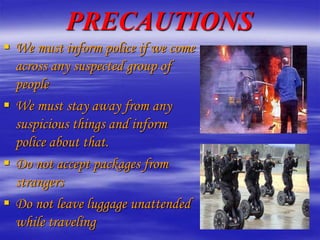
This is another type of
disaster that results in
loss of life and property.
Terrorists use violence
and strike without
warning. They use bombs
, guns etc to terrorize
people
PRECAUTIONS
 We must inform police if we come
across any suspected group of
people
 We must stay away from any
suspicious things and inform
police about that.
 Do not accept packages from
strangers
 Do not leave luggage unattended
while traveling
EPIDEMIC
Epidemic occurs when a
disease attacks a large no of
people at one time. It spreads
at rapid rate among human
population . Most of diseases
are spread after natural
disaster like tsunami , flood
etc.
PRECAUTIONS
•Ensure safe drinking water ,
sanitation after a disaster .
•Health workers should be
trained.
•Covering of all stored water
containers
•A surveillance should be
established to detect outbreaks
Man made disaster

Man made disaster

  • 1.
    Presentation on manmade disaster Submitted To : Submitted To : MS: Jyoti gupta Gopal singh dushyant sharma hemraj jat
  • 2.
  • 3.
    DEFINITION Disasters can beman made where the cause is intentional or unintentional . All kinds of man made disasters lead to human suffering , loss of life and long term damage to a nations economy.
  • 4.
    TYPES OF MANMADE DISASTERS 1. Nuclear disasters 2. Biological disasters 3. Chemical disasters 4. Fire accidents 5. Road accidents 6. Terrorism 7. Epidemic
  • 5.
    NUCLEAR ACCIDENTSIt is atype of explosion deriving its force from nuclear reactions of fission and fusion . It is of two types fission and fusion . Egs. Of fission are atomic bombs , A-bombs , fission bombs . Egs. Of fusion bombs are hydrogen bombs , H-bombs , fusion bombs etc.
  • 6.
    PRECAUTIONS 1. Common indicatorsof these disasters are vomiting , nausea , dizziness etc. 2. Don’t look at fire as it causes instant blindness 3. Close all doors and windows as radioactivity doesn’t penetrate into solid structures 4. Cover all food and water and listen govt. orders
  • 7.
    BIOLOGICAL DISASTERS These arereferred as poor mans nuclear bomb as these are easy to manufacture , transport and have the ability to kill hundreds and thousands of people. They are delivered using dusting airplanes or small perfumes atomizers . They have ability to generate immediate effects.
  • 8.
    PRECAUTIONS 1. The WHOshould lay emphasis on prohibition against biological warfare 2. We should immediately get away from an suspicious thing 3. Cover your mouth with a wet cloth 4. Listen to T.V. and Radio for further GOVT. instructions.
  • 9.
    CHEMICAL DISASTERS Disasters thatare caused by the excessive use and misuse of chemicals in industries are called chemical disasters . The irresponsible handling of powerful chemicals can cause widespread devastation
  • 10.
    BHOPAL DISASTER The Bhopaldisaster, also referred to as the Bhopal gas tragedy, was a gas leak incident in India, considered the world’s worst industrial disaster. It occurred on the night of 2–3 December 1984 at the Union carbide India limited (UCIL) pesticide plant in Bhopal, Madhya Pradesh. Over 500,000 people were exposed to methyl isocyanate gas and other chemicals.
  • 11.
    PRECAUTIONS 1. Industries usingharmful and powerful chemicals should be located far away from residential areas 2. There should be surveys to keep a check on their activity 3. The govt. should formulate an emergency plan to in case of an accident 4. Pollution levels should be checked and maintained
  • 12.
    FIRE ACCIDENTS Accidents thatare caused due to fire are quite common . Fire results in heavy damage both in terms of life and property . Loss of life is high in a crowded building.
  • 13.
    PRECAUTIONS 1. The mainreason is poor wiring and faulty electrical equipment , leaking gas or carelessly thrown cigarettes and matches 2. The main power supply source is good condition. 3. Wire should be properly covered 4. Inflammable things should be kept out of reach of children 5. Power points shouldn’t be overloaded
  • 14.
    TRAVEL ACCIDENTS Travel accidentsare quite common. An accident which involves a no. of people becomes a disaster. Eg of these disasters are air crashes , train or vehicles collisions , capsizing of boats etc
  • 15.
    PRECAUTIONS  All effortsshould be made to carry victims to nearby hospital  If possible, first aid can be given to victims  It is the duty of people present there to get trapped people out  If we smell fuel at accident site , warn people and don’t light fire
  • 16.
    TERRORISM This is anothertype of disaster that results in loss of life and property. Terrorists use violence and strike without warning. They use bombs , guns etc to terrorize people
  • 17.
    PRECAUTIONS  We mustinform police if we come across any suspected group of people  We must stay away from any suspicious things and inform police about that.  Do not accept packages from strangers  Do not leave luggage unattended while traveling
  • 18.
    EPIDEMIC Epidemic occurs whena disease attacks a large no of people at one time. It spreads at rapid rate among human population . Most of diseases are spread after natural disaster like tsunami , flood etc.
  • 19.
    PRECAUTIONS •Ensure safe drinkingwater , sanitation after a disaster . •Health workers should be trained. •Covering of all stored water containers •A surveillance should be established to detect outbreaks