DISASTER
MANAGEMENT PROJECT
TOPIC:
MAN MADE DISASTERS
INTRODUCTION
We are now living in a civilized society. The days of
illiteracy and ignorance have gone. Man has made much
progress in the field of science and technology. Man has
cut forests recklessly to clear the land for cultivation and
along with this ENVIRONMENTAL DEGRADATION
has taken place, which also affects his life. Man is
becoming his own enemy because he has also created
weapons of mass destruction and these weapons are used
against humanity, which further brings sorrow, and
suffering to mankind.
WHAT IS A DISASTER?
“A DISASTER is a natural or man-
made (or technological) hazard
resulting in an event of substantial
extent causing significant physical
damage or destruction, loss of life, or
drastic change to the environment.”
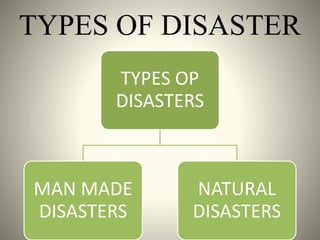
TYPES OF DISASTER
TYPES OP
DISASTERS
MAN MADE
DISASTERS
NATURAL
DISASTERS
WHAT IS A MAN MADE
DISASTER?
Q. What is a man -made disaster?
Man-made disasters are disasters resulting from man-
made hazards (threats having an element of human
intent, negligence, or error; or involving a failure of a
man-made system), as opposed to natural disasters
resulting from natural hazards. Man-made hazards or
disasters are sometimes referred to as anthropogenic .
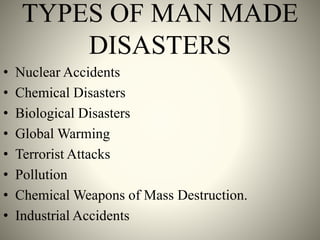
TYPES OF MAN MADE
DISASTERS
• Nuclear Accidents
• Chemical Disasters
• Biological Disasters
• Global Warming
• Terrorist Attacks
• Pollution
• Chemical Weapons of Mass Destruction.
• Industrial Accidents
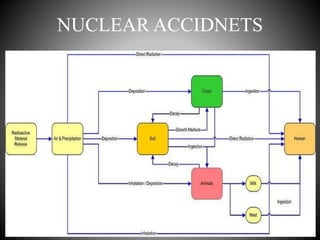
NUCLEAR ACCIDNETS
WHAT ARE NUCLEAR
ACCIDENTS?
A nuclear and radiation accident is defined by the
International Atomic Energy Agency as "an event that
has led to significant consequences to people, the
environment or the facility." Examples include lethal
effects to individuals, large radioactivity release to the
environment, or reactor core melt." The prime
example of a "major nuclear accident" is one in which
a reactor core is damaged and significant amounts of
radioactivity are released, such as in the Chernobyl
Disaster in 1986.
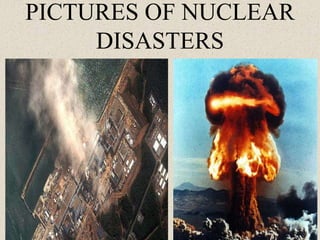
PICTURES OF NUCLEAR
DISASTERS
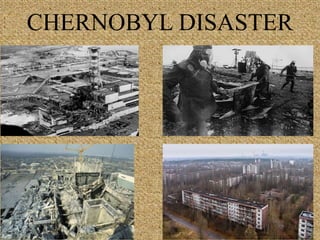
CASE STUDY: CHERNOBYL
NUCLEAR DISASTER OF 1986
• The Chernobyl accident in 1986 was the result of a flawed reactor
design that was operated with inadequately trained personnel.
• The resulting steam explosion and fires released at least 5% of the
radioactive reactor core into the atmosphere and downwind – some
5200 PBq (I-131 eq).
• Two Chernobyl plant workers died on the night of the accident, and
a further 28 people died within a few weeks as a result of acute
radiation poisoning.
• UNSCEAR says that apart from increased thyroid cancers, "there is
no evidence of a major public health impact attributable to
radiation exposure 20 years after the accident."
• Resettlement of areas from which people were relocated is
ongoing.
• The Radiation was so worst that till the next 24,000 years the area
has to be abandoned for complete safety.
CHERNOBYL DISASTER
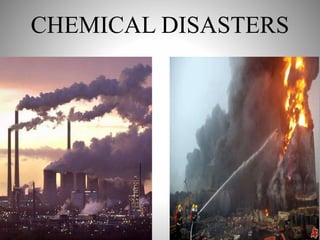
CHEMICAL DISASTERS
A chemical accident is the unintentional release of one
or more hazardous substances which could harm
human health or the environment. Chemical hazards
are systems where chemical accidents could occur
under certain circumstances. Such events include fires,
explosions, leakages or releases of toxic or hazardous
materials that can cause people illness, injury,
disability or death. An example is the introduction of
hydrocarbon methyl that increases the risk of heart
cancer because it changes the way blood cells flow
through the body
CHEMICAL DISASTERS
CASE STUDY: BHOPAL GAS
TRAGEDY
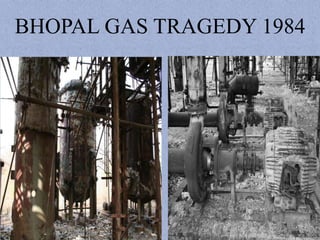
The Bhopal disaster, also referred to as the Bhopal
gas tragedy, was a gas leak incident in India,
considered the world's worst industrial disaster. It
occurred on the night of 2–3 December 1984 at the
Union Carbide India Limited (UCIL) pesticide plant
in Bhopal, Madhya Pradesh. Over 500,000 people
were exposed to methyl Isocyanate gas and other
chemicals. The toxic substance made its way in and
around the shanty towns located near the plant.
BHOPAL GAS TRAGEDY 1984
INDUSTRIAL DISASTERS
Q. What are Industrial Disasters?
Industrial disasters or accidents, which
are disasters caused by industrial companies, either by
accident, negligence or incompetence. They are a form
of industrial accident where great damage, injury or
loss of life are caused. Other disasters can also be
considered industrial disasters, if their causes are
rooted in the products or processes of industry.
CASE STUDY: CHINA GAS
WELL BLOWOUT
A gas well blowout in an underground well happened
at 10:00 pm on Tuesday, 23 December. The disaster
took place at Chuandongbei gas field in Gao Qiao
town in the north eastern part of Chongqing province
and resulted in the release of natural gas and hydrogen
Sulphide, which is highly toxic when inhaled. The
blowout - the worst of its kind in China's history - is
thought to be caused by a puncture to the highly
pressurized gas well caused by drilling.
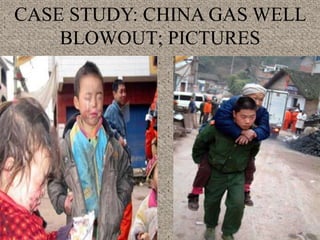
CASE STUDY: CHINA GAS WELL
BLOWOUT; PICTURES
MITIGATION STRTERGIES FOR
CHEMICAL AND INDUSTRIAL DISASTERS
• Hazard Mapping: Inventories and maps of storage
locations of toxins or hazardous substances along with
the possible characteristics should be displayed and
known to all.
• Land Use Planning: Densely populated residential areas
should be located at a distance from industrial areas. A
buffer zone should separate the industrial and the
residential zone. Better Planning is Required to Handle
the Waste that is planned before setting up any industry.
MITIGATION STRTERGIES FOR
CHEMICAL AND INDUSTRIAL DISASTERS
• Community Preparedness: The community should
be aware of the hazardous installations and know
how to combat the situation. The local community
has to be informed about the response steps to be
taken in case of an accident.
• Other Possible Risk Reduction Measures:
- Improve fire resistance and warning systems.
- Limit Storage capacity of toxic substances.
- Maintain a wind flow Diagram of the Region. Etc.
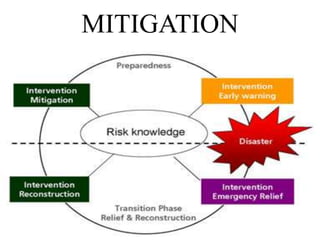
MITIGATION
CONCLUSION
So at the End of the Slide we have learnt that what
is a disaster, types of disasters, What are man made
disasters, Types of Man made disasters, Case
studies of different man made disasters such as the
Chernobyl Disaster and the Bhopal Gas tragedy
and Mitigation Strategies to be followed and how
to keep ourselves prepared for man-made disasters.
AND NOW , A VOTE OF THANKS
TO OUR ESTEEMED AND
HARDWORKING GROUP
MEMBERS
Varun Kakkar
Disaster management - Social Science

Disaster management - Social Science

  • 1.
  • 3.
    INTRODUCTION We are nowliving in a civilized society. The days of illiteracy and ignorance have gone. Man has made much progress in the field of science and technology. Man has cut forests recklessly to clear the land for cultivation and along with this ENVIRONMENTAL DEGRADATION has taken place, which also affects his life. Man is becoming his own enemy because he has also created weapons of mass destruction and these weapons are used against humanity, which further brings sorrow, and suffering to mankind.
  • 4.
    WHAT IS ADISASTER? “A DISASTER is a natural or man- made (or technological) hazard resulting in an event of substantial extent causing significant physical damage or destruction, loss of life, or drastic change to the environment.”
  • 5.
    TYPES OF DISASTER TYPESOP DISASTERS MAN MADE DISASTERS NATURAL DISASTERS
  • 6.
    WHAT IS AMAN MADE DISASTER? Q. What is a man -made disaster? Man-made disasters are disasters resulting from man- made hazards (threats having an element of human intent, negligence, or error; or involving a failure of a man-made system), as opposed to natural disasters resulting from natural hazards. Man-made hazards or disasters are sometimes referred to as anthropogenic .
  • 7.
    TYPES OF MANMADE DISASTERS • Nuclear Accidents • Chemical Disasters • Biological Disasters • Global Warming • Terrorist Attacks • Pollution • Chemical Weapons of Mass Destruction. • Industrial Accidents
  • 8.
  • 9.
    WHAT ARE NUCLEAR ACCIDENTS? Anuclear and radiation accident is defined by the International Atomic Energy Agency as "an event that has led to significant consequences to people, the environment or the facility." Examples include lethal effects to individuals, large radioactivity release to the environment, or reactor core melt." The prime example of a "major nuclear accident" is one in which a reactor core is damaged and significant amounts of radioactivity are released, such as in the Chernobyl Disaster in 1986.
  • 10.
  • 11.
    CASE STUDY: CHERNOBYL NUCLEARDISASTER OF 1986 • The Chernobyl accident in 1986 was the result of a flawed reactor design that was operated with inadequately trained personnel. • The resulting steam explosion and fires released at least 5% of the radioactive reactor core into the atmosphere and downwind – some 5200 PBq (I-131 eq). • Two Chernobyl plant workers died on the night of the accident, and a further 28 people died within a few weeks as a result of acute radiation poisoning. • UNSCEAR says that apart from increased thyroid cancers, "there is no evidence of a major public health impact attributable to radiation exposure 20 years after the accident." • Resettlement of areas from which people were relocated is ongoing. • The Radiation was so worst that till the next 24,000 years the area has to be abandoned for complete safety.
  • 12.
  • 13.
    CHEMICAL DISASTERS A chemicalaccident is the unintentional release of one or more hazardous substances which could harm human health or the environment. Chemical hazards are systems where chemical accidents could occur under certain circumstances. Such events include fires, explosions, leakages or releases of toxic or hazardous materials that can cause people illness, injury, disability or death. An example is the introduction of hydrocarbon methyl that increases the risk of heart cancer because it changes the way blood cells flow through the body
  • 14.
  • 15.
    CASE STUDY: BHOPALGAS TRAGEDY The Bhopal disaster, also referred to as the Bhopal gas tragedy, was a gas leak incident in India, considered the world's worst industrial disaster. It occurred on the night of 2–3 December 1984 at the Union Carbide India Limited (UCIL) pesticide plant in Bhopal, Madhya Pradesh. Over 500,000 people were exposed to methyl Isocyanate gas and other chemicals. The toxic substance made its way in and around the shanty towns located near the plant.
  • 16.
  • 17.
    INDUSTRIAL DISASTERS Q. Whatare Industrial Disasters? Industrial disasters or accidents, which are disasters caused by industrial companies, either by accident, negligence or incompetence. They are a form of industrial accident where great damage, injury or loss of life are caused. Other disasters can also be considered industrial disasters, if their causes are rooted in the products or processes of industry.
  • 18.
    CASE STUDY: CHINAGAS WELL BLOWOUT A gas well blowout in an underground well happened at 10:00 pm on Tuesday, 23 December. The disaster took place at Chuandongbei gas field in Gao Qiao town in the north eastern part of Chongqing province and resulted in the release of natural gas and hydrogen Sulphide, which is highly toxic when inhaled. The blowout - the worst of its kind in China's history - is thought to be caused by a puncture to the highly pressurized gas well caused by drilling.
  • 19.
    CASE STUDY: CHINAGAS WELL BLOWOUT; PICTURES
  • 20.
    MITIGATION STRTERGIES FOR CHEMICALAND INDUSTRIAL DISASTERS • Hazard Mapping: Inventories and maps of storage locations of toxins or hazardous substances along with the possible characteristics should be displayed and known to all. • Land Use Planning: Densely populated residential areas should be located at a distance from industrial areas. A buffer zone should separate the industrial and the residential zone. Better Planning is Required to Handle the Waste that is planned before setting up any industry.
  • 21.
    MITIGATION STRTERGIES FOR CHEMICALAND INDUSTRIAL DISASTERS • Community Preparedness: The community should be aware of the hazardous installations and know how to combat the situation. The local community has to be informed about the response steps to be taken in case of an accident. • Other Possible Risk Reduction Measures: - Improve fire resistance and warning systems. - Limit Storage capacity of toxic substances. - Maintain a wind flow Diagram of the Region. Etc.
  • 22.
  • 23.
    CONCLUSION So at theEnd of the Slide we have learnt that what is a disaster, types of disasters, What are man made disasters, Types of Man made disasters, Case studies of different man made disasters such as the Chernobyl Disaster and the Bhopal Gas tragedy and Mitigation Strategies to be followed and how to keep ourselves prepared for man-made disasters.
  • 24.
    AND NOW ,A VOTE OF THANKS TO OUR ESTEEMED AND HARDWORKING GROUP MEMBERS Varun Kakkar