Efforts by - Pranav Doshi
1
2
INDEX1. Disaster
2. Types of Disaster
3. Manmade Disaster
4. Types of Disaster
5. Fire Accidents
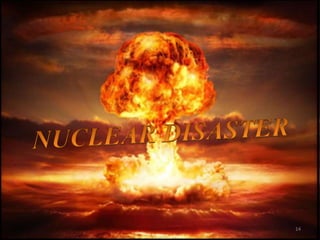
6. Nuclear Disaster
7. Chemical Disaster
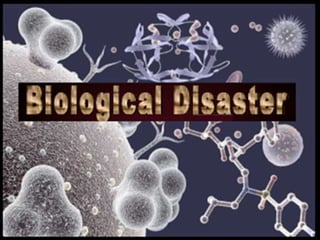
8. Biological Disaster
9. References
3
4
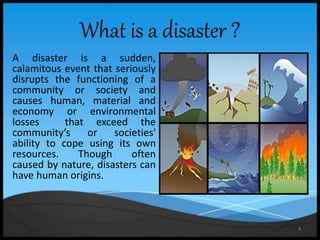
A disaster is a sudden,
calamitous event that seriously
disrupts the functioning of a
community or society and
causes human, material and
economy or environmental
losses that exceed the
community’s or societies'
ability to cope using its own
resources. Though often
caused by nature, disasters can
have human origins.
What is a disaster ?
5
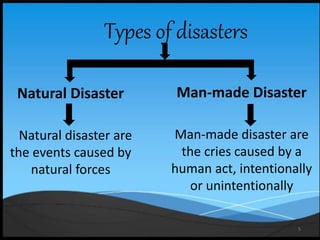
Types of disasters
Natural Disaster
Natural disaster are
the events caused by
natural forces
Man-made Disaster
Man-made disaster are
the cries caused by a
human act, intentionally
or unintentionally
6
7
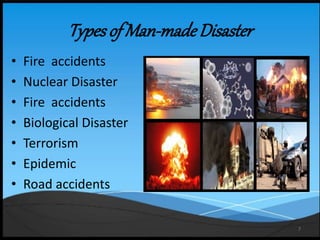
Typesof Man-madeDisaster
• Fire accidents
• Nuclear Disaster
• Fire accidents
• Biological Disaster
• Terrorism
• Epidemic
• Road accidents
8
9
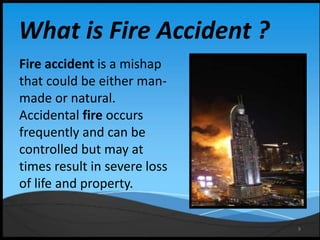
What is Fire Accident ?
Fire accident is a mishap
that could be either man-
made or natural.
Accidental fire occurs
frequently and can be
controlled but may at
times result in severe loss
of life and property.
10
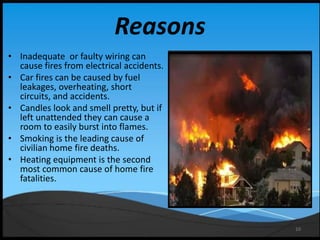
Reasons
• Inadequate or faulty wiring can
cause fires from electrical accidents.
• Car fires can be caused by fuel
leakages, overheating, short
circuits, and accidents.
• Candles look and smell pretty, but if
left unattended they can cause a
room to easily burst into flames.
• Smoking is the leading cause of
civilian home fire deaths.
• Heating equipment is the second
most common cause of home fire
fatalities.
11
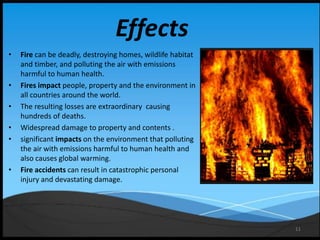
Effects
• Fire can be deadly, destroying homes, wildlife habitat
and timber, and polluting the air with emissions
harmful to human health.
• Fires impact people, property and the environment in
all countries around the world.
• The resulting losses are extraordinary causing
hundreds of deaths.
• Widespread damage to property and contents .
• significant impacts on the environment that polluting
the air with emissions harmful to human health and
also causes global warming.
• Fire accidents can result in catastrophic personal
injury and devastating damage.
12
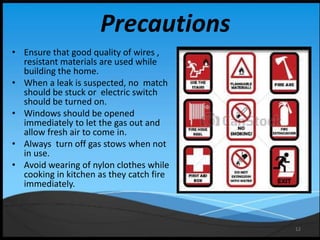
Precautions
• Ensure that good quality of wires ,
resistant materials are used while
building the home.
• When a leak is suspected, no match
should be stuck or electric switch
should be turned on.
• Windows should be opened
immediately to let the gas out and
allow fresh air to come in.
• Always turn off gas stows when not
in use.
• Avoid wearing of nylon clothes while
cooking in kitchen as they catch fire
immediately.
13
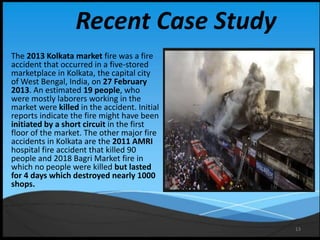
Recent Case Study
The 2013 Kolkata market fire was a fire
accident that occurred in a five-stored
marketplace in Kolkata, the capital city
of West Bengal, India, on 27 February
2013. An estimated 19 people, who
were mostly laborers working in the
market were killed in the accident. Initial
reports indicate the fire might have been
initiated by a short circuit in the first
floor of the market. The other major fire
accidents in Kolkata are the 2011 AMRI
hospital fire accident that killed 90
people and 2018 Bagri Market fire in
which no people were killed but lasted
for 4 days which destroyed nearly 1000
shops.
14
15
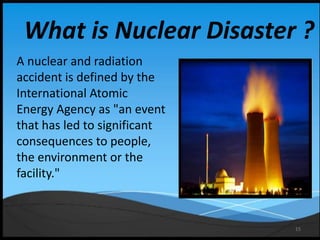
What is Nuclear Disaster ?
A nuclear and radiation
accident is defined by the
International Atomic
Energy Agency as "an event
that has led to significant
consequences to people,
the environment or the
facility."
16
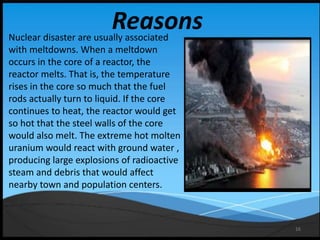
ReasonsNuclear disaster are usually associated
with meltdowns. When a meltdown
occurs in the core of a reactor, the
reactor melts. That is, the temperature
rises in the core so much that the fuel
rods actually turn to liquid. If the core
continues to heat, the reactor would get
so hot that the steel walls of the core
would also melt. The extreme hot molten
uranium would react with ground water ,
producing large explosions of radioactive
steam and debris that would affect
nearby town and population centers.
17
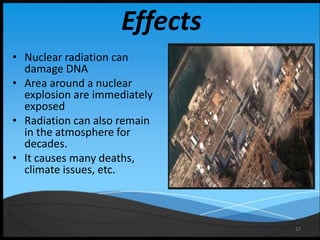
Effects
• Nuclear radiation can
damage DNA
• Area around a nuclear
explosion are immediately
exposed
• Radiation can also remain
in the atmosphere for
decades.
• It causes many deaths,
climate issues, etc.
18
Precautions
• Close all the doors and windows of
house
• Remain indoors as Radiations does
not penetrate solid structures
• Don’t look at the fire caused by
nuclear disaster as it causes
disaster instant blindness.
• Common indicators of these
disasters are vomiting, nausea,
dizziness etc.
• Cover all the food items, water, etc.
19
Recent Case Study
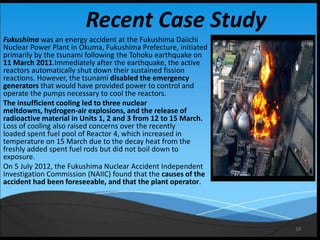
Fukushima was an energy accident at the Fukushima Daiichi
Nuclear Power Plant in Okuma, Fukushima Prefecture, initiated
primarily by the tsunami following the Tohoku earthquake on
11 March 2011.Immediately after the earthquake, the active
reactors automatically shut down their sustained fission
reactions. However, the tsunami disabled the emergency
generators that would have provided power to control and
operate the pumps necessary to cool the reactors.
The insufficient cooling led to three nuclear
meltdowns, hydrogen-air explosions, and the release of
radioactive material in Units 1, 2 and 3 from 12 to 15 March.
Loss of cooling also raised concerns over the recently
loaded spent fuel pool of Reactor 4, which increased in
temperature on 15 March due to the decay heat from the
freshly added spent fuel rods but did not boil down to
exposure.
On 5 July 2012, the Fukushima Nuclear Accident Independent
Investigation Commission (NAIIC) found that the causes of the
accident had been foreseeable, and that the plant operator.
20
21
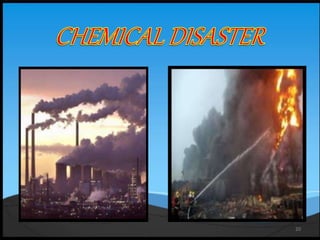
What is Chemical Disaster ?
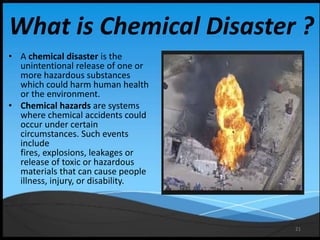
• A chemical disaster is the
unintentional release of one or
more hazardous substances
which could harm human health
or the environment.
• Chemical hazards are systems
where chemical accidents could
occur under certain
circumstances. Such events
include
fires, explosions, leakages or
release of toxic or hazardous
materials that can cause people
illness, injury, or disability.
22
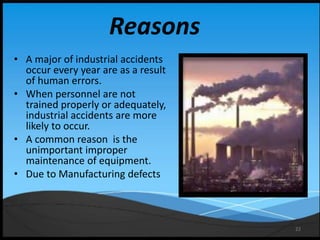
Reasons
• A major of industrial accidents
occur every year are as a result
of human errors.
• When personnel are not
trained properly or adequately,
industrial accidents are more
likely to occur.
• A common reason is the
unimportant improper
maintenance of equipment.
• Due to Manufacturing defects
23
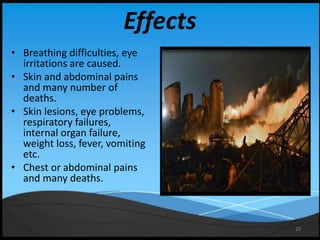
Effects
• Breathing difficulties, eye
irritations are caused.
• Skin and abdominal pains
and many number of
deaths.
• Skin lesions, eye problems,
respiratory failures,
internal organ failure,
weight loss, fever, vomiting
etc.
• Chest or abdominal pains
and many deaths.
24
Precautions
• Do not panic, evacuate calmly
and quickly perpendicular to
the wind though the designated
escape out.
• Keep a wet handkerchief or a
piece of cloth on face during
evacuation.
• Who are unable to evacuate
close all the doors and windows
tightly.
• Don’t pay attention to the
rumors and don’t spread
rumors
• Change clothes when reached
to safe place.
25
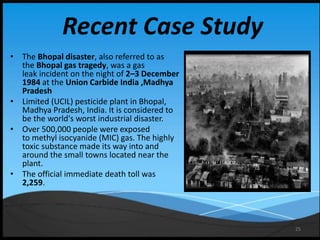
Recent Case Study
• The Bhopal disaster, also referred to as
the Bhopal gas tragedy, was a gas
leak incident on the night of 2–3 December
1984 at the Union Carbide India ,Madhya
Pradesh
• Limited (UCIL) pesticide plant in Bhopal,
Madhya Pradesh, India. It is considered to
be the world's worst industrial disaster.
• Over 500,000 people were exposed
to methyl isocyanide (MIC) gas. The highly
toxic substance made its way into and
around the small towns located near the
plant.
• The official immediate death toll was
2,259.
26
27
What is Biological Disaster ?
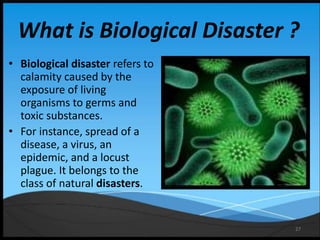
• Biological disaster refers to
calamity caused by the
exposure of living
organisms to germs and
toxic substances.
• For instance, spread of a
disease, a virus, an
epidemic, and a locust
plague. It belongs to the
class of natural disasters.
28
Causes
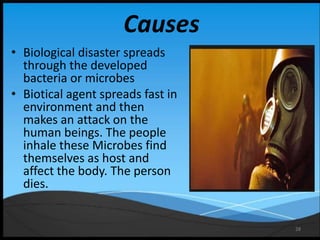
• Biological disaster spreads
through the developed
bacteria or microbes
• Biotical agent spreads fast in
environment and then
makes an attack on the
human beings. The people
inhale these Microbes find
themselves as host and
affect the body. The person
dies.
29
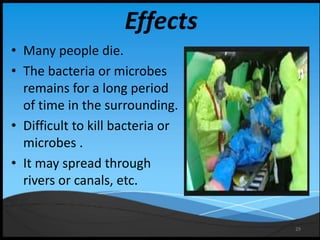
Effects
• Many people die.
• The bacteria or microbes
remains for a long period
of time in the surrounding.
• Difficult to kill bacteria or
microbes .
• It may spread through
rivers or canals, etc.
30
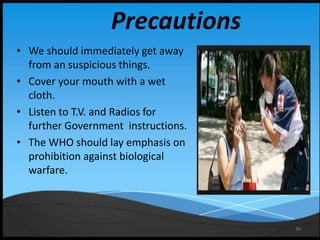
Precautions
• We should immediately get away
from an suspicious things.
• Cover your mouth with a wet
cloth.
• Listen to T.V. and Radios for
further Government instructions.
• The WHO should lay emphasis on
prohibition against biological
warfare.
31
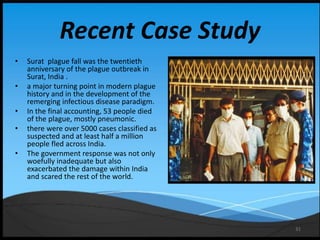
Recent Case Study
• Surat plague fall was the twentieth
anniversary of the plague outbreak in
Surat, India .
• a major turning point in modern plague
history and in the development of the
remerging infectious disease paradigm.
• In the final accounting, 53 people died
of the plague, mostly pneumonic.
• there were over 5000 cases classified as
suspected and at least half a million
people fled across India.
• The government response was not only
woefully inadequate but also
exacerbated the damage within India
and scared the rest of the world.
32
References
• https://en.wikipedia.org/wiki/Fuk
ushima_Daiichi_nuclear_disaster
• http://www.geographiaias.com/bi
ological-disasters-causes-and-
way-forward/
• https://en.wikipedia.org/wiki/Che
mical_accident
• https://en.wikipedia.org/wiki/Nuc
lear_and_radiation_accidents_an
d_incidents
• https://en.wikipedia.org/wiki/201
3_Kolkata_market_fire
33

Man made disaster-Pranav Doshi

  • 1.
    Efforts by -Pranav Doshi 1
  • 2.
    2 INDEX1. Disaster 2. Typesof Disaster 3. Manmade Disaster 4. Types of Disaster 5. Fire Accidents 6. Nuclear Disaster 7. Chemical Disaster 8. Biological Disaster 9. References
  • 3.
  • 4.
    4 A disaster isa sudden, calamitous event that seriously disrupts the functioning of a community or society and causes human, material and economy or environmental losses that exceed the community’s or societies' ability to cope using its own resources. Though often caused by nature, disasters can have human origins. What is a disaster ?
  • 5.
    5 Types of disasters NaturalDisaster Natural disaster are the events caused by natural forces Man-made Disaster Man-made disaster are the cries caused by a human act, intentionally or unintentionally
  • 6.
  • 7.
    7 Typesof Man-madeDisaster • Fireaccidents • Nuclear Disaster • Fire accidents • Biological Disaster • Terrorism • Epidemic • Road accidents
  • 8.
  • 9.
    9 What is FireAccident ? Fire accident is a mishap that could be either man- made or natural. Accidental fire occurs frequently and can be controlled but may at times result in severe loss of life and property.
  • 10.
    10 Reasons • Inadequate orfaulty wiring can cause fires from electrical accidents. • Car fires can be caused by fuel leakages, overheating, short circuits, and accidents. • Candles look and smell pretty, but if left unattended they can cause a room to easily burst into flames. • Smoking is the leading cause of civilian home fire deaths. • Heating equipment is the second most common cause of home fire fatalities.
  • 11.
    11 Effects • Fire canbe deadly, destroying homes, wildlife habitat and timber, and polluting the air with emissions harmful to human health. • Fires impact people, property and the environment in all countries around the world. • The resulting losses are extraordinary causing hundreds of deaths. • Widespread damage to property and contents . • significant impacts on the environment that polluting the air with emissions harmful to human health and also causes global warming. • Fire accidents can result in catastrophic personal injury and devastating damage.
  • 12.
    12 Precautions • Ensure thatgood quality of wires , resistant materials are used while building the home. • When a leak is suspected, no match should be stuck or electric switch should be turned on. • Windows should be opened immediately to let the gas out and allow fresh air to come in. • Always turn off gas stows when not in use. • Avoid wearing of nylon clothes while cooking in kitchen as they catch fire immediately.
  • 13.
    13 Recent Case Study The2013 Kolkata market fire was a fire accident that occurred in a five-stored marketplace in Kolkata, the capital city of West Bengal, India, on 27 February 2013. An estimated 19 people, who were mostly laborers working in the market were killed in the accident. Initial reports indicate the fire might have been initiated by a short circuit in the first floor of the market. The other major fire accidents in Kolkata are the 2011 AMRI hospital fire accident that killed 90 people and 2018 Bagri Market fire in which no people were killed but lasted for 4 days which destroyed nearly 1000 shops.
  • 14.
  • 15.
    15 What is NuclearDisaster ? A nuclear and radiation accident is defined by the International Atomic Energy Agency as "an event that has led to significant consequences to people, the environment or the facility."
  • 16.
    16 ReasonsNuclear disaster areusually associated with meltdowns. When a meltdown occurs in the core of a reactor, the reactor melts. That is, the temperature rises in the core so much that the fuel rods actually turn to liquid. If the core continues to heat, the reactor would get so hot that the steel walls of the core would also melt. The extreme hot molten uranium would react with ground water , producing large explosions of radioactive steam and debris that would affect nearby town and population centers.
  • 17.
    17 Effects • Nuclear radiationcan damage DNA • Area around a nuclear explosion are immediately exposed • Radiation can also remain in the atmosphere for decades. • It causes many deaths, climate issues, etc.
  • 18.
    18 Precautions • Close allthe doors and windows of house • Remain indoors as Radiations does not penetrate solid structures • Don’t look at the fire caused by nuclear disaster as it causes disaster instant blindness. • Common indicators of these disasters are vomiting, nausea, dizziness etc. • Cover all the food items, water, etc.
  • 19.
    19 Recent Case Study Fukushimawas an energy accident at the Fukushima Daiichi Nuclear Power Plant in Okuma, Fukushima Prefecture, initiated primarily by the tsunami following the Tohoku earthquake on 11 March 2011.Immediately after the earthquake, the active reactors automatically shut down their sustained fission reactions. However, the tsunami disabled the emergency generators that would have provided power to control and operate the pumps necessary to cool the reactors. The insufficient cooling led to three nuclear meltdowns, hydrogen-air explosions, and the release of radioactive material in Units 1, 2 and 3 from 12 to 15 March. Loss of cooling also raised concerns over the recently loaded spent fuel pool of Reactor 4, which increased in temperature on 15 March due to the decay heat from the freshly added spent fuel rods but did not boil down to exposure. On 5 July 2012, the Fukushima Nuclear Accident Independent Investigation Commission (NAIIC) found that the causes of the accident had been foreseeable, and that the plant operator.
  • 20.
  • 21.
    21 What is ChemicalDisaster ? • A chemical disaster is the unintentional release of one or more hazardous substances which could harm human health or the environment. • Chemical hazards are systems where chemical accidents could occur under certain circumstances. Such events include fires, explosions, leakages or release of toxic or hazardous materials that can cause people illness, injury, or disability.
  • 22.
    22 Reasons • A majorof industrial accidents occur every year are as a result of human errors. • When personnel are not trained properly or adequately, industrial accidents are more likely to occur. • A common reason is the unimportant improper maintenance of equipment. • Due to Manufacturing defects
  • 23.
    23 Effects • Breathing difficulties,eye irritations are caused. • Skin and abdominal pains and many number of deaths. • Skin lesions, eye problems, respiratory failures, internal organ failure, weight loss, fever, vomiting etc. • Chest or abdominal pains and many deaths.
  • 24.
    24 Precautions • Do notpanic, evacuate calmly and quickly perpendicular to the wind though the designated escape out. • Keep a wet handkerchief or a piece of cloth on face during evacuation. • Who are unable to evacuate close all the doors and windows tightly. • Don’t pay attention to the rumors and don’t spread rumors • Change clothes when reached to safe place.
  • 25.
    25 Recent Case Study •The Bhopal disaster, also referred to as the Bhopal gas tragedy, was a gas leak incident on the night of 2–3 December 1984 at the Union Carbide India ,Madhya Pradesh • Limited (UCIL) pesticide plant in Bhopal, Madhya Pradesh, India. It is considered to be the world's worst industrial disaster. • Over 500,000 people were exposed to methyl isocyanide (MIC) gas. The highly toxic substance made its way into and around the small towns located near the plant. • The official immediate death toll was 2,259.
  • 26.
  • 27.
    27 What is BiologicalDisaster ? • Biological disaster refers to calamity caused by the exposure of living organisms to germs and toxic substances. • For instance, spread of a disease, a virus, an epidemic, and a locust plague. It belongs to the class of natural disasters.
  • 28.
    28 Causes • Biological disasterspreads through the developed bacteria or microbes • Biotical agent spreads fast in environment and then makes an attack on the human beings. The people inhale these Microbes find themselves as host and affect the body. The person dies.
  • 29.
    29 Effects • Many peopledie. • The bacteria or microbes remains for a long period of time in the surrounding. • Difficult to kill bacteria or microbes . • It may spread through rivers or canals, etc.
  • 30.
    30 Precautions • We shouldimmediately get away from an suspicious things. • Cover your mouth with a wet cloth. • Listen to T.V. and Radios for further Government instructions. • The WHO should lay emphasis on prohibition against biological warfare.
  • 31.
    31 Recent Case Study •Surat plague fall was the twentieth anniversary of the plague outbreak in Surat, India . • a major turning point in modern plague history and in the development of the remerging infectious disease paradigm. • In the final accounting, 53 people died of the plague, mostly pneumonic. • there were over 5000 cases classified as suspected and at least half a million people fled across India. • The government response was not only woefully inadequate but also exacerbated the damage within India and scared the rest of the world.
  • 32.
    32 References • https://en.wikipedia.org/wiki/Fuk ushima_Daiichi_nuclear_disaster • http://www.geographiaias.com/bi ological-disasters-causes-and- way-forward/ •https://en.wikipedia.org/wiki/Che mical_accident • https://en.wikipedia.org/wiki/Nuc lear_and_radiation_accidents_an d_incidents • https://en.wikipedia.org/wiki/201 3_Kolkata_market_fire
  • 33.