
DISASTER AND IT’S MANAGEMENT
Prepared by
Group No. : 4
Members : Manan ; Kanishk ; Natasha ; Komal ;
Naman ; Muskan
DISASTER MANAGEMENT
The World is always
changing. disasters are
changes which are so
great they may cause
damage to the shape of
the land or to the lives of people and other
living things. Great changes happen deep inside
the Earth and on its surface. The changes on the
outer part of the Earth happen because of
different kinds of weather.
D – I – S – A – S – T – E – R PARADIGM
 Disaster Paradigm :
 D: Detection
 I: Incident Command
 S: Safety & Security
 A: Assess Hazards
 S: Support
 T: Triage & Treatment
 E: Evacuation
 R: Reallocation &
Redeployment
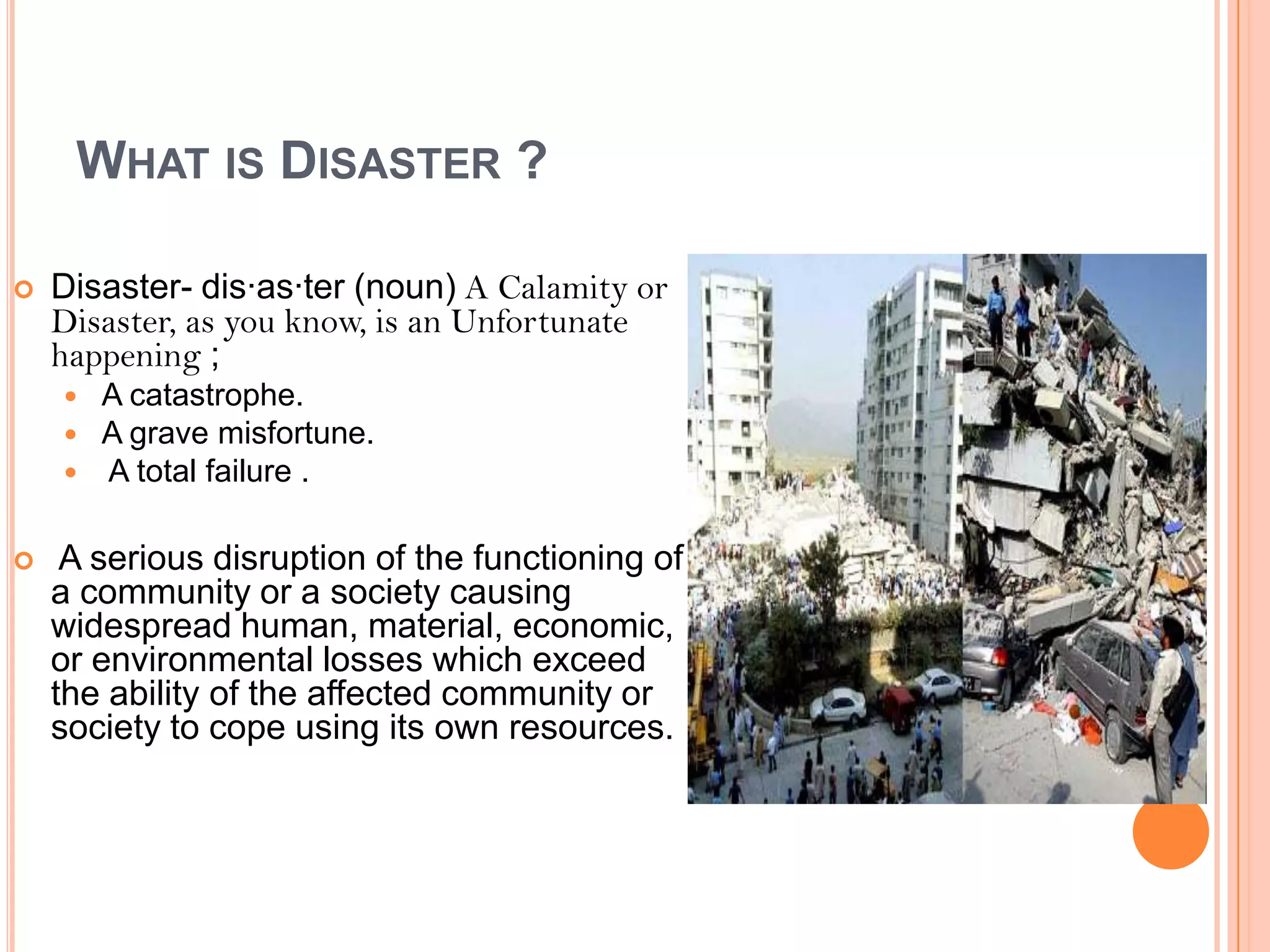
WHAT IS DISASTER ?
 Disaster- dis·as·ter (noun) A Calamity or
Disaster, as you know, is an Unfortunate
happening ;
 A catastrophe.
 A grave misfortune.
 A total failure .
 A serious disruption of the functioning of
a community or a society causing
widespread human, material, economic,
or environmental losses which exceed
the ability of the affected community or
society to cope using its own resources.
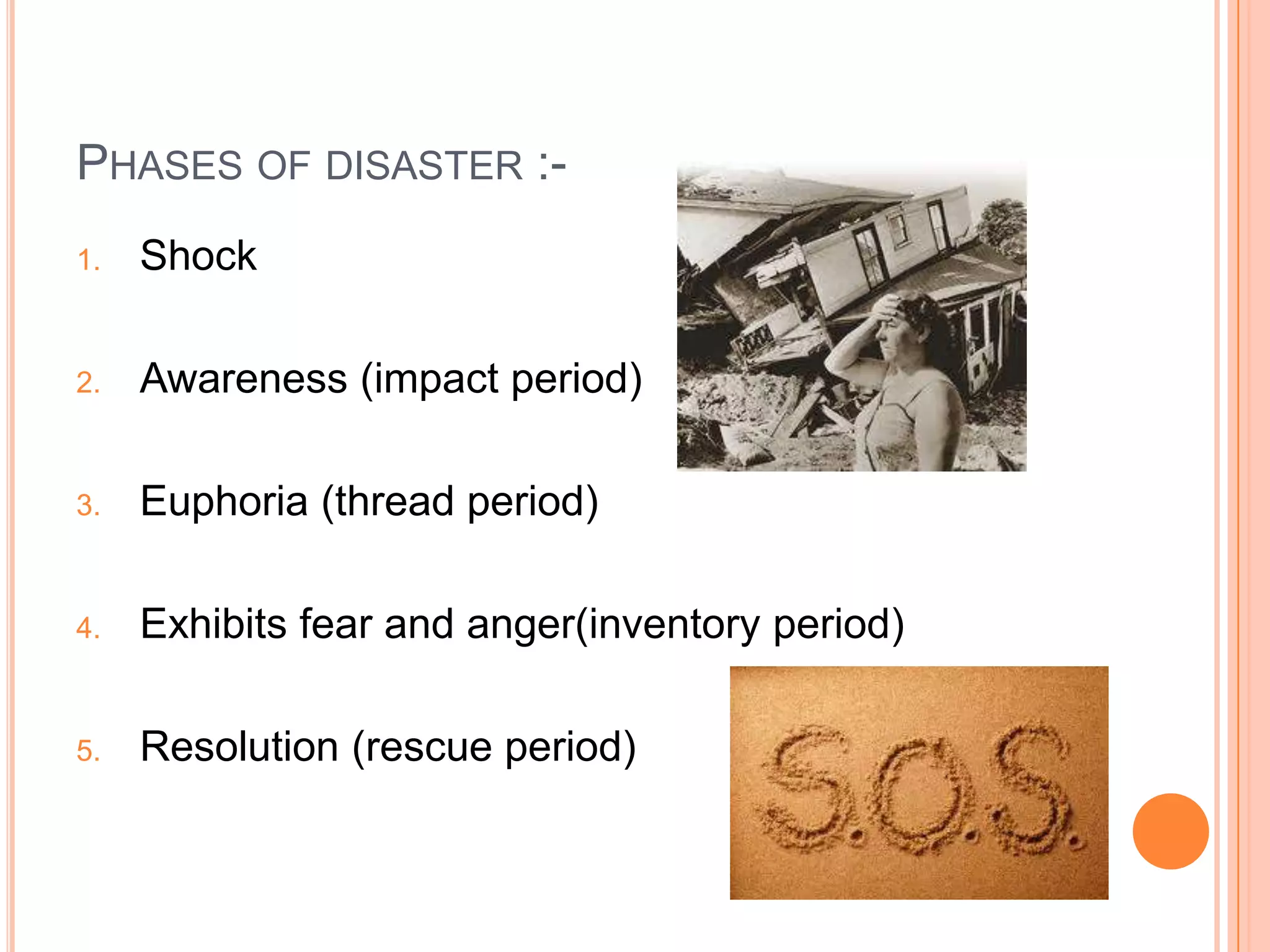
PHASES OF DISASTER :-
1. Shock
2. Awareness (impact period)
3. Euphoria (thread period)
4. Exhibits fear and anger(inventory period)
5. Resolution (rescue period)
DOUBLE CLICK TO OPEN
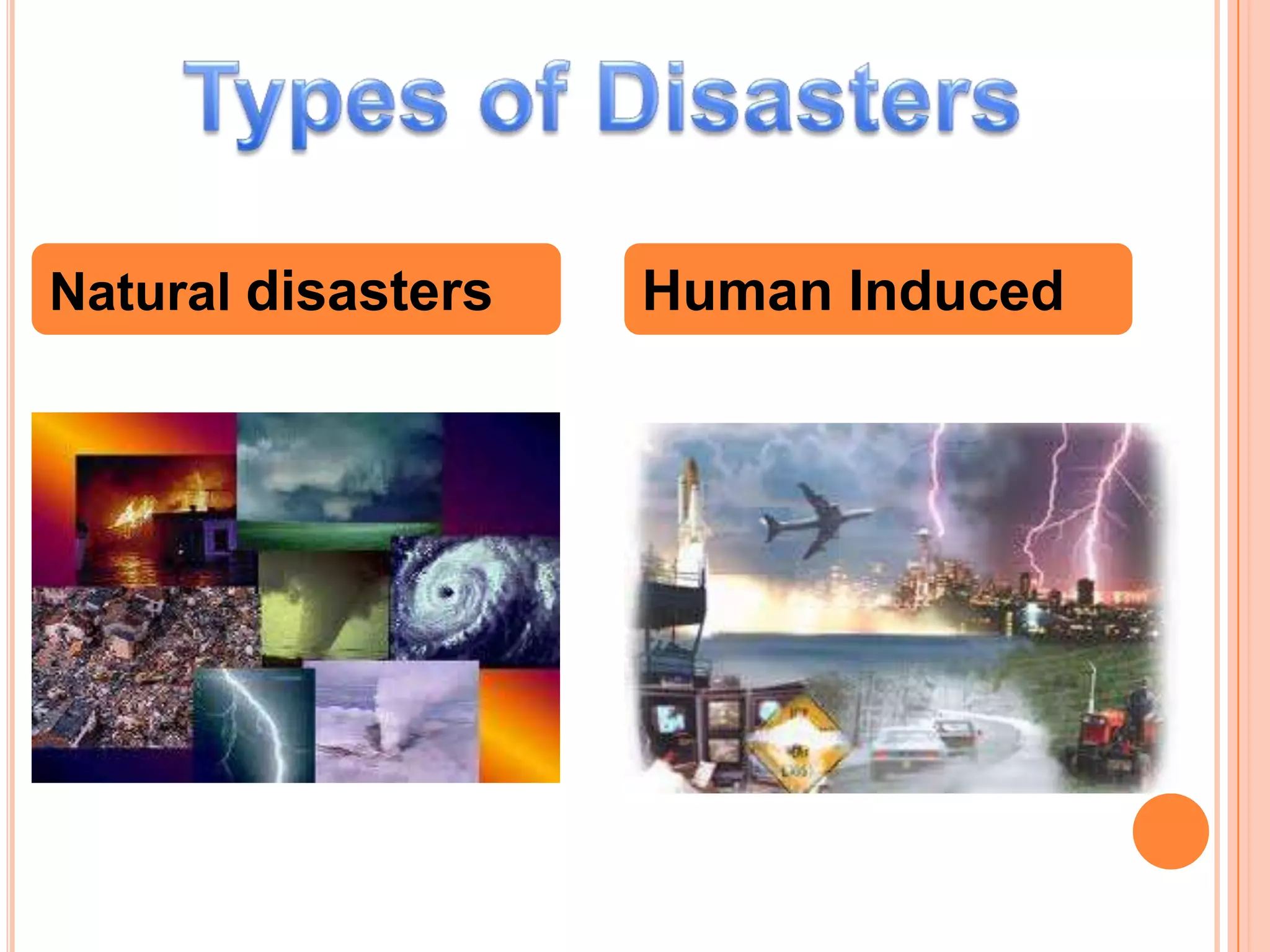
Human InducedNatural disasters
NATURAL DISASTERS
 Earthquakes
 Cyclones
 Floods
 Droughts
 Tsunamis
 Landslides
 Volcanic Eruptions
 Avalanche
 Forest Fires
 Epidemic Diseases
HUMAN-INDUCED DISASTERS
 Conventional warfare
 Non conventional warfare( Eg. Nuclear and
chemical)
 Transportation accident
 Structural collapse
 Explosions
 Fires
 Pollution
 Civil interest
 Terrorist attack
“NATURAL
DISASTERS”
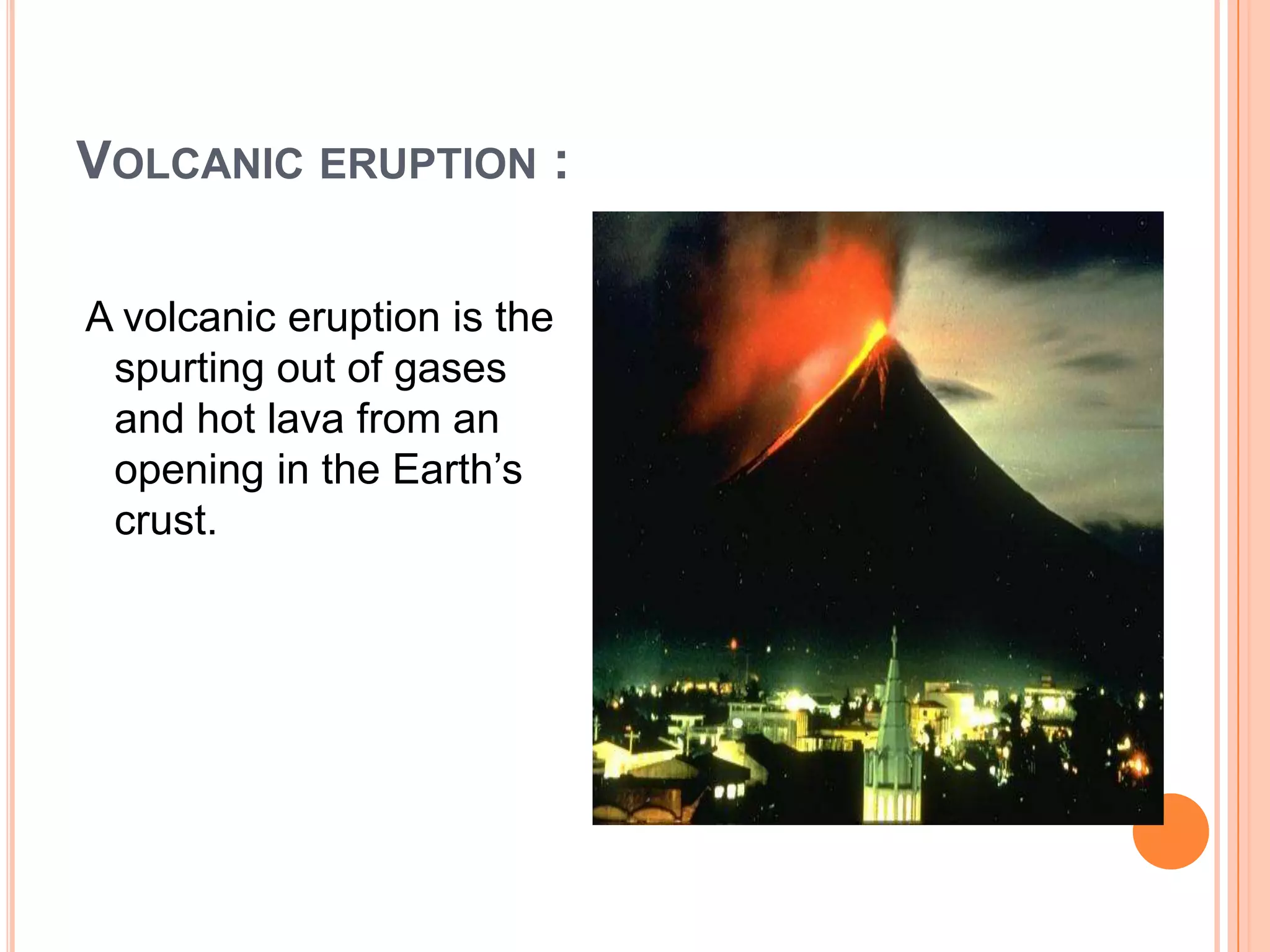
VOLCANIC ERUPTION :
A volcanic eruption is the
spurting out of gases
and hot lava from an
opening in the Earth’s
crust.
EARTHQUAKE :
An earthquake is a
violent shaking of the
ground. Sometimes it is
so strong that the
ground splits apart.
When parts of the
earth, called plates,
move against each
other giant shock
waves move upwards
towards the surface
causing the
earthquake.
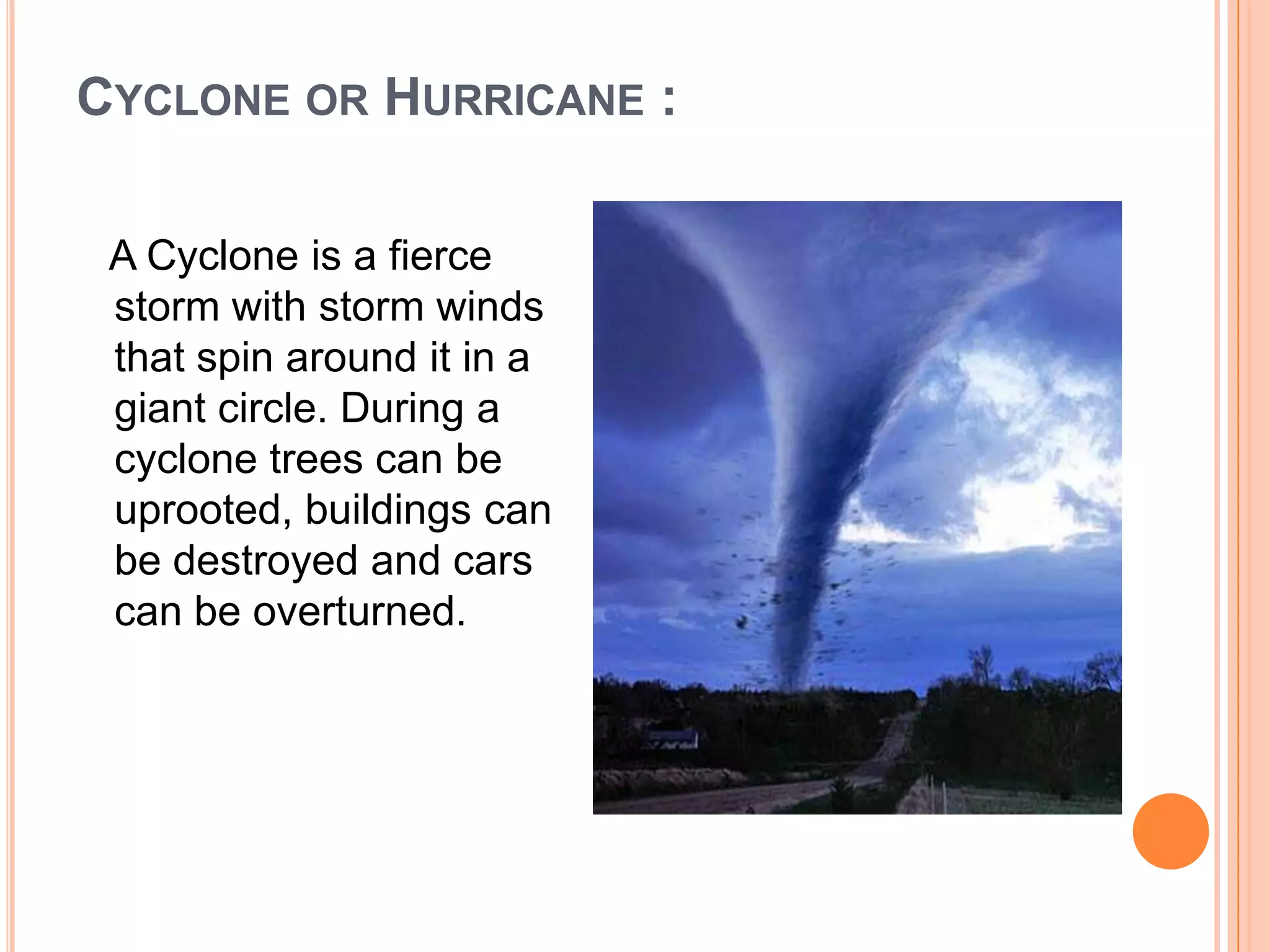
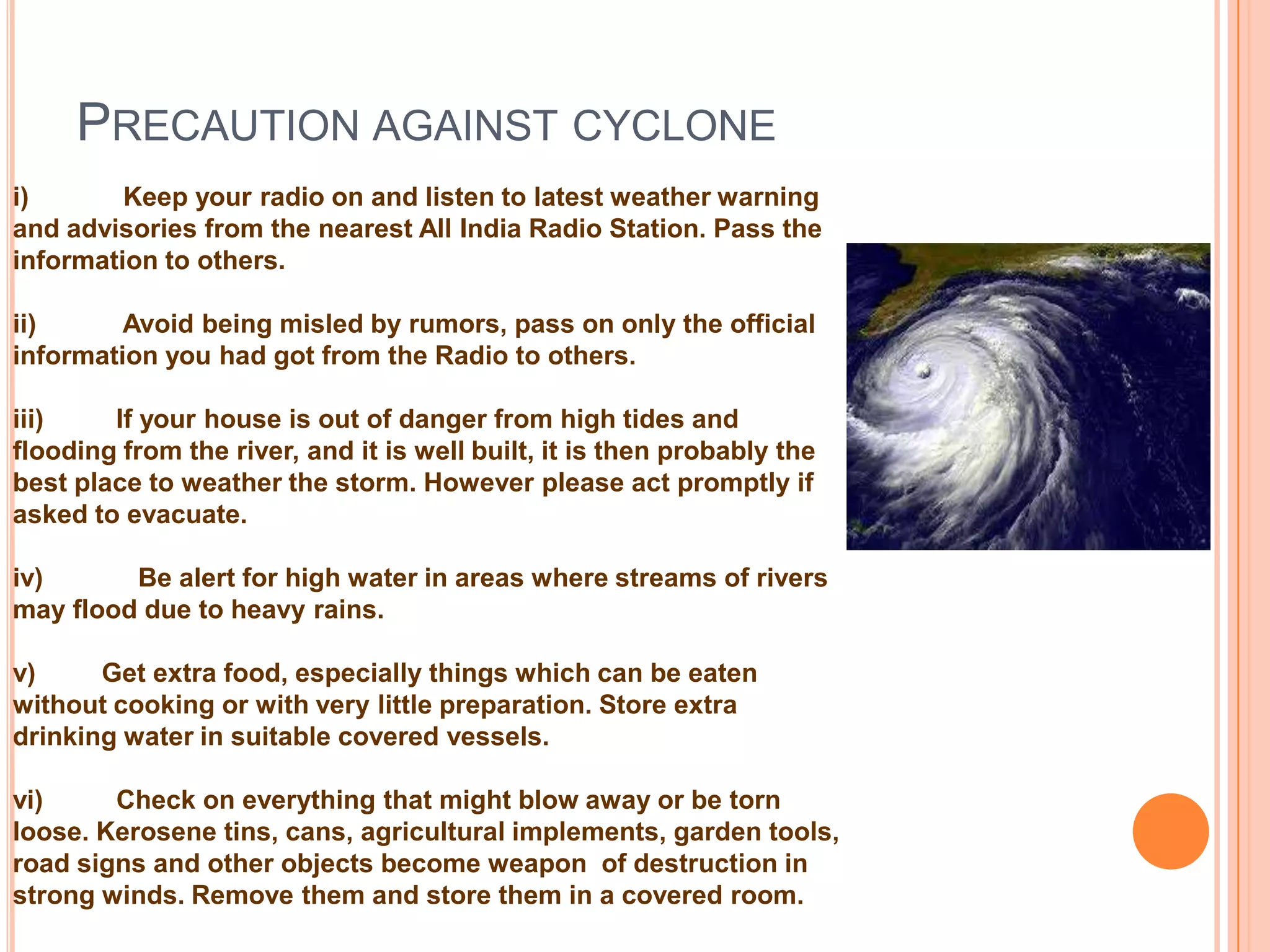
CYCLONE OR HURRICANE :
A Cyclone is a fierce
storm with storm winds
that spin around it in a
giant circle. During a
cyclone trees can be
uprooted, buildings can
be destroyed and cars
can be overturned.
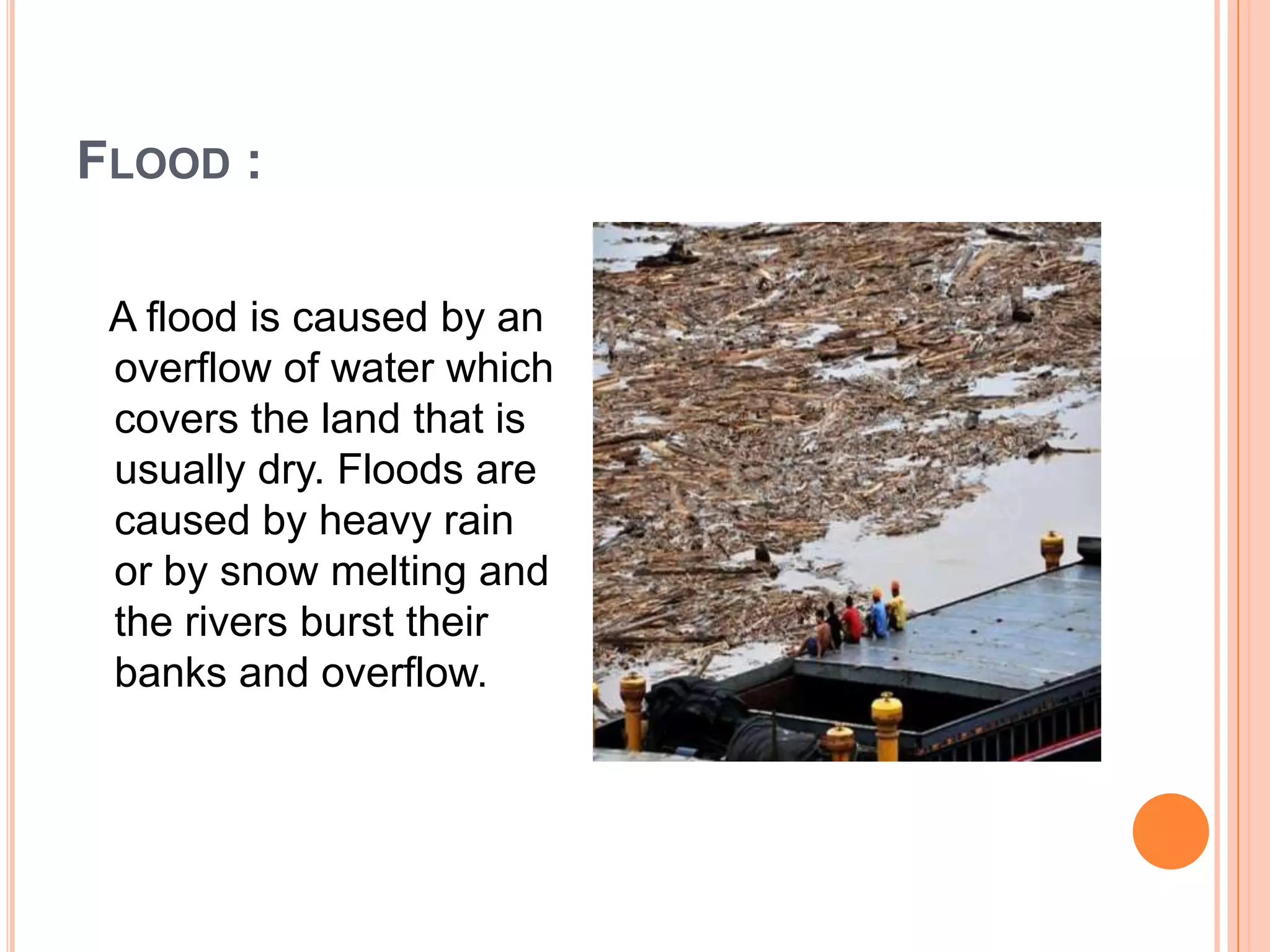
FLOOD :
A flood is caused by an
overflow of water which
covers the land that is
usually dry. Floods are
caused by heavy rain
or by snow melting and
the rivers burst their
banks and overflow.
AVALANCHE :
An Avalanche is a
movement of snow, ice
and rock down a
mountainside.
Avalanches can be
caused by – snow
melting quickly snow
freezing, melting then
freezing again
someone skiing a loud
noise or an earth
tremor
DROUGHT :
A drought is the lack of
rain for a long time.
In 1968 a drought began
in Africa.
Children born during this
year were five years
old before rain fell
again.
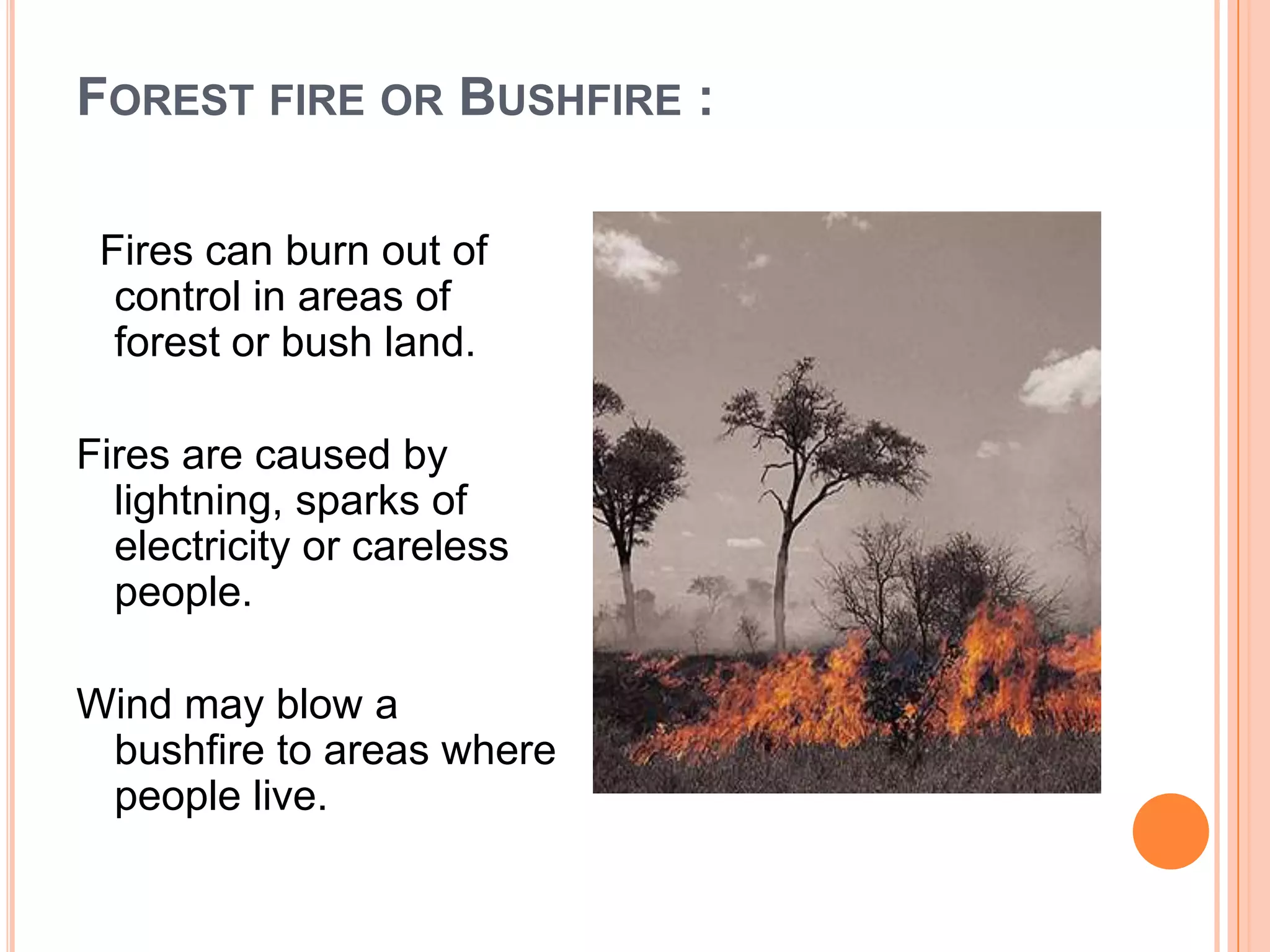
FOREST FIRE OR BUSHFIRE :
Fires can burn out of
control in areas of
forest or bush land.
Fires are caused by
lightning, sparks of
electricity or careless
people.
Wind may blow a
bushfire to areas where
people live.
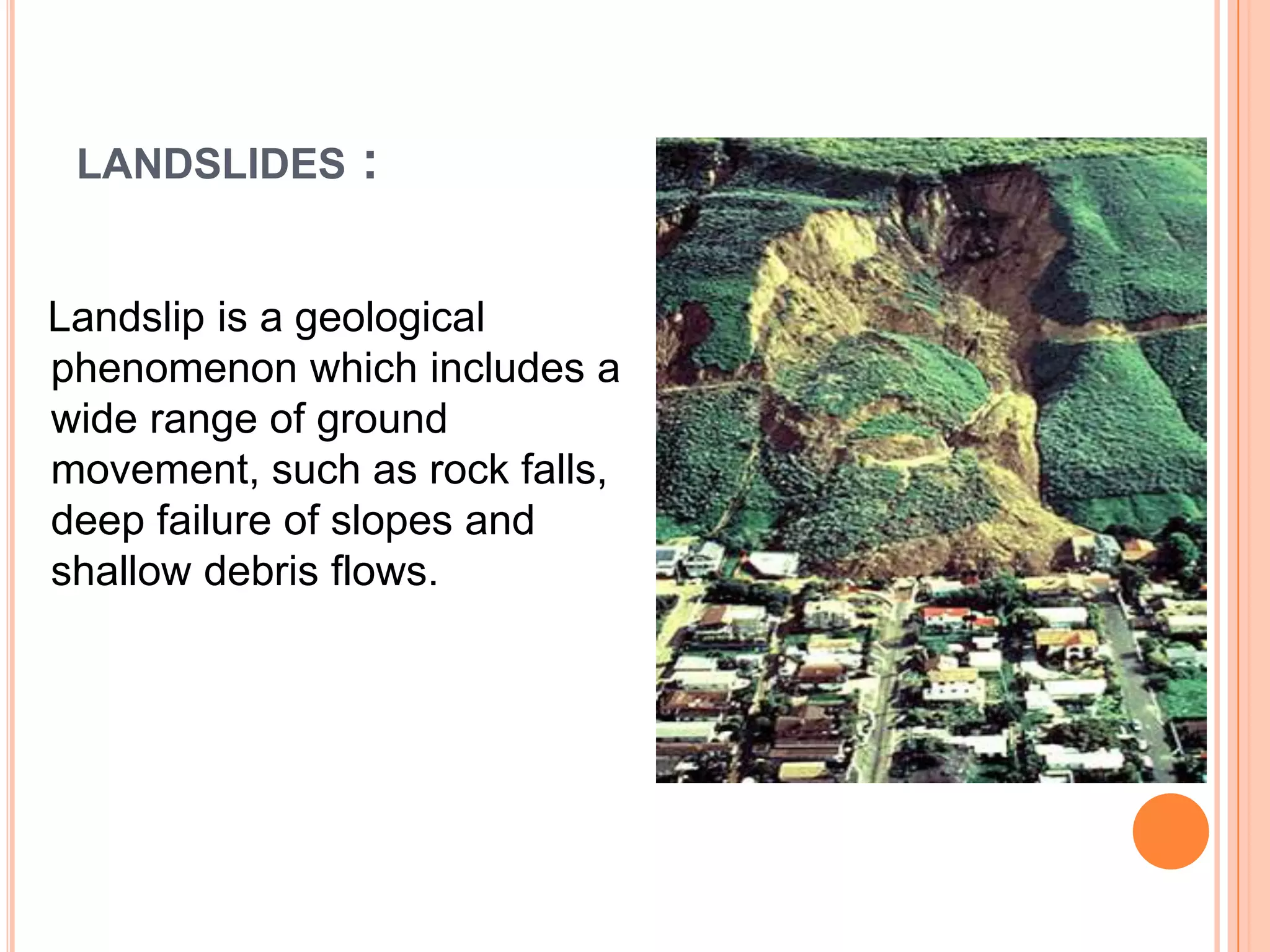
LANDSLIDES :
Landslip is a geological
phenomenon which includes a
wide range of ground
movement, such as rock falls,
deep failure of slopes and
shallow debris flows.
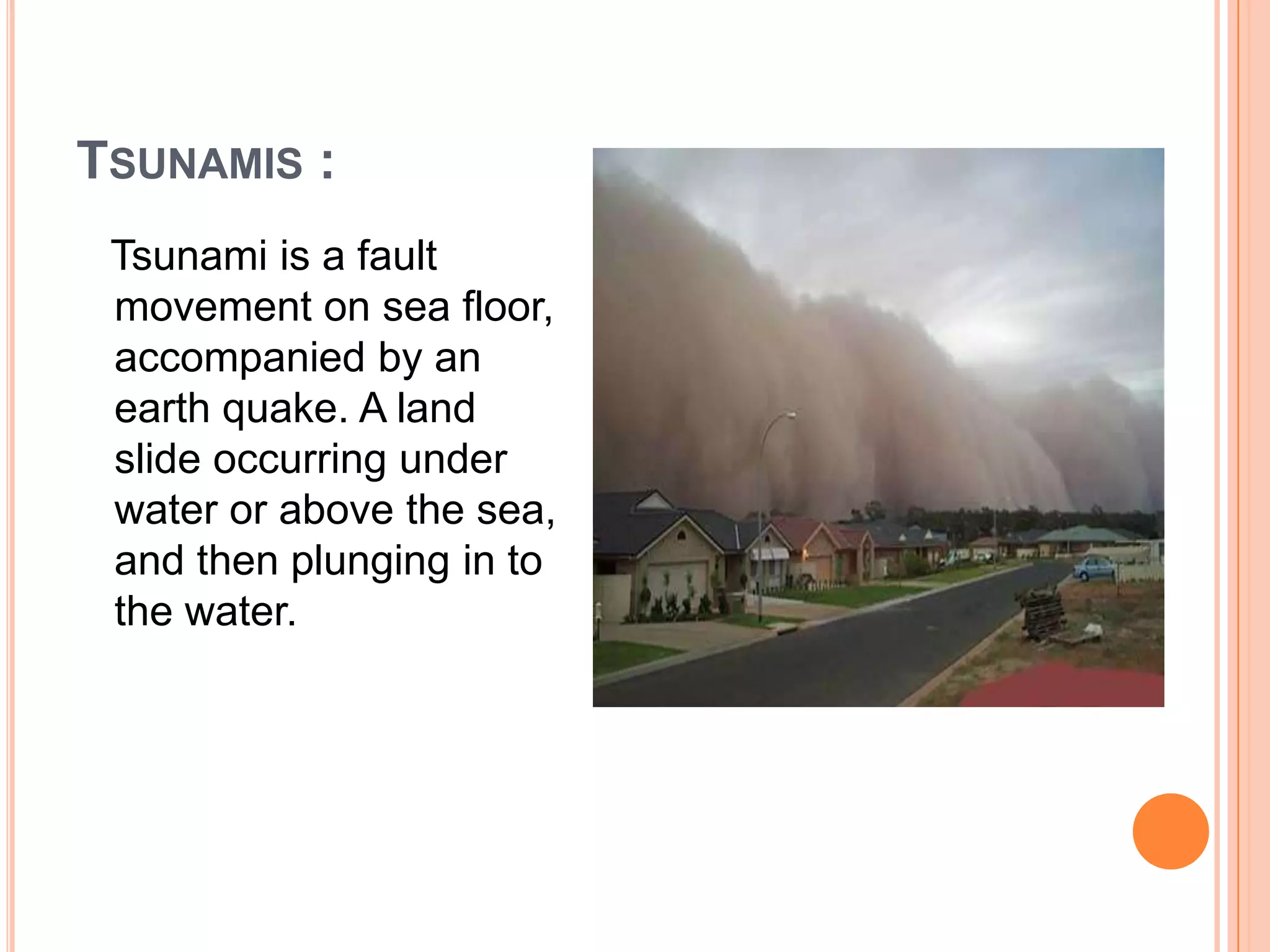
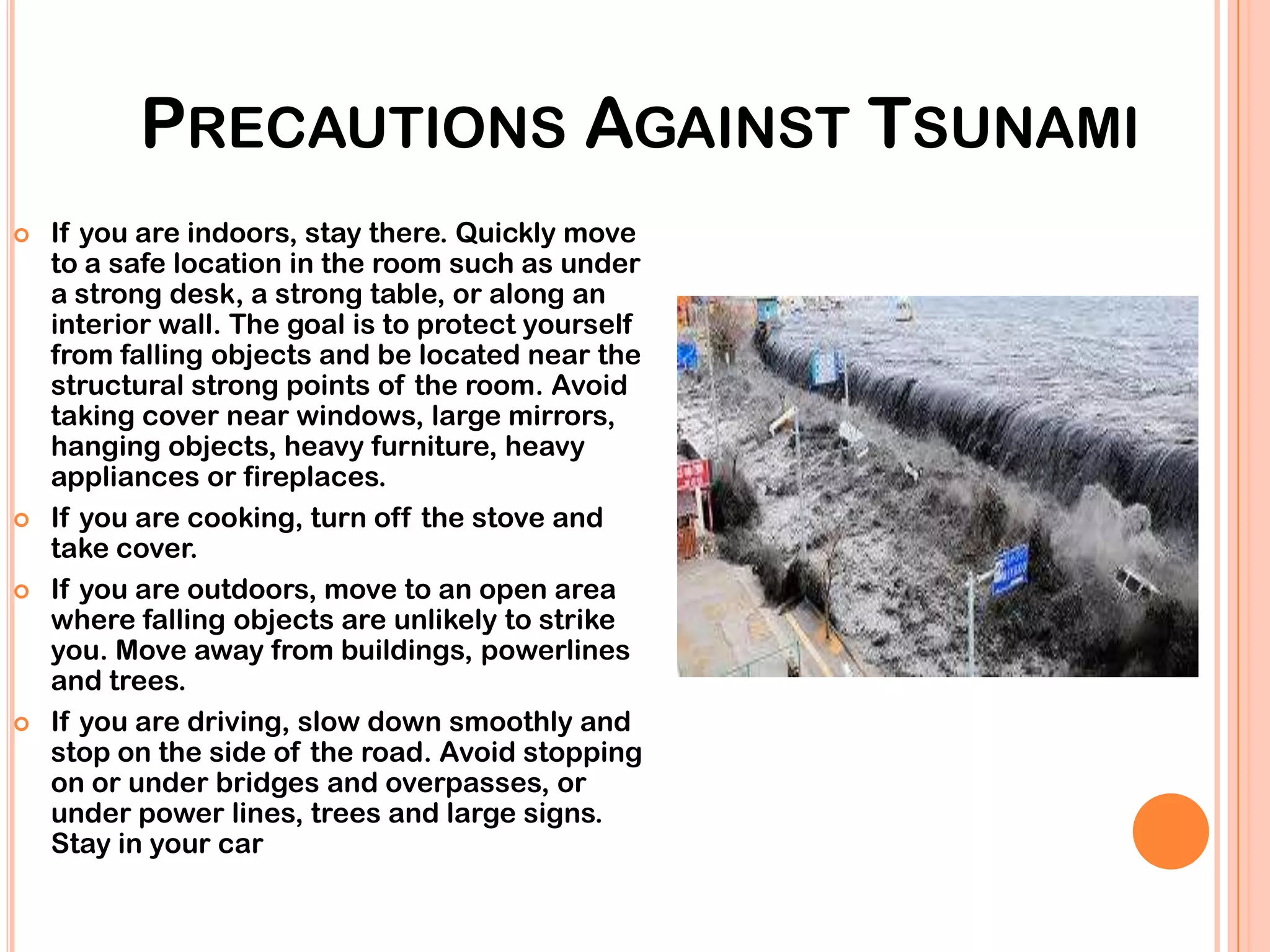
TSUNAMIS :
Tsunami is a fault
movement on sea floor,
accompanied by an
earth quake. A land
slide occurring under
water or above the sea,
and then plunging in to
the water.
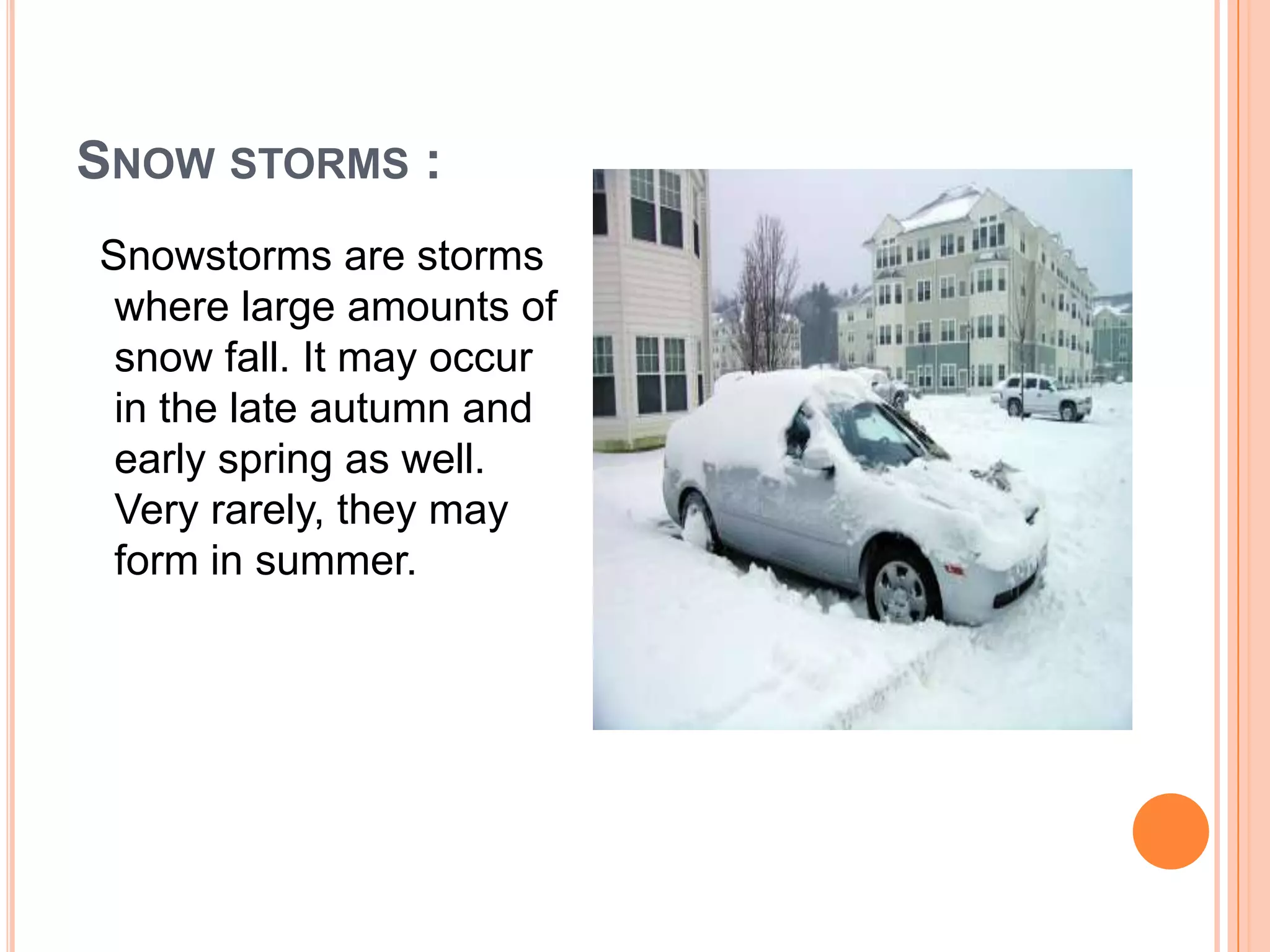
SNOW STORMS :
Snowstorms are storms
where large amounts of
snow fall. It may occur
in the late autumn and
early spring as well.
Very rarely, they may
form in summer.
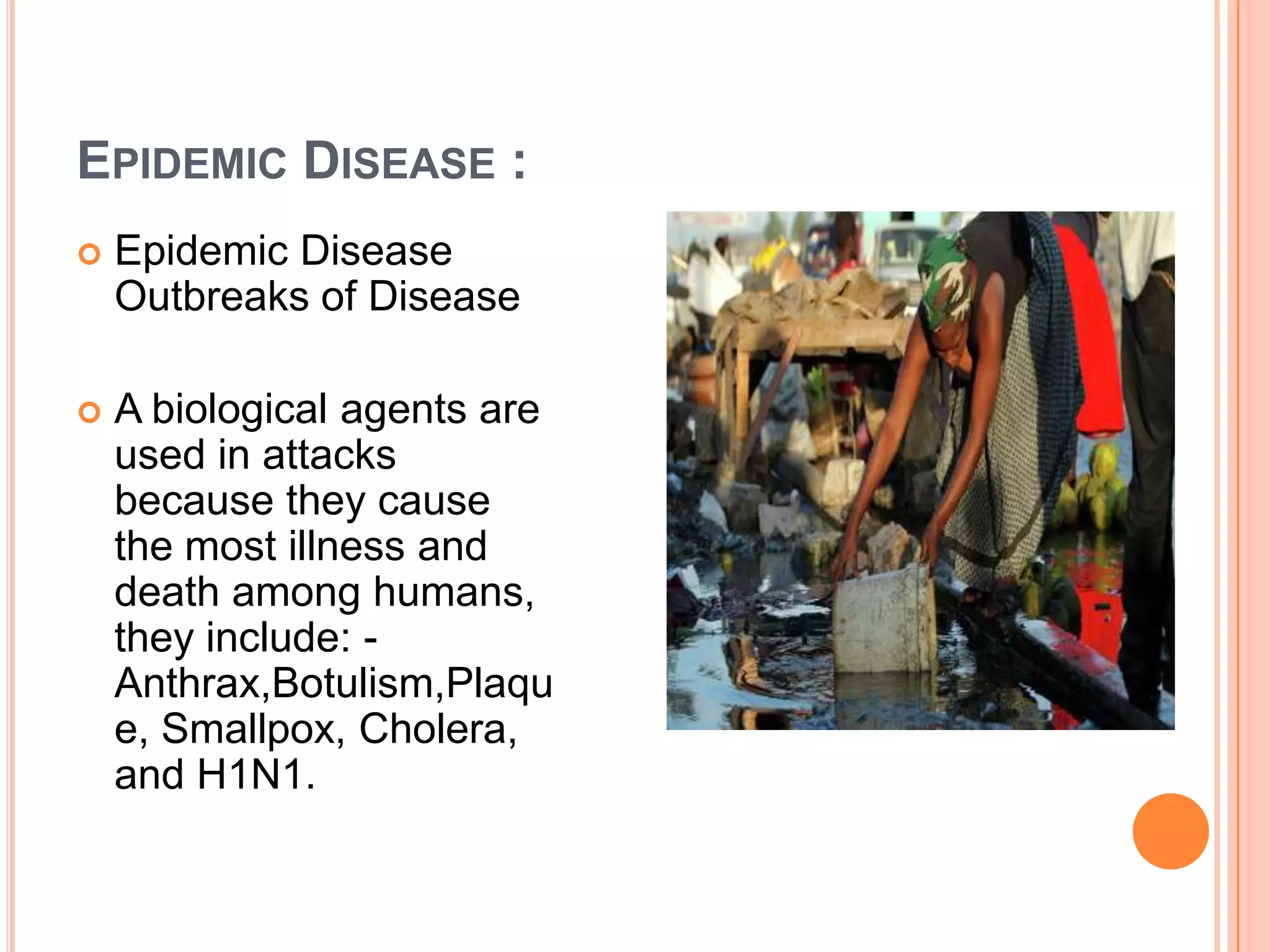
EPIDEMIC DISEASE :
 Epidemic Disease
Outbreaks of Disease
 A biological agents are
used in attacks
because they cause
the most illness and
death among humans,
they include: -
Anthrax,Botulism,Plaqu
e, Smallpox, Cholera,
and H1N1.
“HUMAN
INDUCED
DISASTERS”
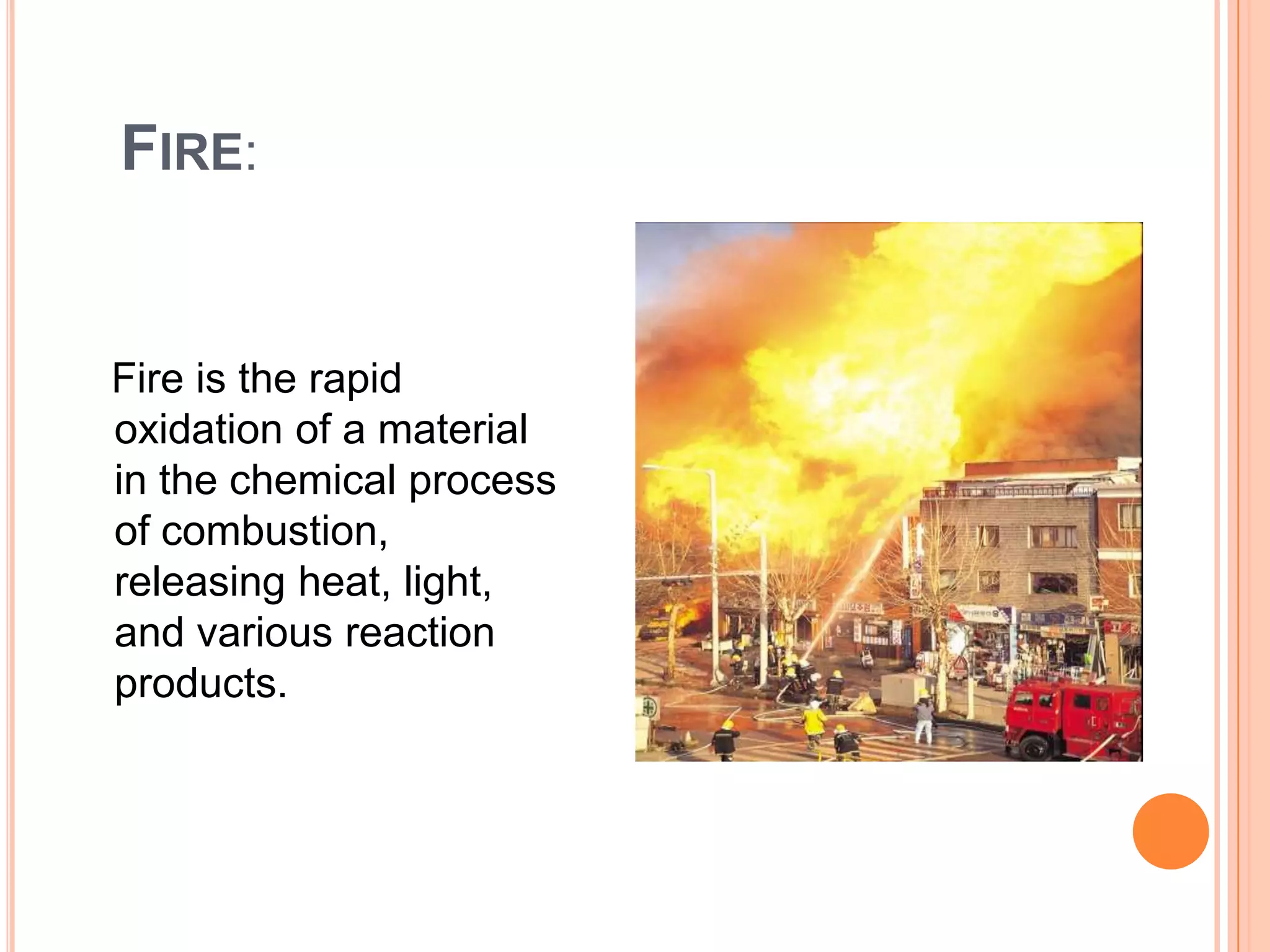
FIRE:
Fire is the rapid
oxidation of a material
in the chemical process
of combustion,
releasing heat, light,
and various reaction
products.
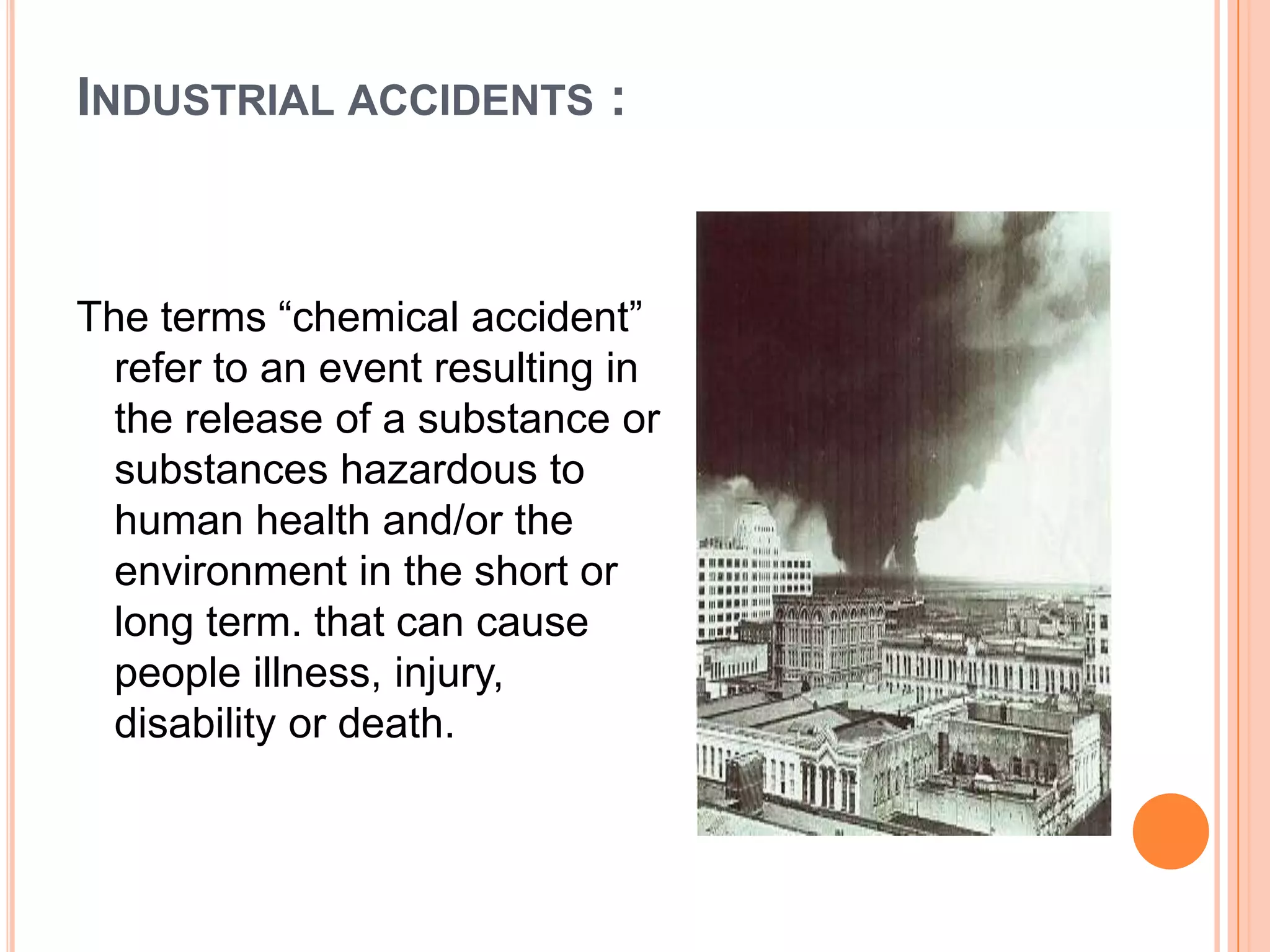
INDUSTRIAL ACCIDENTS :
The terms “chemical accident”
refer to an event resulting in
the release of a substance or
substances hazardous to
human health and/or the
environment in the short or
long term. that can cause
people illness, injury,
disability or death.
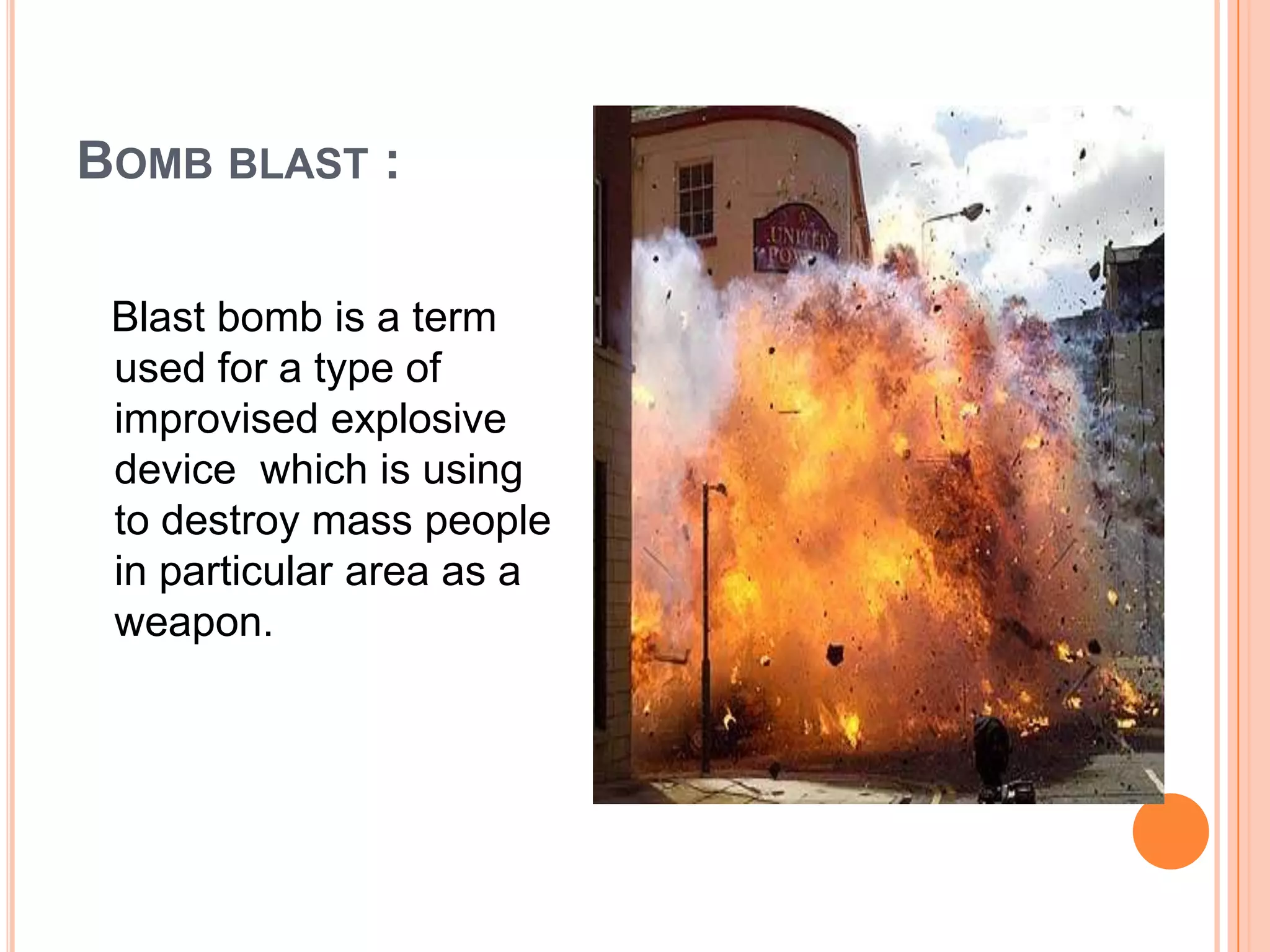
BOMB BLAST :
Blast bomb is a term
used for a type of
improvised explosive
device which is using
to destroy mass people
in particular area as a
weapon.
ROAD ACCIDENTS :
Road accidents A traffic
collision (motor vehicle
collision, motor vehicle
accident, or car crash)
is when a road vehicle
collides with another
vehicle.
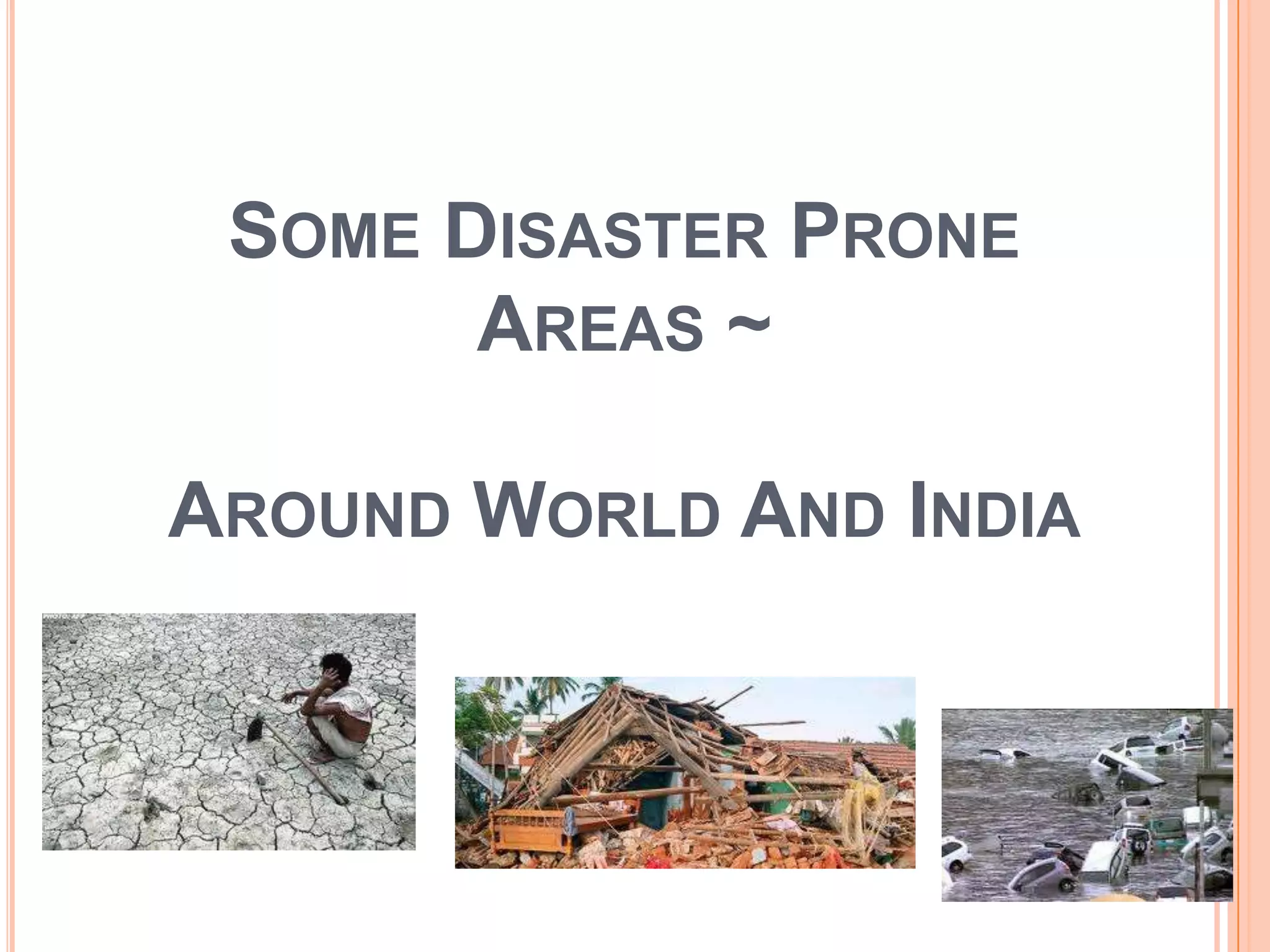
SOME DISASTER PRONE
AREAS ~
AROUND WORLD AND INDIA
WORLD NATURAL HAZARDS RISK ZONES
:
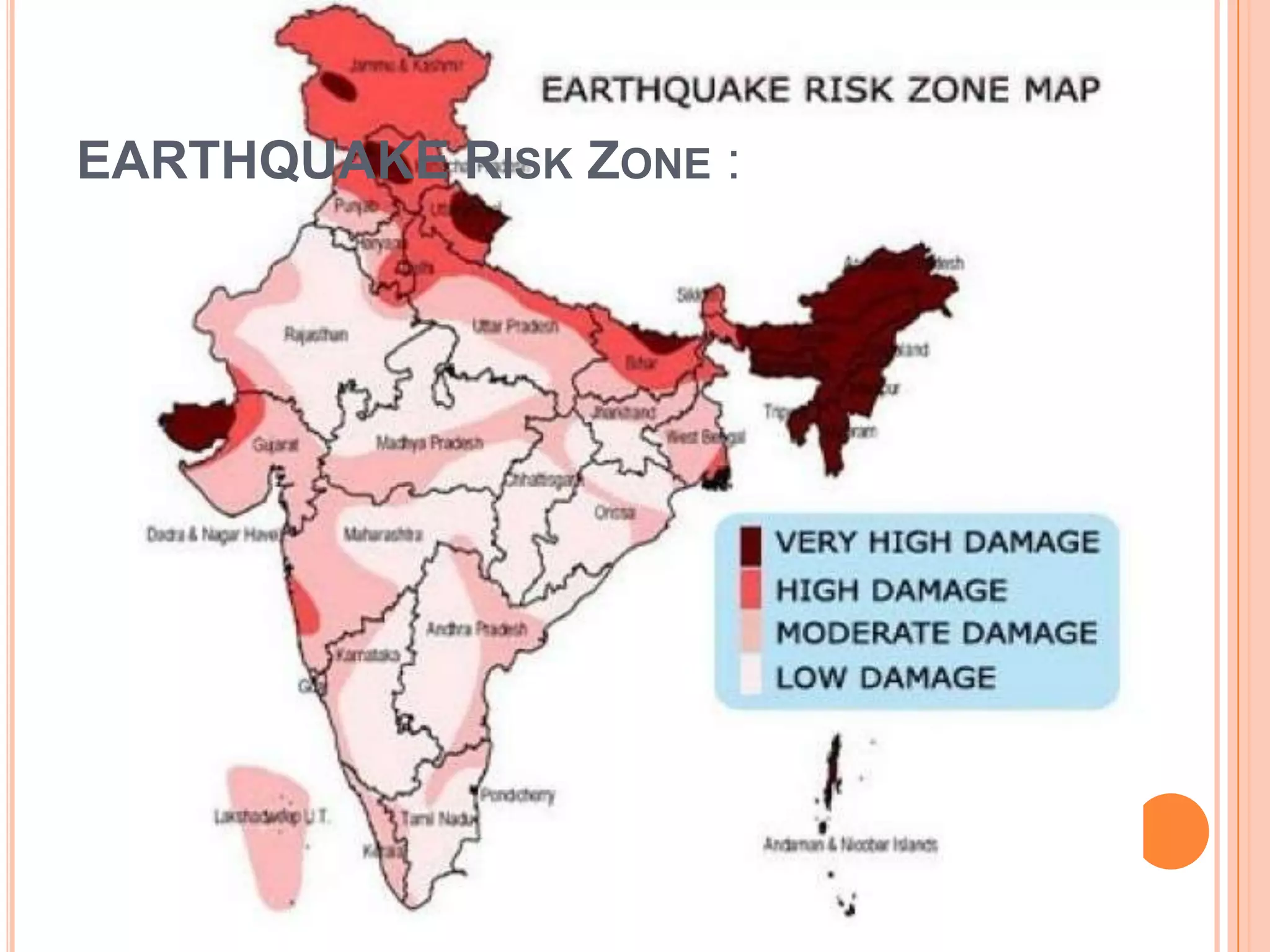
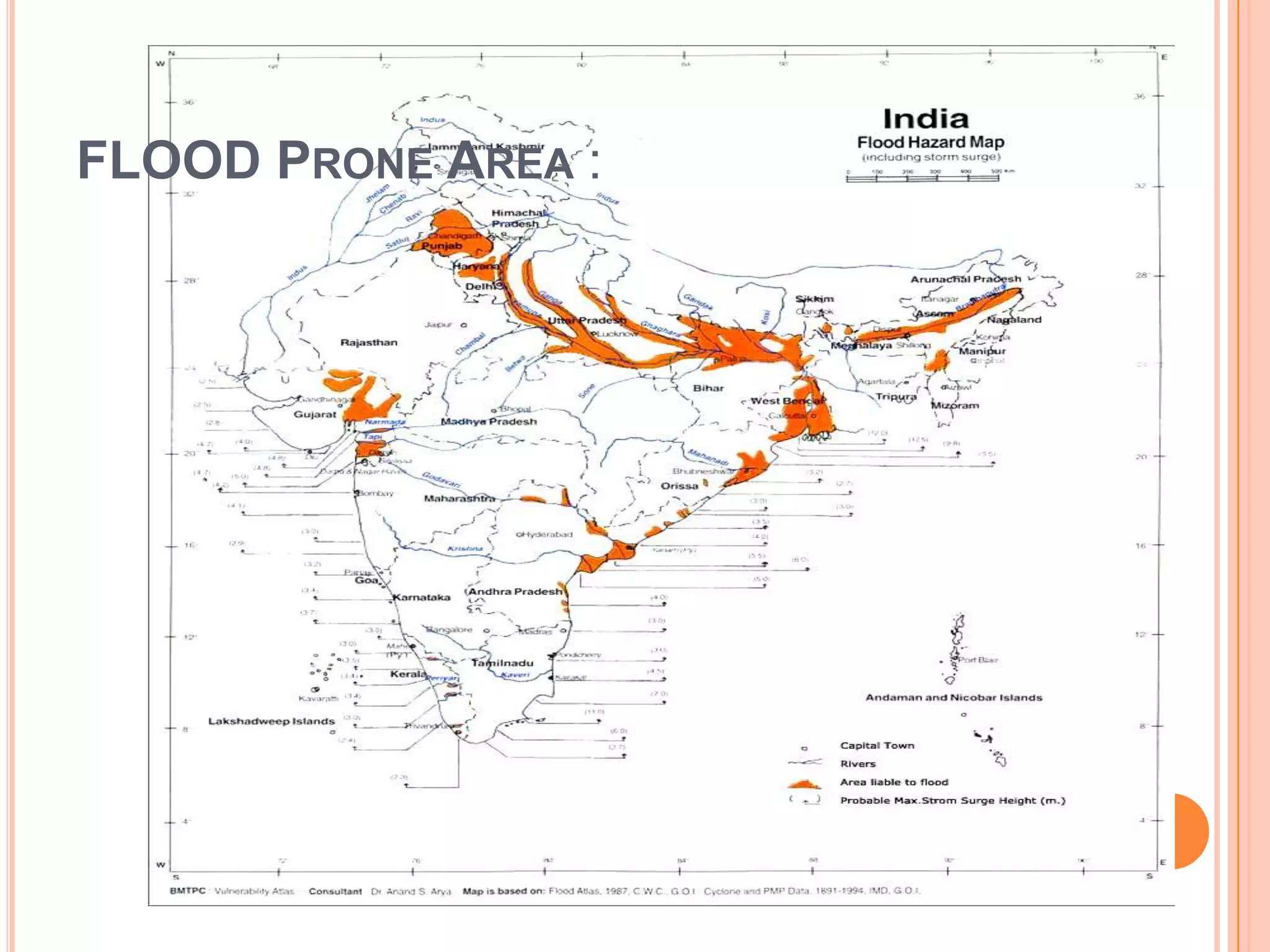
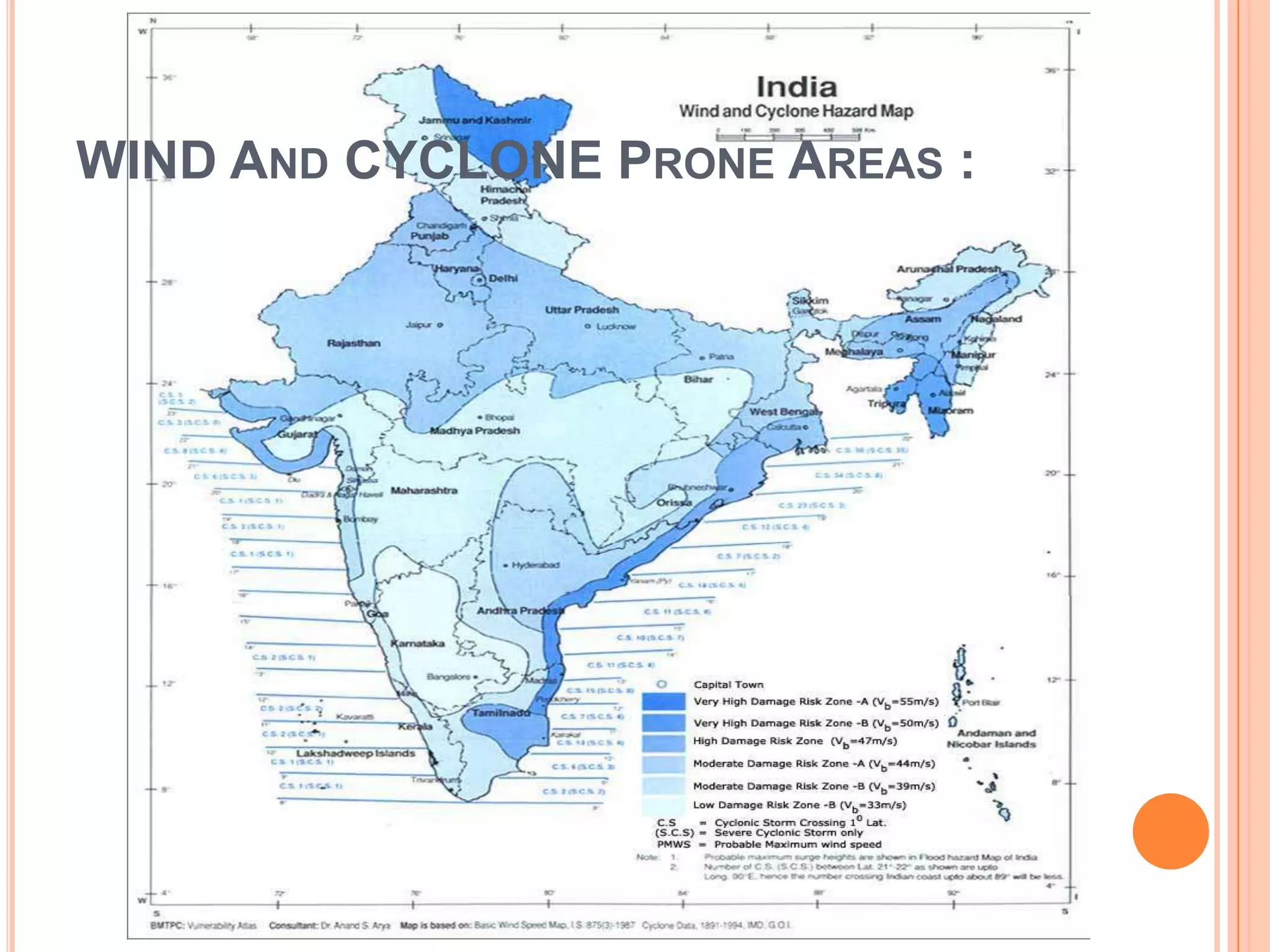
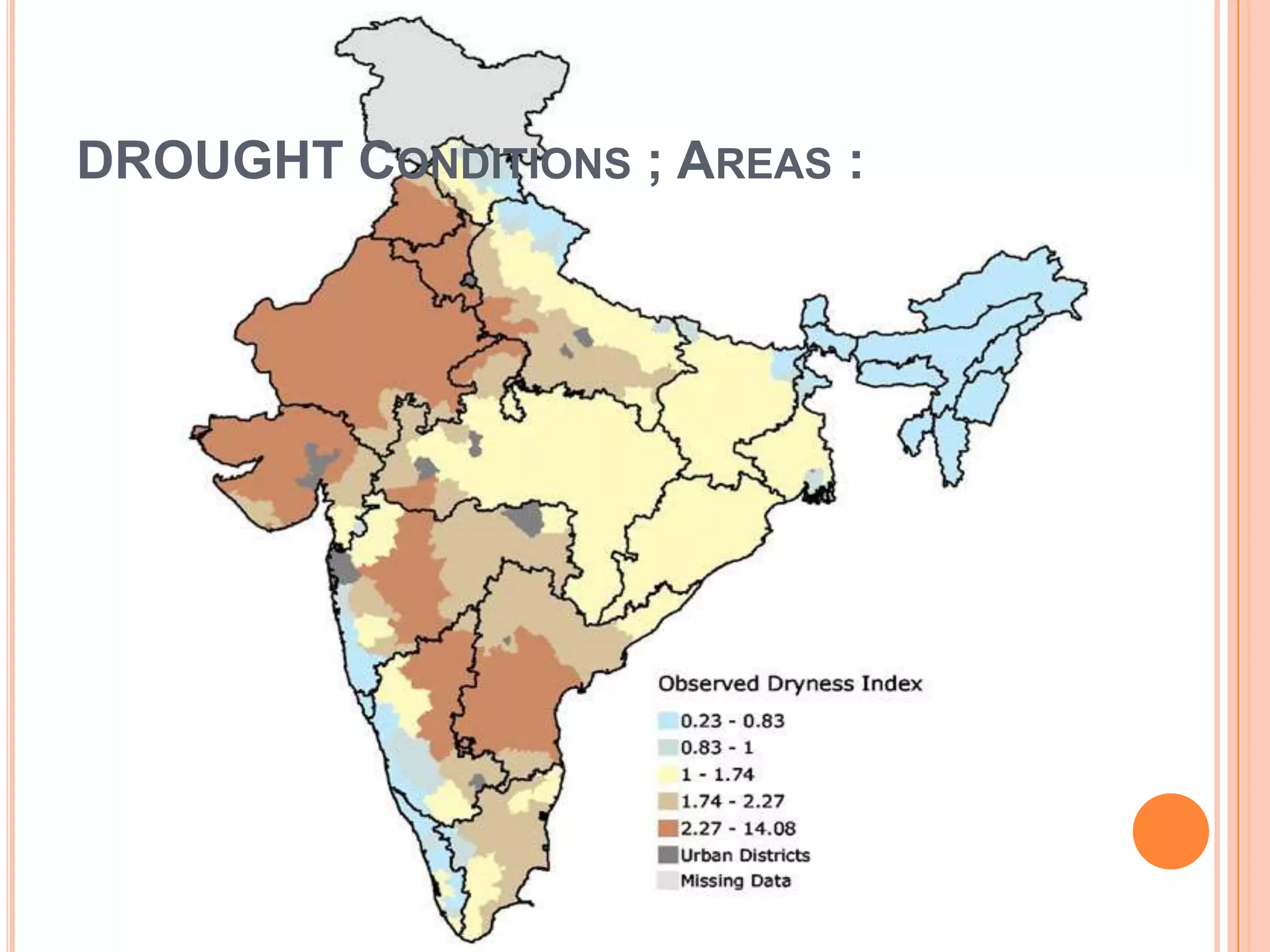
INDIA NATURAL HAZARDS RISK ZONES
EARTHQUAKE RISK ZONE :
FLOOD PRONE AREA :
WIND AND CYCLONE PRONE AREAS :
LANDSLIDE PRONE AREAS :
DROUGHT CONDITIONS ; AREAS :
DISASTER
MANAGEMENT
DISASTER MANAGEMENT :
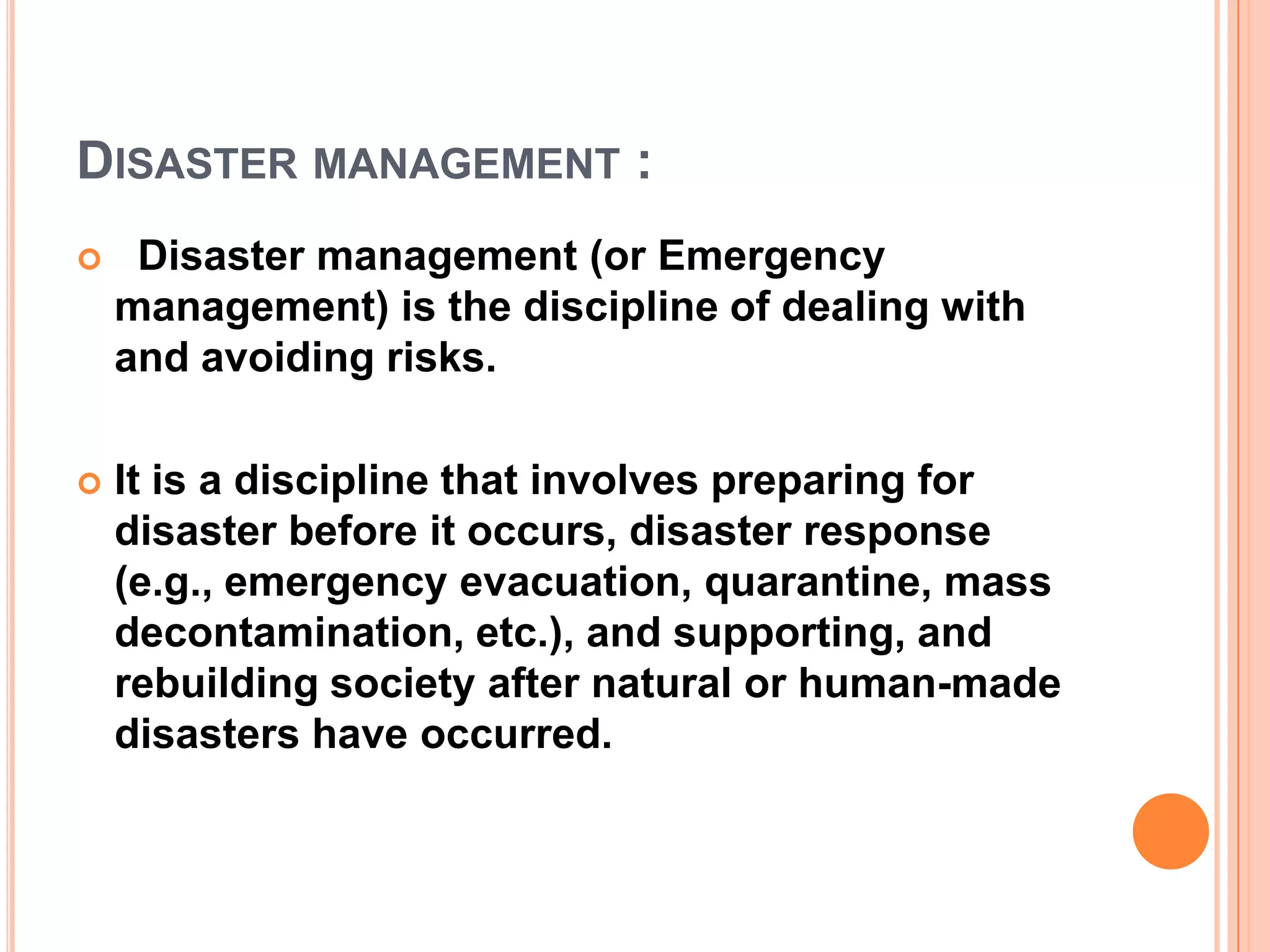
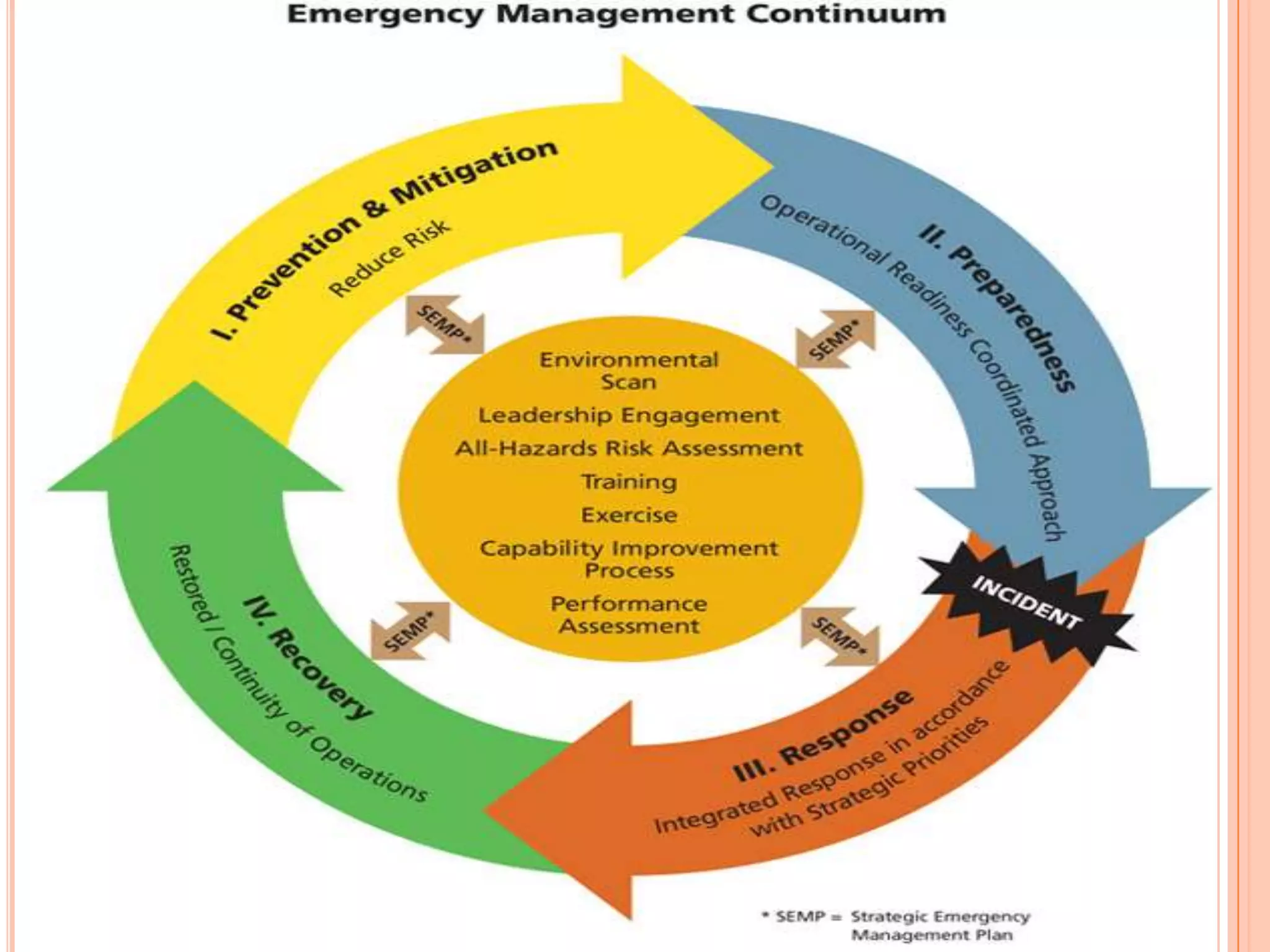
 Disaster management (or Emergency
management) is the discipline of dealing with
and avoiding risks.
 It is a discipline that involves preparing for
disaster before it occurs, disaster response
(e.g., emergency evacuation, quarantine, mass
decontamination, etc.), and supporting, and
rebuilding society after natural or human-made
disasters have occurred.
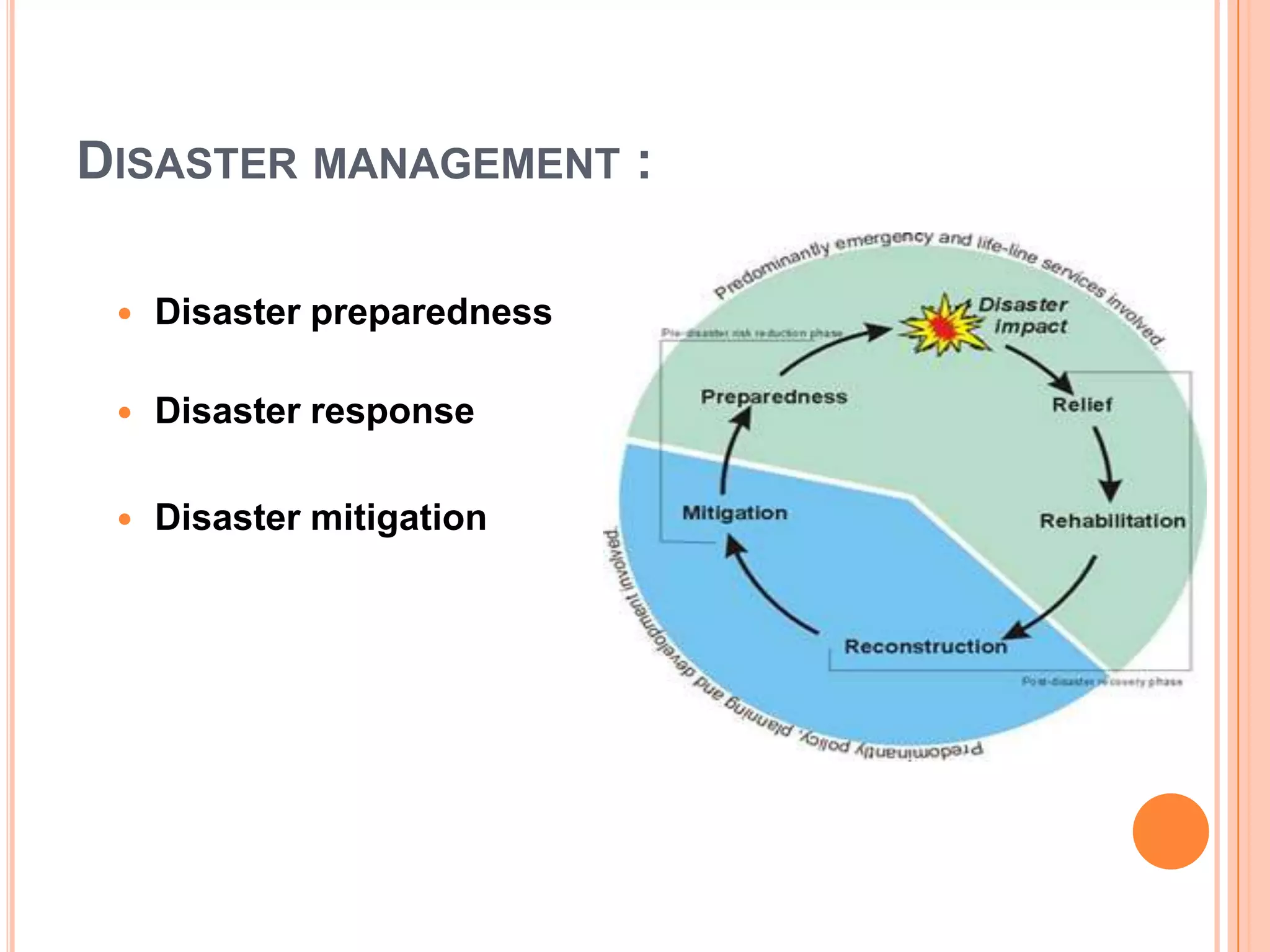
DISASTER MANAGEMENT :
 Disaster preparedness
 Disaster response
 Disaster mitigation
DISASTER PREPAREDNESS
.
DISASTER PREPAREDNESS
It is to ensure that in time
of disaster appropriate
system, procedure and
resources are in place to
assist those afflicted by
the disaster and enable
them to help themselves
PRECAUTION AGAINST
EARTHQUAKE
•Immediately seek a safe location such as
beneath a table or desk
•Cover the back of your head and your eyes to
minimize injury from flying debris.
•Do not take elevators during an earthquake.
•If cooking, turn off heating elements
immediately.
•If outdoors, stay in open areas away from
buildings, power lines, trees, and other potential
hazards.
•If driving, stop quickly but safely and stay in the
vehicle. Do not stop near power lines, bridges,
overpasses, or other potentially dangerous
locations.
PRECAUTION AGAINST CYCLONE
i) Keep your radio on and listen to latest weather warning
and advisories from the nearest All India Radio Station. Pass the
information to others.
ii) Avoid being misled by rumors, pass on only the official
information you had got from the Radio to others.
iii) If your house is out of danger from high tides and
flooding from the river, and it is well built, it is then probably the
best place to weather the storm. However please act promptly if
asked to evacuate.
iv) Be alert for high water in areas where streams of rivers
may flood due to heavy rains.
v) Get extra food, especially things which can be eaten
without cooking or with very little preparation. Store extra
drinking water in suitable covered vessels.
vi) Check on everything that might blow away or be torn
loose. Kerosene tins, cans, agricultural implements, garden tools,
road signs and other objects become weapon of destruction in
strong winds. Remove them and store them in a covered room.
PRECAUTION AGAINST FLOODS
- > Don't enter into Flood Water ;It could be
dangerous.
->Stay away from sewage line, gutter,
draining etc.
-> Be careful snakes; Snakes bites are
common during Floods.
-> Stay away from electric pole and fallen
power-lines to avoid electrocution.
-> Don't use wet electrical appliances - get
them checked before use.
-> Eat freshly cooked and dry food. Always
keep your food covered.
-> stagnation of water can bread
vector/water-borne diseases in case of
sickness, sick medical assistance.
-> use bleaching powder and lime to disinfect
surrounding.
PRECAUTION AGAINST DROUGHTS
 Rather than irrigating your lawn during the
spring, the grasses should be allowed to
grow naturally. Neither the field should be
scalped nor should it be irrigated before
grasses wither because of dry weather
conditions. Here, one needs to mow
frequently.
 Little dryness of soil & drooping of grasses
during moist weather harden the root to
such an extent that they can tolerate dry
conditions.
 Use a sharp blade to mow the grass in
such a manner that they form deep roots
having a dense cover. The more deep is a
root system, the greater will it extract
moisture from soil.
PRECAUTIONS AGAINST TSUNAMI
 If you are indoors, stay there. Quickly move
to a safe location in the room such as under
a strong desk, a strong table, or along an
interior wall. The goal is to protect yourself
from falling objects and be located near the
structural strong points of the room. Avoid
taking cover near windows, large mirrors,
hanging objects, heavy furniture, heavy
appliances or fireplaces.
 If you are cooking, turn off the stove and
take cover.
 If you are outdoors, move to an open area
where falling objects are unlikely to strike
you. Move away from buildings, powerlines
and trees.
 If you are driving, slow down smoothly and
stop on the side of the road. Avoid stopping
on or under bridges and overpasses, or
under power lines, trees and large signs.
Stay in your car
DISASTER RESPONSE
.
DISASTER RESPONSE
Disaster response is some
of total of action taken by
people or institution in the
face of disaster. these
action commence with the
warning of an oncoming
threatening event or with
the event itself if it occur
without warning.
DISASTER RESPONSE
Aims of Emergency:
 To ensure the survival of the maximum
possible number of victims.
 To re establish self sufficiency and essential
services as quickly as possible for all
population groups.
 To repair and replace damaged infra structure
and regenerate viable economic activities.
WARNING SYSTEM
.
INDIA’S RESPONSE TO DISASTER
Central GOVT response to the disaster depends upon:
 The gravity of natural calamity,
 The scale of relief operation necessary
 The requirement of central assistance and financial
support
Types of central response:
1. Policy response
2. Administrative response
DOUBLE CLICK TO OPEN
DISASTER MANAGEMENT ACT
 The Civil Defence Act,1968
 The Civil Defence Rules,1968
 The Civil Defence Regulation,1968
 The disaster Management Act,2005
 The Disaster management National Executive committee
rules,2006
 The Disaster management Rules,2006
 The National Institute of Disaster Management
Regulations-2006
 The Notification of national Disaster response Force
Rules-2008
INTERNATIONAL AGENCIES
 United nation office for the co-ordination of humanitarian
affairs (OCHA)
 World health organization (WHO)
 World food programme (WFP)
 Food and agriculture organization (FAO)
 Organization of American state (OAS)
 International council of voluntary agencies (ICVA)
 Inter national federation of red cross and red crescent
societies (IFRC)
THANK YOU

Disaster management

  • 1.
    DISASTER AND IT’SMANAGEMENT Prepared by Group No. : 4 Members : Manan ; Kanishk ; Natasha ; Komal ; Naman ; Muskan
  • 2.
    DISASTER MANAGEMENT The Worldis always changing. disasters are changes which are so great they may cause damage to the shape of the land or to the lives of people and other living things. Great changes happen deep inside the Earth and on its surface. The changes on the outer part of the Earth happen because of different kinds of weather.
  • 3.
    D – I– S – A – S – T – E – R PARADIGM  Disaster Paradigm :  D: Detection  I: Incident Command  S: Safety & Security  A: Assess Hazards  S: Support  T: Triage & Treatment  E: Evacuation  R: Reallocation & Redeployment
  • 4.
    WHAT IS DISASTER?  Disaster- dis·as·ter (noun) A Calamity or Disaster, as you know, is an Unfortunate happening ;  A catastrophe.  A grave misfortune.  A total failure .  A serious disruption of the functioning of a community or a society causing widespread human, material, economic, or environmental losses which exceed the ability of the affected community or society to cope using its own resources.
  • 5.
    PHASES OF DISASTER:- 1. Shock 2. Awareness (impact period) 3. Euphoria (thread period) 4. Exhibits fear and anger(inventory period) 5. Resolution (rescue period)
  • 6.
  • 7.
  • 8.
    NATURAL DISASTERS  Earthquakes Cyclones  Floods  Droughts  Tsunamis  Landslides  Volcanic Eruptions  Avalanche  Forest Fires  Epidemic Diseases
  • 9.
    HUMAN-INDUCED DISASTERS  Conventionalwarfare  Non conventional warfare( Eg. Nuclear and chemical)  Transportation accident  Structural collapse  Explosions  Fires  Pollution  Civil interest  Terrorist attack
  • 10.
  • 11.
    VOLCANIC ERUPTION : Avolcanic eruption is the spurting out of gases and hot lava from an opening in the Earth’s crust.
  • 12.
    EARTHQUAKE : An earthquakeis a violent shaking of the ground. Sometimes it is so strong that the ground splits apart. When parts of the earth, called plates, move against each other giant shock waves move upwards towards the surface causing the earthquake.
  • 13.
    CYCLONE OR HURRICANE: A Cyclone is a fierce storm with storm winds that spin around it in a giant circle. During a cyclone trees can be uprooted, buildings can be destroyed and cars can be overturned.
  • 14.
    FLOOD : A floodis caused by an overflow of water which covers the land that is usually dry. Floods are caused by heavy rain or by snow melting and the rivers burst their banks and overflow.
  • 15.
    AVALANCHE : An Avalancheis a movement of snow, ice and rock down a mountainside. Avalanches can be caused by – snow melting quickly snow freezing, melting then freezing again someone skiing a loud noise or an earth tremor
  • 16.
    DROUGHT : A droughtis the lack of rain for a long time. In 1968 a drought began in Africa. Children born during this year were five years old before rain fell again.
  • 17.
    FOREST FIRE ORBUSHFIRE : Fires can burn out of control in areas of forest or bush land. Fires are caused by lightning, sparks of electricity or careless people. Wind may blow a bushfire to areas where people live.
  • 18.
    LANDSLIDES : Landslip isa geological phenomenon which includes a wide range of ground movement, such as rock falls, deep failure of slopes and shallow debris flows.
  • 19.
    TSUNAMIS : Tsunami isa fault movement on sea floor, accompanied by an earth quake. A land slide occurring under water or above the sea, and then plunging in to the water.
  • 20.
    SNOW STORMS : Snowstormsare storms where large amounts of snow fall. It may occur in the late autumn and early spring as well. Very rarely, they may form in summer.
  • 21.
    EPIDEMIC DISEASE : Epidemic Disease Outbreaks of Disease  A biological agents are used in attacks because they cause the most illness and death among humans, they include: - Anthrax,Botulism,Plaqu e, Smallpox, Cholera, and H1N1.
  • 22.
  • 23.
    FIRE: Fire is therapid oxidation of a material in the chemical process of combustion, releasing heat, light, and various reaction products.
  • 24.
    INDUSTRIAL ACCIDENTS : Theterms “chemical accident” refer to an event resulting in the release of a substance or substances hazardous to human health and/or the environment in the short or long term. that can cause people illness, injury, disability or death.
  • 25.
    BOMB BLAST : Blastbomb is a term used for a type of improvised explosive device which is using to destroy mass people in particular area as a weapon.
  • 26.
    ROAD ACCIDENTS : Roadaccidents A traffic collision (motor vehicle collision, motor vehicle accident, or car crash) is when a road vehicle collides with another vehicle.
  • 27.
    SOME DISASTER PRONE AREAS~ AROUND WORLD AND INDIA
  • 28.
  • 29.
  • 30.
  • 31.
  • 32.
    WIND AND CYCLONEPRONE AREAS :
  • 33.
  • 34.
  • 35.
  • 36.
    DISASTER MANAGEMENT : Disaster management (or Emergency management) is the discipline of dealing with and avoiding risks.  It is a discipline that involves preparing for disaster before it occurs, disaster response (e.g., emergency evacuation, quarantine, mass decontamination, etc.), and supporting, and rebuilding society after natural or human-made disasters have occurred.
  • 37.
    DISASTER MANAGEMENT : Disaster preparedness  Disaster response  Disaster mitigation
  • 39.
  • 40.
    DISASTER PREPAREDNESS It isto ensure that in time of disaster appropriate system, procedure and resources are in place to assist those afflicted by the disaster and enable them to help themselves
  • 41.
    PRECAUTION AGAINST EARTHQUAKE •Immediately seeka safe location such as beneath a table or desk •Cover the back of your head and your eyes to minimize injury from flying debris. •Do not take elevators during an earthquake. •If cooking, turn off heating elements immediately. •If outdoors, stay in open areas away from buildings, power lines, trees, and other potential hazards. •If driving, stop quickly but safely and stay in the vehicle. Do not stop near power lines, bridges, overpasses, or other potentially dangerous locations.
  • 42.
    PRECAUTION AGAINST CYCLONE i)Keep your radio on and listen to latest weather warning and advisories from the nearest All India Radio Station. Pass the information to others. ii) Avoid being misled by rumors, pass on only the official information you had got from the Radio to others. iii) If your house is out of danger from high tides and flooding from the river, and it is well built, it is then probably the best place to weather the storm. However please act promptly if asked to evacuate. iv) Be alert for high water in areas where streams of rivers may flood due to heavy rains. v) Get extra food, especially things which can be eaten without cooking or with very little preparation. Store extra drinking water in suitable covered vessels. vi) Check on everything that might blow away or be torn loose. Kerosene tins, cans, agricultural implements, garden tools, road signs and other objects become weapon of destruction in strong winds. Remove them and store them in a covered room.
  • 43.
    PRECAUTION AGAINST FLOODS -> Don't enter into Flood Water ;It could be dangerous. ->Stay away from sewage line, gutter, draining etc. -> Be careful snakes; Snakes bites are common during Floods. -> Stay away from electric pole and fallen power-lines to avoid electrocution. -> Don't use wet electrical appliances - get them checked before use. -> Eat freshly cooked and dry food. Always keep your food covered. -> stagnation of water can bread vector/water-borne diseases in case of sickness, sick medical assistance. -> use bleaching powder and lime to disinfect surrounding.
  • 44.
    PRECAUTION AGAINST DROUGHTS Rather than irrigating your lawn during the spring, the grasses should be allowed to grow naturally. Neither the field should be scalped nor should it be irrigated before grasses wither because of dry weather conditions. Here, one needs to mow frequently.  Little dryness of soil & drooping of grasses during moist weather harden the root to such an extent that they can tolerate dry conditions.  Use a sharp blade to mow the grass in such a manner that they form deep roots having a dense cover. The more deep is a root system, the greater will it extract moisture from soil.
  • 45.
    PRECAUTIONS AGAINST TSUNAMI If you are indoors, stay there. Quickly move to a safe location in the room such as under a strong desk, a strong table, or along an interior wall. The goal is to protect yourself from falling objects and be located near the structural strong points of the room. Avoid taking cover near windows, large mirrors, hanging objects, heavy furniture, heavy appliances or fireplaces.  If you are cooking, turn off the stove and take cover.  If you are outdoors, move to an open area where falling objects are unlikely to strike you. Move away from buildings, powerlines and trees.  If you are driving, slow down smoothly and stop on the side of the road. Avoid stopping on or under bridges and overpasses, or under power lines, trees and large signs. Stay in your car
  • 46.
  • 47.
    DISASTER RESPONSE Disaster responseis some of total of action taken by people or institution in the face of disaster. these action commence with the warning of an oncoming threatening event or with the event itself if it occur without warning.
  • 48.
    DISASTER RESPONSE Aims ofEmergency:  To ensure the survival of the maximum possible number of victims.  To re establish self sufficiency and essential services as quickly as possible for all population groups.  To repair and replace damaged infra structure and regenerate viable economic activities.
  • 49.
  • 50.
    INDIA’S RESPONSE TODISASTER Central GOVT response to the disaster depends upon:  The gravity of natural calamity,  The scale of relief operation necessary  The requirement of central assistance and financial support Types of central response: 1. Policy response 2. Administrative response
  • 51.
  • 52.
    DISASTER MANAGEMENT ACT The Civil Defence Act,1968  The Civil Defence Rules,1968  The Civil Defence Regulation,1968  The disaster Management Act,2005  The Disaster management National Executive committee rules,2006  The Disaster management Rules,2006  The National Institute of Disaster Management Regulations-2006  The Notification of national Disaster response Force Rules-2008
  • 53.
    INTERNATIONAL AGENCIES  Unitednation office for the co-ordination of humanitarian affairs (OCHA)  World health organization (WHO)  World food programme (WFP)  Food and agriculture organization (FAO)  Organization of American state (OAS)  International council of voluntary agencies (ICVA)  Inter national federation of red cross and red crescent societies (IFRC)
  • 55.