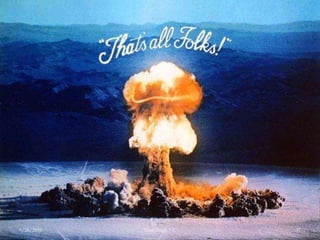
Man Made DiastersA presntation by      7 CVirat Singh  Class St, Mary’ s Convent Inter College, Manak Nagar, Lucknow, India
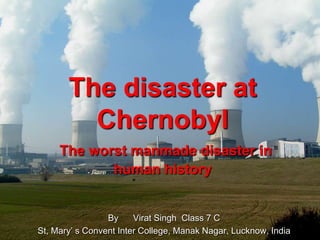
The disaster at Chernobyl The worst manmade disaster in human historyBy      Virat Singh  Class 7 CSt, Mary’ s Convent Inter College, Manak Nagar, Lucknow, India
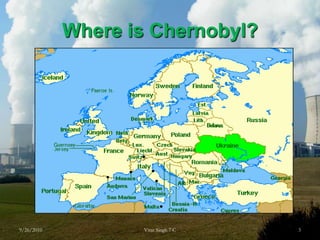
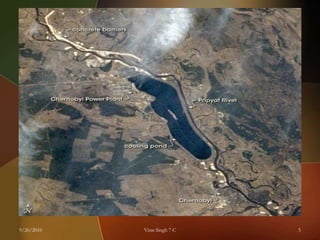
Where is Chernobyl?9/26/20103Virat Singh 7 C
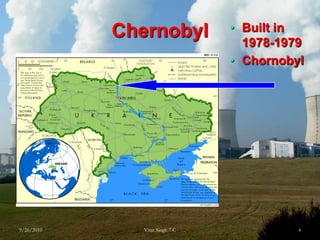
ChernobylBuilt in 1978-1979Chornobyl9/26/20104Virat Singh 7 C
9/26/20105Virat Singh 7 C
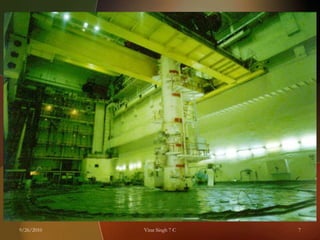
BackgroundReaktorBolshoyMoshehnostyKipyashiy   RBMK, a Russian acronym translated roughly means “reactor (of) high power (of the) channel (type)”   It was a reactor cooled by water and moderated by graphite9/26/20106Virat Singh 7 C
9/26/20107Virat Singh 7 C
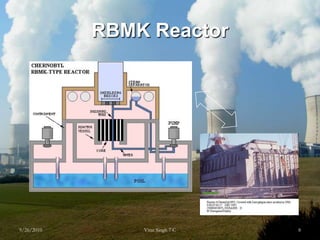
RBMK Reactor9/26/20108Virat Singh 7 C
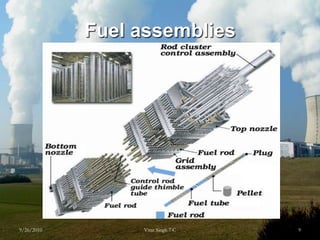
Fuel assemblies9/26/20109Virat Singh 7 C
9/26/201010Virat Singh 7 C
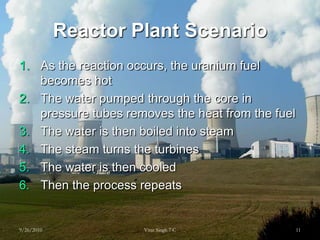
Reactor Plant ScenarioAs the reaction occurs, the uranium fuel becomes hotThe water pumped through the core in pressure tubes removes the heat from the fuelThe water is then boiled into steamThe steam turns the turbinesThe water is then cooledThen the process repeats9/26/201011Virat Singh 7 C
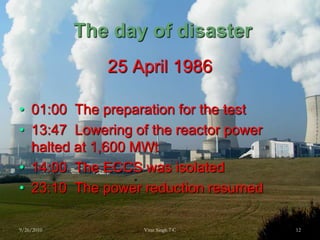
 The day of disaster25 April 198601:00  The preparation for the test13:47  Lowering of the reactor power halted at 1,600 MWt14:00  The ECCS was isolated23:10  The power reduction resumed9/26/201012Virat Singh 7 C
26 April198624:00  Operation shift change24:28  Power level is now 500 MWt and kept decreasing to 30 MWt24:40  The operator withdrew some control rods  01:00  Power had risen to 200MWt01:03  Connecting the fourth main cooling pump to the  left loop of the system 200MWt01:07  Connecting the fourth main cooling pump to the  right of the loop system - this was a violation of NOPContinued to next slide9/26/201013Virat Singh 7 C
26 April 198601:19  Increased feed water flow to the steam drums and removed more control rods -violation of NOP01:23  The test was started01:23:10  Automatic rods withdrawn from the core01:23:21  Two groups of automated control rods were back to the coreContinued to next slide9/26/201014Virat Singh 7 CContinued from  last slide
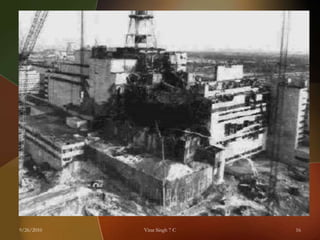
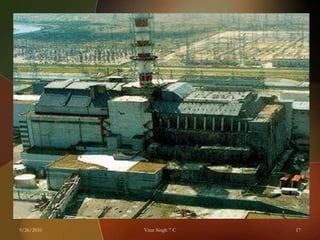
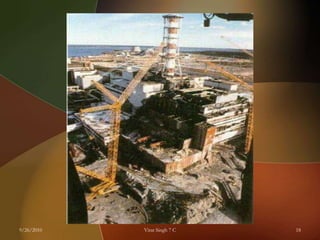
26 April 198601:23:30  Power kept increasing01:23:40  Emergency button pushed01:23:44  Power is at 300000 MW th01:23:48  1st thermal explosion01:23:55  2nd explosion9/26/201015Virat Singh 7 CContinued from  last slide
9/26/201016Virat Singh 7 C
9/26/201017Virat Singh 7 C
9/26/201018Virat Singh 7 C
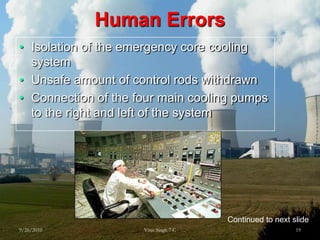
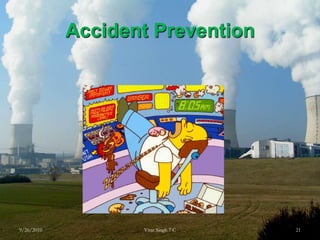
Human ErrorsIsolation of the emergency core cooling systemUnsafe amount of control rods withdrawnConnection of the four main cooling pumps to the right and left of the system9/26/201019Virat Singh 7 CContinued to next slide
Human Errors  The mental modelThe operator did not have a good mental model of the system itself The overconfidenceBy having an electrical engineer on site for an electrical testThe confirmation of cues not obtained from the systemThe beta was too highMany signals were missed before the accident 9/26/201020Virat Singh 7 CContinued from  last slide
Accident Prevention9/26/201021Virat Singh 7 C
System AnalysisUse of graphite as a moderatorLack of a well-built containment structureInadequate instrumentation and alarms for an emergency situationThere were no physical controls that prevented the operators from operating the reactor in its unstable state 9/26/201022Virat Singh 7 C
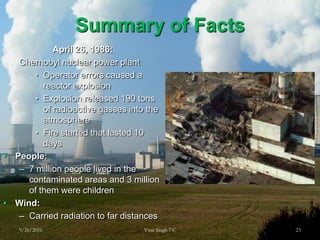
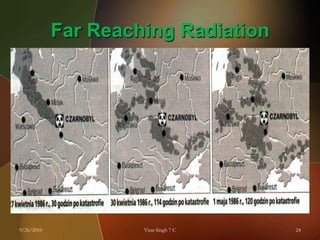
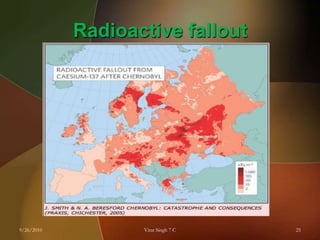
Summary of FactsApril 26, 1986:Chernobyl nuclear power plantOperator errors caused a reactor explosionExplosion released 190 tons of radioactive gasses into the atmosphereFire started that lasted 10 daysPeople:7 million people lived in the contaminated areas and 3 million of them were childrenWind:Carried radiation to far distances9/26/201023Virat Singh 7 C
Far Reaching Radiation9/26/201024Virat Singh 7 C
Radioactive fallout9/26/201025Virat Singh 7 C
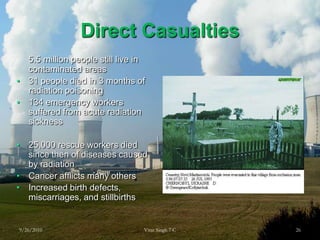
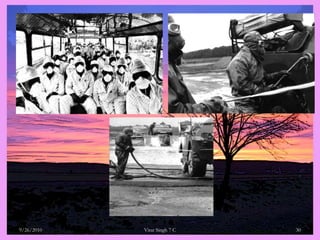
Direct Casualties5.5 million people still live in contaminated areas31 people died in 3 months of radiation poisoning134 emergency workers suffered from acute radiation sickness25,000 rescue workers died since then of diseases caused by radiationCancer afflicts many othersIncreased birth defects, miscarriages, and stillbirths9/26/201026Virat Singh 7 C
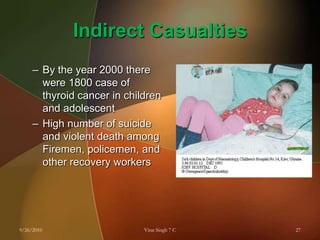
Indirect CasualtiesBy the year 2000 there were 1800 case of thyroid cancer in children and adolescentHigh number of suicide and violent death among Firemen, policemen, and other recovery workers9/26/201027Virat Singh 7 C
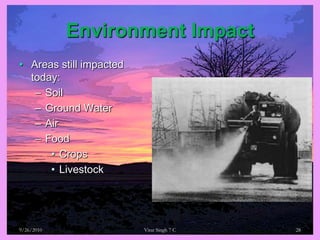
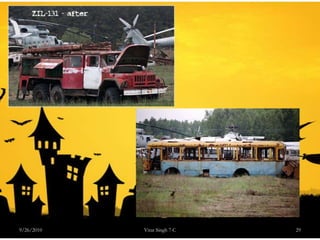
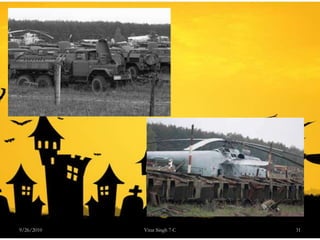
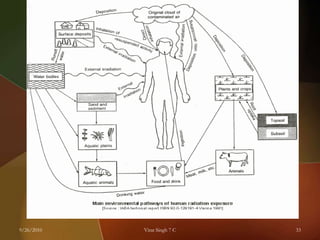
Environment ImpactAreas still impacted today:SoilGround WaterAirFoodCrops Livestock9/26/201028Virat Singh 7 C
9/26/201029Virat Singh 7 C
9/26/201030Virat Singh 7 C
9/26/201031Virat Singh 7 C
9/26/201032Virat Singh 7 C
9/26/201033Virat Singh 7 C
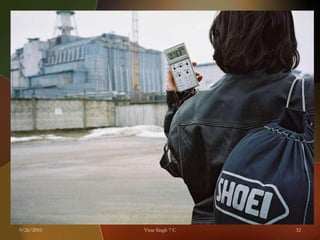
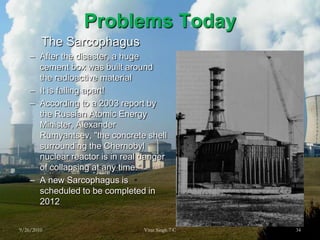
Problems TodayThe SarcophagusAfter the disaster, a huge cement box was built around the radioactive materialIt is falling apart!According to a 2003 report by the Russian Atomic Energy Minister, Alexander Rumyantsev, "the concrete shell surrounding the Chernobyl nuclear reactor is in real danger of collapsing at any time."A new Sarcophagus is scheduled to be completed in 20129/26/201034Virat Singh 7 C
RecommendationsHave proper Standard Operating Procedures (SOP) for both normal and emergency situationsHave scheduled trainings and practices for normal and emergency situations9/26/201035Virat Singh 7 CContinued to next slide
Recommendations A reactor expert must be always there on site Any cues from the system must be confirmed by operators before making hypothesis or take action An environment of team work must be formed so that every body is involved 9/26/201036Virat Singh 7 CContinued from  last slide
9/26/201037Virat Singh 7 C
9/26/2010Virat Singh 7 C38For  viewing this slide show Virat Singh

Man made disaters

  • 1.

    Man Made DiastersApresntation by 7 CVirat Singh Class St, Mary’ s Convent Inter College, Manak Nagar, Lucknow, India
  • 2.
    The disaster atChernobyl The worst manmade disaster in human historyBy Virat Singh Class 7 CSt, Mary’ s Convent Inter College, Manak Nagar, Lucknow, India
  • 3.
  • 4.
  • 5.
  • 6.
    BackgroundReaktorBolshoyMoshehnostyKipyashiy RBMK, a Russian acronym translated roughly means “reactor (of) high power (of the) channel (type)” It was a reactor cooled by water and moderated by graphite9/26/20106Virat Singh 7 C
  • 7.
  • 8.
  • 9.
  • 10.
  • 11.
    Reactor Plant ScenarioAsthe reaction occurs, the uranium fuel becomes hotThe water pumped through the core in pressure tubes removes the heat from the fuelThe water is then boiled into steamThe steam turns the turbinesThe water is then cooledThen the process repeats9/26/201011Virat Singh 7 C
  • 12.
    The dayof disaster25 April 198601:00 The preparation for the test13:47 Lowering of the reactor power halted at 1,600 MWt14:00 The ECCS was isolated23:10 The power reduction resumed9/26/201012Virat Singh 7 C
  • 13.
    26 April198624:00 Operation shift change24:28 Power level is now 500 MWt and kept decreasing to 30 MWt24:40 The operator withdrew some control rods 01:00 Power had risen to 200MWt01:03 Connecting the fourth main cooling pump to the left loop of the system 200MWt01:07 Connecting the fourth main cooling pump to the right of the loop system - this was a violation of NOPContinued to next slide9/26/201013Virat Singh 7 C
  • 14.
    26 April 198601:19 Increased feed water flow to the steam drums and removed more control rods -violation of NOP01:23 The test was started01:23:10 Automatic rods withdrawn from the core01:23:21 Two groups of automated control rods were back to the coreContinued to next slide9/26/201014Virat Singh 7 CContinued from last slide
  • 15.
    26 April 198601:23:30 Power kept increasing01:23:40 Emergency button pushed01:23:44 Power is at 300000 MW th01:23:48 1st thermal explosion01:23:55 2nd explosion9/26/201015Virat Singh 7 CContinued from last slide
  • 16.
  • 17.
  • 18.
  • 19.
    Human ErrorsIsolation ofthe emergency core cooling systemUnsafe amount of control rods withdrawnConnection of the four main cooling pumps to the right and left of the system9/26/201019Virat Singh 7 CContinued to next slide
  • 20.
    Human Errors The mental modelThe operator did not have a good mental model of the system itself The overconfidenceBy having an electrical engineer on site for an electrical testThe confirmation of cues not obtained from the systemThe beta was too highMany signals were missed before the accident 9/26/201020Virat Singh 7 CContinued from last slide
  • 21.
  • 22.
    System AnalysisUse ofgraphite as a moderatorLack of a well-built containment structureInadequate instrumentation and alarms for an emergency situationThere were no physical controls that prevented the operators from operating the reactor in its unstable state 9/26/201022Virat Singh 7 C
  • 23.
    Summary of FactsApril26, 1986:Chernobyl nuclear power plantOperator errors caused a reactor explosionExplosion released 190 tons of radioactive gasses into the atmosphereFire started that lasted 10 daysPeople:7 million people lived in the contaminated areas and 3 million of them were childrenWind:Carried radiation to far distances9/26/201023Virat Singh 7 C
  • 24.
  • 25.
  • 26.
    Direct Casualties5.5 millionpeople still live in contaminated areas31 people died in 3 months of radiation poisoning134 emergency workers suffered from acute radiation sickness25,000 rescue workers died since then of diseases caused by radiationCancer afflicts many othersIncreased birth defects, miscarriages, and stillbirths9/26/201026Virat Singh 7 C
  • 27.
    Indirect CasualtiesBy theyear 2000 there were 1800 case of thyroid cancer in children and adolescentHigh number of suicide and violent death among Firemen, policemen, and other recovery workers9/26/201027Virat Singh 7 C
  • 28.
    Environment ImpactAreas stillimpacted today:SoilGround WaterAirFoodCrops Livestock9/26/201028Virat Singh 7 C
  • 29.
  • 30.
  • 31.
  • 32.
  • 33.
  • 34.
    Problems TodayThe SarcophagusAfterthe disaster, a huge cement box was built around the radioactive materialIt is falling apart!According to a 2003 report by the Russian Atomic Energy Minister, Alexander Rumyantsev, "the concrete shell surrounding the Chernobyl nuclear reactor is in real danger of collapsing at any time."A new Sarcophagus is scheduled to be completed in 20129/26/201034Virat Singh 7 C
  • 35.
    RecommendationsHave proper StandardOperating Procedures (SOP) for both normal and emergency situationsHave scheduled trainings and practices for normal and emergency situations9/26/201035Virat Singh 7 CContinued to next slide
  • 36.
    Recommendations A reactorexpert must be always there on site Any cues from the system must be confirmed by operators before making hypothesis or take action An environment of team work must be formed so that every body is involved 9/26/201036Virat Singh 7 CContinued from last slide
  • 37.
  • 38.
    9/26/2010Virat Singh 7C38For viewing this slide show Virat Singh