1
RAJKUMARI AMRIT KAURCOLLEGE OF NURSING
PRESENTATION ON‘DISASTER NURSING’
Faculty advisor Presented by
Mrs. Sarita Shokanda Fateh chand
Assistant professor M.Sc. Nursing (Pre)
RAKCON RAKCON
2
 Introduction
 Types of disaster
 Natural disaster
 Man made disaster
 Primary Prevention
 Epidemiology of disaster
 Effects of disaster
 Management cycle of disaster
 NDMA
 NIDM
 Disaster nursing
 Goal of disaster nursing
 Principles of disaster nursing
 Role and responsibilities of Nurse
 Conclusion
 Summary
Content
3
INTRODUCTION
Disaster caused by nature’s fury is not uncommon in this planet, earth. In fact,
scientists believe that the birth of this planet. Earth was the result of explosion
that occurred in the solar system. From time immemorial, this planet had
witnessed numerous natural disasters. In the past , man used to view these
natural disasters as the ‘acts of God’. Gradually, science opened the doors of
knowledge and enabled man to understand the mysterious occurrence of natural
disasters.
DEFINITION OF DISASTER
“A Disaster is any occurrence that causes damage, economic
disruption, loss of human life and property, or deterioration of health
and services on scale sufficient to warrant an extraordinary response
from the area or community.”
4
DISASTER alphabetically means:
D-Destructions
I-Incidents
S-Sufferings
A-Administrative failures
S-Sentiments
T-Tragedies
E-Eruption of communicable diseases
R-Research program and its
implementation
• D
7D’S which occur during the Disaster:
Death
Disability
Distress
Disease
Damage to health service
Damage to economy
Disruption
D
5
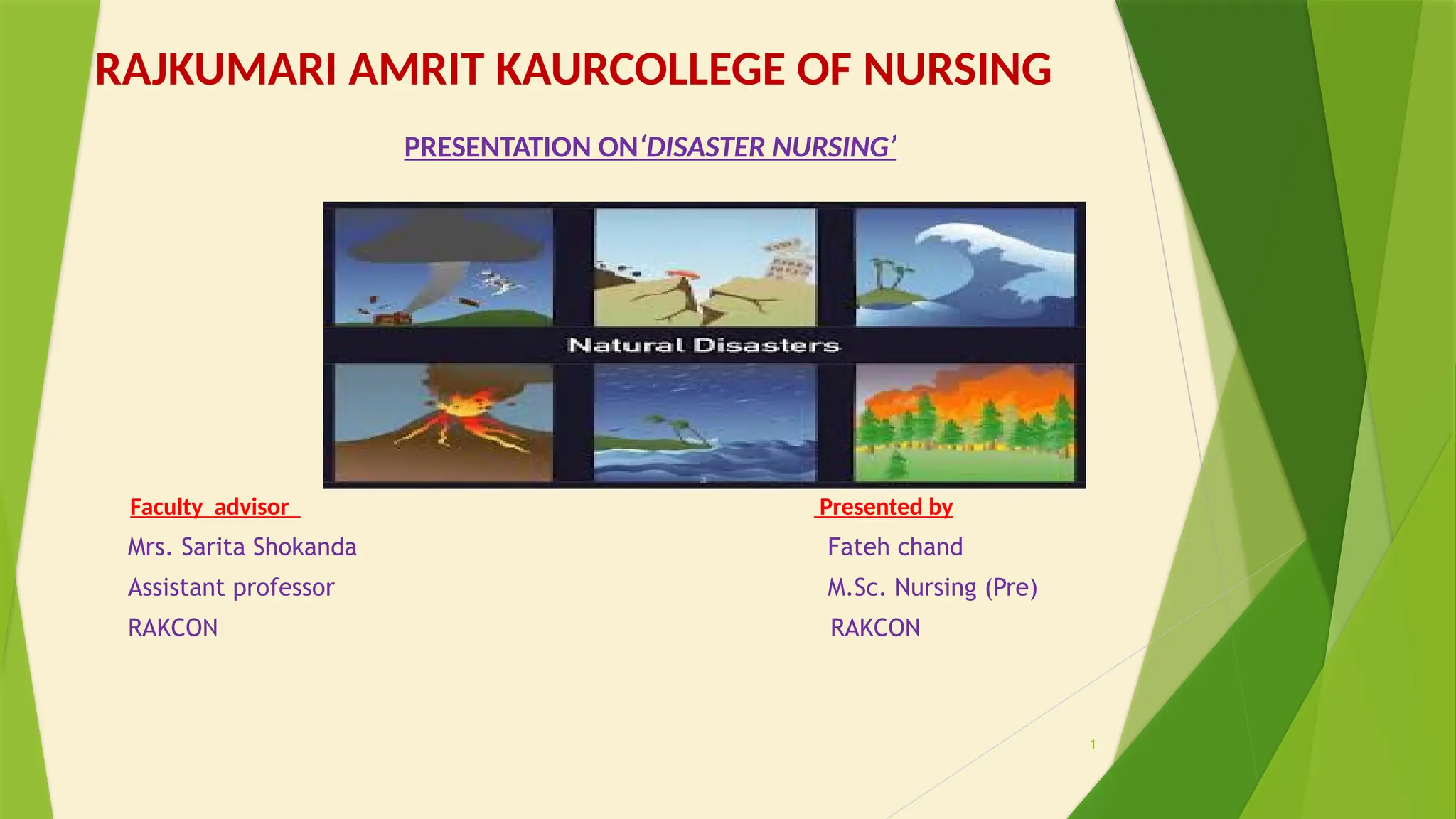
Natural Disaster
Natural calamities or climatic hazards, like earthquake,
Floods, cyclones, famine, drought, forest. fire, dust
storms, sandstorms, landslides, avalanche, volcanic
eruptions,
Tornados, hailstorms, tsunami, communicable
disease etc.
Man-Made Disaster-
These include technical disasters like dam failure, nuclear
accidents, hazards waste accidents, oil spills and leakage,
industrial accidents, fire, explosions, toxic materials,
pollution, terrorist attack, transportation
accidents, social disasters like mass-migration riots etc.
TYPES OF DISASTER
6
Types of disaster on the base of causalities
Minor disasters
involving
approximately 25
victims
Moderate disaster
involving
approximately 100
victims
Major disaster
involving more than
100 victims
Catastrophic disaster
when number of
injured patients
reaches up to 1000 or
more
7
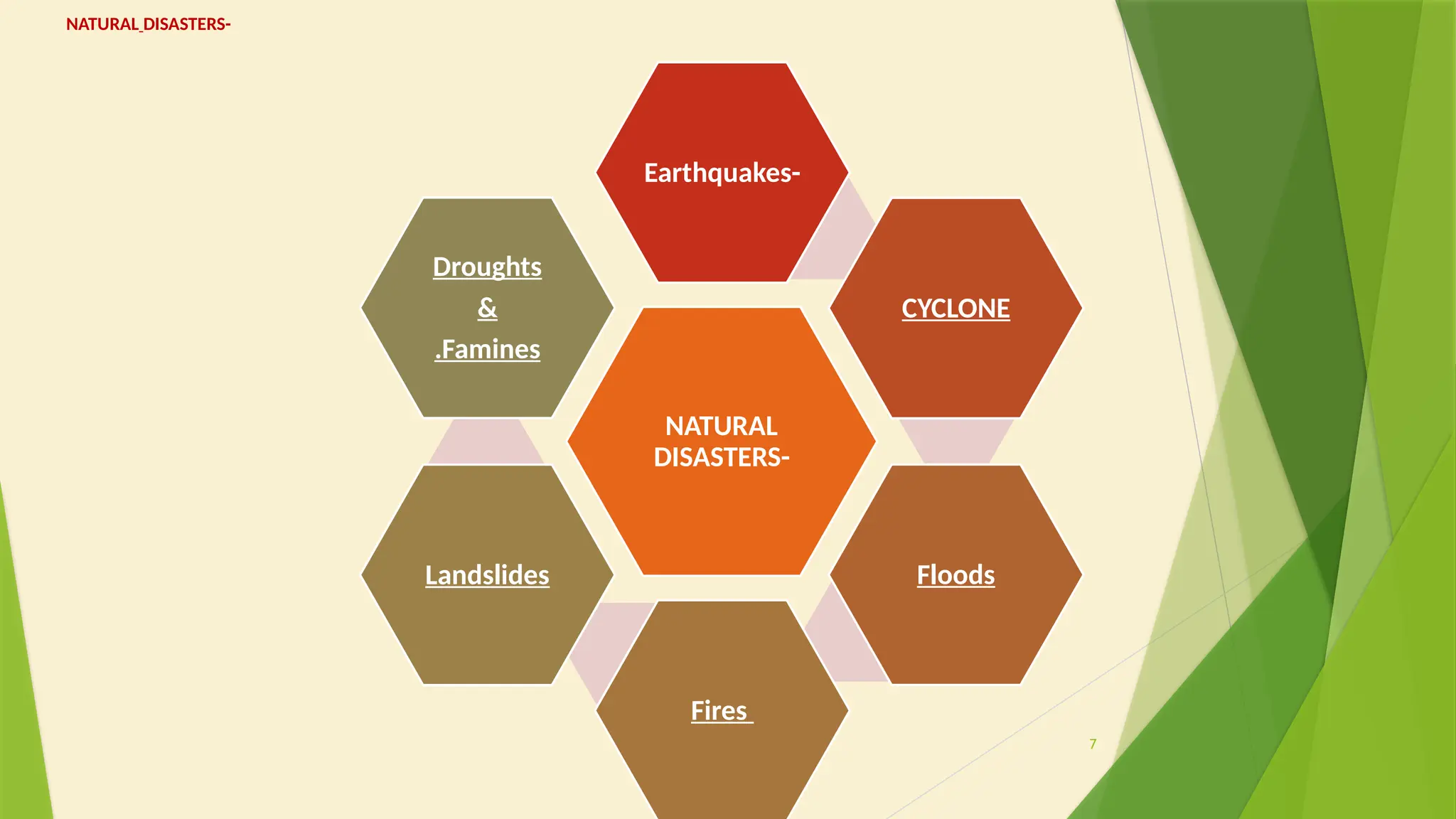
NATURAL DISASTERS-
NATURAL
DISASTERS-
Earthquakes-
CYCLONE
Floods
Fires
Landslides
Droughts
&
.Famines
8
MAN-MADE DISASTERS-
Chemical accident
Radiation Emergency
Bioterrorism
Pandemics and Disease
War &
Civil Conflicts
Terrorism
Political terrorism
Non-political terrorism:
MAN-MADE
DISASTERS
9
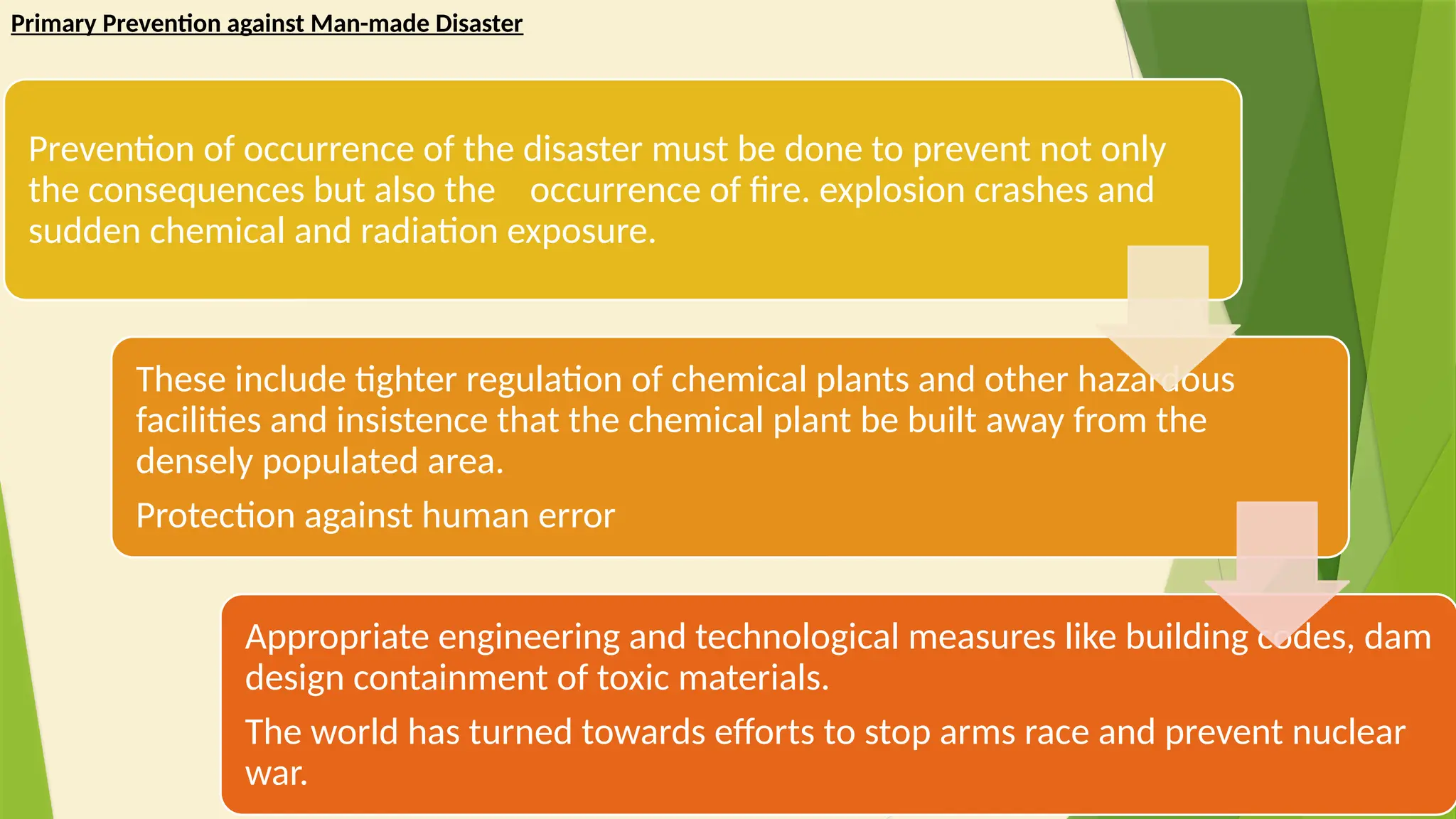
Primary Prevention against Man-made Disaster
Prevention of occurrence of the disaster must be done to prevent not only
the consequences but also the occurrence of fire. explosion crashes and
sudden chemical and radiation exposure.
These include tighter regulation of chemical plants and other hazardous
facilities and insistence that the chemical plant be built away from the
densely populated area.
Protection against human error
Appropriate engineering and technological measures like building codes, dam
design containment of toxic materials.
The world has turned towards efforts to stop arms race and prevent nuclear
war.
10
THE DEADLIEST WORLD DISASTER-
Worldwide, 1918-19:
Influenza pandemic takes
somewhere between 35
million and 75 million lives
India. 1950: Around 30.000
people lost their lives in a
quake of 8.6 magnitude in
Assam, India,
Earthquake of 9.0 and the
resulting tsunami creates
one of the world's worst
disasters. It does major
damage to: Indonesia India,
Sri Lanka
Bhopal gas disaster.
December 2-3, 1984, the
plant released methyl
isocyanate (MIC) gas and
other toxins
The Kargil War between
India and Pakistan between
May and July 1999 in the
Kargil district of Kashmir.
26/12/2008
Mumbai Taj Hotel disaster
India 2009 flu pandemic in
India as the outbreak of
swine flu in various parts of
India and also in the whole
world
2020
Covid 19
Pandemic
11
EPIDEMIOLOGY
OF DISASTER
EPIDEMIOLOG
Y OF DISASTER
Agents
Primary Agents-
Earthquakes, floods,
Hurricanes, Bomb
blasts, Tsunami ext.
Secondary agents -
Bacteria and viruses that
produce contamination
or infection after the
primary agent
Environmental
Factors-
Physical Factors
Chemical Factors
Biological Factors
Social Factors
Psychological Factors
Host Factors-
Age,
Immunization
status,
Degree of
mobility,
Emotional
stability.
12
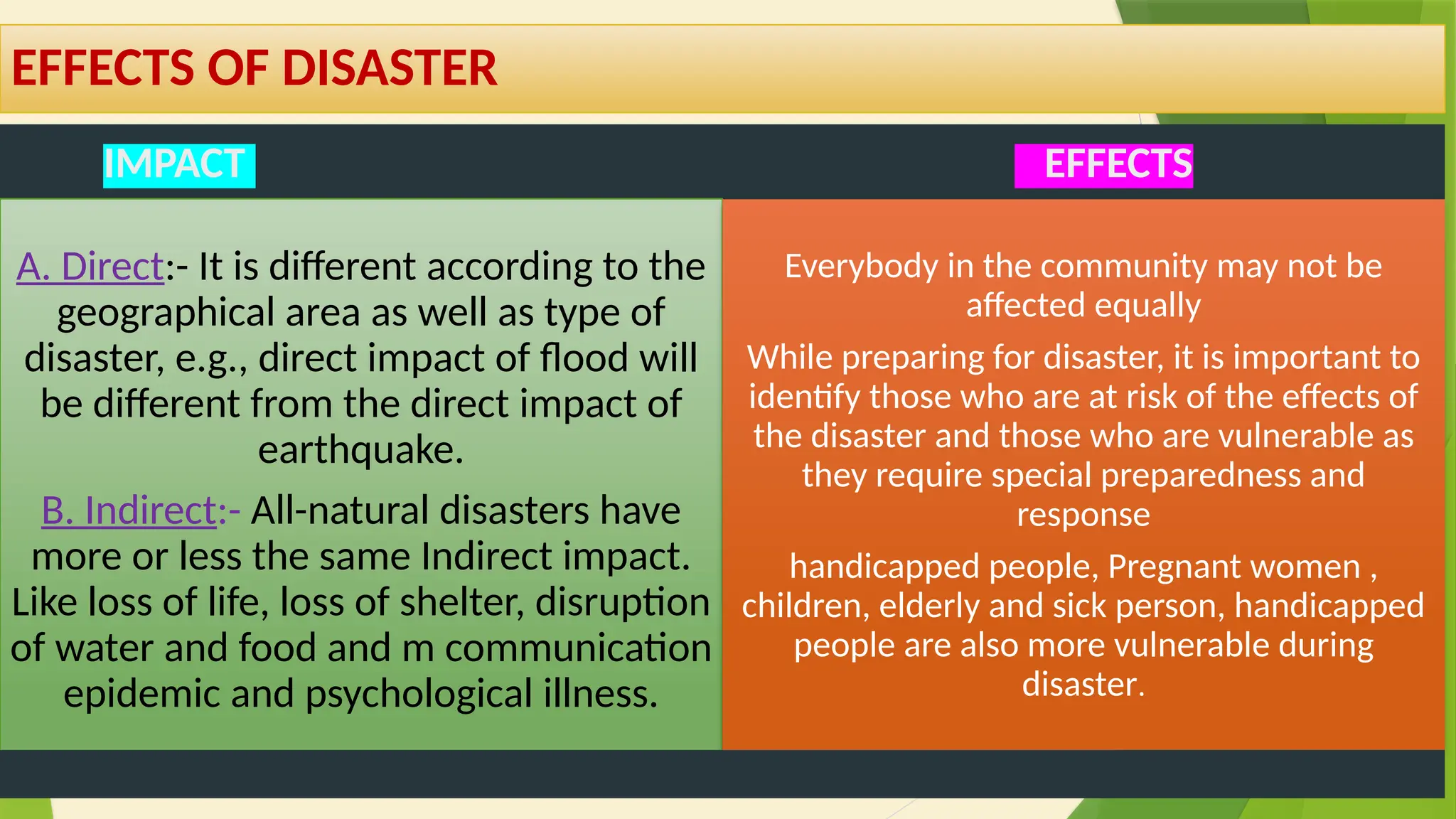
IMPACT EFFECTS
A. Direct:- It is different according to the
geographical area as well as type of
disaster, e.g., direct impact of flood will
be different from the direct impact of
earthquake.
B. Indirect:- All-natural disasters have
more or less the same Indirect impact.
Like loss of life, loss of shelter, disruption
of water and food and m communication
epidemic and psychological illness.
Everybody in the community may not be
affected equally
While preparing for disaster, it is important to
identify those who are at risk of the effects of
the disaster and those who are vulnerable as
they require special preparedness and
response
handicapped people, Pregnant women ,
children, elderly and sick person, handicapped
people are also more vulnerable during
disaster.
EFFECTS OF DISASTER
13
Health Effects of Disasters
 Disasters may cause premature deaths, illnesses, and
injuries.
 Disasters may destroy the local health care infrastructure.
 Disasters may affect the psychological, emotional, and
social well-being of the population.
 Disasters may cause shortages of food and cause severe
nutritional deficiencies.
 Disasters may create large population movements.
 Disasters may create environmental imbalances
14
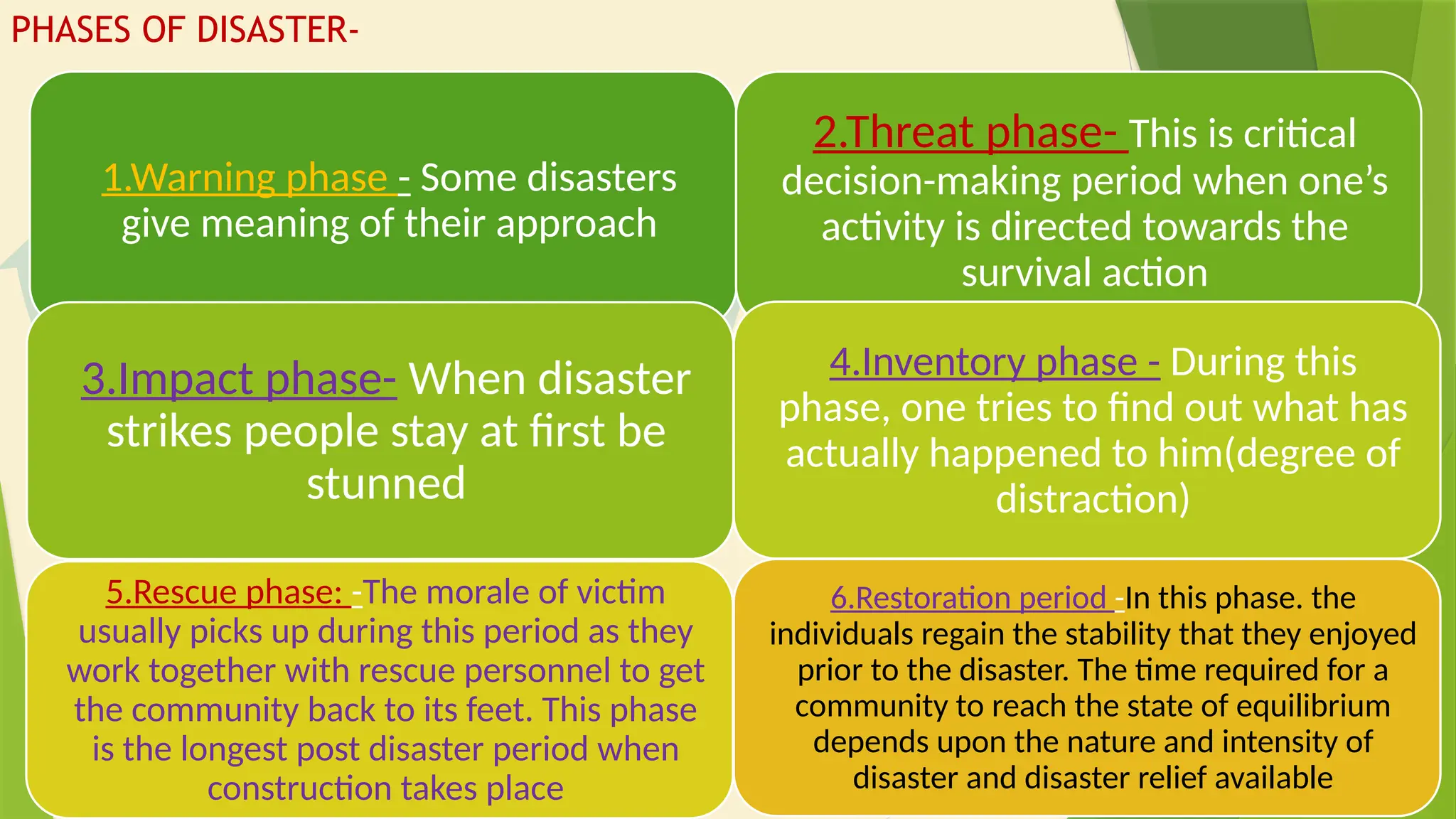
PHASES OF DISASTER-
1.Warning phase - Some disasters
give meaning of their approach
2.Threat phase- This is critical
decision-making period when one’s
activity is directed towards the
survival action
3.Impact phase- When disaster
strikes people stay at first be
stunned
4.Inventory phase - During this
phase, one tries to find out what has
actually happened to him(degree of
distraction)
5.Rescue phase: -The morale of victim
usually picks up during this period as they
work together with rescue personnel to get
the community back to its feet. This phase
is the longest post disaster period when
construction takes place
6.Restoration period -In this phase. the
individuals regain the stability that they enjoyed
prior to the disaster. The time required for a
community to reach the state of equilibrium
depends upon the nature and intensity of
disaster and disaster relief available
15
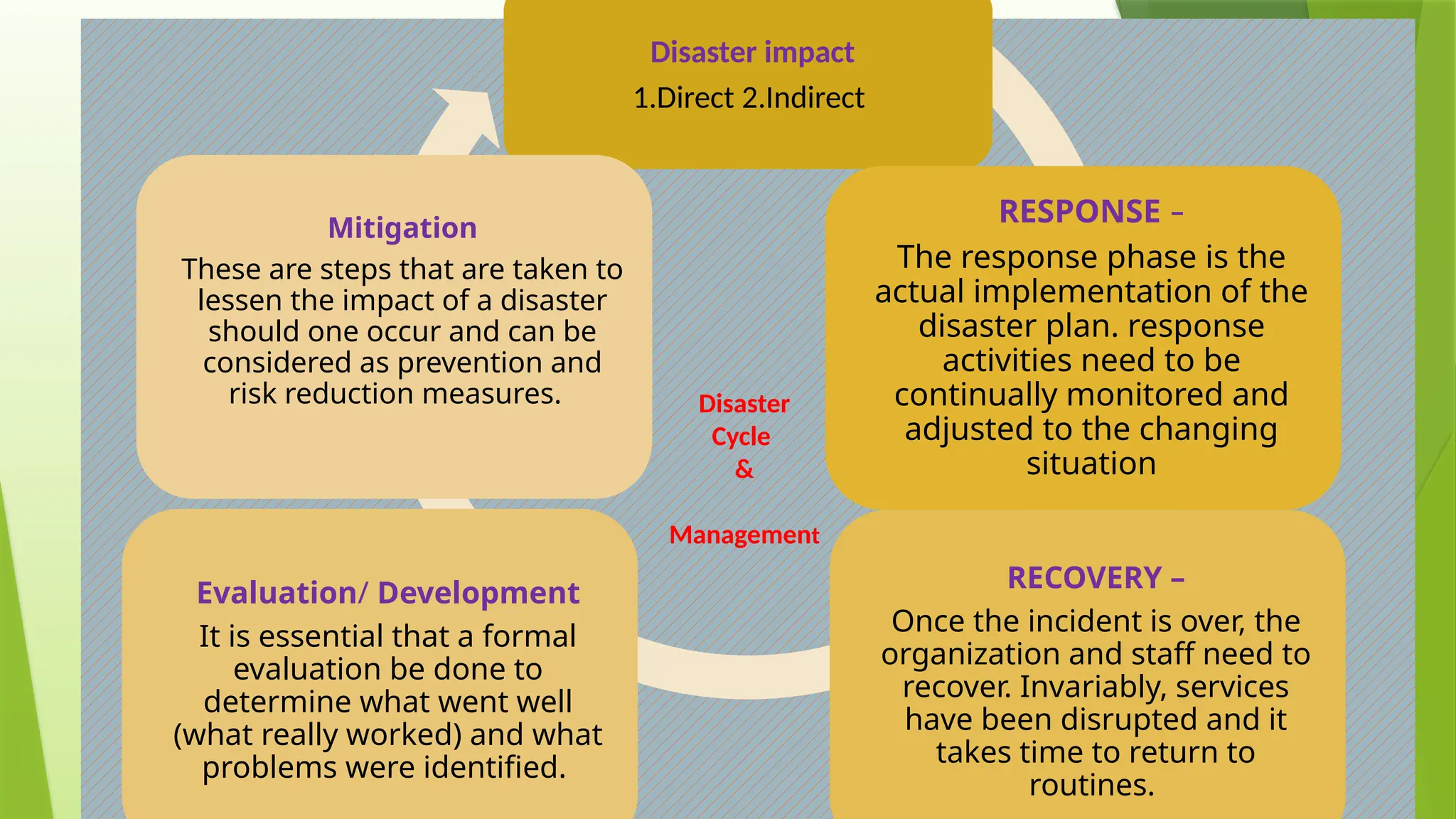
Disaster impact
1.Direct 2.Indirect
RESPONSE –
The response phase is the
actual implementation of the
disaster plan. response
activities need to be
continually monitored and
adjusted to the changing
situation
RECOVERY –
Once the incident is over, the
organization and staff need to
recover. Invariably, services
have been disrupted and it
takes time to return to
routines.
Evaluation/ Development
It is essential that a formal
evaluation be done to
determine what went well
(what really worked) and what
problems were identified.
Mitigation
These are steps that are taken to
lessen the impact of a disaster
should one occur and can be
considered as prevention and
risk reduction measures. Disaster
Cycle
&
Management
16
17
The National Disaster Management Authority (NDMA)
On 23 December 2005, the Government of India enacted the Disaster
Management Act, which envisaged the creation of National Disaster
Management Authority (NDMA), headed by the Prime Minister, and
State Disaster Management Authorities (SDMAs) headed by
respective Chief Ministers, to spearhead and implement a holistic and
integrated approach to Disaster Management in India.
NDMA Vision
 "To build a safer and disaster resilient India by a holistic, pro-active,
 technology
 driven and sustainable development strategy that involves all
stakeholders
 fosters a culture of prevention, preparedness and mitigation."
18
Functions and Responsibilities
 Lay down policies on disaster management.
 Approve the National Plan.
 Lay down guidelines to be followed by the State Authorities in drawing up the
State Plan.
 Lay down guidelines to be followed by the all Ministries of the GOI for the
Purpose of integrating the measures for prevention of disaster
 Coordinate the enforcement and implementation of the policy and plans for
disaster management.
 Recommend provision of funds for the purpose of mitigation.
 Provide such support to other countries affected
 Planning -Capacity building for dealing with threatening disaster situations
 Lay down broad policies and guidelines for the functioning of the National
Institute of Disaster Management.
19
Organization chart
20
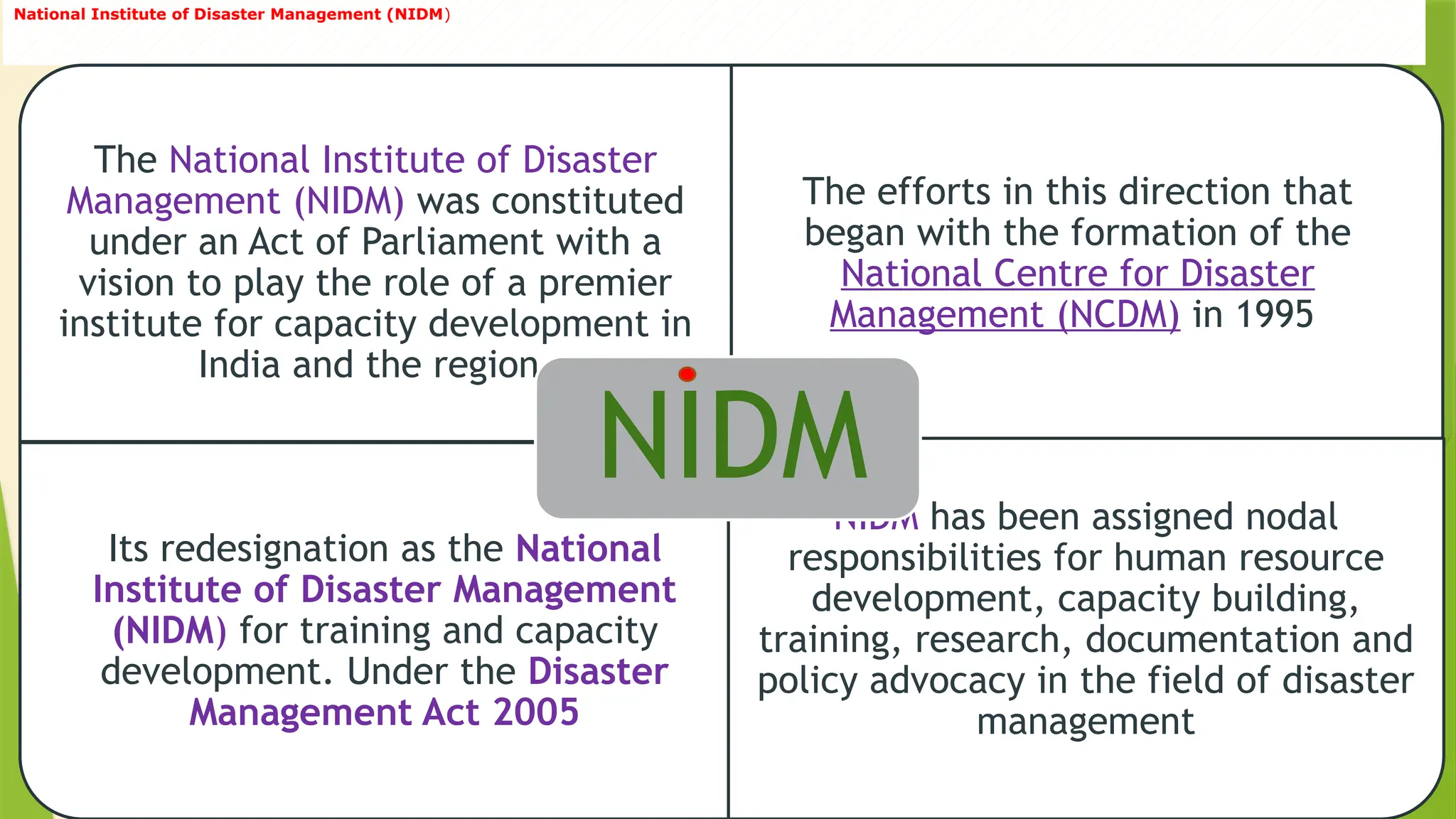
National Institute of Disaster Management (NIDM)
The National Institute of Disaster
Management (NIDM) was constituted
under an Act of Parliament with a
vision to play the role of a premier
institute for capacity development in
India and the region.
The efforts in this direction that
began with the formation of the
National Centre for Disaster
Management (NCDM) in 1995
Its redesignation as the National
Institute of Disaster Management
(NIDM) for training and capacity
development. Under the Disaster
Management Act 2005
NIDM has been assigned nodal
responsibilities for human resource
development, capacity building,
training, research, documentation and
policy advocacy in the field of disaster
management
NIDM
21
VISION
Training
&
research
To be a premier Institute of Excellence for
training and research on disaster risk
mitigation and management in India and to be
recognized as one of the leading Institutions at
the International level in the field.
Prevention
&
preparedness
• To strive relentlessly towards making a disaster
free India by developing and promoting a
culture of prevention and preparedness at all
levels,
22
Function
Function
Of
NIDM
Develop
training
modules,
undertake
research
Provide
assistance in
national level
policy
formulation;
Provide
assistance to
the State
Governments
Develop
educational
materials
Development
plan covering
all aspects of
disaster
management;
Promote
awareness
among
stakeholders
23
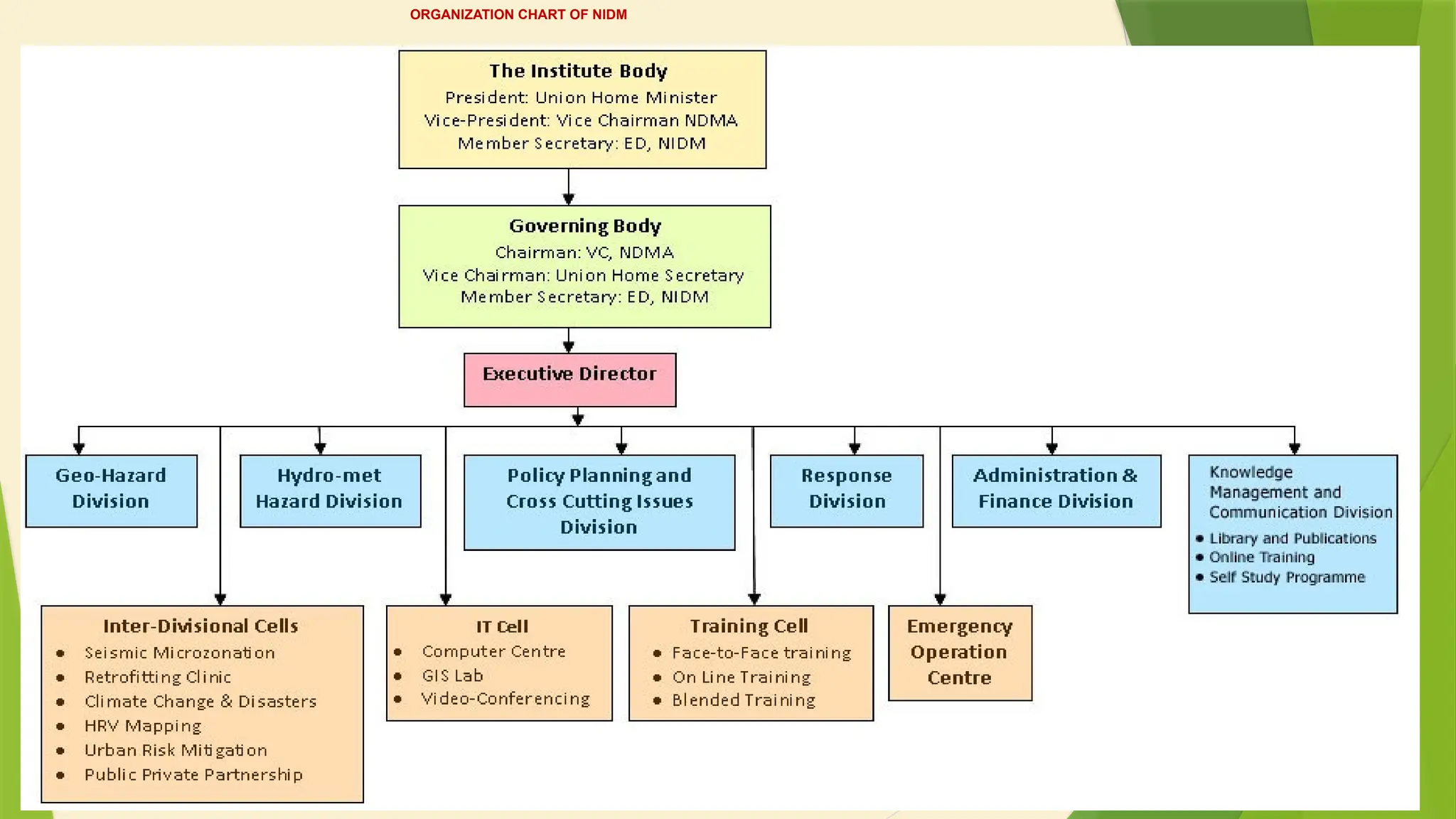
ORGANIZATION CHART OF NIDM
24
Goal of Disaster Management
 The goal of disaster management the safety and sustainability of human
lives.
 Safety is related to avoiding death and injuries to human lives during a
disaster.
 Sustainability is related to livelihood, socioeconomic, cultural, environmental
and psychological aspects
 To save life and protect property
 To sustain survivals and repair essential activities (food, water, health,
sanitation. burial housing and emergency welfare)
 To achieve emergency operational capabilities by amazing damage.
 Providing education training emergency treatment, and tests and exercises.
25
Disaster Nursing
The adaptation of professional nursing knowledge, skills
and attitude in recognizing and meeting the nursing
and medical of disaster victims.
Disaster nursing can be defined as ''an adaptation of
professional nursing skills in recognizing and meeting
the nursing physical and emotional needs resulting from
the disaster.''
26
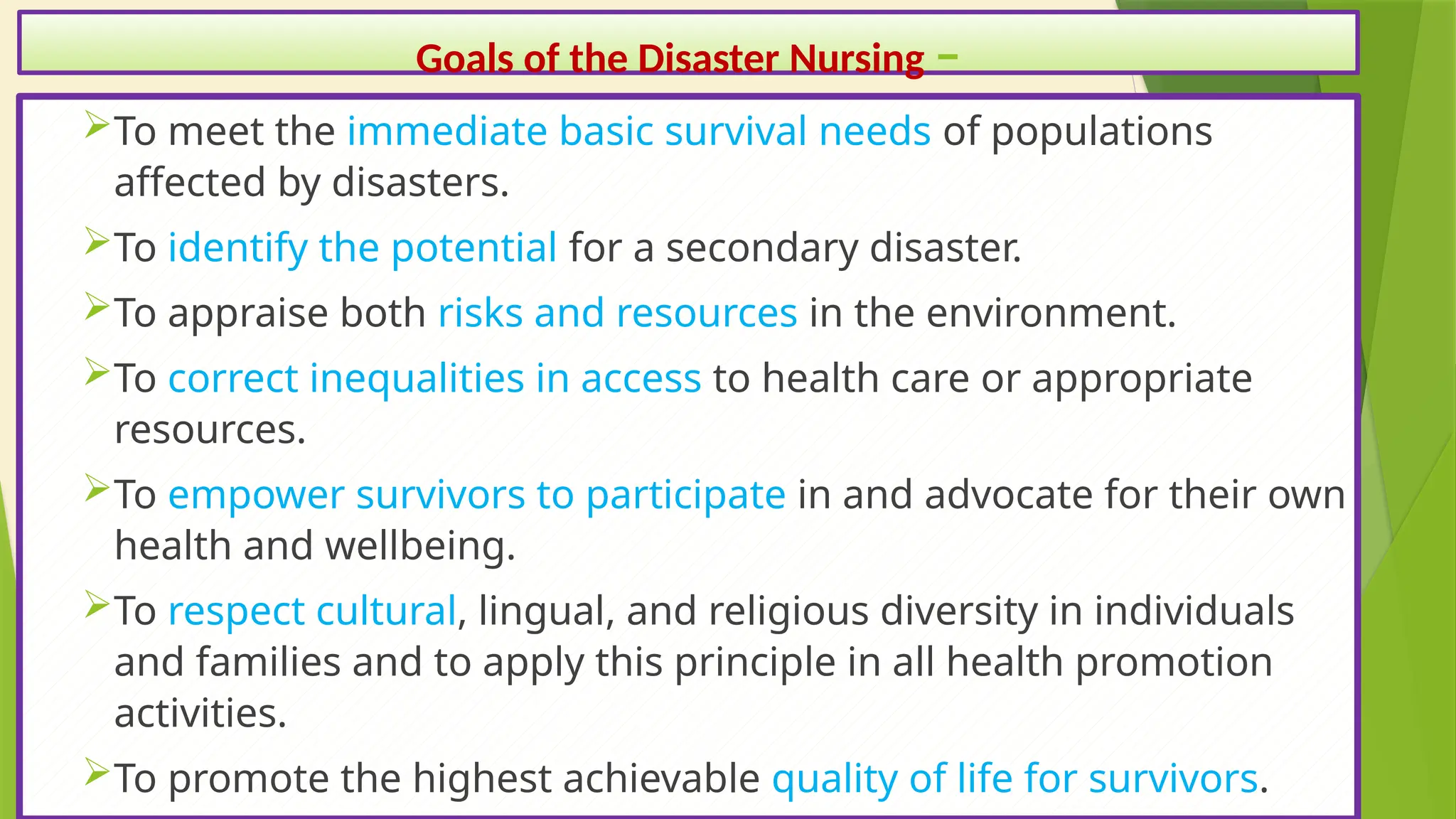
Goals of the Disaster Nursing –
To meet the immediate basic survival needs of populations
affected by disasters.
To identify the potential for a secondary disaster.
To appraise both risks and resources in the environment.
To correct inequalities in access to health care or appropriate
resources.
To empower survivors to participate in and advocate for their own
health and wellbeing.
To respect cultural, lingual, and religious diversity in individuals
and families and to apply this principle in all health promotion
activities.
To promote the highest achievable quality of life for survivors.
27
Principles of Disaster Nursing
Rapid assessment of the situation and of nursing care needs.
Triage and initiation of life-saving measures first.
The selected use of essential nursing interventions and the elimination of
nonessential nursing activities.
Evaluation of the environment and the mitigation or removal of any health
hazards.
Prevention of further injury or illness.
Leadership in coordinating patient triage, care, and transport during times of crisis.
The teaching, supervision, and utilization of auxiliary medical personnel and
volunteers.
Provision of understanding, compassion and emotional support to all victims and
their families
28
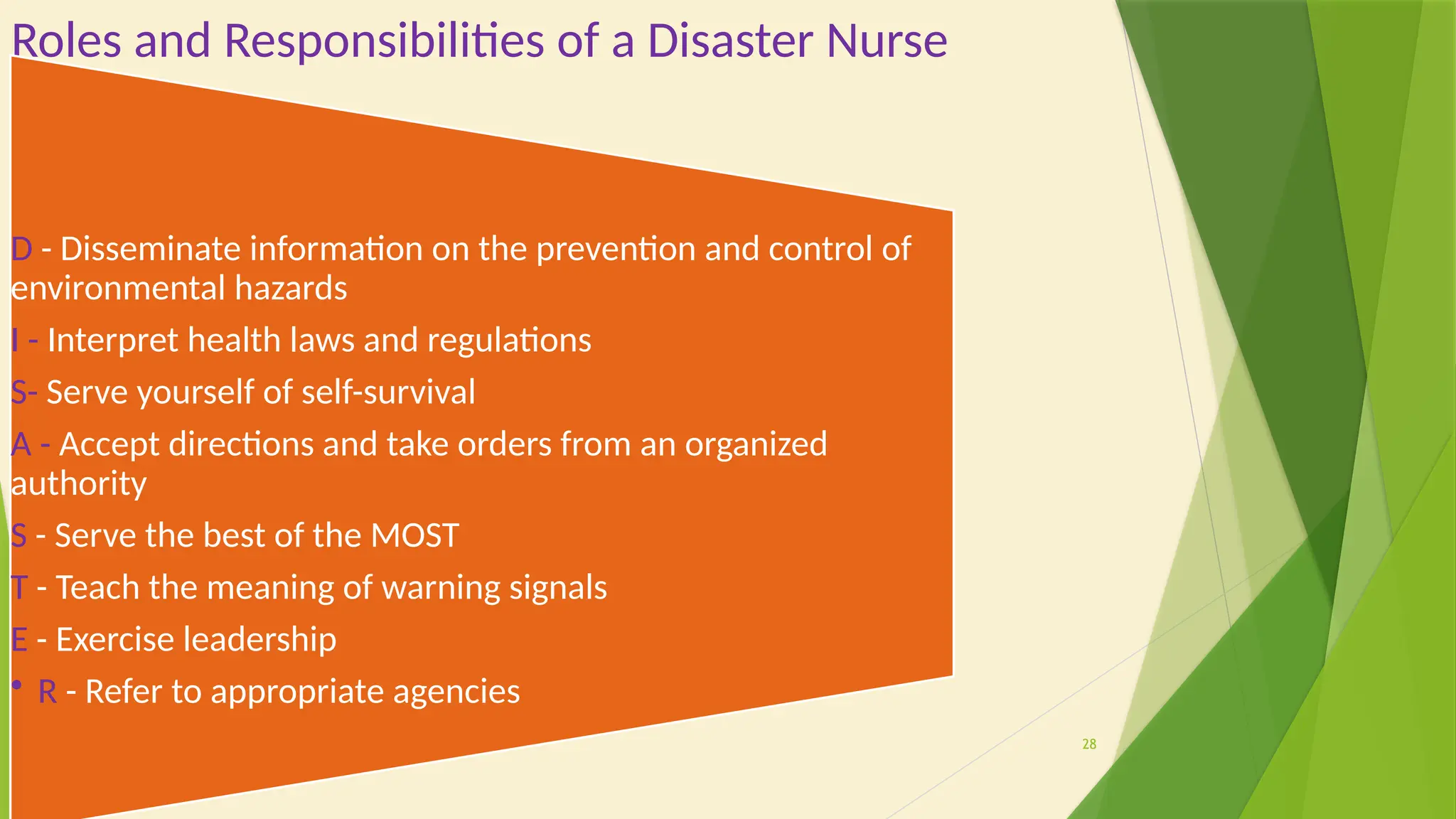
Roles and Responsibilities of a Disaster Nurse
D - Disseminate information on the prevention and control of
environmental hazards
I - Interpret health laws and regulations
S- Serve yourself of self-survival
A - Accept directions and take orders from an organized
authority
S - Serve the best of the MOST
T - Teach the meaning of warning signals
E - Exercise leadership
• R - Refer to appropriate agencies
29
ROLES OF THE NURSES IN DISASTER
 Nurses have an important role to play during each phase of a disaster. For the
purpose of disaster planning and preparation, it is simpler to categorize nurses
as working in either at the disaster site or hospital setting
 Management and Triage at the Disaster Site.
 To deliver appropriate patient care.
 Organizing An Effective Disaster System
30
Management of the Disaster Site.
Disaster Zone
It is the actual location of the
incident from where patients are to
be removed as soon as possible
Treatment Zone
Nurse spend most of their time in this zone
during a disaster, where equipment and
personnel to carry out patient care are
concentrated. Triage of patients into
treatment categories
Transportation Zone-
It should be situated directly next to the
treatment zone, so that ambulance and
other vehicles can load patients and leave
for hospitals
Delivering Appropriate Patient Care
Patient Triage-
Probably Fatal-
Critical-
Serious-
Stable-
Fatal-
31
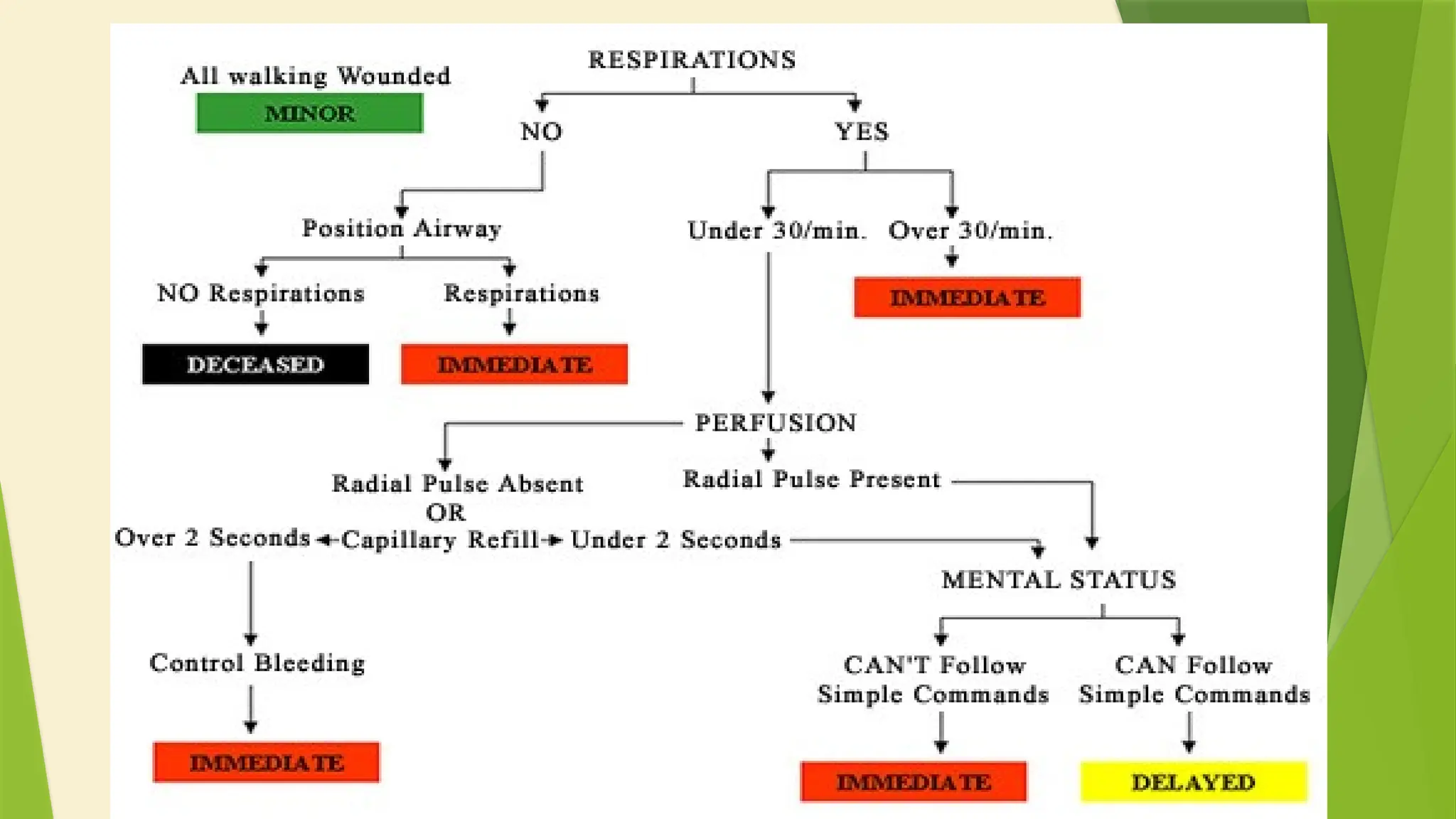
Management of Triage-
 Whereas emergency nurse daily determines which client require priority care. triage is the process of sorting
multiple causalities in the event of war and major disasters. It is required when the number of casualties exceed
immediate treatment resources.
o 1.Red -Urgent critical 2. Yellow –Delayed 3. Green -Minor /walking wounded 4.Black -Dead
32
Triage
Triage
Color
Acuity Need for treatment Remarks
Red Emergent Immediate Threat to life
limb, or organ
Yellow Urgent Delayed Significant injury or illness but can
tolerate a delay in care
Green Non-Urgent Minimal treatment Can safely wait for treatment
Black expired No treatment
Expectant –treat if
resources are available.
Comfort care
Consider transport and care for
expectant patients after initial
"Reds" are cleared, if resources
exist and it does not delay care for
Yellows.
33
34
First-aid
Immediate life-saving treatment for seriously injured
Sorting out and transferring people according to servility
See that all are promptly attended and treated
Provide priority treatment accordingly
Act for the physician in his absence (Red Cross Standing
Order)
See that supplies are adequate
Putting identity care while transferring
35
Immediate Treatment and Support
Disaster nurses provide treatment on site at emergency
treatment stations
Direct nursing care, onsite interventions
Identify the clients if possible.
Arranging for transport once victims are stabilized
Put proper identification data while transferring.
Keep the relatives informed.
 Managing the procurement
Distribution and replenishment of all supplies.
36
Care of Bodies and Notification of Families
 Identification and transport of the dead bodies should be done.
 Records of deaths must be made and maintained and
 family members should be notified of their loved ones' deaths as
quickly and compassionately as possible.
 If feasible a representative from each area’s faith communities
should be available to assist families awaiting news of missing
loved
37
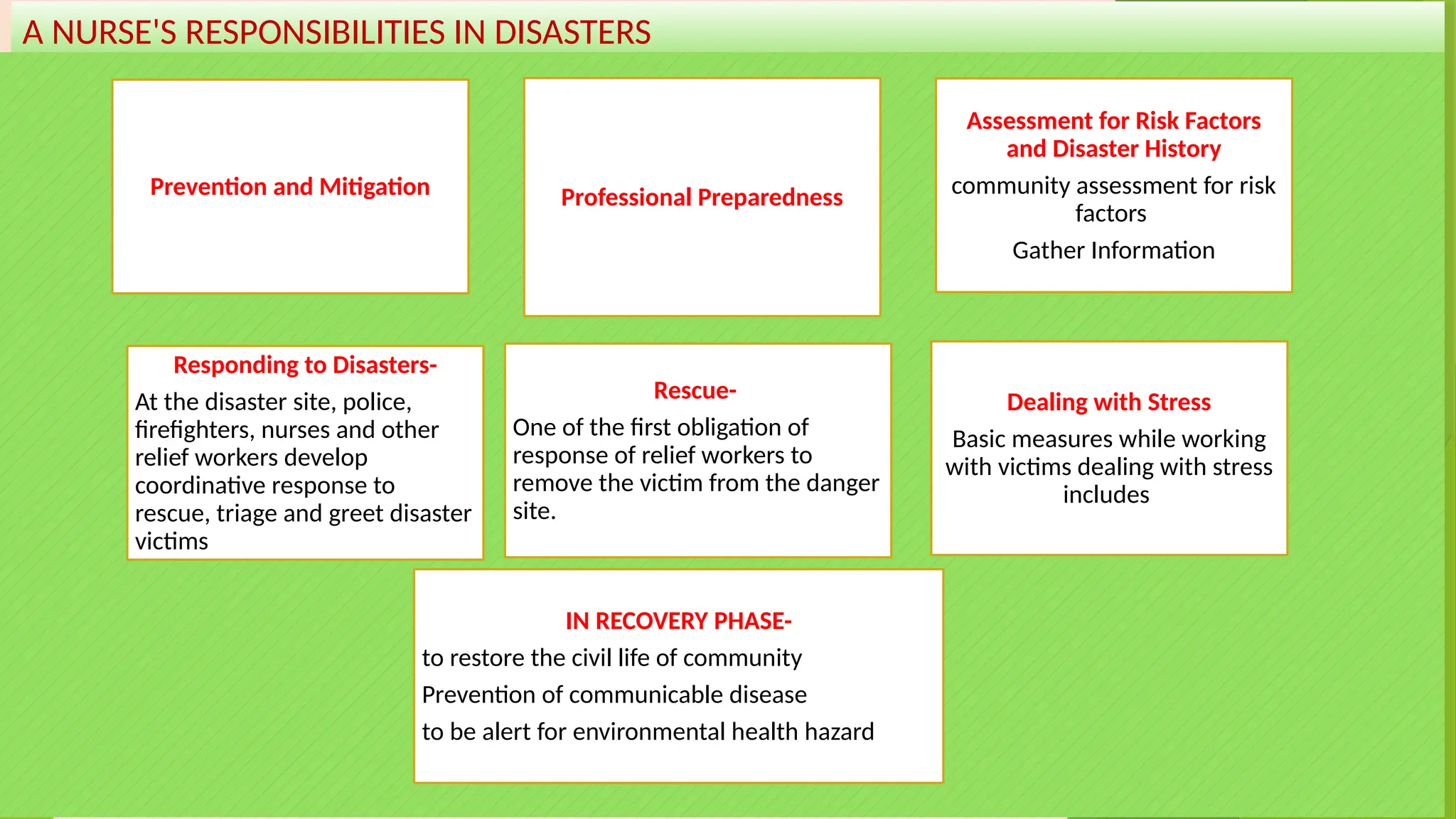
A NURSE'S RESPONSIBILITIES IN DISASTERS
Prevention and Mitigation Professional Preparedness
Assessment for Risk Factors
and Disaster History
community assessment for risk
factors
Gather Information
Responding to Disasters-
At the disaster site, police,
firefighters, nurses and other
relief workers develop
coordinative response to
rescue, triage and greet disaster
victims
Rescue-
One of the first obligation of
response of relief workers to
remove the victim from the danger
site.
IN RECOVERY PHASE-
to restore the civil life of community
Prevention of communicable disease
to be alert for environmental health hazard
Dealing with Stress
Basic measures while working
with victims dealing with stress
includes
38
ROLE OF THE NURSES IN DISASTER AT A HOSPITAL
 it is important that each hospital be prepared for a disaster by having a simple, organized
and well-defined disaster plan.
 A disaster committee with representation from nursing service must be formed.
 in addition, frequent, planned drills are essential to the implementation of a disaster plan.
 Preparation at the Emergency Department
 Making sure as many nursing personnel as possible report for duty
 Assigning them to specific areas/rooms
 Instructing volunteers and ancillary personnel
 Providing breaks or periods of rest for triage nurse and those working in resuscitation and
minor treatment areas
 Commutating the need for additional personnel to whoever concerned
 Periodic checking of supplies
39
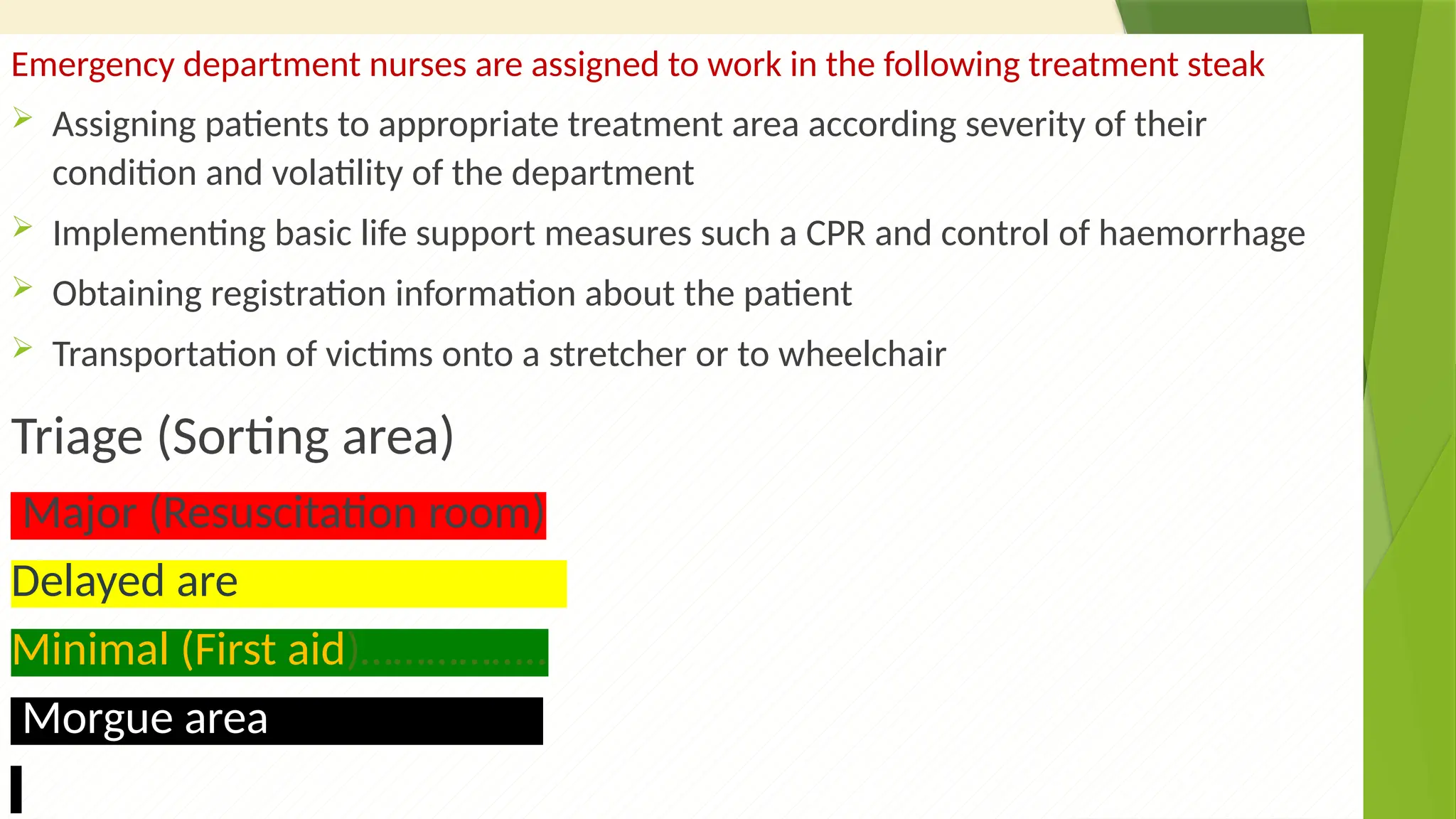
Emergency department nurses are assigned to work in the following treatment steak
 Assigning patients to appropriate treatment area according severity of their
condition and volatility of the department
 Implementing basic life support measures such a CPR and control of haemorrhage
 Obtaining registration information about the patient
 Transportation of victims onto a stretcher or to wheelchair
Triage (Sorting area)
Major (Resuscitation room)
Delayed are……………………….
Minimal (First aid)……………..
Morgue area…………………….
40

 The equipment should be sufficient for victims and the things should be replaced after
use
 When information of disaster is received, trolleys should be arranged at the emergency
gate to receive the patients
 Extra servants should be posted at the gate to transfer the patients to emergency
 Information should be sent to all concerned personnel for supply of extra equipment
 Extra staff should be posted to emergency from other areas
 Disaster cupboard should be kept open and the needed equipment should be checked
 Triage at the entry of the emergency according to the condition of the patient

Policy for Disaster Management
41
 Nursing assessment and intervention in the major treatment area:
 Maintain patient airway
 Maintain ventilation
 Stop or control haemorrhage
 Order laboratory tests only if they can make an immediate difference in the
treatment of patients
 Use available equipment and supplies wisely.
 Use personnel wisely
 Make sure that disaster tag is always on the patient and on the patient's
valuables
 Communicate with the patient and their relatives
42
PREPARATION OF THE INPATIENT AREAS
A)- Defined mechanism - to alert nursing units to an external disaster must be in
place.
 Notify on duty staff and call in off-duty staff
 Stop all non-essential functions
 Evaluate patients who can be discharged
 Reallocate resources to treatment areas
B). The Disaster Cupboard:
Resuscitation equipment-
Suturing material, dressing material, cut down set
Oxygen supply and equipment
Suction machine
Medicine- Emergency drugs, analgesic antibiotics
Linen, blankets.
43
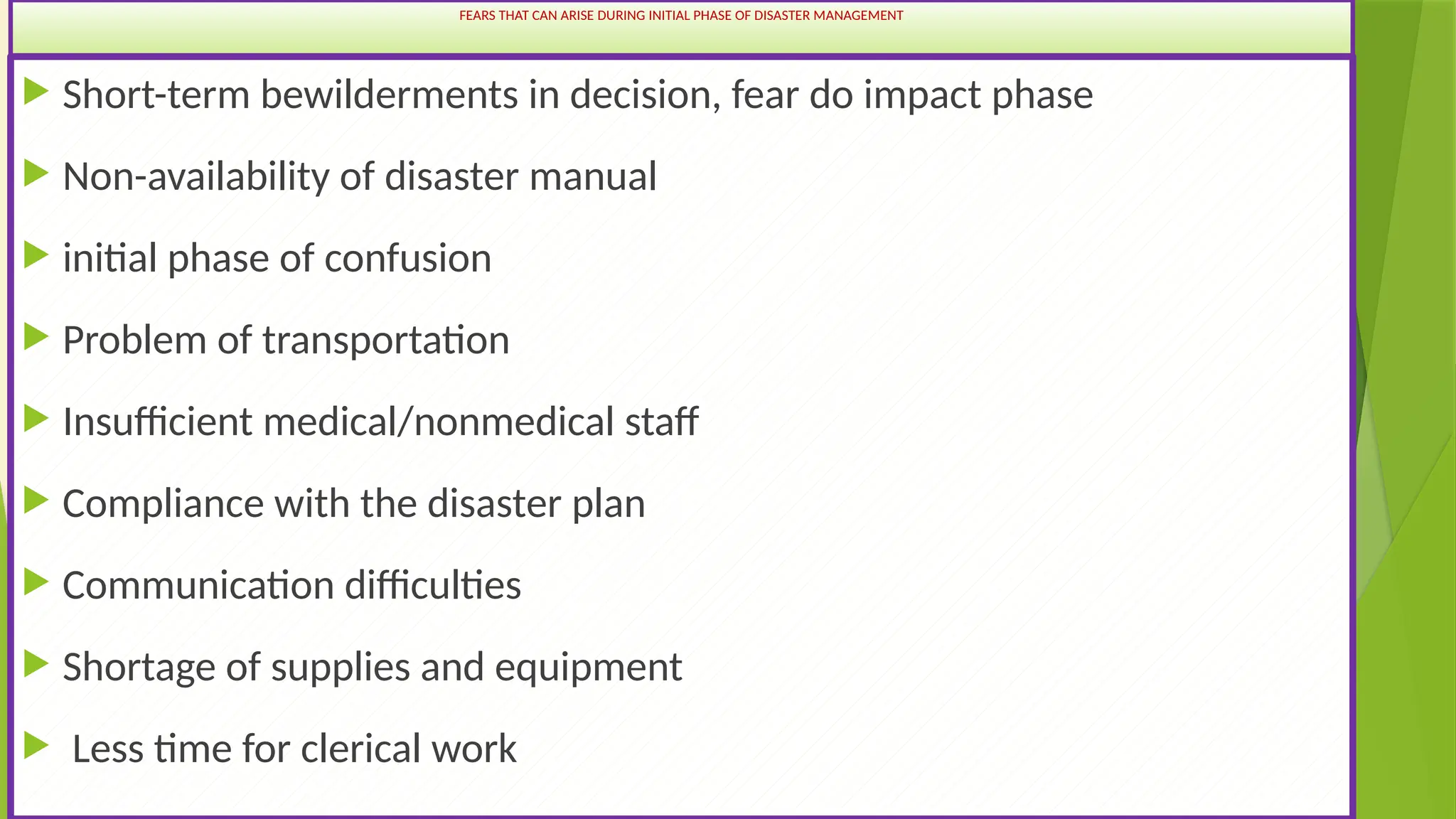
FEARS THAT CAN ARISE DURING INITIAL PHASE OF DISASTER MANAGEMENT
 Short-term bewilderments in decision, fear do impact phase
 Non-availability of disaster manual
 initial phase of confusion
 Problem of transportation
 Insufficient medical/nonmedical staff
 Compliance with the disaster plan
 Communication difficulties
 Shortage of supplies and equipment
 Less time for clerical work
44
Factors Affecting Nursing Care in Disaster
 Shock and anxiety among staff
 Worries about their own family
 Mode of arrival of casualties
 Time limitation for documentation and charting
 Disruption of normal communication
 Influx of people and unfamiliar situation
 Sudden increased demand of supplies and equipment
 Lack of identification of the victims.
45
Qualities
Required for
a Nurse to
Work in
Disaster
Sensitive
to the
problems
Understanding
in nature
Caring
&
Supporting
Emotional
stability
Strictness in
responsibilities
Leadership
ability
&
Teamwork
efficiency
46
Research input
Literature review of disaster health research in Japan: focusing on disaster nursing education
47
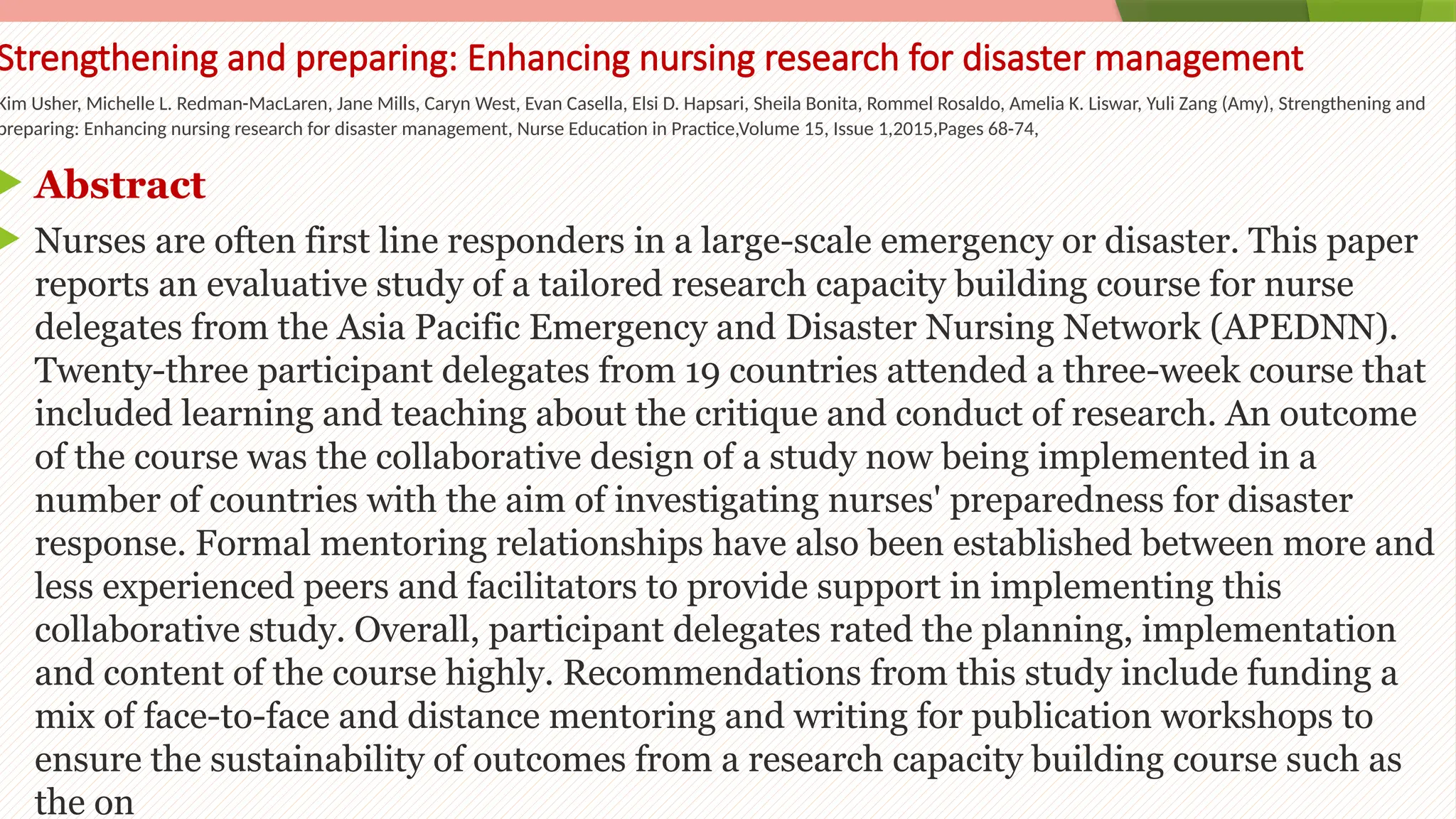
Strengthening and preparing: Enhancing nursing research for disaster management
Kim Usher, Michelle L. Redman-MacLaren, Jane Mills, Caryn West, Evan Casella, Elsi D. Hapsari, Sheila Bonita, Rommel Rosaldo, Amelia K. Liswar, Yuli Zang (Amy), Strengthening and
preparing: Enhancing nursing research for disaster management, Nurse Education in Practice,Volume 15, Issue 1,2015,Pages 68-74,
 Abstract
 Nurses are often first line responders in a large-scale emergency or disaster. This paper
reports an evaluative study of a tailored research capacity building course for nurse
delegates from the Asia Pacific Emergency and Disaster Nursing Network (APEDNN).
Twenty-three participant delegates from 19 countries attended a three-week course that
included learning and teaching about the critique and conduct of research. An outcome
of the course was the collaborative design of a study now being implemented in a
number of countries with the aim of investigating nurses' preparedness for disaster
response. Formal mentoring relationships have also been established between more and
less experienced peers and facilitators to provide support in implementing this
collaborative study. Overall, participant delegates rated the planning, implementation
and content of the course highly. Recommendations from this study include funding a
mix of face-to-face and distance mentoring and writing for publication workshops to
ensure the sustainability of outcomes from a research capacity building course such as
the on
48
Summary
Today we have discussed about introduction, types of
disaster, natural disaster, man made disaster, primary
prevention, epidemiology of disaster, effects of disaster,
management cycle of disaster, NDMA,NIDM,disaster
nursing, goal of disaster nursing, principles of disaster
nursing, role and responsibilities of nurse, Preparation of the
inpatient areas, factors affecting nursing care in disaster and
qualities of a nurse work in disaster
49
CONCLUSION
 Hardly a day now passes without news about a major or complex
emergency happening in some part of the world.
 Disasters continue to strike and cause destruction in developing
and developed countries alike raising peoples concern about their
vulnerability to occurrence that can gravely affect their day-to-day
life and their future. Nurses in any location will be on the frontline
as caregivers and managers in the event of a damaging disasters.
 So, they need to have adequate knowledge and training to work in
such a unique, chaotic stressful situation and to identify and meet
the complex, multivarious health needs of victims of disaster
Bibliography
Brar Navdeep Kaur, Rawat HC. Textbook of advanced nursing practice: Disaster
Nursing.New Delhi:Jayepee Brothers;2015 pg. no.1037- 56.
 https://rajnursing.blogspot.com/2017/09/disaster-nursing.html
 https://www.slideshare.net/tulu2015/disaster-nursing-123862971
 https://nidm.gov.in/
 https://ndma.gov.in/
50
51

Disaster Nursing PRESENTATION, ADVANCED NURSING PRACTICE

  • 1.
    1 RAJKUMARI AMRIT KAURCOLLEGEOF NURSING PRESENTATION ON‘DISASTER NURSING’ Faculty advisor Presented by Mrs. Sarita Shokanda Fateh chand Assistant professor M.Sc. Nursing (Pre) RAKCON RAKCON
  • 2.
    2  Introduction  Typesof disaster  Natural disaster  Man made disaster  Primary Prevention  Epidemiology of disaster  Effects of disaster  Management cycle of disaster  NDMA  NIDM  Disaster nursing  Goal of disaster nursing  Principles of disaster nursing  Role and responsibilities of Nurse  Conclusion  Summary Content
  • 3.
    3 INTRODUCTION Disaster caused bynature’s fury is not uncommon in this planet, earth. In fact, scientists believe that the birth of this planet. Earth was the result of explosion that occurred in the solar system. From time immemorial, this planet had witnessed numerous natural disasters. In the past , man used to view these natural disasters as the ‘acts of God’. Gradually, science opened the doors of knowledge and enabled man to understand the mysterious occurrence of natural disasters. DEFINITION OF DISASTER “A Disaster is any occurrence that causes damage, economic disruption, loss of human life and property, or deterioration of health and services on scale sufficient to warrant an extraordinary response from the area or community.”
  • 4.
    4 DISASTER alphabetically means: D-Destructions I-Incidents S-Sufferings A-Administrativefailures S-Sentiments T-Tragedies E-Eruption of communicable diseases R-Research program and its implementation • D 7D’S which occur during the Disaster: Death Disability Distress Disease Damage to health service Damage to economy Disruption D
  • 5.
    5 Natural Disaster Natural calamitiesor climatic hazards, like earthquake, Floods, cyclones, famine, drought, forest. fire, dust storms, sandstorms, landslides, avalanche, volcanic eruptions, Tornados, hailstorms, tsunami, communicable disease etc. Man-Made Disaster- These include technical disasters like dam failure, nuclear accidents, hazards waste accidents, oil spills and leakage, industrial accidents, fire, explosions, toxic materials, pollution, terrorist attack, transportation accidents, social disasters like mass-migration riots etc. TYPES OF DISASTER
  • 6.
    6 Types of disasteron the base of causalities Minor disasters involving approximately 25 victims Moderate disaster involving approximately 100 victims Major disaster involving more than 100 victims Catastrophic disaster when number of injured patients reaches up to 1000 or more
  • 7.
  • 8.
    8 MAN-MADE DISASTERS- Chemical accident RadiationEmergency Bioterrorism Pandemics and Disease War & Civil Conflicts Terrorism Political terrorism Non-political terrorism: MAN-MADE DISASTERS
  • 9.
    9 Primary Prevention againstMan-made Disaster Prevention of occurrence of the disaster must be done to prevent not only the consequences but also the occurrence of fire. explosion crashes and sudden chemical and radiation exposure. These include tighter regulation of chemical plants and other hazardous facilities and insistence that the chemical plant be built away from the densely populated area. Protection against human error Appropriate engineering and technological measures like building codes, dam design containment of toxic materials. The world has turned towards efforts to stop arms race and prevent nuclear war.
  • 10.
    10 THE DEADLIEST WORLDDISASTER- Worldwide, 1918-19: Influenza pandemic takes somewhere between 35 million and 75 million lives India. 1950: Around 30.000 people lost their lives in a quake of 8.6 magnitude in Assam, India, Earthquake of 9.0 and the resulting tsunami creates one of the world's worst disasters. It does major damage to: Indonesia India, Sri Lanka Bhopal gas disaster. December 2-3, 1984, the plant released methyl isocyanate (MIC) gas and other toxins The Kargil War between India and Pakistan between May and July 1999 in the Kargil district of Kashmir. 26/12/2008 Mumbai Taj Hotel disaster India 2009 flu pandemic in India as the outbreak of swine flu in various parts of India and also in the whole world 2020 Covid 19 Pandemic
  • 11.
    11 EPIDEMIOLOGY OF DISASTER EPIDEMIOLOG Y OFDISASTER Agents Primary Agents- Earthquakes, floods, Hurricanes, Bomb blasts, Tsunami ext. Secondary agents - Bacteria and viruses that produce contamination or infection after the primary agent Environmental Factors- Physical Factors Chemical Factors Biological Factors Social Factors Psychological Factors Host Factors- Age, Immunization status, Degree of mobility, Emotional stability.
  • 12.
    12 IMPACT EFFECTS A. Direct:-It is different according to the geographical area as well as type of disaster, e.g., direct impact of flood will be different from the direct impact of earthquake. B. Indirect:- All-natural disasters have more or less the same Indirect impact. Like loss of life, loss of shelter, disruption of water and food and m communication epidemic and psychological illness. Everybody in the community may not be affected equally While preparing for disaster, it is important to identify those who are at risk of the effects of the disaster and those who are vulnerable as they require special preparedness and response handicapped people, Pregnant women , children, elderly and sick person, handicapped people are also more vulnerable during disaster. EFFECTS OF DISASTER
  • 13.
    13 Health Effects ofDisasters  Disasters may cause premature deaths, illnesses, and injuries.  Disasters may destroy the local health care infrastructure.  Disasters may affect the psychological, emotional, and social well-being of the population.  Disasters may cause shortages of food and cause severe nutritional deficiencies.  Disasters may create large population movements.  Disasters may create environmental imbalances
  • 14.
    14 PHASES OF DISASTER- 1.Warningphase - Some disasters give meaning of their approach 2.Threat phase- This is critical decision-making period when one’s activity is directed towards the survival action 3.Impact phase- When disaster strikes people stay at first be stunned 4.Inventory phase - During this phase, one tries to find out what has actually happened to him(degree of distraction) 5.Rescue phase: -The morale of victim usually picks up during this period as they work together with rescue personnel to get the community back to its feet. This phase is the longest post disaster period when construction takes place 6.Restoration period -In this phase. the individuals regain the stability that they enjoyed prior to the disaster. The time required for a community to reach the state of equilibrium depends upon the nature and intensity of disaster and disaster relief available
  • 15.
    15 Disaster impact 1.Direct 2.Indirect RESPONSE– The response phase is the actual implementation of the disaster plan. response activities need to be continually monitored and adjusted to the changing situation RECOVERY – Once the incident is over, the organization and staff need to recover. Invariably, services have been disrupted and it takes time to return to routines. Evaluation/ Development It is essential that a formal evaluation be done to determine what went well (what really worked) and what problems were identified. Mitigation These are steps that are taken to lessen the impact of a disaster should one occur and can be considered as prevention and risk reduction measures. Disaster Cycle & Management
  • 16.
  • 17.
    17 The National DisasterManagement Authority (NDMA) On 23 December 2005, the Government of India enacted the Disaster Management Act, which envisaged the creation of National Disaster Management Authority (NDMA), headed by the Prime Minister, and State Disaster Management Authorities (SDMAs) headed by respective Chief Ministers, to spearhead and implement a holistic and integrated approach to Disaster Management in India. NDMA Vision  "To build a safer and disaster resilient India by a holistic, pro-active,  technology  driven and sustainable development strategy that involves all stakeholders  fosters a culture of prevention, preparedness and mitigation."
  • 18.
    18 Functions and Responsibilities Lay down policies on disaster management.  Approve the National Plan.  Lay down guidelines to be followed by the State Authorities in drawing up the State Plan.  Lay down guidelines to be followed by the all Ministries of the GOI for the Purpose of integrating the measures for prevention of disaster  Coordinate the enforcement and implementation of the policy and plans for disaster management.  Recommend provision of funds for the purpose of mitigation.  Provide such support to other countries affected  Planning -Capacity building for dealing with threatening disaster situations  Lay down broad policies and guidelines for the functioning of the National Institute of Disaster Management.
  • 19.
  • 20.
    20 National Institute ofDisaster Management (NIDM) The National Institute of Disaster Management (NIDM) was constituted under an Act of Parliament with a vision to play the role of a premier institute for capacity development in India and the region. The efforts in this direction that began with the formation of the National Centre for Disaster Management (NCDM) in 1995 Its redesignation as the National Institute of Disaster Management (NIDM) for training and capacity development. Under the Disaster Management Act 2005 NIDM has been assigned nodal responsibilities for human resource development, capacity building, training, research, documentation and policy advocacy in the field of disaster management NIDM
  • 21.
    21 VISION Training & research To be apremier Institute of Excellence for training and research on disaster risk mitigation and management in India and to be recognized as one of the leading Institutions at the International level in the field. Prevention & preparedness • To strive relentlessly towards making a disaster free India by developing and promoting a culture of prevention and preparedness at all levels,
  • 22.
    22 Function Function Of NIDM Develop training modules, undertake research Provide assistance in national level policy formulation; Provide assistanceto the State Governments Develop educational materials Development plan covering all aspects of disaster management; Promote awareness among stakeholders
  • 23.
  • 24.
    24 Goal of DisasterManagement  The goal of disaster management the safety and sustainability of human lives.  Safety is related to avoiding death and injuries to human lives during a disaster.  Sustainability is related to livelihood, socioeconomic, cultural, environmental and psychological aspects  To save life and protect property  To sustain survivals and repair essential activities (food, water, health, sanitation. burial housing and emergency welfare)  To achieve emergency operational capabilities by amazing damage.  Providing education training emergency treatment, and tests and exercises.
  • 25.
    25 Disaster Nursing The adaptationof professional nursing knowledge, skills and attitude in recognizing and meeting the nursing and medical of disaster victims. Disaster nursing can be defined as ''an adaptation of professional nursing skills in recognizing and meeting the nursing physical and emotional needs resulting from the disaster.''
  • 26.
    26 Goals of theDisaster Nursing – To meet the immediate basic survival needs of populations affected by disasters. To identify the potential for a secondary disaster. To appraise both risks and resources in the environment. To correct inequalities in access to health care or appropriate resources. To empower survivors to participate in and advocate for their own health and wellbeing. To respect cultural, lingual, and religious diversity in individuals and families and to apply this principle in all health promotion activities. To promote the highest achievable quality of life for survivors.
  • 27.
    27 Principles of DisasterNursing Rapid assessment of the situation and of nursing care needs. Triage and initiation of life-saving measures first. The selected use of essential nursing interventions and the elimination of nonessential nursing activities. Evaluation of the environment and the mitigation or removal of any health hazards. Prevention of further injury or illness. Leadership in coordinating patient triage, care, and transport during times of crisis. The teaching, supervision, and utilization of auxiliary medical personnel and volunteers. Provision of understanding, compassion and emotional support to all victims and their families
  • 28.
    28 Roles and Responsibilitiesof a Disaster Nurse D - Disseminate information on the prevention and control of environmental hazards I - Interpret health laws and regulations S- Serve yourself of self-survival A - Accept directions and take orders from an organized authority S - Serve the best of the MOST T - Teach the meaning of warning signals E - Exercise leadership • R - Refer to appropriate agencies
  • 29.
    29 ROLES OF THENURSES IN DISASTER  Nurses have an important role to play during each phase of a disaster. For the purpose of disaster planning and preparation, it is simpler to categorize nurses as working in either at the disaster site or hospital setting  Management and Triage at the Disaster Site.  To deliver appropriate patient care.  Organizing An Effective Disaster System
  • 30.
    30 Management of theDisaster Site. Disaster Zone It is the actual location of the incident from where patients are to be removed as soon as possible Treatment Zone Nurse spend most of their time in this zone during a disaster, where equipment and personnel to carry out patient care are concentrated. Triage of patients into treatment categories Transportation Zone- It should be situated directly next to the treatment zone, so that ambulance and other vehicles can load patients and leave for hospitals Delivering Appropriate Patient Care Patient Triage- Probably Fatal- Critical- Serious- Stable- Fatal-
  • 31.
    31 Management of Triage- Whereas emergency nurse daily determines which client require priority care. triage is the process of sorting multiple causalities in the event of war and major disasters. It is required when the number of casualties exceed immediate treatment resources. o 1.Red -Urgent critical 2. Yellow –Delayed 3. Green -Minor /walking wounded 4.Black -Dead
  • 32.
    32 Triage Triage Color Acuity Need fortreatment Remarks Red Emergent Immediate Threat to life limb, or organ Yellow Urgent Delayed Significant injury or illness but can tolerate a delay in care Green Non-Urgent Minimal treatment Can safely wait for treatment Black expired No treatment Expectant –treat if resources are available. Comfort care Consider transport and care for expectant patients after initial "Reds" are cleared, if resources exist and it does not delay care for Yellows.
  • 33.
  • 34.
    34 First-aid Immediate life-saving treatmentfor seriously injured Sorting out and transferring people according to servility See that all are promptly attended and treated Provide priority treatment accordingly Act for the physician in his absence (Red Cross Standing Order) See that supplies are adequate Putting identity care while transferring
  • 35.
    35 Immediate Treatment andSupport Disaster nurses provide treatment on site at emergency treatment stations Direct nursing care, onsite interventions Identify the clients if possible. Arranging for transport once victims are stabilized Put proper identification data while transferring. Keep the relatives informed.  Managing the procurement Distribution and replenishment of all supplies.
  • 36.
    36 Care of Bodiesand Notification of Families  Identification and transport of the dead bodies should be done.  Records of deaths must be made and maintained and  family members should be notified of their loved ones' deaths as quickly and compassionately as possible.  If feasible a representative from each area’s faith communities should be available to assist families awaiting news of missing loved
  • 37.
    37 A NURSE'S RESPONSIBILITIESIN DISASTERS Prevention and Mitigation Professional Preparedness Assessment for Risk Factors and Disaster History community assessment for risk factors Gather Information Responding to Disasters- At the disaster site, police, firefighters, nurses and other relief workers develop coordinative response to rescue, triage and greet disaster victims Rescue- One of the first obligation of response of relief workers to remove the victim from the danger site. IN RECOVERY PHASE- to restore the civil life of community Prevention of communicable disease to be alert for environmental health hazard Dealing with Stress Basic measures while working with victims dealing with stress includes
  • 38.
    38 ROLE OF THENURSES IN DISASTER AT A HOSPITAL  it is important that each hospital be prepared for a disaster by having a simple, organized and well-defined disaster plan.  A disaster committee with representation from nursing service must be formed.  in addition, frequent, planned drills are essential to the implementation of a disaster plan.  Preparation at the Emergency Department  Making sure as many nursing personnel as possible report for duty  Assigning them to specific areas/rooms  Instructing volunteers and ancillary personnel  Providing breaks or periods of rest for triage nurse and those working in resuscitation and minor treatment areas  Commutating the need for additional personnel to whoever concerned  Periodic checking of supplies
  • 39.
    39 Emergency department nursesare assigned to work in the following treatment steak  Assigning patients to appropriate treatment area according severity of their condition and volatility of the department  Implementing basic life support measures such a CPR and control of haemorrhage  Obtaining registration information about the patient  Transportation of victims onto a stretcher or to wheelchair Triage (Sorting area) Major (Resuscitation room) Delayed are………………………. Minimal (First aid)…………….. Morgue area…………………….
  • 40.
    40   The equipmentshould be sufficient for victims and the things should be replaced after use  When information of disaster is received, trolleys should be arranged at the emergency gate to receive the patients  Extra servants should be posted at the gate to transfer the patients to emergency  Information should be sent to all concerned personnel for supply of extra equipment  Extra staff should be posted to emergency from other areas  Disaster cupboard should be kept open and the needed equipment should be checked  Triage at the entry of the emergency according to the condition of the patient  Policy for Disaster Management
  • 41.
    41  Nursing assessmentand intervention in the major treatment area:  Maintain patient airway  Maintain ventilation  Stop or control haemorrhage  Order laboratory tests only if they can make an immediate difference in the treatment of patients  Use available equipment and supplies wisely.  Use personnel wisely  Make sure that disaster tag is always on the patient and on the patient's valuables  Communicate with the patient and their relatives
  • 42.
    42 PREPARATION OF THEINPATIENT AREAS A)- Defined mechanism - to alert nursing units to an external disaster must be in place.  Notify on duty staff and call in off-duty staff  Stop all non-essential functions  Evaluate patients who can be discharged  Reallocate resources to treatment areas B). The Disaster Cupboard: Resuscitation equipment- Suturing material, dressing material, cut down set Oxygen supply and equipment Suction machine Medicine- Emergency drugs, analgesic antibiotics Linen, blankets.
  • 43.
    43 FEARS THAT CANARISE DURING INITIAL PHASE OF DISASTER MANAGEMENT  Short-term bewilderments in decision, fear do impact phase  Non-availability of disaster manual  initial phase of confusion  Problem of transportation  Insufficient medical/nonmedical staff  Compliance with the disaster plan  Communication difficulties  Shortage of supplies and equipment  Less time for clerical work
  • 44.
    44 Factors Affecting NursingCare in Disaster  Shock and anxiety among staff  Worries about their own family  Mode of arrival of casualties  Time limitation for documentation and charting  Disruption of normal communication  Influx of people and unfamiliar situation  Sudden increased demand of supplies and equipment  Lack of identification of the victims.
  • 45.
    45 Qualities Required for a Nurseto Work in Disaster Sensitive to the problems Understanding in nature Caring & Supporting Emotional stability Strictness in responsibilities Leadership ability & Teamwork efficiency
  • 46.
    46 Research input Literature reviewof disaster health research in Japan: focusing on disaster nursing education
  • 47.
    47 Strengthening and preparing:Enhancing nursing research for disaster management Kim Usher, Michelle L. Redman-MacLaren, Jane Mills, Caryn West, Evan Casella, Elsi D. Hapsari, Sheila Bonita, Rommel Rosaldo, Amelia K. Liswar, Yuli Zang (Amy), Strengthening and preparing: Enhancing nursing research for disaster management, Nurse Education in Practice,Volume 15, Issue 1,2015,Pages 68-74,  Abstract  Nurses are often first line responders in a large-scale emergency or disaster. This paper reports an evaluative study of a tailored research capacity building course for nurse delegates from the Asia Pacific Emergency and Disaster Nursing Network (APEDNN). Twenty-three participant delegates from 19 countries attended a three-week course that included learning and teaching about the critique and conduct of research. An outcome of the course was the collaborative design of a study now being implemented in a number of countries with the aim of investigating nurses' preparedness for disaster response. Formal mentoring relationships have also been established between more and less experienced peers and facilitators to provide support in implementing this collaborative study. Overall, participant delegates rated the planning, implementation and content of the course highly. Recommendations from this study include funding a mix of face-to-face and distance mentoring and writing for publication workshops to ensure the sustainability of outcomes from a research capacity building course such as the on
  • 48.
    48 Summary Today we havediscussed about introduction, types of disaster, natural disaster, man made disaster, primary prevention, epidemiology of disaster, effects of disaster, management cycle of disaster, NDMA,NIDM,disaster nursing, goal of disaster nursing, principles of disaster nursing, role and responsibilities of nurse, Preparation of the inpatient areas, factors affecting nursing care in disaster and qualities of a nurse work in disaster
  • 49.
    49 CONCLUSION  Hardly aday now passes without news about a major or complex emergency happening in some part of the world.  Disasters continue to strike and cause destruction in developing and developed countries alike raising peoples concern about their vulnerability to occurrence that can gravely affect their day-to-day life and their future. Nurses in any location will be on the frontline as caregivers and managers in the event of a damaging disasters.  So, they need to have adequate knowledge and training to work in such a unique, chaotic stressful situation and to identify and meet the complex, multivarious health needs of victims of disaster
  • 50.
    Bibliography Brar Navdeep Kaur,Rawat HC. Textbook of advanced nursing practice: Disaster Nursing.New Delhi:Jayepee Brothers;2015 pg. no.1037- 56.  https://rajnursing.blogspot.com/2017/09/disaster-nursing.html  https://www.slideshare.net/tulu2015/disaster-nursing-123862971  https://nidm.gov.in/  https://ndma.gov.in/ 50
  • 51.