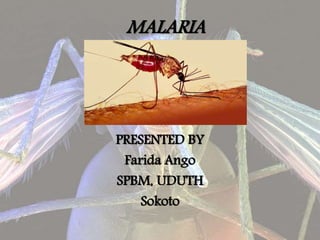
MALARIA
PRESENTED BY
Farida Ango
SPBM, UDUTH
Sokoto
Introduction
• The name malaria comes from the
Italian mal (bad) and aria (air) – it was
originally thought the disease was
spread by the damp air from swamps.
• The link between the disease and the
Anopheles Mosquito was first made by
Ronald Ross, a Scottish army doctor,
working in India
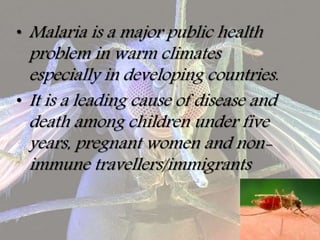
• Malaria is a major public health
problem in warm climates
especially in developing countries.
• It is a leading cause of disease and
death among children under five
years, pregnant women and non-
immune travellers/immigrants
Definition
• Malaria is defined as a mosquito-
borne infectious disease of humans
and other animals caused by
parasitic protozoans of the
genus Plasmodium transmitted via a
bite from an infected
female Anopheles mosquito.
Causes of Malaria
• Malaria is a disease caused by the
protozoan parasites of the genus
Plasmodium.
• There 4 species that commonly
infect man are as follows:
Species Major features
P. falciparum  The most important species as it is responsible for 50% of all
malaria cases worldwide and nearly all morbidity and mortality
from severe malaria
 Found in the tropics & sub-tropics
P. vivax The malaria parasite with the widest geographical distribution
 Seen in tropical and sub-tropical areas but rare in Africa
 Estimated to cause 43% of all malaria cases in the world
P. ovale  This species is relatively rarely encountered
 Primarily seen in tropical Africa, especially, the west coast, but
has been reported in South America and Asia
P. malariae  Responsible for only 7% of malaria cases
 Occurs mainly in sub-tropical climates
Newer species
• A fifth species,
Plasmodium
knowlesi causes
malaria in macaques
but can also infect
humans.
• The most dangerous
of the four is
P.falciparum
Route of transmission
• Vector transmission:-bite by infective
female anopheles mosquitoes.
• Direct transmission
blood transfusion, the parasite can live
for 14 days in blood bottles under -4*C.
The use of contaminated needles.
• Congenital Transmission
Mother to newborn(via the placenta)
The Risk Factors
• Environmental Factor
• Human (host) Factor
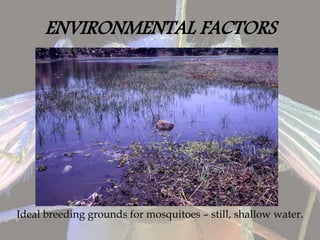
Environmental Factors
• A warm, humid climate -
temperatures between 16°C and 40°C
and abundant rainfall have anopheles
mosquitoes.
• Vegetation nearby to provide shade
for the mosquito to hide during the
day and digest the blood meal from
the night before.
ENVIRONMENTAL FACTORS
Ideal breeding grounds for mosquitoes – still, shallow water.
ENVIRONMENTAL FACTORS
A high risk area – vegetation cover and standing water during
the wet season.
Human Factors
• Poor water supply and sanitation.
• People working in the fields and in
irrigation systems, near or on lakes and
reservoirs etc.
• Migrants moving into malarial areas -
clearing land, looking for work, refugees
etc.
Human Factors
• Collecting water,
an essential fact
of life for
millions of people,
poses real risks of
being bitten.
Who is at high risk of getting
malaria?
• Most at risk are the very young, who
have not yet developed any degree of
natural immunity
• pregnant women
• people with HIV/AIDS
• international travelers from non-
endemic areas
Incubation Period
• Following the infective bite by the
Anopheles mosquito a period of time
(the "incubation period") goes by before
the first symptoms appear.
• The incubation period in most cases
varies from 7 to 30 days.
The life cycle of malaria parasite is
divided into four (4) phases which
are:
• Transmission phase
• Pre-erythrocytic phase
• Erythrocytic phase (asexual
reproduction)
• Sexual reproduction (In mosquito)
Life cycle of malaria parasite
Click on the
diagram to
explore different
areas of
the life cycle
Life cycle of malaria parasite
4. Sexual phase
Some merozoites differentiate into
male and female gametocytes, the
forms of Plasmodia infective to
mosquitoes. These are taken up by a
mosquito during another blood meal.
These fuse to form an ookinette in the
gut lumen of the mosquito. The
ookinette invades the stomach wall to
form the oocyst. This in turn
develops and releases sporozoites
which migrate to the salivary gland of
the mosquito. This mosquito then
goes on to infect another human host.
Listen and watch the
video in order to
understand the life of
malaria parasite
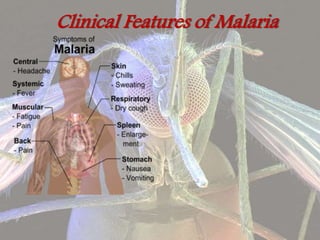
Clinical Features of Malaria
Classification of malaria
Malaria is classified into two groups:
• Uncomplicated malaria
• Complicated malaria
Uncomplicated malaria
The uncomplicated malaria is divided
into three stages:
• Cold stage (sensation of cold,
shivering)
• Hot stage (fever, headaches,
vomiting, seizure in young children)
• Sweating stage (sweats, return to
normal temperature, tiredness)
Severe malaria
• Cerebral malaria (seizures, coma)
• Severe anemia
• Coma
• Renal and respiratory failure
• Cardiovascular collapse and shock
• may lead to death
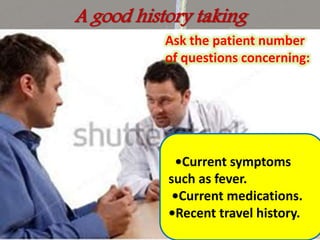
A good history taking
Ask the patient number
of questions concerning:
•Current symptoms
such as fever.
•Current medications.
•Recent travel history.
Physical examination
• Identify signs consistent with
malaria: fever, pallor, jaundice,
splenomegaly
• Exclude other possible causes of
fever (e.g. signs of viral and bacterial
infections)
Investigations
• Blood Film Examination:- Thick and
thin blood films (or “smears”) have
remained the gold standard for the
diagnosis of malaria.
• The films are stained and examined
by microscopy.
Thick blood film -
• Used for detecting malaria: a larger
volume of blood is examined
allowing detection of even low levels
of parasitaemia.
• Also used for determining parasite
density and monitoring the response
to treatment.
Thin blood film
• Gives more information about the
parasite morphology and, therefore,
is used to identify the particular
infecting species of Plasmodium.
Thick blood film
A drop of blood is spread
over a small area. When
dry, the slide is stained with
Field’s or Giemsa stains.
The red cells lyse leaving
behind the parasites.
• Used to detect
parasites, even if
parasitaemia is low
• Less useful for
speciation
Thin blood film
A small drop of blood is spread
across a microscope slide, fixed in
methanol and stained with Giemsa
stain.
The microscopist finds the area of
the film where red cells are lying
next to each other. The fine details
of the parasites can be examined
to determine the species.
• Used for speciation
• Does not detect low
parasitaemia
Rapid Diagnostic Tests (RDTS)
• It is an antigen capture kits.
• A dipstick and a finger prick blood
sample is use.
• Similar to urine pregnancy test, but
the malaria diagnostic kits are
performed from 1-2 drops of blood
• Rapid test - results are available in
10-15 minutes.
RAPID DIAGNOSTIC TESTS (RDTS)
Positive
Other methods of diagnosis of malaria that are
not routinely used in clinical practice include
the followings:
• PCR based techniques:- Detects DNA or RNA
sequences specific to Plasmodium.
• Fluorescent techniques:- Relatively low
specificity and sensitivity. Cannot identify the
parasite species.
• Serologic tests:-Based on immunofluorescence
detection of antibodies against Plasmodium
species. Useful for epidemiologic and not
diagnostic purposes.
•
Management of malaria
The management of malaria is based on the
clinical presentation.
• In severe malaria, anti malarial therapy must be
given Intravenously or Intramuscularly, oral
treatment should be substituted as early as
possible
• Doses must be calculated in on a mg/kg of body
weight.
• It is important to weigh the patient, this is
particularly important for children
The management of malaria include
the following aspect:
• Nursing management
• Chemotheraphy
• Chemophylaxis
Nursing management
• Good nursing care is vital in the management
of malaria.
• Severe cases of malaria need admission while
the uncomplicated cases of malaria will be
treated on outpatient basics.
• Take vital signs of the patient half hourly or
hourly in order monitor the progress of the
patient condition.
• Tepid sponge patient , remove clothing and on
the fan inorder to reduce the body
temperature.
• Administer prescribed antipyretic, if
temperature did not reduce after tepid
sponging.
• Maintain adequate fluid balance, to avoid
overhydration or underhydration
• Administer precribed antimalaria and make
eat before administration.
• Do not give ACT on empty stomach
Chemotherapy
• The chemotherapy depend on the
type of malaria, severity of the
condition and the type of parasite
that cause the malaria.
General recommendations for the
management of un complicated malaria are
as follows:
• Avoid starting Rx on empty stomach.,
• 1st dose given under observation.,
• Dose repeated if vomiting within 30
minutes
• Patient should report back if no
improvement after 48 hrs.
• Patient should be examined for
concomitant illness.
WHO 2010 guideline for the
treatment of uncomplicated
P. falciparum malaria.
WHO 2010 guideline for the treatment of
uncomplicated P. falciparum malaria consist of
two lines management.
• The first line management: is the use of ACT
for treatment of uncomplicated falciparum malaria .
Examples
• artemether plus lumefantrine,
• artesunate plus amodiaquine,
• artesunate plus mefloquine,
• artesunate plus sulfadoxine-pyrimethamine,
• dihydroartemisinin plus piperaquine
• The second line management is the use
of antimalaria and antibiotics e.g
• artesunate plus tetracycline or
doxycycline or clindamycin; any of
these combinations to be given for 7
days;
• quinine plus tetracycline or doxycycline
or clindamycin; any of these
combinations should be given for 7 days
First line treatment
Artemisinin-based
combination therapies (ACTs)
Artemether + Lumefantrine
• Artemether + Lumefantrine, 80 + 480mg P.O.
BID for 3 days
• Dosage forms: Tablet, 20mg +120mg
• Total number of tablets: 24 (Coartem 4 Tabs
BID for 3/7)
Artemether + Lumefantrine
Pediatric Dosage
Artesunate plus amodiaquine
• 4 mg/kg/day artesunate and 10
mg/kg/day amodiaquine once a day
for 3 days
• Available as 50 mg of artesunate and
153 mg base of amodiaquine
separately &
artesunate plus amodiaquine
Artesunate plus amodiaquine
artesunate plus mefloquine
• 4 mg/kg/day artesunate given once a day
for 3 days
• and 25 mg/kg of mefloquine either split
over 2 days as 15mg/kg and 10mg/kg or
• over 3 days as 8.3 mg/kg/day once a day
for 3 days
• Available as 50 mg of artesunate and 250
mg base of mefloquine
artesunate plus mefloquine
artesunate plus sulfadoxine-
pyrimethamine
• 4 mg/kg/day artesunate given once a day for 3
days
• and a single administration of 25/1.25 mg/kg
sulfadoxine-pyrimethamine on day 1
• Available as 50 mg of artesunate tablet; and
tablets containing 500 mg of sulfadoxine and
25 mg of pyrimethamine
Artesunate plus sulfadoxine-
pyrimethamine
Dihydroartemisinin plus
piperaquine
• 4 mg/kg/day dihydroartemisinin and
• 18 mg/kg/day piperaquine once a day for 3
days
• Available as 40 mg of dihydroartemisinin and
320 mg of piperaquine
Dihydroartemisinin plus
piperaquine
Dihydroartemisinin plus
piperaquine
Second line antimalarial treatment
• alternative ACT known to be effective in the
region.
• Artesunate +tetracycline or doxycycline or
clindamycine any of these combination to be given
for 7 days.
• Quinine +tetracycline or doxycyline or
clindamycine any of these should be given for 7
days.
• Addition of a single dose primaquine (0.75
mg/kg)to ACT treatment for uncomplicated
falciparum malaria as an antigametocytes
Treatment of Severe and complicated
P. falciparum malaria
• Quinine dihydrochloride:
• Loading dose:- 20 mg/kg in 500 ml of isotonic
saline or 5 % dextrose over 4 hours (4
ml/minute).
• Maintenance dose :-should be given 8 hours
after the loading dose at 10 mg / kg and it
should be given 8 hourly diluted in 500 ml of
isotonic saline or 5 % dextrose over 4 hours
• The parenteral treatment should be changed
to orally as soon as the patient‘s condition
improves and if there is no vomiting.
• Oral treatment should be given with
Artemether + Lumefantrine in the doses as
indicated above.
• However, if a patient has a history of intake of
Artemether + Lumefantrine before
complications developed,.
• Give Quinine tablets 10 mg salt per kg TDS to
complete 7 days treatment.
Treatment of P. vivax malaria
• P.vivax cases should be treated with
chloroquine for three days and Primaquine
for 14 days
• Chloroquine: 25 mg/kg body weight divided
over three days i.e. 10mg/kg on day 1,
10mg/kg on day 2 and 5mg/kg on day 3.
• Primaquine: 0.25 mg/kg body weight daily
for 14 days.
Treatment of mixed infections
(P.vivax + P.falciparum) cases
• All mixed infections should be treated with full
course of ACT and Primaquine 0.25 mg per kg
body weight daily for 14 days
Chemoprophylaxis
• The need for chemoprophylaxis
depends on the risk in the destination
for travel.
• There are a number of medications for
malaria prophylaxis:
• Atovaquine and Proguanil (Malarone)
• Doxycycline
• Mefloquine
• Chloroquine and hydroxychloroquine
• Primaquine
Chemoprophylaxis
• Chemoprophylaxis is for
prevention only.
• The Dosage does not apply to
Malaria treatment
• Chemoprophylaxis Schedule
 Agents are started 1-2 weeks
before travel
 Agents are continued for 4
weeks after travel
Chemoprophylaxis
• Chloroquine and
hydroxychloroquine
• Primaquine
• 1-2 weeks before travel,
weekly while in
country, and for 4
weeks afterwards
• Only used for
prophylaxis in areas
with p. vivax, and for
terminal prophylaxis
Chemoprophylaxis
• Atovaquone-Proguanil
• Doxycycline
• Mefloquine
• 1-2 days before, daily while
in country and 7 days after
• 1-2 days before, daily in
country and 4 weeks
afterwards
• 2 weeks before, weekly in
country and weekly for 4
weeks afterwards
Complication of malaria
• Splenomegaly (Enlarged spleen)
• Cerebral malaria
• Severe anaemia
• Febrile convulsion
• Thrombocytopaenia
• Splenic rupture
• Hyperparasitisation
• Nephrotic syndrome is also said to be a long-
term complication of P. malariae infection.
Malaria in pregnancy
Overview
• More than 45 million women (30
million in Africa) become pregnant
in malaria endemic areas each year.
• Every minute, about 12 Nigerian
women become pregnant (WHO)
• All are predisposed to dangers of
Malaria in Pregnancy.
• >50 million pregnant women
exposed to malaria each year.
• 11% of Maternal death is due to
Malaria (NPC/UNICEF - Nigeria)
• Pregnant women constitute the main
adult risk group for malaria.
Effects of Pregnancy on Malaria
• More common.
• Malaria is more common in pregnancy
compared to the general population probably
due to Immuno suppression and loss of
acquired immunity to malaria.
• More atypical.
• In pregnancy, malaria tends to be more
atypical in presentation probably due to the
hormonal , immunological and
haematological changes of pregnancy.
• More severe.
• Probably for the same reason, the parasitemia
tends to be 10 times higher and as a result, all
the complications of falciparum malaria are
more common in pregnancy compared to the
non-pregnant population.
• More fatal
• P. falciparum malaria in pregnancy is more
severe, the mortality is also double (13 % )
compared to the non-pregnant population
(6.5%).
• Selective treatment
• Some anti malarial are contra indicated in
pregnancy and therefore the treatment may
become difficult, particularly in cases of
severe P. falciparum malaria.
• Other problems
• Management of complications of malaria may
be difficult due to the various physiological
changes of pregnancy.
Effects Of Malaria On Pregnancy
• Abortion – placental sequestration
• Anemia
• Cerebral malaria
• Low birth weight (Prematurity, IUGR) due to
placental squestration
• Stillbirth
• Congenital infection
• Puerperal sepsis
• Maternal Mortality
Management of Malaria in
Pregnancy
Management of malaria in pregnancy involves
three aspects that are of equal importance
• Treatment of the malaria
• Management of complications
• Prevention of recurrence
Treatment Of Malaria In Pregnancy
• Depends on severity of the disease
Simple / Uncomplicated
Complicated
• Gestational age
First trimester
Second trimester
Third trimester
• Aims at bringing attack/pyrexia to an end.
How to recognizing malaria in
pregnant women
In Uncomplicated malaria, if the patient present
with the followings:
• Fever
• Shivering/chills
• Headaches
• Muscle/joint pains
• Nausea/vomiting (Can tolerate per os)
• False labor pains
• + / ++
In Complicated malaria, the patient present
with the followings:
• Signs of uncomplicated malaria, plus:
• Dizziness
• Breathlessness
• Sleepy/drowsy
• Confusion/coma
• Sometimes fits, jaundice, severe dehydration
• ++ / +++
Treatment of Simple / Uncomplicated
Malaria
• 1st trimester = Quinine ( safe and evidence-
based)
• 2nd and 3rd trimesters
1st Line = Arthemeter/Lumefantrine(Coartem)
2nd Line = Artesunate + Amodiquine
Artesunate + fansider
Treatment of Complicated Malaria
• In Complicated Malaria Parenteral Quinine is
given in all trimesters then Orals
• It is Absolutely safe!
Supportive Treatment in Management
of Malaria in Pregnancy
• Adequate calories
• Correction of electrolyte imbalance
• Blood transfusion / EBT in acute and severe
cases
• Oxygen + Diuretics in pulmonary oedema
• Anticonvulsants
• Monitoring of the fetal growth & health
• If condition is critical patient should be nurse in
ICU.
Intermittent Preventive Treatment
(IPT)
• All pregnant women should receive at least two
doses of IPT after quickening at ANC visits (WHO
recommends a schedule of four visits, three after
quickening)
• Intermittent preventive treatment (IPT) given 3 times
during pregnancy is effective for women with
HIV/AIDS
• Presently, the most effective drug for IPT is
sulfadoxine-pyrimethamine (SP) combination
Intermittent Preventive Treatment
(IPT)
• A single dose is three tablets of sulfadoxine 500 mg +
pyrimethamine 25 mg.
• (Daraprim, the ‘Sunday-Sunday tablet’ is no longer
effective)
• Healthcare provider should dispense dose and directly
observe client taking dose
Complication of malaria in pregnancy
• Anemia
• Acute pulmonary oedema:-
• Hypoglycemia:
• Immuno suppression
• Congenital malaria:
Prevention of Malaria
Early and effective treatment
• Children are at a high risk of malaria.
• They have little immunity or defense
against malaria.
• So be sure to:
• Diagnose malaria early. In malaria areas,
any child with a fever may have malaria.
• Treat children with malaria promptly.
• Use a combination of medicines, so there
is less resistance to the treatment.
Personal protection
• Preventing the mosquitoes from entering the
house – Close door / windows, especially
toilets.
• Well-constructed houses with window
screens
• Preventing the mosquitoes from hiding –
Avoid dark corners/ hanging clothes in rooms
• Mosquito Control – Avoid stagnant water,
insecticide spraying etc.
Protection from mosquito bites –
• Protective clothing,
• Mosquito repellants (containing DEET),
• Insect vaporizers (coils containing
pyrethroids),
• Insecticide treated bed nets (most effective),
• Airconditioning
Malaria Vaccine
• At the moment, there is no effective vaccine
against malaria, although scientists all over
the world are trying to develop one.
• A vaccine developed in columbia (SPF 66)
advanced to phase 3 trials in africa but failed
to show efficacy in chiildren under 1
• Another vaccine (RTS, S/AS02) with the
potential to prevent infection and ameliorate
disease is being tested by GlaxoSmithKline
and the MVI at PATH in Phase I trial in
Gambia
Malaria Vaccine
• In phase II in 2002 trials of the vaccine are
being conducted among the children in
Mozambique, which suffers from year-round
malaria transmission offering a better
opportunity to evaluate vaccine performance
• This vaccine has been safely tested in adult
volunteeers in Belgium, Gambia, kenya and
US
Anti-larval measure
• Using the anti larval measures such as oiling
the collection of standing water or dusting
them with paris green effectively controlled
malaria
• Some moderm larvicides such as temephos
which confer long effect with low toxicity are
more widely used
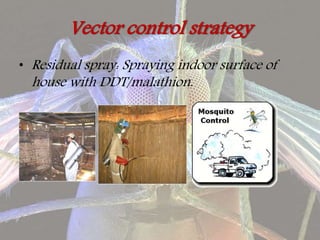
Vector control strategy
• Residual spray: Spraying indoor surface of
house with DDT/malathion.
Global policy for diagnosis and
treatment of malaria
• The Govt of every country affected by malaria
has a National control policy covering
prevention and case management
The Objectives are
• Reduce morbidity and mortality, including
malarial related anemia
• Prevent the progression of uncomplicated
malaria into severe disease
• Reduce the impact of malarial infection on the
fetus during pregnancy. E.t.c
Roll Back Malaria
• Malaria control added a initiative , that was
launched by WHO,UNICEF,UNDP and world
bank in 1998 .
• Aim:-to reduce the Deaths and incidence To
75% by 2015.
World Malaria Day
• World Malaria Day (previously
Africa Malaria Day) is now be
commemorated every year on 25 April.
In conclusion
• Malaria is a serious disease that kills up to 1 million
people a year.
• But malaria can be prevented.
• And malaria can be treated.
• We need to work together to prevent malaria and
to encourage prompt and effective treatment.
Reference
• Adedapo .A (2014), Diagnosis and
Management of Malaria retrieved on
28/04/2014 available on
http://www.slideshare.com
• Delage. D.E (2013), Malaria Prophylaxis –
Travel Medicine retrieved on
29/04/2014 available on
http://www.aangfs.com
Reference
• Jamil.K.F(2011), Malaria recent management
retrieved on 28/04/2014 available on
http://www.slideshare.com
• Mohanty .S(2014), Malaria retrieved on
28/04/2014 available on
http://www.slideshare.com
Reference
• Scott M (2014), Malaria retrieved on
25/04/2014 retrieved from
http://www.fpnotebook.com
• Sgarabotto. D (2014), How to manage
Malaria in a Out-patient retrieved on
28/04/2014 retrieved from
www.slideshare.net
Malaria

Malaria

  • 1.
  • 2.
    Introduction • The namemalaria comes from the Italian mal (bad) and aria (air) – it was originally thought the disease was spread by the damp air from swamps. • The link between the disease and the Anopheles Mosquito was first made by Ronald Ross, a Scottish army doctor, working in India
  • 3.
    • Malaria isa major public health problem in warm climates especially in developing countries. • It is a leading cause of disease and death among children under five years, pregnant women and non- immune travellers/immigrants
  • 4.
    Definition • Malaria isdefined as a mosquito- borne infectious disease of humans and other animals caused by parasitic protozoans of the genus Plasmodium transmitted via a bite from an infected female Anopheles mosquito.
  • 5.
    Causes of Malaria •Malaria is a disease caused by the protozoan parasites of the genus Plasmodium. • There 4 species that commonly infect man are as follows:
  • 6.
    Species Major features P.falciparum  The most important species as it is responsible for 50% of all malaria cases worldwide and nearly all morbidity and mortality from severe malaria  Found in the tropics & sub-tropics P. vivax The malaria parasite with the widest geographical distribution  Seen in tropical and sub-tropical areas but rare in Africa  Estimated to cause 43% of all malaria cases in the world P. ovale  This species is relatively rarely encountered  Primarily seen in tropical Africa, especially, the west coast, but has been reported in South America and Asia P. malariae  Responsible for only 7% of malaria cases  Occurs mainly in sub-tropical climates
  • 7.
    Newer species • Afifth species, Plasmodium knowlesi causes malaria in macaques but can also infect humans. • The most dangerous of the four is P.falciparum
  • 8.
    Route of transmission •Vector transmission:-bite by infective female anopheles mosquitoes. • Direct transmission blood transfusion, the parasite can live for 14 days in blood bottles under -4*C. The use of contaminated needles. • Congenital Transmission Mother to newborn(via the placenta)
  • 9.
    The Risk Factors •Environmental Factor • Human (host) Factor
  • 10.
    Environmental Factors • Awarm, humid climate - temperatures between 16°C and 40°C and abundant rainfall have anopheles mosquitoes. • Vegetation nearby to provide shade for the mosquito to hide during the day and digest the blood meal from the night before.
  • 11.
    ENVIRONMENTAL FACTORS Ideal breedinggrounds for mosquitoes – still, shallow water.
  • 12.
    ENVIRONMENTAL FACTORS A highrisk area – vegetation cover and standing water during the wet season.
  • 13.
    Human Factors • Poorwater supply and sanitation. • People working in the fields and in irrigation systems, near or on lakes and reservoirs etc. • Migrants moving into malarial areas - clearing land, looking for work, refugees etc.
  • 14.
    Human Factors • Collectingwater, an essential fact of life for millions of people, poses real risks of being bitten.
  • 15.
    Who is athigh risk of getting malaria? • Most at risk are the very young, who have not yet developed any degree of natural immunity • pregnant women • people with HIV/AIDS • international travelers from non- endemic areas
  • 16.
    Incubation Period • Followingthe infective bite by the Anopheles mosquito a period of time (the "incubation period") goes by before the first symptoms appear. • The incubation period in most cases varies from 7 to 30 days.
  • 18.
    The life cycleof malaria parasite is divided into four (4) phases which are: • Transmission phase • Pre-erythrocytic phase • Erythrocytic phase (asexual reproduction) • Sexual reproduction (In mosquito)
  • 19.
    Life cycle ofmalaria parasite Click on the diagram to explore different areas of the life cycle
  • 20.
    Life cycle ofmalaria parasite
  • 21.
    Life cycle ofmalaria parasite
  • 22.
    Life cycle ofmalaria parasite
  • 23.
    Life cycle ofmalaria parasite 4. Sexual phase Some merozoites differentiate into male and female gametocytes, the forms of Plasmodia infective to mosquitoes. These are taken up by a mosquito during another blood meal. These fuse to form an ookinette in the gut lumen of the mosquito. The ookinette invades the stomach wall to form the oocyst. This in turn develops and releases sporozoites which migrate to the salivary gland of the mosquito. This mosquito then goes on to infect another human host.
  • 24.
    Listen and watchthe video in order to understand the life of malaria parasite
  • 26.
  • 27.
    Classification of malaria Malariais classified into two groups: • Uncomplicated malaria • Complicated malaria
  • 28.
    Uncomplicated malaria The uncomplicatedmalaria is divided into three stages: • Cold stage (sensation of cold, shivering) • Hot stage (fever, headaches, vomiting, seizure in young children) • Sweating stage (sweats, return to normal temperature, tiredness)
  • 29.
    Severe malaria • Cerebralmalaria (seizures, coma) • Severe anemia • Coma • Renal and respiratory failure • Cardiovascular collapse and shock • may lead to death
  • 31.
    A good historytaking Ask the patient number of questions concerning: •Current symptoms such as fever. •Current medications. •Recent travel history.
  • 32.
    Physical examination • Identifysigns consistent with malaria: fever, pallor, jaundice, splenomegaly • Exclude other possible causes of fever (e.g. signs of viral and bacterial infections)
  • 33.
    Investigations • Blood FilmExamination:- Thick and thin blood films (or “smears”) have remained the gold standard for the diagnosis of malaria. • The films are stained and examined by microscopy.
  • 34.
    Thick blood film- • Used for detecting malaria: a larger volume of blood is examined allowing detection of even low levels of parasitaemia. • Also used for determining parasite density and monitoring the response to treatment.
  • 35.
    Thin blood film •Gives more information about the parasite morphology and, therefore, is used to identify the particular infecting species of Plasmodium.
  • 36.
    Thick blood film Adrop of blood is spread over a small area. When dry, the slide is stained with Field’s or Giemsa stains. The red cells lyse leaving behind the parasites. • Used to detect parasites, even if parasitaemia is low • Less useful for speciation
  • 37.
    Thin blood film Asmall drop of blood is spread across a microscope slide, fixed in methanol and stained with Giemsa stain. The microscopist finds the area of the film where red cells are lying next to each other. The fine details of the parasites can be examined to determine the species. • Used for speciation • Does not detect low parasitaemia
  • 38.
    Rapid Diagnostic Tests(RDTS) • It is an antigen capture kits. • A dipstick and a finger prick blood sample is use. • Similar to urine pregnancy test, but the malaria diagnostic kits are performed from 1-2 drops of blood • Rapid test - results are available in 10-15 minutes.
  • 39.
    RAPID DIAGNOSTIC TESTS(RDTS) Positive
  • 40.
    Other methods ofdiagnosis of malaria that are not routinely used in clinical practice include the followings: • PCR based techniques:- Detects DNA or RNA sequences specific to Plasmodium. • Fluorescent techniques:- Relatively low specificity and sensitivity. Cannot identify the parasite species. • Serologic tests:-Based on immunofluorescence detection of antibodies against Plasmodium species. Useful for epidemiologic and not diagnostic purposes. •
  • 41.
    Management of malaria Themanagement of malaria is based on the clinical presentation. • In severe malaria, anti malarial therapy must be given Intravenously or Intramuscularly, oral treatment should be substituted as early as possible • Doses must be calculated in on a mg/kg of body weight. • It is important to weigh the patient, this is particularly important for children
  • 42.
    The management ofmalaria include the following aspect: • Nursing management • Chemotheraphy • Chemophylaxis
  • 43.
    Nursing management • Goodnursing care is vital in the management of malaria. • Severe cases of malaria need admission while the uncomplicated cases of malaria will be treated on outpatient basics. • Take vital signs of the patient half hourly or hourly in order monitor the progress of the patient condition. • Tepid sponge patient , remove clothing and on the fan inorder to reduce the body temperature.
  • 44.
    • Administer prescribedantipyretic, if temperature did not reduce after tepid sponging. • Maintain adequate fluid balance, to avoid overhydration or underhydration • Administer precribed antimalaria and make eat before administration. • Do not give ACT on empty stomach
  • 45.
    Chemotherapy • The chemotherapydepend on the type of malaria, severity of the condition and the type of parasite that cause the malaria.
  • 46.
    General recommendations forthe management of un complicated malaria are as follows: • Avoid starting Rx on empty stomach., • 1st dose given under observation., • Dose repeated if vomiting within 30 minutes • Patient should report back if no improvement after 48 hrs. • Patient should be examined for concomitant illness.
  • 47.
    WHO 2010 guidelinefor the treatment of uncomplicated P. falciparum malaria.
  • 48.
    WHO 2010 guidelinefor the treatment of uncomplicated P. falciparum malaria consist of two lines management. • The first line management: is the use of ACT for treatment of uncomplicated falciparum malaria . Examples • artemether plus lumefantrine, • artesunate plus amodiaquine, • artesunate plus mefloquine, • artesunate plus sulfadoxine-pyrimethamine, • dihydroartemisinin plus piperaquine
  • 49.
    • The secondline management is the use of antimalaria and antibiotics e.g • artesunate plus tetracycline or doxycycline or clindamycin; any of these combinations to be given for 7 days; • quinine plus tetracycline or doxycycline or clindamycin; any of these combinations should be given for 7 days
  • 50.
  • 51.
    Artemether + Lumefantrine •Artemether + Lumefantrine, 80 + 480mg P.O. BID for 3 days • Dosage forms: Tablet, 20mg +120mg • Total number of tablets: 24 (Coartem 4 Tabs BID for 3/7)
  • 52.
  • 53.
  • 54.
  • 55.
    Artesunate plus amodiaquine •4 mg/kg/day artesunate and 10 mg/kg/day amodiaquine once a day for 3 days • Available as 50 mg of artesunate and 153 mg base of amodiaquine separately &
  • 56.
  • 57.
  • 58.
    artesunate plus mefloquine •4 mg/kg/day artesunate given once a day for 3 days • and 25 mg/kg of mefloquine either split over 2 days as 15mg/kg and 10mg/kg or • over 3 days as 8.3 mg/kg/day once a day for 3 days • Available as 50 mg of artesunate and 250 mg base of mefloquine
  • 59.
  • 60.
    artesunate plus sulfadoxine- pyrimethamine •4 mg/kg/day artesunate given once a day for 3 days • and a single administration of 25/1.25 mg/kg sulfadoxine-pyrimethamine on day 1 • Available as 50 mg of artesunate tablet; and tablets containing 500 mg of sulfadoxine and 25 mg of pyrimethamine
  • 61.
  • 62.
    Dihydroartemisinin plus piperaquine • 4mg/kg/day dihydroartemisinin and • 18 mg/kg/day piperaquine once a day for 3 days • Available as 40 mg of dihydroartemisinin and 320 mg of piperaquine
  • 63.
  • 64.
  • 65.
    Second line antimalarialtreatment • alternative ACT known to be effective in the region. • Artesunate +tetracycline or doxycycline or clindamycine any of these combination to be given for 7 days. • Quinine +tetracycline or doxycyline or clindamycine any of these should be given for 7 days. • Addition of a single dose primaquine (0.75 mg/kg)to ACT treatment for uncomplicated falciparum malaria as an antigametocytes
  • 66.
    Treatment of Severeand complicated P. falciparum malaria • Quinine dihydrochloride: • Loading dose:- 20 mg/kg in 500 ml of isotonic saline or 5 % dextrose over 4 hours (4 ml/minute). • Maintenance dose :-should be given 8 hours after the loading dose at 10 mg / kg and it should be given 8 hourly diluted in 500 ml of isotonic saline or 5 % dextrose over 4 hours
  • 67.
    • The parenteraltreatment should be changed to orally as soon as the patient‘s condition improves and if there is no vomiting. • Oral treatment should be given with Artemether + Lumefantrine in the doses as indicated above. • However, if a patient has a history of intake of Artemether + Lumefantrine before complications developed,. • Give Quinine tablets 10 mg salt per kg TDS to complete 7 days treatment.
  • 68.
    Treatment of P.vivax malaria • P.vivax cases should be treated with chloroquine for three days and Primaquine for 14 days • Chloroquine: 25 mg/kg body weight divided over three days i.e. 10mg/kg on day 1, 10mg/kg on day 2 and 5mg/kg on day 3. • Primaquine: 0.25 mg/kg body weight daily for 14 days.
  • 69.
    Treatment of mixedinfections (P.vivax + P.falciparum) cases • All mixed infections should be treated with full course of ACT and Primaquine 0.25 mg per kg body weight daily for 14 days
  • 70.
    Chemoprophylaxis • The needfor chemoprophylaxis depends on the risk in the destination for travel. • There are a number of medications for malaria prophylaxis: • Atovaquine and Proguanil (Malarone) • Doxycycline • Mefloquine • Chloroquine and hydroxychloroquine • Primaquine
  • 71.
    Chemoprophylaxis • Chemoprophylaxis isfor prevention only. • The Dosage does not apply to Malaria treatment • Chemoprophylaxis Schedule  Agents are started 1-2 weeks before travel  Agents are continued for 4 weeks after travel
  • 72.
    Chemoprophylaxis • Chloroquine and hydroxychloroquine •Primaquine • 1-2 weeks before travel, weekly while in country, and for 4 weeks afterwards • Only used for prophylaxis in areas with p. vivax, and for terminal prophylaxis
  • 73.
    Chemoprophylaxis • Atovaquone-Proguanil • Doxycycline •Mefloquine • 1-2 days before, daily while in country and 7 days after • 1-2 days before, daily in country and 4 weeks afterwards • 2 weeks before, weekly in country and weekly for 4 weeks afterwards
  • 74.
    Complication of malaria •Splenomegaly (Enlarged spleen) • Cerebral malaria • Severe anaemia • Febrile convulsion • Thrombocytopaenia • Splenic rupture • Hyperparasitisation • Nephrotic syndrome is also said to be a long- term complication of P. malariae infection.
  • 75.
  • 76.
    Overview • More than45 million women (30 million in Africa) become pregnant in malaria endemic areas each year. • Every minute, about 12 Nigerian women become pregnant (WHO) • All are predisposed to dangers of Malaria in Pregnancy.
  • 77.
    • >50 millionpregnant women exposed to malaria each year. • 11% of Maternal death is due to Malaria (NPC/UNICEF - Nigeria) • Pregnant women constitute the main adult risk group for malaria.
  • 78.
    Effects of Pregnancyon Malaria • More common. • Malaria is more common in pregnancy compared to the general population probably due to Immuno suppression and loss of acquired immunity to malaria. • More atypical. • In pregnancy, malaria tends to be more atypical in presentation probably due to the hormonal , immunological and haematological changes of pregnancy.
  • 79.
    • More severe. •Probably for the same reason, the parasitemia tends to be 10 times higher and as a result, all the complications of falciparum malaria are more common in pregnancy compared to the non-pregnant population. • More fatal • P. falciparum malaria in pregnancy is more severe, the mortality is also double (13 % ) compared to the non-pregnant population (6.5%).
  • 80.
    • Selective treatment •Some anti malarial are contra indicated in pregnancy and therefore the treatment may become difficult, particularly in cases of severe P. falciparum malaria. • Other problems • Management of complications of malaria may be difficult due to the various physiological changes of pregnancy.
  • 81.
    Effects Of MalariaOn Pregnancy • Abortion – placental sequestration • Anemia • Cerebral malaria • Low birth weight (Prematurity, IUGR) due to placental squestration • Stillbirth • Congenital infection • Puerperal sepsis • Maternal Mortality
  • 82.
    Management of Malariain Pregnancy Management of malaria in pregnancy involves three aspects that are of equal importance • Treatment of the malaria • Management of complications • Prevention of recurrence
  • 83.
    Treatment Of MalariaIn Pregnancy • Depends on severity of the disease Simple / Uncomplicated Complicated • Gestational age First trimester Second trimester Third trimester • Aims at bringing attack/pyrexia to an end.
  • 84.
    How to recognizingmalaria in pregnant women In Uncomplicated malaria, if the patient present with the followings: • Fever • Shivering/chills • Headaches • Muscle/joint pains • Nausea/vomiting (Can tolerate per os) • False labor pains • + / ++
  • 85.
    In Complicated malaria,the patient present with the followings: • Signs of uncomplicated malaria, plus: • Dizziness • Breathlessness • Sleepy/drowsy • Confusion/coma • Sometimes fits, jaundice, severe dehydration • ++ / +++
  • 86.
    Treatment of Simple/ Uncomplicated Malaria • 1st trimester = Quinine ( safe and evidence- based) • 2nd and 3rd trimesters 1st Line = Arthemeter/Lumefantrine(Coartem) 2nd Line = Artesunate + Amodiquine Artesunate + fansider
  • 87.
    Treatment of ComplicatedMalaria • In Complicated Malaria Parenteral Quinine is given in all trimesters then Orals • It is Absolutely safe!
  • 88.
    Supportive Treatment inManagement of Malaria in Pregnancy • Adequate calories • Correction of electrolyte imbalance • Blood transfusion / EBT in acute and severe cases • Oxygen + Diuretics in pulmonary oedema • Anticonvulsants • Monitoring of the fetal growth & health • If condition is critical patient should be nurse in ICU.
  • 89.
    Intermittent Preventive Treatment (IPT) •All pregnant women should receive at least two doses of IPT after quickening at ANC visits (WHO recommends a schedule of four visits, three after quickening) • Intermittent preventive treatment (IPT) given 3 times during pregnancy is effective for women with HIV/AIDS • Presently, the most effective drug for IPT is sulfadoxine-pyrimethamine (SP) combination
  • 90.
    Intermittent Preventive Treatment (IPT) •A single dose is three tablets of sulfadoxine 500 mg + pyrimethamine 25 mg. • (Daraprim, the ‘Sunday-Sunday tablet’ is no longer effective) • Healthcare provider should dispense dose and directly observe client taking dose
  • 91.
    Complication of malariain pregnancy • Anemia • Acute pulmonary oedema:- • Hypoglycemia: • Immuno suppression • Congenital malaria:
  • 92.
  • 93.
    Early and effectivetreatment • Children are at a high risk of malaria. • They have little immunity or defense against malaria. • So be sure to: • Diagnose malaria early. In malaria areas, any child with a fever may have malaria. • Treat children with malaria promptly. • Use a combination of medicines, so there is less resistance to the treatment.
  • 94.
    Personal protection • Preventingthe mosquitoes from entering the house – Close door / windows, especially toilets. • Well-constructed houses with window screens • Preventing the mosquitoes from hiding – Avoid dark corners/ hanging clothes in rooms • Mosquito Control – Avoid stagnant water, insecticide spraying etc.
  • 95.
    Protection from mosquitobites – • Protective clothing, • Mosquito repellants (containing DEET), • Insect vaporizers (coils containing pyrethroids), • Insecticide treated bed nets (most effective), • Airconditioning
  • 96.
    Malaria Vaccine • Atthe moment, there is no effective vaccine against malaria, although scientists all over the world are trying to develop one. • A vaccine developed in columbia (SPF 66) advanced to phase 3 trials in africa but failed to show efficacy in chiildren under 1 • Another vaccine (RTS, S/AS02) with the potential to prevent infection and ameliorate disease is being tested by GlaxoSmithKline and the MVI at PATH in Phase I trial in Gambia
  • 97.
    Malaria Vaccine • Inphase II in 2002 trials of the vaccine are being conducted among the children in Mozambique, which suffers from year-round malaria transmission offering a better opportunity to evaluate vaccine performance • This vaccine has been safely tested in adult volunteeers in Belgium, Gambia, kenya and US
  • 98.
    Anti-larval measure • Usingthe anti larval measures such as oiling the collection of standing water or dusting them with paris green effectively controlled malaria • Some moderm larvicides such as temephos which confer long effect with low toxicity are more widely used
  • 99.
    Vector control strategy •Residual spray: Spraying indoor surface of house with DDT/malathion.
  • 100.
    Global policy fordiagnosis and treatment of malaria • The Govt of every country affected by malaria has a National control policy covering prevention and case management The Objectives are • Reduce morbidity and mortality, including malarial related anemia • Prevent the progression of uncomplicated malaria into severe disease • Reduce the impact of malarial infection on the fetus during pregnancy. E.t.c
  • 101.
    Roll Back Malaria •Malaria control added a initiative , that was launched by WHO,UNICEF,UNDP and world bank in 1998 . • Aim:-to reduce the Deaths and incidence To 75% by 2015.
  • 102.
    World Malaria Day •World Malaria Day (previously Africa Malaria Day) is now be commemorated every year on 25 April.
  • 103.
    In conclusion • Malariais a serious disease that kills up to 1 million people a year. • But malaria can be prevented. • And malaria can be treated. • We need to work together to prevent malaria and to encourage prompt and effective treatment.
  • 104.
    Reference • Adedapo .A(2014), Diagnosis and Management of Malaria retrieved on 28/04/2014 available on http://www.slideshare.com • Delage. D.E (2013), Malaria Prophylaxis – Travel Medicine retrieved on 29/04/2014 available on http://www.aangfs.com
  • 105.
    Reference • Jamil.K.F(2011), Malariarecent management retrieved on 28/04/2014 available on http://www.slideshare.com • Mohanty .S(2014), Malaria retrieved on 28/04/2014 available on http://www.slideshare.com
  • 106.
    Reference • Scott M(2014), Malaria retrieved on 25/04/2014 retrieved from http://www.fpnotebook.com • Sgarabotto. D (2014), How to manage Malaria in a Out-patient retrieved on 28/04/2014 retrieved from www.slideshare.net