MALABSORPTION
Definition:
 Defective absorption of fats, fat- and
water-soluble vitamins, proteins,
carbohydrates, electrolytes and
minerals and water
Characterize by:
 weight loss,
 anorexia,
 abdominal distention,
 borborygmi,
 muscle wasting
 steatorrhea
Types of diarrhea
1. Secretory diarrhea is characterized by
isotonic stool and persists during fasting.
2. Osmotic diarrhea, e.g in lactase
deficiency, due to osmotic forces exerted
by unabsorbed luminal solutes.
3. Malabsorptive diarrhea caused by
inadequate nutrient absorption is
associated with steatorrhea.
4. Exudative diarrhea is due to
inflammatory disease and characterized
by purulent, bloody stools that continue
during fasting.
Malabsorption results from disturbance
in
 (1) Intraluminal digestion, in which proteins,
carbohydrates, and fats are broken down into
absorbable forms.
 (2) Terminal digestion, which involves the
hydrolysis of carbohydrates and peptides by
disaccharidases and peptidases, in the brush
border of the small intestinal mucosa.
 (3) Transepithelial transport, in which nutrients,
fluid, and electrolytes are transported across
and processed within the small intestinal
epithelium.
 (4) Lymphatic transport of absorbed lipids.
Cystic Fibrosis
 Defects in intestinal and pancreatic ductal
chloride ion secretion.
 Leads to interference with bicarbonate, sodium
& water secretion resulting in defective luminal
hydration.
 Meconium ileus, which is present in up to 10%
of newborns with cystic fibrosis.
 Intraductal concretions Obstruction,
lowgrade chronic autodigestion of the pancreas
exocrine pancreatic insufficiency .
Celiac Disease
 celiac disease is often associated with
anemia (due to iron deficiency and B12
and folate deficiency), diarrhea, bloating,
and fatigue.
 silent celiac disease:
 positive serology and villous atrophy
without symptoms.
 latent celiac disease:
 positive serology is not accompanied by
villous atrophy.
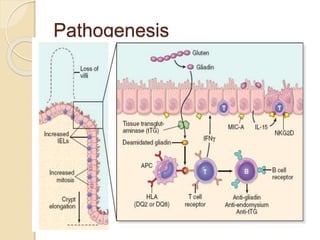
Pathogenesis
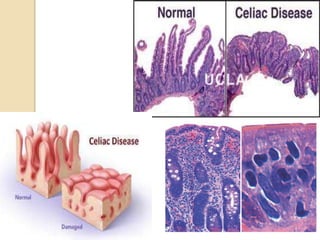
Microscopy
 affecting the proximal more than the distal small
intestine?
 The histopathologic picture is characterized by
 increased numbers of intraepithelial CD8+ T
lymphocytes, with intraepithelian lymphocytosis,
crypt hyperplasia, and villous atrophy.
 increased numbers of plasma cells, mast cells,
and
eosinophils, especially within the upper part of
the lamina propria.
 increase in the number of intraepithelial
lymphocytes particularly within the villus, is a
marker of mild forms of celiac disease.
Environmental (Tropical)
Enteropathy
 syndrome of stunted growth and
impaired intestinal function that is
common in developing countries.
 Many pathogens are endemic in these
communities, but no single infectious
agent has been linked to these diarrheal
episodes.
 histologic features are more similar to
those of severe celiac disease.
 a cycle of mucosal injury, malnutrition,
infection, and inflammation.
Lactase (Disaccharidase)
Deficiency
 lactase, are located in the apical brush
border membrane of the villous
absorptive epithelial cells.
 the defect is biochemical, biopsies are
generally unremarkable.
types:
 Congenital lactase deficiency is an
autosomal recessive disorder caused by a
mutation in the gene encoding lactase.
 explosive diarrhea with watery, frothy stools
and abdominal distention after milk ingestion.
 Symptoms abate when exposure to milk and
milk products is terminated,
 • Acquired lactase deficiency is caused by
downregulation of lactase gene expression.
 Onset of acquired lactase deficiency is
sometimes associated with enteric viral or
bacterial infections
Abetalipoproteinemia
 autosomal recessive disease characterized by an inability
to secrete triglyceride-rich lipoproteins.
 An example of a transepithelial transport defect .
 Mutation in the microsomal triglyceride transfer protein
renders enterocytes unable to export lipoprotein and free
fatty acids.
 As a result, monoglycerides and triglycerides accumulate
within the epithelial cells.
 Lipid vacuoles in small intestinal epithelial cells
particularly after a fatty meal.
 Abetalipoproteinemia manifests in infancy, and the clinical
picture is dominated by failure to thrive, diarrhea, and
steatorrhea.
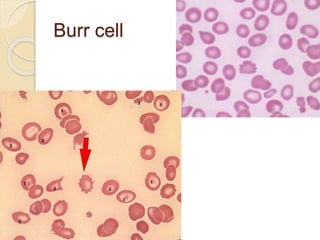
 leads to deficiencies of fat-soluble vitamins, and lipid
defects in
plasma membranes acanthocytic red cell (spur cells) in
peripheral blood smears.
Burr cell
Irritable Bowel Syndrome
 Chronic and relapsing abdominal pain, bloating,
and changes in bowel habits including diarrhea
and constipation.
 The pathogenesis is poorly defined but involves
psychologic stressors, diet, and abnormal
gastrointestinal motility.
 No gross or microscopic abnormalities are found .
 between 20 and 40 years of age, more in female.
 Diagnosis by exclusion.
 The prognosis for IBS is most closely related to
symptom duration, with longer duration correlating
with reduced likelihood of improvement.
Microscopic Colitis
 Microscopic colitis encompasses two
entities, collagenous colitis and
lymphocytic colitis.
 Both of these idiopathic diseases
manifest with chronic, non bloody, watery
diarrhea without weight loss. Findings on
radiologic and endoscopic studies
typically are normal.
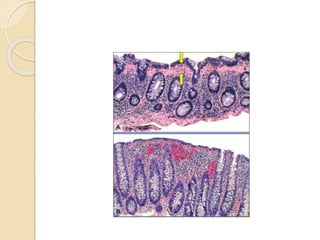
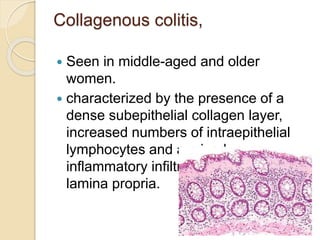
Collagenous colitis,
 Seen in middle-aged and older
women.
 characterized by the presence of a
dense subepithelial collagen layer,
increased numbers of intraepithelial
lymphocytes and a mixed
inflammatory infiltrate within the
lamina propria.
Lymphocytic colitis
 Histologically similar, but the
subepithelial collagen layer is of normal
thickness and the increase in
intraepithelial lymphocytes.
 Lymphocytic colitis is associated with
celiac and autoimmune diseases,
including thyroiditis, arthritis, and
autoimmune or lymphocytic gastritis.
Graft-Versus-Host Disease
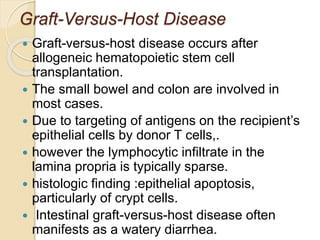
 Graft-versus-host disease occurs after
allogeneic hematopoietic stem cell
transplantation.
 The small bowel and colon are involved in
most cases.
 Due to targeting of antigens on the recipient’s
epithelial cells by donor T cells,.
 however the lymphocytic infiltrate in the
lamina propria is typically sparse.
 histologic finding :epithelial apoptosis,
particularly of crypt cells.
 Intestinal graft-versus-host disease often
manifests as a watery diarrhea.
Whipple disease
 Rare systemic infection.
 involve any organ of the body but principally
affects the intestine, CNS, and joints.
 Cause by a gram-positive, Tropheryma
whippelii.
 more in males in the fourth to fifth decades
of life.
 causes a malabsorptive syndrome
occasionally accompanied by
lymphadenopathy, hyperpigmentation,
polyarthritis, and central nervous system
complaints.
 Response to antibiotic therapy is usually
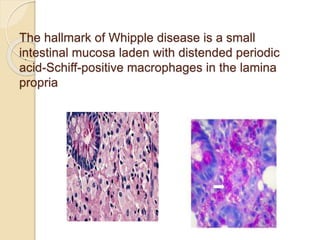
The hallmark of Whipple disease is a small
intestinal mucosa laden with distended periodic
acid-Schiff-positive macrophages in the lamina
propria
.
Malabsorption

Malabsorption

  • 1.
  • 2.
    Definition:  Defective absorptionof fats, fat- and water-soluble vitamins, proteins, carbohydrates, electrolytes and minerals and water
  • 3.
    Characterize by:  weightloss,  anorexia,  abdominal distention,  borborygmi,  muscle wasting  steatorrhea
  • 4.
    Types of diarrhea 1.Secretory diarrhea is characterized by isotonic stool and persists during fasting. 2. Osmotic diarrhea, e.g in lactase deficiency, due to osmotic forces exerted by unabsorbed luminal solutes. 3. Malabsorptive diarrhea caused by inadequate nutrient absorption is associated with steatorrhea. 4. Exudative diarrhea is due to inflammatory disease and characterized by purulent, bloody stools that continue during fasting.
  • 5.
    Malabsorption results fromdisturbance in  (1) Intraluminal digestion, in which proteins, carbohydrates, and fats are broken down into absorbable forms.  (2) Terminal digestion, which involves the hydrolysis of carbohydrates and peptides by disaccharidases and peptidases, in the brush border of the small intestinal mucosa.  (3) Transepithelial transport, in which nutrients, fluid, and electrolytes are transported across and processed within the small intestinal epithelium.  (4) Lymphatic transport of absorbed lipids.
  • 6.
    Cystic Fibrosis  Defectsin intestinal and pancreatic ductal chloride ion secretion.  Leads to interference with bicarbonate, sodium & water secretion resulting in defective luminal hydration.  Meconium ileus, which is present in up to 10% of newborns with cystic fibrosis.  Intraductal concretions Obstruction, lowgrade chronic autodigestion of the pancreas exocrine pancreatic insufficiency .
  • 7.
    Celiac Disease  celiacdisease is often associated with anemia (due to iron deficiency and B12 and folate deficiency), diarrhea, bloating, and fatigue.  silent celiac disease:  positive serology and villous atrophy without symptoms.  latent celiac disease:  positive serology is not accompanied by villous atrophy.
  • 8.
  • 9.
    Microscopy  affecting theproximal more than the distal small intestine?  The histopathologic picture is characterized by  increased numbers of intraepithelial CD8+ T lymphocytes, with intraepithelian lymphocytosis, crypt hyperplasia, and villous atrophy.  increased numbers of plasma cells, mast cells, and eosinophils, especially within the upper part of the lamina propria.  increase in the number of intraepithelial lymphocytes particularly within the villus, is a marker of mild forms of celiac disease.
  • 11.
    Environmental (Tropical) Enteropathy  syndromeof stunted growth and impaired intestinal function that is common in developing countries.  Many pathogens are endemic in these communities, but no single infectious agent has been linked to these diarrheal episodes.  histologic features are more similar to those of severe celiac disease.  a cycle of mucosal injury, malnutrition, infection, and inflammation.
  • 12.
    Lactase (Disaccharidase) Deficiency  lactase,are located in the apical brush border membrane of the villous absorptive epithelial cells.  the defect is biochemical, biopsies are generally unremarkable.
  • 13.
    types:  Congenital lactasedeficiency is an autosomal recessive disorder caused by a mutation in the gene encoding lactase.  explosive diarrhea with watery, frothy stools and abdominal distention after milk ingestion.  Symptoms abate when exposure to milk and milk products is terminated,  • Acquired lactase deficiency is caused by downregulation of lactase gene expression.  Onset of acquired lactase deficiency is sometimes associated with enteric viral or bacterial infections
  • 14.
    Abetalipoproteinemia  autosomal recessivedisease characterized by an inability to secrete triglyceride-rich lipoproteins.  An example of a transepithelial transport defect .  Mutation in the microsomal triglyceride transfer protein renders enterocytes unable to export lipoprotein and free fatty acids.  As a result, monoglycerides and triglycerides accumulate within the epithelial cells.  Lipid vacuoles in small intestinal epithelial cells particularly after a fatty meal.  Abetalipoproteinemia manifests in infancy, and the clinical picture is dominated by failure to thrive, diarrhea, and steatorrhea.  leads to deficiencies of fat-soluble vitamins, and lipid defects in plasma membranes acanthocytic red cell (spur cells) in peripheral blood smears.
  • 15.
  • 16.
    Irritable Bowel Syndrome Chronic and relapsing abdominal pain, bloating, and changes in bowel habits including diarrhea and constipation.  The pathogenesis is poorly defined but involves psychologic stressors, diet, and abnormal gastrointestinal motility.  No gross or microscopic abnormalities are found .  between 20 and 40 years of age, more in female.  Diagnosis by exclusion.  The prognosis for IBS is most closely related to symptom duration, with longer duration correlating with reduced likelihood of improvement.
  • 17.
    Microscopic Colitis  Microscopiccolitis encompasses two entities, collagenous colitis and lymphocytic colitis.  Both of these idiopathic diseases manifest with chronic, non bloody, watery diarrhea without weight loss. Findings on radiologic and endoscopic studies typically are normal.
  • 18.
    Collagenous colitis,  Seenin middle-aged and older women.  characterized by the presence of a dense subepithelial collagen layer, increased numbers of intraepithelial lymphocytes and a mixed inflammatory infiltrate within the lamina propria.
  • 19.
    Lymphocytic colitis  Histologicallysimilar, but the subepithelial collagen layer is of normal thickness and the increase in intraepithelial lymphocytes.  Lymphocytic colitis is associated with celiac and autoimmune diseases, including thyroiditis, arthritis, and autoimmune or lymphocytic gastritis.
  • 21.
    Graft-Versus-Host Disease  Graft-versus-hostdisease occurs after allogeneic hematopoietic stem cell transplantation.  The small bowel and colon are involved in most cases.  Due to targeting of antigens on the recipient’s epithelial cells by donor T cells,.  however the lymphocytic infiltrate in the lamina propria is typically sparse.  histologic finding :epithelial apoptosis, particularly of crypt cells.  Intestinal graft-versus-host disease often manifests as a watery diarrhea.
  • 22.
    Whipple disease  Raresystemic infection.  involve any organ of the body but principally affects the intestine, CNS, and joints.  Cause by a gram-positive, Tropheryma whippelii.  more in males in the fourth to fifth decades of life.  causes a malabsorptive syndrome occasionally accompanied by lymphadenopathy, hyperpigmentation, polyarthritis, and central nervous system complaints.  Response to antibiotic therapy is usually
  • 23.
    The hallmark ofWhipple disease is a small intestinal mucosa laden with distended periodic acid-Schiff-positive macrophages in the lamina propria .