Making it real:
information literacy &
student engagement
    28th August 2008
     NUI Maynooth


          Siobhán Dunne          Ursula Byrne
          Humanities Librarian   Head of Academic Services
          DCU Library            Humanities & Social Sciences
                                 UCD Library
Overview

• Changes in higher education
• Information literacy & achieving learning outcomes
• Case Study 1 – DCU (first years)
• Case Study 2 – UCD (third years)

• Partnership
Changes in Education

• Shift toward semesterisation & modularisation
• New approaches to teaching
• Resulting change in the role of libraries & librarians
• Inter-disciplinary approach
• Development of life-long learning skills
Why is Information Literacy important?


    Is it a named learning outcome or competency in your
    module descriptor?


          –   Slide adapted from presentation by Lorna Dodd, Liaison Librarian, UCD
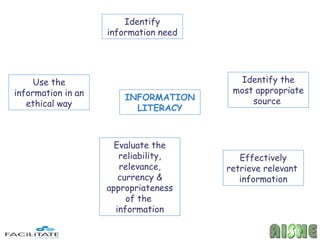
Identify
                    information need


     Use the                              Identify the
information in an                       most appropriate
                        INFORMATION         source
   ethical way            LITERACY


                      Evaluate the
                       reliability,       Effectively
                       relevance,      retrieve relevant
                       currency &         information
                    appropriateness
                         of the
                      information
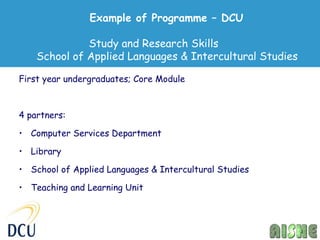
Example of Programme – DCU

              Study and Research Skills
    School of Applied Languages & Intercultural Studies

First year undergraduates; Core Module


4 partners:

• Computer Services Department

• Library

• School of Applied Languages & Intercultural Studies

• Teaching and Learning Unit
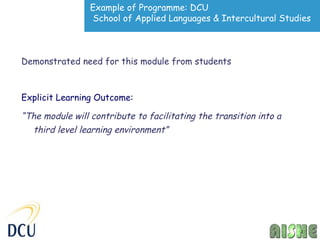
Example of Programme: DCU
                 School of Applied Languages & Intercultural Studies


Demonstrated need for this module from students


Explicit Learning Outcome:

“The module will contribute to facilitating the transition into a
  third level learning environment”
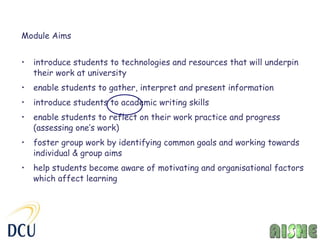
Module Aims


•   introduce students to technologies and resources that will underpin
    their work at university
•   enable students to gather, interpret and present information
•   introduce students to academic writing skills
•   enable students to reflect on their work practice and progress
    (assessing one’s work)
•   foster group work by identifying common goals and working towards
    individual & group aims
•   help students become aware of motivating and organisational factors
    which affect learning
Library component


• 5 x 1 hr
• Diagnostic assessment
• Continuous hands on element
• Discussion and reflection in each session
• Emphasis on collaboration & peer assessment


• Module content posted on VLE
• Timely feedback to guide learning
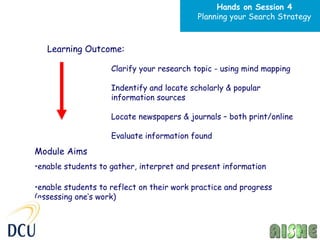
Hands on Session 4
                                           Planning your Search Strategy


   Learning Outcome:

                    Clarify your research topic - using mind mapping

                    Indentify and locate scholarly & popular
                    information sources

                    Locate newspapers & journals – both print/online

                    Evaluate information found
Module Aims
•enable students to gather, interpret and present information

•enable students to reflect on their work practice and progress
(assessing one’s work)
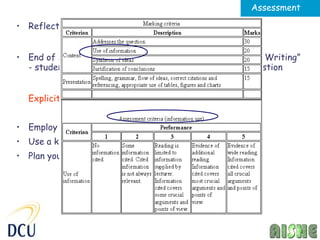
Assessment

• Reflective learning log (30%)


• End of Semester Essay (70%) on the topic of “Academic Writing”
  - students required to formulate their own research question


  Explicit essay criteria


• Employ and cite, AT LEAST three different sources
• Use a keyword search in the library catalogue.
• Plan your research
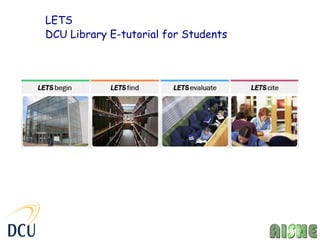
LETS
DCU Library E-tutorial for Students
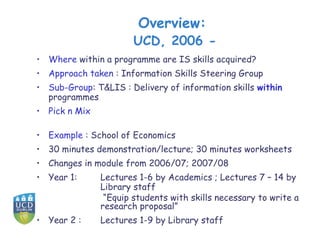
Overview:
                       UCD, 2006 -
• Where within a programme are IS skills acquired?
• Approach taken : Information Skills Steering Group
• Sub-Group: T&LIS : Delivery of information skills within
  programmes
• Pick n Mix

• Example : School of Economics
• 30 minutes demonstration/lecture; 30 minutes worksheets
• Changes in module from 2006/07; 2007/08
• Year 1:      Lectures 1-6 by Academics ; Lectures 7 – 14 by
               Library staff
                “Equip students with skills necessary to write a
               research proposal”
• Year 2 :     Lectures 1-9 by Library staff
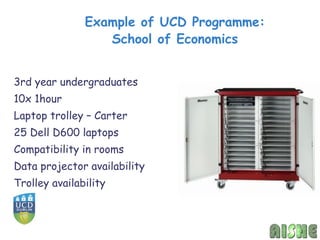
Example of UCD Programme:
                  School of Economics


3rd year undergraduates
10x 1hour
Laptop trolley – Carter
25 Dell D600 laptops
Compatibility in rooms
Data projector availability
Trolley availability
Example of Programme:
        School of Economics – 3rd years

• Create a search strategy
• Identify back-round information
• Use relevant print and electronic journals
• Use relevant databases to locate information
• Locate and evaluate relevant web resources
• Alternative sources to consider – Google Scholar, Open
  Access publications, e-theses, Gateway sites
• Evaluating information found
• Ethical use of Information
                                                    handout
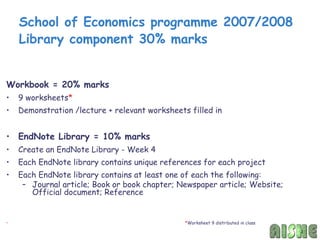
School of Economics programme 2007/2008
    Library component 30% marks


Workbook = 20% marks
•   9 worksheets*
•   Demonstration /lecture + relevant worksheets filled in


• EndNote Library = 10% marks
•   Create an EndNote Library - Week 4
•   Each EndNote library contains unique references for each project
•   Each EndNote library contains at least one of each the following:
     – Journal article; Book or book chapter; Newspaper article; Website;
       Official document; Reference


•                                               *Worksheet 9 distributed in class
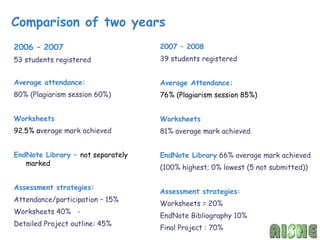
Comparison of two years
2006 – 2007                        2007 – 2008
53 students registered             39 students registered


Average attendance:                Average Attendance:
80% (Plagiarism session 60%)       76% (Plagiarism session 85%)


Worksheets                         Worksheets
92.5% average mark achieved        81% average mark achieved


EndNote Library – not separately   EndNote Library 66% average mark achieved
   marked
                                   (100% highest; 0% lowest (5 not submitted))

Assessment strategies:
                                   Assessment strategies:
Attendance/participation – 15%
                                   Worksheets = 20%
Worksheets 40% -
                                   EndNote Bibliography 10%
Detailed Project outline: 45%
                                   Final Project : 70%
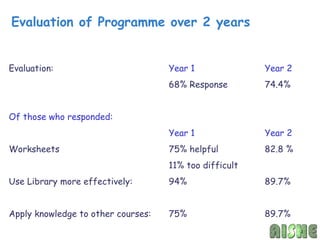
Evaluation of Programme over 2 years


Evaluation:                         Year 1              Year 2
                                    68% Response        74.4%


Of those who responded:
                                    Year 1              Year 2
Worksheets                          75% helpful         82.8 %
                                    11% too difficult
Use Library more effectively:       94%                 89.7%


Apply knowledge to other courses:   75%                 89.7%
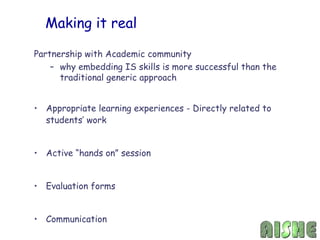
Making it real

Partnership with Academic community
    – why embedding IS skills is more successful than the
      traditional generic approach


• Appropriate learning experiences - Directly related to
  students’ work


• Active “hands on” session


• Evaluation forms


• Communication
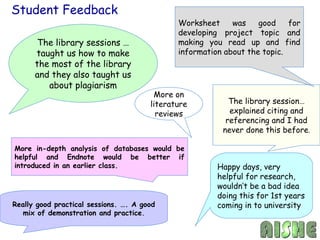
Student Feedback
                                              Worksheet     was    good    for
                                              developing project topic and
       The library sessions …                 making you read up and find
      taught us how to make                   information about the topic.
      the most of the library
      and they also taught us
         about plagiarism
                                        More on
                                       literature          The library session…
                                         reviews           explained citing and
                                                          referencing and I had
                                                         never done this before.

More in-depth analysis of databases would be
helpful and Endnote would be better if
introduced in an earlier class.                         Happy days, very
                                                        helpful for research,
                                                        wouldn’t be a bad idea
                                                        doing this for 1st years
Really good practical sessions. …. A good               coming in to university
   mix of demonstration and practice.
Academic Staff
                                          “Because the skills
Feedback, 2008                               were linked to
                                           credited course
                                          work, the students
The embedding of IS within the            were more engaged
Economics module has resulted in
   students having “a better
                                            in the process”
 understanding of the range of
  economic resources available,
and how to cite these resources
           correctly”


               “They’ll apply what they have learned to
               other modules they are taking in
               Economics, … and have also gained skills
               that’ll be of benefit in the workplace
               when they leave [university]”
Partnership

• Achieving strategic objectives of
  the institution


• Delivering information skills
  across Programmes


• Supporting different forms of
  teaching
   – PBL, Large Group teaching etc
Questions?


Contact


Siobhán Dunne: 01 7008327 siobhan.dunne@dcu.ie


Ursula Byrne:   01 7167025 ursula.byrne@ucd.ie

Making it real : information literacy and student engagement. Authors: Ursula Byrne, Siobhan Dunne

  • 1.
    Making it real: informationliteracy & student engagement 28th August 2008 NUI Maynooth Siobhán Dunne Ursula Byrne Humanities Librarian Head of Academic Services DCU Library Humanities & Social Sciences UCD Library
  • 2.
    Overview • Changes inhigher education • Information literacy & achieving learning outcomes • Case Study 1 – DCU (first years) • Case Study 2 – UCD (third years) • Partnership
  • 3.
    Changes in Education •Shift toward semesterisation & modularisation • New approaches to teaching • Resulting change in the role of libraries & librarians • Inter-disciplinary approach • Development of life-long learning skills
  • 4.
    Why is InformationLiteracy important? Is it a named learning outcome or competency in your module descriptor? – Slide adapted from presentation by Lorna Dodd, Liaison Librarian, UCD
  • 5.
    Identify information need Use the Identify the information in an most appropriate INFORMATION source ethical way LITERACY Evaluate the reliability, Effectively relevance, retrieve relevant currency & information appropriateness of the information
  • 6.
    Example of Programme– DCU Study and Research Skills School of Applied Languages & Intercultural Studies First year undergraduates; Core Module 4 partners: • Computer Services Department • Library • School of Applied Languages & Intercultural Studies • Teaching and Learning Unit
  • 7.
    Example of Programme:DCU School of Applied Languages & Intercultural Studies Demonstrated need for this module from students Explicit Learning Outcome: “The module will contribute to facilitating the transition into a third level learning environment”
  • 8.
    Module Aims • introduce students to technologies and resources that will underpin their work at university • enable students to gather, interpret and present information • introduce students to academic writing skills • enable students to reflect on their work practice and progress (assessing one’s work) • foster group work by identifying common goals and working towards individual & group aims • help students become aware of motivating and organisational factors which affect learning
  • 9.
    Library component • 5x 1 hr • Diagnostic assessment • Continuous hands on element • Discussion and reflection in each session • Emphasis on collaboration & peer assessment • Module content posted on VLE • Timely feedback to guide learning
  • 10.
    Hands on Session4 Planning your Search Strategy Learning Outcome: Clarify your research topic - using mind mapping Indentify and locate scholarly & popular information sources Locate newspapers & journals – both print/online Evaluate information found Module Aims •enable students to gather, interpret and present information •enable students to reflect on their work practice and progress (assessing one’s work)
  • 11.
    Assessment • Reflective learninglog (30%) • End of Semester Essay (70%) on the topic of “Academic Writing” - students required to formulate their own research question Explicit essay criteria • Employ and cite, AT LEAST three different sources • Use a keyword search in the library catalogue. • Plan your research
  • 12.
  • 13.
    Overview: UCD, 2006 - • Where within a programme are IS skills acquired? • Approach taken : Information Skills Steering Group • Sub-Group: T&LIS : Delivery of information skills within programmes • Pick n Mix • Example : School of Economics • 30 minutes demonstration/lecture; 30 minutes worksheets • Changes in module from 2006/07; 2007/08 • Year 1: Lectures 1-6 by Academics ; Lectures 7 – 14 by Library staff “Equip students with skills necessary to write a research proposal” • Year 2 : Lectures 1-9 by Library staff
  • 14.
    Example of UCDProgramme: School of Economics 3rd year undergraduates 10x 1hour Laptop trolley – Carter 25 Dell D600 laptops Compatibility in rooms Data projector availability Trolley availability
  • 15.
    Example of Programme: School of Economics – 3rd years • Create a search strategy • Identify back-round information • Use relevant print and electronic journals • Use relevant databases to locate information • Locate and evaluate relevant web resources • Alternative sources to consider – Google Scholar, Open Access publications, e-theses, Gateway sites • Evaluating information found • Ethical use of Information handout
  • 16.
    School of Economicsprogramme 2007/2008 Library component 30% marks Workbook = 20% marks • 9 worksheets* • Demonstration /lecture + relevant worksheets filled in • EndNote Library = 10% marks • Create an EndNote Library - Week 4 • Each EndNote library contains unique references for each project • Each EndNote library contains at least one of each the following: – Journal article; Book or book chapter; Newspaper article; Website; Official document; Reference • *Worksheet 9 distributed in class
  • 17.
    Comparison of twoyears 2006 – 2007 2007 – 2008 53 students registered 39 students registered Average attendance: Average Attendance: 80% (Plagiarism session 60%) 76% (Plagiarism session 85%) Worksheets Worksheets 92.5% average mark achieved 81% average mark achieved EndNote Library – not separately EndNote Library 66% average mark achieved marked (100% highest; 0% lowest (5 not submitted)) Assessment strategies: Assessment strategies: Attendance/participation – 15% Worksheets = 20% Worksheets 40% - EndNote Bibliography 10% Detailed Project outline: 45% Final Project : 70%
  • 18.
    Evaluation of Programmeover 2 years Evaluation: Year 1 Year 2 68% Response 74.4% Of those who responded: Year 1 Year 2 Worksheets 75% helpful 82.8 % 11% too difficult Use Library more effectively: 94% 89.7% Apply knowledge to other courses: 75% 89.7%
  • 19.
    Making it real Partnershipwith Academic community – why embedding IS skills is more successful than the traditional generic approach • Appropriate learning experiences - Directly related to students’ work • Active “hands on” session • Evaluation forms • Communication
  • 20.
    Student Feedback Worksheet was good for developing project topic and The library sessions … making you read up and find taught us how to make information about the topic. the most of the library and they also taught us about plagiarism More on literature The library session… reviews explained citing and referencing and I had never done this before. More in-depth analysis of databases would be helpful and Endnote would be better if introduced in an earlier class. Happy days, very helpful for research, wouldn’t be a bad idea doing this for 1st years Really good practical sessions. …. A good coming in to university mix of demonstration and practice.
  • 21.
    Academic Staff “Because the skills Feedback, 2008 were linked to credited course work, the students The embedding of IS within the were more engaged Economics module has resulted in students having “a better in the process” understanding of the range of economic resources available, and how to cite these resources correctly” “They’ll apply what they have learned to other modules they are taking in Economics, … and have also gained skills that’ll be of benefit in the workplace when they leave [university]”
  • 22.
    Partnership • Achieving strategicobjectives of the institution • Delivering information skills across Programmes • Supporting different forms of teaching – PBL, Large Group teaching etc
  • 23.
    Questions? Contact Siobhán Dunne: 017008327 siobhan.dunne@dcu.ie Ursula Byrne: 01 7167025 ursula.byrne@ucd.ie

Editor's Notes

  • #4 Harder to fit in “library time” more to cover in shorter period of time – more assignments too, pressure of work – this approach today will give ways the library staff can be included to support the academics New approaches – more information available to students, more distractions too, emphasis on critical thinking,
  • #5 Answer: Because users coping with information explosion – print/electronic/web ; becoming more important to Be able to evaluate information /information sources found/used – University of Google – (Tara Brabazon) 3. Key skills in terms of “graduateness” is developing critical thinking skills 4. Avoid plagiarism –important at every level from 1 st year up to PhDs 5. Develop life-long learning skills – strategic objective of the university Definition of IL And if its not a named learning outcome/objective – where /when does it happen?? It should be learning objective in each module –in that case it would be “Acquire appropriate information….” so academic can customise what is appropriate to module (PBL all info skills are front ended- at beginning of the year , in other programmes it slower approach)
  • #6 Importance of IL as life long learning skill – how is university ensuring this skill set is achieved? IL Framework – providing an opportunity for students to develop IL skills as they progress through programme of study. NB Acknowledge slide from Lorna Dodd, presentation given in Mexico 2008
  • #7 High level of collaboration from university team players - ‘Linking up’ with overall objectives of programme. Library involved in planning and development of module from start – not a bolt on Very brief description of what each component addressed
  • #8 Is a university education simply something that is “done” to me, or am I seen as an individual in this process? Is there space for me as a person in the university, or am I simply a nameless cog in the machine? How important is this module? After completing this module, students will be expected to demonstrate skills and competencies in research, studying and writing in the assessment of all modules.
  • #10 Importance of student involvement and choice and formative assessment Introduction to Library & how library sessions fit in with other sessions practical session to identify current use of information sources Demonstration of library catalogue – searching for reference material & practical session – locating material on catalogue + retrieving it on shelves Discussion on plagiarism How to cite and reference appropriately & practical session – creating references using different styles for books, journals and newspapers
  • #11 Library works with academic to realise their LO. You tell us what you want your students to have achieved by end of session and we’ll design a programme that meets the appropriate level for them. Student focused LO Transferable skills
  • #12 Library works with academic to realise their LO. You tell us what you want your students to have achieved by end of session and we’ll design a programme that meets the appropriate level for them. Student focused LO Transferable skills
  • #13 Sustainability of IL training – meeting the needs of our virtual students
  • #14 2006
  • #15 Wireless network built into the cart
  • #23 Instead of the Library being “bolt on” approach ( 30 minutes at the beginning of 1 st year and never again! ) with partnership we will be more able to : ….. Plagiarism point – support academics in addressing known problems in the institution – web pages, training sessions, advice etc Sustainability point…Pool of knowledge in the Library, experts in PBL, plagiarism etc when staff turn over etc