Gearing Up
   Elgin Academy
       for the
21st Century Learner
WHY?
“The curious are always in some danger.
If you are curious you might never come home”

Jeanette Winterson
WHY?
   Pedagogical Shifts in the 21st Century

Teacher directed learning ➥ Self/ participatory learning
Classroom learning ➥ Networked/global learning
Standards driven ➥ Exploring ideas and concepts
Teaching ➥ Active learning
Teacher expertise ➥ Collaborative learning partners
WHY?
       Learning is more integrated than ever.


There is a direct connection between the curriculum,
       the library and the learning experience


    There is a symbiotic relationship between the
 learning resource, the learner, the teacher and the
                      librarian.
HOW?
        Key Initiatives
"The future is already here...
 It's just not evenly distributed.”

William Gibson
HOW? - Key Movements

   WEB 1.0 was for viewing and linking

          WEB 2.0 is about participation

                          Web 3.0
                            Will be a thread
                        through the data universe
                       our context and any context
                               their/our data
                          infinitely reconnected
                     for other and ever smarter uses

               Personal Learning Environments; - Twitter etc.
                Personal Learning Networks – Skype, rafi.ki
                  Personal web tools – Facebook, Tumblr
                Cloud computing – Open access software
                         Mixed Reality (e, v and p)
HOW?-Key Spheres


                                                       Web 3.0
                          Reading
                        Development


        Extending the                    Information
         Curriculum                        Fluency

                         Bringing the
                        Library ALIVE!
HOW? –Key Work Areas:


    To integrate with the principles, practice and progress
    of:

     - A Curriculum for Excellence(AcfE)
     - A National Information Literacy
       Framework(Scotland)
     - GLOW
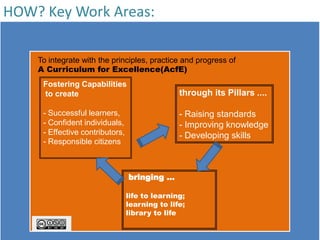
HOW? Key Work Areas:

    To integrate with the principles, practice and progress of
    A Curriculum for Excellence(AcfE)
     Fostering Capabilities
     to create                                  through its Pillars ....

     - Successful learners,                     - Raising standards
     - Confident individuals,                   - Improving knowledge
     - Effective contributors,                  - Developing skills
     - Responsible citizens


                                 bringing …

                                 life to learning;
                                 learning to life;
                                 library to life
HOW? Key Service Areas:


                   Focus for learning;                   Supports the development of literacy;
                 Supports attainment;                  Increases reading confidence and fluency;
            Shares knowledge of resources;                Creates clear links between literacy
                                                                    activities & AcfE
       Selects, organises & manages resources ;
                                                         Assists with the effective use of ICT in
         Matches resources to learners’ needs                    learning and teaching


                                            LIBRARY
                                           RESOURCE
                                            CENTRE

                                                      Facilitate access to a wider range of lending
       Ensures effective retrieval through the ILS,
                                                                          services
            websites, databases and Glow;
                                                           Promote and forge partnerships;
       • information skills programmes across the
                                                       • Provide information, bibliographic and
                       curriculum;
                                                                   research services;
       The development of information literacy;
                                                      • Support personal and social development
HOW? Key Work Areas related to AcfE
:
       Fostering CAPABILITIES in the Library Resource Centre(LRC)


      1. Support successful learners            2. Developing confident individuals
                  through:                                   through:


 • developing listening and talking skills   •applying library skills across other
 • acquiring analytical skills               contexts
 • making critical personal responses to     • experiencing a range of feelings to
 texts                                       resources
 • choosing and reading more                 • trusting personal preferences when
 demanding texts                             choosing resources
 • developing presentation skills to         • learning independently, and in groups
 engage others with                          to carry
 their ideas                                 out research and presentation tasks
 • learning how to use the LRC well          • effectively skimming, scanning and
 • understanding and developing              note-making
 information literacy                        • using resources well for a range of
 • using websites constructively for         purposes
 research                                    • planning research, with no or little
 • learning how to prepare a detailed        support
 bibliography                                • carrying out peer and self-evaluation
HOW? Key Work Areas related to AcfE :
       Fostering CAPABILITIES in the Library Resource Centre(LRC)

    3. Encourage responsible citizens        4. Creating effective contributors
                through:                                  through:


 • learning to care about and share
 information resources                     • share experiences, stories and
 • developing a greater understanding of   opinions with others
 other people, beliefs and cultures        • developing the ability to ask
 • developing sensitivity to others        appropriate questions
 through engagement with resources and     • using resources well to develop
 respecting others in the LRC              knowledge and understanding, and
 • being involved in LRC developments      critical thinking
 • using careers information effectively   • helping with LRC or literacy activities
 • taking part in cultural events          which develop leadership skills
 • developing informed and ethical         • taking part in activities which develop
 viewpoints                                and sustain arguments, opinions and
 • researching projects and properly       debate
 citing sources of information and ideas   • being part of a team through
 • developing good personal judgement      opportunities provided in and by the
 of resources                              LRC
 • using ICT responsibly
HOW? –Key Work Areas: Focus on IL


    To integrate with the principles, practice and progress of:

    A National Information Literacy Framework Scotland


       Image from http://caledonianblogs.net/nilfs/
HOW?: Key Work Areas: Focus on IL
HOW?: Key Work Areas: IL related to SCDF levels
HOW? – Beyond Information Literacy


      From The North Carolina Middle School Journal [http://is.gd/PCngcu]
HOW? Key Work Areas: GLOW


    To integrate with the principles, practice and progress of:


    Opportunities
             Core of the Co-Create teams
             Access GLOW learning materials
             Publicise additions to the LRC,
    I        Invite item requests
             Participate in virtual discussions
             Develop e-learning materials to support LRC courses
             Create online tutorials
             Dynamic book discussion groups
             Tagging of learning materials/OPAC
             “Ask the librarian"
             Librarians as GLOW mentors
WHAT?
“ “What” ain’t no country I’ve heard of….
 They speak English in “What?””

Samuel L. Jackson (from the film
“Pulp Fiction”)
WHAT?- A Future Library Professional’s Life:
       Making a significant impact on teaching and learning


               Making the library space (online and
              offline)stimulating, fun and enjoyable

         Motivating all kinds of readers/searchers/creators


       Keeping up-to-date and staying part of the big picture


                   Being a leader not a follower

       Encouraging learners and teachers to be creative and
                            innovative
WHAT?


     Elgin Academy
    Library Resource
     Centre(EA-LRC)
             WHAT?


      Forward Plan
         Draft
WHAT? - Elgin Academy Library Resource Centre (EA-LRC)
Forward Plan


                         Direction 1:
     To develop Policies & Procedures :
         Based on a Library 3.0 Orientation
              (open, social, semantic, mobile)
         Standards for staff, services and collections
         Procedures for all aspects of the library service
         Evaluation Criteria
WHAT? - Elgin Academy Library Resource Centre (EA-LRC)
Forward Plan


                          Direction 2:
     To streamline the Document Cycle :
       Review selection criteria (in liaison with faculty)
       Review ordering procedures
       Review receipt and access procedures
       Economies of scale - $$ saved through co-ordinated
                             procedures
WHAT? - Elgin Academy Library Resource Centre (EA-LRC)
Forward Plan


                          Direction 3:
     To create a Digital Portal:
         which integrates with:
        library management system
        eLearning
        Digital Content and Services
        Interactive Environments (e.g. GLOW)
WHAT? - Elgin Academy Library Resource Centre (EA-LRC)
Forward Plan


                         Direction 4:
     To be a Training Provider:
         Developing Guided Enquiry as a core skill
         Implementing National Information Literacy Framework
         Workshops for Faculty and Library Co-operation
         Co-ordinate training for library and faculty
WHAT? - Elgin Academy Library Resource Centre (EA-LRC)
Forward Plan - Benefits


                         Short term:
        Better co-ordinated procedures;
        Librarian’s time centred on learner-centred activity;
WHAT? - Elgin Academy Library Resource Centre (EA-LRC)
Forward Plan: Benefits


                      Medium Term:
       An improved student experience;
        More integrated learning process;
        More value derived from the materials and the LRC;
        Better co-operation between faculty and LRC.
WHAT?- Elgin Academy Library Resource Centre (EA-LRC)
Forward Plan: Benefits


                              Long Term:
    Raised Status for EA with a resultant effect on reputation and
    matriculation;
    A dynamic environment with independent learners, engaged faculty
    and informed engaged Library staff
    A 21st century learning environment
    An LRC fully integrated into the teaching and learning cycle
    EA will be ready for Web 3.0
Elgin Academy Library Resource Centre(EALRC) Forward Plan


             To achieve this
Elgin Academy Library Resource Centre(EALRC) Forward Plan
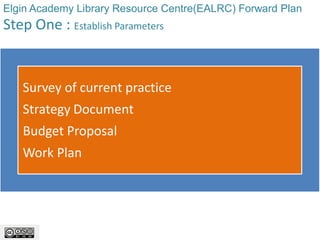
Step One : Establish Parameters


   Survey of current practice
   Strategy Document
   Budget Proposal
   Work Plan
Elgin Academy Library Resource Centre(EALRC) Forward Plan
Step Two : Setup Policy and Procedures


    All relevant documents including:
    Policy Framework Document
    Library Standards Manual
    Library Procedure Manual
    [based on international /national benchmarking and in consultation with
    library staff and faculty]
Elgin Academy Library Resource Centre(EALRC) Forward Plan
Step Three : Review EALRC related to Standards


    Staffing
    Materials & Equipment
    IT Infrastructure – Hub and Network
    Space Review
Elgin Academy Library Resource Centre(EALRC) Forward Plan
Step Four : Implementation
                  a. MATERIALS
                      Establish online selection tools
                      Set up liaison with faculty/students
                      Identify key digital resources
                      Consolidate the materials order (physical & digital)
                       Order, Receive, Distribute, Ensure Their Use, Evaluate


  b. ICT
      Establish library protocols and practice               c. TRAINING
      Review ILS software                                    Prepare and implement Information
      Plan e-learning software                               Fluency Curriculum
      Establish EALRC Portal                                 Work with faculty to integrate library
                                                             into the learning/study cycle
      (or develop within GLOW)
                                                             Training for library staff
Elgin Academy Library Resource Centre(EALRC)
Forward Plan: Outcomes for Students


    They can begin to ......
             Work independently and collaboratively to solve problems
             Analyse information critically in all formats and media contexts
             Apply information strategically to solve personal and social problems
             Make decisions based on accurate and current information
             Use information and communication technologies with skill, purpose and wisdom
             Respect information sources and diverse perspectives
             Honour intellectual property and privacy rights
             Appreciate the aesthetic qualities of various creative and scientific expressions
             Communicate effectively and expressively using a variety of information and media
                  formats.
   [From Achieving Information Literacy (AIL)
   Canadian Association for School Libraries (2003)]
Elgin Academy Library Resource Centre(EALRC)
Forward Plan: Outcomes for Teachers


    They can begin to see......

   1. Research quality rise
   2. An improvement in the output of students;
   3. Job satisfaction increase as the learning process shifts to
          collaborative mode
   4. New opportunities for professional collaboration and development
   5. Personal learning transformed
Elgin Academy Library Resource Centre(EALRC)
Forward Plan: Outcomes for Library Workers


    They can begin to see......

   1. Themselves at the core of the learning cycle
   2. A greater diversity of roles to challenge them;
   3. A richer career path
   4. New opportunities for professional collaboration
   5. Personal learning transformed
THANK YOU
“It is not the strongest of the species that survive,
nor the most intelligent, but the one most
responsive to change'”.
Charles Darwin


 REFERENCES
 "The Future of Research and Scholarship - Open, Social, Semantic, Mobile“ - http://is.gd/jxXDQB
 “A Perfect Match: Library 2.0 in support of IB framework of learning” - http://is.gd/ai6BXB
 “The Next Big Thing is Web 3.0 – Catch It If You Can” - http://is.gd/x2IOBk
 “Learning in the 21st Century” - http://is.gd/HR5UKr
 JISC RSC Info Literacy Package http://is.gd/7iwnDy
 Professional library support for Curriculum for Excellence www.slainte.org.uk
 Curriculum for Excellence www.ltscotland.org.uk/curriculumforexcellence/
 Scottish Library and Information Council www.slainte.org.uk/slic/schoollibs/index.htm
 National Literacy Framework - www.caledonian.ac.uk/ils/framework.html
 “Librarians should get out there ... and start knocking on doors”/Douglas Blane TESS ,6 Feb., 2009

Ea 180112 jr_bain

  • 1.
    Gearing Up Elgin Academy for the 21st Century Learner
  • 2.
    WHY? “The curious arealways in some danger. If you are curious you might never come home” Jeanette Winterson
  • 3.
    WHY? Pedagogical Shifts in the 21st Century Teacher directed learning ➥ Self/ participatory learning Classroom learning ➥ Networked/global learning Standards driven ➥ Exploring ideas and concepts Teaching ➥ Active learning Teacher expertise ➥ Collaborative learning partners
  • 4.
    WHY? Learning is more integrated than ever. There is a direct connection between the curriculum, the library and the learning experience There is a symbiotic relationship between the learning resource, the learner, the teacher and the librarian.
  • 5.
    HOW? Key Initiatives "The future is already here... It's just not evenly distributed.” William Gibson
  • 6.
    HOW? - KeyMovements WEB 1.0 was for viewing and linking WEB 2.0 is about participation Web 3.0 Will be a thread through the data universe our context and any context their/our data infinitely reconnected for other and ever smarter uses Personal Learning Environments; - Twitter etc. Personal Learning Networks – Skype, rafi.ki Personal web tools – Facebook, Tumblr Cloud computing – Open access software Mixed Reality (e, v and p)
  • 7.
    HOW?-Key Spheres Web 3.0 Reading Development Extending the Information Curriculum Fluency Bringing the Library ALIVE!
  • 8.
    HOW? –Key WorkAreas: To integrate with the principles, practice and progress of: - A Curriculum for Excellence(AcfE) - A National Information Literacy Framework(Scotland) - GLOW
  • 9.
    HOW? Key WorkAreas: To integrate with the principles, practice and progress of A Curriculum for Excellence(AcfE) Fostering Capabilities to create through its Pillars .... - Successful learners, - Raising standards - Confident individuals, - Improving knowledge - Effective contributors, - Developing skills - Responsible citizens bringing … life to learning; learning to life; library to life
  • 10.
    HOW? Key ServiceAreas: Focus for learning; Supports the development of literacy; Supports attainment; Increases reading confidence and fluency; Shares knowledge of resources; Creates clear links between literacy activities & AcfE Selects, organises & manages resources ; Assists with the effective use of ICT in Matches resources to learners’ needs learning and teaching LIBRARY RESOURCE CENTRE Facilitate access to a wider range of lending Ensures effective retrieval through the ILS, services websites, databases and Glow; Promote and forge partnerships; • information skills programmes across the • Provide information, bibliographic and curriculum; research services; The development of information literacy; • Support personal and social development
  • 11.
    HOW? Key WorkAreas related to AcfE : Fostering CAPABILITIES in the Library Resource Centre(LRC) 1. Support successful learners 2. Developing confident individuals through: through: • developing listening and talking skills •applying library skills across other • acquiring analytical skills contexts • making critical personal responses to • experiencing a range of feelings to texts resources • choosing and reading more • trusting personal preferences when demanding texts choosing resources • developing presentation skills to • learning independently, and in groups engage others with to carry their ideas out research and presentation tasks • learning how to use the LRC well • effectively skimming, scanning and • understanding and developing note-making information literacy • using resources well for a range of • using websites constructively for purposes research • planning research, with no or little • learning how to prepare a detailed support bibliography • carrying out peer and self-evaluation
  • 12.
    HOW? Key WorkAreas related to AcfE : Fostering CAPABILITIES in the Library Resource Centre(LRC) 3. Encourage responsible citizens 4. Creating effective contributors through: through: • learning to care about and share information resources • share experiences, stories and • developing a greater understanding of opinions with others other people, beliefs and cultures • developing the ability to ask • developing sensitivity to others appropriate questions through engagement with resources and • using resources well to develop respecting others in the LRC knowledge and understanding, and • being involved in LRC developments critical thinking • using careers information effectively • helping with LRC or literacy activities • taking part in cultural events which develop leadership skills • developing informed and ethical • taking part in activities which develop viewpoints and sustain arguments, opinions and • researching projects and properly debate citing sources of information and ideas • being part of a team through • developing good personal judgement opportunities provided in and by the of resources LRC • using ICT responsibly
  • 13.
    HOW? –Key WorkAreas: Focus on IL To integrate with the principles, practice and progress of: A National Information Literacy Framework Scotland Image from http://caledonianblogs.net/nilfs/
  • 14.
    HOW?: Key WorkAreas: Focus on IL
  • 15.
    HOW?: Key WorkAreas: IL related to SCDF levels
  • 16.
    HOW? – BeyondInformation Literacy From The North Carolina Middle School Journal [http://is.gd/PCngcu]
  • 17.
    HOW? Key WorkAreas: GLOW To integrate with the principles, practice and progress of: Opportunities Core of the Co-Create teams Access GLOW learning materials Publicise additions to the LRC, I Invite item requests Participate in virtual discussions Develop e-learning materials to support LRC courses Create online tutorials Dynamic book discussion groups Tagging of learning materials/OPAC “Ask the librarian" Librarians as GLOW mentors
  • 18.
    WHAT? “ “What” ain’tno country I’ve heard of…. They speak English in “What?”” Samuel L. Jackson (from the film “Pulp Fiction”)
  • 19.
    WHAT?- A FutureLibrary Professional’s Life: Making a significant impact on teaching and learning Making the library space (online and offline)stimulating, fun and enjoyable Motivating all kinds of readers/searchers/creators Keeping up-to-date and staying part of the big picture Being a leader not a follower Encouraging learners and teachers to be creative and innovative
  • 20.
    WHAT? Elgin Academy Library Resource Centre(EA-LRC) WHAT? Forward Plan Draft
  • 21.
    WHAT? - ElginAcademy Library Resource Centre (EA-LRC) Forward Plan Direction 1: To develop Policies & Procedures : Based on a Library 3.0 Orientation (open, social, semantic, mobile) Standards for staff, services and collections Procedures for all aspects of the library service Evaluation Criteria
  • 22.
    WHAT? - ElginAcademy Library Resource Centre (EA-LRC) Forward Plan Direction 2: To streamline the Document Cycle : Review selection criteria (in liaison with faculty) Review ordering procedures Review receipt and access procedures Economies of scale - $$ saved through co-ordinated procedures
  • 23.
    WHAT? - ElginAcademy Library Resource Centre (EA-LRC) Forward Plan Direction 3: To create a Digital Portal: which integrates with: library management system eLearning Digital Content and Services Interactive Environments (e.g. GLOW)
  • 24.
    WHAT? - ElginAcademy Library Resource Centre (EA-LRC) Forward Plan Direction 4: To be a Training Provider: Developing Guided Enquiry as a core skill Implementing National Information Literacy Framework Workshops for Faculty and Library Co-operation Co-ordinate training for library and faculty
  • 25.
    WHAT? - ElginAcademy Library Resource Centre (EA-LRC) Forward Plan - Benefits Short term: Better co-ordinated procedures; Librarian’s time centred on learner-centred activity;
  • 26.
    WHAT? - ElginAcademy Library Resource Centre (EA-LRC) Forward Plan: Benefits Medium Term: An improved student experience; More integrated learning process; More value derived from the materials and the LRC; Better co-operation between faculty and LRC.
  • 27.
    WHAT?- Elgin AcademyLibrary Resource Centre (EA-LRC) Forward Plan: Benefits Long Term: Raised Status for EA with a resultant effect on reputation and matriculation; A dynamic environment with independent learners, engaged faculty and informed engaged Library staff A 21st century learning environment An LRC fully integrated into the teaching and learning cycle EA will be ready for Web 3.0
  • 28.
    Elgin Academy LibraryResource Centre(EALRC) Forward Plan To achieve this
  • 29.
    Elgin Academy LibraryResource Centre(EALRC) Forward Plan Step One : Establish Parameters Survey of current practice Strategy Document Budget Proposal Work Plan
  • 30.
    Elgin Academy LibraryResource Centre(EALRC) Forward Plan Step Two : Setup Policy and Procedures All relevant documents including: Policy Framework Document Library Standards Manual Library Procedure Manual [based on international /national benchmarking and in consultation with library staff and faculty]
  • 31.
    Elgin Academy LibraryResource Centre(EALRC) Forward Plan Step Three : Review EALRC related to Standards Staffing Materials & Equipment IT Infrastructure – Hub and Network Space Review
  • 32.
    Elgin Academy LibraryResource Centre(EALRC) Forward Plan Step Four : Implementation a. MATERIALS Establish online selection tools Set up liaison with faculty/students Identify key digital resources Consolidate the materials order (physical & digital) Order, Receive, Distribute, Ensure Their Use, Evaluate b. ICT Establish library protocols and practice c. TRAINING Review ILS software Prepare and implement Information Plan e-learning software Fluency Curriculum Establish EALRC Portal Work with faculty to integrate library into the learning/study cycle (or develop within GLOW) Training for library staff
  • 33.
    Elgin Academy LibraryResource Centre(EALRC) Forward Plan: Outcomes for Students They can begin to ...... Work independently and collaboratively to solve problems Analyse information critically in all formats and media contexts Apply information strategically to solve personal and social problems Make decisions based on accurate and current information Use information and communication technologies with skill, purpose and wisdom Respect information sources and diverse perspectives Honour intellectual property and privacy rights Appreciate the aesthetic qualities of various creative and scientific expressions Communicate effectively and expressively using a variety of information and media formats. [From Achieving Information Literacy (AIL) Canadian Association for School Libraries (2003)]
  • 34.
    Elgin Academy LibraryResource Centre(EALRC) Forward Plan: Outcomes for Teachers They can begin to see...... 1. Research quality rise 2. An improvement in the output of students; 3. Job satisfaction increase as the learning process shifts to collaborative mode 4. New opportunities for professional collaboration and development 5. Personal learning transformed
  • 35.
    Elgin Academy LibraryResource Centre(EALRC) Forward Plan: Outcomes for Library Workers They can begin to see...... 1. Themselves at the core of the learning cycle 2. A greater diversity of roles to challenge them; 3. A richer career path 4. New opportunities for professional collaboration 5. Personal learning transformed
  • 36.
    THANK YOU “It isnot the strongest of the species that survive, nor the most intelligent, but the one most responsive to change'”. Charles Darwin REFERENCES "The Future of Research and Scholarship - Open, Social, Semantic, Mobile“ - http://is.gd/jxXDQB “A Perfect Match: Library 2.0 in support of IB framework of learning” - http://is.gd/ai6BXB “The Next Big Thing is Web 3.0 – Catch It If You Can” - http://is.gd/x2IOBk “Learning in the 21st Century” - http://is.gd/HR5UKr JISC RSC Info Literacy Package http://is.gd/7iwnDy Professional library support for Curriculum for Excellence www.slainte.org.uk Curriculum for Excellence www.ltscotland.org.uk/curriculumforexcellence/ Scottish Library and Information Council www.slainte.org.uk/slic/schoollibs/index.htm National Literacy Framework - www.caledonian.ac.uk/ils/framework.html “Librarians should get out there ... and start knocking on doors”/Douglas Blane TESS ,6 Feb., 2009