Image source: https://flic.kr/p/qHpEnS
Overview
• Rationale for this research
• Literature review & methodology
• Professional challenges
• Recommendations and future research
• Reflections on ethnography
Rationale
• Primary research requirement: MSc Education & Training
Leadership
• To capture the student voice - very little prior knowledge
of the undergraduate research process
• To advance a prior study on first year undergraduate
research behaviour (Dunne & Sheridan, 2012)
• ‘Library as lab’ - a natural habitat for observing research
behaviour
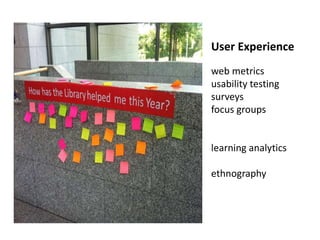
User Experience
web metrics
usability testing
surveys
focus groups
learning analytics
ethnography
The Ethnographer
“participates, overtly or covertly, in
people's daily lives for an extended
period of time, watching what
happens, listening to what is said,
and/or asking questions through
informal and formal interviews,
collecting documents and artefacts
- in fact, gathering whatever data
are available to throw light on the
issues that are the emerging focus
of inquiry”
(Hammersley & Atkinson, 2007)
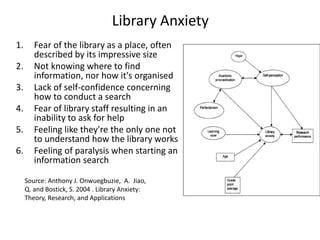
Library Anxiety
1. Fear of the library as a place, often
described by its impressive size
2. Not knowing where to find
information, nor how it's organised
3. Lack of self-confidence concerning
how to conduct a search
4. Fear of library staff resulting in an
inability to ask for help
5. Feeling like they're the only one not
to understand how the library works
6. Feeling of paralysis when starting an
information search
Source: Anthony J. Onwuegbuzie, A. Jiao,
Q. and Bostick, S. 2004 . Library Anxiety:
Theory, Research, and Applications
The Participants
• 5 final year undergraduate students:
3 Communications + 2 Intercultural Studies
3 Generation X + 2 Millennial
• Recruited through lecture call; follow on emails &
flyers
• Incentivised participation through offer of
dedicated consultation & on the fly advice
• 6 week ethnographic study
Methodology
• Study approved by DCU Research Ethics Committee:
students received outline of research, plain language
statement & informed consent
• Data collection:
2 X 1 hour observation sessions
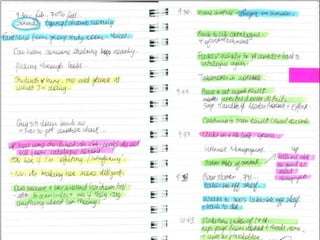
Maintain a student diary
1 X retrospective interview
• Data triangulation: validated by cross referencing
observation data & diary data
• Data analysis: colour coding & assignment of broad themes
Emergent Themes
• Time and space for research
• Research behaviour
• Uncertainty about the research process
• Harnessing social media
• Support networks
• Organising research
Time & Space
“Finished analysing five articles. Went home
and examined work on bus”
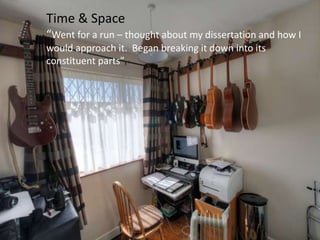
Time & Space
“Went for a run – thought about my dissertation and how I
would approach it. Began breaking it down into its
constituent parts”
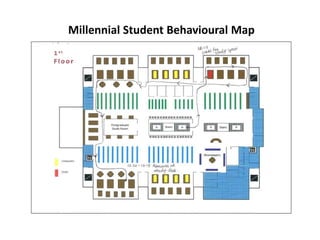
Millennial Student Behavioural Map
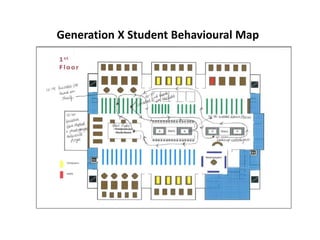
Generation X Student Behavioural Map
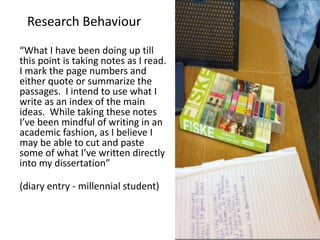
Research behaviours
“What I have been doing up till
this point is taking notes as I read.
I mark the page numbers and
either quote or summarize the
passages. I intend to use what I
write as an index of the main
ideas. While taking these notes
I’ve been mindful of writing in an
academic fashion, as I believe I
may be able to cut and paste
some of what I’ve written directly
into my dissertation”
(diary entry - millennial student)
Research Behaviour
Extract from my field notes (millennial student)
12.37 Opens article, takes notes in spiral bound notebook
Opens tab containing Word document
Flicks to another tab
12.39 Opens a different tab containing another article, this time
from acadmia.edu. Reads some text from it
Picks up phone to respond to Facebook message
Returns to Word and types text
12.41 Repeats this.
Checks word count and records in notebook
Opens up text book, scans index
Looks up body of text
Continues to flick between index and text.
12.42 Places book back on desk and opens Google
Opens library catalogue and enters search
Moves to Advanced catalogue search
Scans results and opens book record
12.44 Opens tab containing Google Book search
Scans table of contents
12.45 Opens tab with ‘different’ journal article
Scans first page
Returns to Word doc
Flips to Google results tab
Returns to Word doc and types for a minute
12.47 Returns to article
Returns to Word doc and types for another minute
Scrolls through Word doc (finger on screen) this lasts for about a minute
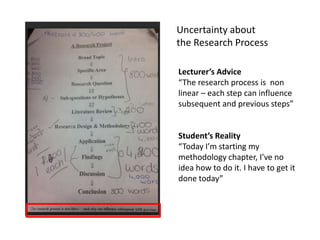
Uncertainty about
the Research Process
Lecturer’s Advice
“The research process is non
linear – each step can influence
subsequent and previous steps”
Student’s Reality
“Today I’m starting my
methodology chapter, I’ve no
idea how to do it. I have to get it
done today”
Source Evaluation
Millennial Student
“While waiting on articles to load, I begin to examine
other ones I already have open. There is a slight problem
in that I’ve found articles covering [blank] and [blank] and
[blank] but none covering all three”.
Generation X Student
“So it’s looking at the value of things, it’s looking at the
whole thing. It’s not looking at the title and going ‘that
title doesn’t match what I need’. And I think a lot of
people do that, they look at it and go I don’t know, this
isn’t what I’m looking for”
Crowdsourcing research advice
“there was one girl who went on [Facebook ] & said: ‘I’m doing
this all wrong’ and eight or nine hours later said ‘I’m doing it this
way anyway’. Even though there was people who said you are
doing it wrong... so you have this kind of rationalisation, they all
picked each other up...I wanted to go on and say just take your
finger out, you still have three days, just do it, you can still
salvage it. But all there was was no, its gonna be ok cos everyone
here has said so”
[Generation X student]
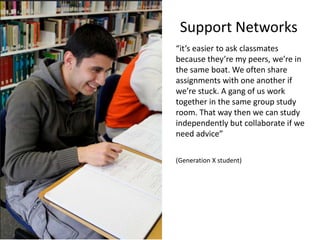
Support Networks
“it’s easier to ask classmates
because they’re my peers, we’re in
the same boat. We often share
assignments with one another if
we’re stuck. A gang of us work
together in the same group study
room. That way then we can study
independently but collaborate if we
need advice”
(Generation X student)
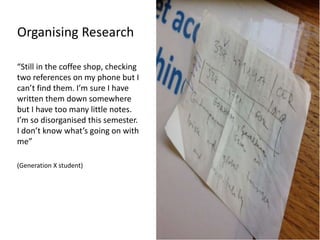
Organising Research
“Still in the coffee shop, checking
two references on my phone but I
can’t find them. I’m sure I have
written them down somewhere
but I have too many little notes.
I’m so disorganised this semester.
I don’t know what’s going on with
me”
(Generation X student)
Key Learning Moments
• Increased student diversity brings new challenges for intercultural
communication: cultural library anxiety means some students avoid
seeking the help they require
• Issues of trust and the co-production of knowledge: as co creators of
data, this was collaborative ethnography
• Ethnographic approach uncovers information difficult to elicit by other
means and complements traditional feedback mechanisms such as The
National Survey of Student Engagement
• Students strongly desire extra supports to teach them research skills
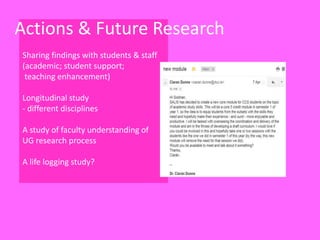
Sharing findings with students & staff
(academic; student support;
teaching enhancement)
Longitudinal study
- different disciplines
A study of faculty understanding of
UG research process
A life logging study?
Actions & Future Research
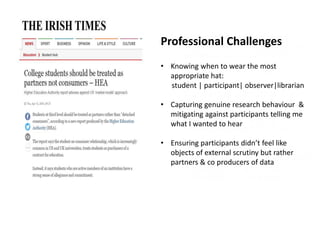
Professional Challenges
• Knowing when to wear the most
appropriate hat:
student | participant| observer|librarian
• Capturing genuine research behaviour &
mitigating against participants telling me
what I wanted to hear
• Ensuring participants didn’t feel like
objects of external scrutiny but rather
partners & co producers of data
References
• Asher, A., and Miller, S. 2011. So You Want to Do Anthropology in Your Library? or A Practical
Guide to Ethnographic Research in Academic Libraries. [Online] Available from:
http://www.erialproject.org/wp-content/uploads/2011/03/Toolkit-3.22.11.pdf
• Dunne, S. 2016. How Do They Research? An Ethnographic Study of Final Year Undergraduate
Research Behaviour in an Irish University. New Review of Academic Librarianship. [Online]
Available from:
http://www.tandfonline.com/doi/full/10.1080/13614533.2016.1168747#.V1GW1vkrLcs
• Dunne, S. and Sheridan, V. 2012. The bigger picture: undergraduate voices reflecting on
academic transition in an Irish university. Innovations in Education and Teaching
International, 49(3), pp. 237-247. [Online] Available from:
http://www.tandfonline.com/doi/full/10.1080/14703297.2012.703019#abstract
• Fried Foster, N. and Gibbons, S. 2007. Studying Students: The Undergraduate Research
Project at the University of Rochester. [Online] Available from:
http://www.ala.org/acrl/sites/ala.org.acrl/files/content/publications/booksanddigitalresourc
es/digital/Foster-Gibbons_cmpd.pdf
• Hammersley, M. and Atkinson, P. 2007. Ethnography: principles in practice. London:
Routledge.
• Healey, M. and Jenkins, A. 2009. Developing undergraduate research and inquiry. [Online]
Available from:
https://www.heacademy.ac.uk/sites/default/files/developingundergraduate_final.pdf
• Lanclos, D. 2015. Ethnographic Techniques and New Visions for Libraries, in Library Analytics
and Metrics: Using Data to Drive Decisions and Services. Ed. Ben Showers. London: Facet
Publishing, pp. 96-107.
• Priestner, A. and Borg, M. 2016. User Experience in Libraries: Applying Ethnography and User
Centred Design. London: Routledge.
Questions?
siobhan.dunne@dcu.ie
@dunnesiobhan

Watch listen Learn: Understanding the undergraduate research process through an ethnographic lens

  • 1.
  • 2.
    Overview • Rationale forthis research • Literature review & methodology • Professional challenges • Recommendations and future research • Reflections on ethnography
  • 3.
    Rationale • Primary researchrequirement: MSc Education & Training Leadership • To capture the student voice - very little prior knowledge of the undergraduate research process • To advance a prior study on first year undergraduate research behaviour (Dunne & Sheridan, 2012) • ‘Library as lab’ - a natural habitat for observing research behaviour
  • 4.
    User Experience web metrics usabilitytesting surveys focus groups learning analytics ethnography
  • 5.
    The Ethnographer “participates, overtlyor covertly, in people's daily lives for an extended period of time, watching what happens, listening to what is said, and/or asking questions through informal and formal interviews, collecting documents and artefacts - in fact, gathering whatever data are available to throw light on the issues that are the emerging focus of inquiry” (Hammersley & Atkinson, 2007)
  • 6.
    Library Anxiety 1. Fearof the library as a place, often described by its impressive size 2. Not knowing where to find information, nor how it's organised 3. Lack of self-confidence concerning how to conduct a search 4. Fear of library staff resulting in an inability to ask for help 5. Feeling like they're the only one not to understand how the library works 6. Feeling of paralysis when starting an information search Source: Anthony J. Onwuegbuzie, A. Jiao, Q. and Bostick, S. 2004 . Library Anxiety: Theory, Research, and Applications
  • 7.
    The Participants • 5final year undergraduate students: 3 Communications + 2 Intercultural Studies 3 Generation X + 2 Millennial • Recruited through lecture call; follow on emails & flyers • Incentivised participation through offer of dedicated consultation & on the fly advice • 6 week ethnographic study
  • 8.
    Methodology • Study approvedby DCU Research Ethics Committee: students received outline of research, plain language statement & informed consent • Data collection: 2 X 1 hour observation sessions Maintain a student diary 1 X retrospective interview • Data triangulation: validated by cross referencing observation data & diary data • Data analysis: colour coding & assignment of broad themes
  • 10.
    Emergent Themes • Timeand space for research • Research behaviour • Uncertainty about the research process • Harnessing social media • Support networks • Organising research
  • 11.
    Time & Space “Finishedanalysing five articles. Went home and examined work on bus”
  • 12.
    Time & Space “Wentfor a run – thought about my dissertation and how I would approach it. Began breaking it down into its constituent parts”
  • 13.
  • 14.
    Generation X StudentBehavioural Map
  • 15.
    Research behaviours “What Ihave been doing up till this point is taking notes as I read. I mark the page numbers and either quote or summarize the passages. I intend to use what I write as an index of the main ideas. While taking these notes I’ve been mindful of writing in an academic fashion, as I believe I may be able to cut and paste some of what I’ve written directly into my dissertation” (diary entry - millennial student) Research Behaviour
  • 16.
    Extract from myfield notes (millennial student) 12.37 Opens article, takes notes in spiral bound notebook Opens tab containing Word document Flicks to another tab 12.39 Opens a different tab containing another article, this time from acadmia.edu. Reads some text from it Picks up phone to respond to Facebook message Returns to Word and types text 12.41 Repeats this. Checks word count and records in notebook Opens up text book, scans index Looks up body of text Continues to flick between index and text.
  • 17.
    12.42 Places bookback on desk and opens Google Opens library catalogue and enters search Moves to Advanced catalogue search Scans results and opens book record 12.44 Opens tab containing Google Book search Scans table of contents 12.45 Opens tab with ‘different’ journal article Scans first page Returns to Word doc Flips to Google results tab Returns to Word doc and types for a minute 12.47 Returns to article Returns to Word doc and types for another minute Scrolls through Word doc (finger on screen) this lasts for about a minute
  • 18.
    Uncertainty about the ResearchProcess Lecturer’s Advice “The research process is non linear – each step can influence subsequent and previous steps” Student’s Reality “Today I’m starting my methodology chapter, I’ve no idea how to do it. I have to get it done today”
  • 19.
    Source Evaluation Millennial Student “Whilewaiting on articles to load, I begin to examine other ones I already have open. There is a slight problem in that I’ve found articles covering [blank] and [blank] and [blank] but none covering all three”. Generation X Student “So it’s looking at the value of things, it’s looking at the whole thing. It’s not looking at the title and going ‘that title doesn’t match what I need’. And I think a lot of people do that, they look at it and go I don’t know, this isn’t what I’m looking for”
  • 20.
    Crowdsourcing research advice “therewas one girl who went on [Facebook ] & said: ‘I’m doing this all wrong’ and eight or nine hours later said ‘I’m doing it this way anyway’. Even though there was people who said you are doing it wrong... so you have this kind of rationalisation, they all picked each other up...I wanted to go on and say just take your finger out, you still have three days, just do it, you can still salvage it. But all there was was no, its gonna be ok cos everyone here has said so” [Generation X student]
  • 21.
    Support Networks “it’s easierto ask classmates because they’re my peers, we’re in the same boat. We often share assignments with one another if we’re stuck. A gang of us work together in the same group study room. That way then we can study independently but collaborate if we need advice” (Generation X student)
  • 22.
    Organising Research “Still inthe coffee shop, checking two references on my phone but I can’t find them. I’m sure I have written them down somewhere but I have too many little notes. I’m so disorganised this semester. I don’t know what’s going on with me” (Generation X student)
  • 23.
    Key Learning Moments •Increased student diversity brings new challenges for intercultural communication: cultural library anxiety means some students avoid seeking the help they require • Issues of trust and the co-production of knowledge: as co creators of data, this was collaborative ethnography • Ethnographic approach uncovers information difficult to elicit by other means and complements traditional feedback mechanisms such as The National Survey of Student Engagement • Students strongly desire extra supports to teach them research skills
  • 24.
    Sharing findings withstudents & staff (academic; student support; teaching enhancement) Longitudinal study - different disciplines A study of faculty understanding of UG research process A life logging study? Actions & Future Research
  • 25.
    Professional Challenges • Knowingwhen to wear the most appropriate hat: student | participant| observer|librarian • Capturing genuine research behaviour & mitigating against participants telling me what I wanted to hear • Ensuring participants didn’t feel like objects of external scrutiny but rather partners & co producers of data
  • 26.
    References • Asher, A.,and Miller, S. 2011. So You Want to Do Anthropology in Your Library? or A Practical Guide to Ethnographic Research in Academic Libraries. [Online] Available from: http://www.erialproject.org/wp-content/uploads/2011/03/Toolkit-3.22.11.pdf • Dunne, S. 2016. How Do They Research? An Ethnographic Study of Final Year Undergraduate Research Behaviour in an Irish University. New Review of Academic Librarianship. [Online] Available from: http://www.tandfonline.com/doi/full/10.1080/13614533.2016.1168747#.V1GW1vkrLcs • Dunne, S. and Sheridan, V. 2012. The bigger picture: undergraduate voices reflecting on academic transition in an Irish university. Innovations in Education and Teaching International, 49(3), pp. 237-247. [Online] Available from: http://www.tandfonline.com/doi/full/10.1080/14703297.2012.703019#abstract • Fried Foster, N. and Gibbons, S. 2007. Studying Students: The Undergraduate Research Project at the University of Rochester. [Online] Available from: http://www.ala.org/acrl/sites/ala.org.acrl/files/content/publications/booksanddigitalresourc es/digital/Foster-Gibbons_cmpd.pdf • Hammersley, M. and Atkinson, P. 2007. Ethnography: principles in practice. London: Routledge. • Healey, M. and Jenkins, A. 2009. Developing undergraduate research and inquiry. [Online] Available from: https://www.heacademy.ac.uk/sites/default/files/developingundergraduate_final.pdf • Lanclos, D. 2015. Ethnographic Techniques and New Visions for Libraries, in Library Analytics and Metrics: Using Data to Drive Decisions and Services. Ed. Ben Showers. London: Facet Publishing, pp. 96-107. • Priestner, A. and Borg, M. 2016. User Experience in Libraries: Applying Ethnography and User Centred Design. London: Routledge.
  • 27.

Editor's Notes

  • #4 To identify existing skills gaps in curriculum and support services