London 2011
PRE–CONFERENCE WORKSHOP

22nd Century Librarians
       and the death of
      information skills
                            Andy Jackson
             Learning & Teaching Librarian
                      University of Dundee
About me
Andy Jackson
Learning & Teaching Librarian at Dundee University

Interested in information skills, employability
   & graduate attributes

                   This workshop…
• …Is the sequel to a workshop at LILAC 2010
    – ‘Just enough education to perform : information skills,
      professionalism and employability’
• …Is intended to stimulate discussion & debate
Outcomes from this workshop…
• An opportunity to reflect on our own jobs and roles

• A grounding in the issues surrounding graduate skills
  and graduate attributes

• An understanding of the changing relationship between
  you and your learners

• Some ideas for potential staff development in your own
  institutions and libraries
This workshop will cover…
• Activity One : the ideal graduate
  – Key information skills
  – Personal attributes
• The 21st Century Graduate
  – Quality enhancements
  – Graduate attributes and the new technologies
  – 22nd Century Librarians
• Activity Two : Learning behaviour and the new
  technologies
  – Challenges of the 21st Century Graduate
  – What would help us meet these challenges?
• Discussion, potential developments, questions,
  comments, suggestions…
Activity One
• What makes a good graduate?
     • Consider the learners in your own organisation
  – In pairs or groups of three, consider the following :-
     • What are the most important INFORMATION SKILLS
       you feel they should have when they graduate
       (suggest two)?
     • What PROFESSIONAL ATTRIBUTES would you like
       your students to have when they graduate (suggest
       two)?

  – You have 5 minutes to complete this activity
     • Be prepared to feed back at the end, either in
       person…
OK, time’s up!
Activity One - feedback
• Personal attributes and information skills
  – Can we agree on what information skills are the
    most important to a graduate?
  – Can we identify a set of ‘professional’ attributes,
    (values, attitudes, behaviours) which we think will
    be valuable to a graduate?

• New graduates are likely to be:-
  – Working towards a different kind of learning
    outcome
  – Using technologies and learning styles we haven’t
    yet fully embraced in Libraries
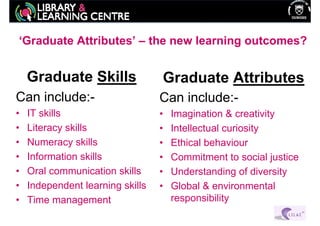
‘Graduate Attributes’ – the new learning outcomes?


    Graduate Skills               Graduate Attributes
Can include:-                     Can include:-
•   IT skills                     •   Imagination & creativity
•   Literacy skills               •   Intellectual curiosity
•   Numeracy skills               •   Ethical behaviour
•   Information skills            •   Commitment to social justice
•   Oral communication skills     •   Understanding of diversity
•   Independent learning skills   •   Global & environmental
•   Time management                   responsibility
Graduate Attributes
• Strong connection with HE’s current focus on
  employability and professionalism
• Quality Assurance initiatives are driving this
  debate (via the QAA in the UK)
  – Institutional Audit/Institutional Review (England/Wales/N
    Ireland)

  – ELIR (Scotland)
     • Enhancement Theme - ‘Graduates for the 21st Century’

• Information literacy widely accepted as one of
  the key graduate attributes in HE
Challenges posed by pursuit of ‘Graduate Attributes’

• They are not merely ‘skills’…
                    Imagination & creativity
                           Intellectual curiosity
     – …although we still need to teach the ‘skills’

•                             Ethical behaviour
    We may be required to engage much more
             Commitment to social justice
    with pedagogy and the practice of teaching

•   We may beUnderstanding anddiversity
                 required to possess of display
    the attributes we are aiming environmental
                    Global & to develop
                                      responsibility
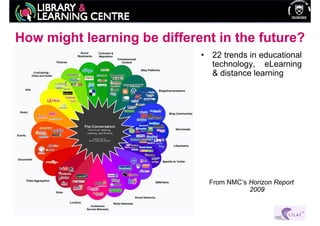
How might learning be different in the future?
                             •   22 trends in educational
                                 technology, eLearning
                                 & distance learning


                                 From NMC’s Horizon Report
                                            2009
Horizon Report
• Annual horizon-scanning paper produced by
  the New Media Consortium (NMC)
• 2011 report lists six ‘technologies to watch’
  – Electronic books (yes, really!)
  – Mobile computing
  – Augmented reality
  – Game-based learning
  – Gesture-based computing
  – Learning analytics
Challenges posed by these ‘imminent technologies’
• Predicting how they will affect
  education
• Predicting how they will affect our
  Libraries
• Aligning our organisations to meet
  the new pedagogies these
  innovations will demand
• Aligning these new technologies
  with the pursuit of Graduate Skills
• Developing our own professional &
  personal skills in order to engage
  effectively with these technologies
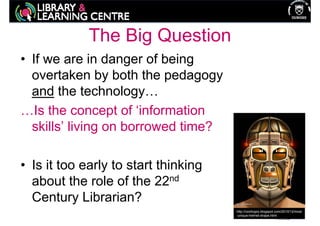
The Big Question
• If we are in danger of being
  overtaken by both the pedagogy
  and the technology…
…Is the concept of ‘information
  skills’ living on borrowed time?

• Is it too early to start thinking
  about the role of the 22nd
  Century Librarian?
                                      http://coolhqpix.blogspot.com/2010/12/most
                                      -unique-helmet-shape.html
Activity Two
• Consider your current activities related to
  information skills teaching
• You will work on one of two topics :-
   – The challenges of learners and learning
     behaviour
   – The challenges of current and emerging
     technologies
  – What would help you address these
    challenges?
Activity Two – Group One
• Consider your current activities related to
  information skills teaching
  – Working in groups of four to five, discuss :-
     • What things do you find challenging about the way
       your students behave as learners?
     • What things do you think your learners find
       challenging about information skills?
     • What would help you address these challenges?

  – You have 15 minutes to complete this activity
     • Be prepared to feed back at the end
Activity Two – Group Two
• Consider your current activities related to
  information skills teaching
  – Working in groups of four to five, discuss :-
     • What things do you find challenging about the
       technologies that your learners use?
     • What do you think your learners find challenging
       about using your Library and its resources?
     • What would help you address these challenges?

  – You have 15 minutes to complete this activity
     • Be prepared to feed back at the end
OK, time’s up!
Activity Two - feedback
• Discussion questions:-
  – Do you feel you are keeping up with changes to
    technology?
    • If so, what or who helps you to keep up?

  – Do you feel you are keeping up with the
    preferences and expectations of your learners?
    • Again, what or who helps with this?

  – Are you sufficiently skilled for working towards
    the development of graduate attributes?
    • If not, how can you rectify this?
Closing thoughts
• Rumours of the death of information
  skills have been wildly exaggerated
  – “Digital media literacy continues its rise in
    importance as a key skill in every
    discipline and profession” (Horizon Report 2011)

• Information Skills practitioners must
  therefore engage as far as possible
  with evolving technologies and
  pedagogies
Thanks for participating!


a.z.jackson@dundee.ac.uk
               Andy Jackson
        Learning & Teaching Librarian
            University of Dundee
Jackson - 22nd Century Librarians and the death of information skills

Jackson - 22nd Century Librarians and the death of information skills

  • 1.
    London 2011 PRE–CONFERENCE WORKSHOP 22ndCentury Librarians and the death of information skills Andy Jackson Learning & Teaching Librarian University of Dundee
  • 2.
    About me Andy Jackson Learning& Teaching Librarian at Dundee University Interested in information skills, employability & graduate attributes This workshop… • …Is the sequel to a workshop at LILAC 2010 – ‘Just enough education to perform : information skills, professionalism and employability’ • …Is intended to stimulate discussion & debate
  • 3.
    Outcomes from thisworkshop… • An opportunity to reflect on our own jobs and roles • A grounding in the issues surrounding graduate skills and graduate attributes • An understanding of the changing relationship between you and your learners • Some ideas for potential staff development in your own institutions and libraries
  • 4.
    This workshop willcover… • Activity One : the ideal graduate – Key information skills – Personal attributes • The 21st Century Graduate – Quality enhancements – Graduate attributes and the new technologies – 22nd Century Librarians • Activity Two : Learning behaviour and the new technologies – Challenges of the 21st Century Graduate – What would help us meet these challenges? • Discussion, potential developments, questions, comments, suggestions…
  • 5.
    Activity One • Whatmakes a good graduate? • Consider the learners in your own organisation – In pairs or groups of three, consider the following :- • What are the most important INFORMATION SKILLS you feel they should have when they graduate (suggest two)? • What PROFESSIONAL ATTRIBUTES would you like your students to have when they graduate (suggest two)? – You have 5 minutes to complete this activity • Be prepared to feed back at the end, either in person…
  • 6.
  • 7.
    Activity One -feedback • Personal attributes and information skills – Can we agree on what information skills are the most important to a graduate? – Can we identify a set of ‘professional’ attributes, (values, attitudes, behaviours) which we think will be valuable to a graduate? • New graduates are likely to be:- – Working towards a different kind of learning outcome – Using technologies and learning styles we haven’t yet fully embraced in Libraries
  • 8.
    ‘Graduate Attributes’ –the new learning outcomes? Graduate Skills Graduate Attributes Can include:- Can include:- • IT skills • Imagination & creativity • Literacy skills • Intellectual curiosity • Numeracy skills • Ethical behaviour • Information skills • Commitment to social justice • Oral communication skills • Understanding of diversity • Independent learning skills • Global & environmental • Time management responsibility
  • 9.
    Graduate Attributes • Strongconnection with HE’s current focus on employability and professionalism • Quality Assurance initiatives are driving this debate (via the QAA in the UK) – Institutional Audit/Institutional Review (England/Wales/N Ireland) – ELIR (Scotland) • Enhancement Theme - ‘Graduates for the 21st Century’ • Information literacy widely accepted as one of the key graduate attributes in HE
  • 10.
    Challenges posed bypursuit of ‘Graduate Attributes’ • They are not merely ‘skills’… Imagination & creativity Intellectual curiosity – …although we still need to teach the ‘skills’ • Ethical behaviour We may be required to engage much more Commitment to social justice with pedagogy and the practice of teaching • We may beUnderstanding anddiversity required to possess of display the attributes we are aiming environmental Global & to develop responsibility
  • 11.
    How might learningbe different in the future? • 22 trends in educational technology, eLearning & distance learning From NMC’s Horizon Report 2009
  • 12.
    Horizon Report • Annualhorizon-scanning paper produced by the New Media Consortium (NMC) • 2011 report lists six ‘technologies to watch’ – Electronic books (yes, really!) – Mobile computing – Augmented reality – Game-based learning – Gesture-based computing – Learning analytics
  • 13.
    Challenges posed bythese ‘imminent technologies’ • Predicting how they will affect education • Predicting how they will affect our Libraries • Aligning our organisations to meet the new pedagogies these innovations will demand • Aligning these new technologies with the pursuit of Graduate Skills • Developing our own professional & personal skills in order to engage effectively with these technologies
  • 14.
    The Big Question •If we are in danger of being overtaken by both the pedagogy and the technology… …Is the concept of ‘information skills’ living on borrowed time? • Is it too early to start thinking about the role of the 22nd Century Librarian? http://coolhqpix.blogspot.com/2010/12/most -unique-helmet-shape.html
  • 15.
    Activity Two • Consideryour current activities related to information skills teaching • You will work on one of two topics :- – The challenges of learners and learning behaviour – The challenges of current and emerging technologies – What would help you address these challenges?
  • 16.
    Activity Two –Group One • Consider your current activities related to information skills teaching – Working in groups of four to five, discuss :- • What things do you find challenging about the way your students behave as learners? • What things do you think your learners find challenging about information skills? • What would help you address these challenges? – You have 15 minutes to complete this activity • Be prepared to feed back at the end
  • 17.
    Activity Two –Group Two • Consider your current activities related to information skills teaching – Working in groups of four to five, discuss :- • What things do you find challenging about the technologies that your learners use? • What do you think your learners find challenging about using your Library and its resources? • What would help you address these challenges? – You have 15 minutes to complete this activity • Be prepared to feed back at the end
  • 18.
  • 19.
    Activity Two -feedback • Discussion questions:- – Do you feel you are keeping up with changes to technology? • If so, what or who helps you to keep up? – Do you feel you are keeping up with the preferences and expectations of your learners? • Again, what or who helps with this? – Are you sufficiently skilled for working towards the development of graduate attributes? • If not, how can you rectify this?
  • 20.
    Closing thoughts • Rumoursof the death of information skills have been wildly exaggerated – “Digital media literacy continues its rise in importance as a key skill in every discipline and profession” (Horizon Report 2011) • Information Skills practitioners must therefore engage as far as possible with evolving technologies and pedagogies
  • 21.
    Thanks for participating! a.z.jackson@dundee.ac.uk Andy Jackson Learning & Teaching Librarian University of Dundee