Talking ‘pedagogy’ for librarians

       Working towards the PgC THE
What we’ll be talking about
• What is the PgC THE?

• Personal journey

• Cons

• Benefits
What is the PgC THE?
• Postgraduate certificate in Teaching in Higher
  Education

• All academic staff expected to complete 60
  credits to gain HEA Fellowship

• Non academic staff can stop at 20 credits
  – And become a Associate fellow of HEA
What’s involved:
        HEA Associate - 20 credits
• Introductory studies, Teaching in Higher
  Education
  – 40 hours of teaching, including teaching prep
  – Teaching intervention
     • An aspect of learning and teaching practice that you can
       develop and improve
     • With peer observations and student evaluation/feedback
  – Provide evidence of learning in portfolio
     • Includes reflections, feedback & academic paper on teaching
       intervention
What’s involved
      HEA Fellowship – 40 credits
• Further 80 hours of concurrent teaching
• Two teaching interventions

  – 4 peer observations, 1 report and 1 poster,
    2 student evaluations

• Reflective summary
HEA – UK Professional Standards Framework

• Design and plan learning activities and/or
  programmes of study
• Teach and/or support learning
• Assess and give feedback to learners
• Develop effective learning environments and
  approaches to student support and guidance
• Engage in continuing professional
  development
How a librarian might ‘teach’ rather
             than ‘train’
Topic: Gather information for an early years assignment
using relevant subject databases
Task: Students are divided into groups and asked to
search for information relating to their topic to become
an ‘expert’ in their subject area. Each group has 30
minutes to investigate their topic and when the time is
up, each expert group will take turns to come up to the
front and demonstrate the database.
Assessment: Poster visualizing their research
Would we have done this before?
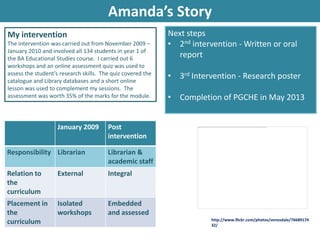
Amanda’s Story
My intervention                                              Next steps
The intervention was carried out from November 2009 –        • 2nd intervention - Written or oral
January 2010 and involved all 134 students in year 1 of
the BA Educational Studies course. I carried out 6
                                                                report
workshops and an online assessment quiz was used to
assess the student’s research skills. The quiz covered the
catalogue and Library databases and a short online
                                                             • 3rd Intervention - Research poster
lesson was used to complement my sessions. The
assessment was worth 35% of the marks for the module.        • Completion of PGCHE in May 2013


                    January 2009        Post
                                        intervention

Responsibility Librarian                Librarian &
                                        academic staff
Relation to         External            Integral
the
curriculum
Placement in        Isolated            Embedded
the                 workshops           and assessed
                                                                         http://www.flickr.com/photos/venosdale/76689174
curriculum                                                               32/
Limits: barriers & obstacles
•   Lack of information strategy
      •   Varies from university to university

•   Lack of academic co-operation
      •   Not always willing to involve librarians

•   Other commitments and responsibilities
Is it worth it? Yes!!!
• HEA professional recognition is invaluable

• Information literacy framework: understanding how to
  teach good information skills is essential
   – Formal teaching qualification helps you do this more effectively

• Understanding of learning theory is important
   – More realistic expectations of students

• Greater self-motivation to take risks and engage with new
  and exciting forms of teaching technology
“The reward of a
thing well done,
is to have done
it”.

         Ralph Waldo
         Emerson,
         "Nominalist and
         Realist", Essays:
         Second Series
         (1844).

Talking 'pedagogy' for librarians: doing the PgC THE

  • 1.
    Talking ‘pedagogy’ forlibrarians Working towards the PgC THE
  • 2.
    What we’ll betalking about • What is the PgC THE? • Personal journey • Cons • Benefits
  • 3.
    What is thePgC THE? • Postgraduate certificate in Teaching in Higher Education • All academic staff expected to complete 60 credits to gain HEA Fellowship • Non academic staff can stop at 20 credits – And become a Associate fellow of HEA
  • 4.
    What’s involved: HEA Associate - 20 credits • Introductory studies, Teaching in Higher Education – 40 hours of teaching, including teaching prep – Teaching intervention • An aspect of learning and teaching practice that you can develop and improve • With peer observations and student evaluation/feedback – Provide evidence of learning in portfolio • Includes reflections, feedback & academic paper on teaching intervention
  • 5.
    What’s involved HEA Fellowship – 40 credits • Further 80 hours of concurrent teaching • Two teaching interventions – 4 peer observations, 1 report and 1 poster, 2 student evaluations • Reflective summary
  • 6.
    HEA – UKProfessional Standards Framework • Design and plan learning activities and/or programmes of study • Teach and/or support learning • Assess and give feedback to learners • Develop effective learning environments and approaches to student support and guidance • Engage in continuing professional development
  • 7.
    How a librarianmight ‘teach’ rather than ‘train’ Topic: Gather information for an early years assignment using relevant subject databases Task: Students are divided into groups and asked to search for information relating to their topic to become an ‘expert’ in their subject area. Each group has 30 minutes to investigate their topic and when the time is up, each expert group will take turns to come up to the front and demonstrate the database. Assessment: Poster visualizing their research
  • 8.
    Would we havedone this before?
  • 11.
    Amanda’s Story My intervention Next steps The intervention was carried out from November 2009 – • 2nd intervention - Written or oral January 2010 and involved all 134 students in year 1 of the BA Educational Studies course. I carried out 6 report workshops and an online assessment quiz was used to assess the student’s research skills. The quiz covered the catalogue and Library databases and a short online • 3rd Intervention - Research poster lesson was used to complement my sessions. The assessment was worth 35% of the marks for the module. • Completion of PGCHE in May 2013 January 2009 Post intervention Responsibility Librarian Librarian & academic staff Relation to External Integral the curriculum Placement in Isolated Embedded the workshops and assessed http://www.flickr.com/photos/venosdale/76689174 curriculum 32/
  • 12.
    Limits: barriers &obstacles • Lack of information strategy • Varies from university to university • Lack of academic co-operation • Not always willing to involve librarians • Other commitments and responsibilities
  • 13.
    Is it worthit? Yes!!! • HEA professional recognition is invaluable • Information literacy framework: understanding how to teach good information skills is essential – Formal teaching qualification helps you do this more effectively • Understanding of learning theory is important – More realistic expectations of students • Greater self-motivation to take risks and engage with new and exciting forms of teaching technology
  • 14.
    “The reward ofa thing well done, is to have done it”. Ralph Waldo Emerson, "Nominalist and Realist", Essays: Second Series (1844).

Editor's Notes

  • #2 http://www.flickr.com/photos/tomitapio/931352138/Don’t introduce yourself as this has already been done. photo credit: <a href="http://www.flickr.com/photos/tomitapio/931352138/">TomiTapio</a> via <a href="http://photopin.com">photopin</a> <a href="http://creativecommons.org/licenses/by-sa/2.0/">cc</a>
  • #3 What is the PgC THE?Aim of programme – to develop your understanding of learning & teaching practices in line with a structured programme that will lead to a recognised teaching qualification in Higher Education. Both Amanda and I started ourPgC THE early in 2009. We both undertook an intensive induction programme which lasted around 5 days. This included a 2 day residential induction and two days back at Cardiff Met in which we started to develop our ideas and requirements for the teaching intervention. It introduced us to learning theory and practices, peer observation and reflection. We had to produce a written learning statement of our own experiences, present and provide peer observations of individual presentations. It was a steep learning curve: by the end of the introductory course, we had understanding of some of the key cognitive learning theories and different approaches to teaching practices in education. And these approaches to teaching and learning are vastly different from when I was a student. There is a greater emphasis on being a facilitator of learning, so rather than just talking to students and expecting them to understand – a traditional didactic way of teaching. You had to create an environment that was conductive to learning through a variety of means. Awareness of different learning styles or approaches. Group work, peer assessment, etc. Assessment approaches were discussed as well – not enough just to mark students work – there are a number of summative and formative ways of assessing, which includes peer assessment, or comparing marks between one group and another. nd assessment wasn’t simply marking students work as being right or wrong – it is present in front of other academic staff across Wales. This involved intensive group work, peer observations of and course wh and a reflect post 2 days on either side of this a preWe attended a two-day intensive residential which introduced us to pedagogical theories of learning and understanding. and explored the 20 credit module Structure of programmeCourseworkInterventionsCatherineAmandaBenefitsCons
  • #4 What is the PgC THE?Aim of programme – to develop your understanding of learning & teaching practices in line with a structured programme that will lead to a recognised teaching qualification in Higher Education. Both Amanda and I started ourPgC THE early in 2009. We both undertook an intensive induction programme which lasted around 5 days. This included a 2 day residential induction and 3 days based at Cardiff Met in which we started to develop our ideas and requirements for the teaching intervention. It introduced us to learning theory and practices, peer observation and reflection. We had to produce a written learning statement of our own experiences, present and in turn provide peer observations feedback of individual presentations. It was a steep learning curve: by the end of the introductory course, we had understanding of some of the key cognitive learning theories and different approaches to teaching practices in education. And these approaches to teaching and learning are vastly different from when I was a student. There is a greater emphasis on being a facilitator of learning, so rather than just talking to students and expecting them to understand – a traditional didactic way of teaching. You had to create an environment that was conductive to learning through a variety of means and the course encouraged you to explore these approaches through a variety of workshops help throughout the year. All academic staff are expected to complete 60 credits to gain HEA Fellowship – at Cardiff Met you get a higher rate of pay on completion of this qualification. The 20 credits module was set up for non academic staff who did some teaching, but not These included teachers toolkit - Awareness of different learning styles or approaches. Group work, peer assessment, etc. Assessment approaches were discussed as well – not enough just to mark students work – there are a number of summative and formative ways of assessing, which includes peer assessment, or comparing marks between one group and another.
  • #5 I completed my 20 credits earlier this year, but actually did the intervention in 2009. I had to provide evidence that I’d undertaken 40 hours of teaching, including
  • #9 photo credit: <a href="http://www.flickr.com/photos/billypalooza/186473466/">billypalooza</a> via <a href="http://photopin.com">photopin</a> <a href="http://creativecommons.org/licenses/by-nc-nd/2.0/">cc</a>http://www.flickr.com/photos/billypalooza/186473466/
  • #10 http://www.flickr.com/photos/venosdale/7668917432/
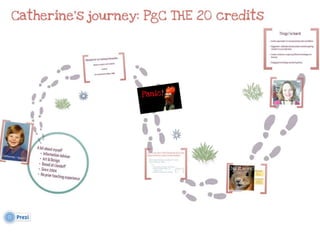
  • #11 http://prezi.com/dtqd8q3ih6h1/catherines-pgc-the-learning-journey/
  • #13 http://www.flickr.com/photos/hi-phi/66012169/photo credit: <a href="http://www.flickr.com/photos/hi-phi/66012169/">[phil h]</a> via <a href="http://photopin.com">photopin</a> <a href="http://creativecommons.org/licenses/by-nc-sa/2.0/">cc</a>
  • #15 photo credit: <a href="http://www.flickr.com/photos/tcmorgan/7364516242/">Tc Morgan</a> via <a href="http://photopin.com">photopin</a> <a href="http://creativecommons.org/licenses/by-nc-sa/2.0/">cc</a>http://www.flickr.com/photos/tcmorgan/7364516242/Quote found from Wiki Quotes!! https://en.wikiquote.org/wiki/Work