Dr Jane Secker,
London School of Economics and Political Science


                    CONUL Information Literacy Seminar
                                        14th June 2012
                                    flickr.com/photos/mcginnly/2197675676
   Developing the new curriculum
    ◦ Arcadia Fellowship May to July 2011
    ◦ Research undertaken with Dr Emma Coonan from
      Cambridge University Library
   Outputs from the research
    ◦ Expert consultation
    ◦ Theoretical background
    ◦ The curriculum and supporting docs
   ANCIL Phase 2: strategies for implementation -
    ANCIL at LSE
The Arcadia Programme
    Based at Cambridge University Library
    Academic advisor: Professor John Naughton
    Exploring the role of academic libraries in a digital age
    20 Arcadia Fellows over 3 years
    Many from outside Cambridge, not all librarians
Develop a new, revolutionary
curriculum for information literacy in a
digital age

• Understand the needs of undergraduates entering HE over
  the coming 5 years
• Map the current landscape of information literacy
• Develop a practical curriculum and supporting resources
• All in 10 weeks from May – July 2011
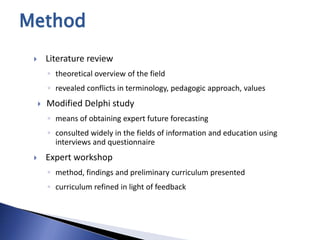
Method
        Literature review
         ◦ theoretical overview of the field
         ◦ revealed conflicts in terminology, pedagogic approach, values
        Modified Delphi study
         ◦ means of obtaining expert future forecasting
         ◦ consulted widely in the fields of information and education using
           interviews and questionnaire
        Expert workshop
         ◦ method, findings and preliminary curriculum presented
         ◦ curriculum refined in light of feedback
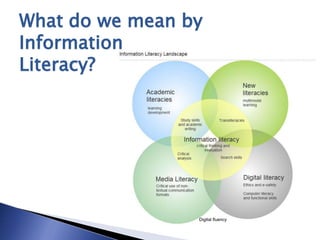
What do we mean by
Information
Literacy?


                 Digital fluency
   Interviews and online questionnaire with a range of experts in
    the information and education field
   Open questions on what an information literacy curriculum for
    future undergraduates should look like
   The experts told us:
    ◦ How you teach IL as important as what you teach
    ◦ Flexibility in terms of content, delivery, format, timing
    ◦ Teaching rather than training
    ◦ Embedded in the academic discipline: holistic and supported by the
      institution as a whole
    ◦ Focus on underlying skills, knowledge and behaviour rather than
      technologies and tools
IL is not:
• seen as part of the mainstream academic mission

• merely functional/technological skills

• the preserve or saviour of the library


IL is:
• a continuum of skills, abilities, values and attitudes
   around analysing, evaluating, managing and assimilating
   information
• fundamental to the ongoing development of the
   individual, social as well as academic
It is the defining characteristics of the discerning
 scholar, the informed and judicious citizen and
              the autonomous learner


ANCIL definition of information literacy (2011)
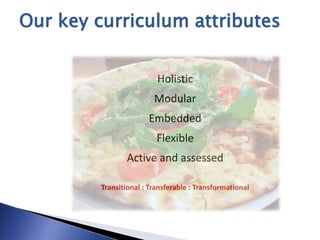
Our key curriculum attributes


                          Holistic
                         Modular
                       Embedded
                          Flexible
                 Active and assessed

         Transitional : Transferable : Transformational
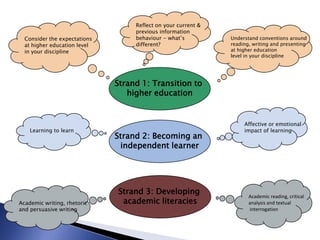
Reflect on your current &
                                   previous information
  Consider the expectations        behaviour - what’s          Understand conventions around
  at higher education level        different?                  reading, writing and presenting
  in your discipline                                           at higher education
                                                               level in your discipline


                              Strand 1: Transition to
                                 higher education


                                                                    Affective or emotional
    Learning to learn                                               impact of learning
                              Strand 2: Becoming an
                               independent learner


                              Strand 3: Developing
                                                                      Academic reading, critical
Academic writing, rhetoric     academic literacies                    analysis and textual
and persuasive writing                                                interrogation
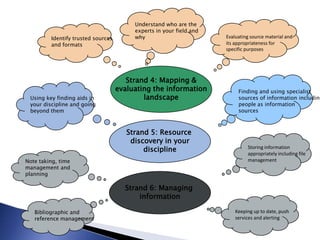
Understand who are the
                                         experts in your field and
         Identify trusted sources        why                         Evaluating source material and
         and formats                                                 its appropriateness for
                                                                     specific purposes


                                       Strand 4: Mapping &
                                    evaluating the information            Finding and using specialist
 Using key finding aids in                  landscape                     sources of information including
 your discipline and going                                                people as information
 beyond them                                                              sources


                                       Strand 5: Resource
                                        discovery in your
                                            discipline                        Storing information
                                                                              appropriately including file
Note taking, time                                                             management
management and
planning

                                      Strand 6: Managing
                                          information

   Bibliographic and                                                     Keeping up to date, push
   reference management                                                  services and alerting
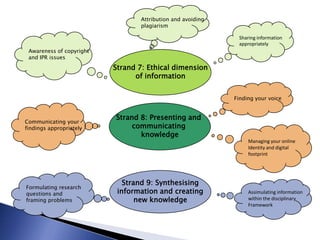
Attribution and avoiding
                                 plagiarism

                                                             Sharing information
                                                             appropriately
 Awareness of copyright
 and IPR issues
                          Strand 7: Ethical dimension
                                of information


                                                            Finding your voice


                          Strand 8: Presenting and
Communicating your
findings appropriately         communicating
                                 knowledge
                                                                 Managing your online
                                                                 Identity and digital
                                                                 footprint


                             Strand 9: Synthesising
Formulating research
questions and              information and creating              Assimulating information
framing problems                 new knowledge                   within the disciplinary
                                                                 Framework
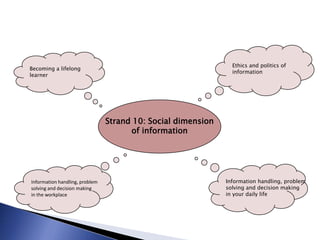
Ethics and politics of
Becoming a lifelong
                                                                information
learner


                                Strand 10: Social dimension
                                      of information


Information handling, problem                                 Information handling, problem
solving and decision making                                   solving and decision making
in the workplace                                              in your daily life
   Follow on joint fellowship was funded at Cambridge from
    Oct – Dec 2011
   Katy Wrathall and Helen Webster explored strategies for
    implementing the new curriculum
   Helen explored bottom up approaches at Cambridge
    ◦ Developed resources for supervisors and colleges
    ◦ Information Literacy First Aid Model
   Katy started top down at York St John and University of
    Worcester
    ◦ Piloted the use of ANCIL as an institutional audit tool
   Lesson plans, teaching resources all on project wiki
   Specialist social science institution
   Highly ranked in terms of research excellence
   Cosmopolitan student body, relatively small undergraduate
    population
   Largest departments Economics and Accounting and Finance
    but strong qualitative departments: Anthropology, Political
    Science, Sociology, International Relations, Philosophy etc.
   Compulsory course for undergraduates (LSE100)
   Traditional teaching and assessment: lectures & seminars
    and end of year exams
   LSE use Moodle
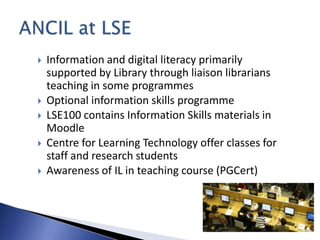
   Information and digital literacy primarily
    supported by Library through liaison librarians
    teaching in some programmes
   Optional information skills programme
   LSE100 contains Information Skills materials in
    Moodle
   Centre for Learning Technology offer classes for
    staff and research students
   Awareness of IL in teaching course (PGCert)
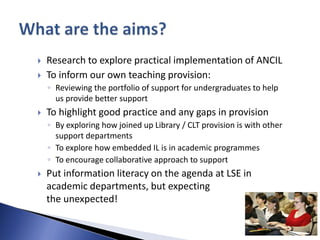
   Research to explore practical implementation of ANCIL
   To inform our own teaching provision:
    ◦ Reviewing the portfolio of support for undergraduates to help
      us provide better support
   To highlight good practice and any gaps in provision
    ◦ By exploring how joined up Library / CLT provision is with other
      support departments
    ◦ To explore how embedded IL is in academic programmes
    ◦ To encourage collaborative approach to support
   Put information literacy on the agenda at LSE in
    academic departments, but expecting
    the unexpected!
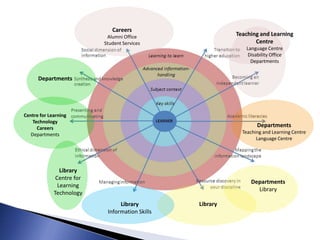
Careers
                            Alumni Office                  Teaching and Learning
                           Student Services                       Centre
                                                              Language Centre
                                                               Disability Office
                                                                Departments


      Departments


Centre for Learning
    Technology
      Careers                                                      Departments
   Departments                                               Teaching and Learning Centre
                                                                   Language Centre


                Library
              Centre for
                                                                Departments
               Learning
                                                                  Library
             Technology
                                 Library         Library
                            Information Skills
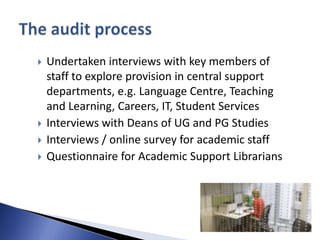
   Undertaken interviews with key members of
    staff to explore provision in central support
    departments, e.g. Language Centre, Teaching
    and Learning, Careers, IT, Student Services
   Interviews with Deans of UG and PG Studies
   Interviews / online survey for academic staff
   Questionnaire for Academic Support Librarians
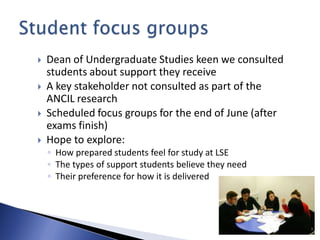
   Dean of Undergraduate Studies keen we consulted
    students about support they receive
   A key stakeholder not consulted as part of the
    ANCIL research
   Scheduled focus groups for the end of June (after
    exams finish)
   Hope to explore:
    ◦ How prepared students feel for study at LSE
    ◦ The types of support students believe they need
    ◦ Their preference for how it is delivered
@Kaiho on flickr


                   Watch this space!
ANCIL outputs
Phase 1 reports
• Executive summary, expert consultation report, and
  theoretical background
• Curriculum and supporting documents
                    http://newcurriculum.wordpress.com/
Phase 2 resources and case studies
• Case studies - University of Worcester, York St John
  University
• Cambridge resources
                   http://implementingancil.pbworks.com
YouTube Video
• Search for “ANCIL curriculum”
           http://www.youtube.com/watch?v=vY-V2givIiE
Email: j.secker@lse.ac.uk Twitter: @jsecker

Blog : www.newcurriculum.wordpress.com

Wiki : www.implementingancil.pbworks.com

Developing and implementing a new curriculum for information literacy

  • 1.
    Dr Jane Secker, LondonSchool of Economics and Political Science CONUL Information Literacy Seminar 14th June 2012 flickr.com/photos/mcginnly/2197675676
  • 2.
    Developing the new curriculum ◦ Arcadia Fellowship May to July 2011 ◦ Research undertaken with Dr Emma Coonan from Cambridge University Library  Outputs from the research ◦ Expert consultation ◦ Theoretical background ◦ The curriculum and supporting docs  ANCIL Phase 2: strategies for implementation - ANCIL at LSE
  • 3.
    The Arcadia Programme  Based at Cambridge University Library  Academic advisor: Professor John Naughton  Exploring the role of academic libraries in a digital age  20 Arcadia Fellows over 3 years  Many from outside Cambridge, not all librarians
  • 4.
    Develop a new,revolutionary curriculum for information literacy in a digital age • Understand the needs of undergraduates entering HE over the coming 5 years • Map the current landscape of information literacy • Develop a practical curriculum and supporting resources • All in 10 weeks from May – July 2011
  • 5.
    Method  Literature review ◦ theoretical overview of the field ◦ revealed conflicts in terminology, pedagogic approach, values  Modified Delphi study ◦ means of obtaining expert future forecasting ◦ consulted widely in the fields of information and education using interviews and questionnaire  Expert workshop ◦ method, findings and preliminary curriculum presented ◦ curriculum refined in light of feedback
  • 6.
    What do wemean by Information Literacy? Digital fluency
  • 8.
    Interviews and online questionnaire with a range of experts in the information and education field  Open questions on what an information literacy curriculum for future undergraduates should look like  The experts told us: ◦ How you teach IL as important as what you teach ◦ Flexibility in terms of content, delivery, format, timing ◦ Teaching rather than training ◦ Embedded in the academic discipline: holistic and supported by the institution as a whole ◦ Focus on underlying skills, knowledge and behaviour rather than technologies and tools
  • 9.
    IL is not: •seen as part of the mainstream academic mission • merely functional/technological skills • the preserve or saviour of the library IL is: • a continuum of skills, abilities, values and attitudes around analysing, evaluating, managing and assimilating information • fundamental to the ongoing development of the individual, social as well as academic
  • 10.
    It is thedefining characteristics of the discerning scholar, the informed and judicious citizen and the autonomous learner ANCIL definition of information literacy (2011)
  • 11.
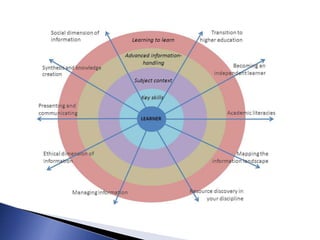
    Our key curriculumattributes Holistic Modular Embedded Flexible Active and assessed Transitional : Transferable : Transformational
  • 13.
    Reflect on yourcurrent & previous information Consider the expectations behaviour - what’s Understand conventions around at higher education level different? reading, writing and presenting in your discipline at higher education level in your discipline Strand 1: Transition to higher education Affective or emotional Learning to learn impact of learning Strand 2: Becoming an independent learner Strand 3: Developing Academic reading, critical Academic writing, rhetoric academic literacies analysis and textual and persuasive writing interrogation
  • 14.
    Understand who arethe experts in your field and Identify trusted sources why Evaluating source material and and formats its appropriateness for specific purposes Strand 4: Mapping & evaluating the information Finding and using specialist Using key finding aids in landscape sources of information including your discipline and going people as information beyond them sources Strand 5: Resource discovery in your discipline Storing information appropriately including file Note taking, time management management and planning Strand 6: Managing information Bibliographic and Keeping up to date, push reference management services and alerting
  • 15.
    Attribution and avoiding plagiarism Sharing information appropriately Awareness of copyright and IPR issues Strand 7: Ethical dimension of information Finding your voice Strand 8: Presenting and Communicating your findings appropriately communicating knowledge Managing your online Identity and digital footprint Strand 9: Synthesising Formulating research questions and information and creating Assimulating information framing problems new knowledge within the disciplinary Framework
  • 16.
    Ethics and politicsof Becoming a lifelong information learner Strand 10: Social dimension of information Information handling, problem Information handling, problem solving and decision making solving and decision making in the workplace in your daily life
  • 18.
    Follow on joint fellowship was funded at Cambridge from Oct – Dec 2011  Katy Wrathall and Helen Webster explored strategies for implementing the new curriculum  Helen explored bottom up approaches at Cambridge ◦ Developed resources for supervisors and colleges ◦ Information Literacy First Aid Model  Katy started top down at York St John and University of Worcester ◦ Piloted the use of ANCIL as an institutional audit tool  Lesson plans, teaching resources all on project wiki
  • 19.
    Specialist social science institution  Highly ranked in terms of research excellence  Cosmopolitan student body, relatively small undergraduate population  Largest departments Economics and Accounting and Finance but strong qualitative departments: Anthropology, Political Science, Sociology, International Relations, Philosophy etc.  Compulsory course for undergraduates (LSE100)  Traditional teaching and assessment: lectures & seminars and end of year exams  LSE use Moodle
  • 20.
    Information and digital literacy primarily supported by Library through liaison librarians teaching in some programmes  Optional information skills programme  LSE100 contains Information Skills materials in Moodle  Centre for Learning Technology offer classes for staff and research students  Awareness of IL in teaching course (PGCert)
  • 21.
    Research to explore practical implementation of ANCIL  To inform our own teaching provision: ◦ Reviewing the portfolio of support for undergraduates to help us provide better support  To highlight good practice and any gaps in provision ◦ By exploring how joined up Library / CLT provision is with other support departments ◦ To explore how embedded IL is in academic programmes ◦ To encourage collaborative approach to support  Put information literacy on the agenda at LSE in academic departments, but expecting the unexpected!
  • 22.
    Careers Alumni Office Teaching and Learning Student Services Centre Language Centre Disability Office Departments Departments Centre for Learning Technology Careers Departments Departments Teaching and Learning Centre Language Centre Library Centre for Departments Learning Library Technology Library Library Information Skills
  • 23.
    Undertaken interviews with key members of staff to explore provision in central support departments, e.g. Language Centre, Teaching and Learning, Careers, IT, Student Services  Interviews with Deans of UG and PG Studies  Interviews / online survey for academic staff  Questionnaire for Academic Support Librarians
  • 24.
    Dean of Undergraduate Studies keen we consulted students about support they receive  A key stakeholder not consulted as part of the ANCIL research  Scheduled focus groups for the end of June (after exams finish)  Hope to explore: ◦ How prepared students feel for study at LSE ◦ The types of support students believe they need ◦ Their preference for how it is delivered
  • 25.
    @Kaiho on flickr Watch this space!
  • 26.
    ANCIL outputs Phase 1reports • Executive summary, expert consultation report, and theoretical background • Curriculum and supporting documents http://newcurriculum.wordpress.com/ Phase 2 resources and case studies • Case studies - University of Worcester, York St John University • Cambridge resources http://implementingancil.pbworks.com YouTube Video • Search for “ANCIL curriculum” http://www.youtube.com/watch?v=vY-V2givIiE
  • 27.
    Email: j.secker@lse.ac.uk Twitter:@jsecker Blog : www.newcurriculum.wordpress.com Wiki : www.implementingancil.pbworks.com

Editor's Notes

  • #2 Jane to welcome/introduce and begin session
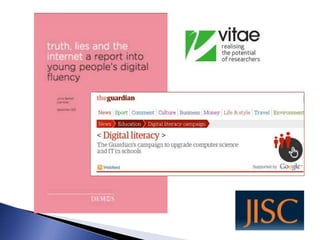
  • #8 EmmaThe 2011 Demos report argues that helping young people navigate hugely variable Internet sources should be achieved not by tighter controls but by ensuring they can make informed judgements (4).The move towards independent learning is again key not just to our practices but in our thinking – we should think less about the internet causing harm (passive learning model) and instead focus on what young people bring to the technologies – helping them equip and empower themselves with an understanding of how to apply critical judgement.The Guardian’s high-provile digital literacy campaign for radical change to how ICT is taught and thought about in schools, JISC’s portfolio of projects around the digital library, data management, digital repositories, and Vitae’s events for the ‘Digital Researcher’ – all show that this concept of digital literacy or fluency is becoming of national importance (at last!). In this environment we have a chance to rehabilitate IL.
  • #13 Jane (or Emma depending on timing?)
  • #18 Emma:Not separated (that’s why the learner is at the centre of our spider diagram)Biggs - Learning outcomes, activities and assessment aligned
  • #20 LSE has around 9000 students in total, 4500 are undergraduates. The rest are postgraduate and come from over 140 countries. 16 Nobel Prize winners from LSE – the first being George Bernard Shaw who was one of the founders of the school34 past or present world leaders have studied ot taught at LSE.
  • #28 Emma – find more info at ...