Major electrolytes
Pt. L R College of Pharmacy
faridabad
Electrolytes used in acid-base
therapy( inorganic compounds)
• Sodium acetate
• Potassium acetate
• Sodium bicarbonate
• Sodium citrate
• Potassium citrate
• Sodium lactate
• Ammonium chloride
• Potassium bicarbonate
• Body of human beings contains both body
fluid & electrolytes
• The body fluids are divided into followings
• Intracellular fluid:- (intra means inside
the cell) fluid present inside the cell or as
cytoplasmic fluid. It’s about 45-50% of
body wt.
• Extra cellular fluid:- fluid present outside
the cells i.e. it is about 12-15% of body wt.
Prolonged fever, sever vomiting or
diarrhea cause the dis-balancing of
physiological ions in the human body
instead in the normal situation body
mechanism itself maintains the
physiological ions conc” & maintain the
electrolytes in the body but whenever body
fails to do that mechanism we needs to
replace the ions from out side of body.
• Diarrhea:- passage of loose , liquid or
watery stool
Clinical types of diarrheal disease
• Acute watery diarrhea
• Acute bloody diarrhea
• Persistent diarrhea
• Diarrhea with severe malnutrition
( marasmus & kwashiorkor )
Control of diarrheal diseases
• Short term
(a.) Appropriate clinical management
• ORS
• Intravenous rehydration
• Maintenance therapy
• Appropriate feeding
• Chemotherapy
• Zinc supplementation
( b.) better MCH care practices
Maternal nutrition
Child nutrition
( c.) preventive strategies
Sanitation
Health education
immunization
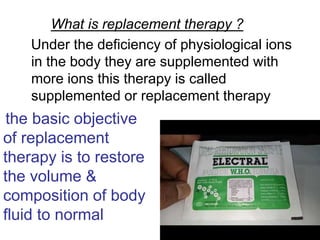
What is replacement therapy ?
Under the deficiency of physiological ions
in the body they are supplemented with
more ions this therapy is called
supplemented or replacement therapy
the basic objective
of replacement
therapy is to restore
the volume &
composition of body
fluid to normal
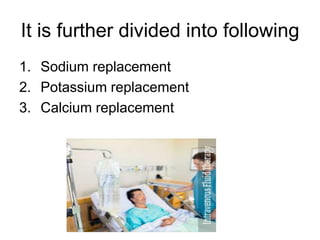
It is further divided into following
1. Sodium replacement
2. Potassium replacement
3. Calcium replacement
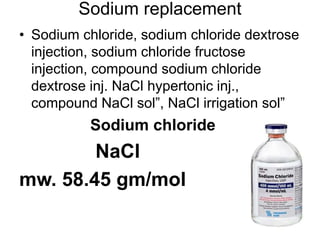
Sodium replacement
• Sodium chloride, sodium chloride dextrose
injection, sodium chloride fructose
injection, compound sodium chloride
dextrose inj. NaCl hypertonic inj.,
compound NaCl sol”, NaCl irrigation sol”
Sodium chloride
NaCl
mw. 58.45 gm/mol
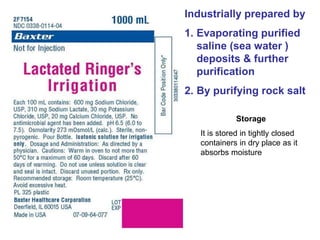
Industrially prepared by
1. Evaporating purified
saline (sea water )
deposits & further
purification
2. By purifying rock salt
Storage
It is stored in tightly closed
containers in dry place as it
absorbs moisture
Physical properties
• Colorless cubic crystals
• Saline taste & odorless
• Soluble in water, glycerin
• Slightly soluble in alcohol
Uses
• It is salt extra cellular fluid
• Used for replacement therapy & manufacturing
of isotonic sol” (0.9% w/w)
• Isotonic solution used as wet dressing for
irrigating body cavities
• Tissue hypertonic sol” are administered for
maintenance therapy when patient is unable to
take fluid orally for 1-3 days
• Hypertonic inj. used in loss of sodium
• orally administered hypertonic sol” induces
vomiting so used in poisoning accidents
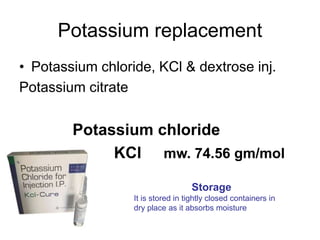
Potassium replacement
• Potassium chloride, KCl & dextrose inj.
Potassium citrate
Potassium chloride
KCl mw. 74.56 gm/mol
Storage
It is stored in tightly closed containers in
dry place as it absorbs moisture
Physical properties
• Colorless, odourless
• Elongated, prismatic or cubical crystals
• Saline taste
• Soluble in water
• Insoluble in alcohol, ether
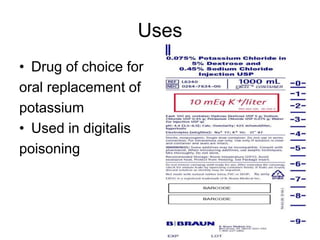
Uses
• Drug of choice for
oral replacement of
potassium
• Used in digitalis
poisoning
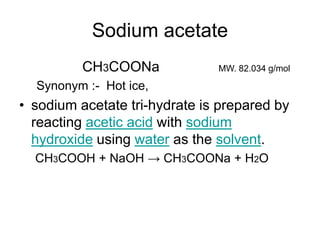
Sodium acetate
CH3COONa MW. 82.034 g/mol
Synonym :- Hot ice,
• sodium acetate tri-hydrate is prepared by
reacting acetic acid with sodium
hydroxide using water as the solvent.
CH3COOH + NaOH → CH3COONa + H2O
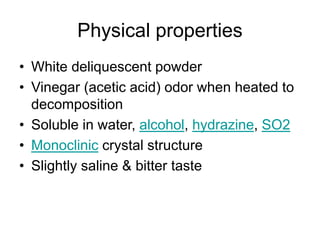
Physical properties
• White deliquescent powder
• Vinegar (acetic acid) odor when heated to
decomposition
• Soluble in water, alcohol, hydrazine, SO2
• Monoclinic crystal structure
• Slightly saline & bitter taste
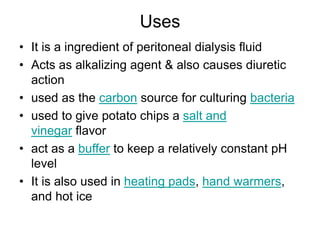
Uses
• It is a ingredient of peritoneal dialysis fluid
• Acts as alkalizing agent & also causes diuretic
action
• used as the carbon source for culturing bacteria
• used to give potato chips a salt and
vinegar flavor
• act as a buffer to keep a relatively constant pH
level
• It is also used in heating pads, hand warmers,
and hot ice
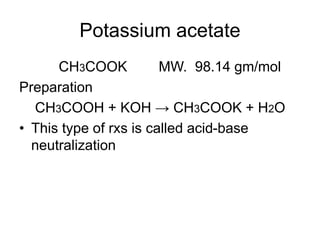
Potassium acetate
CH3COOK MW. 98.14 gm/mol
Preparation
CH3COOH + KOH → CH3COOK + H2O
• This type of rxs is called acid-base
neutralization
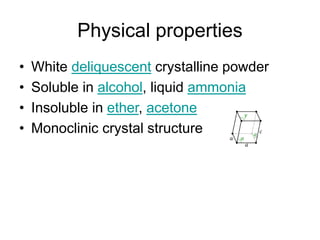
Physical properties
• White deliquescent crystalline powder
• Soluble in alcohol, liquid ammonia
• Insoluble in ether, acetone
• Monoclinic crystal structure
Uses
• Deicing
• Potassium acetate is the extinguishing
agent used in Class K fire extinguishers
• used as a food additive as
a preservative and acidity regulator
• Drug of choice for oral replacement of
potassium
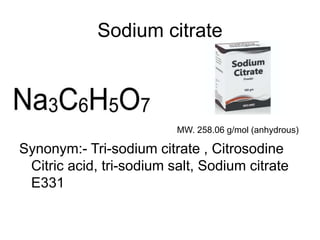
Sodium citrate
MW. 258.06 g/mol (anhydrous)
Synonym:- Tri-sodium citrate , Citrosodine
Citric acid, tri-sodium salt, Sodium citrate
E331
Physical properties
●White crystalline powder
●slightly deliquescent in
moist air
●Freely soluble in water
●salt effloresces on exposure
to dry air
●Practically insoluble in
Alcohol & ether
●Like citric acid, it has a sour taste
Uses
• used as a food additive, usually for flavor or as
a preservative
• buffering agent or acidity regulator from the medical
point of view, it is used as alkalinizing agent
• sodium citrate as an anticoagulant in blood transfusions
• Sodium citrate is used to relieve discomfort in urinary-
tract infections, such as cystitis
• used as an osmotic laxative
• agent for removal of carbonate scale from boilers without
removing them from operation
• Good sequestering properties
Sodium bicarbonate
NaHCO3 MW. 84.00 gm/mol
• Synonym:- Baking soda, bicarb (laboratory
slang), bicarbonate of soda, nahcolite,
bread soda, cooking soda.
• Preparation:- solvay’s process
Physical properties
• White crystalline powder
• Freely soluble in water
• odourless
• Insoluble in alcohol & ether
• Saline taste
• Monoclinic crystal structure
• Salt effloresces on the exposure to dry air
thus stored in air tight container
uses
• primarily used in baking as a leavening agent
• Baking soda is used to soften pulses (peas,
beans) before and during cooking
• Fungicide and pest control
• has weak disinfectant properties
• Pyrotechnics
• used to neutralize unwanted acid to treat acid
indigestion and heartburn i.e. stomach
acid produces salt, water, and carbon dioxide
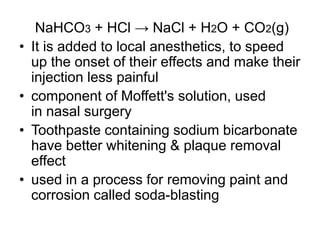
NaHCO3 + HCl → NaCl + H2O + CO2(g)
• It is added to local anesthetics, to speed
up the onset of their effects and make their
injection less painful
• component of Moffett's solution, used
in nasal surgery
• Toothpaste containing sodium bicarbonate
have better whitening & plaque removal
effect
• used in a process for removing paint and
corrosion called soda-blasting
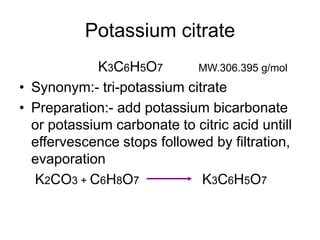
Potassium citrate
K3C6H5O7 MW.306.395 g/mol
• Synonym:- tri-potassium citrate
• Preparation:- add potassium bicarbonate
or potassium carbonate to citric acid untill
effervescence stops followed by filtration,
evaporation
K2CO3 + C6H8O7 K3C6H5O7
Physical properties
• White crystalline hygroscopic powder
• Freely soluble in water
• odour-less
• Insoluble in ethanol
• Saline taste
• Soluble in glycerin
uses
• to treat/manage gout and arrhythmia
• used as an alkalizing agent in the treatment of
mild urinary tract infections such as cystitis
• used in many soft drinks as a buffering agent
• used to treat urinary calculi (kidney stones)
• Long standing diarrhea causes the hypo-kalemia
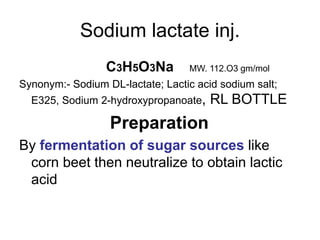
Sodium lactate inj.
C3H5O3Na MW. 112.O3 gm/mol
Synonym:- Sodium DL-lactate; Lactic acid sodium salt;
E325, Sodium 2-hydroxypropanoate, RL BOTTLE
Preparation
By fermentation of sugar sources like
corn beet then neutralize to obtain lactic
acid
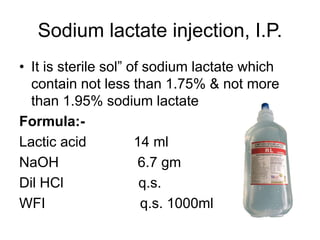
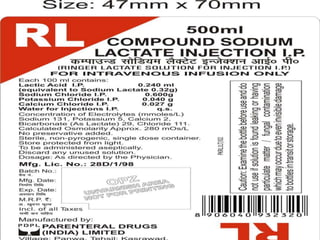
Sodium lactate injection, I.P.
• It is sterile sol” of sodium lactate which
contain not less than 1.75% & not more
than 1.95% sodium lactate
Formula:-
Lactic acid 14 ml
NaOH 6.7 gm
Dil HCl q.s.
WFI q.s. 1000ml
Physical properties
• White crystalline powder
• Water soluble
• Odourless
• Mild saline taste
uses
• as a preservative, acidity regulator, and bulking
agent
• used in shampoo products and other similar
items such as liquid soaps, as it is an
effective humectant and moisturizer
• used to treat arrhythmias caused by overdosing
of class I antiarrythmics, as well as
presser sympathomimetics resulting in
hypertension
• Fluid & electrolyte re-plenisher used in a
strength of 1/6 molar
• Given i.v. in treatment of metabolic acidosis in
patients of limited oral intake of sod’ bicarbonate
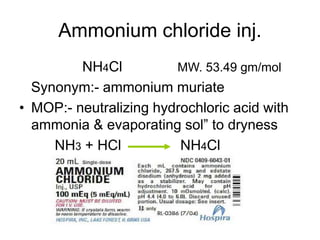
Ammonium chloride inj.
NH4Cl MW. 53.49 gm/mol
Synonym:- ammonium muriate
• MOP:- neutralizing hydrochloric acid with
ammonia & evaporating sol” to dryness
NH3 + HCl NH4Cl
Physical properties
• White crystalline powder
• Cool, saline & hygroscopic
• Freely soluble in water & glycerin
• Sparingly soluble in alcohol
Ammonium chloride injection U.S.P
• It is 100 m-eq, sterile, non-pyrogenic sol”
of NH4Cl in WFI used i.v.
– Ammonium chloride increases acidity by
increasing the amount of hydrogen ion
concentrations.
– Ammonium chloride can be used as an
expectorant due to its irritative action on the
bronchial mucosa. This effect causes the
production of respiratory tract fluid which in
order facilitates the effective cough.
uses
• Expectorant in cough syrups
• diuretic & systemic acidifier
• The ammonium ion (NH4+) in the body plays an
important role in the maintenance of acid-base
balance. The kidney uses ammonium (NH4+) in place of
sodium (Na+) to combine with fixed anions in
maintaining acid-base balance, especially as a
homeostatic compensatory mechanism in metabolic
acidosis. The therapeutic effects of Ammonium Chloride
depend upon the ability of the kidney to utilize ammonia
in the excretion of an excess of fixed anions and the
conversion of ammonia to urea by the liver, thereby
liberating hydrogen (H+) and chloride (Cl–) ions into the
extracellular fluid.
• Ammonium Chloride Injection, USP, after dilution in
isotonic sodium chloride injection, may be indicated in
the treatment of patients with: (1) hypochloremic states
and (2) metabolic alkalosis
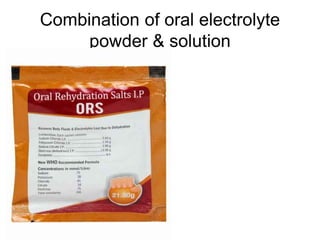
Combination of oral electrolyte
powder & solution
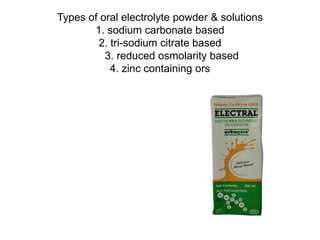
Types of oral electrolyte powder & solutions
1. sodium carbonate based
2. tri-sodium citrate based
3. reduced osmolarity based
4. zinc containing ors
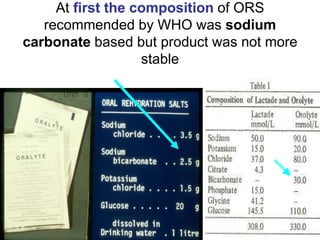
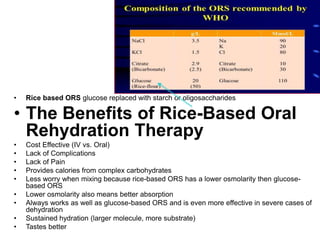
At first the composition of ORS
recommended by WHO was sodium
carbonate based but product was not more
stable
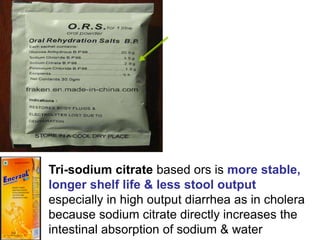
Tri-sodium citrate based ors is more stable,
longer shelf life & less stool output
especially in high output diarrhea as in cholera
because sodium citrate directly increases the
intestinal absorption of sodium & water
• In 2003, WHO and UNICEF recommended
that the osmolarity of ORS be reduced from
311 to 245 mosm/L. This recommendation
was based on multiple clinical trials showing
that the reduced osmolarity solution reduces
stool volume in children with diarrhea by
about 25% and the need for IV therapy by
about 30% when compared to standard
ORS.
• Since january 2004, only new ORS
formulation is procured by UNICEF & india
was first country in the world to launch this
ORS formulation since june 2004.
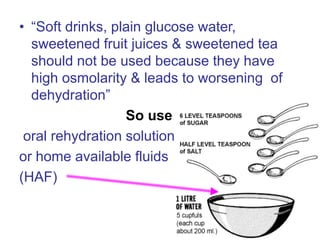
• “Soft drinks, plain glucose water,
sweetened fruit juices & sweetened tea
should not be used because they have
high osmolarity & leads to worsening of
dehydration”
So use
oral rehydration solution
or home available fluids
(HAF)
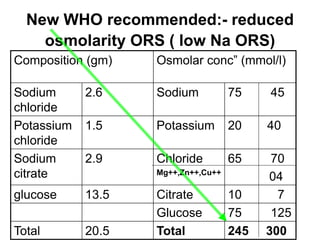
New WHO recommended:- reduced
osmolarity ORS ( low Na ORS)
Composition (gm) Osmolar conc” (mmol/l)
Sodium
chloride
2.6 Sodium 75 45
Potassium
chloride
1.5 Potassium 20 40
Sodium
citrate
2.9 Chloride
Mg++,Zn++,Cu++
65 70
04
glucose 13.5 Citrate 10 7
Glucose 75 125
Total 20.5 Total 245 300
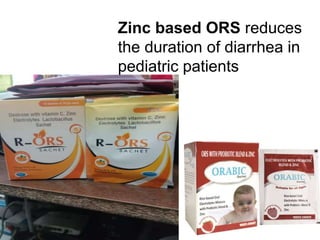
Zinc based ORS reduces
the duration of diarrhea in
pediatric patients
• Rice based ORS glucose replaced with starch or oligosaccharides
• The Benefits of Rice-Based Oral
Rehydration Therapy
• Cost Effective (IV vs. Oral)
• Lack of Complications
• Lack of Pain
• Provides calories from complex carbohydrates
• Less worry when mixing because rice-based ORS has a lower osmolarity then glucose-
based ORS
• Lower osmolarity also means better absorption
• Always works as well as glucose-based ORS and is even more effective in severe cases of
dehydration
• Sustained hydration (larger molecule, more substrate)
• Tastes better
Major intra & extra cellular electrolytes

Major intra & extra cellular electrolytes

  • 1.
    Major electrolytes Pt. LR College of Pharmacy faridabad
  • 2.
    Electrolytes used inacid-base therapy( inorganic compounds) • Sodium acetate • Potassium acetate • Sodium bicarbonate • Sodium citrate • Potassium citrate • Sodium lactate • Ammonium chloride • Potassium bicarbonate
  • 3.
    • Body ofhuman beings contains both body fluid & electrolytes • The body fluids are divided into followings • Intracellular fluid:- (intra means inside the cell) fluid present inside the cell or as cytoplasmic fluid. It’s about 45-50% of body wt. • Extra cellular fluid:- fluid present outside the cells i.e. it is about 12-15% of body wt.
  • 4.
    Prolonged fever, severvomiting or diarrhea cause the dis-balancing of physiological ions in the human body instead in the normal situation body mechanism itself maintains the physiological ions conc” & maintain the electrolytes in the body but whenever body fails to do that mechanism we needs to replace the ions from out side of body.
  • 5.
    • Diarrhea:- passageof loose , liquid or watery stool Clinical types of diarrheal disease • Acute watery diarrhea • Acute bloody diarrhea • Persistent diarrhea • Diarrhea with severe malnutrition ( marasmus & kwashiorkor )
  • 6.
    Control of diarrhealdiseases • Short term (a.) Appropriate clinical management • ORS • Intravenous rehydration • Maintenance therapy • Appropriate feeding • Chemotherapy • Zinc supplementation
  • 7.
    ( b.) betterMCH care practices Maternal nutrition Child nutrition ( c.) preventive strategies Sanitation Health education immunization
  • 8.
    What is replacementtherapy ? Under the deficiency of physiological ions in the body they are supplemented with more ions this therapy is called supplemented or replacement therapy the basic objective of replacement therapy is to restore the volume & composition of body fluid to normal
  • 9.
    It is furtherdivided into following 1. Sodium replacement 2. Potassium replacement 3. Calcium replacement
  • 10.
    Sodium replacement • Sodiumchloride, sodium chloride dextrose injection, sodium chloride fructose injection, compound sodium chloride dextrose inj. NaCl hypertonic inj., compound NaCl sol”, NaCl irrigation sol” Sodium chloride NaCl mw. 58.45 gm/mol
  • 11.
    Industrially prepared by 1.Evaporating purified saline (sea water ) deposits & further purification 2. By purifying rock salt Storage It is stored in tightly closed containers in dry place as it absorbs moisture
  • 12.
    Physical properties • Colorlesscubic crystals • Saline taste & odorless • Soluble in water, glycerin • Slightly soluble in alcohol
  • 13.
    Uses • It issalt extra cellular fluid • Used for replacement therapy & manufacturing of isotonic sol” (0.9% w/w) • Isotonic solution used as wet dressing for irrigating body cavities • Tissue hypertonic sol” are administered for maintenance therapy when patient is unable to take fluid orally for 1-3 days • Hypertonic inj. used in loss of sodium • orally administered hypertonic sol” induces vomiting so used in poisoning accidents
  • 14.
    Potassium replacement • Potassiumchloride, KCl & dextrose inj. Potassium citrate Potassium chloride KCl mw. 74.56 gm/mol Storage It is stored in tightly closed containers in dry place as it absorbs moisture
  • 15.
    Physical properties • Colorless,odourless • Elongated, prismatic or cubical crystals • Saline taste • Soluble in water • Insoluble in alcohol, ether
  • 16.
    Uses • Drug ofchoice for oral replacement of potassium • Used in digitalis poisoning
  • 17.
    Sodium acetate CH3COONa MW.82.034 g/mol Synonym :- Hot ice, • sodium acetate tri-hydrate is prepared by reacting acetic acid with sodium hydroxide using water as the solvent. CH3COOH + NaOH → CH3COONa + H2O
  • 18.
    Physical properties • Whitedeliquescent powder • Vinegar (acetic acid) odor when heated to decomposition • Soluble in water, alcohol, hydrazine, SO2 • Monoclinic crystal structure • Slightly saline & bitter taste
  • 19.
    Uses • It isa ingredient of peritoneal dialysis fluid • Acts as alkalizing agent & also causes diuretic action • used as the carbon source for culturing bacteria • used to give potato chips a salt and vinegar flavor • act as a buffer to keep a relatively constant pH level • It is also used in heating pads, hand warmers, and hot ice
  • 20.
    Potassium acetate CH3COOK MW.98.14 gm/mol Preparation CH3COOH + KOH → CH3COOK + H2O • This type of rxs is called acid-base neutralization
  • 21.
    Physical properties • Whitedeliquescent crystalline powder • Soluble in alcohol, liquid ammonia • Insoluble in ether, acetone • Monoclinic crystal structure
  • 22.
    Uses • Deicing • Potassiumacetate is the extinguishing agent used in Class K fire extinguishers • used as a food additive as a preservative and acidity regulator • Drug of choice for oral replacement of potassium
  • 23.
    Sodium citrate MW. 258.06g/mol (anhydrous) Synonym:- Tri-sodium citrate , Citrosodine Citric acid, tri-sodium salt, Sodium citrate E331
  • 24.
    Physical properties ●White crystallinepowder ●slightly deliquescent in moist air ●Freely soluble in water ●salt effloresces on exposure to dry air ●Practically insoluble in Alcohol & ether ●Like citric acid, it has a sour taste
  • 25.
    Uses • used asa food additive, usually for flavor or as a preservative • buffering agent or acidity regulator from the medical point of view, it is used as alkalinizing agent • sodium citrate as an anticoagulant in blood transfusions • Sodium citrate is used to relieve discomfort in urinary- tract infections, such as cystitis • used as an osmotic laxative • agent for removal of carbonate scale from boilers without removing them from operation • Good sequestering properties
  • 26.
    Sodium bicarbonate NaHCO3 MW.84.00 gm/mol • Synonym:- Baking soda, bicarb (laboratory slang), bicarbonate of soda, nahcolite, bread soda, cooking soda. • Preparation:- solvay’s process
  • 27.
    Physical properties • Whitecrystalline powder • Freely soluble in water • odourless • Insoluble in alcohol & ether • Saline taste • Monoclinic crystal structure • Salt effloresces on the exposure to dry air thus stored in air tight container
  • 28.
    uses • primarily usedin baking as a leavening agent • Baking soda is used to soften pulses (peas, beans) before and during cooking • Fungicide and pest control • has weak disinfectant properties • Pyrotechnics • used to neutralize unwanted acid to treat acid indigestion and heartburn i.e. stomach acid produces salt, water, and carbon dioxide
  • 29.
    NaHCO3 + HCl→ NaCl + H2O + CO2(g) • It is added to local anesthetics, to speed up the onset of their effects and make their injection less painful • component of Moffett's solution, used in nasal surgery • Toothpaste containing sodium bicarbonate have better whitening & plaque removal effect • used in a process for removing paint and corrosion called soda-blasting
  • 30.
    Potassium citrate K3C6H5O7 MW.306.395g/mol • Synonym:- tri-potassium citrate • Preparation:- add potassium bicarbonate or potassium carbonate to citric acid untill effervescence stops followed by filtration, evaporation K2CO3 + C6H8O7 K3C6H5O7
  • 31.
    Physical properties • Whitecrystalline hygroscopic powder • Freely soluble in water • odour-less • Insoluble in ethanol • Saline taste • Soluble in glycerin
  • 32.
    uses • to treat/managegout and arrhythmia • used as an alkalizing agent in the treatment of mild urinary tract infections such as cystitis • used in many soft drinks as a buffering agent • used to treat urinary calculi (kidney stones) • Long standing diarrhea causes the hypo-kalemia
  • 33.
    Sodium lactate inj. C3H5O3NaMW. 112.O3 gm/mol Synonym:- Sodium DL-lactate; Lactic acid sodium salt; E325, Sodium 2-hydroxypropanoate, RL BOTTLE Preparation By fermentation of sugar sources like corn beet then neutralize to obtain lactic acid
  • 34.
    Sodium lactate injection,I.P. • It is sterile sol” of sodium lactate which contain not less than 1.75% & not more than 1.95% sodium lactate Formula:- Lactic acid 14 ml NaOH 6.7 gm Dil HCl q.s. WFI q.s. 1000ml
  • 36.
    Physical properties • Whitecrystalline powder • Water soluble • Odourless • Mild saline taste
  • 37.
    uses • as apreservative, acidity regulator, and bulking agent • used in shampoo products and other similar items such as liquid soaps, as it is an effective humectant and moisturizer • used to treat arrhythmias caused by overdosing of class I antiarrythmics, as well as presser sympathomimetics resulting in hypertension • Fluid & electrolyte re-plenisher used in a strength of 1/6 molar • Given i.v. in treatment of metabolic acidosis in patients of limited oral intake of sod’ bicarbonate
  • 38.
    Ammonium chloride inj. NH4ClMW. 53.49 gm/mol Synonym:- ammonium muriate • MOP:- neutralizing hydrochloric acid with ammonia & evaporating sol” to dryness NH3 + HCl NH4Cl
  • 39.
    Physical properties • Whitecrystalline powder • Cool, saline & hygroscopic • Freely soluble in water & glycerin • Sparingly soluble in alcohol
  • 40.
    Ammonium chloride injectionU.S.P • It is 100 m-eq, sterile, non-pyrogenic sol” of NH4Cl in WFI used i.v. – Ammonium chloride increases acidity by increasing the amount of hydrogen ion concentrations. – Ammonium chloride can be used as an expectorant due to its irritative action on the bronchial mucosa. This effect causes the production of respiratory tract fluid which in order facilitates the effective cough.
  • 41.
    uses • Expectorant incough syrups • diuretic & systemic acidifier • The ammonium ion (NH4+) in the body plays an important role in the maintenance of acid-base balance. The kidney uses ammonium (NH4+) in place of sodium (Na+) to combine with fixed anions in maintaining acid-base balance, especially as a homeostatic compensatory mechanism in metabolic acidosis. The therapeutic effects of Ammonium Chloride depend upon the ability of the kidney to utilize ammonia in the excretion of an excess of fixed anions and the conversion of ammonia to urea by the liver, thereby liberating hydrogen (H+) and chloride (Cl–) ions into the extracellular fluid. • Ammonium Chloride Injection, USP, after dilution in isotonic sodium chloride injection, may be indicated in the treatment of patients with: (1) hypochloremic states and (2) metabolic alkalosis
  • 42.
    Combination of oralelectrolyte powder & solution
  • 43.
    Types of oralelectrolyte powder & solutions 1. sodium carbonate based 2. tri-sodium citrate based 3. reduced osmolarity based 4. zinc containing ors
  • 44.
    At first thecomposition of ORS recommended by WHO was sodium carbonate based but product was not more stable
  • 45.
    Tri-sodium citrate basedors is more stable, longer shelf life & less stool output especially in high output diarrhea as in cholera because sodium citrate directly increases the intestinal absorption of sodium & water
  • 46.
    • In 2003,WHO and UNICEF recommended that the osmolarity of ORS be reduced from 311 to 245 mosm/L. This recommendation was based on multiple clinical trials showing that the reduced osmolarity solution reduces stool volume in children with diarrhea by about 25% and the need for IV therapy by about 30% when compared to standard ORS. • Since january 2004, only new ORS formulation is procured by UNICEF & india was first country in the world to launch this ORS formulation since june 2004.
  • 47.
    • “Soft drinks,plain glucose water, sweetened fruit juices & sweetened tea should not be used because they have high osmolarity & leads to worsening of dehydration” So use oral rehydration solution or home available fluids (HAF)
  • 48.
    New WHO recommended:-reduced osmolarity ORS ( low Na ORS) Composition (gm) Osmolar conc” (mmol/l) Sodium chloride 2.6 Sodium 75 45 Potassium chloride 1.5 Potassium 20 40 Sodium citrate 2.9 Chloride Mg++,Zn++,Cu++ 65 70 04 glucose 13.5 Citrate 10 7 Glucose 75 125 Total 20.5 Total 245 300
  • 49.
    Zinc based ORSreduces the duration of diarrhea in pediatric patients
  • 50.
    • Rice basedORS glucose replaced with starch or oligosaccharides • The Benefits of Rice-Based Oral Rehydration Therapy • Cost Effective (IV vs. Oral) • Lack of Complications • Lack of Pain • Provides calories from complex carbohydrates • Less worry when mixing because rice-based ORS has a lower osmolarity then glucose- based ORS • Lower osmolarity also means better absorption • Always works as well as glucose-based ORS and is even more effective in severe cases of dehydration • Sustained hydration (larger molecule, more substrate) • Tastes better