Functions of major
Physiological ions, Electrolytes used in the replacement therapy: Sodium
Chloride, Potassium chloride, Calcium gluconate and Oral Rehydration Salt
(ORS), Physiological acid base balance.
Electrolytes:
Substance when dissolvedin solution separates into ions & is able to carry an electrical current
Cation - positively charged electrolyte e.g. Ca++ Anion - negatively charged electrolyte e.g. Cl-
But in our body, electrolytes are certain charged nutrients present in our body that have many important functions like:
Electrolytes regulate our nerve and muscles function, our body’s hydration, blood pH, blood pressure, and
rebuilding of damaged tissue.
Electrolytic Fluid Compartments:
Body contain 60-70% of water
Body Fluids
Intracellular Fluid
(Fluid inside the cell)
[45-50% of body
weight]
Extracellular
Fluid
Interstitial Fluid
(Between the
cell) [12-15% of
body
weight]
Plasma or Vascular
fluid (Fluid within
blood vascular
system)
[4-5% of body
weight]a
3.
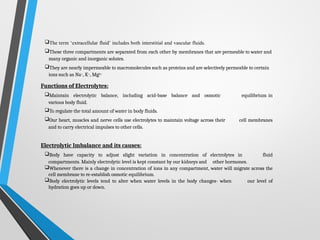
The term ‘extracellularfluid’ includes both interstitial and vascular fluids.
These three compartments are separated from each other by membranes that are permeable to water and
many organic and inorganic solutes.
They are nearly impermeable to macromolecules such as proteins and are selectively permeable to certain
ions such as Na+, K+, Mg2+
Functions of Electrolytes:
Maintain electrolytic balance, including acid-base balance and osmotic equilibrium in
various body fluid.
To regulate the total amount of water in body fluids.
Our heart, muscles and nerve cells use electrolytes to maintain voltage across their cell membranes
and to carry electrical impulses to other cells.
Electrolytic Imbalance and its causes:
Body have capacity to adjust slight variation in concentration of electrolytes in fluid
compartments. Mainly electrolytic level is kept constant by our kidneys and other hormones.
Whenever there is a change in concentration of ions in any compartment, water will migrate across the
cell membrane to re-establish osmotic equilibrium.
Body electrolytic levels tend to alter when water levels in the body changes- when our level of
hydration goes up or down.
4.
Several othercauses include:
Kidney disease Vomiting or prolong periods
Poor diet severe dehydration
Diarrhea Congestive heart failure
Edema (fluid get accumulated in intestinal space between cell due to low osmotic pressure)
Acid-Base imbalance
Symptoms of electrolytic Imbalance:
The symptoms will depend on which electrolyte is out of balance, and whether that level is too high or too
low.
An altered level of magnesium, sodium, potassium, or calcium may produce one or more of the following
symptoms:
Irregular heart beat Weakness
Bone disorder Blood pressure change
Confusion Seizures
Nervous system disorder
Major Physiological Ions and their functions:
Cations: Sodium, potassium, calcium, magnesium
Anions: Chloride, bicarbonate, phosphate, sulphate
5.
A. MAJOR EXTRACELLULARIONS
CHLORIDE (Cl-)
Amount present in body: 50 mEq/Kg;
Recommended daily Requirement: 5-10 g as NaCl
Food Source: Common table salt, Animal food
Function: Maintenance of proper hydration, osmotic pressure, normal electrolyte balance,
acid-base balance, Gastric HCl
Deficiency: Hypochloremia occur due to kidney disease, metabolic acidosis (due to diabetes
or renal failure or prolong vomiting)
Excessive Presence: Hyperchloremia in dehydration, decreased renal blood flow
associated with congestive heart failure (CHF), severe renal damage and excessive Cl- intake.
6.
SODIUM (Na+)
Amount presentin body: 1.8 g/Kg;
Recommended daily Requirement: Approx. 3-5 g.
Food Source: Table salt, baking soda, animal food and some vegetables.
Function: Maintenance of normal hydration & osmotic pressure, acid-base balance, cell
membrane permeability, muscle contraction, carbon dioxide transport, transmission of
nerve impulses.
Deficiency: Hyponateremia may occur with excess loss of urine (diuresis) in diabetes
insipidus, Addison’s disease (with reduced secretion of anti-diuretic hormone,
aldosterone) diarrhea & vomiting, renal damage.
Excessive Presence: Hypernateremia may occur in hyperadrenalism (Cushing’s
syndrome) with increased aldosterone production, severe dehydration, certain types of
head injury, hypertension.
7.
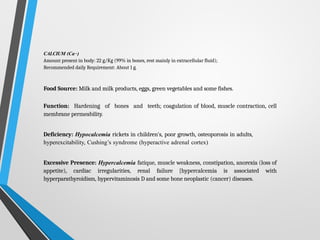
CALCIUM (Ca++)
Amount presentin body: 22 g/Kg (99% in bones, rest mainly in extracellular fluid);
Recommended daily Requirement: About 1 g.
Food Source: Milk and milk products, eggs, green vegetables and some fishes.
Function: Hardening of bones and teeth; coagulation of blood, muscle contraction, cell
membrane permeability.
Deficiency: Hypocalcemia rickets in children's, poor growth, osteoporosis in adults,
hyperexcitability, Cushing’s syndrome (hyperactive adrenal cortex)
Excessive Presence: Hypercalcemia fatique, muscle weakness, constipation, anorexia (loss of
appetite), cardiac irregularities, renal failure [hypercalcemia is associated with
hyperparathyroidism, hypervitaminosis D and some bone neoplastic (cancer) diseases.
8.
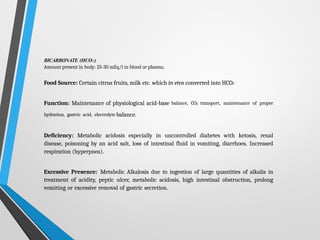
BICARBONATE (HCO3-)
Amount presentin body: 25-30 mEq/l in blood or plasma;
Food Source: Certain citrus fruits, milk etc. which in vivo converted into HCO3-
Function: Maintenance of physiological acid-base balance, CO2 transport, maintenance of proper
hydration, gastric acid, electrolyte balance.
Deficiency: Metabolic acidosis especially in uncontrolled diabetes with ketosis, renal
disease, poisoning by an acid salt, loss of intestinal fluid in vomiting, diarrhoea. Increased
respiration (hyperpnea).
Excessive Presence: Metabolic Alkalosis due to ingestion of large quantities of alkalis in
treatment of acidity, peptic ulcer, metabolic acidosis, high intestinal obstruction, prolong
vomiting or excessive removal of gastric secretion.
9.
B. MAJOR INTRACELLULARIONS
PHOSPHATE (PO43-)
Amount present in body: 12 g/Kg
Recommended daily Requirement: 800 mg
Food Source: Milk and milk products, oatmeal, whole grains, legumes, nuts, egg yolk, meat especially in liver
and kidney.
Function: like calcium, it is predominant constituent of bones and teeth; building block of several
important substance including those used by the cell for energy (ATP), cell membranes, DNA & RNA,
secondary messengers, modulation of enzyme activity, biological buffer etc.
Deficiency: Hypophosphatemia may be associated with vitamin D deficiency, hyperparathyroidism and
prolong use of aluminium hydroxide gel antacids. It may leads to rare osteomalacia and cardiac arrhythmia.
Excessive Presence: Hyperphosphatemia may be associated with hypervitaminsois D, renal failure,
hypoparathyroidism, it may lead to formation of kidney stone with possible kidney damage.
9
10.
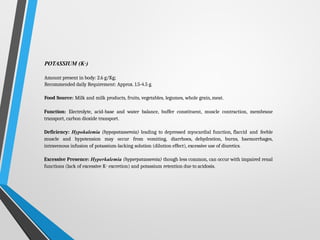
POTASSIUM (K+)
Amount presentin body: 2.6 g/Kg;
Recommended daily Requirement: Approx. 1.5-4.5 g.
Food Source: Milk and milk products, fruits, vegetables, legumes, whole grain, meat.
Function: Electrolyte, acid-base and water balance, buffer constituent, muscle contraction, membrane
transport, carbon dioxide transport.
Deficiency: Hypokalemia (hypopotassemia) leading to depressed myocardial function, flaccid and feeble
muscle and hypotension may occur from vomiting, diarrhoea, dehydration, burns, haemorrhages,
intravenous infusion of potassium-lacking solution (dilution effect), excessive use of diuretics.
Excessive Presence: Hyperkalemia (hyperpotassemia) though less common, can occur with impaired renal
functions (lack of excessive K+ excretion) and potassium retention due to acidosis.
11.
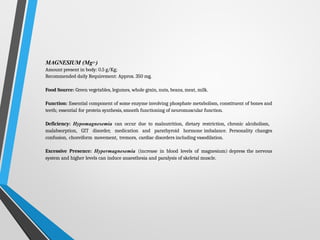
MAGNESIUM (Mg2+)
Amount presentin body: 0.5 g/Kg;
Recommended daily Requirement: Approx. 350 mg.
Food Source: Green vegetables, legumes, whole grain, nuts, beans, meat, milk.
Function: Essential component of some enzyme involving phosphate metabolism, constituent of bones and
teeth; essential for protein synthesis, smooth functioning of neuromuscular function.
Deficiency: Hypomagnesemia can occur due to malnutrition, dietary restriction, chronic alcoholism,
malabsorption, GIT disorder, medication and parathyroid hormone imbalance. Personality changes
confusion, choreiform movement, tremors, cardiac disorders including vasodilation.
Excessive Presence: Hypermagnesemia (increase in blood levels of magnesium) depress the nervous
system and higher levels can induce anaesthesia and paralysis of skeletal muscle.
12.
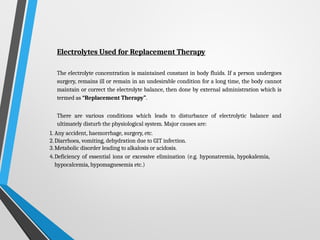
Electrolytes Used forReplacement Therapy
The electrolyte concentration is maintained constant in body fluids. If a person undergoes
surgery, remains ill or remain in an undesirable condition for a long time, the body cannot
maintain or correct the electrolyte balance, then done by external administration which is
termed as “Replacement Therapy”.
There are various conditions which leads to disturbance of electrolytic balance and
ultimately disturb the physiological system. Major causes are:
1. Any accident, haemorrhage, surgery, etc.
2.Diarrhoea, vomiting, dehydration due to GIT infection.
3.Metabolic disorder leading to alkalosis or acidosis.
4.Deficiency of essential ions or excessive elimination (e.g. hyponatremia, hypokalemia,
hypocalcemia, hypomagnesemia etc.)
13.
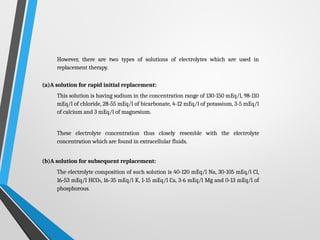
However, there aretwo types of solutions of electrolytes which are used in
replacement therapy.
(a)A solution for rapid initial replacement:
This solution is having sodium in the concentration range of 130-150 mEq/l, 98-110
mEq/l of chloride, 28-55 mEq/l of bicarbonate, 4-12 mEq/l of potassium, 3-5 mEq/l
of calcium and 3 mEq/l of magnesium.
These electrolyte concentration thus closely resemble with the electrolyte
concentration which are found in extracellular fluids.
(b)A solution for subsequent replacement:
The electrolyte composition of such solution is 40-120 mEq/l Na, 30-105 mEq/l Cl,
16-53 mEq/l HCO3, 16-35 mEq/l K, 1-15 mEq/l Ca, 3-6 mEq/l Mg and 0-13 mEq/l of
phosphorous.
14.
Sodium Chloride
Molecular Formula:NaCl
Molecular weight: 58.5
Synonyms: Rock salt, common salt, Table salt
Natural Source: Rock salt, Sea water.
Standards: Sodium chloride contains not less than 99.0% and not more than 100.5% of NaCl,
calculated on dried basis.
Method of preparation:
In laboratory it is prepared by reaction between a strong acid (HCl) and a strong base (NaOH). The
sodium chloride present in dissolved form; solid is obtained by evaporation of water.
Industrially, it is prepared (i) by evaporating purified saline (sea water) diposits and further
purification. (ii) by purifying rock salt
Properties:
1. It occurs in the form of white or colorless crystals.
2. It is soluble in water but insoluble in alcohol.
3. With silver nitrate solution, it gives white insoluble precipitate of silver chloride which is soluble in
ammonia.
NaCl + AgNO3 → AgCl ↓ + NaNO3
15.
Uses:
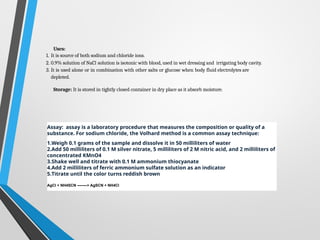
1. It issource of both sodium and chloride ions.
2. 0.9% solution of NaCl solution is isotonic with blood, used in wet dressing and irrigating body cavity.
3. It is used alone or in combination with other salts or glucose when body fluid electrolytes are
depleted.
Storage: It is stored in tightly closed container in dry place as it absorb moisture.
Assay: assay is a laboratory procedure that measures the composition or quality of a
substance. For sodium chloride, the Volhard method is a common assay technique:
1.Weigh 0.1 grams of the sample and dissolve it in 50 milliliters of water
2.Add 50 milliliters of 0.1 M silver nitrate, 5 milliliters of 2 M nitric acid, and 2 milliliters of
concentrated KMnO4
3.Shake well and titrate with 0.1 M ammonium thiocyanate
4.Add 2 milliliters of ferric ammonium sulfate solution as an indicator
5.Titrate until the color turns reddish brown
AgCl + NH4SCN ——–> AgSCN + NH4Cl
16.
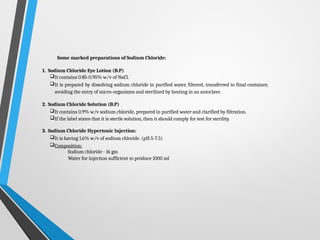
Some marked preparationsof Sodium Chloride:
1. Sodium Chloride Eye Lotion (B.P)
It contains 0.85-0.95% w/v of NaCl.
It is prepared by dissolving sodium chloride in purified water, filtered, transferred to final container,
avoiding the entry of micro-organisms and sterilized by heating in an autoclave.
2. Sodium Chloride Solution (B.P)
It contains 0.9% w/v sodium chloride, prepared in purified water and clarified by filtration.
If the label states that it is sterile solution, then it should comply for test for sterility.
3. Sodium Chloride Hypertonic Injection:
It is having 1.6% w/v of sodium chloride. (pH 5-7.5)
Composition:
Sodium chloride - 16 gm
Water for injection sufficient to produce 1000 ml
17.
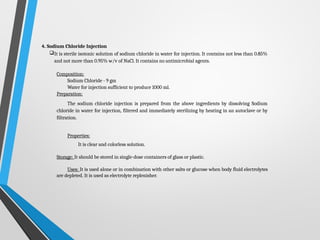
4. Sodium ChlorideInjection
It is sterile isotonic solution of sodium chloride in water for injection. It contains not less than 0.85%
and not more than 0.95% w/v of NaCl. It contains no antimicrobial agents.
Composition:
Sodium Chloride - 9 gm
Water for injection sufficient to produce 1000 ml.
Preparation:
The sodium chloride injection is prepared from the above ingredients by dissolving Sodium
chloride in water for injection, filtered and immediately sterilizing by heating in an autoclave or by
filtration.
Properties:
It is clear and colorless solution.
Storage: It should be stored in single-dose containers of glass or plastic.
Uses: It is used alone or in combination with other salts or glucose when body fluid electrolytes
are depleted. It is used as electrolyte replenisher.
18.
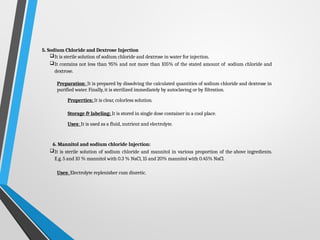
5. Sodium Chlorideand Dextrose Injection
It is sterile solution of sodium chloride and dextrose in water for injection.
It contains not less than 95% and not more than 105% of the stated amount of sodium chloride and
dextrose.
Preparation: It is prepared by dissolving the calculated quantities of sodium chloride and dextrose in
purified water. Finally, it is sterilized immediately by autoclaving or by filtration.
Properties: It is clear, colorless solution.
Storage & labeling: It is stored in single dose container in a cool place.
Uses: It is used as a fluid, nutrient and electrolyte.
6. Mannitol and sodium chloride Injection:
It is sterile solution of sodium chloride and mannitol in various proportion of the above ingredients.
E.g. 5 and 10 % mannitol with 0.3 % NaCl, 15 and 20% mannitol with 0.45% NaCl.
Uses: Electrolyte replenisher cum diuretic.
19.
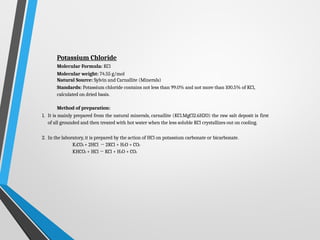
Potassium Chloride
Molecular Formula:KCl
Molecular weight: 74.55 g/mol
Natural Source: Sylvin and Carnallite (Minerals)
Standards: Potassium chloride contains not less than 99.0% and not more than 100.5% of KCl,
calculated on dried basis.
Method of preparation:
1. It is mainly prepared from the natural minerals, carnallite (KCl.MgCl2.6H2O) the raw salt deposit is first
of all grounded and then treated with hot water when the less soluble KCl crystallizes out on cooling.
2. In the laboratory, it is prepared by the action of HCl on potassium carbonate or bicarbonate.
K2CO3 + 2HCl → 2KCl + H2O + CO2
KHCO3 + HCl → KCl + H2O + CO2
20.
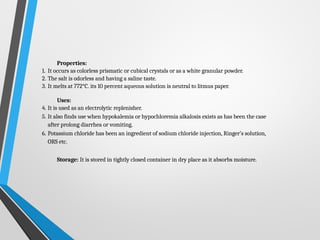
Properties:
1. It occursas colorless prismatic or cubical crystals or as a white granular powder.
2. The salt is odorless and having a saline taste.
3. It melts at 772°C. its 10 percent aqueous solution is neutral to litmus paper.
Uses:
4. It is used as an electrolytic replenisher.
5. It also finds use when hypokalemia or hypochloremia alkalosis exists as has been the case
after prolong diarrhea or vomiting.
6. Potassium chloride has been an ingredient of sodium chloride injection, Ringer’s solution,
ORS etc.
Storage: It is stored in tightly closed container in dry place as it absorbs moisture.
21.
Some marked preparationsof Potassium Chloride:
1. Potassium Chloride and Sodium Chloride I.V. Infusion (B.P.)
It is a sterile solution containing 95.0 to 105.0% of the stated amount of sodium chloride and potassium
chloride.
2. Potassium Chloride and Glucose intravenous Infusion (B.P.)
It is a sterile solution in water for injection containing KCl 95.0 to 105.0 of the stated amount of glucose
and potassium chloride.
3. Potassium chloride, Sodium Chloride and Glucose intravenous infusion (B.P.)
It is a sterile solution of water for injection containing:
KCl - 0.3%
NaCl - 0.18%
Glucose - 40%
4. Effervescent KCl Tablet:
It Contains: KCl - 600mg
KHCO3 - 400mg
KCl sustain release tablet of 600mg.
22.
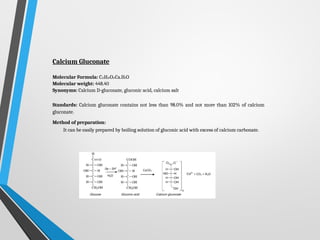
Calcium Gluconate
Molecular Formula:C12H22O14Ca.H2O
Molecular weight: 448.40
Synonyms: Calcium D-gluconate, gluconic acid, calcium salt
Standards: Calcium gluconate contains not less than 98.0% and not more than 102% of calcium
gluconate.
Method of preparation:
It can be easily prepared by boiling solution of gluconic acid with excess of calcium carbonate.
23.
Properties:
1. It occursas white, tasteless, odorless, crystalline or granular powder.
2. It is soluble in water, more soluble in boiling water but insoluble in alcohol and other solvent.
Uses:
3. It is used as calcium replenisher.
4. Its tablet also finds use in supplementary diet of convalescent and expectant mother.
Some marked preparations of Sodium Chloride:
5. Calcium Gluconate Injection:
It is sterile solution of calcium gluconate in water for injection. The amount of calcium gluconate
must be in between 8.5-9.4% w/v.
6. Calcium Gluconate Tablet:
Chewable Tablets are available in the strength of 0.325g, 0.5g, 0.65g, 1.0g.
24.
Assay
The assay ofcalcium gluconate is a replacement complexometric titration that uses magnesium
and the
indicator mordant black II to determine the percentage purity of calcium gluconate:
1.Weigh 0.5 grams of calcium gluconate and dissolve in 50 milliliters of warm water
2.Cool the solution and add 5 milliliters of 0.05 M magnesium sulfate and 10 milliliters of strong
ammonia-ammonium chloride solution
•Titrate with 0.05 M EDTA (EthyleneDiamineTetraAcetic acid) until the red color changes to blue
using mordant black II mixture as an indicator.
25.
Electrolyte Combination Therapy
When a patient undergoes a surgery, he is unable to take normal diet. Therefore, he is given infusions
containing saline and glucose.
But when the patient is deficient or in chronic illness, he also needs additional electrolytes which are
intended for the fluid maintenance of the body. This type of treatment is called electrolyte combination
therapy.
Electrolyte combination Products are categories in two categories:
1. Fluid Maintenance: The fluid or solution of electrolytes have to be administered intravenously which
provide the normal requirement of water and electrolytes.
2. Electrolyte replacement: in case of excessive vomiting, diarrhea or prolong fever, electrolyte
combination find use in replacement therapy. Many electrolytes’ combinations and varying
concentration are available a dry powder to get dissolve in specified amount of water also known as
“oral electrolyte solution”.
26.
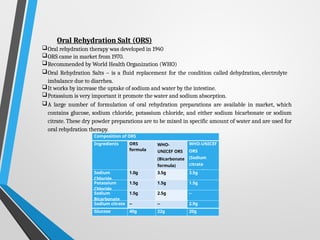
Oral Rehydration Salt(ORS)
Oral rehydration therapy was developed in 1940
ORS came in market from 1970.
Recommended by World Health Organization (WHO)
Oral Rehydration Salts – is a fluid replacement for the condition called dehydration, electrolyte
imbalance due to diarrhea.
It works by increase the uptake of sodium and water by the intestine.
Potassium is very important it promote the water and sodium absorption.
A large number of formulation of oral rehydration preparations are available in market, which
contains glucose, sodium chloride, potassium chloride, and either sodium bicarbonate or sodium
citrate. These dry powder preparations are to be mixed in specific amount of water and are used for
oral rehydration therapy.
Composition of ORS
Ingredients ORS
formula
WHO-
UNICEF ORS
(Bicarbonate
formula)
WHO-UNICEF
ORS
(Sodium
citrate
formula)
Sodium
Chloride
1.0g 3.5g 3.5g
Potassium
Chloride
1.5g 1.5g 1.5g
Sodium
Bicarbonate
1.5g 2.5g --
Sodium citrate -- -- 2.9g
Glucose 40g 22g 20g
27.
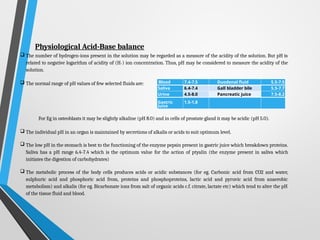
Physiological Acid-Base balance
The number of hydrogen-ions present in the solution may be regarded as a measure of the acidity of the solution. But pH is
related to negative logarithm of acidity of (H+) ion concentration. Thus, pH may be considered to measure the acidity of the
solution.
The normal range of pH values of few selected fluids are:
For Eg in osteoblasts it may be slightly alkaline (pH 8.0) and in cells of prostate gland it may be acidic (pH 5.0).
The individual pH in an organ is maintained by secretions of alkalis or acids to suit optimum level.
The low pH in the stomach is best to the functioning of the enzyme pepsin present in gastric juice which breakdown proteins.
Saliva has a pH range 6.4-7.4 which is the optimum value for the action of ptyalin (the enzyme present in saliva which
initiates the digestion of carbohydrates)
The metabolic process of the body cells produces acids or acidic substances (for eg. Carbonic acid from CO2 and water,
sulphuric acid and phosphoric acid from, proteins and phosphoproteins, lactic acid and pyruvic acid from anaerobic
metabolism) and alkalis (for eg. Bicarbonate ions from salt of organic acids c.f. citrate, lactate etc) which tend to alter the pH
of the tissue fluid and blood.
Blood 7.4-7.5 Duodenal fluid 5.5-7.5
Saliva 6.4-7.4 Gall bladder bile 5.5-7.7
Urine 4.5-8.0 Pancreatic juice 7.5-8.2
Gastric
Juice
1.5-1.8
28.
The term Alkalosisrefers to excess removal of H+ from the body fluid, in contrast to the
excess addition of H+, which is referred to as Acidosis.
There are mainly three regulatory mechanisms which maintain the pH of the each system
and equilibrium with one another.
These are:
1. Buffer of the body fluids
2.Respiratory mechanism
3.Renal regulation
1. Buffer System:
Buffers are the chemicals capable to maintain a constant pH. Buffer system is consists
of a weak acid and the salt of that acid.
They resist the rapid change in the pH of body fluid by converting strong acids and
bases into weak acids and bases. Buffer is thus able to remove excess H+ from the body
fluid but not from body.
The major buffer systems existing in the body fluids are as follows:
29.
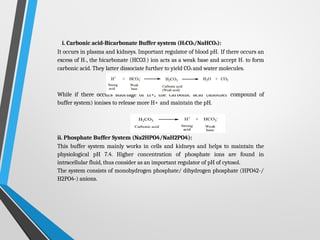
i. Carbonic acid-BicarbonateBuffer system (H2CO3/NaHCO3):
It occurs in plasma and kidneys. Important regulator of blood pH. If there occurs an
excess of H+, the bicarbonate (HCO3-) ion acts as a weak base and accept H+ to form
carbonic acid. They latter dissociate further to yield CO2 and water molecules.
While if there occurs shortage of H+, the carbonic acid (another compound of
buffer system) ionises to release more H+ and maintain the pH.
ii. Phosphate Buffer System (Na2HPO4/NaH2PO4):
This buffer system mainly works in cells and kidneys and helps to maintain the
physiological pH 7.4. Higher concentration of phosphate ions are found in
intracellular fluid, thus consider as an important regulator of pH of cytosol.
The system consists of monohydrogen phosphate/ dihydrogen phosphate (HPO42-/
H2PO4-) anions.
30.
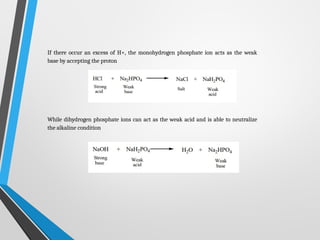
If there occuran excess of H+, the monohydrogen phosphate ion acts as the weak
base by accepting the proton
While dihydrogen phosphate ions can act as the weak acid and is able to neutralize
the alkaline condition
31.
iii. Protein (Hemoglobin)Buffer System:
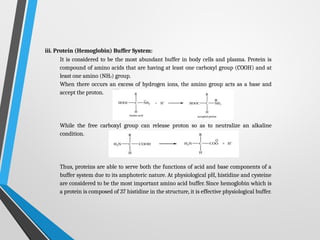
It is considered to be the most abundant buffer in body cells and plasma. Protein is
compound of amino acids that are having at least one carboxyl group (COOH) and at
least one amino (NH2) group.
When there occurs an excess of hydrogen ions, the amino group acts as a base and
accept the proton.
While the free carboxyl group can release proton so as to neutralize an alkaline
condition.
Thus, proteins are able to serve both the functions of acid and base components of a
buffer system due to its amphoteric nature. At physiological pH, histidine and cysteine
are considered to be the most important amino acid buffer. Since hemoglobin which is
a protein is composed of 37 histidine in the structure, it is effective physiological buffer.
32.
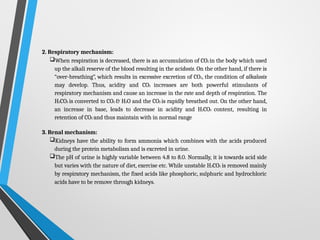
2. Respiratory mechanism:
Whenrespiration is decreased, there is an accumulation of CO2 in the body which used
up the alkali reserve of the blood resulting in the acidosis. On the other hand, if there is
“over-breathing”, which results in excessive excretion of CO2, the condition of alkalosis
may develop. Thus, acidity and CO2 increases are both powerful stimulants of
respiratory mechanism and cause an increase in the rate and depth of respiration. The
H2CO3 is converted to CO2 & H2O and the CO2 is rapidly breathed out. On the other hand,
an increase in base, leads to decrease in acidity and H2CO3 content, resulting in
retention of CO2 and thus maintain with in normal range
3. Renal mechanism:
Kidneys have the ability to form ammonia which combines with the acids produced
during the protein metabolism and is excreted in urine.
The pH of urine is highly variable between 4.8 to 8.0. Normally, it is towards acid side
but varies with the nature of diet, exercise etc. While unstable H2CO3 is removed mainly
by respiratory mechanism, the fixed acids like phosphoric, sulphuric and hydrochloric
acids have to be remove through kidneys.

![Electrolytes:
Substance when dissolved in solution separates into ions & is able to carry an electrical current
Cation - positively charged electrolyte e.g. Ca++ Anion - negatively charged electrolyte e.g. Cl-
But in our body, electrolytes are certain charged nutrients present in our body that have many important functions like:
Electrolytes regulate our nerve and muscles function, our body’s hydration, blood pH, blood pressure, and
rebuilding of damaged tissue.
Electrolytic Fluid Compartments:
Body contain 60-70% of water
Body Fluids
Intracellular Fluid
(Fluid inside the cell)
[45-50% of body
weight]
Extracellular
Fluid
Interstitial Fluid
(Between the
cell) [12-15% of
body
weight]
Plasma or Vascular
fluid (Fluid within
blood vascular
system)
[4-5% of body
weight]a](https://image.slidesharecdn.com/majorextraandintracellularelectrolytes-250327054524-0e97e377/85/Major-Extra-and-Intracellular-Electrolytes-2-320.jpg)