Maintenance
Management
Introduction
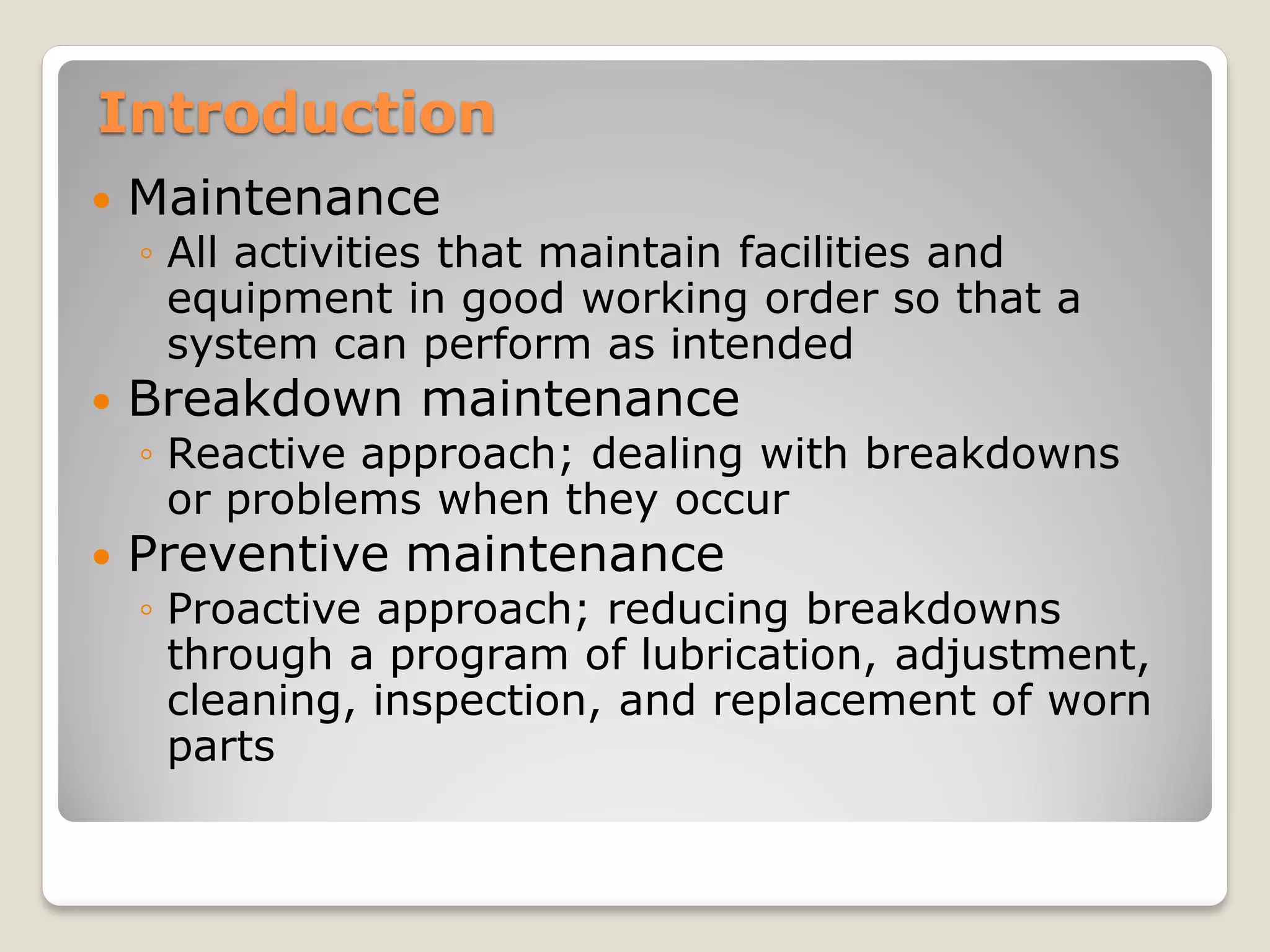
 Maintenance
◦ All activities that maintain facilities and
equipment in good working order so that a
system can perform as intended
 Breakdown maintenance
◦ Reactive approach; dealing with breakdowns
or problems when they occur
 Preventive maintenance
◦ Proactive approach; reducing breakdowns
through a program of lubrication, adjustment,
cleaning, inspection, and replacement of worn
parts
Maintenance Reasons
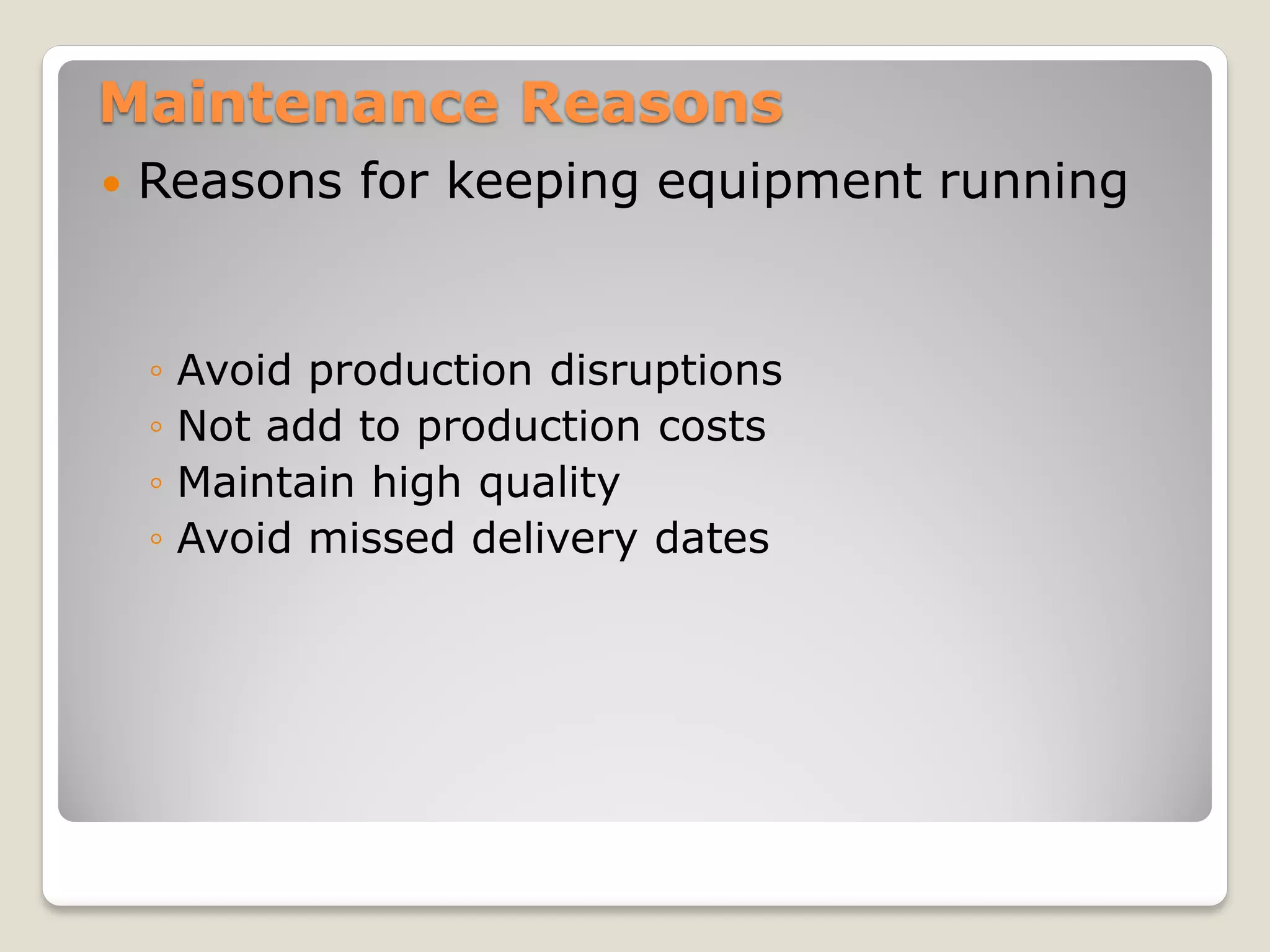
 Reasons for keeping equipment running
◦ Avoid production disruptions
◦ Not add to production costs
◦ Maintain high quality
◦ Avoid missed delivery dates
Breakdown Consequences
 Production capacity is reduced
◦ Orders are delayed
 No production
◦ Overhead continues
◦ Cost per unit increases
 Quality issues
◦ Product may be damaged
 Safety issues
◦ Injury to employees
◦ Injury to customers
Total Maintenance Cost
Breakdown and
repair cost
Optimum Amount of
preventive maintenance
Demand
Total Cost
Preventive
maintenance cost
Preventive Maintenance
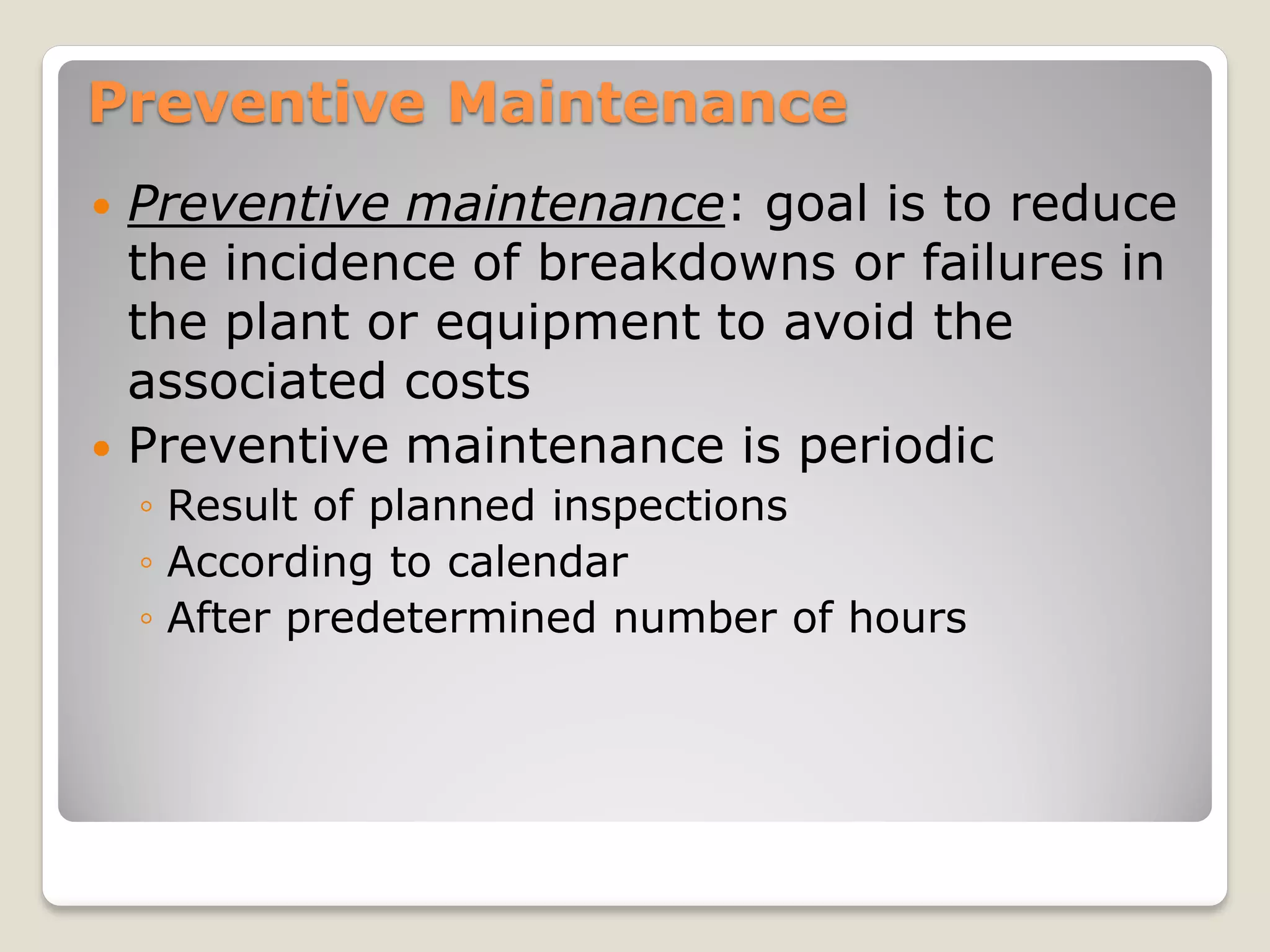
 Preventive maintenance: goal is to reduce
the incidence of breakdowns or failures in
the plant or equipment to avoid the
associated costs
 Preventive maintenance is periodic
◦ Result of planned inspections
◦ According to calendar
◦ After predetermined number of hours
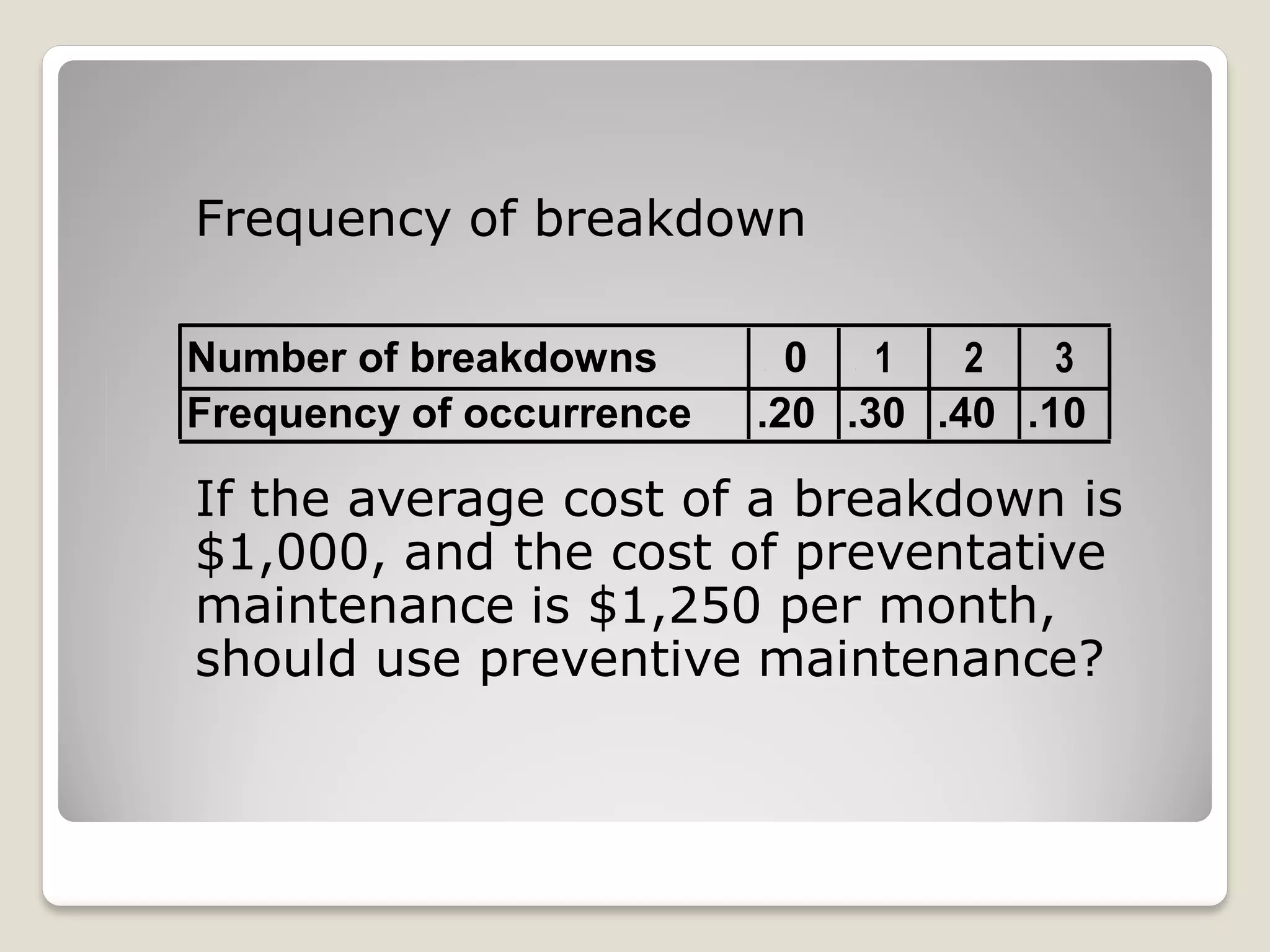
Frequency of breakdown
If the average cost of a breakdown is
$1,000, and the cost of preventative
maintenance is $1,250 per month,
should use preventive maintenance?
Number of breakdowns 0 1 2 3
Frequency of occurrence .20 .30 .40 .10
Number of
Breakdowns
Frequency of
Occurrence
Expected number of
Breakdowns
0
1
2
3
.20
.30
.40
.10
1.00
0
.30
.80
.30
1.40
Expected cost to repair = 1.4 breakdowns per month X $1000 = $1400
Preventive maintenance = $1250
PM results in savings of $150 per month
Predictive Maintenance
 Predictive maintenance
◦ An attempt to determine when best to
perform preventive maintenance activities
 Total productive maintenance
◦ JIT approach where workers perform
preventive maintenance on the machines
they operate
Breakdown Programs
 Standby or backup equipment that can
be quickly pressed into service
 Inventories of spare parts that can be
installed as needed
 Operators who are able to perform
minor repairs
 Repair people who are well trained and
readily available to diagnose and correct
problems with equipment
Replacement
 Trade-off decisions
◦ Cost of replacement vs cost of continued
maintenance
◦ New equipment with new features vs
maintenance
◦ Installation of new equipment may cause
disruptions
◦ Training costs of employees on new equipment
◦ Forecasts for demand on equipment may require
new equipment capacity
 When is it time for replacement?
Calculating OEE
OEE
The OEE calculation is based on the
three OEE Factors: Availability,
Performance, and Quality. Here's how
each of these factors is calculated.
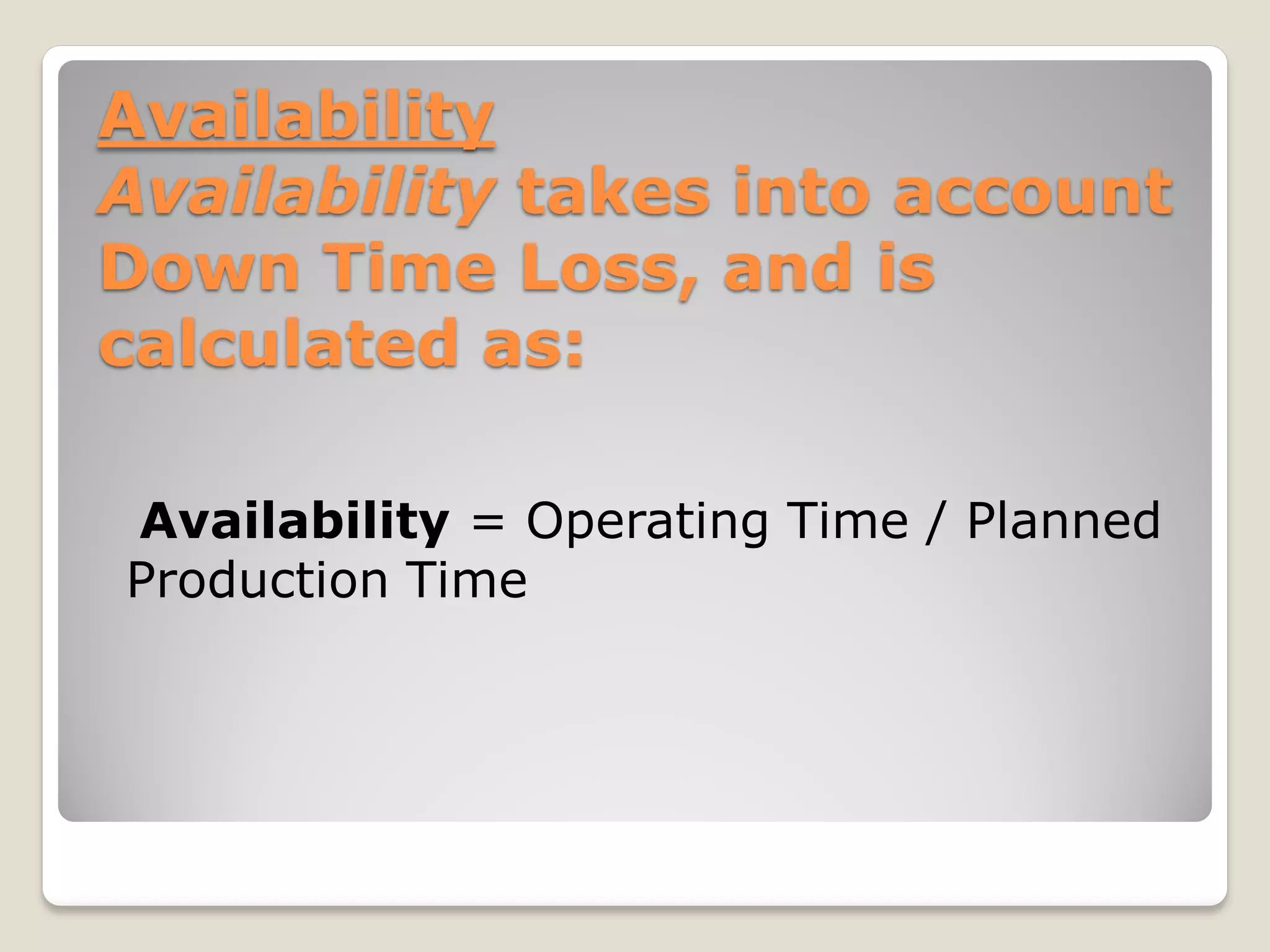
Availability
Availability takes into account
Down Time Loss, and is
calculated as:
Availability = Operating Time / Planned
Production Time
Performance
Performance takes into
account Speed Loss, and is
calculated as:
Performance = Total Pieces / Operating
Time) / Ideal Run Rate
Quality
Quality takes into account
Quality Loss, and is calculated
as:
Quality = Good Pieces / Total Pieces
OEE
OEE takes into account all
three OEE Factors, and is
calculated as:
OEE = Availability x Performance x Quality
 It is very important to recognize that
improving OEE is not the only objective.
Take a look at the following data for two
production shifts.

Superficially, it may appear that the
second shift is performing better than the
first, since its OEE is higher. Very few
companies, however, would want to trade
a 5.0% increase in Availability for a 3.5%
decline in Quality
 Example OEE Calculation
 The table below contains hypothetical
shift data, to be used for a complete OEE
calculation, starting with the calculation of
the OEE Factors of Availability,
Performance, and Quality. Note that the
same units of measurement (in this case
minutes and pieces) are consistently used
throughout the calculations
OEE
Shift Length 8 hours = 480 min.
Short Breaks 2 @ 15 min. = 30 min.
Meal Break 1 @ 30 min. = 30 min.
Down Time 47 minutes
Ideal Run Rate 60 pieces per minute
Total Pieces 19,271 pieces
Reject Pieces 423 pieces
 Planned Production Time
= [Shift Length - Breaks]
= [480 - 60]
= 420 minutes
Operating Time
= [Planned Production Time - Down Time]
= [420 - 47]
= 373 minutes
Good Pieces
= [Total Pieces - Reject Pieces]
= [19,271 - 423]
= 18,848 pieces
Availability=Operating Time / Planned Production Time
373 minutes / 420 minutes=0.8881 (88.81%)
Performance=(Total Pieces / Operating Time) / Ideal Run Rate
(19,271 pieces / 373 minutes) / 60 pieces per minute=0.8611 (86.11%)
Quality=Good Pieces / Total Pieces
0.8881 x 0.8611 x 0.9780=0.7479 (74.79%)
OEE=Availability x Performance x Quality
0.8881 x 0.8611 x 0.9780=0.7479 (74.79%)
Maintenance

Maintenance

  • 1.
  • 2.
    Introduction  Maintenance ◦ Allactivities that maintain facilities and equipment in good working order so that a system can perform as intended  Breakdown maintenance ◦ Reactive approach; dealing with breakdowns or problems when they occur  Preventive maintenance ◦ Proactive approach; reducing breakdowns through a program of lubrication, adjustment, cleaning, inspection, and replacement of worn parts
  • 3.
    Maintenance Reasons  Reasonsfor keeping equipment running ◦ Avoid production disruptions ◦ Not add to production costs ◦ Maintain high quality ◦ Avoid missed delivery dates
  • 4.
    Breakdown Consequences  Productioncapacity is reduced ◦ Orders are delayed  No production ◦ Overhead continues ◦ Cost per unit increases  Quality issues ◦ Product may be damaged  Safety issues ◦ Injury to employees ◦ Injury to customers
  • 5.
    Total Maintenance Cost Breakdownand repair cost Optimum Amount of preventive maintenance Demand Total Cost Preventive maintenance cost
  • 6.
    Preventive Maintenance  Preventivemaintenance: goal is to reduce the incidence of breakdowns or failures in the plant or equipment to avoid the associated costs  Preventive maintenance is periodic ◦ Result of planned inspections ◦ According to calendar ◦ After predetermined number of hours
  • 7.
    Frequency of breakdown Ifthe average cost of a breakdown is $1,000, and the cost of preventative maintenance is $1,250 per month, should use preventive maintenance? Number of breakdowns 0 1 2 3 Frequency of occurrence .20 .30 .40 .10
  • 8.
    Number of Breakdowns Frequency of Occurrence Expectednumber of Breakdowns 0 1 2 3 .20 .30 .40 .10 1.00 0 .30 .80 .30 1.40 Expected cost to repair = 1.4 breakdowns per month X $1000 = $1400 Preventive maintenance = $1250 PM results in savings of $150 per month
  • 9.
    Predictive Maintenance  Predictivemaintenance ◦ An attempt to determine when best to perform preventive maintenance activities  Total productive maintenance ◦ JIT approach where workers perform preventive maintenance on the machines they operate
  • 10.
    Breakdown Programs  Standbyor backup equipment that can be quickly pressed into service  Inventories of spare parts that can be installed as needed  Operators who are able to perform minor repairs  Repair people who are well trained and readily available to diagnose and correct problems with equipment
  • 11.
    Replacement  Trade-off decisions ◦Cost of replacement vs cost of continued maintenance ◦ New equipment with new features vs maintenance ◦ Installation of new equipment may cause disruptions ◦ Training costs of employees on new equipment ◦ Forecasts for demand on equipment may require new equipment capacity  When is it time for replacement?
  • 12.
  • 13.
    OEE The OEE calculationis based on the three OEE Factors: Availability, Performance, and Quality. Here's how each of these factors is calculated.
  • 14.
    Availability Availability takes intoaccount Down Time Loss, and is calculated as: Availability = Operating Time / Planned Production Time
  • 15.
    Performance Performance takes into accountSpeed Loss, and is calculated as: Performance = Total Pieces / Operating Time) / Ideal Run Rate
  • 16.
    Quality Quality takes intoaccount Quality Loss, and is calculated as: Quality = Good Pieces / Total Pieces
  • 17.
    OEE OEE takes intoaccount all three OEE Factors, and is calculated as: OEE = Availability x Performance x Quality
  • 18.
     It isvery important to recognize that improving OEE is not the only objective. Take a look at the following data for two production shifts.  Superficially, it may appear that the second shift is performing better than the first, since its OEE is higher. Very few companies, however, would want to trade a 5.0% increase in Availability for a 3.5% decline in Quality
  • 19.
     Example OEECalculation  The table below contains hypothetical shift data, to be used for a complete OEE calculation, starting with the calculation of the OEE Factors of Availability, Performance, and Quality. Note that the same units of measurement (in this case minutes and pieces) are consistently used throughout the calculations
  • 20.
    OEE Shift Length 8hours = 480 min. Short Breaks 2 @ 15 min. = 30 min. Meal Break 1 @ 30 min. = 30 min. Down Time 47 minutes Ideal Run Rate 60 pieces per minute Total Pieces 19,271 pieces Reject Pieces 423 pieces
  • 21.
     Planned ProductionTime = [Shift Length - Breaks] = [480 - 60] = 420 minutes Operating Time = [Planned Production Time - Down Time] = [420 - 47] = 373 minutes Good Pieces = [Total Pieces - Reject Pieces] = [19,271 - 423] = 18,848 pieces
  • 22.
    Availability=Operating Time /Planned Production Time 373 minutes / 420 minutes=0.8881 (88.81%) Performance=(Total Pieces / Operating Time) / Ideal Run Rate (19,271 pieces / 373 minutes) / 60 pieces per minute=0.8611 (86.11%) Quality=Good Pieces / Total Pieces 0.8881 x 0.8611 x 0.9780=0.7479 (74.79%) OEE=Availability x Performance x Quality 0.8881 x 0.8611 x 0.9780=0.7479 (74.79%)