TOTAL PRODUCTIVE
MAINTENANCE
(TPM)
BY
SASIDHARAN M
INTRODUCTION
• Total productive maintenance (TPM) originated in Japan in 1971
as a method for improved machine availability through better
utilization of maintenance and production resources.
• TPM is a maintenance process developed for improving
productivity by making processes more reliable and less
wasteful.TPM is an extension of TQM(Total Quality
Management)
WHY TPM ?
• Avoid wastage in a quickly changing economic environment.
• Producing goods without reducing product quality.
• Reduce cost.
• Produce a low batch quantity at the earliest possible time.
• Goods send to the customers must be non defective.
WHAT IS TPM?
• Strategy of TPM is to change the attitude from “I use, You
maintain” to “I use, I maintain”.
• Think about how to Increase production and reduced cost by
reducing or eliminating loss, and this is the TPM.
OBJECTIVES OF TPM
• Improving the effectiveness of machines.
• Improving the efficiency, reliability and effectiveness of
maintenance of machine.
• Scheduling maintenance for avoiding early maintenance.
• Involving operation team also in smaller scale maintenance,
such as machine checklist inspection before starting and after
closing the machines.
• Arrangement of training for amending the skills of employees.
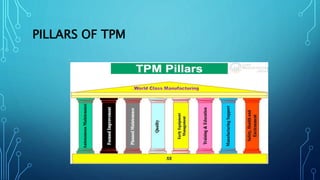
PILLARS OF TPM
PILLAR 1 – AUTONOMOUS MAINTENANCE
• A collaborative team activity involving production, maintenance, and
engineering.
• Maintaining Basic conditions on shop floor & in Machines.
• All over participation through TPM Circles.
• Example: 5 S’, JISHU HOZEN ( Autonomous maintenance ), etc.,
• An approach that
• Develops operating and maintenance skills
• Strengthens communication and cooperation
PILLAR 2 – FOCUSED IMPROVEMENT
• Improvement on every one’s activity.
• Improvement is to eliminate Production losses and cost
reduction.
• Improvement in Reliability, Maintainability, and cost.
PILLAR 3 – PLANNED MAINTENANCE
• Logical analysis “Real causes for real counter measures”.
• Focus on Prevention.
• It is aimed to have trouble free machines and equipments
producing defect free products for total customer satisfaction.
• Example: Preventive Maintenance, Breakdown Maintenance,
etc.,
PILLAR 4 – QUALITY MAINTENANCE
• Developing perfect machine for perfect Quality.
• Eliminating In – Process defects and custom complaints.
• Policy :
• Defect free conditions and control of equipments.
• QM activities to support quality assurance.
• Focus of prevention of defects at source
• Focus on POKA-YOKE. ( fool proof system )
• In-line detection and segregation of defects.
• Effective implementation of operator quality assurance.
PILLAR 5 – EDUCATION & TRAINING
• Skills development for uniformity of work practices on machines.
• Skills for Zero defects, Zero breakdowns & Zero accidents.
• Multi Skilled employees in all departments.
• Four Levels of Skills
• Level 1: Lack both theoretical and practical ability (needs to be taught)
• Level 2: Knows theory but not in practice
• Level 3: Has mastered practice but not theory
• Level 4: Mastered both practice and theory
PILLAR 6 – DEVELOPMENT MANAGEMENT
• Developing machines for “high equipment effectiveness”.
• Quick process for developing new products.
• Example: KAIZEN
• Kaizen Policy :
• Practice concepts of zero losses in every sphere of activity.
• Relentless pursuit to achieve cost reduction targets in all resources.
• Relentless pursuit to improve over all plant equipment effectiveness.
• Extensive use of PM analysis as a tool for eliminating losses.
• Focus of easy handling of operators.
PILLAR 7 – SAFETY, HEALTH &
ENVIRONMENT
• Zero accidents and Zero hazards at works.
• Zero Pollution at Plant and Environment.
PILLAR 8 – OFFICE TPM
• Office TPM must be followed to improve productivity, efficiency in the administrative
functions and identify and eliminate losses.
• This includes analyzing processes and procedures towards increased office automation.
• Plans & Guidelines:
• Providing awareness about office TPM to all support departments
• Helping them to identify P, Q, C, D, S, M in each function in relation to plant performance
• Identify the scope for improvement in each function
• Collect relevant data
• Help them to solve problems in their circles
AVAILABILITY
• Calculation: Availability = Available Time / Scheduled Time
• Example:
• A given Work Center is scheduled to run for an 8 hour (480 minute) shift.
• The normal shift includes a scheduled 30 minute break when the Work
Center is expected to be down.
• The Work Center experiences 60 minutes of unscheduled downtime.
• Scheduled Time = 480 min – 30 min break = 450 Min
• Available Time = 450 min Scheduled – 60 min Unscheduled Downtime =
390 Min
• Availability = 390 Avail Min / 450 Scheduled Min = 87%
PERFORMANCE
• Calculation: Performance = (Parts Produced * Ideal Cycle Time) / Available Time
• Example:
• A given Work Center is scheduled to run for an 8 hour (480 minute) shift with a 30
minute scheduled break.
• Available Time = 450 Min Sched – 60 Min Unsched Downtime = 390 Minutes
• The Standard Rate for the part being produced is 40 Units/Hour or 1.5 Minutes/Unit
• The Work Center produces 242 Total Units during the shift. Note: The basis is Total
Units, not Good Units. The Performance metric does not penalize for Quality.
• Time to Produce Parts = 242 Units * 1.5 Minutes/Unit = 363 Minutes
• Performance = 363 Minutes / 390 Minutes = 93.0%
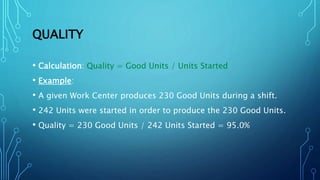
QUALITY
• Calculation: Quality = Good Units / Units Started
• Example:
• A given Work Center produces 230 Good Units during a shift.
• 242 Units were started in order to produce the 230 Good Units.
• Quality = 230 Good Units / 242 Units Started = 95.0%
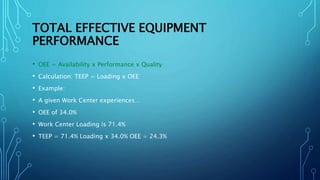
TOTAL EFFECTIVE EQUIPMENT
PERFORMANCE
• OEE = Availability x Performance x Quality
• Calculation: TEEP = Loading x OEE
• Example:
• A given Work Center experiences…
• OEE of 34.0%
• Work Center Loading is 71.4%
• TEEP = 71.4% Loading x 34.0% OEE = 24.3%
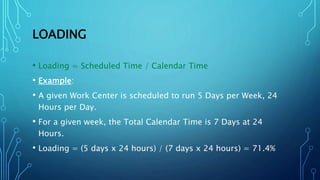
LOADING
• Loading = Scheduled Time / Calendar Time
• Example:
• A given Work Center is scheduled to run 5 Days per Week, 24
Hours per Day.
• For a given week, the Total Calendar Time is 7 Days at 24
Hours.
• Loading = (5 days x 24 hours) / (7 days x 24 hours) = 71.4%
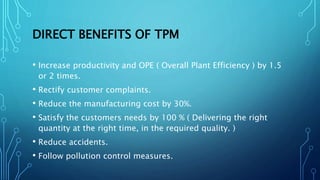
DIRECT BENEFITS OF TPM
• Increase productivity and OPE ( Overall Plant Efficiency ) by 1.5
or 2 times.
• Rectify customer complaints.
• Reduce the manufacturing cost by 30%.
• Satisfy the customers needs by 100 % ( Delivering the right
quantity at the right time, in the required quality. )
• Reduce accidents.
• Follow pollution control measures.
INDIRECT BENEFITS OF TPM
• Higher confidence level among the employees.
• Keep the work place clean, neat and attractive.
• Favorable change in the attitude of the operators.
• Achieve goals by working as team.
• Horizontal deployment of a new concept in all areas of the
organization.
• Share knowledge and experience.
• The workers get a feeling of owning the machine.
DIFFICULTIES FACED IN TPM
IMPLEMENTATION
• Sufficient resources like people, money, time, etc. and assistance are not
provided.
• TPM is not a “quick fix” approach, it involve cultural change to the ways to
do the things.
• Incomplete understanding of the methodology and philosophy by middle
management.
• Many people treat it just another “program of the month” without paying any
focus and also doubt about its effectiveness.
• Workers show strong resistance to any change
• Many people considered TPM activities as additional work or threat.

Total productive maintenance

  • 1.
  • 2.
    INTRODUCTION • Total productivemaintenance (TPM) originated in Japan in 1971 as a method for improved machine availability through better utilization of maintenance and production resources. • TPM is a maintenance process developed for improving productivity by making processes more reliable and less wasteful.TPM is an extension of TQM(Total Quality Management)
  • 3.
    WHY TPM ? •Avoid wastage in a quickly changing economic environment. • Producing goods without reducing product quality. • Reduce cost. • Produce a low batch quantity at the earliest possible time. • Goods send to the customers must be non defective.
  • 4.
    WHAT IS TPM? •Strategy of TPM is to change the attitude from “I use, You maintain” to “I use, I maintain”. • Think about how to Increase production and reduced cost by reducing or eliminating loss, and this is the TPM.
  • 5.
    OBJECTIVES OF TPM •Improving the effectiveness of machines. • Improving the efficiency, reliability and effectiveness of maintenance of machine. • Scheduling maintenance for avoiding early maintenance. • Involving operation team also in smaller scale maintenance, such as machine checklist inspection before starting and after closing the machines. • Arrangement of training for amending the skills of employees.
  • 6.
  • 7.
    PILLAR 1 –AUTONOMOUS MAINTENANCE • A collaborative team activity involving production, maintenance, and engineering. • Maintaining Basic conditions on shop floor & in Machines. • All over participation through TPM Circles. • Example: 5 S’, JISHU HOZEN ( Autonomous maintenance ), etc., • An approach that • Develops operating and maintenance skills • Strengthens communication and cooperation
  • 8.
    PILLAR 2 –FOCUSED IMPROVEMENT • Improvement on every one’s activity. • Improvement is to eliminate Production losses and cost reduction. • Improvement in Reliability, Maintainability, and cost.
  • 9.
    PILLAR 3 –PLANNED MAINTENANCE • Logical analysis “Real causes for real counter measures”. • Focus on Prevention. • It is aimed to have trouble free machines and equipments producing defect free products for total customer satisfaction. • Example: Preventive Maintenance, Breakdown Maintenance, etc.,
  • 10.
    PILLAR 4 –QUALITY MAINTENANCE • Developing perfect machine for perfect Quality. • Eliminating In – Process defects and custom complaints. • Policy : • Defect free conditions and control of equipments. • QM activities to support quality assurance. • Focus of prevention of defects at source • Focus on POKA-YOKE. ( fool proof system ) • In-line detection and segregation of defects. • Effective implementation of operator quality assurance.
  • 11.
    PILLAR 5 –EDUCATION & TRAINING • Skills development for uniformity of work practices on machines. • Skills for Zero defects, Zero breakdowns & Zero accidents. • Multi Skilled employees in all departments. • Four Levels of Skills • Level 1: Lack both theoretical and practical ability (needs to be taught) • Level 2: Knows theory but not in practice • Level 3: Has mastered practice but not theory • Level 4: Mastered both practice and theory
  • 12.
    PILLAR 6 –DEVELOPMENT MANAGEMENT • Developing machines for “high equipment effectiveness”. • Quick process for developing new products. • Example: KAIZEN • Kaizen Policy : • Practice concepts of zero losses in every sphere of activity. • Relentless pursuit to achieve cost reduction targets in all resources. • Relentless pursuit to improve over all plant equipment effectiveness. • Extensive use of PM analysis as a tool for eliminating losses. • Focus of easy handling of operators.
  • 13.
    PILLAR 7 –SAFETY, HEALTH & ENVIRONMENT • Zero accidents and Zero hazards at works. • Zero Pollution at Plant and Environment.
  • 14.
    PILLAR 8 –OFFICE TPM • Office TPM must be followed to improve productivity, efficiency in the administrative functions and identify and eliminate losses. • This includes analyzing processes and procedures towards increased office automation. • Plans & Guidelines: • Providing awareness about office TPM to all support departments • Helping them to identify P, Q, C, D, S, M in each function in relation to plant performance • Identify the scope for improvement in each function • Collect relevant data • Help them to solve problems in their circles
  • 15.
    AVAILABILITY • Calculation: Availability= Available Time / Scheduled Time • Example: • A given Work Center is scheduled to run for an 8 hour (480 minute) shift. • The normal shift includes a scheduled 30 minute break when the Work Center is expected to be down. • The Work Center experiences 60 minutes of unscheduled downtime. • Scheduled Time = 480 min – 30 min break = 450 Min • Available Time = 450 min Scheduled – 60 min Unscheduled Downtime = 390 Min • Availability = 390 Avail Min / 450 Scheduled Min = 87%
  • 16.
    PERFORMANCE • Calculation: Performance= (Parts Produced * Ideal Cycle Time) / Available Time • Example: • A given Work Center is scheduled to run for an 8 hour (480 minute) shift with a 30 minute scheduled break. • Available Time = 450 Min Sched – 60 Min Unsched Downtime = 390 Minutes • The Standard Rate for the part being produced is 40 Units/Hour or 1.5 Minutes/Unit • The Work Center produces 242 Total Units during the shift. Note: The basis is Total Units, not Good Units. The Performance metric does not penalize for Quality. • Time to Produce Parts = 242 Units * 1.5 Minutes/Unit = 363 Minutes • Performance = 363 Minutes / 390 Minutes = 93.0%
  • 17.
    QUALITY • Calculation: Quality= Good Units / Units Started • Example: • A given Work Center produces 230 Good Units during a shift. • 242 Units were started in order to produce the 230 Good Units. • Quality = 230 Good Units / 242 Units Started = 95.0%
  • 18.
    TOTAL EFFECTIVE EQUIPMENT PERFORMANCE •OEE = Availability x Performance x Quality • Calculation: TEEP = Loading x OEE • Example: • A given Work Center experiences… • OEE of 34.0% • Work Center Loading is 71.4% • TEEP = 71.4% Loading x 34.0% OEE = 24.3%
  • 19.
    LOADING • Loading =Scheduled Time / Calendar Time • Example: • A given Work Center is scheduled to run 5 Days per Week, 24 Hours per Day. • For a given week, the Total Calendar Time is 7 Days at 24 Hours. • Loading = (5 days x 24 hours) / (7 days x 24 hours) = 71.4%
  • 20.
    DIRECT BENEFITS OFTPM • Increase productivity and OPE ( Overall Plant Efficiency ) by 1.5 or 2 times. • Rectify customer complaints. • Reduce the manufacturing cost by 30%. • Satisfy the customers needs by 100 % ( Delivering the right quantity at the right time, in the required quality. ) • Reduce accidents. • Follow pollution control measures.
  • 21.
    INDIRECT BENEFITS OFTPM • Higher confidence level among the employees. • Keep the work place clean, neat and attractive. • Favorable change in the attitude of the operators. • Achieve goals by working as team. • Horizontal deployment of a new concept in all areas of the organization. • Share knowledge and experience. • The workers get a feeling of owning the machine.
  • 22.
    DIFFICULTIES FACED INTPM IMPLEMENTATION • Sufficient resources like people, money, time, etc. and assistance are not provided. • TPM is not a “quick fix” approach, it involve cultural change to the ways to do the things. • Incomplete understanding of the methodology and philosophy by middle management. • Many people treat it just another “program of the month” without paying any focus and also doubt about its effectiveness. • Workers show strong resistance to any change • Many people considered TPM activities as additional work or threat.