Introduction to Maintenance
Imagine:
 On December 7,2016, PIA flight PK 661 ATR-42 aircraft left Chitral at 3:30 pm
 All two engines, hydraulic systems working
 4:40 pm explosion shook plane at Havelian
 Number 2 engine torn apart, 2 separate hydraulic lines ceased to work
 In spite of maintenance work, engine still failed
 Imagine having no maintenance system
 Maintenance and reliability is important
 Maintenance and product quality
 Maintenance and productivity
 Maintenance and safety
 Maintenance and supply chain, JIT
 Failure cause disruption, waste,accident, inconvenience and expensive
 Operators less able to do repairs themselves
 Machine and product failure can have effect on company’s operation and profitability
 Idle workers, facility
 Losses due to breakdown
Failure:
 Failure – inability to produce work in appropriate manner
 Equipment / machine failure on production floor – worn out bearing, pump, pressure leaks,
broken shaft, overheated machine etc.
 Equipment failure in office – failure of power supply, air-conditioned system, computer network,
photocopy machine
 Vehicle failure – brake, transmission, engine, cooling system
Maintenance in Service Industry
 Hospital
 Restaurants
 Transport companies
 Banks
 Hotels and resorts
 Shopping malls / retail
 Gas station
Maintenance in Manufacturing Companies
 Electronic
 Automotive
 Petrochemicals
 Refinery
 Furniture
 Ceramics
 Food and beverages
Maintenance
 All actions necessary for retaining an item, or restoring to it, a serviceable condition, include
servicing, repair, modification, overhaul, inspection and condition verification
 Increase availability of a system
 Keep system’s equipment in working order
Purpose of Maintenance:
 Attempt to maximize performance of production equipment efficiently and regularly
 Prevent breakdown or failures
 Minimize production loss from failures
 Increase reliability of the operating systems
Principle Objectives in Maintenance:
 To achieve product quality and customer satisfaction through adjusted and serviced equipment
 Maximize useful life of equipment
 Keep equipment safe and prevent safety hazards
 Minimize frequency and severity of interruptions
 Maximize production capacity – through high utilization of facility
Problems in Maintenance:
 Lack of management attention to maintenance
 Little participation by accounting in analyzing and reporting costs
 Difficulties in applying quantitative analysis
 Difficulties in obtaining time and cost estimates for maintenance works
 Difficulties in measuring performance
Problems Exist Due To:
 Failure to develop written objectives and policy
 Inadequate budgetary control
 Inadequate control procedures for work order, service requests etc.
 Infrequent use of standards
 To control maintenance work
 Absence of cost reports to aid maintenance planning and control system
Maintenance Objectives:
 Must be consistent with the goals of production (cost, quality, delivery, safety)
 Must be comprehensive and include specific responsibilities
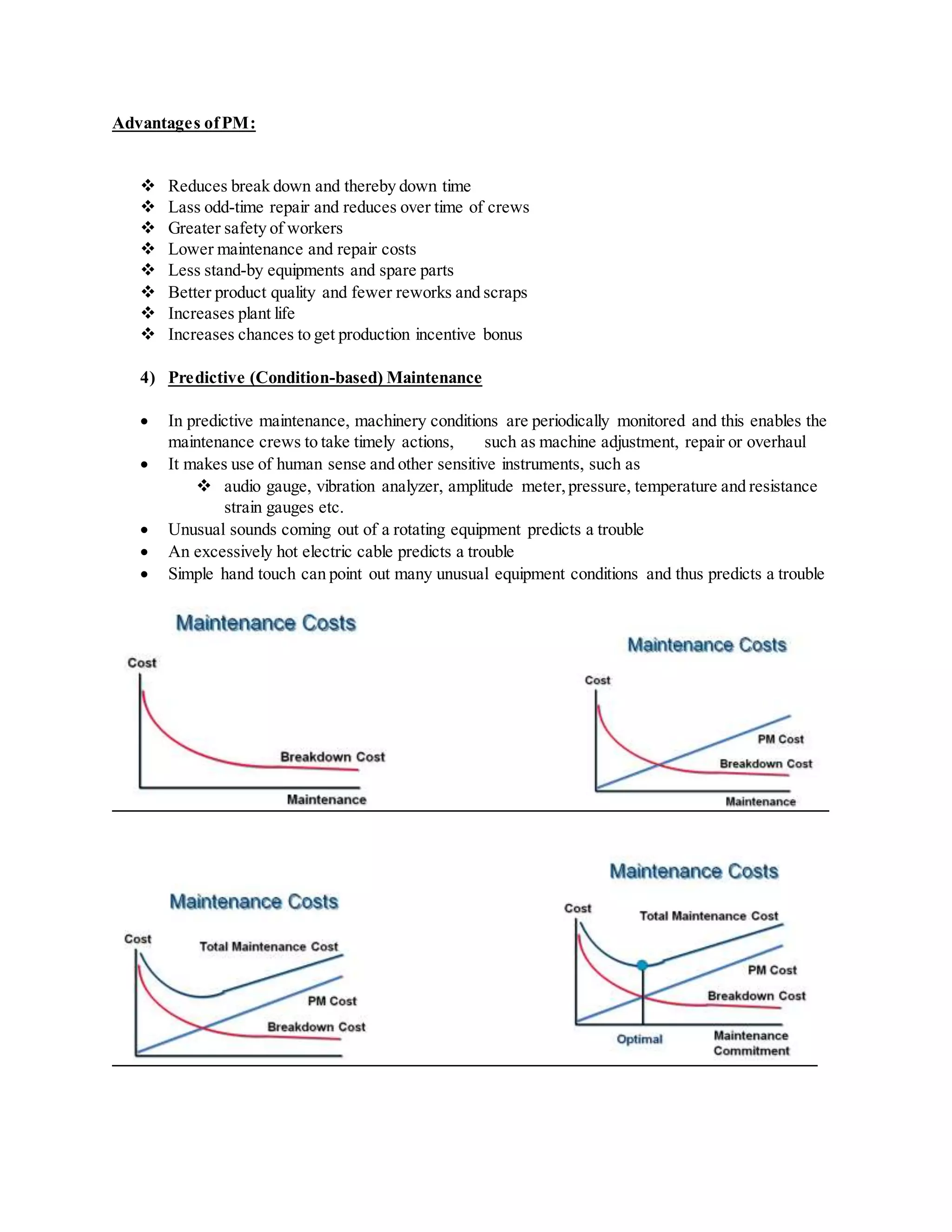
Maintenance Costs
 Cost to replace or repair
 Losses of output
 Delayed shipment
 Scrap and rework
Types ofMaintenance:
 Maintenance may be classified into four categories:
 (some authors prefer three categories- scheduled and preventive maintenances are merged)
 Corrective or Breakdown maintenance
 Scheduled maintenance
 Preventive maintenance
 Predictive (Condition-based) maintenance
1) Corrective or Breakdown Maintenance:
 Corrective or Breakdown maintenance implies that repairs are made after the equipment is failed
and cannot perform its normal function anymore
 Quite justified in small factories where:
 Down times are non-critical and repair costs are less than other type of maintenance
 Financial justification for scheduling are not felt
Disadvantages ofCorrective Maintenance
 Breakdown generally occurs inappropriate times leading to poor and hurried maintenance
 Excessive delay in production & reduces output
 Faster plant deterioration
 Increases chances of accidents and less safety for both workers and machines
 More spoilt materials
 Direct loss of profit
 Cannot be employed for equipments regulated by statutory provisions e.g. cranes,lift and hoists
etc
2) Scheduled Maintenance:
 Scheduled maintenance is a stitch-in-time procedure and incorporates
 inspection
 lubrication
 repair and overhaul of equipments
 If neglected can result in breakdown
 Generally followed for:
 overhauling of machines
 changing of heavy equipment oils
 cleaning of water and other tanks etc.
3) Preventive Maintenance (PM):
 Principle – “Prevention is better than cure”
 Procedure - Stitch-in-time
 It
 locates weak spots of machinery and equipments
 provides them periodic/scheduled inspections and minor repairs to reduce the danger of
unanticipated breakdowns
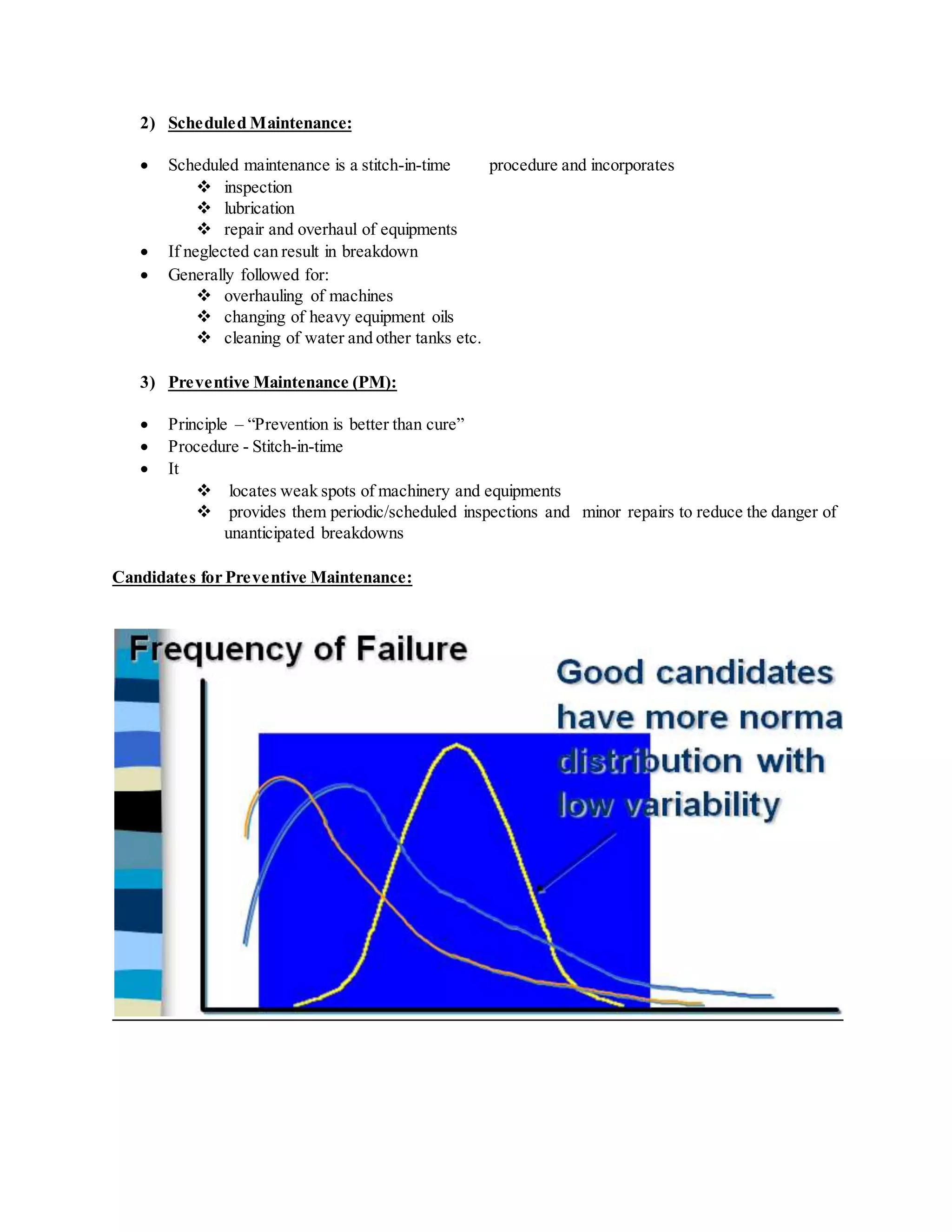
Candidates for Preventive Maintenance:
Advantages ofPM:
 Reduces break down and thereby down time
 Lass odd-time repair and reduces over time of crews
 Greater safety of workers
 Lower maintenance and repair costs
 Less stand-by equipments and spare parts
 Better product quality and fewer reworks and scraps
 Increases plant life
 Increases chances to get production incentive bonus
4) Predictive (Condition-based) Maintenance
 In predictive maintenance, machinery conditions are periodically monitored and this enables the
maintenance crews to take timely actions, such as machine adjustment, repair or overhaul
 It makes use of human sense and other sensitive instruments, such as
 audio gauge, vibration analyzer, amplitude meter,pressure, temperature and resistance
strain gauges etc.
 Unusual sounds coming out of a rotating equipment predicts a trouble
 An excessively hot electric cable predicts a trouble
 Simple hand touch can point out many unusual equipment conditions and thus predicts a trouble
Determining the Size ofRepair Crews:
 Problem:
 A factory has 200 machines and the maintenance engineer supervises the repair crews who
repair malfunctioning machines. The maintenance policy is to repair the broken down
machine and bring back in production within 2 hours on the average. Ifaverage breakdown
rate is 3.5 machines/hour and each repair crewcan repair 0.25 machine per hour on the
average. Howmany repair crews are required ?
Solution
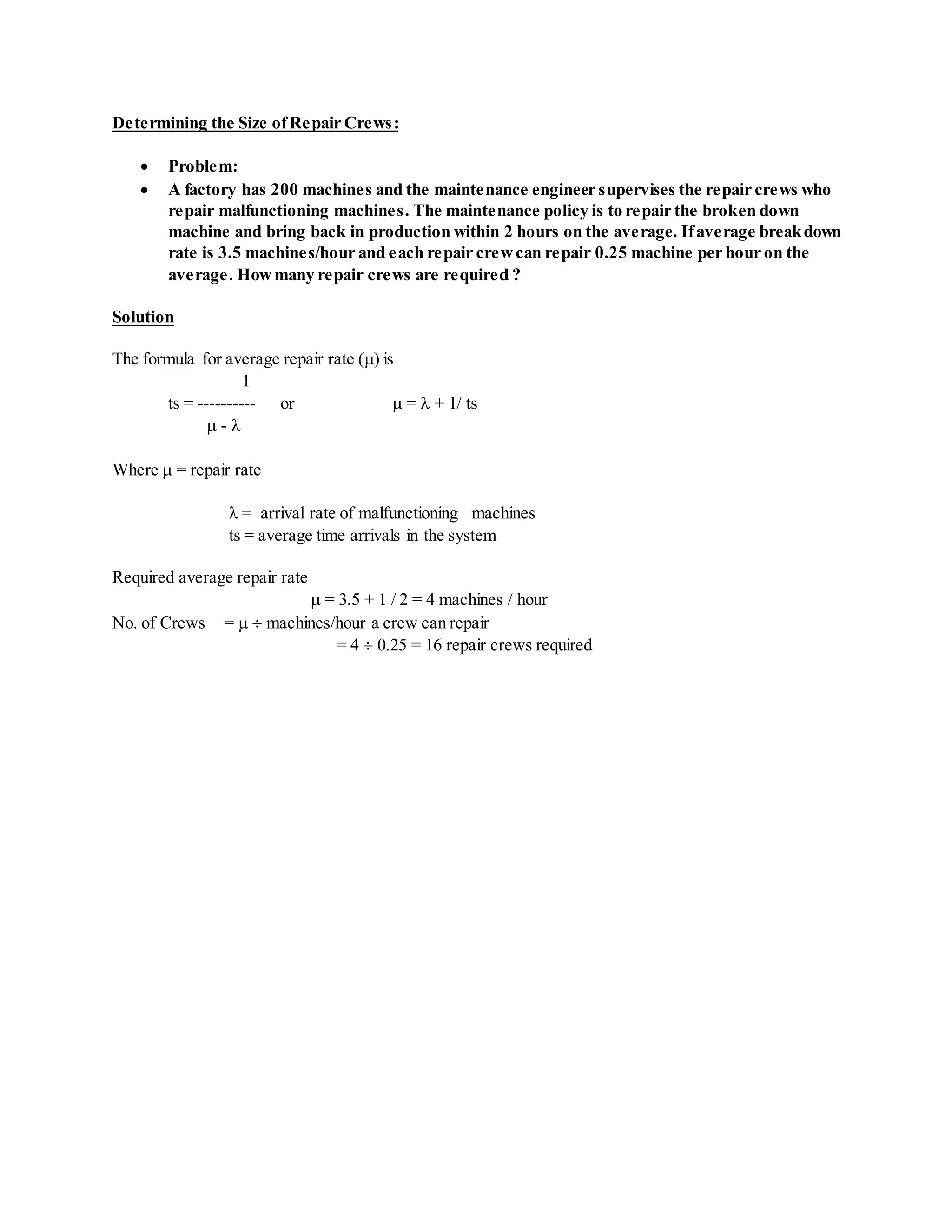
The formula for average repair rate () is
1
ts = ---------- or  =  + 1/ ts
 - 
Where  = repair rate
 = arrival rate of malfunctioning machines
ts = average time arrivals in the system
Required average repair rate
 = 3.5 + 1 / 2 = 4 machines / hour
No. of Crews =   machines/hour a crew can repair
= 4  0.25 = 16 repair crews required

Introduction to maintenance

  • 1.
    Introduction to Maintenance Imagine: On December 7,2016, PIA flight PK 661 ATR-42 aircraft left Chitral at 3:30 pm  All two engines, hydraulic systems working  4:40 pm explosion shook plane at Havelian  Number 2 engine torn apart, 2 separate hydraulic lines ceased to work  In spite of maintenance work, engine still failed  Imagine having no maintenance system  Maintenance and reliability is important  Maintenance and product quality  Maintenance and productivity  Maintenance and safety  Maintenance and supply chain, JIT  Failure cause disruption, waste,accident, inconvenience and expensive  Operators less able to do repairs themselves  Machine and product failure can have effect on company’s operation and profitability  Idle workers, facility  Losses due to breakdown Failure:  Failure – inability to produce work in appropriate manner  Equipment / machine failure on production floor – worn out bearing, pump, pressure leaks, broken shaft, overheated machine etc.  Equipment failure in office – failure of power supply, air-conditioned system, computer network, photocopy machine  Vehicle failure – brake, transmission, engine, cooling system Maintenance in Service Industry  Hospital  Restaurants  Transport companies  Banks  Hotels and resorts  Shopping malls / retail  Gas station
  • 2.
    Maintenance in ManufacturingCompanies  Electronic  Automotive  Petrochemicals  Refinery  Furniture  Ceramics  Food and beverages Maintenance  All actions necessary for retaining an item, or restoring to it, a serviceable condition, include servicing, repair, modification, overhaul, inspection and condition verification  Increase availability of a system  Keep system’s equipment in working order Purpose of Maintenance:  Attempt to maximize performance of production equipment efficiently and regularly  Prevent breakdown or failures  Minimize production loss from failures  Increase reliability of the operating systems Principle Objectives in Maintenance:  To achieve product quality and customer satisfaction through adjusted and serviced equipment  Maximize useful life of equipment  Keep equipment safe and prevent safety hazards  Minimize frequency and severity of interruptions  Maximize production capacity – through high utilization of facility Problems in Maintenance:  Lack of management attention to maintenance  Little participation by accounting in analyzing and reporting costs  Difficulties in applying quantitative analysis  Difficulties in obtaining time and cost estimates for maintenance works  Difficulties in measuring performance Problems Exist Due To:  Failure to develop written objectives and policy  Inadequate budgetary control  Inadequate control procedures for work order, service requests etc.  Infrequent use of standards  To control maintenance work  Absence of cost reports to aid maintenance planning and control system
  • 3.
    Maintenance Objectives:  Mustbe consistent with the goals of production (cost, quality, delivery, safety)  Must be comprehensive and include specific responsibilities Maintenance Costs  Cost to replace or repair  Losses of output  Delayed shipment  Scrap and rework Types ofMaintenance:  Maintenance may be classified into four categories:  (some authors prefer three categories- scheduled and preventive maintenances are merged)  Corrective or Breakdown maintenance  Scheduled maintenance  Preventive maintenance  Predictive (Condition-based) maintenance 1) Corrective or Breakdown Maintenance:  Corrective or Breakdown maintenance implies that repairs are made after the equipment is failed and cannot perform its normal function anymore  Quite justified in small factories where:  Down times are non-critical and repair costs are less than other type of maintenance  Financial justification for scheduling are not felt Disadvantages ofCorrective Maintenance  Breakdown generally occurs inappropriate times leading to poor and hurried maintenance  Excessive delay in production & reduces output  Faster plant deterioration  Increases chances of accidents and less safety for both workers and machines  More spoilt materials  Direct loss of profit  Cannot be employed for equipments regulated by statutory provisions e.g. cranes,lift and hoists etc
  • 4.
    2) Scheduled Maintenance: Scheduled maintenance is a stitch-in-time procedure and incorporates  inspection  lubrication  repair and overhaul of equipments  If neglected can result in breakdown  Generally followed for:  overhauling of machines  changing of heavy equipment oils  cleaning of water and other tanks etc. 3) Preventive Maintenance (PM):  Principle – “Prevention is better than cure”  Procedure - Stitch-in-time  It  locates weak spots of machinery and equipments  provides them periodic/scheduled inspections and minor repairs to reduce the danger of unanticipated breakdowns Candidates for Preventive Maintenance:
  • 5.
    Advantages ofPM:  Reducesbreak down and thereby down time  Lass odd-time repair and reduces over time of crews  Greater safety of workers  Lower maintenance and repair costs  Less stand-by equipments and spare parts  Better product quality and fewer reworks and scraps  Increases plant life  Increases chances to get production incentive bonus 4) Predictive (Condition-based) Maintenance  In predictive maintenance, machinery conditions are periodically monitored and this enables the maintenance crews to take timely actions, such as machine adjustment, repair or overhaul  It makes use of human sense and other sensitive instruments, such as  audio gauge, vibration analyzer, amplitude meter,pressure, temperature and resistance strain gauges etc.  Unusual sounds coming out of a rotating equipment predicts a trouble  An excessively hot electric cable predicts a trouble  Simple hand touch can point out many unusual equipment conditions and thus predicts a trouble
  • 6.
    Determining the SizeofRepair Crews:  Problem:  A factory has 200 machines and the maintenance engineer supervises the repair crews who repair malfunctioning machines. The maintenance policy is to repair the broken down machine and bring back in production within 2 hours on the average. Ifaverage breakdown rate is 3.5 machines/hour and each repair crewcan repair 0.25 machine per hour on the average. Howmany repair crews are required ? Solution The formula for average repair rate () is 1 ts = ---------- or  =  + 1/ ts  -  Where  = repair rate  = arrival rate of malfunctioning machines ts = average time arrivals in the system Required average repair rate  = 3.5 + 1 / 2 = 4 machines / hour No. of Crews =   machines/hour a crew can repair = 4  0.25 = 16 repair crews required