What is light?
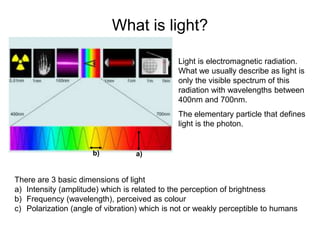
Light is electromagnetic radiation.
What we usually describe as light is
only the visible spectrum of this
radiation with wavelengths between
400nm and 700nm.
The elementary particle that defines
light is the photon.
There are 3 basic dimensions of light
a) Intensity (amplitude) which is related to the perception of brightness
b) Frequency (wavelength), perceived as colour
c) Polarization (angle of vibration) which is not or weakly perceptible to humans
a)
b)
What is a microscope?
Starting with use of a simple lens in ancient
times, to the first compound microscope
around 1590, and up to the microscopes you
are using in 7th grade life science, the
microscope has allowed scientists to make
discoveries about the “invisible world.”
The microscope has
become one of the most
recognizable symbols of
science.
Micro- = “small”; -scope = “to look at”
Photographs of cells are taken using a microscope, and these pictures
are called micrographs.
What is a microscope?
Theoretically a microscope is an array of two lenses.
Objective
lens
Tube lens Eyepiece
lens
Focal plane Image plane
Classic compound microscope
Image plane
Your friend - the objective
What is magnification?
Magnification is a measure of how much larger a
microscope (or set of lenses within a microscope)
causes an object to appear.
Magnification is defined by the
magnification by the objective
x
the magnification by eyepiece
BUT maximum magnification does not mean maximum
resolution!
What is resolution?
Resolution describes the minimal distance of two points that can be distinguished.
The resolution of a microscope or lens is the smallest distance by which two points can
be separated and still be distinguished as separate objects.
The smaller this value, the higher the resolving power of the microscope and the better
the clarity and detail of the image.
Picture taken from http://microscopy.fsu.edu/primer/anatomy/numaperture.html
NA = n sin 
What is the numerical aperture?
NA is an estimate of how much light from the sample is collected by the objective
α1
α2
Coverslip (n = 1.5)
Glass slide (n = 1.5)
Oil (n = 1.5)
Air (n = 1.0)
n = refractive index
α = angle of incident illumination
Objective lens
• The higher the numerical aperture of a
lens, the better the resolution of a
specimen will be which can be obtained
with that lens.
• d=0.5 λ/n sin Ɵ
– Where d= resolution
– Λ = wavelength of light used
Numerical aperture, NOT
magnification determines resolution!
Increasing NA
A lens with a larger NA will be able to visualize finer details and will also
collect more light and give a brighter image than a lens with lower NA.
Light Electron
Microscopy
Light (Optical) Microscopy
• Visible light is uses.
• Glass lens are used
• Advantage: It can often be performed on
living cells, so it’s possible to watch cells
carrying out their normal behaviors (e.g.,
migrating or dividing) under the
microscope.
Principle
• When a ray of light passes from one
medium to another it bends by
phenomena called refraction.
• Bending of light slows the speed.
• The bending of light is determined by
refractive index of the medium.
Types of Light Microscopes
1.Bright field Light Microscope
2.Phase Contrast Light Microscope
3.Dark-Field Light Microscope
4.Fluorescence Light Microscope
Contrasting techniques
Brightfield
Darkfield
Phase contrast
DIC
Taken from: http://fig.cox.miami.edu/~cmallery/150/Fallsyll.htm
Fibroblast grown in culture
Brightfield
Piece of artificially grown skin
(www.igb.fhg.de/.../dt/PI_BioTechnica2001.dt.html )
Cross section of sunflower root
(http://www.zum.de/Faecher/Materialien/beck/12/bs12-5.htm)
Principle: Light is transmitted through the sample and absorbed by it.
Application: Only useful for specimens that can be contrasted via dyes.
Very little contrast in unstained specimens.
With a bright background, the human eye requires local intensity fluctuations
of at least 10 to 20% to be able to recognize objects.
Typical Classroom Microscope
Eyepiece
Eyepiece
• Also known as the ocular
• Contains the first lens you look through
- usually a magnification of 10x
• Located on the top of the body tube
Objective Lenses
Objective Lenses
• Used in combination with the eyepiece
to provide a range of magnification
• Magnification ranges from 40x to 400x
• Located on the nose-piece at the
bottom of the body tube
Nosepiece
Nosepiece
• Holds the objective lenses
• Rotates to enable magnification
• Located at the bottom of the body tube
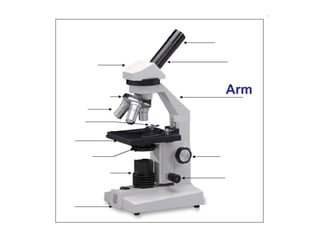
Arm
Arm
• Supports the upper parts of the
microscope
• Used to carry the microscope
• When carrying a microscope, always
have one hand on the arm and one
hand on the base. Use two hands!!
Base
Base
• Supports the whole microscope
• Used to carry the microscope
• When carrying a microscope, always
have one hand on the arm and one
hand on the base. Use two hands!!
Stage
Stage
• Supports the slide
• The slide contains the specimen or
object that you are viewing with the
microscope.
Stage Clip
Stage Clip
• Helps to hold the slide in place
• Usually one on each side of the hole
(stage opening) = 2 stage clips
• The stage opening allows light to pass
from the light source to the lenses.
Light Source
Light Source
• Provides light necessary for viewing the
specimen
• Usually either a mirror or illuminator
• Sends light through the stage opening
to the diaphragm
Diaphragm
Diaphragm
• Wheel or lever located below the stage
opening
• Regulates the amount of light that can
enter the lenses
• May need to be adjusted based on the
thickness of the specimen being
studied
Coarse Adjustment
Knob
Coarse Adjustment Knob
• Raises and lowers the stage or
objective lenses
• Used only when focusing the low
power (4x) objective lens
Fine Adjustment Knob
• Raises and lowers the stage or
objective lenses a small distance for
exact focusing
• Used when focusing the medium
power (10x) and high power (40x)
objective lenses
Let’s Review...
Phase contrast
Principle: Incident light [Io] is out of phase with transmitted light [I] as it was slowed down while
passing through different parts of the sample and when the phases of the light are synchronized
by an interference lens, a new image with greater contrast is seen.
I
I0
Phase ring
aligned
not aligned
Phase stops
https://www.youtube.com/watch?v=fC
Zw4X7V5Pw
Phase contrast
Application: Phase contrast is the most commonly used contrasting technique All
tissue culture microscopes and the time-lapse microscopes are set up for phase.
wrong phase stop
brightfield right phase stop
Applications
• Determine morphologies of living
cells such as plant and animal cells
• Studying microbial motility and
structures of locomotion
• To detect certain microbial elements
such as the bacterial endospores
Fluorescence
https://www.youtube.com/watch?v=SfzmW7EMdLE
Applications
• Used in the visualization of bacterial agents such
as Mycobacterium tuberculosis.
• Used to identify specific antibodies produced
against bacterial antigens/pathogens in
immunofluorescence techniques by labeling the
antibodies with fluorochromes.
• Used in ecological studies to identify and observe
microorganisms labeled by the fluorochromes
• It can also be used to differentiate between dead
and live bacteria by the color they emit when
treated with special stains
Confocal Microscope
• https://www.youtube.com/watch?v=QFtZF
bug1SA
Darkfield
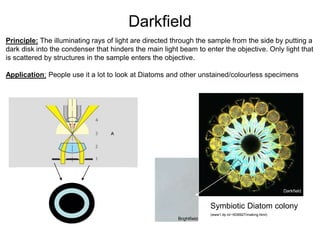
Principle: The illuminating rays of light are directed through the sample from the side by putting a
dark disk into the condenser that hinders the main light beam to enter the objective. Only light that
is scattered by structures in the sample enters the objective.
Application: People use it a lot to look at Diatoms and other unstained/colourless specimens
Brightfield
Darkfield
Symbiotic Diatom colony
(www1.tip.nl/~t936927/making.html)
Applications
• It is used to visualize the internal
organs of larger cells such as the
eukaryotic cells
• Identification of bacterial cells with
distinctive shapes such
as Treponema pallidum, a causative
agent of syphilis.
https://www.youtube.com/watch?v=W9Mhk
myfMLQ

Microscopy and staining techniques details

  • 1.
    What is light? Lightis electromagnetic radiation. What we usually describe as light is only the visible spectrum of this radiation with wavelengths between 400nm and 700nm. The elementary particle that defines light is the photon. There are 3 basic dimensions of light a) Intensity (amplitude) which is related to the perception of brightness b) Frequency (wavelength), perceived as colour c) Polarization (angle of vibration) which is not or weakly perceptible to humans a) b)
  • 2.
    What is amicroscope?
  • 3.
    Starting with useof a simple lens in ancient times, to the first compound microscope around 1590, and up to the microscopes you are using in 7th grade life science, the microscope has allowed scientists to make discoveries about the “invisible world.” The microscope has become one of the most recognizable symbols of science.
  • 4.
    Micro- = “small”;-scope = “to look at” Photographs of cells are taken using a microscope, and these pictures are called micrographs.
  • 5.
    What is amicroscope? Theoretically a microscope is an array of two lenses. Objective lens Tube lens Eyepiece lens Focal plane Image plane Classic compound microscope Image plane
  • 6.
    Your friend -the objective
  • 7.
    What is magnification? Magnificationis a measure of how much larger a microscope (or set of lenses within a microscope) causes an object to appear. Magnification is defined by the magnification by the objective x the magnification by eyepiece BUT maximum magnification does not mean maximum resolution!
  • 8.
    What is resolution? Resolutiondescribes the minimal distance of two points that can be distinguished. The resolution of a microscope or lens is the smallest distance by which two points can be separated and still be distinguished as separate objects. The smaller this value, the higher the resolving power of the microscope and the better the clarity and detail of the image. Picture taken from http://microscopy.fsu.edu/primer/anatomy/numaperture.html
  • 9.
    NA = nsin  What is the numerical aperture? NA is an estimate of how much light from the sample is collected by the objective α1 α2 Coverslip (n = 1.5) Glass slide (n = 1.5) Oil (n = 1.5) Air (n = 1.0) n = refractive index α = angle of incident illumination Objective lens
  • 10.
    • The higherthe numerical aperture of a lens, the better the resolution of a specimen will be which can be obtained with that lens. • d=0.5 λ/n sin Ɵ – Where d= resolution – Λ = wavelength of light used
  • 11.
    Numerical aperture, NOT magnificationdetermines resolution! Increasing NA A lens with a larger NA will be able to visualize finer details and will also collect more light and give a brighter image than a lens with lower NA.
  • 12.
  • 13.
    Light (Optical) Microscopy •Visible light is uses. • Glass lens are used • Advantage: It can often be performed on living cells, so it’s possible to watch cells carrying out their normal behaviors (e.g., migrating or dividing) under the microscope.
  • 14.
    Principle • When aray of light passes from one medium to another it bends by phenomena called refraction. • Bending of light slows the speed. • The bending of light is determined by refractive index of the medium.
  • 15.
    Types of LightMicroscopes 1.Bright field Light Microscope 2.Phase Contrast Light Microscope 3.Dark-Field Light Microscope 4.Fluorescence Light Microscope
  • 16.
    Contrasting techniques Brightfield Darkfield Phase contrast DIC Takenfrom: http://fig.cox.miami.edu/~cmallery/150/Fallsyll.htm Fibroblast grown in culture
  • 17.
    Brightfield Piece of artificiallygrown skin (www.igb.fhg.de/.../dt/PI_BioTechnica2001.dt.html ) Cross section of sunflower root (http://www.zum.de/Faecher/Materialien/beck/12/bs12-5.htm) Principle: Light is transmitted through the sample and absorbed by it. Application: Only useful for specimens that can be contrasted via dyes. Very little contrast in unstained specimens. With a bright background, the human eye requires local intensity fluctuations of at least 10 to 20% to be able to recognize objects.
  • 18.
  • 19.
  • 20.
    Eyepiece • Also knownas the ocular • Contains the first lens you look through - usually a magnification of 10x • Located on the top of the body tube
  • 21.
  • 22.
    Objective Lenses • Usedin combination with the eyepiece to provide a range of magnification • Magnification ranges from 40x to 400x • Located on the nose-piece at the bottom of the body tube
  • 23.
  • 24.
    Nosepiece • Holds theobjective lenses • Rotates to enable magnification • Located at the bottom of the body tube
  • 25.
  • 26.
    Arm • Supports theupper parts of the microscope • Used to carry the microscope • When carrying a microscope, always have one hand on the arm and one hand on the base. Use two hands!!
  • 27.
  • 28.
    Base • Supports thewhole microscope • Used to carry the microscope • When carrying a microscope, always have one hand on the arm and one hand on the base. Use two hands!!
  • 29.
  • 30.
    Stage • Supports theslide • The slide contains the specimen or object that you are viewing with the microscope.
  • 31.
  • 32.
    Stage Clip • Helpsto hold the slide in place • Usually one on each side of the hole (stage opening) = 2 stage clips • The stage opening allows light to pass from the light source to the lenses.
  • 33.
  • 34.
    Light Source • Provideslight necessary for viewing the specimen • Usually either a mirror or illuminator • Sends light through the stage opening to the diaphragm
  • 35.
  • 36.
    Diaphragm • Wheel orlever located below the stage opening • Regulates the amount of light that can enter the lenses • May need to be adjusted based on the thickness of the specimen being studied
  • 37.
  • 38.
    Coarse Adjustment Knob •Raises and lowers the stage or objective lenses • Used only when focusing the low power (4x) objective lens
  • 39.
  • 40.
    Fine Adjustment Knob •Raises and lowers the stage or objective lenses a small distance for exact focusing • Used when focusing the medium power (10x) and high power (40x) objective lenses
  • 41.
  • 42.
    Phase contrast Principle: Incidentlight [Io] is out of phase with transmitted light [I] as it was slowed down while passing through different parts of the sample and when the phases of the light are synchronized by an interference lens, a new image with greater contrast is seen. I I0 Phase ring aligned not aligned Phase stops https://www.youtube.com/watch?v=fC Zw4X7V5Pw
  • 43.
    Phase contrast Application: Phasecontrast is the most commonly used contrasting technique All tissue culture microscopes and the time-lapse microscopes are set up for phase. wrong phase stop brightfield right phase stop
  • 44.
    Applications • Determine morphologiesof living cells such as plant and animal cells • Studying microbial motility and structures of locomotion • To detect certain microbial elements such as the bacterial endospores
  • 45.
  • 46.
    Applications • Used inthe visualization of bacterial agents such as Mycobacterium tuberculosis. • Used to identify specific antibodies produced against bacterial antigens/pathogens in immunofluorescence techniques by labeling the antibodies with fluorochromes. • Used in ecological studies to identify and observe microorganisms labeled by the fluorochromes • It can also be used to differentiate between dead and live bacteria by the color they emit when treated with special stains
  • 47.
  • 48.
    Darkfield Principle: The illuminatingrays of light are directed through the sample from the side by putting a dark disk into the condenser that hinders the main light beam to enter the objective. Only light that is scattered by structures in the sample enters the objective. Application: People use it a lot to look at Diatoms and other unstained/colourless specimens Brightfield Darkfield Symbiotic Diatom colony (www1.tip.nl/~t936927/making.html)
  • 49.
    Applications • It isused to visualize the internal organs of larger cells such as the eukaryotic cells • Identification of bacterial cells with distinctive shapes such as Treponema pallidum, a causative agent of syphilis. https://www.youtube.com/watch?v=W9Mhk myfMLQ