MICROSCOPY
DR.P.NITHIYA
ASSISTANT PROFESSOR
DEPARTMENT OF BOTANY
SEETHALAKSHMI RAMASWAMI COLLEGE
TIRUCHIRAPPALLI
Microscope and Microscopy
A microscope (from the Ancient Greek: μικρός,
mikrós, "small" and σκοπεῖν, skopeîn, "to look" or
"see") is an instrument used to see objects that are
too small to be seen by the naked eye.
Microscopy is the science of investigating small
objects and structures using such an instrument.
MICROSCOPY
 Microscopy comprises of the tools that are used to see/image
the microscopic objects and even macromolecules.
 There exists a wide variety of microscopic tools for studying
the biomolecules and biological processes.
 Light microscopy is the simplest form of microscopy. It
includes all forms of microscopic methods that use
electromagnetic radiation to achieve magnification.
 In this lecture, we shall be discussing the principles of
microscopy.
Magnification
Magnification
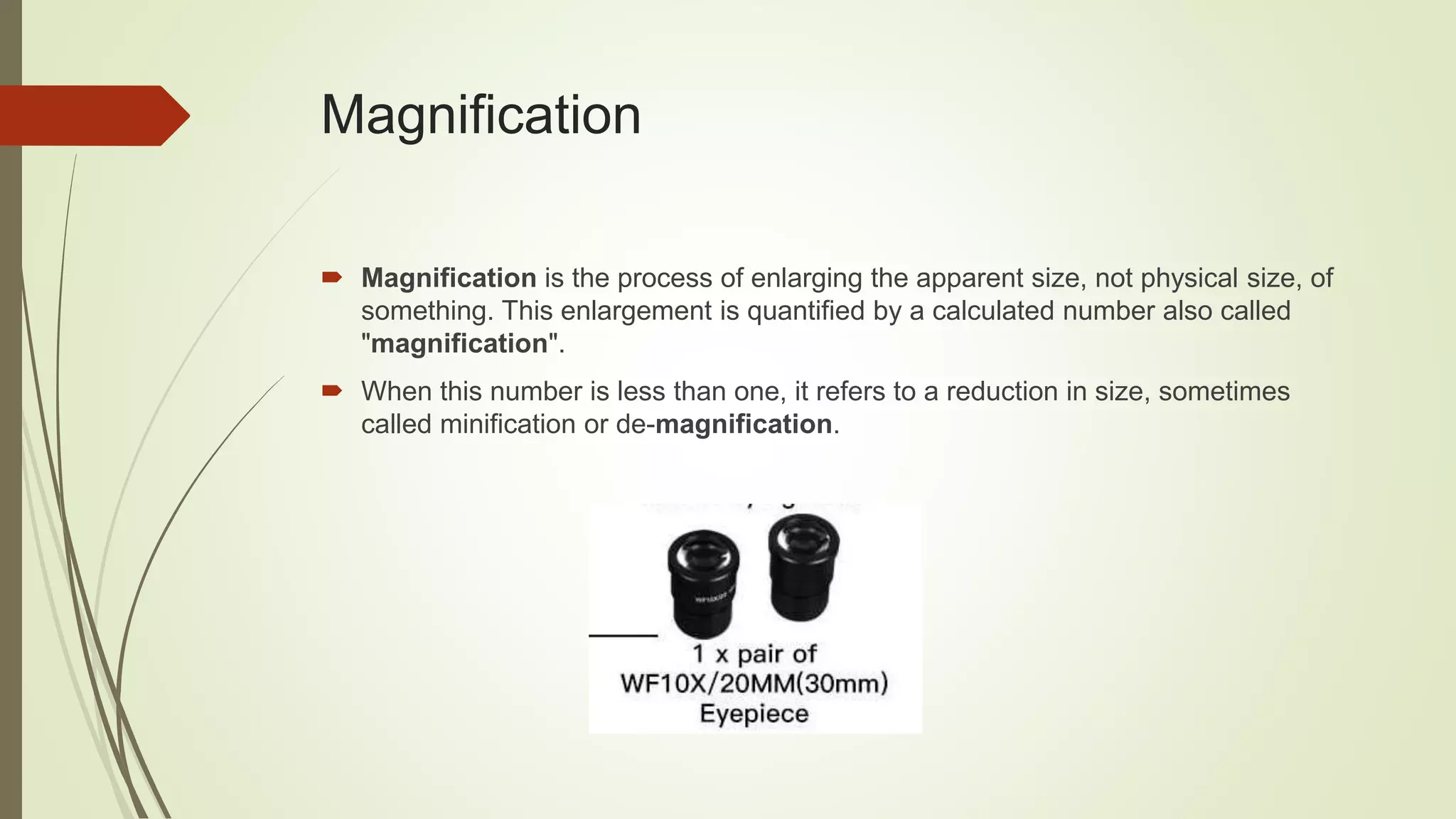
 Magnification is the process of enlarging the apparent size, not physical size, of
something. This enlargement is quantified by a calculated number also called
"magnification".
 When this number is less than one, it refers to a reduction in size, sometimes
called minification or de-magnification.
Resolution
Light Microscope
price of TEM microscope
Resolution
 Resolution is the fineness of detail in a bitmap image and is measured in pixels
per inch (ppi).
 Resolution is the ability to separate two points
Resolution
 The resolution of an optical microscope is defined as the shortest distance
between two points on a specimen that can still be distinguished by the observer
or camera system as separate entities.
Resolution
Numerical Aperture
The numerical aperture (NA) of an optical system
(e.g. an imaging system) is a measure for its angular
acceptance for incoming light.
Numerical aperture is the limit of the light at which
they are entering in to the objective
Light microscope
Condenser and Numerical aperture
Numerical aperture = n sin 
where
 is angle of light forming the numerical
aperture
n= Refractive index
REFRACTION AND REFRACTIVE INDEX
 Light microscopy uses glass (lens) for bending and focusing
the light.
 Refraction (bending) of light is the manifestation of different
light velocities in different materials.
 Refractive index of a material is therefore a measure of the
velocity of light in that material.
 The bending caused in the light beam when it enters from one
material into another is given by the Snell’s law
Refractive index
 Refractive index tells us how fast light travels in the material compared
to in a vacuum (or air)
 n= speed of light in a vacuum (or air) / speed of light in the material
Electromagnetic spectrum
Thank you

Microscopy

  • 1.
    MICROSCOPY DR.P.NITHIYA ASSISTANT PROFESSOR DEPARTMENT OFBOTANY SEETHALAKSHMI RAMASWAMI COLLEGE TIRUCHIRAPPALLI
  • 2.
    Microscope and Microscopy Amicroscope (from the Ancient Greek: μικρός, mikrós, "small" and σκοπεῖν, skopeîn, "to look" or "see") is an instrument used to see objects that are too small to be seen by the naked eye. Microscopy is the science of investigating small objects and structures using such an instrument.
  • 3.
    MICROSCOPY  Microscopy comprisesof the tools that are used to see/image the microscopic objects and even macromolecules.  There exists a wide variety of microscopic tools for studying the biomolecules and biological processes.  Light microscopy is the simplest form of microscopy. It includes all forms of microscopic methods that use electromagnetic radiation to achieve magnification.  In this lecture, we shall be discussing the principles of microscopy.
  • 4.
  • 5.
    Magnification  Magnification isthe process of enlarging the apparent size, not physical size, of something. This enlargement is quantified by a calculated number also called "magnification".  When this number is less than one, it refers to a reduction in size, sometimes called minification or de-magnification.
  • 6.
  • 7.
  • 8.
    price of TEMmicroscope
  • 9.
    Resolution  Resolution isthe fineness of detail in a bitmap image and is measured in pixels per inch (ppi).  Resolution is the ability to separate two points
  • 11.
    Resolution  The resolutionof an optical microscope is defined as the shortest distance between two points on a specimen that can still be distinguished by the observer or camera system as separate entities.
  • 12.
  • 13.
    Numerical Aperture The numericalaperture (NA) of an optical system (e.g. an imaging system) is a measure for its angular acceptance for incoming light. Numerical aperture is the limit of the light at which they are entering in to the objective
  • 14.
  • 15.
  • 16.
    Numerical aperture =n sin  where  is angle of light forming the numerical aperture n= Refractive index
  • 17.
    REFRACTION AND REFRACTIVEINDEX  Light microscopy uses glass (lens) for bending and focusing the light.  Refraction (bending) of light is the manifestation of different light velocities in different materials.  Refractive index of a material is therefore a measure of the velocity of light in that material.  The bending caused in the light beam when it enters from one material into another is given by the Snell’s law
  • 18.
    Refractive index  Refractiveindex tells us how fast light travels in the material compared to in a vacuum (or air)  n= speed of light in a vacuum (or air) / speed of light in the material
  • 19.
  • 20.