BASIC PRINCIPLES OF MRI
PHYSICS
AUTHOR
DR. GULSHAN KUMAR MADHPURIYA
Clinico-radiologist
MRI:- Basic principles
There are 5 Basic steps are involving in getting an MR image-
1. The patient is placed in a magnet
2. A radiofrequency (Rf) pulse is sent by coil
3. The Rf pulse is turned off
4. The patient emits a signal
5. Emitted signal from the patient used for Reconstruction of image.
Now let us understand these steps at molecular level.
STRUCTURE OF THE ATOM
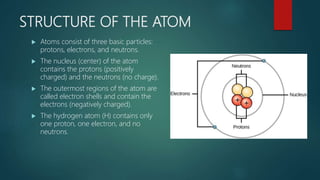
 Atoms consist of three basic particles:
protons, electrons, and neutrons.
 The nucleus (center) of the atom
contains the protons (positively
charged) and the neutrons (no charge).
 The outermost regions of the atom are
called electron shells and contain the
electrons (negatively charged).
 The hydrogen atom (H) contains only
one proton, one electron, and no
neutrons.
Nucleus needs to have 2 properties for MR IMAGING:-
 Spin and charge
Nuclei are made of protons and neutrons
 Both have spin ½ property, but
 Protons also have charge ,
Pairs of spins tend to cancel, so only atoms with an odd number of protons
have spin, called as MR ACTIVE NUCLEI
Good MR active nuclei are 1H, 13C, 19 F, 23 Na, 31P
.
Presently, MR imaging is based on proton imaging
 Why Proton or hydrogen imaging?
Why Proton or hydrogen only?
1. Hydrogen atom has only one proton & so equivalent to a proton.
2. The majority of hydrogen is in water (H2O), Thus
3. Hydrogen is the most abundant atom in the body.
4. H gives best and most intense signal among all nuclei because of large
magnetic moment created by the single proton in the nucleus of the
atom.
Why we can’t act like magnets?
The protons (i.e. Hydrogens ions) in body are spinning in a random fashion,
and cancel all the magnetism. That is our natural state.
We need to discipline them first,, How?
SPIN VS PRECESSION
 When the protons aligns along the ext. mag field ,
they not only rotates around itself (spin) but also
its axis of rotation moves forming a “cone”, This
movement of the axis of rotation is called as
precession
?GYRATION
Spin versus precession. Spin is rotation of a proton around its own axis
while precession is rotation of the axis itself under the influence of
external magnetic field such that it forms a ‘cone’
 The number of precessions of a proton per second is called precession frequency. It is
measured in Hertz
 Precession frequency is directly proportional to the strength of ext. mag field .This
relationship is expressed by LARMOR’S EQUATION
Wo = γ.Bo
Wo (omega zero): precession frequency in MHz
Bo : strength of external magnetic field in Tesla
γ (Gamma): Gyromagnetic ratio, which is specific to nucleus.
Precession frequency of hydrogen proton for
 1 Tesla is 42.57 (42) MHz and for
 1.5 Tesla it is 63.86 (64) MHz.
 3 Testa it’s 127.7(128) MHz
12
An atom will only absorb external energy if that energy is delivered at
precisely it’s resonant frequency.
Resonance is referred to as the property of an atom to absorb energy
only at the Larmor frequency. This is the basis of MR.
13
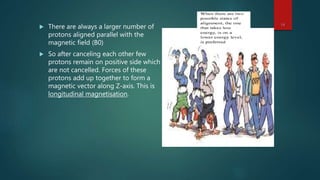
 There are always a larger number of
protons aligned parallel with the
magnetic field (B0)
 So after canceling each other few
protons remain on positive side which
are not cancelled. Forces of these
protons add up together to form a
magnetic vector along Z-axis. This is
longitudinal magnetisation.
14
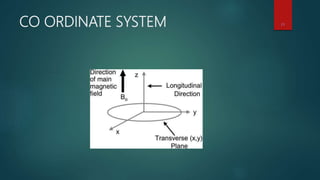
CO ORDINATE SYSTEM 15
MRI:- Basic principles
Basic steps of MR examination
1. The patient is placed in a magnet
2. A radiofrequency (Rf) pulse is sent in
3. The Rf pulse is turned off
4. The patient emits a signal
5. Emitted signal from the patient used for Reconstruction of image.
The patient is placed in a magnet …
17
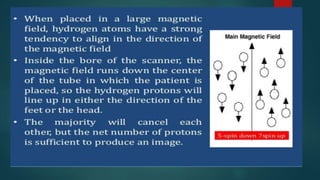
 When the protons are placed in an external mag. Field,
they align themselves according to the external mag. field
like a campass needle aligns itself along the magnetic field
of earth.
 The protons may however align in two differents ways:
parallel or antiparallel to ex. Mag. field.
 These differents types of aligments have differents energy
levels. Naturally the preferred state of aligments is the one
which requires less energy.
 Not only they rotate around themselves (called spin) but
also their axis of rotation moves such that it forms a 'cone'.
This movement of axis of rotation of proton is called as
precession.
 Proton poining in opposite direction cancels each others
magnetic effect in respective direction.
 As there are more proton aligned parallel to the external
magnetic field, there is a net magnetic movement aligned
with or longitudinal to the external magnetic field. And thus
called Longitudinal magnetization.
 In a strong external magnetic field a new magnetic vector is
induced in the patient, who becomes a magnet himself.
19
Longitudinal magnetization
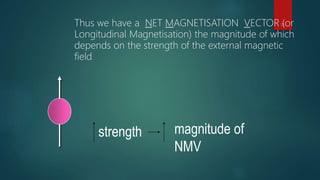
Thus we have a NET MAGNETISATION VECTOR (or
Longitudinal Magnetisation) the magnitude of which
depends on the strength of the external magnetic
field
21
strength magnitude of
NMV
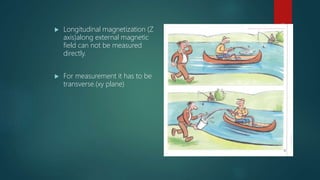
 Longitudinal magnetization (Z
axis)along external magnetic
field can not be measured
directly.
 For measurement it has to be
transverse.(xy plane)
22
MRI:- Basic principles
Basic steps of MR examination
1. The patient is placed in a magnet
2. A radiofrequency (Rf) pulse is sent in
3. The Rf pulse is turned off
4. The patient emits a signal
5. Emitted signal from the patient used for Reconstruction of image.
A radiofrequency (Rf) pulse is
sent in…
24
25
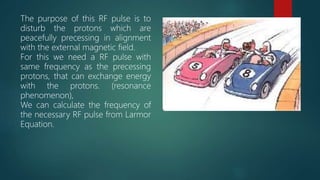
The purpose of this RF pulse is to
disturb the protons which are
peacefully precessing in alignment
with the external magnetic field.
For this we need a RF pulse with
same frequency as the precessing
protons, that can exchange energy
with the protons. (resonance
phenomenon),
We can calculate the frequency of
the necessary RF pulse from Larmor
Equation.
 Some of the protons pick up the energy and
move from lower energy level to high energy
level.
 That is, some of the protons that are were
previously pointing along the magnetic field
align them against the magnetic field
(antiparallel). This causes the longitudinal
magnetization to decrease,
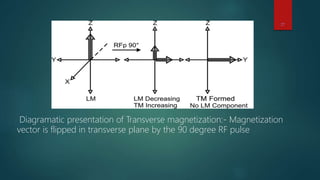
 The imbalance results in tilting of the
magnetization into the transverse (X-Y) plane.
This is called as transverse magnetization.
 In short, RF pulse causes tilting of the
magnetization into transverse plane.
Diagramatic presentation of Transverse magnetization:- Magnetization
vector is flipped in transverse plane by the 90 degree RF pulse
27
 Such a pulse which flips the NMV(net magnetic vector) in
transverse plane (at an angle of 90°) in the x-y plane (Mxy) is called
as 90° pulse.
 The other most common flip angle in MR is180°.
 A 180° pulse will flip the magnetization through the x-y plane and
into the opposite direction of B0.
28
The Rf pulse is turned off…
29
 Before RF pulse there was only longitudinal magnetization.
 After the 90dgr pulse there is only transversal magnetization and this is spinning around
 With time after the removal of RF pulse the transversal magnetization decreases and
longitudinal magnetization increases in spiral motion
 When the Rf pulse is turned off:
 Longitudinal magnetization gradually increases
-T1 Recovery
 Transverse magnetization decreases
- T2 Decay
31
4) The patient emits a signal
 When a antenna is placed near the tissue,
an electric current is set up in the antenna
due to spiraling movement of the
magnetic vector from transversal to
longitudinal direction.
 Due to the spiraling movement, vector
gradually moves away from the antenna
and thus the amplitude of the current
lnduced reduces gradually. This is called
FID signal. / free induction decay.
FID (Free Induction Decay) signal
 Free refers to system free from RF excitation;
 Induction describes the mechanism through which the
signal(induced current) is detected; and
 Decay refers to the decrease in signal amplitude over
time.
Current is received as signal by the RF
coil.
5) Emitted signal from the patient used
for Reconstruction of image.
 MR signal received by the coil is transformed into image by complex mathematical
process such as Fourier Transformation by computers.
 The emitted energy is too small to convert them to images. hence., repeated ON-OFF
of RF pulses are required.
 The emitted energy is stored (K- space), analysed and converted into images.
MRI:- Basic principles
Basic steps of MR examination
1. The patient is placed in a magnet
2. A radiofrequency (Rf) pulse is sent in
3. The Rf pulse is turned off
4. The patient emits a signal
5. Emitted signal from the patient used for Reconstruction of image.
LOCALIZATION OF SIGNAL
How do we know whether the signal is coming from the head or from the foot?
 The answer to our problem is:
Gradient Coils.
 The solution to our problem can be found in the properties of an RF-wave, which are:
phase, frequency and amplitude
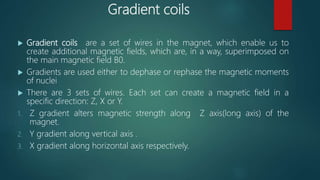
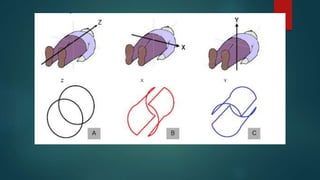
Gradient coils
 Gradient coils are a set of wires in the magnet, which enable us to
create additional magnetic fields, which are, in a way, superimposed on
the main magnetic field B0.
 Gradients are used either to dephase or rephase the magnetic moments
of nuclei
 There are 3 sets of wires. Each set can create a magnetic field in a
specific direction: Z, X or Y.
1. Z gradient alters magnetic strength along Z axis(long axis) of the
magnet.
2. Y gradient along vertical axis .
3. X gradient along horizontal axis respectively.
The three gradients are—
 1. Slice selection gradient
 2. Phase encoding gradient
 3. Frequency encoding (read out) gradient.
For axial images
i. Z-axis—Slice selection gradient
ii. Y-axis—Phase encoding gradient
iii. X-axis—Frequency encoding gradient.
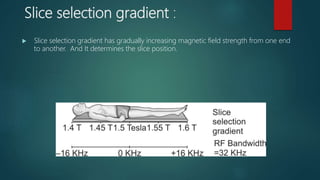
Slice selection gradient :
 Slice selection gradient has gradually increasing magnetic field strength from one end
to another. And It determines the slice position.
 The protons in the feet now spin at 63.5 MHz, the ones in the iso-centre of the
magnet still at 63.6 MHz and the ones in the head with 63.7 MHz.
 Now, if we apply an RF-pulse with a frequency of 63.7 MHz ONLY the protons in a thin
slice in the head will react because they are the only ones which spin with the same
frequency
Phase Encoding Gradients
Additional gradient magnetic field is created in the Anterior-Posterior direction.
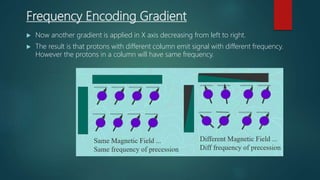
Frequency Encoding Gradient
 Now another gradient is applied in X axis decreasing from left to right.
 The result is that protons with different column emit signal with different frequency.
However the protons in a column will have same frequency.
Let’s recapitulate all this
 1. The Gz gradient selected an
axial slice.
 2. The Gy gradient created
rows with different phases.
 3. The Gx gradient created
columns with different
frequencies.
 FOURIER TRANSFORMATION
echo
RF
signal
readout

phase
slice
TE

Phase Encoding Gradient
Frequency Encoding Gradient
Slice Selection Gradient
To recapitulate
K-space, the path to MRI.
ENTER IF YOU DARE
K-SPACE
 k-space, matrix, time-domain
 The acquired data (also known as
raw data) is put into this box such
that signals with low frequencies go
in the center and those with high
frequencies are spaced around the
center.
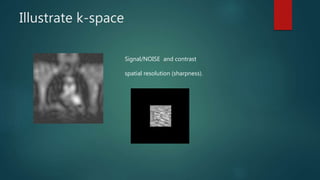
 Signal with low frequencies contain
information about signal and
contrast, while high frequencies
contain information about spatial
resolution (sharpness).
Illustrate k-space
Illustrate k-space
Signal/NOISE and contrast
spatial resolution (sharpness).
Illustrate k-space
Signal/NOISE and contrast
spatial resolution (sharpness).
k-Space Filling Techniques
Centric:- To store contrast
information first as would be
the case when you do a
contrast enhanced MR angio.
Reversed Centric:-
This method is not used
Spiral
This is a special case. This
method is used with very fast
scan techniques such as in
Single/Multiple Shot Echo
Planar Imaging.
54
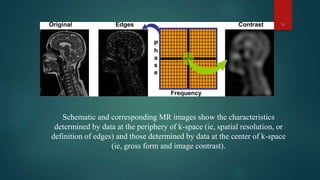
Schematic and corresponding MR images show the characteristics
determined by data at the periphery of k-space (ie, spatial resolution, or
definition of edges) and those determined by data at the center of k-space
(ie, gross form and image contrast).
RELAXATION
 Relaxation means recovery of photons back towards the
equilibrium after been disturbed by RF excitation .
 Basically two things happens when RF pulse is switched off:
1. When RF pulse is switched off , LM starts increasing along Z
axis k/as Longitudinal Relaxation ,
2. While, TM starts reducing in the transverse plane k/as
Transverse Relaxation.
The components of magnetization in Longitudinal & transverse
planes can be represented by a single vector. This vector
represents sum of these components and c/as NET
MAGNETIZATION VECTOR(NMV)
NMV lies between LM and TM.
Longitudinal Relaxation and T1
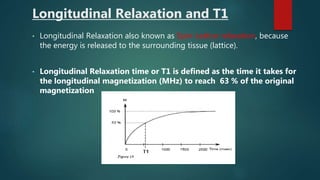
• Longitudinal Relaxation also known as Spin-Lattice relaxation, because
the energy is released to the surrounding tissue (lattice).
• Longitudinal Relaxation time or T1 is defined as the time it takes for
the longitudinal magnetization (MHz) to reach 63 % of the original
magnetization
Longitudinal Relaxation and T1
• H atom may be bound very tight, such as in fat tissue, while the other
has a much looser bond, such as in water. Tightly bound protons will
release their energy much quicker to their surroundings than loosely
bound protons. The rate at which they release their energy is therefore
different.
• Longitudinal relaxation has something to do with exchange of energy,
thermal energy, which the protons emit to the surrounding lattice while
returning to their lower state of energy
T1 depends on tissue composition , structure and surroundings.
 Since water molecules move too rapidly the protons in water take
long time to transfer their energy , hence water has long T1.
T1 increases with the strength of the external magnetic field
 T2 relaxation is also a time constant.
T2 is defined as the time it takes for the spins to de-phase to 37% of the original value.
Transverse relaxation & T2
 T2 relaxation is also called spin–spin relaxation because it describes
interactions between protons in their immediate surroundings
(molecules)
 Just like T1 relaxation, T2 relaxation does not happen at once. Again, it
depends on how the Hydrogen proton is bound in its molecule and that
again is different for each tissue
Transverse relaxation & T2
PROCESS OF DEPHASING
• These protons are constantly exposed to static or slowly fluctuating local
magnetic fields. Hence they start losing phase after RF pulse is switched
off. This process of getting from a total in-phase situation to a total out-
of-phase situation resulting in decrease in magnitude of TM k/as
Transverse relaxation.
T2 depends on inhomogeneity of local magnetic fields within the tissues.
 As water molecules moves very fast , their mag fields fluctuate very
fast. These fluctuating magnetic fields cancel each other . So there is
no big differences in mag field strength inside such a tissue. Because
of lack of inhomogeneity protons stay in phase for a long time
resulting in long T2 for water.
 If tissue is impure or have large molecules , this maintains
inhomogeneity of the intrinsic mag field within tissue , as a result
protons go out of phase very fast and have short T2. Fat has shorter
T2.
1. T1 and T2 relaxation are two independent processes, which happen simultaneously.
2. T1 happens along the Z-axis; T2 happens in the X-Y plane.
3. T2 is much quicker than T1
 When both relaxation processes are finished the net magnetization
vector is aligned with the main magnetic field (B0).
Remember this
T2* (T2 star)
 Decay of the TM caused by combination of spin-spin relaxation
and inhomogeneity of ext. magnetic field c/as T2*relaxation.
 Dephasing effect of ext. mag field is removed by 180degree
pulse used in spin echo sequence, hence there is true T2
relaxation in a spin echo sequence.
 T2* relaxation is seen in gradient echo sequence as there is no
180degree pulse.
 T2* is shorter than T2
Repetition Time (TR)
The Repetition Time (TR) is the time between two excitation
pulses
1. In SE it’s between two 90º pulses
2. In GE it’s between two α pulses
3. In IR it’s between two 180º pulse
Echo Time (TE)
The Echo Time is the time between the excitation pulse and the echo
Inversion Time (TI)
 The Inversion Time is the time between an 180º excitation pulse and
the 90º-excitation pulse (Figure A and B).
 TI is only used in IR type sequences and in a special kind of GE
sequences (Turbo GE).
 TI has the highest impact on image contrast in IR sequences
Remember
 T1 and T2 refer to tissue properties,
 TR and TE refer to equipment parameters.
T1 Weighted Image parameters
 Short TR < 700 mS
 Short TE < 30 mS
 Best for anatomy detail.
T2 Weighted Image parameters
 Long TR > 2000 mS
 Long TE > 80 mS
 More sensitive for detection of pathology
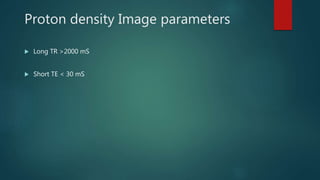
Proton density Image parameters
 Long TR >2000 mS
 Short TE < 30 mS
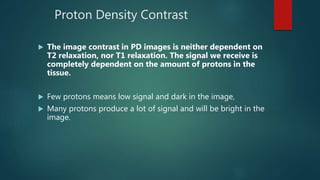
Proton Density Contrast
 The image contrast in PD images is neither dependent on
T2 relaxation, nor T1 relaxation. The signal we receive is
completely dependent on the amount of protons in the
tissue.
 Few protons means low signal and dark in the image,
 Many protons produce a lot of signal and will be bright in the
image.
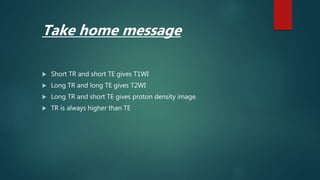
 Short TR and short TE gives T1WI
 Long TR and long TE gives T2WI
 Long TR and short TE gives proton density image.
 TR is always higher than TE
Take home message
T1 Weighted Image
 The magnitude of LM indirectly determines the strength of MR signal. Tilting of
stronger LM by 90 degree RF pulse will result into greater magnitude of TM and
stronger MR signal. The tissues with short T1 regain their maximum LM in short-
time after RF pulse is switched off.
 When the next RF pulse is sent, TM will be stronger and resultant signal will also
be stronger. Therefore, material with short T1 have bright signal on T1 weighted
images.
 On T1-W images, differences in signal intensity of tissues are due to their
different T1.
Figs A and B: (A) At short TR the difference between LM of tissue A (with short T1) and of
tissue B (long T1) is more as compared to long TR. This results in more difference in signal
intensity (contrast) between A and B at short TR. The contrast on the short TR image is
because of T1 differences of tissues. Hence it is T1-weighted image. (B) T1-weighted axial
image of brain: CSF is dark, white matter is brighter than gray matter and scalp fat is bright
because of short T1
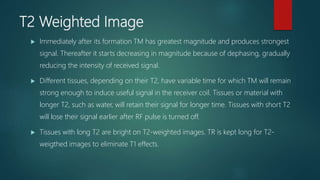
T2 Weighted Image
 Immediately after its formation TM has greatest magnitude and produces strongest
signal. Thereafter it starts decreasing in magnitude because of dephasing, gradually
reducing the intensity of received signal.
 Different tissues, depending on their T2, have variable time for which TM will remain
strong enough to induce useful signal in the receiver coil. Tissues or material with
longer T2, such as water, will retain their signal for longer time. Tissues with short T2
will lose their signal earlier after RF pulse is turned off.
 Tissues with long T2 are bright on T2-weighted images. TR is kept long for T2-
weigthed images to eliminate T1 effects.
 Figs 2.7A and B: T2-weighted image. (A) Tissue B has short T2 that results into early
loss of magnitude of TM and reduction in signal. At short TE, there is no significant
difference between magnitude of TM of A and B. At long TE, signal difference
between A and B is more because tissue B will lose most of its signal while tissue A
will still have good signal. Since the image contrast is because of differences in T2 of
tissues, it is T2-weighted image. (B) T2-weighted axial image of brain: CSF is bright;
white matter is darker than gray matter
T1 Weighted Image
 The contrast created in the image is determined in particular by the
difference in T1 relaxation times between fat and water. Fat has a high
signal intensity (white) and water a low signal intensity (black).
 Why does fat have a high signal intensity on a T1 weighted image?
 Answer:
 Fat has a shorter T1 relaxation time than water.
 Explanation:
 By its short T1 relaxation time, fat will recover quicker from longitudinal
magnetization (Z axis).
T1 Weighted Image
Signal intensities in T1 weighted image.
Non mobile protons
Amount
flow-void
phenomenon
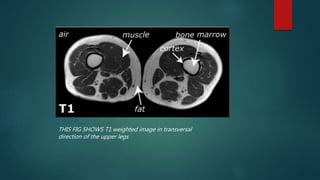
THIS FIG SHOWS T1 weighted image in transversal
direction of the upper legs
SPOTTER
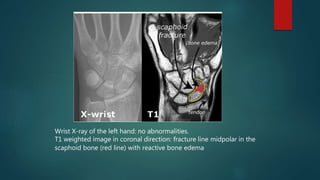
Wrist X-ray of the left hand: no abnormalities.
T1 weighted image in coronal direction: fracture line midpolar in the
scaphoid bone (red line) with reactive bone edema.
SPOTTER
X-ray of left upper leg/left knee: lytic lesion in the femur with multilayered periosteal
reaction and soft tissue mass (PA diagnosis: osteosarcoma).
The T1 weighted image clearly visualizes the permeative cortex destruction and the
breakthrough into soft tissues. Note also the abnormal low signal intensity of the bone
marrow (fat has been replaced by tumor).
T2 Weighted Image
 Characteristic of a T2 weighted image is the high signal intensity of water.
 Pathology is often associated with edema/fluid and therefore a T2
sequence is very suitable to detect pathology
 Tip: always look for fluid-filled structures (CSF, vitreous, effusion, ascites,
gallbladder, bladder) to decide whether you are looking at a T1 or T2
weighted image. Fluid has a high signal intensity on T2 weighted images.
T2 Weighted Image
SPOTTER
Figure. Brain tumor with surrounding (reactive) edema frontoparietal left. Both the tumor and the edema
have high signal intensity on T2. PA diagnosis: lymphoma.
PD weighted image
 Tissues with few protons have low signal intensity, tissues with many
protons have high signal intensity.
a) Fat has a relatively high signal intensity, however, not as high as in a T1
weighted image.
b) Fluid has an intermediate signal intensity rather than the high signal
intensity as in a T2 weighted image.
• A PD weighted image is used to evaluate meniscal tears in the knee.
• Additionally, a PD sequence can be useful in e.g. brain MRI to
evaluate gray/white matter pathology.
• BECAUSE as opposed to a T2 weighted image, a PD clearly
differentiate between gray and white matter (gray matter has a
higher signal intensity than white matter)
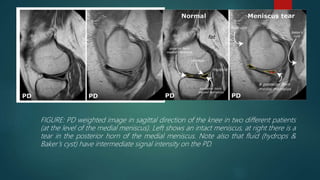
FIGURE: PD weighted image in sagittal direction of the knee in two different patients
(at the level of the medial meniscus). Left shows an intact meniscus, at right there is a
tear in the posterior horn of the medial meniscus. Note also that fluid (hydrops &
Baker’s cyst) have intermediate signal intensity on the PD.
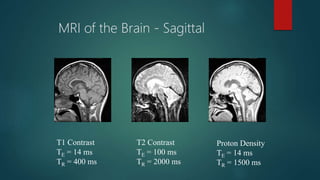
MRI of the Brain - Sagittal
T1 Contrast
TE = 14 ms
TR = 400 ms
T2 Contrast
TE = 100 ms
TR = 2000 ms
Proton Density
TE = 14 ms
TR = 1500 ms
Magnetic Resonance
T1-Hyperintense (bright)
“Fat and the 4 M’s”
Fat (unless deliberately suppressed)
Methemoglobin (subacute hematoma)
Mineral deposition ( Mg, Mn, etc.)
Melanin (melanoma)
“Missc” (highly proteinaceous fluid)
Contrast material (gadolinium)
T1-Hypointense (dark)
Water, paucity of mobile protons (air, cortical bone)
High flow (e.g. arterial “flow voids”)
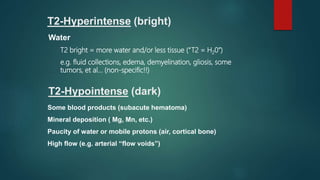
T2-Hyperintense (bright)
Water
T2 bright = more water and/or less tissue (“T2 = H20”)
e.g. fluid collections, edema, demyelination, gliosis, some
tumors, et al… (non-specific!!)
T2-Hypointense (dark)
Some blood products (subacute hematoma)
Mineral deposition ( Mg, Mn, etc.)
Paucity of water or mobile protons (air, cortical bone)
High flow (e.g. arterial “flow voids”)
 To be continued

MRI physics part 1: Basic principle by GKM

  • 1.
    BASIC PRINCIPLES OFMRI PHYSICS AUTHOR DR. GULSHAN KUMAR MADHPURIYA Clinico-radiologist
  • 2.
    MRI:- Basic principles Thereare 5 Basic steps are involving in getting an MR image- 1. The patient is placed in a magnet 2. A radiofrequency (Rf) pulse is sent by coil 3. The Rf pulse is turned off 4. The patient emits a signal 5. Emitted signal from the patient used for Reconstruction of image. Now let us understand these steps at molecular level.
  • 3.
    STRUCTURE OF THEATOM  Atoms consist of three basic particles: protons, electrons, and neutrons.  The nucleus (center) of the atom contains the protons (positively charged) and the neutrons (no charge).  The outermost regions of the atom are called electron shells and contain the electrons (negatively charged).  The hydrogen atom (H) contains only one proton, one electron, and no neutrons.
  • 4.
    Nucleus needs tohave 2 properties for MR IMAGING:-  Spin and charge Nuclei are made of protons and neutrons  Both have spin ½ property, but  Protons also have charge , Pairs of spins tend to cancel, so only atoms with an odd number of protons have spin, called as MR ACTIVE NUCLEI Good MR active nuclei are 1H, 13C, 19 F, 23 Na, 31P .
  • 5.
    Presently, MR imagingis based on proton imaging  Why Proton or hydrogen imaging?
  • 6.
    Why Proton orhydrogen only? 1. Hydrogen atom has only one proton & so equivalent to a proton. 2. The majority of hydrogen is in water (H2O), Thus 3. Hydrogen is the most abundant atom in the body. 4. H gives best and most intense signal among all nuclei because of large magnetic moment created by the single proton in the nucleus of the atom.
  • 7.
    Why we can’tact like magnets? The protons (i.e. Hydrogens ions) in body are spinning in a random fashion, and cancel all the magnetism. That is our natural state. We need to discipline them first,, How?
  • 10.
    SPIN VS PRECESSION When the protons aligns along the ext. mag field , they not only rotates around itself (spin) but also its axis of rotation moves forming a “cone”, This movement of the axis of rotation is called as precession ?GYRATION
  • 11.
    Spin versus precession.Spin is rotation of a proton around its own axis while precession is rotation of the axis itself under the influence of external magnetic field such that it forms a ‘cone’
  • 12.
     The numberof precessions of a proton per second is called precession frequency. It is measured in Hertz  Precession frequency is directly proportional to the strength of ext. mag field .This relationship is expressed by LARMOR’S EQUATION Wo = γ.Bo Wo (omega zero): precession frequency in MHz Bo : strength of external magnetic field in Tesla γ (Gamma): Gyromagnetic ratio, which is specific to nucleus. Precession frequency of hydrogen proton for  1 Tesla is 42.57 (42) MHz and for  1.5 Tesla it is 63.86 (64) MHz.  3 Testa it’s 127.7(128) MHz 12
  • 13.
    An atom willonly absorb external energy if that energy is delivered at precisely it’s resonant frequency. Resonance is referred to as the property of an atom to absorb energy only at the Larmor frequency. This is the basis of MR. 13
  • 14.
     There arealways a larger number of protons aligned parallel with the magnetic field (B0)  So after canceling each other few protons remain on positive side which are not cancelled. Forces of these protons add up together to form a magnetic vector along Z-axis. This is longitudinal magnetisation. 14
  • 15.
  • 16.
    MRI:- Basic principles Basicsteps of MR examination 1. The patient is placed in a magnet 2. A radiofrequency (Rf) pulse is sent in 3. The Rf pulse is turned off 4. The patient emits a signal 5. Emitted signal from the patient used for Reconstruction of image.
  • 17.
    The patient isplaced in a magnet … 17
  • 18.
     When theprotons are placed in an external mag. Field, they align themselves according to the external mag. field like a campass needle aligns itself along the magnetic field of earth.  The protons may however align in two differents ways: parallel or antiparallel to ex. Mag. field.  These differents types of aligments have differents energy levels. Naturally the preferred state of aligments is the one which requires less energy.  Not only they rotate around themselves (called spin) but also their axis of rotation moves such that it forms a 'cone'. This movement of axis of rotation of proton is called as precession.
  • 19.
     Proton poiningin opposite direction cancels each others magnetic effect in respective direction.  As there are more proton aligned parallel to the external magnetic field, there is a net magnetic movement aligned with or longitudinal to the external magnetic field. And thus called Longitudinal magnetization.  In a strong external magnetic field a new magnetic vector is induced in the patient, who becomes a magnet himself. 19
  • 20.
  • 21.
    Thus we havea NET MAGNETISATION VECTOR (or Longitudinal Magnetisation) the magnitude of which depends on the strength of the external magnetic field 21 strength magnitude of NMV
  • 22.
     Longitudinal magnetization(Z axis)along external magnetic field can not be measured directly.  For measurement it has to be transverse.(xy plane) 22
  • 23.
    MRI:- Basic principles Basicsteps of MR examination 1. The patient is placed in a magnet 2. A radiofrequency (Rf) pulse is sent in 3. The Rf pulse is turned off 4. The patient emits a signal 5. Emitted signal from the patient used for Reconstruction of image.
  • 24.
    A radiofrequency (Rf)pulse is sent in… 24
  • 25.
    25 The purpose ofthis RF pulse is to disturb the protons which are peacefully precessing in alignment with the external magnetic field. For this we need a RF pulse with same frequency as the precessing protons, that can exchange energy with the protons. (resonance phenomenon), We can calculate the frequency of the necessary RF pulse from Larmor Equation.
  • 26.
     Some ofthe protons pick up the energy and move from lower energy level to high energy level.  That is, some of the protons that are were previously pointing along the magnetic field align them against the magnetic field (antiparallel). This causes the longitudinal magnetization to decrease,  The imbalance results in tilting of the magnetization into the transverse (X-Y) plane. This is called as transverse magnetization.  In short, RF pulse causes tilting of the magnetization into transverse plane.
  • 27.
    Diagramatic presentation ofTransverse magnetization:- Magnetization vector is flipped in transverse plane by the 90 degree RF pulse 27
  • 28.
     Such apulse which flips the NMV(net magnetic vector) in transverse plane (at an angle of 90°) in the x-y plane (Mxy) is called as 90° pulse.  The other most common flip angle in MR is180°.  A 180° pulse will flip the magnetization through the x-y plane and into the opposite direction of B0. 28
  • 29.
    The Rf pulseis turned off… 29
  • 30.
     Before RFpulse there was only longitudinal magnetization.  After the 90dgr pulse there is only transversal magnetization and this is spinning around  With time after the removal of RF pulse the transversal magnetization decreases and longitudinal magnetization increases in spiral motion
  • 31.
     When theRf pulse is turned off:  Longitudinal magnetization gradually increases -T1 Recovery  Transverse magnetization decreases - T2 Decay 31
  • 32.
    4) The patientemits a signal  When a antenna is placed near the tissue, an electric current is set up in the antenna due to spiraling movement of the magnetic vector from transversal to longitudinal direction.  Due to the spiraling movement, vector gradually moves away from the antenna and thus the amplitude of the current lnduced reduces gradually. This is called FID signal. / free induction decay.
  • 33.
    FID (Free InductionDecay) signal  Free refers to system free from RF excitation;  Induction describes the mechanism through which the signal(induced current) is detected; and  Decay refers to the decrease in signal amplitude over time. Current is received as signal by the RF coil.
  • 34.
    5) Emitted signalfrom the patient used for Reconstruction of image.  MR signal received by the coil is transformed into image by complex mathematical process such as Fourier Transformation by computers.  The emitted energy is too small to convert them to images. hence., repeated ON-OFF of RF pulses are required.  The emitted energy is stored (K- space), analysed and converted into images.
  • 36.
    MRI:- Basic principles Basicsteps of MR examination 1. The patient is placed in a magnet 2. A radiofrequency (Rf) pulse is sent in 3. The Rf pulse is turned off 4. The patient emits a signal 5. Emitted signal from the patient used for Reconstruction of image.
  • 37.
    LOCALIZATION OF SIGNAL Howdo we know whether the signal is coming from the head or from the foot?  The answer to our problem is: Gradient Coils.  The solution to our problem can be found in the properties of an RF-wave, which are: phase, frequency and amplitude
  • 38.
    Gradient coils  Gradientcoils are a set of wires in the magnet, which enable us to create additional magnetic fields, which are, in a way, superimposed on the main magnetic field B0.  Gradients are used either to dephase or rephase the magnetic moments of nuclei  There are 3 sets of wires. Each set can create a magnetic field in a specific direction: Z, X or Y. 1. Z gradient alters magnetic strength along Z axis(long axis) of the magnet. 2. Y gradient along vertical axis . 3. X gradient along horizontal axis respectively.
  • 40.
    The three gradientsare—  1. Slice selection gradient  2. Phase encoding gradient  3. Frequency encoding (read out) gradient. For axial images i. Z-axis—Slice selection gradient ii. Y-axis—Phase encoding gradient iii. X-axis—Frequency encoding gradient.
  • 41.
    Slice selection gradient:  Slice selection gradient has gradually increasing magnetic field strength from one end to another. And It determines the slice position.
  • 42.
     The protonsin the feet now spin at 63.5 MHz, the ones in the iso-centre of the magnet still at 63.6 MHz and the ones in the head with 63.7 MHz.  Now, if we apply an RF-pulse with a frequency of 63.7 MHz ONLY the protons in a thin slice in the head will react because they are the only ones which spin with the same frequency
  • 43.
    Phase Encoding Gradients Additionalgradient magnetic field is created in the Anterior-Posterior direction.
  • 44.
    Frequency Encoding Gradient Now another gradient is applied in X axis decreasing from left to right.  The result is that protons with different column emit signal with different frequency. However the protons in a column will have same frequency.
  • 45.
    Let’s recapitulate allthis  1. The Gz gradient selected an axial slice.  2. The Gy gradient created rows with different phases.  3. The Gx gradient created columns with different frequencies.  FOURIER TRANSFORMATION
  • 46.
  • 47.
    K-space, the pathto MRI. ENTER IF YOU DARE
  • 48.
    K-SPACE  k-space, matrix,time-domain  The acquired data (also known as raw data) is put into this box such that signals with low frequencies go in the center and those with high frequencies are spaced around the center.  Signal with low frequencies contain information about signal and contrast, while high frequencies contain information about spatial resolution (sharpness).
  • 49.
  • 50.
    Illustrate k-space Signal/NOISE andcontrast spatial resolution (sharpness).
  • 51.
    Illustrate k-space Signal/NOISE andcontrast spatial resolution (sharpness).
  • 52.
    k-Space Filling Techniques Centric:-To store contrast information first as would be the case when you do a contrast enhanced MR angio. Reversed Centric:- This method is not used Spiral This is a special case. This method is used with very fast scan techniques such as in Single/Multiple Shot Echo Planar Imaging.
  • 54.
    54 Schematic and correspondingMR images show the characteristics determined by data at the periphery of k-space (ie, spatial resolution, or definition of edges) and those determined by data at the center of k-space (ie, gross form and image contrast).
  • 55.
    RELAXATION  Relaxation meansrecovery of photons back towards the equilibrium after been disturbed by RF excitation .  Basically two things happens when RF pulse is switched off: 1. When RF pulse is switched off , LM starts increasing along Z axis k/as Longitudinal Relaxation , 2. While, TM starts reducing in the transverse plane k/as Transverse Relaxation. The components of magnetization in Longitudinal & transverse planes can be represented by a single vector. This vector represents sum of these components and c/as NET MAGNETIZATION VECTOR(NMV) NMV lies between LM and TM.
  • 56.
    Longitudinal Relaxation andT1 • Longitudinal Relaxation also known as Spin-Lattice relaxation, because the energy is released to the surrounding tissue (lattice). • Longitudinal Relaxation time or T1 is defined as the time it takes for the longitudinal magnetization (MHz) to reach 63 % of the original magnetization
  • 57.
    Longitudinal Relaxation andT1 • H atom may be bound very tight, such as in fat tissue, while the other has a much looser bond, such as in water. Tightly bound protons will release their energy much quicker to their surroundings than loosely bound protons. The rate at which they release their energy is therefore different. • Longitudinal relaxation has something to do with exchange of energy, thermal energy, which the protons emit to the surrounding lattice while returning to their lower state of energy
  • 58.
    T1 depends ontissue composition , structure and surroundings.  Since water molecules move too rapidly the protons in water take long time to transfer their energy , hence water has long T1. T1 increases with the strength of the external magnetic field
  • 59.
     T2 relaxationis also a time constant. T2 is defined as the time it takes for the spins to de-phase to 37% of the original value. Transverse relaxation & T2
  • 60.
     T2 relaxationis also called spin–spin relaxation because it describes interactions between protons in their immediate surroundings (molecules)  Just like T1 relaxation, T2 relaxation does not happen at once. Again, it depends on how the Hydrogen proton is bound in its molecule and that again is different for each tissue Transverse relaxation & T2
  • 61.
    Transverse relaxation &T2 PROCESS OF DEPHASING • These protons are constantly exposed to static or slowly fluctuating local magnetic fields. Hence they start losing phase after RF pulse is switched off. This process of getting from a total in-phase situation to a total out- of-phase situation resulting in decrease in magnitude of TM k/as Transverse relaxation.
  • 62.
    T2 depends oninhomogeneity of local magnetic fields within the tissues.  As water molecules moves very fast , their mag fields fluctuate very fast. These fluctuating magnetic fields cancel each other . So there is no big differences in mag field strength inside such a tissue. Because of lack of inhomogeneity protons stay in phase for a long time resulting in long T2 for water.  If tissue is impure or have large molecules , this maintains inhomogeneity of the intrinsic mag field within tissue , as a result protons go out of phase very fast and have short T2. Fat has shorter T2.
  • 64.
    1. T1 andT2 relaxation are two independent processes, which happen simultaneously. 2. T1 happens along the Z-axis; T2 happens in the X-Y plane. 3. T2 is much quicker than T1  When both relaxation processes are finished the net magnetization vector is aligned with the main magnetic field (B0). Remember this
  • 65.
    T2* (T2 star) Decay of the TM caused by combination of spin-spin relaxation and inhomogeneity of ext. magnetic field c/as T2*relaxation.  Dephasing effect of ext. mag field is removed by 180degree pulse used in spin echo sequence, hence there is true T2 relaxation in a spin echo sequence.  T2* relaxation is seen in gradient echo sequence as there is no 180degree pulse.  T2* is shorter than T2
  • 67.
    Repetition Time (TR) TheRepetition Time (TR) is the time between two excitation pulses 1. In SE it’s between two 90º pulses 2. In GE it’s between two α pulses 3. In IR it’s between two 180º pulse
  • 68.
    Echo Time (TE) TheEcho Time is the time between the excitation pulse and the echo
  • 69.
    Inversion Time (TI) The Inversion Time is the time between an 180º excitation pulse and the 90º-excitation pulse (Figure A and B).  TI is only used in IR type sequences and in a special kind of GE sequences (Turbo GE).  TI has the highest impact on image contrast in IR sequences
  • 70.
    Remember  T1 andT2 refer to tissue properties,  TR and TE refer to equipment parameters.
  • 71.
    T1 Weighted Imageparameters  Short TR < 700 mS  Short TE < 30 mS  Best for anatomy detail.
  • 72.
    T2 Weighted Imageparameters  Long TR > 2000 mS  Long TE > 80 mS  More sensitive for detection of pathology
  • 73.
    Proton density Imageparameters  Long TR >2000 mS  Short TE < 30 mS
  • 74.
    Proton Density Contrast The image contrast in PD images is neither dependent on T2 relaxation, nor T1 relaxation. The signal we receive is completely dependent on the amount of protons in the tissue.  Few protons means low signal and dark in the image,  Many protons produce a lot of signal and will be bright in the image.
  • 75.
     Short TRand short TE gives T1WI  Long TR and long TE gives T2WI  Long TR and short TE gives proton density image.  TR is always higher than TE Take home message
  • 76.
    T1 Weighted Image The magnitude of LM indirectly determines the strength of MR signal. Tilting of stronger LM by 90 degree RF pulse will result into greater magnitude of TM and stronger MR signal. The tissues with short T1 regain their maximum LM in short- time after RF pulse is switched off.  When the next RF pulse is sent, TM will be stronger and resultant signal will also be stronger. Therefore, material with short T1 have bright signal on T1 weighted images.  On T1-W images, differences in signal intensity of tissues are due to their different T1.
  • 77.
    Figs A andB: (A) At short TR the difference between LM of tissue A (with short T1) and of tissue B (long T1) is more as compared to long TR. This results in more difference in signal intensity (contrast) between A and B at short TR. The contrast on the short TR image is because of T1 differences of tissues. Hence it is T1-weighted image. (B) T1-weighted axial image of brain: CSF is dark, white matter is brighter than gray matter and scalp fat is bright because of short T1
  • 78.
    T2 Weighted Image Immediately after its formation TM has greatest magnitude and produces strongest signal. Thereafter it starts decreasing in magnitude because of dephasing, gradually reducing the intensity of received signal.  Different tissues, depending on their T2, have variable time for which TM will remain strong enough to induce useful signal in the receiver coil. Tissues or material with longer T2, such as water, will retain their signal for longer time. Tissues with short T2 will lose their signal earlier after RF pulse is turned off.  Tissues with long T2 are bright on T2-weighted images. TR is kept long for T2- weigthed images to eliminate T1 effects.
  • 79.
     Figs 2.7Aand B: T2-weighted image. (A) Tissue B has short T2 that results into early loss of magnitude of TM and reduction in signal. At short TE, there is no significant difference between magnitude of TM of A and B. At long TE, signal difference between A and B is more because tissue B will lose most of its signal while tissue A will still have good signal. Since the image contrast is because of differences in T2 of tissues, it is T2-weighted image. (B) T2-weighted axial image of brain: CSF is bright; white matter is darker than gray matter
  • 80.
    T1 Weighted Image The contrast created in the image is determined in particular by the difference in T1 relaxation times between fat and water. Fat has a high signal intensity (white) and water a low signal intensity (black).  Why does fat have a high signal intensity on a T1 weighted image?  Answer:  Fat has a shorter T1 relaxation time than water.  Explanation:  By its short T1 relaxation time, fat will recover quicker from longitudinal magnetization (Z axis).
  • 81.
    T1 Weighted Image Signalintensities in T1 weighted image. Non mobile protons Amount flow-void phenomenon
  • 82.
    THIS FIG SHOWST1 weighted image in transversal direction of the upper legs
  • 83.
  • 84.
    Wrist X-ray ofthe left hand: no abnormalities. T1 weighted image in coronal direction: fracture line midpolar in the scaphoid bone (red line) with reactive bone edema.
  • 85.
  • 86.
    X-ray of leftupper leg/left knee: lytic lesion in the femur with multilayered periosteal reaction and soft tissue mass (PA diagnosis: osteosarcoma). The T1 weighted image clearly visualizes the permeative cortex destruction and the breakthrough into soft tissues. Note also the abnormal low signal intensity of the bone marrow (fat has been replaced by tumor).
  • 87.
    T2 Weighted Image Characteristic of a T2 weighted image is the high signal intensity of water.  Pathology is often associated with edema/fluid and therefore a T2 sequence is very suitable to detect pathology  Tip: always look for fluid-filled structures (CSF, vitreous, effusion, ascites, gallbladder, bladder) to decide whether you are looking at a T1 or T2 weighted image. Fluid has a high signal intensity on T2 weighted images.
  • 88.
  • 90.
  • 91.
    Figure. Brain tumorwith surrounding (reactive) edema frontoparietal left. Both the tumor and the edema have high signal intensity on T2. PA diagnosis: lymphoma.
  • 92.
    PD weighted image Tissues with few protons have low signal intensity, tissues with many protons have high signal intensity. a) Fat has a relatively high signal intensity, however, not as high as in a T1 weighted image. b) Fluid has an intermediate signal intensity rather than the high signal intensity as in a T2 weighted image.
  • 93.
    • A PDweighted image is used to evaluate meniscal tears in the knee. • Additionally, a PD sequence can be useful in e.g. brain MRI to evaluate gray/white matter pathology. • BECAUSE as opposed to a T2 weighted image, a PD clearly differentiate between gray and white matter (gray matter has a higher signal intensity than white matter)
  • 95.
    FIGURE: PD weightedimage in sagittal direction of the knee in two different patients (at the level of the medial meniscus). Left shows an intact meniscus, at right there is a tear in the posterior horn of the medial meniscus. Note also that fluid (hydrops & Baker’s cyst) have intermediate signal intensity on the PD.
  • 96.
    MRI of theBrain - Sagittal T1 Contrast TE = 14 ms TR = 400 ms T2 Contrast TE = 100 ms TR = 2000 ms Proton Density TE = 14 ms TR = 1500 ms
  • 98.
    Magnetic Resonance T1-Hyperintense (bright) “Fatand the 4 M’s” Fat (unless deliberately suppressed) Methemoglobin (subacute hematoma) Mineral deposition ( Mg, Mn, etc.) Melanin (melanoma) “Missc” (highly proteinaceous fluid) Contrast material (gadolinium) T1-Hypointense (dark) Water, paucity of mobile protons (air, cortical bone) High flow (e.g. arterial “flow voids”)
  • 99.
    T2-Hyperintense (bright) Water T2 bright= more water and/or less tissue (“T2 = H20”) e.g. fluid collections, edema, demyelination, gliosis, some tumors, et al… (non-specific!!) T2-Hypointense (dark) Some blood products (subacute hematoma) Mineral deposition ( Mg, Mn, etc.) Paucity of water or mobile protons (air, cortical bone) High flow (e.g. arterial “flow voids”)
  • 101.
     To becontinued