MAGNETIC MICROSPHERS
A Novel Drug Delivery System
SUPERVISED BY:
Mrs. Deeksha sharma
Lecturer
Dept. of Pharmaceutics
Jaipur College of Pharmacy
SUBMITTED BY:
Teekam Chand
B. Pharm. IV Year
Enroll. No. 2016/1827
Jaipur College of Pharmacy
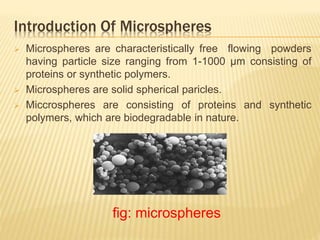
Introduction Of Microspheres
 Microspheres are characteristically free flowing powders
having particle size ranging from 1-1000 μm consisting of
proteins or synthetic polymers.
 Microspheres are solid spherical paricles.
 Miccrospheres are consisting of proteins and synthetic
polymers, which are biodegradable in nature.
fig: microspheres
IDEAL CHARACTERISTICS OF MICROSPHERES:
A. The ability to incorporate reasonably high concentrations of
the drug.
B. Stability of the preparation after synthesis with a clinically
acceptable shelf life.
C. Controlled particle size and dispersability in aqueous
vehicles for injection.
D. Release of active reagent with a good control over a wide
time scale.
E. Biocompatibility with a controllable biodegradability.
F. Susceptibility to chemical modification.
Advantages And Disadvantags Of Microspheres
ADVANTAGES:-
1) Particle size reduction for enhancing solubility of the poorly
soluble drug.
2) Provide constant and prolonged therapeutic effect.
3) Decrease dose and toxicity.
4) Provide constant drug concentration in blood.
5) Protects the GIT from irritant effects of the drug.
6) Convert liquid to solid form & to mask the bitter taste.
7) Improve the bioavailability and reduce the incidence or
intensity of adverse.
8) Reduce the dosing frequency and thereby improve the
patient.
CONT’D
Disadvantages:-
1) The costs of the materials and processing of the controlled
release preparation higher.
2) Process conditions like change in temperature, pH, solvent
addition, and evaporation /agitation may influence the
stability of core particles.
3) Degradation of products due to heat, hydrolysis, oxidation,
solar radiation or biological agents.
4) Reproducibility is less.
5) The fate of polymer additives such as plasticizers,
stabilizers, antioxidants and fillers.
 Magnetic microspheres are supermolecular
Particles that are small enough to circulate
Through capillaries without producing embolic
Occlusion but are to be captured in micro
vessels.
 Dragged in to the adjacent tissues by
magnetic
Fields of 0.5-0.8 teals (T).
Advantages:-
1. Avoidance of drug toxicity.
2. Adaptable to any part of the body.
3. Controlled drug release within target tissue.
4. Therapeutic responses in target organs.
5. Increased duration of action.
6. First pass effect can be avoided.
7. Method of preparation is simple.
8. Injected into the body using hypodermic needle
9. Improved protein and peptide drug delivery.
10. Improve patient compliance.
CONT’D
Disadvantages:-
1. Magnetic targeting is an expensive aspect.
2. Advance technique for monitoring
3. Removal once injected is difficult.
4. Unknown toxicity of beads.
1. Magnetic microspheres are injected into an artery that
supplies a given site. As the microspheres would be
selectively and magnetically localized at the capillary level,
they would have free flow access through the large
arteries. Thus the microspheres would serve as time-
release capsule system sitting in the desired location.
2. A much lower magnetic field strength is necessary to
restrict the microspheres at the slower moving flow
velocities of blood in capillaries.
3. After removal of the magnetic field, the microspheres still
continued to lodge at the target site, presumable because
they had lodged in the vascular endothelium, penetrated in
to the interstitial space, resulting in their retention.
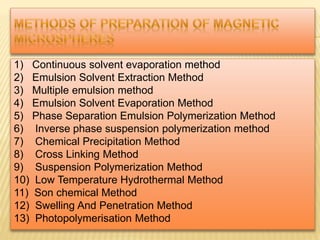
1) Continuous solvent evaporation method
2) Emulsion Solvent Extraction Method
3) Multiple emulsion method
4) Emulsion Solvent Evaporation Method
5) Phase Separation Emulsion Polymerization Method
6) Inverse phase suspension polymerization method
7) Chemical Precipitation Method
8) Cross Linking Method
9) Suspension Polymerization Method
10) Low Temperature Hydrothermal Method
11) Son chemical Method
12) Swelling And Penetration Method
13) Photopolymerisation Method
CONT’D
14) Vapour Deposition Method
15) Alkaline Co- Precipitation Method
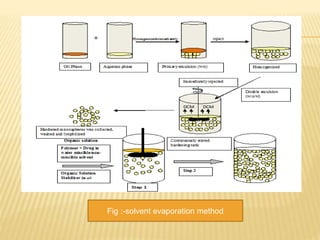
 Solution in volatile organic solvent
 (Polymer + drug + magnet)


 Auxiliary solution stirring



Homogenization stirring
 (temp. 22o -30o c)


 Magnetic microsphere separated
 By centrifugation



Freeze drying and storage at 4o c
Fig :-solvent evaporation method
The preparation involved first the dispersion of an aqueous
phase, containing magnetite nanoparticles and a water-
soluble homo-polymer, into droplets in an organic medium
using an amphiphilic block copolymer as the dispersant.
This was followed by water distillation at a raised
temperature from the aqueous droplets to yield polymer
magnetite particles. The structure of the particles was then
locked in by a reagent being added to crosslink the water-
soluble copolymer block and homo-polymer. Since the
hydrophobic block of the copolymer consisted of a protected
polyester, the removal of the protective moieties from the
coronal chains yielded poly (acrylic acid) or other functional
polymers to render water dispensability to the spheres and
to enable biomolecule immobilization.
CONT’D
Fig :- emulsion solvent extraction
method
EVALUATION OF MAGNETIC MICROSPHERES
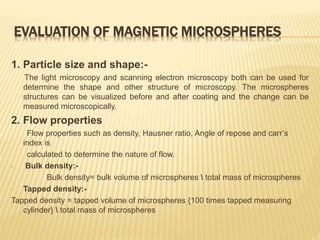
1. Particle size and shape:-
The light microscopy and scanning electron microscopy both can be used for
determine the shape and other structure of microscopy. The microspheres
structures can be visualized before and after coating and the change can be
measured microscopically.
2. Flow properties
Flow properties such as density, Hausner ratio, Angle of repose and carr’s
index is
calculated to determine the nature of flow.
• Bulk density:-
Bulk density= bulk volume of microspheres  total mass of microspheres
• Tapped density:-
Tapped density = tapped volume of microspheres {100 times tapped measuring
cylinder}  total mass of microspheres
CONT’D
Hausner Ratio:-
Hausner ratio = tapped density  bulk density
Angle of repose:-
tan θ =H  R
carr’s index:-
Carr’s index = tapped density – bulk density  tapped density
3. Swelling Index :-
swelling index = (mass of swollen microspheres - mass of dry
microspheresmass of dried microspheres)100
4. Drug entrapment capacity:-
Efficiency of drug entrapment can be calculated in term of percentage drug
entrapment.
% entrapment = (actual content theoretical content) 100
5. DRUG CONTENT AND DRUG ENTRAPMENT
EFFICIENCY
Efficiency of drug entrapment is calculated as percentage drug entrapment
Theoretical
drug content can be determined by assuming that the entire drug present in the
polymer
solution used gets entrapped in microspheres and no loss occurs in the preparation
of
microspheres.
% Entrapment = (actual content / theoretical content) x 100
REFERENCES
1. Prasanth VV, Moy AC, Mathew ST, Mathapan R (2011) Microspheres: an
overview. Int J of Pharm & Biomedical Sci 2: 332-338
2. vimal M, Amareshwar P, Hemamalini K, Sreenivas K et al. Preparation
and
evaluation of Diclo fenac sodium k Ethyl cellulose composite magnetic
microspheres Int J pharm Analysis 2009; 1(2):40-45.
3. Vyas, Khar (2001) Targeted and Controlled drug delivery, CBS
Publishers and distributors. Journal of drug delivery research, pp. 1-594.
4. Patel NR, Patel DA, Bharadia PD, Pandya V, Modi V (2011) Microsphere
as a novel drug deliver. International Journal of Pharmacy & Life
Sciences 2(8): 992-997.
5. Vyas SP, Khar RK. Targeted & Controlled Drug DeliveryNovel Carrier
systems. CBS Publications; 2004, p. 458-483.
Magnetic  Microspheres.pptx

Magnetic Microspheres.pptx

  • 1.
    MAGNETIC MICROSPHERS A NovelDrug Delivery System SUPERVISED BY: Mrs. Deeksha sharma Lecturer Dept. of Pharmaceutics Jaipur College of Pharmacy SUBMITTED BY: Teekam Chand B. Pharm. IV Year Enroll. No. 2016/1827 Jaipur College of Pharmacy
  • 3.
    Introduction Of Microspheres Microspheres are characteristically free flowing powders having particle size ranging from 1-1000 μm consisting of proteins or synthetic polymers.  Microspheres are solid spherical paricles.  Miccrospheres are consisting of proteins and synthetic polymers, which are biodegradable in nature. fig: microspheres
  • 4.
    IDEAL CHARACTERISTICS OFMICROSPHERES: A. The ability to incorporate reasonably high concentrations of the drug. B. Stability of the preparation after synthesis with a clinically acceptable shelf life. C. Controlled particle size and dispersability in aqueous vehicles for injection. D. Release of active reagent with a good control over a wide time scale. E. Biocompatibility with a controllable biodegradability. F. Susceptibility to chemical modification.
  • 5.
    Advantages And DisadvantagsOf Microspheres ADVANTAGES:- 1) Particle size reduction for enhancing solubility of the poorly soluble drug. 2) Provide constant and prolonged therapeutic effect. 3) Decrease dose and toxicity. 4) Provide constant drug concentration in blood. 5) Protects the GIT from irritant effects of the drug. 6) Convert liquid to solid form & to mask the bitter taste. 7) Improve the bioavailability and reduce the incidence or intensity of adverse. 8) Reduce the dosing frequency and thereby improve the patient.
  • 6.
    CONT’D Disadvantages:- 1) The costsof the materials and processing of the controlled release preparation higher. 2) Process conditions like change in temperature, pH, solvent addition, and evaporation /agitation may influence the stability of core particles. 3) Degradation of products due to heat, hydrolysis, oxidation, solar radiation or biological agents. 4) Reproducibility is less. 5) The fate of polymer additives such as plasticizers, stabilizers, antioxidants and fillers.
  • 8.
     Magnetic microspheresare supermolecular Particles that are small enough to circulate Through capillaries without producing embolic Occlusion but are to be captured in micro vessels.  Dragged in to the adjacent tissues by magnetic Fields of 0.5-0.8 teals (T).
  • 9.
    Advantages:- 1. Avoidance ofdrug toxicity. 2. Adaptable to any part of the body. 3. Controlled drug release within target tissue. 4. Therapeutic responses in target organs. 5. Increased duration of action. 6. First pass effect can be avoided. 7. Method of preparation is simple. 8. Injected into the body using hypodermic needle 9. Improved protein and peptide drug delivery. 10. Improve patient compliance.
  • 10.
    CONT’D Disadvantages:- 1. Magnetic targetingis an expensive aspect. 2. Advance technique for monitoring 3. Removal once injected is difficult. 4. Unknown toxicity of beads.
  • 11.
    1. Magnetic microspheresare injected into an artery that supplies a given site. As the microspheres would be selectively and magnetically localized at the capillary level, they would have free flow access through the large arteries. Thus the microspheres would serve as time- release capsule system sitting in the desired location. 2. A much lower magnetic field strength is necessary to restrict the microspheres at the slower moving flow velocities of blood in capillaries. 3. After removal of the magnetic field, the microspheres still continued to lodge at the target site, presumable because they had lodged in the vascular endothelium, penetrated in to the interstitial space, resulting in their retention.
  • 13.
    1) Continuous solventevaporation method 2) Emulsion Solvent Extraction Method 3) Multiple emulsion method 4) Emulsion Solvent Evaporation Method 5) Phase Separation Emulsion Polymerization Method 6) Inverse phase suspension polymerization method 7) Chemical Precipitation Method 8) Cross Linking Method 9) Suspension Polymerization Method 10) Low Temperature Hydrothermal Method 11) Son chemical Method 12) Swelling And Penetration Method 13) Photopolymerisation Method
  • 14.
    CONT’D 14) Vapour DepositionMethod 15) Alkaline Co- Precipitation Method
  • 15.
     Solution involatile organic solvent  (Polymer + drug + magnet)    Auxiliary solution stirring    Homogenization stirring  (temp. 22o -30o c)    Magnetic microsphere separated  By centrifugation    Freeze drying and storage at 4o c
  • 16.
  • 17.
    The preparation involvedfirst the dispersion of an aqueous phase, containing magnetite nanoparticles and a water- soluble homo-polymer, into droplets in an organic medium using an amphiphilic block copolymer as the dispersant. This was followed by water distillation at a raised temperature from the aqueous droplets to yield polymer magnetite particles. The structure of the particles was then locked in by a reagent being added to crosslink the water- soluble copolymer block and homo-polymer. Since the hydrophobic block of the copolymer consisted of a protected polyester, the removal of the protective moieties from the coronal chains yielded poly (acrylic acid) or other functional polymers to render water dispensability to the spheres and to enable biomolecule immobilization.
  • 18.
    CONT’D Fig :- emulsionsolvent extraction method
  • 19.
    EVALUATION OF MAGNETICMICROSPHERES 1. Particle size and shape:- The light microscopy and scanning electron microscopy both can be used for determine the shape and other structure of microscopy. The microspheres structures can be visualized before and after coating and the change can be measured microscopically. 2. Flow properties Flow properties such as density, Hausner ratio, Angle of repose and carr’s index is calculated to determine the nature of flow. • Bulk density:- Bulk density= bulk volume of microspheres total mass of microspheres • Tapped density:- Tapped density = tapped volume of microspheres {100 times tapped measuring cylinder} total mass of microspheres
  • 20.
    CONT’D Hausner Ratio:- Hausner ratio= tapped density bulk density Angle of repose:- tan θ =H R carr’s index:- Carr’s index = tapped density – bulk density tapped density 3. Swelling Index :- swelling index = (mass of swollen microspheres - mass of dry microspheresmass of dried microspheres)100 4. Drug entrapment capacity:- Efficiency of drug entrapment can be calculated in term of percentage drug entrapment. % entrapment = (actual content theoretical content) 100
  • 21.
    5. DRUG CONTENTAND DRUG ENTRAPMENT EFFICIENCY Efficiency of drug entrapment is calculated as percentage drug entrapment Theoretical drug content can be determined by assuming that the entire drug present in the polymer solution used gets entrapped in microspheres and no loss occurs in the preparation of microspheres. % Entrapment = (actual content / theoretical content) x 100
  • 22.
    REFERENCES 1. Prasanth VV,Moy AC, Mathew ST, Mathapan R (2011) Microspheres: an overview. Int J of Pharm & Biomedical Sci 2: 332-338 2. vimal M, Amareshwar P, Hemamalini K, Sreenivas K et al. Preparation and evaluation of Diclo fenac sodium k Ethyl cellulose composite magnetic microspheres Int J pharm Analysis 2009; 1(2):40-45. 3. Vyas, Khar (2001) Targeted and Controlled drug delivery, CBS Publishers and distributors. Journal of drug delivery research, pp. 1-594. 4. Patel NR, Patel DA, Bharadia PD, Pandya V, Modi V (2011) Microsphere as a novel drug deliver. International Journal of Pharmacy & Life Sciences 2(8): 992-997. 5. Vyas SP, Khar RK. Targeted & Controlled Drug DeliveryNovel Carrier systems. CBS Publications; 2004, p. 458-483.