
BY- Puja Saha
INTRODUCTION
 These systems are those where the rate controlling step is the
diffusion of dissolved drug molecule through the rate
controlling element.
 Usually this barrier is an insoluble polymer which is porous in
nature and allows diffusion of dissolved drug.
 Depending on the mechanism of drug diffusion-
 Reservoir devices
 Matrix devices
Reservoir devices
 Characterized by a core of drug surrounded by a polymeric
membrane.
 Generally described by Fick’s law-
the amount of drug passing across a unit area is proportional to
the concentration difference across that plane.
J = - dC/ Dx
where, J= flux
D= diffusion coefficient
dC/ dx= rate of change in conc C relative to a distance
X in the membrane.
Reservoir diffusional system can offer zero order release kinetics
which can be controlled by changing the characteristics of the
polymer. (advantage)
Unless the polymer used is soluble, the system must be removed
from the body after the drug has been released. (disadvantages)
Matrix devices
 A matrix device consists of drug dispersed homogeneously
throughout a polymer matrix.
 Drug in the outside layer exposed to the bathing solution is
dissolved first and then diffuses out of the matrix.
 The rate of dissolution of drug particles within the matrix must
be faster than the diffusion rate of dissolved drug leaving the
matrix.
Assumptions
 A pseudo-state is maintained during drug release.
 The diameter of the drug particles is less than the average
distance of drug diffusion through the matrix.
 The bathing solution provides sink condition.
 No change occurs in the characteristics of polymer matrix.
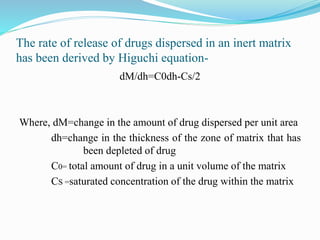
The rate of release of drugs dispersed in an inert matrix
has been derived by Higuchi equation-
dM/dh=C0dh-Cs/2
Where, dM=change in the amount of drug dispersed per unit area
dh=change in the thickness of the zone of matrix that has
been depleted of drug
C0= total amount of drug in a unit volume of the matrix
CS =saturated concentration of the drug within the matrix
 Since the drug is dispersed in the matrix system, accidental
leakage is less likely. (advantages)
 The remaining matrix ‘ghost’ must be removed after the drug
has been released. (disadvantages)
METHOD OF FABRICATION
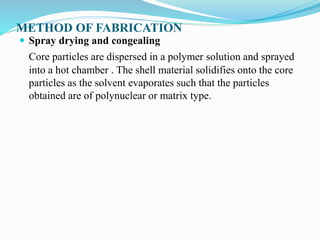
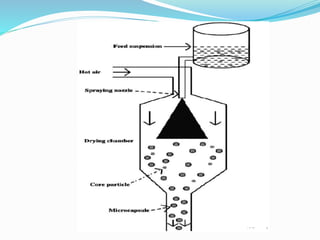
 Spray drying and congealing
Core particles are dispersed in a polymer solution and sprayed
into a hot chamber . The shell material solidifies onto the core
particles as the solvent evaporates such that the particles
obtained are of polynuclear or matrix type.
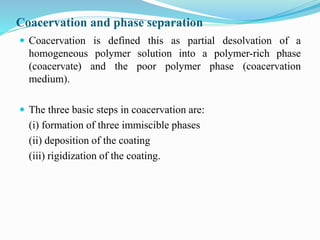
Coacervation and phase separation
 Coacervation is defined this as partial desolvation of a
homogeneous polymer solution into a polymer-rich phase
(coacervate) and the poor polymer phase (coacervation
medium).
 The three basic steps in coacervation are:
(i) formation of three immiscible phases
(ii) deposition of the coating
(iii) rigidization of the coating.
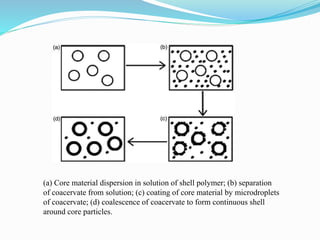
(a) Core material dispersion in solution of shell polymer; (b) separation
of coacervate from solution; (c) coating of core material by microdroplets
of coacervate; (d) coalescence of coacervate to form continuous shell
around core particles.
THANK YOU

Diffusion controlled dds

  • 1.
  • 2.
    INTRODUCTION  These systemsare those where the rate controlling step is the diffusion of dissolved drug molecule through the rate controlling element.  Usually this barrier is an insoluble polymer which is porous in nature and allows diffusion of dissolved drug.  Depending on the mechanism of drug diffusion-  Reservoir devices  Matrix devices
  • 3.
    Reservoir devices  Characterizedby a core of drug surrounded by a polymeric membrane.  Generally described by Fick’s law- the amount of drug passing across a unit area is proportional to the concentration difference across that plane. J = - dC/ Dx where, J= flux D= diffusion coefficient dC/ dx= rate of change in conc C relative to a distance X in the membrane.
  • 4.
    Reservoir diffusional systemcan offer zero order release kinetics which can be controlled by changing the characteristics of the polymer. (advantage) Unless the polymer used is soluble, the system must be removed from the body after the drug has been released. (disadvantages)
  • 5.
    Matrix devices  Amatrix device consists of drug dispersed homogeneously throughout a polymer matrix.  Drug in the outside layer exposed to the bathing solution is dissolved first and then diffuses out of the matrix.  The rate of dissolution of drug particles within the matrix must be faster than the diffusion rate of dissolved drug leaving the matrix.
  • 6.
    Assumptions  A pseudo-stateis maintained during drug release.  The diameter of the drug particles is less than the average distance of drug diffusion through the matrix.  The bathing solution provides sink condition.  No change occurs in the characteristics of polymer matrix.
  • 7.
    The rate ofrelease of drugs dispersed in an inert matrix has been derived by Higuchi equation- dM/dh=C0dh-Cs/2 Where, dM=change in the amount of drug dispersed per unit area dh=change in the thickness of the zone of matrix that has been depleted of drug C0= total amount of drug in a unit volume of the matrix CS =saturated concentration of the drug within the matrix
  • 8.
     Since thedrug is dispersed in the matrix system, accidental leakage is less likely. (advantages)  The remaining matrix ‘ghost’ must be removed after the drug has been released. (disadvantages)
  • 9.
    METHOD OF FABRICATION Spray drying and congealing Core particles are dispersed in a polymer solution and sprayed into a hot chamber . The shell material solidifies onto the core particles as the solvent evaporates such that the particles obtained are of polynuclear or matrix type.
  • 11.
    Coacervation and phaseseparation  Coacervation is defined this as partial desolvation of a homogeneous polymer solution into a polymer-rich phase (coacervate) and the poor polymer phase (coacervation medium).  The three basic steps in coacervation are: (i) formation of three immiscible phases (ii) deposition of the coating (iii) rigidization of the coating.
  • 12.
    (a) Core materialdispersion in solution of shell polymer; (b) separation of coacervate from solution; (c) coating of core material by microdroplets of coacervate; (d) coalescence of coacervate to form continuous shell around core particles.
  • 13.